2W2X1 Nuclear Weapons
The Air Force’s nuclear deterrent does not maintain itself. Every B61 bomb on a bomber ramp and every warhead component in a storage vault gets there because a small group of Airmen have been trusted with the most consequential hardware the U.S. military operates. That’s the 2W2X1 Nuclear Weapons AFSC.
This is one of the most selective enlisted careers in the Air Force. The job requires a Top Secret security clearance, continuous screening under the Personnel Reliability Assurance Program, and technical training at Sheppard AFB before you ever touch a live weapon system. The community is tight, the work is precise, and the stakes are as high as they get. For the right person, it’s also one of the most meaningful jobs in uniform.
Qualifying requires specific ASVAB line scores. Our ASVAB study guide covers what to target and how to prepare.
Job Role
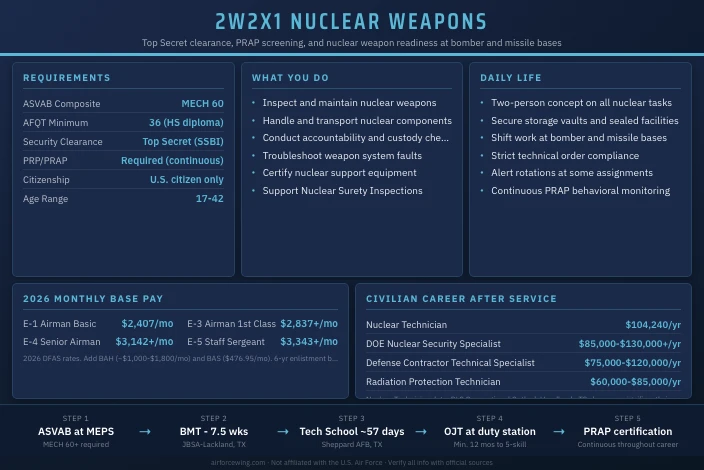
Nuclear Weapons specialists (AFSC 2W2X1) inspect, assemble, maintain, store, handle, modify, and account for nuclear weapons, weapon components, associated equipment, and specialized test and handling equipment. They ensure every nuclear weapon system in the Air Force inventory meets strict safety, security, and readiness standards at all times.
Daily Tasks
The day-to-day work centers on technical orders, which are official Air Force maintenance documents that govern every procedure. A 2W2X1 specialist follows these exactly, in sequence, with no improvisation.
Common daily tasks include:
- Inspecting nuclear weapons and components for serviceability
- Performing scheduled and unscheduled maintenance on weapon systems
- Troubleshooting malfunctions in weapons and support equipment
- Operating specialized lifting, handling, and transportation equipment
- Maintaining custody records and conducting inventory accountability checks
- Testing and certifying general and specialized support equipment
- Participating in nuclear surety inspections and readiness evaluations
Specialty Codes
The 2W2X1 AFSC uses a straightforward skill-level structure. There are no formal shredouts like some other AFSCs, but Special Experience Identifiers (SEIs) can be earned for specific assignments and qualifications.
| Code | Designation | Description |
|---|---|---|
| 2W211 | Apprentice | Initial skill level; 3-skill in training status |
| 2W231 | Journeyman | 5-skill level; fully qualified technician |
| 2W251 | Craftsman | 7-skill level; supervisory and advanced duties |
| 2W271 | Superintendent | 9-skill level; senior NCO leadership |
Mission Contribution
The United States nuclear deterrent depends entirely on weapons that work. 2W2X1 Airmen are the people responsible for keeping them that way. When a bomber crew gets tasked with a nuclear mission, the weapons that crew carries have been assembled, inspected, and certified by 2W2X1 specialists. The entire theory of nuclear deterrence collapses if adversaries believe those weapons might be unreliable. The technical work these Airmen do every day is what keeps that deterrence credible.
Technology and Equipment
The equipment list in nuclear weapons work is unlike anything in the civilian world. Specialists work with nuclear weapon assemblies, fuzes, and delivery system interfaces. They also operate:
- Weapons storage vaults and environmental control systems
- Specialized lifting devices, dollies, and trailers designed for nuclear handling
- General and special-purpose test equipment for weapons components
- Secure communications and accountability systems
- Radiation monitoring instruments
- Nuclear-certified transportation vehicles and trailers
Everything in this career field is either purpose-built for nuclear operations or heavily modified from conventional equipment to meet nuclear safety standards.
Salary
Base Pay
Pay follows the standard military pay scale based on rank and years of service. The table below shows 2026 base pay at entry and junior career grades.
| Rank | Grade | Monthly Base Pay |
|---|---|---|
| Airman Basic | E-1 | $2,407 |
| Airman | E-2 | $2,698 |
| Airman First Class | E-3 | $2,837 |
| Senior Airman | E-4 | $3,142 |
| Staff Sergeant | E-5 | $3,343 |
| Technical Sergeant | E-6 | $3,401 |
Pay figures reflect 2026 DFAS military pay tables.
A 6-year enlistment bonus of $10,000 has been available for 2W2X1. Bonus availability changes; confirm current amounts with your recruiter before signing.
Allowances
Base pay is only part of total compensation. Airmen also receive:
- Basic Allowance for Housing (BAH): Varies by duty station, rank, and dependent status. A single E-4 at a typical base can expect roughly $1,000 to $1,800 monthly. Use the DFAS BAH calculator for your specific location.
- Basic Allowance for Subsistence (BAS): $476.95 per month (2026 rate) for enlisted members.
- Special Pay: Nuclear-related duty assignments may qualify for additional special pay. Confirm with your unit’s finance office.
Additional Benefits
Active duty Air Force members receive free healthcare through TRICARE Prime, which covers medical, dental, vision, mental health, and prescriptions with no premiums, no deductibles, and no copays. Housing support, 30 days of paid leave per year, and access to on-base facilities add significant value beyond the paycheck.
The military retirement system under the Blended Retirement System (BRS) provides a monthly pension equal to 2% of your high-36 average pay for each year of service, starting at 20 years. That means 40% of average base pay at retirement. The Thrift Savings Plan (TSP) adds up to 5% government-matched contributions on top of that.
Education benefits include up to $4,500 per year in tuition assistance while serving and full Post-9/11 GI Bill eligibility after separation, which covers in-state tuition at public universities and up to $29,920.95 annually at private schools for the 2025-2026 academic year.
Qualifications
Requirements Table
| Requirement | Details |
|---|---|
| ASVAB Composite | MECH 60 minimum |
| AFQT Minimum | 36 (HS diploma); 65 (non-graduate) |
| Citizenship | U.S. citizen required |
| Age | 17-42 at enlistment |
| Education | High school diploma or equivalent |
| Security Clearance | Top Secret (SSBI) + Personnel Reliability Assurance Program (PRAP) |
| Physical | Normal color vision; normal depth perception |
| Medical | No history of untreatable emotional instability |
| Drug/Alcohol | No documented abuse history |
Eligibility requirements are published on the official Air Force careers page.
ASVAB Details
The MECH composite draws from the General Science (GS), Auto and Shop Information (AS), Mathematics Knowledge (MK), and Mechanical Comprehension (MC) subtests. The minimum score is 60. Strong scores on the Mechanical Comprehension and General Science subtests will push your MECH composite higher. If the ASVAB isn’t your strong suit, the ASVAB prep guide covers the mechanical reasoning and science content that appears in these subtests.
Personnel Reliability Assurance Program (PRAP): The PRAP is not a one-time clearance check. It’s an ongoing evaluation of your conduct, mental health, financial stability, and reliability throughout your entire career. Any disqualifying event can result in decertification and removal from the nuclear mission. This program makes 2W2X1 one of the most thoroughly vetted enlisted careers in the Air Force.
Application Process
Service Obligation and Entry Rank
A standard initial enlistment for 2W2X1 is 4 to 6 years. The 6-year enlistment has been tied to the $10,000 bonus. All Airmen enter as Airman Basic (E-1) unless they qualify for advanced rank through college credits, JROTC participation, or recruiter referral programs.
Work Environment
Setting and Schedule
The daily environment depends heavily on your assignment. At a bomber base like Barksdale AFB or Minot AFB, much of the work happens in secure storage areas and maintenance facilities, often underground or in climate-controlled vaults. The work requires methodical attention to procedure, not speed.
Shift work is common. Nuclear weapons operations don’t pause for weekends or holidays, so teams rotate through day, swing, and mid shifts on cycles that vary by base and mission tempo. Some assignments involve alert status rotations where you’re required to be on base and ready to respond within specific timeframes.
The environment is physically confined in storage areas but the work itself requires more precision than brute strength. You’ll spend time on your feet, frequently with heavy test equipment, and occasionally in constrained spaces.
Chain of Command and Performance Feedback
Nuclear weapons work is strictly hierarchical. Every procedure is performed with a two-person concept, meaning no technician works alone on nuclear tasks. Your immediate supervisor is usually a 7-skill or 9-skill NCO who certifies your training progress and signs off on task qualifications.
Performance feedback comes through the Enlisted Performance Report (EPR) system, which evaluates your job performance, professional development, and contribution to the unit mission. EPR scores directly affect promotion competitiveness. In a small career field, your reputation follows you, and supervisors in the nuclear community tend to know each other across bases.
Team Dynamics and Autonomy
The two-person concept defines this career field. You never certify yourself, and no single person has unrestricted access to nuclear weapons. This isn’t bureaucracy, it’s a fundamental safety principle. Working well with a partner under pressure, following procedures without shortcutting, and communicating clearly are more valuable here than individual initiative.
As you gain skill levels, you’ll have more responsibility for planning and supervising work rather than performing it. Senior NCOs in this field become technical authorities whose judgment carries real weight in mission decisions.
Job Satisfaction and Retention
Retention in 2W2X1 tends to be higher than many other enlisted AFSCs. The clearance, the specialized training, and the mission weight make career Airmen of people who might otherwise separate. The community is small and professional. The work is demanding but predictable in structure. Many 2W2X1 Airmen describe high satisfaction with the sense of mission purpose, even when daily tasks are routine.
Training
Initial Training Pipeline
| Phase | Location | Duration | Focus |
|---|---|---|---|
| Basic Military Training (BMT) | JBSA-Lackland, TX | 7.5 weeks | Military foundations, fitness, discipline |
| Technical School | Sheppard AFB, TX | ~57 days | Nuclear weapons maintenance, safety, procedures |
BMT at Joint Base San Antonio-Lackland is the same 7.5-week program all enlisted Airmen complete. After graduation, you’ll report directly to the 363rd Training Squadron at Sheppard AFB in Wichita Falls, Texas.
Tech School covers nuclear weapons theory, system components, safety rules, handling procedures, and the technical orders that govern every maintenance action. It’s classroom-heavy early, with hands-on procedures on training devices in the latter portion. The training lasts approximately 57 days.
Before you touch a live nuclear weapon at your first duty station, you’ll complete an extensive on-the-job training (OJT) program under a certified trainer. The 3-skill level you graduate with from Tech School is a starting point, not a qualification to work independently on nuclear systems.
Advanced Training
After reaching the 5-skill (Journeyman) level, options for advanced training expand. Possibilities include:
- Nuclear Surety Inspection (NSI) preparation: Senior technicians receive additional training to prepare units for Nuclear Surety Inspections, which are high-stakes evaluations conducted by Air Force Global Strike Command.
- Unit Task Code (UTC) training: Specific deployment packages require additional qualification training beyond the standard career field curriculum.
- Supervisor development: 7-skill and 9-skill training focuses on program management, technical order management, and team leadership.
The Air Force also supports education through on-base community college programs and tuition assistance. Several Airmen in this career field pursue degrees in nuclear technology, engineering technology, or physics while serving. Getting MECH 60 on the ASVAB is the first gate, the ASVAB study guide covers the mechanical reasoning and science subtests that drive this composite.
Career Progression
Rank and Progression Timeline
| Rank | Grade | Typical Time to Reach |
|---|---|---|
| Airman Basic | E-1 | Entry |
| Airman | E-2 | ~6 months |
| Airman First Class | E-3 | ~16 months |
| Senior Airman | E-4 | ~3 years |
| Staff Sergeant | E-5 | ~5-6 years (board-selected) |
| Technical Sergeant | E-6 | ~8-11 years (board-selected) |
| Master Sergeant | E-7 | ~14-17 years (board-selected) |
| Senior Master Sergeant | E-8 | ~18-21 years (board-selected) |
| Chief Master Sergeant | E-9 | ~22+ years (board-selected) |
Promotion to Senior Airman (E-4) is time-based. Everything from Staff Sergeant upward requires a competitive promotion board, and scores are weighted by EPR ratings, decorations, professional military education, and job performance.
Skill Level Progression
You enter the career field as a 3-skill (Apprentice). Upgrading to 5-skill (Journeyman) requires completing a Career Development Course (CDC), passing end-of-course tests, and logging a minimum of 12 months in upgrade training status (9 months for retrainees). The 7-skill (Craftsman) requires completing a second CDC and meeting time-in-grade requirements. The 9-skill (Superintendent) is a senior NCO designation.
Specialization and SEIs
The 2W2X1 career field is narrow by design. There are no formal shredout codes that redirect you into entirely different technical paths. However, Special Experience Identifiers can reflect expertise in specific weapons systems, handling equipment, or inspection roles. Senior technicians frequently develop into Nuclear Surety Program Managers or career field functional managers at the unit and wing level.
Retraining
If your goals shift, the Air Force retraining process allows applications to cross into other career fields, subject to eligibility and Air Force needs. However, the Top Secret clearance and PRAP certification you hold as a 2W2X1 specialist can make you attractive for retraining into intelligence, cyber, or other clearance-required fields.
Performance Evaluation
The Enlisted Performance Report is the primary performance evaluation tool. It covers five performance factors: executing the mission, leading people, managing resources, improving the unit, and setting the example. Stratification lines at the top of EPRs signal that you’re a top performer in the unit. In competitive promotions, a stack of well-written, stratified EPRs is essential.
Physical Demands
Daily Physical Demands
The 2W2X1 career field involves physically demanding work in some assignment contexts. Technicians regularly handle heavy components using specialized equipment, but manual strength is still required. Expect:
- Standing and walking for extended periods during maintenance operations
- Lifting and manipulating awkward components within weapon handling equipment
- Working in confined storage areas with limited range of motion
- Wearing personal protective equipment, which can be cumbersome
- Extended outdoor exposure during flight-line or vehicle operations
The job does not require extreme physical fitness by military standards, but you need to stay within Air Force standards. Desk-bound tasks do not define this career field.
Air Force Fitness Assessment Standards
All Airmen must pass the Air Force Fitness Assessment annually. There are no AFSC-specific standards. The FA is scored on a 100-point scale and consists of four components.
| Component | Max Points | Under 25 Male Min | Under 25 Female Min |
|---|---|---|---|
| 1.5-Mile Run | 60 | 13:36 | 16:22 |
| Push-Ups (1 min) | 10 | 42 reps | 27 reps |
| Sit-Ups (1 min) | 10 | 50 reps | 50 reps |
| Waist Circumference | 20 | ≤ 39.0 in | ≤ 35.5 in |
Minimum passing composite: 75 points. Standards are age- and gender-normed. Always verify current standards with af.mil before your assessment.
Medical Evaluations
Beyond the initial MEPS screening, 2W2X1 Airmen are subject to periodic medical reviews as part of the PRAP. These evaluations assess fitness for duty in the nuclear program and can include mental health screenings. Any condition that affects reliability, judgment, or emotional stability can result in PRAP decertification. Annual fitness assessments, periodic physical examinations, and the PRAP reviews combine to make this one of the most continuously monitored enlisted careers in the Air Force.
Deployment
Deployment Details
Deployments for 2W2X1 specialists depend heavily on the current nuclear posture and Air Force Global Strike Command (AFGSC) requirements. Nuclear weapons work does not typically involve the same tempo as conventional munitions or combat support AFSCs, but forward deployments do occur. NATO nuclear-sharing missions and theater nuclear deployments send 2W2X1 Airmen to locations in Europe, primarily. Rotational deployments can last from 90 days to six months.
The nuclear mission is inherently home-station focused. Most career time is spent at a bomber or missile base rather than forward deployed. But when AFGSC needs nuclear capability forward, 2W2X1 specialists go with it.
Duty Stations
Assignments are concentrated at bases that host nuclear-capable aircraft or storage facilities. Primary duty stations include:
- Minot AFB, ND: B-52 bomber wing and ICBM missile wing
- Barksdale AFB, LA: B-52 bomber wing; home of Air Force Global Strike Command
- Whiteman AFB, MO: B-2 stealth bomber wing
- Dyess AFB, TX: B-1 bomber wing (conventional; note B-1 is no longer nuclear)
- F.E. Warren AFB, WY: ICBM missile wing
- Malmstrom AFB, MT: ICBM missile wing
- Kirtland AFB, NM: nuclear weapons storage and maintenance
- European duty locations: NATO nuclear-sharing missions
Assignment preferences are submitted through the assignment system, but the Air Force fills requirements first. Minot and Barksdale absorb the largest portion of 2W2X1 Airmen.
Risk/Safety
Job Hazards
Working with nuclear weapons involves radiation exposure risk. All 2W2X1 Airmen wear dosimeters to track cumulative exposure, and procedures follow ALARA principles to minimize dose. Additional hazards include high-voltage test equipment, compressed gases in weapon systems, high-explosive components in some assemblies, and heavy lifting operations. Technical orders governing these hazards are mandatory, not advisory.
Safety Protocols
Nuclear safety is governed by the Nuclear Weapons Safety Rules and DOD-level directives. Key safety principles include:
- Two-Person Concept (2PC): No individual works alone on nuclear weapons tasks at any time
- Positive Control: Weapons are always in authorized custody under approved security conditions
- Tamper Detection: Storage positions and transport events use seals and monitoring to detect unauthorized access
- Strict technical order compliance: Deviation from published procedures is not permitted
The Air Force conducts Nuclear Surety Inspections (NSIs) to evaluate unit compliance. A failed NSI is a significant career event for everyone in the unit.
Security and Legal Requirements
The Top Secret clearance requires a full Single Scope Background Investigation. Your finances, personal relationships, foreign contacts, and conduct history will be examined. Debt problems, undisclosed foreign contacts, or conduct violations can all result in clearance revocation.
The PRAP adds a behavioral reliability layer. You’re subject to continuous evaluation by supervisors, medical personnel, and security staff. Self-reporting of disqualifying information is mandatory, and unauthorized disclosure of nuclear information carries severe federal criminal penalties.
Impact on Family
Family Considerations
The nuclear mission concentrates assignments at a limited number of bases, which shapes where your family will live. Minot, North Dakota, for example, is a small city far from major metro areas. The winters are severe. Some Airmen find this tight-knit environment ideal for raising a family; others find the isolation difficult.
Alert rotations and exercise periods mean periods of limited family availability. During Nuclear Surety Inspection cycles, work hours increase significantly and weekend activities get curtailed for the unit. These cycles are predictable, which allows some planning, but they still put strain on family time.
The Air Force provides support through the Airman and Family Readiness Center, family housing on most bomber and missile bases, and a strong community of other nuclear community families who have lived the same lifestyle.
Relocation
Assignment cycles in the Air Force typically run three years per base. For 2W2X1, the pool of eligible bases is smaller than most AFSCs, which means there’s less geographic variety across a 20-year career. Many nuclear Airmen cycle through two or three of the same bases multiple times. Families who value stability in location may find this appealing; those hoping for a wide range of assignments may find it limiting.
Permanent Change of Station (PCS) moves include a Basic Allowance for Housing rate change, dislocation allowance, and household goods transportation support.
Reserve and Air National Guard
Component Availability
The 2W2X1 AFSC is available in both the Air Force Reserve and the Air National Guard, but positions are limited. Nuclear weapons maintenance requirements exist at bomber and missile bases with a Reserve or Guard presence, primarily at Minot AFB and Barksdale AFB. Not every Reserve or Guard wing maintains an active nuclear weapons unit, so availability of positions varies considerably.
Drill Schedule and Training
Reserve and Air National Guard Airmen in 2W2X1 follow the standard one weekend per month (Unit Training Assembly) plus two weeks per year (Annual Tour) commitment. However, the nuclear-specific certification requirements add training complexity. PRAP certification must be maintained through the same standards as active duty, which means periodic behavioral health screenings and supervisory reporting requirements continue even in part-time status.
Annual training periods may be used for certification maintenance, nuclear weapons handling exercises, or surety inspection preparation. The training commitment often exceeds the minimum 38 days per year for Airmen actively supporting nuclear mission requirements.
Part-Time Pay
A Reserve or Guard E-4 (Senior Airman) earns approximately $250 per drill day based on 2026 rates, or roughly $500 to $1,000 for a standard drill weekend (two to four drill periods). Full-time active duty base pay for the same grade starts at $3,142 per month. The difference is significant, but part-time service preserves the ability to work a civilian career simultaneously.
Component Comparison
| Category | Active Duty | Air Force Reserve | Air National Guard |
|---|---|---|---|
| Commitment | Full-time | 1 wknd/mo + 2 wks/yr | 1 wknd/mo + 2 wks/yr |
| Monthly Pay (E-4) | $3,142 | ~$500-$1,000/mo drill | ~$500-$1,000/mo drill |
| Healthcare | TRICARE Prime (free) | TRICARE Reserve Select (premium) | State-dependent; TRS available |
| Education | TA + Post-9/11 GI Bill | Federal TA; GI Bill after qualifying service | State tuition waivers vary; GI Bill available |
| Deployment Tempo | Moderate (AFGSC focus) | Lower; mobilization possible | Lower; state + federal missions |
| Retirement | 20-yr pension (BRS) | Points-based at 60 yrs old | Points-based at 60 yrs old |
| Nuclear Certification | Continuous PRAP | Continuous PRAP | Continuous PRAP |
Civilian Career Integration
The Top Secret clearance earned through 2W2X1 service makes Reserve and Guard members attractive to defense contractors and federal agencies. Part-time service in this AFSC pairs reasonably well with civilian careers in defense industry, government security, or engineering-adjacent technical roles. USERRA protections guarantee your civilian employer cannot terminate you for military training or deployment obligations, and many defense contractors actively value employees with active clearances.
Post-Service
Civilian Career Options
The 2W2X1 specialty has no direct civilian equivalent in the private sector. Nuclear weapons assembly and maintenance is a government function with no commercial counterpart. But the skills translate into high-value civilian careers, particularly those requiring a clearance, technical precision, and demonstrated reliability.
| Civilian Job Title | Median Annual Salary | Job Outlook |
|---|---|---|
| Nuclear Technician | $104,240 | -8% (2024-2034), ~700 openings/yr |
| Explosive Ordnance Disposal (Federal) | $80,000-$110,000 | Stable demand |
| DOE Nuclear Security Specialist | $85,000-$130,000+ | Stable; clearance-dependent |
| Defense Contractor Technical Specialist | $75,000-$120,000 | Strong demand with TS clearance |
| Radiation Protection Technician | $60,000-$85,000 | Stable demand |
Nuclear technician figures reflect BLS Occupational Outlook Handbook data for 2024.
The Top Secret clearance is the most portable credential from this career field. Cleared candidates command higher compensation across nearly every defense-adjacent civilian sector. The Department of Energy, national laboratories (Los Alamos, Sandia, Oak Ridge), and defense contractors working on nuclear systems programs actively hire veterans with 2W2X1 backgrounds.
Transition Support
Transition Assistance Program (TAP) workshops, available at every major Air Force installation, help separating Airmen translate military experience into civilian resume language and connect with employers. Hiring Our Heroes and similar veteran hiring programs run career fairs at many large Air Force bases. The Post-9/11 GI Bill covers full tuition for degree programs if you plan to pursue formal education after separation.
Is This a Good Job
Who Fits
The 2W2X1 career field selects for a specific kind of person. Strong candidates tend to be:
- Comfortable with rigid, procedural work where rules are absolute
- Detail-oriented and patient with repetitive but high-stakes tasks
- Able to pass and maintain a rigorous background and behavioral screening process
- Willing to live at a limited number of bases, many in remote locations
- Drawn to work that carries significant national security weight
- Capable of working closely with a partner under pressure while following technical orders exactly
If you’ve handled firearms safely and responsibly, enjoy mechanical troubleshooting, and have a clean background with no financial or legal complications, the entry requirements are achievable for the right candidate.
Who Doesn’t Fit
This job is a poor match for Airmen who want flexibility, frequent travel to exotic locations, or work that changes significantly from year to year. The two-person concept means you’re never working solo, which frustrates people who prefer independent work styles. The PRAP screening disqualifies candidates with certain medical histories, financial instability, or any history of drug use. It also disqualifies people who are not comfortable with continuous behavioral monitoring.
Anyone who values geographic variety in assignments will find the limited base pool frustrating over a 10 to 20-year career. The nuclear mission runs primarily from a handful of cold-weather or remote bases. That’s the reality of where the weapons are, and it doesn’t change.
Career Alignment
The clearest career match is someone who wants a small, elite community doing work that matters at the highest level of national security. The technical depth is real but not overwhelming for someone with a solid mechanical aptitude. The clearance opens doors well beyond the Air Force. The pay is standard military, but the 6-year bonus, stability of assignments, and post-service clearance value add up to a strong total picture for the right person.
More Information
Talk to an Air Force recruiter to confirm current PRAP eligibility requirements, bonus availability, and assignment options before you commit. Nuclear weapons positions are filled selectively, and a recruiter can tell you whether 2W2X1 slots are open at your target bases. If you haven’t taken the ASVAB yet, the PICAT prep course can help you qualify in the mechanical area before your first test. AFPC publishes the career field education and training plan (CFETP) for 2W2X1, which details every training requirement at each skill level.
This site is not affiliated with the U.S. Air Force or any government agency. Verify all information with official Air Force sources before making enlistment or career decisions.
Explore more Air Force Munitions and Weapons careers such as 2W0X1 Munitions Systems and 2W1X1 Aircraft Armament Systems.