2W1X1 Aircraft Armament Systems
Every bomb released from an F-15 and every missile fired from an F-16 depends on a 2W1X1 doing their job right. Aircraft Armament Systems specialists install, inspect, and certify the guns, bomb racks, missile launchers, and release systems that make fighter aircraft deadly. When the pilot squeezes the trigger, it’s because an armament troop verified that the system would work. Before committing to any AFSC, know what this job actually demands day to day.
Qualifying requires specific ASVAB line scores. Our ASVAB study guide covers what to target and how to prepare.
Job Role
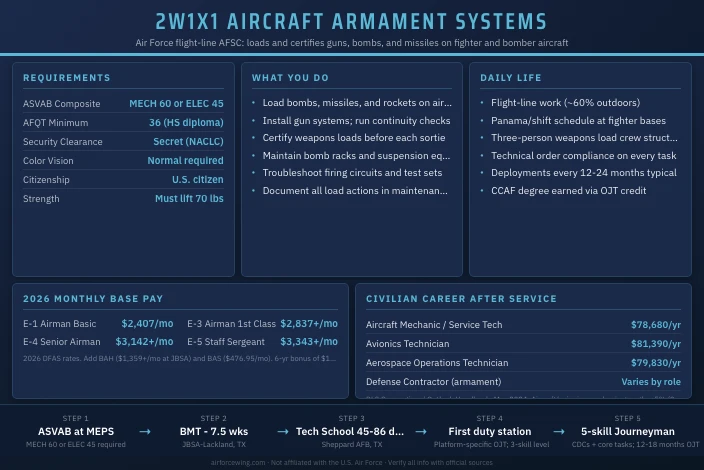
2W1X1 Aircraft Armament Systems specialists load and maintain all weapons systems mounted on Air Force aircraft. They install and inspect guns, bomb racks, missile launch rails, and suspension systems, then certify each system is safe before the aircraft flies. The work spans conventional munitions, rockets, and precision-guided weapons across virtually every Air Force fighter, bomber, and attack platform.
What the Job Looks Like Day to Day
A typical shift starts before dawn on the flight line. Armament troops review the mission load plan, pull the required munitions from the munitions storage area, and coordinate with weapons load crews. From there the work is physical: positioning weapons carts, torquing sway braces, running electrical continuity checks, and verifying every pin and plug before signing off on the load. A single sortie can require one Airman to inspect dozens of connection points.
Off the flight line, 2W1X1s maintain the ground equipment used to handle and test weapons systems. They troubleshoot electrical faults in firing circuits, test bomb-release mechanisms on maintenance stands, and keep up with technical order (TO) compliance for every system they’re rated on. Documentation is a constant. Every action goes into maintenance records.
Specific Roles and Shredouts
The 2W1X1 AFSC uses aircraft-specific shredouts once an Airman is assigned to a particular platform. Common shredouts include:
| Code | Platform | Notes |
|---|---|---|
| 2W1X1A | B-52 Stratofortress | Conventional bomb and cruise missile carriage |
| 2W1X1B | B-1 Lancer | Rotary launcher and conventional munitions |
| 2W1X1C | A-10 Thunderbolt II / F-16 | Gun system, Maverick, conventional bombs |
| 2W1X1E | F-15 Eagle / Strike Eagle | Air-to-air missiles, JDAM, bombs |
| 2W1X1F | F-22 Raptor | Internal weapons bay; limited billet count |
| 2W1X1H | F-35 Lightning II | Internal and external stores; newer platform |
Shredout assignments follow duty station. An Airman heading to Eglin AFB will train on F-15 systems; one heading to Davis-Monthan will focus on the A-10 and F-16.
Mission Contribution
The Air Force cannot execute a combat sortie without functional weapons systems. Armament specialists are the last checkpoint before an aircraft takes off armed. That responsibility sits with the troop who signed off the forms. Fighter aircraft can carry anywhere from a single gun to a mix of air-to-air missiles, precision-guided bombs, and rockets on a single sortie. Each weapon type has its own suspension equipment, electrical interfaces, and safety requirements.
During peacetime, the work keeps systems in peak condition for exercises and evaluations. During real-world deployments, armament troops load hundreds of sorties per week under time pressure.
Technology and Equipment
The equipment 2W1X1s work with includes:
- MHU-83 and MHU-110 bomb-lift trucks for positioning heavy munitions
- Multiple Ejector Racks (MER) and Tactical Munitions Dispensers (TMD)
- BRU-46 and BRU-57 bomb rack units
- LAU-61, LAU-68 rocket launchers and Hydra-70 rocket pods
- AIM-9 Sidewinder and AIM-120 AMRAAM missile-to-rail interface hardware
- Gun systems including the M61A2 Vulcan rotary cannon on F-15s and F-22s
- Armament Systems Test Sets (ASTS) for electrical continuity and firing circuit checks
The equipment evolves as new platforms enter the fleet. Airmen on F-35 assignments also work with stealth-compatible internal bay hardware that differs significantly from legacy rail launchers.
Salary
Base Pay
2W1X1 is a standard enlisted AFSC with no special duty pay. All pay comes from the DFAS military pay tables.
| Rank | Pay Grade | Monthly Base Pay (2026) |
|---|---|---|
| Airman Basic | E-1 | $2,407 |
| Airman | E-2 | $2,698 |
| Airman First Class | E-3 | $2,837, $3,198 |
| Senior Airman | E-4 | $3,142, $3,816 |
| Staff Sergeant | E-5 | $3,343, $4,422 |
| Technical Sergeant | E-6 | $3,401, $5,044 |
| Master Sergeant | E-7 | $3,932, $5,537 |
Figures from DFAS 2026 Military Pay Tables. Pay increases with years of service within each grade.
Allowances
Base pay is only part of total compensation. Most Airmen also receive:
- Basic Allowance for Housing (BAH): Varies by duty station and dependent status. A single E-4 at JBSA-Lackland receives roughly $1,359/month; rates at coastal installations run higher.
- Basic Allowance for Subsistence (BAS): $476.95/month for all enlisted (2026 rate), paid regardless of rank.
- Both allowances are tax-free, which meaningfully raises take-home pay compared to equivalent civilian wages.
A 6-year enlistment bonus of $10,000 has been available for this AFSC. Bonus availability changes with Air Force manning needs; confirm current offers with your recruiter before signing.
Additional Benefits
TRICARE Prime covers medical, dental, vision, mental health, and prescriptions with no premiums, deductibles, or co-pays while on active duty. The Post-9/11 GI Bill covers full in-state tuition at public colleges and up to $29,920.95 per academic year at private schools, plus a monthly housing allowance tied to the E-5 BAH rate at the school’s ZIP code.
The Air Force also provides up to $4,500 per year in Tuition Assistance for courses taken while on active duty. The Blended Retirement System (BRS) includes automatic TSP contributions from the government: 1% after 60 days, with matching up to 4% for members who contribute. At 20 years, Airmen receive 40% of their high-36 average basic pay as a monthly pension for life.
Work-Life Balance
Shift work is common on the flight line. Panama schedules (12-hour days rotating across a four-team cycle) are standard at many fighter bases, especially during surge operations or exercises. A typical rotation means three to four days on, then three to four days off. During steady-state operations, work weeks average 40 to 50 hours. During exercises and deployments, that number climbs. Airmen accrue 30 days of paid leave per year.
Qualifications
Requirements Table
| Requirement | Standard |
|---|---|
| ASVAB Composite | MECH 60 OR ELEC 45 |
| AFQT Minimum | 36 (high school diploma) |
| Citizenship | U.S. citizen required |
| Security Clearance | Secret (NACLC) |
| Color Vision | Normal color vision required |
| Depth Perception | Normal depth perception required |
| Physical Strength | Must be able to lift 70 lbs |
| Age | 17-42 at time of enlistment |
| Education | High school diploma or GED |
The MECH composite combines scores from the General Science, Auto/Shop, Mathematics Knowledge, and Mechanical Comprehension subtests. The ELEC composite draws from General Science, Arithmetic Reasoning, Mathematics Knowledge, and Electronics Information. You need to hit one of the two thresholds, not both. Most candidates find MECH 60 to be the more accessible path if they have mechanical aptitude. The ASVAB study guide covers both composite areas with targeted practice tests.
High school coursework in physics, auto mechanics, or electronics gives a measurable edge on both composite areas. If your initial ASVAB scores fall short, a retest is permitted after 30 days.
Security Clearance
The job requires a Secret clearance obtained through a National Agency Check, Local Agency Checks, and Credit (NACLC) investigation. The Air Force initiates this process after enlistment. Disqualifying factors include recent drug use, significant financial problems, and certain criminal history. Minor issues may be resolved through a waiver, but weapons-related positions get heightened scrutiny. Be straightforward on your SF-86, omissions are treated more seriously than disclosed issues.
Shredouts involving nuclear-capable aircraft (B-52, B-1, F-35 in certain configurations) may require additional personnel reliability screening. Discuss this with your recruiter if there are any concerns about your background.
Application Process
The selection process typically runs three to six months from MEPS to ship date:
Service Obligation
Standard 4-year enlistment with the option to extend to 6 years for the enlistment bonus. Airmen who accept an enlistment bonus sign a 6-year contract. There is no aviation-specific service obligation beyond the standard enlistment term for this AFSC.
Work Environment
Setting and Schedule
2W1X1 is an outdoor job. Industry estimates put the work at roughly 60% outdoor and 40% indoor. The flight line is the primary workplace: open tarmac in direct sun, rain, wind, or cold depending on the base and season. Aircraft do not stay in hangars during normal operations, so armament troops work in the elements. Full-body PPE, hearing protection, and steel-toed boots are standard.
Indoor work happens in weapons load trainer facilities, maintenance bays, and armament shops. Continuity checks, equipment maintenance, and technical order reviews all take place in controlled environments. Nighttime operations are routine at high-tempo bases.
Shift schedules vary by base and mission tempo. Panama schedules are common at single-mission fighter bases. Some assignments run standard day shifts with on-call requirements during exercises.
Chain of Command and Communication
Armament specialists work within the Aircraft Maintenance Squadron (AMXS) or the Maintenance Squadron (MXS) depending on the base organizational structure. The immediate chain runs from Airman to Crew Chief to Production Superintendent and up through the Maintenance Operations Center. Weapons load crews typically consist of three Airmen: one crew chief and two loaders.
Performance feedback comes through the Air Force Enlisted Performance Report (EPR) system, with formal reports written annually by the ratee’s supervisor. Mid-term feedback sessions at the six-month mark give Airmen a written record of how they’re tracking. Supervisors in this career field tend to give direct, specific feedback because the technical standard is binary: the weapons system either passes inspection or it doesn’t.
Team Dynamics
Weapons loading is team work. A three-person load crew operates as a unit. The crew chief directs and verifies; the loaders execute. Autonomy increases with rank and certification level. A freshly-graduated 3-skill Airman works under direct supervision for every load. A 5-skill SrA can serve as an assistant crew chief, overseeing specific steps while the crew chief handles certification. By SSgt, most Airmen are running their own crews.
The work culture in this career field runs toward high standards and accountability. An armament troop who skips a step doesn’t just fail an inspection, they potentially cause a weapons release malfunction over a target or, worse, an unsafe release on the ground. That context creates a serious work culture.
Job Satisfaction
Retention in this career field tends to be solid among Airmen who connect with hands-on technical work and want a job where quality is immediately verifiable. The work is physically demanding but finite: when the jets launch, the mission is done for that sortie. Airmen who find office environments frustrating often describe the flight-line structure as one of the job’s strengths.
Training
Initial Training Pipeline
| Phase | Location | Length | Focus |
|---|---|---|---|
| Basic Military Training (BMT) | JBSA-Lackland, TX | 7.5 weeks | Military foundations, fitness, discipline |
| Technical School | Sheppard AFB, TX | 45-86 days | Aircraft armament systems, electrical fundamentals, loading procedures |
| On-the-Job Training (OJT) | First duty station | 12-18 months | Platform-specific qualification, task certification to 5-skill level |
BMT follows the standard Air Force format. After graduation, Airmen proceed directly to Sheppard AFB for the Aircraft Armament Systems course. The tech school curriculum covers weapons suspension equipment, electrical firing circuits, bomb rack mechanics, and gun system fundamentals. The range of 45 to 86 days reflects platform-specific modules; Airmen training on more complex systems spend more time in the course.
After tech school, new Airmen arrive at their first duty station as 3-skill level (Apprentice) specialists. They work under a certified trainer through a structured OJT program until they complete all required task certifications and the 2W151 Career Development Courses (CDCs). Completing the CDCs and core tasks earns the 5-skill level (Journeyman), which is the baseline qualification for independent work. Strong ASVAB prep, particularly on the Mechanical and Electronics sections, builds the foundation for tech school success; the ASVAB practice tests can help you identify gaps before MEPS.
Advanced Training and Certifications
Beyond the 5-skill level, Airmen can pursue:
- 7-skill level (Craftsman): Requires completion of the 2W171 CDCs, 7-level core tasks, and promotion to SSgt or above. Qualifies Airmen to supervise load crews and serve as production superintendents.
- 9-skill level (Superintendent): Reserved for SMSgt and CMSgt. Senior leadership and program management focus.
- Weapons Standardization Certification: Selected Airmen become Weapons Load Standardization and Evaluation Teams (WLSET) members, responsible for evaluating and certifying other load crews across the wing.
- Multiple Aircraft Qualifications (MAQ): Airmen can earn qualifications on secondary platforms during their careers, increasing assignment flexibility and promotion competitiveness.
- Community College of the Air Force (CCAF): The Aircraft Armament Systems Technology associate degree is earned automatically through tech school and on-the-job training credit accumulation. No separate coursework required.
Career Progression
Rank and Time-in-Service Expectations
| Rank | Grade | Typical Time in Service | Key Milestone |
|---|---|---|---|
| Airman Basic | E-1 | 0-6 months | BMT graduation |
| Airman | E-2 | 6 months | Automatic promotion |
| Airman First Class | E-3 | 16 months | Automatic promotion |
| Senior Airman | E-4 | ~3 years | 5-skill level completion typical |
| Staff Sergeant | E-5 | 5-7 years | 7-skill level; crew chief authority |
| Technical Sergeant | E-6 | 10-12 years | Flight chief or section NCOIC roles |
| Master Sergeant | E-7 | 14-18 years | Superintendent track begins |
| Senior Master Sergeant | E-8 | 18-22 years | Maintenance superintendent |
| Chief Master Sergeant | E-9 | 22+ years | Career field manager level |
Promotion to SSgt and above is competitive across the Air Force. Promotion points come from EPR scores, decorations, professional military education (PME), and time-in-grade. Armament specialists who earn multiple aircraft qualifications and complete in-residence PME early tend to be more competitive.
Specialization and Career Branching
The most significant specialization fork in this career field is WLSET duty. Airmen selected for Weapons Load Evaluation roles become the quality assurance authority for their wing’s armament operations. It is a high-visibility position that looks strong on an EPR and typically accelerates promotion timelines.
Senior NCOs may also branch toward maintenance officer transition through the Warrant Officer or Limited Duty Officer programs, though these paths are competitive and depend on current Air Force needs. Retraining into related maintenance AFSCs (such as 2A6X1 or 2A3X3) is possible through the formal retraining program for Airmen who want to shift specialties.
EPR System
The Air Force uses the EPR to evaluate enlisted performance. Raters assign scores from 1 to 5 across several performance dimensions, with narrative comments describing specific contributions. The overall stratification statement ("#1 of 7 SSgts") carries significant weight in promotion decisions. In 2W1X1, EPR narratives typically highlight sortie counts supported, weapons load inspection pass rates, WLSET results, and additional duties performed.
Airmen who want to advance quickly should pursue EPR stratification by taking on additional duties, completing PME ahead of schedule, and earning recognition through quarterly or annual awards programs.
Physical Demands
Daily Physical Requirements
The job is physically demanding in a sustained, repetitive way rather than an acute peak-effort way. A typical shift may involve:
- Lifting and positioning items up to 70 lbs repeatedly
- Bending, kneeling, and working in confined positions under aircraft
- Standing on concrete flight lines for 6 to 12 hours per shift
- Wearing full PPE and hearing protection in all weather conditions
- Climbing ladders and working at height on large aircraft
The work is not a sprint. It is sustained physical labor across an extended shift. Airmen with back, knee, or shoulder vulnerabilities tend to accumulate wear over a career in this field.
Air Force Fitness Assessment Standards
All Airmen regardless of AFSC take the Air Force Fitness Assessment annually. The assessment is scored on a 100-point scale with a minimum passing composite of 75. Components must each meet minimum thresholds independently.
| Component | Max Points | Notes |
|---|---|---|
| 1.5-Mile Run | 60 | Primary aerobic component |
| Waist Circumference / Body Composition | 20 | Measured annually |
| Push-Ups (1 minute) | 10 | Muscular fitness |
| Sit-Ups (1 minute) | 10 | Core endurance |
Standards are age- and gender-normed. The 1.5-mile run carries the most weight at 60 points. Airmen who train specifically for the run tend to score well overall. See af.mil for current scoring tables by age and gender bracket.
Medical Evaluations
MEPS screens all recruits for color vision, depth perception, and general physical fitness before enlistment. Normal color vision is a hard requirement for 2W1X1, there is no waiver for this standard. Once on active duty, Airmen complete annual physical fitness assessments and periodic occupational health screenings as required by the installation medical group. Working around aircraft fuels, lubricants, and ordnance chemicals means that hearing conservation and hazardous material training are recurring requirements throughout a career.
Deployment
Deployment Patterns
2W1X1 Airmen deploy regularly. Fighter bases generate the highest deployment tempo because armament is essential to every combat sortie. Typical Air Expeditionary Force (AEF) deployments run 4 to 6 months, though contingency deployments can run longer. The Air Force rotates expeditionary unit assignments on a cycle that usually puts a fighter-base Airman downrange every 12 to 24 months during normal operations.
Most deployments are overseas to locations in the Middle East, Pacific, or Europe depending on the platform and wing alignment. Some domestic deployments support training exercises at test ranges and major combat exercises.
Duty Stations
Assignments depend on the platform shredout. Common installations include:
- F-15 (2W1X1E): Eglin AFB, FL; Kadena AB, Japan; RAF Lakenheath, UK; Nellis AFB, NV; Mountain Home AFB, ID
- A-10 / F-16 (2W1X1C): Davis-Monthan AFB, AZ; Moody AFB, GA; McConnell AFB, KS; Osan AB, South Korea; Whiteman AFB, MO
- B-52 (2W1X1A): Barksdale AFB, LA; Minot AFB, ND
- F-22 (2W1X1F): Langley AFB, VA; Elmendorf-Richardson, AK; Tyndall AFB, FL
- F-35 (2W1X1H): Luke AFB, AZ; Eglin AFB, FL; Hill AFB, UT; Burlington ANG, VT
Initial assignment is largely determined by Air Force needs. Airmen can submit assignment preference statements through the Air Force Personnel Center, but needs of the Air Force take priority for first-term Airmen.
Risk/Safety
Job Hazards
This is one of the higher-risk maintenance specialties. The hazards are real and must be taken seriously:
- Explosives and propellants: Armament specialists handle live munitions, explosive bolts, and rocket motors. Improper handling of fuzes, ejector cartridges, or impulse cartridges can cause serious injury or death.
- Aircraft jet blast: Working around powered aircraft during weapons loading operations exposes troops to jet exhaust and potential foreign object damage (FOD): - Fall hazards: Loading weapons on large aircraft requires working at height on equipment stands.
- Electrical hazards: Firing circuits carry electrical charge that can actuate explosive devices if mishandled.
- Compressed gas: Many suspension systems use high-pressure gas cartridges.
Safety Protocols
Every task is governed by technical orders that specify the exact sequence of steps, required PPE, and safety checks. The Air Force Weapons Safety program conducts periodic audits of armament operations. Load crews sign off on every step in a documented sequence. No step can be skipped or reordered. Supervisors are legally responsible for the safety of their crews.
Violations of weapons safety technical orders can result in administrative or judicial action under the Uniform Code of Military Justice (UCMJ). This is not a career field where cutting corners is tolerated.
Security Clearance and Legal Obligations
Maintaining a Secret clearance is a continuous requirement. Any life event that could affect clearance eligibility, financial problems, arrests, foreign contacts, drug use, must be reported to the Security Forces squadron and the unit security manager. Failure to report is itself a violation. Armament Airmen also handle controlled items and classified weapons data, which creates additional accountability obligations under Air Force instructions and federal law.
The standard military service contract applies: an Airman cannot simply leave during their enlistment. Separation before the end of a service commitment requires approval through formal separation procedures.
Impact on Family
Family Considerations
The flight-line schedule affects family life in specific ways. Panama schedules mean alternating long-day and short-day rotations, which makes routine family schedules harder to maintain. Deployments run 4 to 6 months and happen regularly throughout a career. During exercises and surge periods, Airmen can spend extended time on base with limited family contact.
The Air Force provides significant family support infrastructure. Military OneSource offers counseling, financial advice, and family readiness services. The Airman and Family Readiness Center (A&FRC) at every installation helps with PCS moves, deployment preparation, and spousal employment resources. Military family housing or BAH is available at all duty stations.
Relocation
2W1X1 is a high-demand AFSC at fighter and bomber bases worldwide. PCS moves happen every two to four years on average. Most Airmen will serve at least one overseas assignment over a 20-year career. Permanent assignments in Europe (Lakenheath, UK) or the Pacific (Kadena, Japan; Osan, South Korea) are common and come with overseas cost-of-living allowances (COLA) that significantly supplement base pay.
Families should be prepared for overseas moves, including dependents attending Department of Defense Education Activity (DoDEA) schools. Many spouses pursue portable careers or remote work to stay employed across multiple relocations.
Reserve and Air National Guard
Component Availability
2W1X1 is available in both the Air Force Reserve (AFR) and the Air National Guard (ANG). Fighter wings in the Reserve and Guard operate the same aircraft as active-duty units and require fully qualified armament specialists. The Guard in particular has a strong 2W1X1 presence because many ANG wings operate F-15, F-16, and A-10 aircraft.
Skill level ceilings in the Reserve and Guard are the same as active duty. Technicians can reach CMSgt (E-9) through the part-time components.
Drill Schedule
The standard commitment is one Unit Training Assembly (UTA) weekend per month (two days) plus 15 days of Annual Tour (AT) per year. For 2W1X1 specifically, additional training days are common. Weapons load proficiency requires regular practice to maintain currency, so many armament units schedule extra training assemblies or add additional days to Annual Tour to meet loading standard requirements.
Part-Time Pay
An E-4 SrA earns one day’s base pay for each drill period performed. A standard UTA weekend (four drill periods) pays approximately 4 x ($3,142 / 30) = roughly $419 for the weekend, based on 2026 base pay at less than two years of service. Monthly Reserve or Guard drill pay is substantially less than active-duty monthly income but supplements civilian employment.
Reserve vs. Active Duty Comparison
| Factor | Active Duty | Air Force Reserve | Air National Guard |
|---|---|---|---|
| Commitment | Full-time | 1 weekend/month + 15 days/year | 1 weekend/month + 15 days/year |
| Monthly Pay (E-4) | $3,142, $3,816 | Drill pay only (~$419/weekend) | Drill pay only (~$419/weekend) |
| Healthcare | TRICARE Prime (free) | TRICARE Reserve Select (premiums apply) | TRICARE Reserve Select or state plan |
| Education | TA + GI Bill at 36 months | Federal TA; GI Bill based on activation days | State tuition waivers vary; federal TA available |
| Deployment Tempo | Frequent (every 12-24 months) | Varies; mobilizations possible | Varies by unit; state missions also possible |
| Retirement | 20-year pension (BRS) | Points-based Reserve retirement | Points-based Reserve retirement |
ANG members may access state-funded tuition benefits that active-duty Airmen cannot. These vary by state and can significantly reduce out-of-pocket education costs.
Civilian Career Integration
2W1X1 pairs naturally with careers in aviation maintenance, explosive ordnance disposal support, or federal defense contracting. Reserve and Guard service reinforces technical skills used in civilian aerospace and defense jobs. USERRA protects civilian employment during military activations, and many defense contractors actively recruit veterans with weapons systems maintenance backgrounds.
Post-Service
Veterans who served as 2W1X1 specialists transition into a broad set of technical and defense-sector careers. The combination of precision mechanical work, electrical systems knowledge, and documented quality-assurance experience translates directly.
Civilian Career Prospects
| Civilian Job Title | Median Annual Salary (May 2024) | Job Outlook (2024-2034) |
|---|---|---|
| Aircraft Mechanic and Service Technician | $78,680 | +5% |
| Avionics Technician | $81,390 | +6% |
| Aerospace Engineering and Operations Technician | $79,830 | +8% |
| Explosives Worker / Ordnance Handler | Varies (classified government roles common) | Stable |
Salary data from BLS Occupational Outlook Handbook, May 2024.
Defense contractors who support Air Force fighter fleets actively hire former 2W1X1 Airmen for both on-base contractor positions and depot maintenance roles. Companies supporting F-35 sustainment, F-15 depot work, and munitions programs regularly seek technicians with hands-on armament loading and inspection experience.
The CCAF associate degree earned through this AFSC can stack toward a bachelor’s program in aviation maintenance technology, engineering technology, or a related field. Many veterans use the Post-9/11 GI Bill to complete a four-year degree after separating.
Transition Resources
The Air Force Transition Assistance Program (TAP) is mandatory for separating Airmen and provides resume writing, job search tools, and veteran hiring event access. Hiring Our Heroes runs military hiring events connected to defense and aviation employers specifically relevant to this career field. The CCAF and any additional certifications earned on active duty translate directly to FAA Airframe and Powerplant (A&P) license coursework credit at many aviation maintenance schools.
Is This a Good Job
Who Does Well
People who succeed in this career field share a few traits:
- Detail-oriented under physical pressure. The work requires mental precision while working in noise, heat, or cold with time constraints. This is not a sterile lab environment.
- Comfortable with physical labor. Long shifts on concrete in all weather are the norm, not the exception. Joint and back durability matter over a full career.
- Team-oriented but capable of working independently. Load crews run as teams, but each Airman owns specific steps and must execute them without errors.
- Comfortable with accountability. You sign off on weapons systems. That signature means something. Airmen who are uncomfortable with that kind of responsibility struggle in this field.
- Interested in aviation and mechanical systems. Airmen who find aircraft fascinating tend to stay engaged with the technical work. Those who view it purely as a job often find the physical demands and irregular schedule harder to sustain.
Potential Challenges
The job is demanding in ways that are not always visible from the outside:
- Deployment frequency is among the highest of any maintainer AFSC because weapons are needed on every combat sortie.
- Physical wear accumulates over years of lifting, kneeling, and working in awkward positions under aircraft.
- The responsibility level is high from the first year. A mistake by a 3-skill Airman can have real consequences.
- Panama schedule and surge periods can strain family life significantly.
This job is a poor fit for anyone uncomfortable with explosives, unwilling to work outdoors in variable weather, or looking for a predictable 9-to-5 structure.
Career and Lifestyle Fit
If you want hands-on technical work that keeps you close to fighter aircraft, has clear advancement criteria, and builds skills directly applicable to defense-sector careers after service, 2W1X1 delivers. The combination of a Secret clearance, aircraft-specific technical qualifications, and demonstrated quality assurance experience makes this background genuinely competitive in the civilian aviation and defense labor market.
If you want laboratory conditions, indoor work, or a job with no deployment risk, look elsewhere in the Air Force’s technical career fields.
More Information
Talk to an Air Force recruiter to confirm current ASVAB score requirements, bonus availability, and open assignments for 2W1X1. Requirements shift with Air Force manning levels, and the information in this guide reflects conditions as of early 2026. Your recruiter can pull current data from the Air Force Personnel Center and walk you through the guaranteed AFSC enlistment process. If you haven’t taken the ASVAB yet, the ASVAB study guide covers the Mechanical and Electronics composites that matter for this specialty.
This site is not affiliated with the U.S. Air Force or any government agency. Verify all information with official Air Force sources before making enlistment or career decisions.
Explore more Air Force Munitions and Weapons careers such as 2W0X1 Munitions Systems and 2W2X1 Nuclear Weapons.