2W0X1 Munitions Systems
Every bomb that leaves the flight line started in an AMMO shop. Before a pilot can release a precision-guided munition, an Airman in AFSC 2W0X1 has inspected it, assembled it, and delivered it. That work happens in desert heat, arctic cold, and deployed locations around the world. If you want a hands-on technical career that ties directly to combat outcomes, Munitions Systems sits at the center of every Air Force combat sortie.
Qualifying requires specific ASVAB line scores. Our ASVAB study guide covers what to target and how to prepare.
Job Role
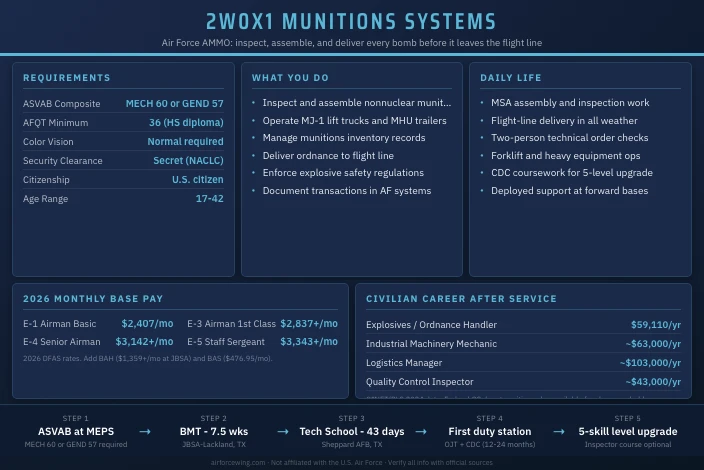
2W0X1 Munitions Systems specialists manage the full lifecycle of Air Force conventional munitions, from depot receipt through flight-line delivery. They inspect, store, assemble, test, and transport all nonnuclear weapons in the Air Force inventory, including bombs, rockets, missiles, and small-arms ammunition. Every combat sortie that drops ordnance depends on their work being done correctly.
Daily Tasks
The AMMO career field covers more ground than most people expect. Day-to-day work includes:
- Receiving, inspecting, and inventorying incoming munitions shipments
- Assembling guided and unguided bomb bodies, fuzes, fins, and seekers to technical order specifications
- Operating forklifts, MJ-1 lift trucks, and other materials-handling equipment to transport ordnance
- Maintaining munitions storage areas and performing serviceability inspections
- Managing explosive hazard classifications and enforcing quantity-distance safety rules
- Documenting all munitions transactions in Air Force information management systems
- Loading munitions onto aircraft trailers and positioning them on the flight line for weapons loaders
Specific Roles
The 2W0X1 AFSC does not have fixed shredouts within the enlisted specialty code itself, but Airmen can earn Special Experience Identifiers and progress into Inspector positions, which require a separate qualification course at the AMMO Schoolhouse.
| Classification | Code | Description |
|---|---|---|
| Apprentice | 2W031 | Entry-level; awarded after Tech School |
| Journeyman | 2W051 | 5-skill level after OJT and CDC completion |
| Craftsman | 2W071 | 7-skill level; supervisory and leadership roles |
| Superintendent | 2W091 | Senior NCO managing entire munitions flights |
| Chief Enlisted Manager | 2W000 | CMSgt-level functional manager |
Mission Contribution
Air power only exists when weapons work. Munitions Systems Airmen are the link between the defense industrial base and the warfighter. A strike package that takes out a high-value target began in an AMMO storage area where an Airman built the weapon to exact specifications. The career field also supports readiness through peacetime munitions accountability, which keeps units legally compliant and operationally ready to generate sorties on short notice.
Technology and Equipment
The tools in an AMMO shop span mechanical and digital. Airmen use the Integrated Conventional Munitions Management System and other Air Force logistics platforms for inventory control and documentation. Physical equipment includes MHU-series trailers, MJ-1 “Jammer” lift trucks, fuze testers, and a range of hand and power tools specific to weapons assembly. Airmen learn to work with everything from Mk 82 unguided bombs to GPS-guided Joint Direct Attack Munitions and AIM-120 missiles.
Salary
Base Pay and Allowances
Pay for 2W0X1 Airmen follows standard DFAS military pay tables. Most recruits enter at E-1 and reach E-4 within three to four years.
| Grade | Title | Monthly Base Pay (entry) |
|---|---|---|
| E-1 | Airman Basic | $2,407 |
| E-2 | Airman | $2,698 |
| E-3 | Airman First Class | $2,837 |
| E-4 | Senior Airman | $3,142 |
| E-5 | Staff Sergeant | $3,343 |
| E-6 | Technical Sergeant | $3,401 |
Rates are from the DFAS 2026 military pay tables and reflect the 3.8% raise effective January 1, 2026.
On top of base pay, Airmen living off-base receive Basic Allowance for Housing, which varies by duty location and dependency status. A single E-4 at Joint Base San Antonio earns roughly $1,359/month in BAH; rates at higher cost-of-living installations run significantly higher. All enlisted Airmen also receive Basic Allowance for Subsistence of $476.95 per month in 2026, regardless of rank or location.
Additional Benefits
TRICARE Prime covers active-duty Airmen and their families at no cost, including medical, dental, vision, and prescriptions. AMMO Airmen who work in hazardous environments receive no additional hazard pay automatically, though specific duty assignments may qualify.
The Blended Retirement System combines a traditional pension at 20 years (40% of high-36 average pay) with Thrift Savings Plan matching. The government automatically contributes 1% of base pay to TSP after 60 days and matches up to 4% of what you contribute, for a total government contribution of up to 5%.
Education benefits include Air Force Tuition Assistance covering up to $4,500 annually while on active duty, and the Post-9/11 GI Bill available after separation for qualifying service.
Work-Life Balance
Munitions flights typically run day and swing shifts during peacetime, with flight-line surges during exercises and deployments. During high-tempo periods, 12-hour days are common. Most CONUS assignments offer predictable schedules between major exercises. Airmen earn 30 days of paid leave annually, accruing at 2.5 days per month.
Qualifications
Requirements Table
| Requirement | Standard |
|---|---|
| ASVAB Composite | MECH 60 or GEND 57 |
| AFQT Minimum | 36 (high school diploma) |
| Citizenship | U.S. citizen |
| Age at Enlistment | 17-42 |
| Color Vision | Normal required |
| Depth Perception | Normal required |
| Driver’s License | Valid state license required |
| Security Clearance | Secret (NACLC) |
| Physical Profile | PULHES meets Air Force standards |
Requirements published at airforce.com Munitions Systems.
The two paths to qualification reflect the dual nature of the job. The MECH 60 (Mechanical composite) route suits candidates with strong mechanical aptitude from subtests covering General Science, Auto and Shop Information, Mathematics Knowledge, and Mechanical Comprehension. The GEND 57 (General composite) route draws on Word Knowledge, Paragraph Comprehension, Arithmetic Reasoning, and Mathematics Knowledge. Either score qualifies you; most recruits qualify through one but not both.
Non-high school graduates who hold a GED or alternative credential must score AFQT 65 or higher to qualify for Air Force enlistment in any AFSC.
Application Process
The path to 2W0X1 runs through a Military Entrance Processing Station. At MEPS, you take the ASVAB, complete a physical, and meet with a classifier who will match your scores and preferences to open AFSC slots. Munitions Systems is frequently available due to its volume of positions across the force. Background investigation for the Secret clearance begins at MEPS and continues through the accession pipeline.
Expect the process from initial recruiter contact to shipping date to take two to six months, depending on clearance processing and open training slots.
Selection Competitiveness
The MECH 60 or GEND 57 requirement is moderate by Air Force standards. Candidates who scored well on the mechanical and math subtests in high school typically meet it without additional preparation. AMMO Airmen report that demonstrating attention to detail during the MEPS process and expressing genuine interest in technical work helps during classification.
Service Obligation
Standard first-term enlistments run four years on active duty. Some bonus-eligible contracts may require a longer commitment. Contact a recruiter for current bonus availability for 2W0X1.
Recruits without prior military experience typically enter at E-1 (Airman Basic). College credit or Junior ROTC participation may qualify you to enter at E-2 or E-3.
Prepare for both the Mechanical and General ASVAB composites to give yourself the best chance at qualifying. The ASVAB study guide at /guides/test-prep/asvab/ covers both composite areas.
Work Environment
Setting and Schedule
Munitions Systems Airmen split time between two primary environments: the storage area and the flight line. The munitions storage area (MSA) is where inspection, assembly, and inventory work happens, often in enclosed igloos or open storage pads. Work there involves structured routines following technical orders and safety regulations. Flight-line delivery is faster-paced and weather-exposed, moving ordnance from the MSA to aircraft in direct support of flying operations.
Peacetime duty follows a standard shift structure, typically days and evenings. Exercises and deployments flip that routine. During high-tempo operations, Airmen work extended shifts and operate under compressed timelines.
Leadership and Communication
Munitions flights are organized into sections: a storage section, a line delivery section, and a production section at larger units. First-line supervisors at the SSgt and TSgt level manage daily task assignments. EPR feedback cycles are annual, with mid-cycle verbal counseling from supervisors. The AMMO community is tight-knit; NCOs invest heavily in training junior Airmen because precision matters.
Team Dynamics and Autonomy
Most AMMO work is team-based by necessity. Technical orders require a two-person check for many assembly and delivery tasks, which builds strong team habits. Senior Airmen and above gain increasing autonomy as they complete their 5-skill level requirements. 7-level Craftsmen routinely manage entire sections and make independent technical decisions on complex assembly tasks.
Job Satisfaction and Retention
The AMMO career field has a strong community identity. Airmen take pride in the “AMMO” culture, which carries its own patches, customs, and unit identity across every Air Force installation in the world. Retention rates are solid in technical fields with practical civilian applications. The physical nature of the work and the sense of direct contribution to the mission both score highly in retention surveys.
Training
Training Pipeline
| Phase | Location | Duration | Focus |
|---|---|---|---|
| BMT | JBSA-Lackland, TX | 7.5 weeks | Military fundamentals |
| Munitions Apprentice Course | Sheppard AFB, TX | 43 days | Munitions safety, assembly, storage |
| OJT / CDC | First duty station | 12-24 months | Skill-level upgrade to 5-level |
| Inspector Course (optional) | Sheppard AFB, TX | ~3 weeks | Inspector qualification, SEI award |
Advanced Training
After reaching the 5-skill level, Airmen can pursue the Munitions Inspector qualification course at the AMMO Schoolhouse at Sheppard AFB. Inspector-qualified Airmen oversee complex assembly operations and sign off on technical order compliance checks. The course is roughly three weeks long.
Senior NCOs often attend the Senior Noncommissioned Officer Academy and may be selected for functional manager roles at major commands or the Air Staff, where they influence policy and training standards across the entire AMMO career field.
Everything starts with qualifying ASVAB scores. Our study guide covers what to study first.
Career Progression
Rank Progression
| Rank | Grade | Typical Time in Service | Role |
|---|---|---|---|
| Airman Basic | E-1 | Entry | BMT graduate |
| Airman | E-2 | 6 months | Entry-level AMMO tasks |
| Airman First Class | E-3 | 18 months | Assigned shop tasks |
| Senior Airman | E-4 | 3 years | Journeyman-level work |
| Staff Sergeant | E-5 | 4-6 years | Section team leader |
| Technical Sergeant | E-6 | 8-12 years | Flight-level supervisor |
| Master Sergeant | E-7 | 14-18 years | Section chief or flight chief |
| Senior Master Sergeant | E-8 | 18-22 years | Squadron functional manager |
| Chief Master Sergeant | E-9 | 22+ years | Wing-level or MAJCOM functional |
Promotions to E-5 through E-7 are competitive and based on Enlisted Performance Report scores, Promotion Fitness Examination results, and whole-person factors evaluated by a central board. Time-in-grade requirements apply at all levels.
Specialization Options
Within 2W0X1, Airmen can pursue:
- Inspector qualification via the AMMO Schoolhouse Inspector Course (awarded as SEI)
- Conventional Maintenance quality assurance roles at wing and depot levels
- Deployed Emergency Munitions Maintenance tasking at forward operating locations
- Lead crew positions for nuclear surety inspections at bases that house both conventional and certain classified weapons
Role Flexibility
Retraining from 2W0X1 to other career fields is possible after completing your first enlistment or with Air Force approval mid-career. The mechanical and logistics skills earned in AMMO translate well to maintenance and supply AFSCs. Airmen interested in the nuclear enterprise can request retraining to 2W2X1, though clearance upgrades and PRP entry add processing time.
Performance Evaluation
The Air Force evaluates enlisted performance through the Enlisted Performance Report system. EPRs are written annually by the immediate supervisor and reviewed by the rater and additional rater up the chain. For promotion consideration, EPRs are stacked-ranked within a unit, which means relative performance against peers matters as much as absolute performance. AMMO NCOs who demonstrate technical precision, leadership under pressure, and adherence to safety standards build the strongest records.
Physical Demands
Physical Requirements
The daily physical demand of 2W0X1 is higher than many Air Force jobs. Airmen routinely:
- Lift and maneuver munitions weighing up to 500 pounds using mechanical equipment
- Climb into storage igloos and work in confined spaces
- Stand and walk on concrete flight lines and storage pads for full shifts
- Operate forklifts, trailers, and bomb-lift trucks in all weather conditions
The job is not an extreme physical outlier, but it is consistently active. Airmen who struggle with extended physical labor or are not comfortable with heavy equipment will find the work demanding.
Air Force Fitness Assessment Standards
All Airmen take the Air Force Fitness Assessment annually. The FA is scored on a 100-point scale; a composite score of 75 is the minimum to pass. Each component also has its own minimum standard that must be met independently.
| Component | Max Points | Notes |
|---|---|---|
| 1.5-Mile Run | 60 | Primary aerobic component |
| Waist Circumference | 20 | Body composition measurement |
| Push-Ups (1 min) | 10 | Muscular endurance |
| Sit-Ups (1 min) | 10 | Core strength |
Standards are age- and gender-normed. For the under-25 age bracket, run time and repetition minimums are set higher than for older age groups. Verify current scoring tables on the official Air Force fitness page.
Medical Evaluations
Normal color vision and normal depth perception are mandatory for initial qualification and retention in 2W0X1. Both are tested at MEPS. Loss of either standard during service requires a medical evaluation that may result in retraining. Airmen also undergo periodic occupational health screenings due to exposure to explosive materials, fuels, and hazardous compounds. Hearing protection is required in certain storage and assembly operations.
Deployment
Deployment Details
2W0X1 is one of the higher-deployment career fields in the Air Force. Combat operations require munitions continuously, so AMMO Airmen deploy at rates driven by the demand for air power. Typical deployment lengths run 90 to 179 days on a rotational basis, though some assignments are longer depending on theater requirements. Airmen can expect at least one deployment within their first enlistment at active fighter or bomber bases.
Deployments are predominantly overseas to locations that support air operations in Europe, the Pacific, and the Middle East. Some Airmen also deploy to temporary duty locations for joint exercises in CONUS and allied nations.
Duty Stations
AMMO Airmen are needed at every installation that generates flying operations. Common assignment locations include:
- Fighter wings: Langley AFB (VA), Luke AFB (AZ), Mountain Home AFB (ID), Kunsan AB (Korea), Aviano AB (Italy)
- Bomber bases: Barksdale AFB (LA), Dyess AFB (TX), Minot AFB (ND)
- Special operations installations and expeditionary bases
- Air Logistics Complexes for depot-level munitions work
Initial assignment preferences are submitted through your recruiter, but the Air Force fills needs based on authorizations. High-priority locations like overseas tours and fighter wings are common for first-termers in this field.
Risk/Safety
Job Hazards
Munitions work carries inherent risk. The primary hazards include:
- Explosive materials: Handling live ordnance, fuzes, and propellants
- Toxic and hazardous substances: Primers, solid propellants, and fuze chemistries
- Heavy equipment: Forklifts, trailers, and bomb-lift trucks on flight lines with active aircraft
- Weather exposure: Working in extreme heat, cold, and precipitation during flight-line operations
The accident rate in the AMMO career field is low because safety controls are extensive and enforced rigorously. But the consequence of an error is severe, which is why the culture of compliance with technical orders is non-negotiable.
Safety Protocols
Every munitions assembly and handling task follows a published technical order. Two-person integrity checks are required for high-risk steps. Explosive safety rules govern site distances, personnel counts near live ordnance, and emergency procedures. AMMO Airmen receive explosive ordnance safety training as part of the Apprentice Course and receive refresher training annually. Personal protective equipment is mandatory during fuze and propellant handling.
Security and Legal Requirements
The Secret clearance required for 2W0X1 is processed through a National Agency Check, Local Agency Checks and Credit investigation. Airmen who receive an interim clearance can begin the 3-skill level upgrade immediately while the full investigation completes. Any foreign travel, financial derogatory information, or criminal history can delay or deny clearance.
Munitions accountability carries federal legal weight. Airmen sign for explosive materiel and are responsible for accurate documentation under Air Force and DoD regulations. Discrepancies in munitions inventories trigger formal investigations and can result in administrative or legal action.
Impact on Family
Family Considerations
Frequent deployment is the primary family-life factor for 2W0X1 Airmen. At high-tempo fighter and bomber bases, operational demand drives deployment cycles that can average one rotation every 18 to 24 months for junior enlisted. Families gain access to on-base family support programs, Military OneSource counseling, and base Family Readiness Center resources during deployments.
TRICARE covers dependents at no cost for active-duty Airmen. Dependent children are eligible for Space-Available travel on military aircraft and access to on-base childcare, schools, and recreational facilities.
Relocation
Permanent Change of Station moves happen roughly every three years on average, though operational needs can shorten or lengthen that timeline. The Air Force covers moving costs through the Household Goods program, and BAH adjusts to the new duty location. Families with school-age children should factor base-to-base school transitions into their planning. Airmen can submit assignment preferences through the assignment system, but AFPC fills needs based on the force.
Reserve and Air National Guard
Component Availability
2W0X1 is available in both the Air Force Reserve and the Air National Guard. Munitions positions exist at Reserve and Guard flying wings, where conventional munitions support is required for combat aircraft operations. The Reserve and Guard have historically listed 2W0X1 among their critical shortage specialties, which sometimes makes bonus incentives available.
Drill Schedule and Commitment
The standard Reserve and Guard commitment is one weekend per month (Unit Training Assembly) plus two weeks per year (Annual Tour). AMMO weekends often involve more physical work than administrative career fields, since maintaining proficiency with munitions handling equipment requires hands-on practice. Annual tours may include participation in major flying exercises.
Part-Time Pay
A Reserve or Guard E-4 (SrA) earns approximately four days of base pay per drill weekend (two UTAs Saturday and Sunday, each counting as one day). At E-4 entry base pay of $3,142/month, the daily rate is roughly $104, so a typical drill weekend pays approximately $418 before taxes. Compare that to an active-duty SrA earning $3,142 monthly for full-time service.
Benefits Comparison
| Factor | Active Duty | Air Force Reserve | Air National Guard |
|---|---|---|---|
| Commitment | Full-time | 1 wknd/mo + 2 wks/yr | 1 wknd/mo + 2 wks/yr |
| Monthly Pay (E-4 entry) | $3,142 | ~$418/drill wknd | ~$418/drill wknd |
| Healthcare | TRICARE Prime (free) | TRICARE Reserve Select (premiums apply) | TRICARE Reserve Select (premiums apply) |
| Education | Tuition Assistance ($4,500/yr) + GI Bill on separation | Federal TA while activated; GI Bill after qualifying service | State tuition waivers (varies); Federal TA when activated |
| Deployment tempo | High (90-179 day rotations) | Moderate (mobilizations as needed) | Moderate (mobilizations as needed) |
| Retirement | 20-year high-36 pension | Points-based Reserve retirement | Points-based Reserve retirement |
Guard Airmen in AMMO can often find civilian careers in defense contracting, logistics, or government depot work near their unit, which makes the part-time model highly compatible with civilian employment.
Civilian Career Integration
USERRA protections require civilian employers to hold your job during military activations. Defense contractors and government agencies that support Air Force logistics actively recruit veterans with munitions handling and accountability experience. Guard Airmen report that the AMMO background is a direct credential for depot and contractor positions that require explosives familiarity and security clearance.
Post-Service
Civilian Transition
The skills from 2W0X1 are directly transferable. Munitions systems experience covers logistics, inventory management, explosives safety, hazardous materials handling, and quality control. All of those skills have civilian demand in defense, mining, construction, and government work.
Federal employment routes include defense logistics positions at Air Force Materiel Command depots and civilian GS positions in munitions management at active bases. These roles often specifically recruit from the 2W0X1 career field.
Transition assistance programs including the Transition Assistance Program (TAP) and Hiring Our Heroes help veterans translate military credentials into civilian resumes and connect with employers who understand military experience.
Civilian Career Prospects
| Civilian Job Title | Median Annual Wage | Job Outlook |
|---|---|---|
| Explosives Workers, Ordnance Handling Experts, and Blasters | $59,110 | Stable; ~500 openings/yr |
| Industrial Machinery Mechanic | ~$63,000 | Growing |
| Logistics Manager | ~$103,000 | Growing |
| Quality Control Inspector | ~$43,000 | Stable |
Civilian wages sourced from O*NET / BLS data (2024). Exact figures vary by industry, region, and experience level.
Veterans with a Secret clearance and explosives handling experience are competitive candidates for federal GS-08 through GS-12 positions at Air Force depots and defense contractor facilities. A clearance alone adds significant market value compared to candidates without government security access.
Is This a Good Job
Who Thrives in This Career
The strongest 2W0X1 Airmen tend to share a few traits. They are methodical and rule-driven, because the job does not reward improvisation. They are physically active and comfortable in outdoor environments. They don’t mind repetitive technical processes, because building a bomb body for the 200th time still has to be done exactly right. And they take pride in work that directly enables combat operations, even when that work happens far from the headline-grabbing part of the mission.
If you tested well in mechanical subjects, enjoy working with your hands, and want a clear sense of how your daily output connects to the Air Force mission, this job will be satisfying.
Potential Challenges
Deployment frequency is the most common reason 2W0X1 Airmen struggle with the job long-term. Bases like Luke, Kunsan, and Mountain Home operate at high operational tempos, and the AMMO shop deploys constantly. For Airmen with young families who prefer stability, the pace is real.
The technical order discipline can also feel constraining to someone who thrives on creative problem-solving. AMMO does not give you latitude to improvise assembly procedures. Every step follows a published document, and deviations are reportable events. That structure is a feature for many Airmen and a frustration for others.
Career and Lifestyle Fit
This role is strong for someone who wants a portable technical skill, a security clearance, and a career that transitions well into defense contractor or federal civilian work. It is less suited to someone who wants to work primarily indoors, prefers administrative or analytical work, or is not comfortable with the legal and personal responsibility that comes with signing for explosive materiel.
More Information
Talk to an Air Force recruiter to find out what 2W0X1 openings look like for your start date, and ask about current bonus availability for this AFSC. Recruiters can also walk you through clearance eligibility and help you understand which ASVAB composite is more achievable given your practice scores. You can find a recruiter at airforce.com.
- Prepare for the ASVAB with our study guide to make sure your line scores qualify
This site is not affiliated with the U.S. Air Force or any government agency. Verify all information with official Air Force sources before making enlistment or career decisions.
Explore more Air Force munitions and weapons careers to compare this AFSC against other roles in the group, such as 2W1X1 Aircraft Armament Systems and 2W2X1 Nuclear Weapons.