2M0X3 Missile and Space Facilities
Every Minuteman III missile on alert in Wyoming, Montana, or North Dakota depends on a functioning facility to stay ready. The power has to flow, the environmental systems have to hold temperature, and the diesel generators have to start when called. That work belongs to the 2M0X3 Missile and Space Facilities specialist.
This AFSC sits at the intersection of facility maintenance and nuclear deterrence. These Airmen keep power generation, electrical distribution, and environmental control systems running at ICBM launch facilities and spacelift complexes. If a launch control center loses power or a missile alert facility overheats, the mission stops. Before you commit to this path, it’s worth studying for the ASVAB with a strong focus on electronics.
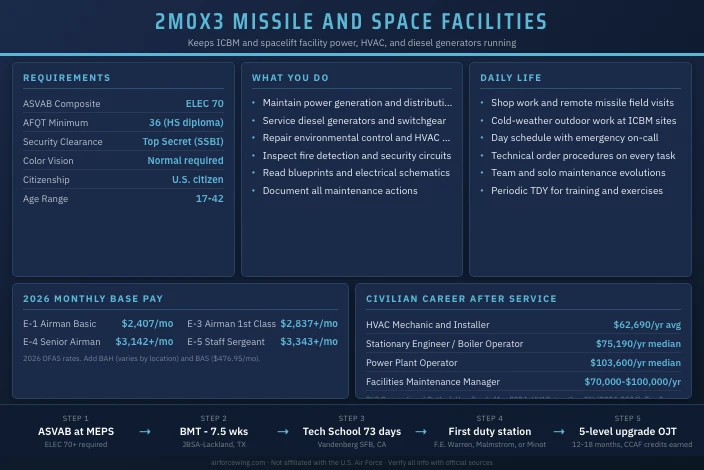
Job Role and Responsibilities
2M0X3 Missile and Space Facilities specialists install, operate, maintain, and repair power generation and distribution systems, environmental controls, and associated support equipment at ICBM weapon system sites and spacelift facilities. They troubleshoot electrical circuits, service diesel generators, maintain heating and cooling systems, and keep fire and security warning systems operational across remote missile alert facilities and launch complexes.
Day-to-Day Responsibilities
The work is technical and procedural. These Airmen follow Air Force technical orders to maintain every system in the facility envelope, from the diesel generator that backs up commercial power to the HVAC unit keeping a launch control capsule at a stable temperature.
Daily tasks include:
- Performing preventive maintenance on power generation and electrical distribution equipment
- Servicing and repairing diesel generators and associated transfer switch gear
- Testing and maintaining environmental control systems including heating, ventilation, and cooling
- Inspecting and troubleshooting fire detection and security warning system circuits
- Reading blueprints, schematics, and electrical diagrams to diagnose faults
- Documenting all maintenance actions in Air Force maintenance tracking systems
- Operating specialized vehicles and ground support equipment at facility sites
Specialized Roles
The 2M0X3 career field does not use separate shredout codes. Progression runs through skill levels:
| Skill Level | Code | Description |
|---|---|---|
| Apprentice | 2M033 | Entry-level; completes mandatory training tasks under supervision |
| Journeyman | 2M053 | Requires 2M033 plus hands-on facilities maintenance experience |
| Craftsman | 2M073 | Requires 2M053 plus supervisory experience in power generation and facilities |
Special Experience Identifiers (SEIs) may be awarded for specific equipment qualifications. Crossflow to other specialties is available at Staff Sergeant and above.
Mission Contribution
ICBMs represent the land-based leg of the nuclear triad. A missile that cannot maintain alert because its facility systems failed is a missile that isn’t contributing to deterrence. The 2M0X3 specialist is the reason launch facilities stay powered, pressurized, and thermally stable across all weather conditions. The job matters most when conditions are worst, blizzards, grid outages, and equipment failures don’t pause the deterrence mission.
Spacelift facilities at Vandenberg Space Force Base add another dimension. These Airmen support the power and environmental systems for launch complexes and research facilities, meaning their work contributes to both national defense and space access missions.
Equipment and Technology
The equipment profile is broad. Generators in the 15 to 500 kW range are common, along with automatic transfer switches, uninterruptible power supply systems, three-phase distribution panels, pneumatic and electronic environmental control units, and above- and below-grade facility systems unique to hardened missile structures. Airmen also use diagnostic test equipment, multimeters, oscilloscopes, and specialized software to monitor and log system performance.
Salary and Benefits
Base Pay
All figures are 2026 DFAS rates. Pay increases with time in service at every grade.
| Rank | Grade | Monthly Base Pay (Entry) |
|---|---|---|
| Airman Basic | E-1 | $2,407 |
| Airman | E-2 | $2,698 |
| Airman First Class | A1C / E-3 | $2,837 |
| Senior Airman | SrA / E-4 | $3,142 |
| Staff Sergeant | SSgt / E-5 | $3,343 |
| Technical Sergeant | TSgt / E-6 | $3,401 |
Base pay is only part of the picture. Active duty Airmen also receive Basic Allowance for Subsistence (BAS) of $476.95 per month and Basic Allowance for Housing (BAH) that varies by location and dependency status. A single E-4 at Joint Base San Antonio earns $1,359 in BAH monthly; with dependents that rises to $1,728. Most ICBM bases are in mid-cost-of-living areas where BAH stretches further.
Enlistment and Reenlistment Bonus
The 2M0X3 career field has offered a $10,000 selective reenlistment bonus for 6-year contracts. Bonus availability changes with Air Force manning needs, confirm current offers with your recruiter before signing.
Additional Benefits
Active duty Airmen receive TRICARE Prime at zero cost: no enrollment fee, no deductible, and no copays for active duty members. Dental care at military treatment facilities is also covered at no cost. The Air Force contributes up to 5% of base pay to the Thrift Savings Plan under the Blended Retirement System, and the standard 30 days of paid leave per year applies.
The Post-9/11 GI Bill covers full in-state tuition at public universities or up to $29,920.95 per academic year at private schools, plus a monthly housing allowance during enrollment. Tuition Assistance provides up to $4,500 per year for classes taken while on active duty.
Work-Life Balance
Most 2M0X3 assignments follow a standard day schedule with periodic on-call rotations for emergencies. Missile field visits can require extended duty periods when a system is down. The work is not shift-heavy by Air Force standards, though duty can extend when facilities require immediate corrective maintenance.
Qualifications and Eligibility
The ELEC 70 requirement is among the higher electronics scores in the enlisted Air Force. Start your preparation early, and use the ASVAB study guide to sharpen the General Science, Arithmetic Reasoning, Mathematics Knowledge, and Electronics sections that feed the ELEC composite.
Qualification Table
| Requirement | Standard |
|---|---|
| ASVAB Composite | ELEC 70 |
| AFQT Minimum | 36 (HS diploma); 65 (GED) |
| Security Clearance | Top Secret (SSBI required) |
| Citizenship | U.S. citizen |
| Color Vision | Normal required |
| Emotional Stability | No record of emotional instability |
| Height/Heights | Freedom from fear of heights required |
| Age | 17-42 at enlistment |
| Education | High school diploma or equivalent; math and physics coursework desirable |
Application Process
The process runs through a Military Entrance Processing Station (MEPS):
Selection and Competitiveness
The ELEC 70 cutoff screens out a large percentage of applicants. Candidates with high school coursework in physics, electrical theory, or industrial technology tend to score better. No prior civilian certifications are required, but demonstrated mechanical aptitude or hands-on experience with electrical systems can help during the application conversation with your recruiter.
Service Obligation
Initial enlistment terms are typically 4 or 6 years. The 6-year contract ties to the reenlistment bonus. Airmen enter at Airman Basic (E-1) unless they qualify for advanced enlistment based on college credits, JROTC, or prior service.
Work Environment
Setting and Schedule
Most 2M0X3 Airmen work across two environments: the main base facility shop and the missile field. The shop is an indoor, climate-controlled workspace for planning, parts staging, and lighter repairs. The missile field is different, scattered across hundreds of square miles of high plains, and facilities require scheduled visits in all weather conditions.
Typical work environment features:
- Base shop: Climate-controlled, Monday-Friday daytime hours, focused on planning, parts staging, and shop-level repairs
- Missile field: Remote site visits in all seasons, including sub-zero winters; work cannot be postponed for weather
- Schedule: Standard daytime hours with periodic on-call rotations; emergency call-outs occur when a facility system fails outside normal hours
- Drive times: Sites can be 30-90 minutes from main base; Airmen spend meaningful time in vehicles between locations
Chain of Command and Feedback
2M0X3 Airmen work within Civil Engineer or Missile Maintenance units, depending on installation. The chain runs from team chief through flight chief to squadron leadership. Performance feedback comes through the Air Force Enlisted Performance Report (EPR) system, with formal evaluations annually at the SSgt level and below, and more frequently as Airmen approach promotion boards.
Team Dynamics
The work alternates between individual troubleshooting and team-based maintenance. A journeyman might independently service a diesel generator and complete the technical order documentation alone, then join a larger team for a scheduled maintenance inspection that requires multiple technicians. The mix keeps the work from becoming monotonous.
Newer Airmen work closely with experienced Craftsmen who sign off on their training records. The skill-level system means 3-level Airmen are learning while contributing, with increasing autonomy as they complete qualification tasks.
Job Satisfaction
Airmen in facilities-focused AFSCs tend to report satisfaction tied to seeing the direct outcome of their work: a generator starts, a system holds temperature, a facility passes inspection. The technical depth grows over a career, and the unique operating environment, nuclear-coded facilities with strict procedural requirements, gives the work a weight that distinguishes it from typical facility maintenance roles.
Training and Skill Development
The training pipeline for 2M0X3 runs from BMT through Tech School and into on-the-job qualification at the first assignment. If you’re still working on the ELEC 70 requirement, the ASVAB study guide covers the electronics and math fundamentals taught in Tech School.
Training Pipeline
| Phase | Location | Duration | Focus |
|---|---|---|---|
| Basic Military Training (BMT) | JBSA-Lackland, TX | 7.5 weeks | Core military skills, fitness, and Air Force culture |
| Airman’s Week | JBSA-Lackland, TX | 1 week | Transition between BMT and Tech School |
| Technical School | Vandenberg Space Force Base, CA | 73 days (~10 weeks) | Power generation, electrical distribution, environmental controls, technical order reading |
| On-the-Job Training (OJT) | First duty station | 12-18 months | AFSC qualification tasks and 5-level upgrade |
Tech School Curriculum
At Vandenberg, instruction covers reading electrical schematics and blueprints, understanding three-phase power theory, operating and maintaining diesel generator sets, servicing HVAC and environmental control equipment, and working within missile facility technical order requirements. The course mixes classroom instruction with hands-on lab time on actual facility equipment.
Vandenberg is also where Airmen get their first exposure to the space launch environment, since the base hosts both missile wings and Space Force launch facilities.
Advanced Training and Development
After completing the 5-level upgrade at their first assignment, Airmen can pursue the 7-level Craftsman course, which prepares them for supervisory and quality control roles. The Air Force also funds relevant civilian certifications through education programs. HVAC certifications, electrical journeyman training, and EPA 608 refrigerant handling credentials are common pursuits.
The Community College of the Air Force pathway can lead to an associate degree in Electrical Systems Technology, and the Tuition Assistance program supports bachelor’s degree work on the side.
Career Progression and Advancement
Rank Progression
| Grade | Rank | Typical Time to Achieve | Role |
|---|---|---|---|
| E-1 | Airman Basic (AB) | Entry | Student / trainee |
| E-2 | Airman (Amn) | 6 months | OJT, building qualification tasks |
| E-3 | Airman First Class (A1C) | 16 months | Completing 3-level tasks, growing independence |
| E-4 | Senior Airman (SrA) | 3 years | Fully qualified journeyman-track |
| E-5 | Staff Sergeant (SSgt) | ~6 years (board) | Team lead, 5-level, supervising A1Cs |
| E-6 | Technical Sergeant (TSgt) | ~11 years (board) | NCOIC-track, 7-level, facility oversight |
| E-7 | Master Sergeant (MSgt) | ~16 years (board) | Flight superintendent or NCOIC |
Promotion to SSgt and above is competitive. The board weighs EPR scores, decorations, education, and professional military education (PME) completion. Airmen who earn their CCAF degree and complete Airman Leadership School early tend to be more competitive.
Specialization and Transfers
The 2M0X3 specialty does not branch into shredouts, but experienced Airmen can apply for Special Duty Assignments including recruiter, military training instructor, or command post positions. Retraining to related AFSCs like 3E0X1 (Electrical Systems) or 3E1X1 (Heating, Ventilation, and Air Conditioning) is possible through the Enlisted Retraining Program, though approval depends on Air Force manning requirements.
Performance Evaluation
The Enlisted Performance Report (EPR) is the primary evaluation tool. Raters score Airmen on job performance, leadership, and military bearing on a scale that feeds directly into promotion board scores. A “Promote” recommendation is the baseline; “Must Promote” designations are limited and highly competitive. Airmen should request feedback from their supervisor regularly rather than waiting for the annual EPR cycle.
Keys to Advancement
The technical depth of this AFSC rewards Airmen who pursue additional certifications, cross-train on adjacent equipment, and volunteer for challenging assignments. Taking on a collateral duty, career advisor, unit training manager, or dorm council, signals initiative to supervisors writing EPRs.
Physical Demands and Medical Evaluations
Daily Physical Requirements
The work requires physical capability across a range of conditions. Airmen regularly:
- Lift and carry tools, equipment, and generator components weighing up to 50 pounds
- Work in confined spaces such as equipment bays and below-grade facility access points
- Climb ladders and access elevated equipment panels
- Operate in outdoor environments during all weather conditions at remote missile field sites
- Maintain sustained physical effort during extended maintenance evolutions
Freedom from fear of heights is a formal qualification requirement because facility work includes elevated equipment access.
Air Force Fitness Assessment
All Airmen, regardless of AFSC, take the Air Force Fitness Assessment annually. The test is scored on a 100-point scale with a minimum passing composite of 75. Every component has its own minimum score that must be met.
| Component | Maximum Points | Minimum (Under 25, Male) | Minimum (Under 25, Female) |
|---|---|---|---|
| 1.5-Mile Run | 60 | ~11:57 | ~13:56 |
| Push-Ups (1 min) | 10 | 33 reps | 18 reps |
| Sit-Ups (1 min) | 10 | 42 reps | 38 reps |
| Waist Circumference | 20 | Meets standard | Meets standard |
Medical Standards
Beyond the initial MEPS physical, Airmen undergo periodic occupational health evaluations. Normal color vision must be maintained throughout the career. The security clearance renewal process also involves ongoing review of medical and mental health history.
Deployment and Duty Stations
Primary Duty Stations
The 2M0X3 career field concentrates at missile wings and space launch installations. Most assignments are domestic.
- F.E. Warren Air Force Base, Wyoming: 90th Missile Wing, Minuteman III fields spanning Wyoming, Colorado, and Nebraska
- Malmstrom Air Force Base, Montana: 341st Missile Wing, 200 Minuteman III missiles across central Montana
- Minot Air Force Base, North Dakota: 91st Missile Wing, 150 Minuteman III missiles
- Vandenberg Space Force Base, California: Tech School location plus active missile and space launch missions
- Hill Air Force Base, Utah: Missile maintenance and logistics support mission
- Ramstein Air Base, Germany: Overseas assignment supporting European theater facilities
ICBM bases are in rural, cold-weather environments. Housing on or near base is available at all locations, and BAH rates in these areas are generally modest compared to coastal installations.
Deployment Patterns
2M0X3 Airmen deploy less frequently than many other AFSCs. The ICBM mission is inherently fixed, missiles don’t move, and their facilities require continuous on-site maintenance. Deployments do occur in support of expeditionary missions, overseas contingency operations, or space-related taskings, but a career in 2M0X3 spent primarily at a missile wing will involve fewer and shorter deployments than, say, a maintenance AFSC supporting fighter operations.
Temporary duty (TDY) assignments for training, exercises, and technical assistance are more common than extended deployments.
Assignment Process
Assignments are managed through the Air Force Personnel Center (AFPC). Airmen submit preference sheets before each Permanent Change of Station (PCS) cycle. First-term Airmen have limited control over initial assignments, but re-assignees with a few years of service have more influence through the Dream Sheet process.
Risk, Safety, and Legal Considerations
Job Hazards
The work involves real hazards that require consistent attention:
- Electrical shock and arc flash from high-voltage distribution systems
- Carbon monoxide exposure during diesel generator operations in enclosed spaces
- Confined space hazards when working in below-grade equipment vaults
- Thermal stress from prolonged outdoor work in extreme cold at missile sites
- Chemical exposure from battery electrolytes and refrigerants
Safety Protocols
The Air Force manages these risks through a layered system. Technical orders specify lockout/tagout procedures for every powered system. Personal protective equipment, arc flash suits, hearing protection, and confined space monitoring equipment, is mandatory for applicable tasks. All Airmen complete confined space and electrical safety training before performing qualifying tasks.
Security and Legal Requirements
The Top Secret clearance requires an SSBI conducted by the Defense Counterintelligence and Security Agency (DCSA). Maintaining the clearance requires continuous reporting of foreign contacts, financial changes, and personal conduct issues. Loss of the clearance means loss of the AFSC.
Airmen working in or near missile facilities operate under strict security protocols governed by AFI 31-101 and nuclear surety directives. Violations of nuclear surety procedures carry serious legal and administrative consequences.
Impact on Family and Personal Life
Family Considerations
ICBM bases in Wyoming, Montana, and North Dakota are remote by most measures. The towns near these installations are small. Shopping options, restaurant variety, and entertainment are limited compared to metro-area bases. That said, housing costs near these bases are low, and the pace of life appeals to Airmen who prefer a quieter environment.
What families can expect at ICBM bases:
- Housing costs: Lower than coastal or urban installations; BAH stretches further at remote bases
- Schools and childcare: Available on-installation at all three major missile wings
- Spousal employment: Limited local job market; remote work and federal civilian positions are the most viable options
- Community pace: Small towns with tight military communities; less traffic, crime, and urban stress
- Family readiness: Family Support Centers, Military OneSource counseling, and commissary/exchange access on all installations
Relocation
PCS moves occur every 2-4 years on average. The Air Force provides relocation allowances including Dislocation Allowance (DLA) and a weight allowance for household goods. Most 2M0X3 assignments cycle through a small pool of bases, so Airmen and families can anticipate the remote Great Plains environment more than once over a career.
Time away from home is relatively predictable. Missile field trips are day-trips or short overnight evolutions rather than multi-month deployments. Families generally find the schedule more stable than AFSCs with heavy deployment cycles.
Support Systems
The Air Force offers Military OneSource counseling, the Airman and Family Readiness Center at each installation, TRICARE coverage for family members, and a commissary and exchange system that partially offsets the limited local retail environment at remote bases.
Reserve and Air National Guard
Component Availability
The 2M0X3 AFSC is available in both the Air Force Reserve and the Air National Guard. Reserve and Guard units that support missile wings or space operations facilities may carry this specialty. Availability of part-time positions varies by state and unit, and not all states with Guard units have 2M0X3 slots, confirm with your recruiter.
Drill Schedule and Training
The standard Reserve and Guard commitment is one weekend per month (Unit Training Assembly) plus two weeks of Annual Tour. 2M0X3’s technical complexity and clearance requirements typically add periodic qualification training and equipment certification events beyond the standard schedule.
Part-Time Pay and Benefits
An E-4 Senior Airman earns approximately $3,142 per month on active duty. Reserve and Guard Airmen are paid per drill period, a standard weekend consists of four drill periods. An E-4 drilling one weekend per month earns roughly $628 for the weekend (4 x $157/period), plus pay during Annual Tour.
| Feature | Active Duty | Air Force Reserve | Air National Guard |
|---|---|---|---|
| Commitment | Full-time | 1 weekend/mo + 2 wks/yr | 1 weekend/mo + 2 wks/yr |
| Monthly Pay (E-4) | $3,142+ | ~$628/drill weekend | ~$628/drill weekend |
| Healthcare | TRICARE Prime (free) | TRICARE Reserve Select (premiums apply) | TRICARE Reserve Select or state plan |
| Education | GI Bill + Tuition Assistance | Reserve GI Bill (Chapter 1606) or Post-9/11 GI Bill if mobilized | State tuition waivers often available; Post-9/11 GI Bill if mobilized |
| Retirement | 20-year defined benefit (high-36) | Points-based; eligible at 60 | Points-based; eligible at 60 |
| Deployment tempo | Regular per Air Force requirements | Periodic mobilization; lower than active duty | Periodic activation; varies by unit |
Civilian Career Integration
The 2M0X3 skill set pairs naturally with careers in facilities management, power generation, industrial HVAC, and critical infrastructure maintenance. Guard service in this AFSC doesn’t conflict with civilian employers in these sectors, it reinforces the skillset. The federal USERRA law protects Guard and Reserve members’ civilian employment and benefits during activations.
Post-Service Opportunities
Transition to Civilian Careers
The technical skills built in 2M0X3 translate directly into in-demand civilian roles. Power generation, environmental controls, and critical facility maintenance are all growth areas in the civilian economy, data centers, hospitals, military contractors, and utilities all need experienced technicians.
The Air Force Transition Assistance Program (TAP) helps separating Airmen translate military experience into civilian resume language and connect with employers. The Hiring Our Heroes program specifically targets defense-sector employers familiar with cleared veteran candidates.
Civilian Career Prospects
| Civilian Job Title | Median Annual Salary | Job Outlook (2024-2034) |
|---|---|---|
| HVAC Mechanic and Installer | $62,690 (avg, May 2024) | +9% growth |
| Stationary Engineer / Boiler Operator | $75,190 (median, May 2024) | +2% growth |
| Power Plant Operator | $103,600 (median, May 2024) | -10% (coal plant retirements offset by renewables) |
| Facilities Maintenance Manager | Varies by sector; $70,000-$100,000 common | Steady demand |
Data from the Bureau of Labor Statistics Occupational Outlook Handbook.
Airmen with Top Secret clearances can also pursue cleared contractor roles with defense companies supporting missile programs, space launch operations, and government facility management. These roles typically pay a significant premium above standard civilian market rates.
Certifications and Licensing
Several civilian credentials map directly onto 2M0X3 training:
- EPA Section 608 Refrigerant Handling Certification: required for civilian HVAC work
- OSHA 30 electrical safety: valued by industrial employers
- State electrical journeyman license: tech school training provides a foundation; state exam required
- NATE certification (HVAC), recognized premium for service technicians
The CCAF associate degree earned during service is regionally accredited and accepted by most state licensing boards as partial fulfillment of education requirements for licensure.
Is This a Good Job for You?
Ideal Candidate Profile
This AFSC fits people who:
- Genuinely enjoy troubleshooting electrical and mechanical systems
- Can follow detailed technical procedures precisely without cutting corners
- Are comfortable working in remote, cold-weather environments without close supervision
- Have the personal conduct history to pass a Top Secret background investigation
- Want stable work with predictable schedules rather than heavy deployments
- Are interested in post-service civilian careers in facilities or power generation
Physics and mathematics background makes the ELEC 70 cutoff more achievable. Prior hands-on experience, even hobbyist-level electrical or HVAC work, translates to better test performance and faster training progression.
Potential Challenges
The remote basing reality is real. Great Falls, Montana, and Cheyenne, Wyoming, are not metropolitan areas. Airmen or spouses who want urban amenities, diverse dining options, or proximity to major cities will find ICBM bases frustrating. This is a known trade-off going in.
The security clearance requirement means a segment of otherwise-qualified applicants won’t make it through. Financial issues, prior drug use, and foreign contacts are the most common disqualifiers. Be honest at MEPS and with your recruiter, problems disclosed upfront are handled very differently than issues discovered during the investigation.
Fit Assessment
The combination of Top Secret clearance and specialized facility experience opens civilian doors that basic maintenance roles don’t. Airmen who complete a full first term and separate in good standing frequently find themselves hired directly by defense contractors at above-market rates.
More Information
A local Air Force recruiter can confirm current ELEC score requirements, bonus availability, and open 2M0X3 slots for your contract window. Slot availability changes monthly based on Air Force manning numbers, so the conversation is worth having sooner rather than later. Recruiters can also walk through the SSBI process in detail so you know what to expect before you sign. If you’re still building toward the ELEC 70 score, the ASVAB study guide and PiCAT prep resources can help you reach it.
This site is not affiliated with the U.S. Air Force or any government agency. Verify all information with official Air Force sources before making enlistment or career decisions.
Explore more Air Force munitions and weapons careers such as 2M0X1 Missile and Space Systems Electronic Maintenance and 2M0X2 Missile and Space Systems Maintenance.