2M0X2 Missile and Space Systems Maintenance
The Minuteman III intercontinental ballistic missile sits inside a hardened silo, capped by a blast door weighing over 100 tons, ready to launch within minutes of an order. Behind that readiness is 2M0X2, the Airmen who maintain the missile itself. They service the propulsion stages, mechanical subsystems, reentry vehicles, and associated support hardware that keep the nation’s ground-based nuclear deterrent operational around the clock. If you want a technical career built around systems that actually matter to national survival, this is one of the most consequential maintenance jobs in the Air Force.
Qualifying requires specific ASVAB line scores. Our ASVAB study guide covers what to target and how to prepare.
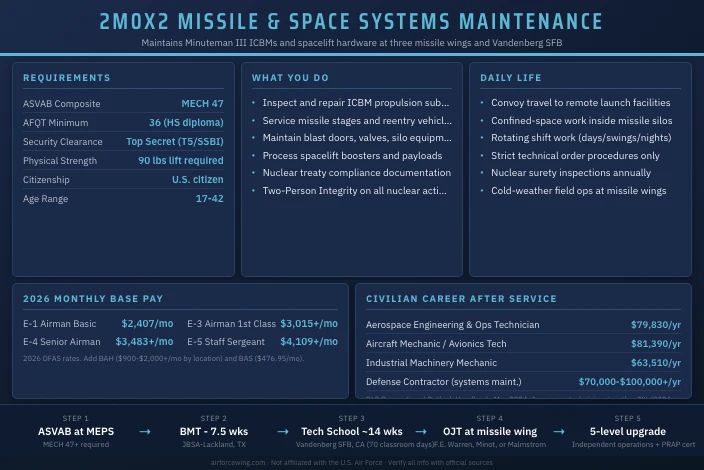
Job Role
2M0X2 Missile and Space Systems Maintenance specialists service, inspect, and repair missiles, spacelift boosters, payloads, research and development systems, environmental blast doors and valves, and all associated subsystems and support equipment. They work across the full lifecycle of an ICBM, from routine scheduled maintenance to emergency repairs, and ensure every system complies with nuclear treaty obligations.
What 2M0X2 Airmen Do Every Day
The work centers on keeping missile hardware in launch-ready condition. On any given day, a 2M0X2 specialist might travel out to a launch facility in a convoy, descend into a missile alert facility, and perform hands-on maintenance on the missile itself. Tasks include:
- Inspecting, repairing, and replacing components across propulsion, guidance, mechanical, and electrical subsystems
- Connecting and disconnecting reentry systems, guidance and control sections, and missile stages at the launch facility
- Performing preventive maintenance inspections and electrical tests on missile hardware
- Maintaining environmental systems including blast doors, valves, and facility support equipment
- Processing spacelift boosters and payloads at space launch facilities
- Documenting all maintenance actions and ensuring compliance with technical orders
- Supporting nuclear treaty verification activities and compliance checks
Work follows strict technical orders with no improvisation. Every step is verified and signed off. The Air Force’s nuclear surety standards are among the most demanding in any organization anywhere.
Specific Roles Within 2M0X2
| AFSC Code | Level | Description |
|---|---|---|
| 2M032 | Apprentice (3-level) | Entry-level; performs basic maintenance under supervision |
| 2M052 | Journeyman (5-level) | Independently performs missile and space launch maintenance |
| 2M072 | Craftsman (7-level) | Supervises maintenance operations and quality assurance |
| 2M092 | Superintendent (9-level) | Senior NCOIC; manages programs and personnel |
Mission Contribution
Every Air Force ICBM wing depends entirely on 2M0X2 specialists to keep missiles certified for alert status. The U.S. land-based nuclear deterrent consists of roughly 400 Minuteman III missiles spread across three states. The Air Force is also developing the Sentinel ICBM to replace Minuteman III, which means 2M0X2 Airmen will be part of fielding an entirely new strategic weapons system over the next decade. The job sits at the intersection of conventional maintenance and nuclear strategy.
Technology and Equipment
The hardware range is broad. 2M0X2 Airmen work with missile propulsion stages (solid-fuel rocket motors), reentry vehicles, mechanical ground support equipment, specialized lifting and handling fixtures, hydraulic and pneumatic systems, and blast door mechanisms. At space launch facilities, the scope expands to include commercial and government spacelift boosters and satellite payloads. Test and measurement equipment, technical order management systems, and digital maintenance documentation tools are part of the daily toolkit.
Salary
Base Pay
Pay is the same across all Air Force enlisted specialties at the same grade and time in service, the difference is what you do with the career. 2026 pay figures are from DFAS.
| Rank | Grade | Example Time in Service | Monthly Base Pay |
|---|---|---|---|
| Airman Basic | E-1 | Entry | $2,407 |
| Airman First Class | E-3 | 2 years | $3,015 |
| Senior Airman | E-4 | 3-4 years | $3,483 |
| Staff Sergeant | E-5 | 6 years | $4,109 |
| Technical Sergeant | E-6 | 10 years | $4,759 |
| Master Sergeant | E-7 | 12 years | $5,537 |
Base pay is just the start. A Senior Airman at a CONUS installation also receives Basic Allowance for Housing (BAH), which ranges from roughly $900 to $2,000+ monthly depending on duty location and dependency status. The flat-rate Basic Allowance for Subsistence (BAS) adds $476.95/month for enlisted Airmen (2026 rate).
Additional Benefits
Healthcare through TRICARE Prime costs nothing for active-duty Airmen, no enrollment fee, no deductible, no copays. Coverage extends to medical, dental, vision, mental health, and prescriptions.
The Post-9/11 GI Bill (Chapter 33) pays full in-state tuition at public universities after qualifying service. For private schools, the annual cap is $29,920.95 for the 2025-2026 academic year. You also receive a monthly housing allowance based on the E-5 BAH rate at your school’s ZIP code, plus up to $1,000 per year in book stipends. The bill covers up to 36 months of education benefits.
The Blended Retirement System (BRS) combines a traditional pension, 40% of your high-36 average pay after 20 years, with a Thrift Savings Plan contribution. The government automatically contributes 1% of your basic pay and matches up to 4% more when you contribute.
Work-Life Balance
You earn 30 days of paid leave per year, accruing at 2.5 days per month. Missile wing assignments involve shift work and on-call rotations because ICBM alert is a 24/7 mission. Work schedules vary by unit but typically include day, swing, and night shifts on a rotating basis. Time in the field at launch facilities can run 12-hour shifts, but installations also include on-base amenities, fitness centers, and family support programs.
Qualifications
Basic Qualifications Table
| Requirement | Minimum Standard |
|---|---|
| ASVAB Composite | MECH 47 |
| AFQT Minimum | 36 (high school diploma) |
| Security Clearance | Top Secret (T5 Investigation / SSBI) |
| Citizenship | U.S. citizen |
| Age | 17-42 at enlistment |
| Color Vision | Normal color vision required |
| Physical Strength | Must be able to lift and maneuver 90 lbs |
| Education | High school diploma or equivalent |
The Top Secret clearance with SSBI (Single Scope Background Investigation / Tier 5) is a hard requirement. The investigation is thorough and covers foreign contacts, financial history, and personal conduct over the prior 10 years. An interim Top Secret clearance can allow entry-level award of the AFSC while the full investigation is pending, but the final T5 must be completed for retention.
The MECH composite draws from Mechanical Comprehension, Auto and Shop Information, and General Science subtests. Background in physics, mechanics, or basic electricity is considered desirable. Strong spatial reasoning and attention to detail help in the maintenance environment, these are systems where a missed torque value can have serious consequences. If your practice score is close to the cutoff, the Air Force ASVAB test prep guide is the right place to build the mechanical sections before MEPS.
Application Process
Your Air Force recruiter will verify your ASVAB scores, run a preliminary background check, and schedule your MEPS (Military Entrance Processing Station) physical. The Top Secret clearance investigation starts after you enlist. The process runs roughly:
Selection and Service Obligation
The standard active-duty enlistment is four years. 2M0X2 is a specialized nuclear career field, so the Air Force invests heavily in each person who completes the training pipeline. Retraining out of the career field later in a career is possible but requires command approval given the workforce investment and clearance requirements.
People who strengthen their applications tend to have coursework or work experience in mechanics, hydraulics, or electrical systems. A clean background with no foreign entanglements matters for the clearance more than it does in most career fields.
Work Environment
Setting and Schedule
Most 2M0X2 work happens at missile wings, three installations in the northern Great Plains and one testing facility on the California coast. Launch facility maintenance requires travel to remote field sites, sometimes in extreme cold. North Dakota and Montana missile fields operate year-round regardless of temperature, and winter conditions at sites near Minot or Malmstrom regularly reach -30 degrees Fahrenheit. Climate-controlled launch facilities and maintenance facilities handle the most sensitive equipment work, but transport and outdoor tasks happen in whatever weather arrives.
Shift work is the norm. The ICBM mission never pauses, so maintenance crews rotate through day, swing, and night schedules. Some assignments at space launch facilities at Vandenberg Space Force Base involve supporting satellite launches, which follow commercial and government launch schedules rather than fixed shift rotations.
Leadership and Communication
2M0X2 Airmen work in small, tightly organized maintenance teams. A typical maintenance crew at a launch facility has a crew chief (typically a 7-level craftsman) and two to four maintainers. Communication up the chain happens through formal maintenance documentation, but in the field, the crew chief and Airmen work closely and informally. The Enlisted Performance Report (EPR) system evaluates performance across five areas: job proficiency, leadership, adaptability, communication, and personal qualities. Performance reviews happen annually.
Team Dynamics and Autonomy
At the 3-level (apprentice), work is supervised. By the 5-level journeyman stage, you perform maintenance independently and are expected to troubleshoot without constant oversight. Crew chief roles at the 7-level carry real responsibility, you are the person certifying the work before the convoy leaves the launch facility. The job rewards people who are methodical and detail-oriented but can also manage the physical and logistical demands of field maintenance.
Job Satisfaction
The ICBM community is small and tight-knit. Airmen in this career field consistently report a strong sense of purpose, maintaining a system this critical to national security creates a different kind of job satisfaction than most maintenance roles. The work is demanding and the duty locations are remote, but the community tends to retain Airmen who fit the profile. The isolation of missile wing assignments is frequently cited as the biggest adjustment, particularly for Airmen with families.
Training
Training Pipeline
| Phase | Location | Duration | Focus |
|---|---|---|---|
| Basic Military Training (BMT) | JBSA-Lackland, TX | 7.5 weeks | Core military skills, fitness, discipline |
| Missile & Space Systems Maintenance Course (3-level) | Vandenberg Space Force Base, CA | 70 classroom days (~14 weeks) | Propulsion, mechanical systems, ICBM subsystems, technical orders |
| On-the-Job Training (OJT) | First duty station | Variable (typically 12-18 months) | Hands-on proficiency under supervision toward 5-level upgrade |
Tech School at Vandenberg covers the fundamentals of missile propulsion systems, mechanical subsystems, electrical and fluid power systems, and nuclear surety requirements. Students work with actual training hardware and mockup systems before being authorized to work on operational missiles. The curriculum includes safety regulations, environmental compliance, and treaty verification procedures.
Advanced Training and Development
After reaching 5-level (journeyman) status, Airmen can pursue several development paths:
- Nuclear Surety Inspector certification, which qualifies you to conduct nuclear safety inspections
- Standardization and Evaluation (Stan/Eval) roles that evaluate other Airmen’s performance
- Sentinel ICBM fielding and integration training as the program transitions from Minuteman III
- Community College of the Air Force (CCAF) degree in Missile and Space Systems Maintenance, which you earn concurrent with your military service
- Tuition Assistance covers up to $4,500 per year toward additional college coursework
The Air Force also runs formal professional military education (PME) at each career stage, including Airman Leadership School at SSgt, the Noncommissioned Officer Academy at TSgt, and the Senior NCO Academy at SMSgt.
Everything starts with qualifying ASVAB scores. Our study guide covers what to study first.
Career Progression
Rank Progression Timeline
| Paygrade | Rank | Typical Time in Service | Monthly Base Pay (2026) |
|---|---|---|---|
| E-1 | Airman Basic (AB) | Entry | $2,407 |
| E-2 | Airman (Amn) | ~6 months | $2,698 |
| E-3 | Airman First Class (A1C) | ~16 months | $3,015 |
| E-4 | Senior Airman (SrA) | ~3 years | $3,483 |
| E-5 | Staff Sergeant (SSgt) | ~6 years | $4,109 |
| E-6 | Technical Sergeant (TSgt) | ~10 years | $4,759 |
| E-7 | Master Sergeant (MSgt) | ~14 years | $5,537 |
| E-8 | Senior Master Sergeant (SMSgt) | ~18 years | $6,866 |
| E-9 | Chief Master Sergeant (CMSgt) | ~22 years | $8,040+ |
Promotion to E-5 and above is competitive and requires a combination of time in grade, performance scores on the EPR, professional military education completion, and a passing score on the promotion fitness examination. Senior NCO promotions (E-7 through E-9) are centrally managed at the Air Force Personnel Center and are more selective.
Role Flexibility and Transfers
Retraining to another AFSC is possible but the Air Force controls the timing based on force management priorities. 2M0X2 is a critical career field, so the Air Force tends to hold onto qualified people. Officers commissioned from within the enlisted ranks sometimes pursue developmental education and move into acquisition or space operations fields. Cross-training into related specialties like 2M0X1 (Electronic Maintenance) or 2W2X1 (Nuclear Weapons) is possible with command approval.
How to Succeed
The Airmen who advance fastest in this career field share a few traits. They document everything correctly. They learn the technical orders thoroughly enough to work from memory and catch anomalies. They mentor junior Airmen rather than just finishing tasks. Senior NCOs in this field frequently come up through the quality assurance and standardization pathways because those roles build the evaluative skills that matter at the chief level.
Physical Demands
Daily Physical Requirements
The physical side of this job is real. Airmen regularly lift, carry, and position hardware weighing up to 90 pounds. Field maintenance in winter conditions at northern missile wings means working outdoors in extreme cold while maintaining fine motor skills. Crew transport to launch facilities involves long drives on rural roads, often in early morning hours. The combination of physical labor, confined-space work inside launch facilities, and shift rotation means this job is more physically demanding than a typical maintenance shop role.
Air Force Fitness Assessment Standards
All Airmen take the Air Force Fitness Assessment annually. The assessment is scored on a 100-point scale with a minimum passing composite of 75. Each component also has a minimum threshold that must be met regardless of total score.
| Component | Maximum Points |
|---|---|
| 1.5-Mile Run | 60 |
| Waist Circumference | 20 |
| Push-Ups (1 minute) | 10 |
| Sit-Ups (1 minute) | 10 |
Standards are age- and gender-normed. For the youngest age bracket (under 25), current standards apply based on official Air Force publications. Verify current minimums with official Air Force sources before training to a specific number.
Medical Evaluations
Beyond the initial MEPS physical, 2M0X2 Airmen are subject to the Personnel Reliability Assurance Program (PRAP), which replaced the legacy Personnel Reliability Program. PRAP involves ongoing evaluation of behavior, reliability, and fitness to work with or around nuclear weapons. Commanders and supervisors have a responsibility to report any conduct or mental health concerns. This is not a one-time check, it follows you throughout the career field. Periodic drug testing, psychological evaluations, and physical fitness standards all feed into continued PRAP eligibility.
Deployment
Where 2M0X2 Airmen Are Assigned
The ICBM mission concentrates at a small number of installations. Most career assignments will come from this list:
- F.E. Warren Air Force Base, Wyoming: 90th Missile Wing; home to 150 Minuteman III missiles
- Minot Air Force Base, North Dakota: 91st Missile Wing; operates 150 Minuteman III missiles
- Malmstrom Air Force Base, Montana: 341st Missile Wing; operates 150 Minuteman III missiles
- Vandenberg Space Force Base, California: tech school location and ICBM test launch facility; space launch support missions
Assignment preferences can be submitted, but the Air Force fills positions based on mission needs. Most first-term Airmen go to one of the three missile wings. Vandenberg assignments are less common and typically require higher skill levels or specific position openings.
Deployment Details
The ICBM mission is inherently CONUS-based, which means deployment rates are lower than for many Air Force career fields. Most 2M0X2 Airmen spend the bulk of their careers at stateside missile wings rather than deploying overseas. Short temporary duty (TDY) trips to other missile wings or test facilities do occur. Airmen supporting space launch missions at Vandenberg may travel to support launch operations. The nuclear surety environment limits some overseas assignments because maintaining clearance and PRAP eligibility requires a more controlled personnel environment.
Risk/Safety
Job Hazards
Working around nuclear weapons systems means working in a heavily regulated safety environment. Propulsion systems use solid-fuel rocket motors with energetic materials. Hydraulic and pneumatic systems operate at high pressures. Confined-space work inside silos and launch facilities carries standard confined-space entry risks. Cold weather field operations create hypothermia and equipment-handling hazards. Every task has a technical order, and deviation from the technical order is a serious violation with career consequences.
Safety Protocols
The Air Force nuclear surety program is one of the most extensive safety regimes in any field. No single person ever handles nuclear or safety-significant components alone, the Two-Person Integrity (TPI) rule requires a second certified person present for all nuclear-related actions. Safety equipment, protective gear, and documentation requirements are detailed and enforced. Safety violations, including near-misses that are self-reported, are tracked and reviewed. The culture in this career field treats complacency as a hazard.
Security and Legal Requirements
The Top Secret clearance with T5 investigation is the foundation. Airmen must maintain their clearance by self-reporting foreign contacts, financial problems, and personal conduct issues. Losing a clearance in this career field effectively ends the career in 2M0X2. PRAP adds another layer, any conduct that raises questions about reliability or trustworthiness can result in decertification and reassignment. The service obligation from the initial enlistment contract is a binding legal commitment; early separation generally requires an approved discharge and may carry financial penalties.
Impact on Family
Family Considerations
Missile wing assignments put families in relatively small communities. Minot, Cheyenne, Great Falls. These cities have all the basics, but they are not metro areas. Military family support programs through the Airman and Family Readiness Center are available at every installation, including financial counseling, childcare referrals, deployment support, and school transition assistance. Spouses and dependents receive TRICARE Prime coverage at no cost under the active-duty plan.
The shift work rotation is the biggest adjustment for families. A 2M0X2 Airman working swing and night shifts has a schedule that regularly conflicts with school events, weekend plans, and normal social rhythms. That reality applies to any nuclear-related career field and should factor into the decision.
Relocation and Flexibility
With only four installations in this career field, PCS (permanent change of station) moves tend to cycle among the three missile wings and Vandenberg. Most Airmen PCS every two to four years. The tight assignment pool means some Airmen return to the same installation more than once during a career. The Air Force Assignment System allows Airmen to submit preferred assignment requests, and compassionate reassignment programs exist for documented family hardship situations.
Reserve and Air National Guard
Component Availability
2M0X2 is available in the Air Force Reserve. Reserve units supporting the ICBM mission exist at the missile wings, typically in a traditional or active-duty-aligned role. The Air National Guard generally does not operate ICBM-related specialties because the ICBM mission is a strategic active-duty force responsibility. Reserve participation in nuclear missions carries the same clearance and PRAP requirements as active duty.
Drill Schedule and Training Commitment
Standard Reserve commitment is one weekend per month (Unit Training Assembly, or UTA) plus two weeks per year of Annual Tour. However, nuclear-related AFSCs often require additional training days and certifications beyond the standard schedule. Annual recertifications, nuclear surety training, and weapons system-specific currency requirements add training days that a standard support-role Reserve Airman would not face.
Part-Time Pay
An E-4 Senior Airman in the Air Force Reserve earns approximately $738 per drill weekend (two days at 2026 rates), compared to roughly $3,483 per month on active duty. The drill weekend rate reflects four drill periods (four half-days) over a weekend.
Reserve vs. Active Duty vs. Air National Guard Comparison
| Category | Active Duty | Air Force Reserve | Air National Guard |
|---|---|---|---|
| Commitment | Full-time | 1 weekend/month + 2 weeks/year | 1 weekend/month + 2 weeks/year |
| Monthly Base Pay (E-4) | ~$3,483 | ~$738/drill weekend | ~$738/drill weekend |
| Healthcare | TRICARE Prime (free) | TRICARE Reserve Select (premium required) | TRICARE Reserve Select (premium required) + state options |
| Education Benefits | Full TA + GI Bill (Post-9/11) | TA + Reserve GI Bill | TA + Reserve GI Bill + state tuition waivers (varies by state) |
| Deployment Tempo | Rotational assignment; lower than many AFSCs | Occasional mobilization | Rare; strategic mission is active-duty primary |
| Retirement | BRS pension at 20 years + TSP | Points-based Reserve retirement | Points-based Reserve retirement |
| 2M0X2 Availability | Yes, all 4 installations | Yes, missile wing reserve units | Generally not available |
Civilian Career Integration
Reserve service in 2M0X2 pairs well with civilian careers in aerospace maintenance, defense contracting, or systems integration. Companies supporting the Sentinel ICBM program, space launch operations, and defense maintenance contracts actively recruit people with 2M0X2 experience and active Top Secret clearances. USERRA (Uniformed Services Employment and Reemployment Rights Act) protects Reserve Airmen from losing civilian jobs due to military service.
Post-Service
Transition to Civilian Life
The combination of hands-on missile systems experience, a Top Secret clearance, and PRAP certification makes 2M0X2 alumni attractive to defense contractors and government agencies. Northrop Grumman (the prime contractor for the Sentinel ICBM program), Lockheed Martin, Boeing, and ULA all maintain large workforces of former missile maintainers. Government service through Department of Defense civilian positions or contractor roles at missile wings is a natural transition path.
The CCAF degree in Missile and Space Systems Maintenance provides a credential that civilian employers recognize, and it transfers into many community college and university programs. Hiring Our Heroes and the Air Force Transition Assistance Program (TAP) provide structured job search support.
Civilian Career Prospects
| Civilian Job Title | Median Annual Salary | Job Outlook (2024-2034) |
|---|---|---|
| Aerospace Engineering & Operations Technician | $79,830 | +8% (much faster than average) |
| Industrial Machinery Mechanic | $63,510 | +13% (much faster than average) |
| Aircraft Mechanic / Avionics Technician | $81,390 | +5% |
| Defense Contractor (systems maintenance) | Varies; often $70,000-$100,000+ | Strong; driven by Sentinel program |
Salary and outlook data from BLS Occupational Outlook Handbook.
The Sentinel ICBM modernization program is projected to span decades, creating sustained contractor demand for people with legacy Minuteman III maintenance backgrounds. Former 2M0X2 Airmen with clearances can expect to enter contractor roles at salaries well above the BLS median for standard aerospace technicians.
Discharge and Separation
Honorable discharge leads to the full suite of veteran benefits including the GI Bill, VA home loan guaranty, and VA healthcare eligibility. The Air Force Separation Pay program provides financial support for involuntary separations. Voluntary early separation requires approval and may require repayment of any enlistment bonuses received.
Is This a Good Job
Who Fits
The Airmen who thrive in 2M0X2 tend to be the ones who take precision work seriously as a matter of personal pride. You need to be comfortable following technical orders exactly, every time, without shortcuts. The nuclear environment eliminates improvisation. If you are the kind of person who finds satisfaction in getting mechanical systems right and knowing the stakes are real, the work is genuinely fulfilling.
Strong candidates also tend to:
- Have a mechanical aptitude that goes beyond basic interest, they’ve actually worked on engines, HVAC systems, or industrial equipment
- Tolerate isolation and remote assignments without needing urban amenities
- Adapt to shift work without it destroying their health or relationships
- Handle the ongoing scrutiny of clearance and PRAP requirements without resentment
Who Does Not Fit
If you want frequent overseas deployments or constant travel, this is the wrong career field. The ICBM mission is CONUS-bound, and the assignment pool is small. If you want to live near major cities, the three main missile wings are not in them. If background scrutiny, financial reviews, foreign contact reporting, behavioral monitoring, feels invasive, the nuclear environment will be a constant friction point.
People who struggle with highly procedural work also tend to wash out. There’s very little room in missile maintenance for creative problem-solving that deviates from the technical order. The technical order is the job.
Career and Lifestyle Alignment
For someone who wants to build a career in the defense and aerospace industry, 2M0X2 is an excellent entry point. The Top Secret clearance alone carries market value that follows you into the civilian workforce. The technical skills are directly transferable to contractor roles on the Sentinel program and to commercial space launch operations. If your long-term goal is a technical career in aerospace or defense, military or civilian, this AFSC sets you up for it.
More Information
Talk to an Air Force recruiter to confirm current qualification requirements, check your ASVAB eligibility, and ask about available 2M0X2 positions. Recruiter contact information is available at airforce.com. The recruiter can also walk you through the security clearance process and what to expect during the T5 investigation.
- Prepare for the ASVAB with our study guide to make sure your line scores qualify
This site is not affiliated with the U.S. Air Force or any government agency. Verify all information with official Air Force sources before making enlistment or career decisions.
Explore more Air Force munitions and weapons careers such as 2W2X1 Nuclear Weapons and 2W0X1 Munitions Systems.