2M0X1 Missile and Space Systems Electronic Maintenance
Most people never see the weapons that underpin American nuclear deterrence. The Airmen in 2M0X1 keep them running. These specialists maintain the guidance computers, launch electronics, and communications systems for Minuteman III intercontinental ballistic missiles and space lift vehicles, the hardware that gives the country’s nuclear triad its credibility. The ELEC 50 composite requirement exists for a reason: this work demands real electronics competence, not just mechanical aptitude. If you want a career where technical precision carries strategic weight, this AFSC is worth a hard look.
Qualifying requires specific ASVAB line scores. Our ASVAB study guide covers what to target and how to prepare.
Job Role
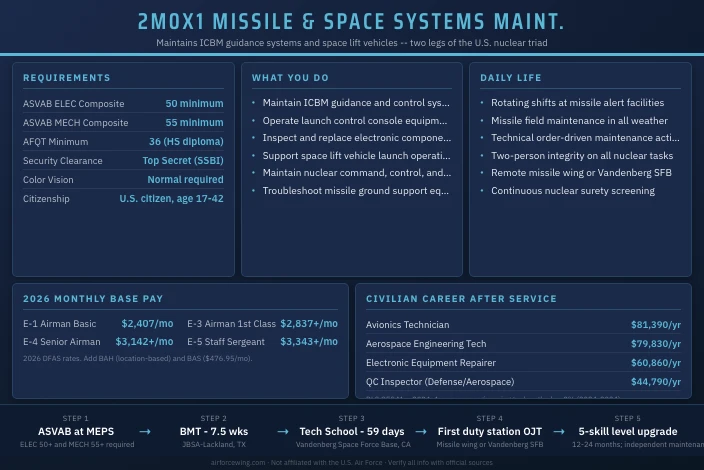
2M0X1 Missile and Space Systems Electronic Maintenance specialists maintain, operate, and supervise the upkeep of missiles, space lift boosters, payloads, guidance and control systems, and nuclear command, control, and communications systems. They are responsible for maintaining two legs of the United States’ nuclear triad and supporting space launch operations at Vandenberg Space Force Base, California.
What the Job Looks Like Day to Day
The work splits between missile alert facilities, missile equipment buildings, and launch facilities spread across remote missile fields. A typical day involves running scheduled maintenance on launch control equipment, replacing or recalibrating electronic components, reviewing technical orders before any task, and documenting every action in maintenance records. Shift work is standard at missile wings because the weapons stay on alert around the clock.
Core daily tasks include:
- Monitoring and operating console equipment in launch control facilities
- Inspecting, testing, and replacing guidance and control system components
- Coordinating launch operations checks with missile combat crews
- Troubleshooting electronic faults in missile ground support equipment
- Maintaining nuclear command, control, and communications systems
- Supporting space lift vehicle preparation and launch operations at space launch facilities
How This Role Fits the Bigger Picture
The Minuteman III is one of three legs of the U.S. nuclear triad, alongside submarine-launched ballistic missiles and nuclear-capable bombers. Twentieth Air Force operates three missile wings across Wyoming, Montana, and North Dakota, collectively responsible for hundreds of deployed ICBMs. Without working guidance systems and launch electronics, those missiles cannot perform their deterrence mission. Every 2M0X1 specialist touches systems that nation-state adversaries factor into their strategic calculations daily.
Equipment and Technology
The job centers on missile-specific electronics rather than general aircraft avionics. Specialists work with launch control consoles, guidance replacement units, inertial measurement systems, secure communications equipment, and ground support electronics. At space lift facilities, the work extends to booster stage instrumentation, payload integration electronics, and launch sequencing systems. The technology is sophisticated and constantly updated as aging Minuteman infrastructure is replaced under the Sentinel ICBM modernization program.
The Air Force is fielding the LGM-35A Sentinel as the Minuteman III replacement. 2M0X1 Airmen entering service now will likely work on both legacy Minuteman systems and the new Sentinel platform as the transition progresses through the 2030s.
Salary
Base Pay
Pay starts the moment you raise your right hand, before you reach your first duty station. The table below shows 2026 DFAS base pay for the enlisted grades most relevant to early-career 2M0X1 Airmen.
| Grade | Rank | Entry Pay | 4 Years | 8 Years |
|---|---|---|---|---|
| E-1 | Airman Basic (AB) | $2,407/mo | , | , |
| E-2 | Airman (Amn) | $2,698/mo | , | , |
| E-3 | Airman First Class (A1C) | $2,837/mo | $3,198/mo | , |
| E-4 | Senior Airman (SrA) | $3,142/mo | $3,659/mo | $3,816/mo |
| E-5 | Staff Sergeant (SSgt) | $3,343/mo | $3,947/mo | $4,299/mo |
| E-6 | Technical Sergeant (TSgt) | $3,401/mo | $4,069/mo | $4,613/mo |
Figures from the DFAS 2026 military pay tables.
Allowances
Base pay is the floor, not the ceiling. Most Airmen living off-base add Basic Allowance for Housing (BAH) and Basic Allowance for Subsistence (BAS) to their monthly income. BAH varies by duty location and dependency status, at an installation like Malmstrom AFB or F.E. Warren AFB, an E-4 without dependents receives a location-specific rate that covers most or all of a modest apartment’s rent. BAS for enlisted Airmen is $476.95 per month in 2026, a flat national rate that doesn’t vary by rank within the enlisted grades.
Special Duty Assignment Pay and other incentive pays may apply depending on assignment and additional duties, though specific amounts vary and should be verified with your recruiter or finance office.
Additional Benefits
Active-duty Airmen receive TRICARE Prime at no cost, covering medical, dental, vision, mental health, and prescriptions with zero enrollment fees, deductibles, or copays. Annual leave accrues at 2.5 days per month (30 days per year), with up to 60 days carryover.
The Post-9/11 GI Bill covers full in-state tuition at public universities after separation, plus a monthly housing allowance tied to the E-5 BAH rate at your school’s ZIP code and a book stipend of $1,000 per year. Private school tuition is capped at $29,920.95 per academic year. After six years of service, you can transfer unused GI Bill benefits to a spouse or dependent children.
Retirement under the Blended Retirement System (BRS) combines a 20-year pension worth 40% of your high-36 average basic pay with a government-matched Thrift Savings Plan contribution of up to 5% of basic pay. The TSP match begins after 60 days of service and vests at two years.
Qualifications
Minimum Requirements
| Requirement | Standard |
|---|---|
| Age | 17-42 at enlistment |
| Citizenship | U.S. citizen |
| Education | High school diploma or GED equivalent |
| AFQT minimum | 36 (HS diploma); 65 (GED) |
| ASVAB Electronics (ELEC) | 50 minimum |
| ASVAB Mechanical (MECH) | 55 minimum |
| Color vision | Normal required |
| Security clearance | Top Secret (SSBI) |
| Physical | No fear of heights; able to perform physically demanding tasks |
Data from the official 2M0X1 career page at airforce.com and AFI 36-2101.
The Top Secret clearance requires a Single Scope Background Investigation (SSBI), which involves a thorough review of your finances, foreign contacts, and personal history going back 10 years. Drug use, significant debt, or foreign family ties can delay or disqualify a clearance. Start cleaning up any financial issues before you apply.
ASVAB Composite Details
The Air Force ELEC composite is calculated from General Science (GS), Arithmetic Reasoning (AR), Mathematics Knowledge (MK), and Electronics Information (EI) subtests. A score of 50 is competitive but not extreme, solid performance across those four subtests gets you there. The MECH composite draws from General Science (GS), Auto/Shop (AS), Mathematics Knowledge (MK), and Mechanical Comprehension (MC). Scoring above the minimums strengthens your application, especially if your recruiter has limited slots available. If you need to raise either score, the Air Force ASVAB test prep guide breaks down both the electronics and mechanical sections before test day.
Application and Selection Process
Service Obligation and Entry Rank
Enlistees enter at E-1 (Airman Basic). Most standard enlistment contracts run four years for active duty, though six-year contracts are available and may carry a higher probability of assignment to your preferred specialty. The service obligation starts on your BMT ship date.
Waivers exist for some disqualifying factors, including minor prior drug use and certain medical conditions. Waiver approval is not guaranteed and depends on Air Force accession needs at the time of your application. Discuss specific circumstances with a recruiter.
Work Environment
Setting and Schedule
The work environment in 2M0X1 is unlike almost any other enlisted AFSC. Missile wings operate in remote locations, the missile fields at F.E. Warren AFB span parts of Wyoming, Colorado, and Nebraska; Malmstrom’s fields stretch across central Montana; Minot’s cover north-central North Dakota. Airmen work long stretches at missile alert facilities far from the main base, often in small teams with limited direct supervision.
Launch facility maintenance involves outdoor work in all weather. Montana winters are serious, and Wyoming wind is unrelenting. Equipment buildings and launch control facilities are climate-controlled, but getting to remote sites requires off-road driving across open terrain in any season.
Shift work is standard because the nuclear deterrence mission never pauses. Many 2M0X1 Airmen work rotating schedules with extended time at missile alert facilities followed by time off-duty back at the main base. At Vandenberg Space Force Base, the work environment shifts to a space launch campus with a more structured daytime schedule tied to launch windows.
Chain of Command and Performance Feedback
The chain of command in missile maintenance runs from the crew chief level up through the maintenance operations center to wing-level leadership. Performance is evaluated annually through the Enlisted Performance Report (EPR) system, with rater feedback on job proficiency, leadership, and adherence to standards. EPR ratings drive promotion eligibility and assignment quality, a marginal EPR can stall a promotion cycle, while a strong one opens doors for special assignments and leadership billets.
Team Dynamics
Most maintenance tasks require at least two Airmen due to nuclear security protocols and technical order requirements. Independent decision-making within your technical boundaries is expected, but no task on a nuclear system happens without a two-person team and proper documentation. The culture rewards methodical thinkers over improvisers.
Retention in missile maintenance tends to be solid. Airmen who thrive here cite the high-responsibility nature of the work, the tight-knit team environment at remote missile wings, and the technical depth that keeps the job intellectually engaging across a full career.
Training
Training Pipeline
| Phase | Location | Length | Focus |
|---|---|---|---|
| Basic Military Training (BMT) | JBSA-Lackland, TX | 7.5 weeks | Military discipline, fitness, Air Force core values |
| Technical School | Vandenberg Space Force Base, CA | 59 days | Electronics theory, missile systems, launch equipment, guidance systems |
| On-the-Job Training (OJT) | First duty station | 12-24 months | 5-skill level upgrade tasks, unit-specific systems |
Tech School in Detail
Technical training at Vandenberg Space Force Base covers the electronics foundation first, circuit theory, schematic reading, and test equipment, then transitions into missile-specific systems. Students learn how guidance and control units function, how launch control consoles operate, and how to apply technical orders to real maintenance tasks. The 59-day course awards credits toward an Electronic Systems Technology degree, which can accelerate a college program after separation.
Vandenberg is also a working space launch facility, so tech school takes place in the same environment where some graduates will eventually work. That context, seeing actual launch operations while you’re still in training, is an orientation most technical schools can’t match.
Advanced Training and Development
After reaching the 5-skill level (Senior Airman or Staff Sergeant), Airmen can pursue upgrade training for the 7-skill level, which qualifies them to supervise maintenance teams. The 7-skill level requires a CDC (Career Development Course) self-study program, a skills evaluation, and documented proficiency across the full task list.
The Air Force Community College program and tuition assistance (up to $4,500 per year) support degree completion while on active duty. The electronics and systems training from 2M0X1 pairs well with electrical engineering technology or systems engineering degree programs. Several Airmen in this field have used the SSBI and technical background to move into defense contractor roles or DoD civilian positions mid-career.
Everything starts with qualifying ASVAB scores. Our study guide covers what to study first.
Career Progression
Typical Career Path
| Skill Level | Rank Range | Time Frame | Role |
|---|---|---|---|
| 3-skill (Apprentice) | E-1 to E-4 | 0-4 years | Performs maintenance under supervision; completes OJT task list |
| 5-skill (Journeyman) | E-4 to E-6 | 4-8 years | Works independently; begins supervising junior Airmen |
| 7-skill (Craftsman) | E-6 to E-7 | 8-14 years | Leads maintenance teams; manages scheduling and technical oversight |
| 9-skill (Superintendent) | E-8 to E-9 | 14+ years | Manages the career field at the unit level; advises commanders |
Promotion and Specialization
Promotion from E-1 through E-3 is time-based and largely automatic for Airmen in good standing. E-4 (Senior Airman) promotion considers time-in-grade plus a weighted score from EPRs, fitness assessments, and education. E-5 and above enter a competitive promotion board system where stratification on your EPR, how your supervisor ranks you against peers, drives outcomes.
Specialization options within 2M0X1 include assignment to space launch facilities at Vandenberg SFB, nuclear command and control systems maintenance, and test and evaluation units that support ICBM development programs. Some Airmen pursue the Special Experience Identifier (SEI) system to document unique expertise in specific missile or space systems.
The Sentinel ICBM modernization program will create demand for experienced 2M0X1 Airmen through the 2030s. Those who stay in the field can expect continued relevance as the Air Force replaces Minuteman III hardware with next-generation systems.
Retraining and Lateral Moves
Retraining into or out of 2M0X1 is possible after completing the initial service commitment, subject to Air Force manning requirements. The electronics background transfers well into other technical AFSCs if career interests shift. Requests go through the base education and training office and require commander endorsement.
Physical Demands
Daily Physical Requirements
The job is physically demanding in ways that aren’t always obvious from the job title. Missile field maintenance requires carrying test equipment and tools across uneven terrain in variable weather, climbing in and out of equipment buildings and launch facilities, and working in confined spaces. Some components require overhead work or awkward positions. Cold-weather gear at northern missile wings adds bulk and weight that affects how you move. The work is not sedentary.
No fear of heights is a listed requirement because launch facilities involve ladders and elevated work platforms. Physical conditioning beyond the minimum fitness standards makes the job easier and reduces injury risk.
Air Force Fitness Assessment
All Airmen, regardless of AFSC, must pass the Air Force Fitness Assessment annually. The FA uses a 100-point scale with a minimum composite passing score of 75 points. Each component also carries its own minimum standard that must be met independently.
| Component | Points Available | Notes |
|---|---|---|
| 1.5-Mile Run | 60 | Primary aerobic measure |
| Waist Circumference / Body Composition | 20 | Age- and gender-normed |
| Push-Ups (1 minute) | 10 | |
| Sit-Ups (1 minute) | 10 |
Standards are age- and gender-normed. A failing FA score triggers mandatory fitness improvement programs and can affect promotion eligibility. Verify current scoring tables at af.mil.
Medical Standards
A standard MEPS physical determines medical qualification for enlistment. Ongoing medical fitness is evaluated through periodic assessments. Personnel Reliability Program (PRP) requirements may apply to 2M0X1 Airmen assigned to nuclear duties. PRP requires continuous fitness-for-duty screening, including psychological and conduct evaluations, throughout your assignment.
Deployment
Duty Station Assignments
Most 2M0X1 Airmen spend the majority of their career at one of the three Minuteman III missile wings or at Vandenberg Space Force Base:
- F.E. Warren AFB, Wyoming: 90th Missile Wing; roughly 150 ICBMs across Wyoming, Colorado, and Nebraska
- Malmstrom AFB, Montana: 341st Missile Wing; central Montana missile fields
- Minot AFB, North Dakota: 91st Missile Wing; largest ICBM wing by warhead count
- Vandenberg Space Force Base, California: space launch and test and evaluation missions
These are relatively remote installations. Great Falls, Montana (near Malmstrom) and Minot, North Dakota are small cities. Cheyenne, Wyoming (near F.E. Warren) and Lompoc/Santa Maria, California (near Vandenberg) offer somewhat more urban amenities. Assignment preferences can be submitted, but the Air Force fills needs based on manning requirements.
Deployment Patterns
2M0X1 is not a high-deployment AFSC in the traditional sense. The ICBM mission is fixed-location by nature, the missiles don’t move and neither does the maintenance workforce, for the most part. Short-term temporary duties (TDYs) for training exercises, test launches at Vandenberg, or support to other units are common. Extended combat deployments are less frequent than in many other AFSCs, though the Air Force retains the authority to deploy any Airman as mission needs dictate.
Airmen assigned to Vandenberg space lift missions experience a different operational tempo, tied to launch schedules and contract requirements with the Space Force.
Risk/Safety
Job Hazards
Working around nuclear weapons and missile systems involves real hazards that the Air Force manages through rigorous protocols. Propellant and oxidizer chemicals associated with missile systems are toxic and require proper protective equipment. Electrical systems in launch facilities carry high-voltage hazards. Work in confined launch facility spaces creates engulfment and atmosphere risks that require atmospheric testing before entry.
The radiation environment near nuclear components requires periodic dosimetry monitoring. Maintenance actions on certain systems require personal protective equipment and strict adherence to technical order procedures.
Safety Protocols
The nuclear enterprise operates under some of the most tightly controlled safety protocols in any industry. Every maintenance action follows a published technical order, and deviation is not tolerated. Two-person integrity (TPI) rules require that no single individual ever has unsupervised access to nuclear weapons or components. Safety violations carry severe professional consequences.
The Air Force uses a formal mishap prevention and reporting system, and 2M0X1 Airmen receive nuclear safety training as part of both tech school and unit orientation.
Security Clearance and Legal Obligations
The Top Secret clearance granted through the SSBI process carries ongoing obligations. You must report foreign contacts, foreign travel, significant changes in personal finances, and any arrests or legal issues to your security manager. Failing to report a required event can result in clearance revocation, and without a clearance, you cannot perform the job.
Nuclear weapons handling also falls under specific legal authorities including the Atomic Energy Act and Air Force nuclear surety directives. Violations of nuclear surety rules are career-ending and can carry criminal penalties. That standard sounds daunting, but in practice it reinforces the methodical culture of the career field.
Impact on Family
What Missile Wing Life Looks Like
The remote locations of ICBM missile wings are the most significant lifestyle factor for families. Malmstrom, Minot, and F.E. Warren are all in states with harsh winters, limited commercial infrastructure, and small surrounding communities. Some families find the close-knit base community appealing, on-base amenities, stable schools, and a tight support network offset the geographic isolation. Others struggle with the distance from major cities or the weather.
The rotating shift schedules and extended time at missile alert facilities mean Airmen are away from home regularly, even without deploying overseas. A typical 24-hour alert tour at a missile alert facility means one overnight away from home per rotation. Families who enter this lifestyle aware of that pattern tend to adapt better than those who don’t expect it.
Support Resources
Military OneSource, Air Force Family Support Centers, and chaplaincy services are available at all three missile wing installations. Base housing options exist at each installation, and off-base communities are generally affordable relative to coastal Air Force bases. Base schools and military childcare are present, though capacity can be limited at smaller wings.
Vandenberg Space Force Base, by contrast, is in coastal California with access to urban amenities and a larger surrounding population. Assignment there typically means a higher cost of living offset by higher BAH rates.
Reserve and Air National Guard
Component Availability
The 2M0X1 AFSC is available in both the Air Force Reserve and the Air National Guard. Reserve and Guard Airmen in this career field may be assigned to missile wing support units, space launch operations, or test and evaluation support depending on the unit’s mission and location.
Drill Commitment and Training
Standard Reserve and Guard commitment is one weekend per month (Unit Training Assembly) plus two weeks per year (Annual Tour). 2M0X1 Airmen in nuclear-assigned units may face additional training days, annual recertification requirements, and readiness exercises beyond the standard weekend schedule. Nuclear duty qualifications require currency, you can’t let skills lapse and expect to remain mission-qualified.
Part-Time Pay and Benefits
An E-4 with two to four years of service earns approximately $3,303 to $3,659 per month on active duty. A drill weekend pays four days of base pay at your grade, roughly $441 to $488 per drill weekend at those rates, before taxes. The comparison favors active duty significantly in total compensation, but Reserve and Guard service layers military income on top of a civilian career.
| Feature | Active Duty | Air Force Reserve | Air National Guard |
|---|---|---|---|
| Commitment | Full-time | 1 wknd/mo + 2 wks/yr | 1 wknd/mo + 2 wks/yr |
| E-4 monthly pay | $3,142-$3,816/mo | ~$441-$488/drill weekend | ~$441-$488/drill weekend |
| Healthcare | TRICARE Prime (free) | TRICARE Reserve Select (premiums apply) | TRICARE Reserve Select or state plan |
| Education | Federal TA + Post-9/11 GI Bill | Federal TA; GI Bill after qualifying service | Federal TA; state tuition waivers (varies by state) |
| Deployment tempo | Moderate (TDY-heavy) | Lower; varies by mobilization | Lower; varies by mobilization |
| Retirement | 20-year pension (BRS) | Points-based reserve retirement | Points-based reserve retirement |
TRICARE Reserve Select requires member-paid premiums but provides broad coverage. The Air National Guard offers state-specific tuition assistance programs that can eliminate tuition costs at in-state public universities, check your state’s Guard benefit program for current rates.
Reserve retirement uses a points system rather than a 20-year pension. Points accumulate through drill weekends, annual tours, and any active service. You must earn a minimum of 50 qualifying points per year to count that year toward retirement, and you must serve at least 20 qualifying years to draw a reserve pension. Benefits begin at age 60, reduced for qualifying active service.
Civilian Career Integration
The SSBI clearance and missile systems background pair well with defense contractor positions supporting ICBM test programs, space launch operations, and government electronics maintenance. Employers with large Defense Department contracts actively recruit Airmen with active Top Secret clearances and nuclear systems experience. USERRA protects civilian employment during military mobilizations, requiring employers to hold jobs and benefits for Airmen called to active duty.
Post-Service
Civilian Career Pathways
The electronics competence and Top Secret clearance from 2M0X1 service open civilian job markets that are largely inaccessible to candidates without that background. Defense contractors supporting Northrop Grumman’s Sentinel ICBM program, Boeing’s space systems division, and United Launch Alliance’s launch operations actively recruit veterans with missile and space electronics experience.
An active Top Secret clearance alone can add $10,000 to $20,000 per year to civilian salary offers in defense-adjacent industries compared to equivalent roles without cleared access.
| Civilian Job Title | Median Annual Wage | Outlook (2024-2034) |
|---|---|---|
| Avionics Technician | $81,390 | +6% |
| Aerospace Engineering and Operations Technician | $79,830 | +8% (faster than average) |
| Electronic Equipment Installer and Repairer | $60,860 | Stable |
| Quality Control Inspector (Defense/Aerospace) | $44,790 | Stable |
Wage data from the BLS Occupational Outlook Handbook and BLS OES May 2024 figures.
Transition Assistance
The Air Force Transition Assistance Program (TAP) runs at every installation and includes resume writing, interview preparation, and federal job application support. Hiring Our Heroes events on base connect separating Airmen with defense and commercial employers. The skills learned in 2M0X1 translate directly into O*NET occupation code 17-3021 for Aerospace Engineering and Operations Technologists.
A DD-214 with a nuclear systems maintenance background and a Top Secret clearance is a document that opens doors. Treat it accordingly.
Is This a Good Job
Who Does Well in 2M0X1
The career attracts a specific type of person. The Airmen who stay, and thrive, tend to be:
- Detail-oriented by nature. Following a 40-step technical order precisely isn’t tedious to them; it’s satisfying.
- Comfortable with remote settings. Montana winters and Wyoming plains don’t bother them.
- Technically curious. They want to understand why a system works, not just how to swap parts.
- Drawn to high-stakes responsibility. Knowing the systems they maintain carry strategic deterrence weight motivates them rather than weighing on them.
The ELEC 50 requirement filters out applicants who don’t have a genuine aptitude for electronics. If you scraped the minimum on every subtest, reconsider, the technical order content in tech school and OJT assumes you can absorb electronics concepts quickly.
Who Should Think Twice
The lifestyle realities are genuine obstacles for some people. Long periods away at missile alert facilities affect family life in ways that differ from typical deployments, the absences are shorter but more frequent and less predictable than a six-month overseas rotation. Remote base locations without major metropolitan areas nearby aren’t for everyone.
The nuclear surety requirements are also demanding in a way that goes beyond job performance. You’re subject to continuous reliability screening. A financial crisis, a legal issue, or a family member’s foreign travel can trigger a security review. That’s not a theoretical risk, it happens, and it’s career-disruptive when it does.
Career Alignment
If you want a technical career with genuine strategic relevance, clear civilian hiring value, and a tightly controlled professional environment, 2M0X1 delivers on all three. If you want high deployment frequency, an urban base lifestyle, or a job that translates to a broad commercial market, other AFSCs are a better fit. The people who find this career most rewarding tend to stay in it for a full 20 years, the retention profile reflects that.
More Information
Talk to an Air Force recruiter about current 2M0X1 accession slots, bonus availability, and assignment preferences. Bring your ASVAB score report to the conversation, knowing your current ELEC and MECH composites before the meeting lets you skip the preliminary questions and focus on whether the job is available for your ship date. The official career overview lives at airforce.com under Science and Technology, and AFPC posts current enlisted accession priorities.
- Prepare for the ASVAB with our study guide to make sure your line scores qualify
This site is not affiliated with the U.S. Air Force or any government agency. Verify all information with official Air Force sources before making enlistment or career decisions.
Explore more Air Force Munitions and Weapons careers to see how this AFSC fits alongside other specialties in the nuclear and conventional weapons enterprise.