4T0X1 Medical Laboratory Specialist
Most people think diagnosis starts when the doctor walks into the exam room. It actually starts in the lab. The 4T0X1 Medical Laboratory Specialist runs the blood work, urinalysis, microbiology cultures, and blood bank testing that tells physicians what’s happening inside a patient.
Without accurate lab results, treatment decisions are guesses. In the Air Force, Medical Laboratory Specialists work in military treatment facilities worldwide, deploy in support of combat operations, and graduate with credentials that open doors in one of the most stable civilian job markets in healthcare. The ASVAB bar is higher than most medical AFSCs, the Air Force wants people who can handle technical science in a clinical environment.
Qualifying requires specific ASVAB line scores. Our ASVAB study guide covers what to target and how to prepare.
Job Role
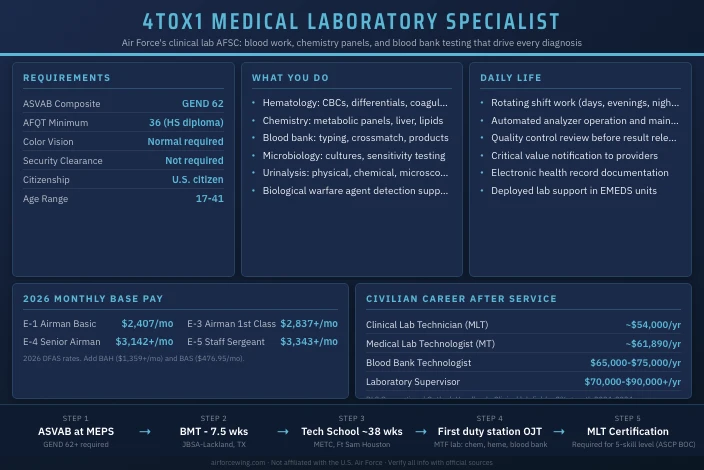
The 4T0X1 Medical Laboratory Specialist performs chemical, microbiological, immunological, hematological, and blood bank analyses on patient specimens. Lab specialists operate and maintain diagnostic equipment, document results in electronic health records, apply quality control procedures, and help detect biological agents with potential use in warfare. Their test results directly inform physician diagnoses across every department of a military treatment facility.
Daily Tasks
Lab work is methodical and fast-paced at the same time. On any given shift, a 4T0X1 might process dozens of complete blood counts, run chemistry panels to screen for kidney or liver dysfunction, and prepare blood products for a patient heading into surgery. Work includes:
- Collecting and processing blood, urine, and tissue specimens
- Operating automated analyzers for hematology and chemistry panels
- Performing urinalysis, coagulation studies, and microbiology cultures
- Conducting compatibility testing and issuing blood products from the blood bank
- Identifying and reporting abnormal results to clinical staff
- Calibrating equipment and applying daily quality control protocols
- Maintaining laboratory safety and biohazard containment procedures
Specialization Codes
The 4T0X1 career field uses shredout suffixes to denote specialized assignments at higher skill levels.
| Code | Specialization |
|---|---|
| 4T0X1 | Core laboratory operations (hematology, chemistry, blood bank, microbiology) |
| 4T0X1A | Blood Transshipment Center operations |
Special Experience Identifiers (SEIs) may be awarded for specific skills such as automated instrumentation maintenance or laboratory management. The GEND 62 ASVAB requirement means preparation matters, an ASVAB study guide targeting the General composite can make the difference at MEPS.
Mission Contribution
Every clinical decision the Air Force makes, from clearing a pilot for flight duty to diagnosing a deployed Airman with a tropical infection, depends on laboratory data. Medical Laboratory Specialists are the people who produce that data. They also support force health protection by identifying infectious disease outbreaks and screening for exposure to biological threats. In deployed settings, lab capability directly affects how quickly medical teams can triage and treat mass casualty events.
Technology and Equipment
4T0X1 Airmen work with sophisticated automated platforms rather than manual benchtop methods. Standard equipment includes:
- Automated hematology analyzers (cell counters, differentials)
- Chemistry and immunoassay analyzers
- Automated blood bank systems and refrigerated storage units
- Microscopes for manual differential counts and urinalysis sediment review
- Microbiology culture incubators and identification systems
- Laboratory information systems integrated with the electronic health record
Salary
Pay starts at enlistment and grows with every promotion. Base pay is the floor, housing and food allowances add significantly to total compensation.
Base Pay Table
| Rank | Grade | Monthly Base Pay (2026) |
|---|---|---|
| Airman Basic | E-1 | $2,407 |
| Airman | E-2 | $2,698 |
| Airman First Class | A1C (E-3) | $2,837, $3,198 |
| Senior Airman | SrA (E-4) | $3,142, $3,816 |
| Staff Sergeant | SSgt (E-5) | $3,343, $4,422 |
| Technical Sergeant | TSgt (E-6) | $3,401, $5,044 |
| Master Sergeant | MSgt (E-7) | $3,932, $5,537 |
DFAS 2026 pay tables. Ranges reflect years of service within grade.
Allowances
Base pay doesn’t include housing or food allowances, which are tax-free and add meaningfully to take-home pay.
Basic Allowance for Housing (BAH): Tax-free monthly housing allowance. Varies by duty location, pay grade, and dependent status. An E-4 at Joint Base San Antonio earns roughly $1,359/month without dependents or $1,728/month with dependents. Rates at higher-cost installations are significantly higher.
Basic Allowance for Subsistence (BAS): A flat $476.95/month for all enlisted Airmen regardless of rank or location.
Additional Benefits
The Air Force provides a package beyond base pay and allowances:
- Healthcare: TRICARE Prime at no cost for active-duty members. Zero enrollment fee, zero deductible, zero copays. Coverage includes medical, dental, vision, mental health, and prescriptions.
- Retirement: The Blended Retirement System combines a pension (40% of high-36 average basic pay at 20 years) with government TSP contributions matching up to 4% of base pay.
- Education: Tuition Assistance covers up to $4,500 per year toward college courses while serving. The Post-9/11 GI Bill covers full in-state tuition plus a monthly housing allowance and book stipend after separation.
- Leave: 30 days of paid leave per year.
Qualifications
The ASVAB requirement for 4T0X1 is one of the higher thresholds in the medical career field, reflecting the technical science background the job demands. Plan accordingly before you test. A focused PICAT study program can also help you lock in your score before the official ASVAB at MEPS.
Qualifications Table
| Requirement | Standard |
|---|---|
| ASVAB Composite | GEND 62 (General composite) |
| AFQT Minimum | 36 (high school diploma); 65 (GED) |
| Color Vision | Normal color vision required |
| Citizenship | U.S. citizen |
| Age | 17 to 41 at time of enlistment |
| Education | High school diploma or equivalent |
| Security Clearance | None required |
| Physical Profile | Normal medical accession standards |
Requirements confirmed at airforce.com and AFI 36-2101.
ASVAB General Composite
The Air Force General (GEND) composite combines Word Knowledge, Paragraph Comprehension, Arithmetic Reasoning, and Mathematics Knowledge subtests. A score of 62 is competitive relative to the enlisted average. If you’re close but not there yet, focused study on reading comprehension and arithmetic will move the needle fastest.
Application Process
The path from interest to enlistment follows these steps:
- Contact a recruiter: An Air Force recruiter confirms your eligibility and runs a pre-screen.
- ASVAB testing at MEPS: You take the ASVAB at a Military Entrance Processing Station. You need GEND 62 or higher to qualify for 4T0X1.
- Medical examination: MEPS conducts a full physical. Normal color vision is verified at this stage.
- Background check: A basic suitability review for enlistment.
- Job selection and contract: If you qualify and a seat is available, you select 4T0X1 and sign your contract.
- Ship to BMT: You depart for Basic Military Training at JBSA-Lackland, TX.
The full process from initial contact to shipping date typically runs one to three months depending on seat availability and medical processing time.
Selection Competitiveness
4T0X1 is not among the most competitive AFSCs to obtain, but the GEND 62 score screens out a meaningful portion of applicants. Color vision disqualification is the other common gate. There’s no prerequisite lab experience required, the Air Force trains you from scratch at Tech School.
Service Obligation
Standard enlistment contracts are four years active duty. The technical training pipeline for 4T0X1 is long (over nine months at Tech School), which means the Air Force will want you to stay and apply those skills. Some recruits enter under six-year contracts in exchange for bonuses or preferred assignment locations. Verify current bonus availability with your recruiter, special duty bonuses change periodically.
Enlistees enter service at E-1 (Airman Basic) unless they qualify for advanced pay grade through college credits, JROTC service, or recruiter-specific incentive programs.
Work Environment
Setting and Schedule
4T0X1 Airmen work primarily in military treatment facility laboratories, the same clinical space shared with registered medical technologists, pathologists, and laboratory officers. The physical environment is controlled, climate-regulated, and equipment-dense. Labs run 24 hours a day because patient care doesn’t stop overnight. Most assignments involve rotating shifts covering days, evenings, and nights on a recurring schedule. Weekend and holiday coverage is expected at many facilities.
Deployed labs operate in smaller, expeditionary configurations. The equipment is less automated and the specimen volume is lower, but the diagnostic demand is just as urgent. You may process critical specimens with no pathologist on site and a physician waiting for results to make a treatment call.
Leadership and Communication
New 3-skill level Airmen work under direct supervision from senior technicians and NCOs. As you build competency and earn your 5-skill level certification, you move to independent bench operation within established protocols. Technical Sergeants and Master Sergeants run laboratory sections, manage quality assurance programs, and interface with the medical staff. Results are communicated directly through the electronic health record, with critical values requiring immediate verbal notification to the ordering provider.
Performance feedback follows the Air Force Enlisted Performance Report (EPR) system. You receive an annual EPR rating that drives promotion and assignment decisions. Lab specialists who earn the MLT certification, maintain a clean quality record, and take on additional duties position themselves well for senior rater top block marks.
Team Dynamics and Autonomy
Laboratories run on protocols and verification checks, so autonomy comes with guardrails. Early in your career, every reportable result goes through a second check. As your skill level increases, you gain authority to verify and release results independently within your assigned sections. The team is typically small, a military treatment facility lab may have a dozen people covering all sections, so you rotate through chemistry, hematology, blood bank, and microbiology rather than staying in one area all day.
Job Satisfaction
Lab work appeals to people who prefer behind-the-scenes technical precision over direct patient interaction. You rarely work bedside, but every result you produce affects a patient directly. The job has a low physical demand profile compared to most healthcare AFSCs, and the skill set transfers cleanly to civilian employment. Retention in the medical laboratory career field tends to be solid among Airmen who discover they enjoy the analytical, process-oriented nature of the work.
Training
Training Pipeline Table
| Phase | Location | Duration | Focus |
|---|---|---|---|
| Basic Military Training (BMT) | JBSA-Lackland, TX | 7.5 weeks | Military customs, physical fitness, discipline |
| Technical School | METC, JBSA-Fort Sam Houston, TX | ~268 days (~38 weeks) | Laboratory science, clinical procedures, instrumentation |
| On-the-Job Training (OJT) | First duty station | Ongoing until 5-skill level | Applied lab practice, unit-specific systems |
Training length confirmed at airforce.com and the 4T0X1 CFETP.
Initial Training
BMT at Lackland lasts 7.5 weeks. It covers Air Force customs and courtesies, drill and ceremonies, weapons qualification, and physical fitness standards. You won’t do any lab work at BMT, it’s entirely military orientation.
Tech School at the Medical Education and Training Campus (METC) at Fort Sam Houston runs roughly 268 days. That’s nearly nine months of focused laboratory science curriculum. The program covers all major lab disciplines:
- Hematology: Blood cell counting, manual differentials, coagulation testing
- Urinalysis: Physical, chemical, and microscopic examination
- Clinical chemistry: Metabolic panels, liver function, lipid profiles, therapeutic drug monitoring
- Microbiology: Culture identification, antibiotic susceptibility testing, parasitology
- Blood bank (immunohematology): ABO/Rh typing, crossmatch, antibody identification, blood product preparation
- Immunology and serology: Infectious disease testing, rapid antigen screens
METC is the largest military medical training campus in the world, running programs for all branches. 4T0X1 students graduate with credits applicable to a Community College of the Air Force (CCAF) degree in Medical Laboratory Technology.
Advanced Training
Once you’re at your first duty station, OJT continues under a Career Field Education and Training Plan (CFETP) task list. You must complete all core tasks and demonstrate proficiency before the 5-skill level is awarded. Earning the 5-skill level also requires national MLT (Medical Laboratory Technician) certification from the American Society for Clinical Pathology (ASCP) Board of Certification or equivalent. This is a mandatory requirement, not optional.
Opportunities for further development include:
- CCAF degree in Medical Laboratory Technology (credits from Tech School count toward the degree)
- MT (Medical Technologist) certification for Airmen who complete a bachelor’s degree program
- Noncommissioned Officer Professional Military Education (Airman Leadership School, NCO Academy) for career advancement
- Clinical laboratory officer commission pathways for Airmen interested in transitioning to officer status
Everything starts with qualifying ASVAB scores. Our study guide covers what to study first.
Career Progression
Progression Table
| Skill Level | Rank | Typical Timeframe | Key Milestones |
|---|---|---|---|
| 3-Skill Level (Apprentice) | A1C, SrA (E-3 to E-4) | 0 to ~2 years | Complete Tech School, start OJT task sign-offs |
| 5-Skill Level (Journeyman) | SrA, SSgt (E-4 to E-5) | ~2 to 5 years | Complete OJT tasks, earn MLT certification |
| 7-Skill Level (Craftsman) | SSgt, TSgt (E-5 to E-6) | ~6 to 10 years | SNCO leadership roles, section management |
| 9-Skill Level (Superintendent) | MSgt, CMSgt (E-7 to E-9) | 15+ years | Laboratory superintendent, clinical leadership |
Promotion to Staff Sergeant and above is competitive and based on EPR scores, time in service, test scores, and performance. MLT certification is required for promotion consideration at the 5-level and above.
Specialization and Role Flexibility
After reaching the 5-skill level, Airmen can apply for special assignments:
- Blood Transshipment Center (BTC) duty: managing large-scale blood product logistics at hub installations
- AFSC retraining into clinical laboratory officer programs (4T071 management track) or adjacent medical AFSCs
- Laboratory NCO leadership billets at major medical centers such as Wilford Hall Ambulatory Surgical Center (JBSA) or Tripler Army Medical Center
Retraining to a different AFSC requires Air Force approval, is subject to needs of the force, and typically opens up after the first enlistment term.
Performance Evaluation
The EPR system rates Airmen on a five-tier scale. Key factors for lab Airmen include technical proficiency, quality assurance results, MLT certification status, additional duties performance, and leadership contributions. Top block EPRs are required for promotion in the competitive SSgt and TSgt zones. Airmen who volunteer for additional duties, mentor junior Airmen, and pursue CCAF degrees tend to score higher on the factors that drive stratification.
Physical Demands
Daily Physical Demands
The 4T0X1 is one of the less physically demanding AFSCs on a daily basis. Lab work involves:
- Standing for extended periods at bench stations
- Fine motor control for specimen handling, pipetting, and microscope use
- Lifting and transporting specimen containers and supply deliveries (typically under 40 lbs)
- Wearing personal protective equipment including gloves, gowns, and eye protection throughout shifts
There’s no requirement for heavy lifting, running to incidents, or operating in extreme outdoor environments during normal lab operations. Deployed settings may require more physical adaptability.
Air Force Fitness Assessment
All Airmen, regardless of AFSC, must pass the Air Force Fitness Assessment annually. The assessment is the same for every enlisted Airman; it does not vary by job. Standards are age- and gender-normed.
| Component | Max Points |
|---|---|
| 1.5-Mile Run | 60 |
| Waist Circumference | 20 |
| Push-Ups (1 minute) | 10 |
| Sit-Ups (1 minute) | 10 |
| Total | 100 |
Minimum passing composite score is 75 out of 100. Each component also has a separate minimum threshold that must be met regardless of total score.
Medical Evaluations
Beyond the initial MEPS physical, active-duty Airmen undergo periodic health assessments throughout their career. Lab personnel may be subject to occupational health monitoring given potential exposure to bloodborne pathogens and chemical reagents. Standard Air Force occupational health programs include bloodborne pathogen training and Hepatitis B vaccination series for healthcare workers.
Deployment
Deployment Details
4T0X1 Airmen deploy in support of combat and contingency operations. Laboratory capability is embedded in Air Force Expeditionary Medical Support (EMEDS) packages that deploy to austere locations. Typical deployment lengths run 90 to 120 days on a rotation cycle, though this varies by theater and mission requirements. Deployments can be to locations in the Middle East, Europe, the Pacific, or wherever Air Force medical support is needed.
Deployment frequency depends on your unit and current operational tempo. Airmen assigned to EMEDS-aligned units may deploy more frequently than those at large fixed-facility medical centers. Most 4T0X1 Airmen can expect at least one deployment during a four-year enlistment.
Duty Station Options
Medical Laboratory Specialists serve at Air Force installations with military treatment facilities (MTFs) worldwide. Major assignment locations include:
- Joint Base San Antonio, TX (large MTF and training environment)
- Wright-Patterson AFB, OH
- Langley AFB, VA (now Joint Base Langley-Eustis)
- Travis AFB, CA
- Ramstein AB, Germany
- Kadena AB, Japan
- Hickam AFB, HI (Joint Base Pearl Harbor-Hickam)
Assignments are based on Air Force needs, your preferences submitted through the Assignment Management System, and available vacancies. Overseas tours are typically two to three years; CONUS tours are three years.
Risk/Safety
Job Hazards
Laboratory work involves regular contact with human blood, body fluids, and tissue specimens that may carry infectious pathogens including HIV, Hepatitis B and C, and various bacterial and viral agents. Chemical reagents used in analyzers and staining procedures can be hazardous with improper handling. Radiation exposure is minimal in most lab environments but present in some specialized applications.
Safety Protocols
Air Force laboratories operate under strict biosafety and infection control standards aligned with CDC guidelines and College of American Pathologists (CAP) accreditation requirements at larger facilities. Standard protections include:
- Mandatory PPE (gloves, eye protection, lab coats) for all specimen handling
- Engineered sharps containers and needlestick prevention devices
- Laminar flow hoods for microbiology work with aerosolization risk
- Chemical hygiene plans for all reagent storage and disposal
- Hepatitis B vaccination and post-exposure protocols
Security and Legal Requirements
No security clearance is required for standard 4T0X1 duties. Airmen handling patient data are subject to HIPAA privacy requirements and Air Force medical records regulations. Standard military legal obligations apply: you’re bound by the Uniform Code of Military Justice (UCMJ) and your enlistment contract for the duration of your service commitment.
Laboratory results carry legal weight in patient care decisions. Releasing inaccurate results or bypassing quality control steps is a serious violation of both clinical standards and military regulations. The Air Force takes laboratory quality assurance failures seriously at the individual technician level.
Impact on Family
Family Considerations
The rotating shift schedule is the biggest daily adjustment for families. Days, evenings, and nights rotate on a regular cycle, which affects meal times, childcare, and household routines. The work itself stays at the lab, unlike some operational AFSCs, 4T0X1 Airmen rarely have duty that bleeds into personal time outside of scheduled shifts, except for on-call assignments at some facilities.
Deployment separations are the harder challenge. The Air Force maintains family support services through Military OneSource, installation family support centers, and the Airman and Family Readiness Center on every base. Spouses can access the same TRICARE coverage and commissary/exchange benefits as the active-duty member.
The shift rotation is worth planning around concretely before you report to your first duty assignment. A typical rotating schedule cycles through day, evening, and night shifts over a four- to six-week block. When the Airman is on night shift, family dinners, school pickup, and evening activities all shift, the person who handles them has to change too. Families who build flexible household routines from the beginning adapt faster than those who try to maintain a standard schedule that the shift work keeps disrupting.
Childcare is one of the more immediate practical challenges. Night shift and weekend coverage requirements mean on-base Child Development Centers, which typically operate during business hours, may not match the Airman’s schedule during certain shift rotations. Off-base childcare options and family support networks from other military families become important. The Air Force’s fee assistance program for off-base childcare is available to active-duty families and can offset the higher cost of extended-hours civilian providers.
Laboratory work does not typically carry the same emotional burden as behavioral health or emergency medicine, but sustained exposure to bloodborne pathogens, patient specimens, and the occasional code-level critical result does create low-grade occupational stress that some Airmen notice over time. This is manageable and normal, but worth acknowledging.
Spouses with healthcare backgrounds often find the labor market near Air Force installations reasonably strong. Hospitals, clinics, and reference laboratories around military communities hire civilian healthcare workers regularly, and spouses with certifications in lab technology, nursing, or pharmacy are frequently able to find work within commuting distance of the installation.
Relocation and Flexibility
Permanent Change of Station (PCS) moves happen roughly every three years. The Air Force pays for household goods shipment and provides a PCS allowance. Lab work is available at virtually every military treatment facility worldwide, so the skills travel well regardless of where you’re assigned. Spouses with civilian lab certifications or healthcare licenses can often find employment near Air Force installations given the civilian healthcare demand around military communities.
Reserve and Air National Guard
The 4T0X1 AFSC is available in both the Air Force Reserve (AFRC) and the Air National Guard (ANG). Reserve and Guard labs support their home-station MTFs and mobilize in support of contingency operations.
Commitment and Drill Schedule
Standard Reserve and Guard commitment is one weekend per month (Unit Training Assembly, or UTA) plus two weeks of Annual Tour. The lab-specific requirement is that Reserve and Guard Airmen must maintain their MLT certification to operate independently, which means keeping up with continuing education credits between drill weekends.
Some laboratory assignments require additional training days for annual competency assessments or equipment recertification beyond the standard UTA schedule.
Part-Time Pay
An E-4 Senior Airman in the Reserve or Guard earns four days of base pay per drill weekend (two UTAs per weekend). At the 2026 E-4 base pay rate, that’s roughly $419 to $489 per drill weekend depending on years of service. Annual two-week training adds an additional two weeks of full daily pay.
Active Duty vs. Reserve/Guard Comparison
| Factor | Active Duty | Air Force Reserve | Air National Guard |
|---|---|---|---|
| Commitment | Full-time | 1 weekend/month + 2 weeks/year | 1 weekend/month + 2 weeks/year |
| Monthly Pay (E-4) | $3,142, $3,816/month | ~$419, $489/drill weekend | ~$419, $489/drill weekend |
| Healthcare | TRICARE Prime (free) | TRICARE Reserve Select (premiums apply) | TRICARE Reserve Select (premiums apply) |
| Education Benefits | Tuition Assistance ($4,500/year) | Federal TA available on drill status | State tuition waivers vary by state |
| GI Bill | Full Post-9/11 GI Bill eligibility | Partial (depends on activation days) | Partial (depends on activation days) |
| Retirement | 20-year pension (high-36, BRS) | Points-based reserve retirement at age 60 | Points-based reserve retirement at age 60 |
| Deployment Tempo | Higher; scheduled rotations | Lower; mobilization-based | Lower; mobilization-based |
Civilian Career Integration
The Guard and Reserve are well-suited to 4T0X1 Airmen working full-time in civilian hospital or clinical labs. The skills are identical, the MLT certification covers both worlds, and drill weekends don’t typically conflict with civilian employment. USERRA protects your civilian job during mobilization periods, and most healthcare employers are familiar with military lab technician credentials.
Post-Service
Military laboratory training is one of the most direct credential-to-career paths available to enlisted Airmen. The MLT certification you earn in service is recognized by civilian employers nationwide with no gap training required.
Civilian Career Prospects
| Civilian Title | Median Annual Salary | Job Outlook (2024-2034) |
|---|---|---|
| Clinical Laboratory Technician | ~$54,000/yr | +2% (stable) |
| Medical Laboratory Technologist (MT) | ~$61,890/yr | +2% (stable) |
| Blood Bank Technologist | ~$65,000, $75,000/yr | Stable demand |
| Laboratory Supervisor | $70,000, $90,000+/yr | Stable; leadership premium |
| Public Health Laboratory Scientist | ~$60,000, $80,000/yr | Growing; government and hospital settings |
BLS Occupational Outlook Handbook figures. Salary varies by location, experience, and employer type.
Transition Support
The Air Force Transition Assistance Program (TAP) helps separating Airmen prepare resumes, practice interviews, and connect with civilian employers. Airmen leaving 4T0X1 with an active MLT certification can apply immediately to hospital, clinical, and reference laboratory positions without additional schooling. Many employers in the healthcare sector actively recruit veterans for lab roles because of the discipline, accuracy habits, and quality assurance experience the military builds.
The Community College of the Air Force (CCAF) degree in Medical Laboratory Technology, which you complete during service, satisfies associate degree requirements for many MT certification programs. Airmen who want to advance to the Medical Technologist (MT) level can bridge from an MLT credential to an MT credential through accredited clinical laboratory science programs, some of which offer military credit transfer.
Your MLT certification does not expire as long as you maintain continuing education credits. Keep it active during your enlistment so you can use it immediately after separation.
Is This a Good Job
Ideal Candidate Profile
The 4T0X1 is the right pick for someone who:
- Scored well in science and math in high school
- Prefers technical, analytical work over direct patient contact
- Can maintain focus and precision through repetitive procedures
- Wants a credential with strong civilian value in a stable market
- Doesn’t need to be the person in the room when the dramatic moment happens
Laboratory medicine is detail work. The value you create is invisible to patients, they never see you, but your results affect every diagnosis. People who take satisfaction in doing precise, consequential work behind the scenes tend to thrive here.
Potential Challenges
Rotating shifts are real and sustained. If you have young children or a spouse with a demanding schedule, the night and weekend rotations will require serious coordination. The work is repetitive by design; protocols exist precisely so the process doesn’t vary. Some people find that monotonous after a few years.
The nine-month Tech School is also a long stretch at one location before you see your permanent duty station. It’s one of the longer training pipelines in the enlisted medical field.
Career and Lifestyle Alignment
This AFSC is a strong fit if you plan to work in healthcare long-term. The MLT credential opens immediate civilian employment, and the Air Force pays for your training and certification. If your goal is combat or operational field work, look elsewhere, the lab is largely a fixed-facility, clinical environment. Occasional EMEDS deployments provide some variety, but this is not a high-optempo, field-intensive AFSC by default.
More Information
Talk to an Air Force recruiter to confirm current ASVAB score requirements, Tech School seat availability, and any active bonus incentives. The airforce.com career page for 4T0X1 has the current job listing with up-to-date requirements. If you’re still building your ASVAB score, an ASVAB study course targeting the General composite is the most direct preparation path for 4T0X1.
Official sources:
- airforce.com: Medical Laboratory career page, official Air Force career listing with current ASVAB requirements, training details, and related information
- Medical Education and Training Campus (METC), the joint-service training campus at Fort Sam Houston where the 268-day 4T0X1 Tech School is conducted
- Air Force Medical Service, Air Force medicine career information and the organizational structure 4T0X1 Airmen serve within
Certification and licensing resources:
- ASCP Board of Certification, the American Society for Clinical Pathology administers the MLT (Medical Laboratory Technician) and MT (Medical Technologist) certification exams; the MLT is required for the 4T0X1 5-skill level
- NAACLS Accredited Programs, for Airmen pursuing a bachelor’s degree in Clinical Laboratory Science to upgrade from MLT to MT credential after service; NAACLS accredits the programs that qualify graduates to sit for the MT exam
- Community College of the Air Force, the CCAF degree in Medical Laboratory Technology credits earned in Tech School; understanding the degree requirements helps you plan how many additional courses to take during your enlistment
For civilian career research:
- BLS Clinical Laboratory Technologists and Technicians, median wages, employment outlook, and typical employer types for the civilian careers this AFSC leads to
- American Society for Clinical Laboratory Science (ASCLS), professional organization for clinical lab scientists; hosts career resources, continuing education, and a job board
If you’re still building your ASVAB score, an ASVAB study course targeting the General composite is the most direct preparation path for 4T0X1.
This site is not affiliated with the U.S. Air Force or any government agency. Verify all information with official Air Force sources before making enlistment or career decisions.
Explore more Air Force medical careers such as 4N0X1 Aerospace Medical Technician and 4P0X1 Pharmacy Technician.