4R0X1 Diagnostic Imaging
A physician orders an X-ray. A surgeon reviews a CT scan before cutting. A flight surgeon clears a pilot for combat duty based on imaging results. Every one of those decisions depends on an Airman who knows how to operate the equipment, position the patient, and produce a diagnostic-quality image. That Airman is a 4R0X1 Diagnostic Imaging Specialist.
This AFSC sits at the intersection of patient care and technical precision. You won’t be drawing blood or running an IV, you’ll be running the machines that show physicians what’s happening inside the body when nothing else can. The Air Force trains you for free, the credentials transfer directly to civilian employment, and the field is growing. If you’re drawn to healthcare technology and want a skill with long-term value, this is worth a close look.
Qualifying requires specific ASVAB line scores. Our ASVAB study guide covers what to target and how to prepare.
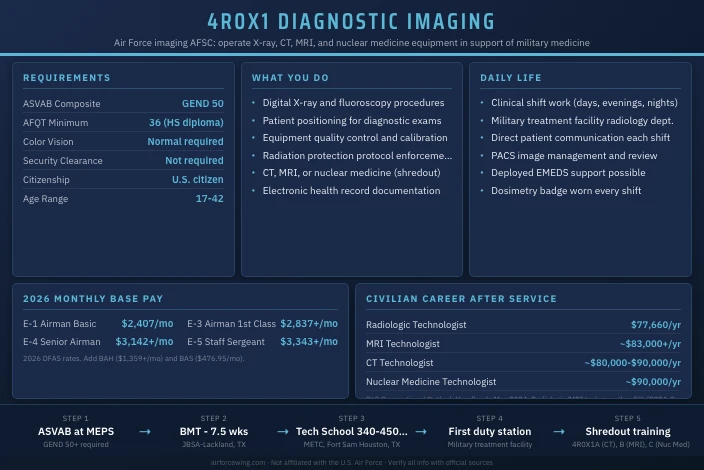
Job Role
The 4R0X1 Diagnostic Imaging Specialist operates radiological and imaging equipment to produce diagnostic images used in patient care. Imaging specialists perform X-ray, fluoroscopy, and other modality procedures; conduct quality control checks on equipment; properly position patients for each exam type; and support physician diagnosis by delivering technically accurate images. Their work is essential to military medicine from the clinic to the deployed theater.
Daily Tasks
Most days are spent in the imaging department of a military treatment facility, cycling through scheduled appointments and handling urgent requests from the emergency department or flight medicine clinic. Typical tasks include:
- Positioning patients and selecting imaging parameters for chest X-rays, bone studies, trauma imaging, and contrast procedures
- Operating digital X-ray, fluoroscopy, and related imaging platforms
- Performing daily quality control tests on equipment to verify image quality and radiation output accuracy
- Documenting procedures and image data in the electronic health record
- Communicating with patients about procedure steps and addressing questions about their exam
- Coordinating with radiologists and physicians on urgent or clinically complex imaging requests
- Applying radiation protection protocols for patients, staff, and themselves
The work pace varies by installation size. A large medical center like Wilford Hall runs high patient volumes with a full radiology team. A smaller clinic on a remote installation may have one or two imaging specialists handling every request that comes through the door.
Specialization Codes
4R0X1 uses shredout suffixes that reflect expanded training in advanced imaging modalities. These are assigned as Airmen progress and receive additional certification.
| Code | Specialization |
|---|---|
| 4R0X1 | General diagnostic imaging (X-ray, fluoroscopy) |
| 4R0X1A | Advanced imaging, Computed Tomography (CT) |
| 4R0X1B | Advanced imaging, Magnetic Resonance Imaging (MRI) |
| 4R0X1C | Advanced imaging, Nuclear Medicine |
Special Experience Identifiers (SEIs) may be awarded for specific skills at the unit level, including mammography or interventional procedures at larger facilities.
Mission Contribution
Imaging is the diagnostic backbone of military medicine. Before a surgeon can plan an operation, a flight surgeon can assess a pilot’s fitness, or a trauma team can prioritize injuries in a mass casualty event, they need images. 4R0X1 Airmen provide that capability at fixed military treatment facilities and in forward-deployed settings where imaging must be set up and operational under field conditions.
During deployments, the imaging specialist may be the only technologist on site, operating equipment independently with no radiologist physically present. Remote reads by off-site physicians are common in deployed environments. That independence demands sound judgment and solid technical fundamentals, qualities the Air Force builds into every 4R0X1 Airman during the training pipeline.
Technology and Equipment
4R0X1 Airmen work with modern digital imaging systems rather than traditional film-based equipment. Daily tools include:
- Digital radiography (DR) and computed radiography (CR) systems
- Fluoroscopy units for real-time contrast studies
- CT scanners (for those with 4R0X1A shredout)
- MRI systems (for those with 4R0X1B shredout)
- Nuclear medicine gamma cameras (for those with 4R0X1C shredout)
- Picture Archiving and Communication Systems (PACS) for image storage and physician access
- Radiation dosimetry equipment for personnel monitoring
Salary
Base pay starts at enlistment and grows at every promotion. Housing and food allowances add significantly to total compensation, and both are tax-free.
Base Pay Table
| Rank | Grade | Monthly Base Pay (2026) |
|---|---|---|
| Airman Basic | E-1 | $2,407 |
| Airman | E-2 | $2,698 |
| Airman First Class | A1C (E-3) | $2,837, $3,198 |
| Senior Airman | SrA (E-4) | $3,142, $3,816 |
| Staff Sergeant | SSgt (E-5) | $3,343, $4,422 |
| Technical Sergeant | TSgt (E-6) | $3,401, $5,044 |
| Master Sergeant | MSgt (E-7) | $3,932, $5,537 |
DFAS 2026 pay tables. Ranges reflect years of service within grade.
Allowances
Base pay doesn’t include housing or food allowances. Both are tax-free and add meaningfully to take-home pay.
Basic Allowance for Housing (BAH): Monthly housing allowance that varies by duty location, pay grade, and dependent status. An E-4 at Joint Base San Antonio earns roughly $1,359/month without dependents, or $1,728/month with dependents. Rates at high-cost installations like Travis AFB or Joint Base Lewis-McChord run considerably higher.
Basic Allowance for Subsistence (BAS): A flat $476.95/month for all enlisted Airmen regardless of rank or location.
Additional Benefits
- Healthcare: TRICARE Prime at no cost for active-duty members. Zero enrollment fee, zero deductible, zero copays. Coverage includes medical, dental, vision, mental health, and prescriptions.
- Retirement: The Blended Retirement System (BRS) combines a pension (40% of high-36 average basic pay at 20 years) with government TSP contributions matching up to 4% of base pay.
- Education: Tuition Assistance covers up to $4,500 per year toward college courses while serving. The Post-9/11 GI Bill covers full in-state tuition plus a monthly housing allowance after separation.
- Leave: 30 days of paid leave per year.
Work-Life Balance
Imaging departments run on shift schedules because patient care doesn’t stop at 5 p.m. Expect rotating days, evenings, and occasional nights depending on facility size and staffing. Large medical centers run 24-hour imaging services; smaller installations may have reduced overnight hours. Holiday and weekend coverage is standard across the career field.
Qualifications
The GEND composite tests reading comprehension, vocabulary, and arithmetic, skills that map directly to what imaging technologists use daily: understanding anatomy, calculating technique factors, and reading physician orders accurately. An ASVAB prep course targeting the General composite is the most direct path if you need to raise your score before testing at MEPS.
Qualifications Table
| Requirement | Standard |
|---|---|
| ASVAB Composite | GEND 50 (General composite) |
| AFQT Minimum | 36 (high school diploma); 65 (GED) |
| Color Vision | Normal color vision required |
| Citizenship | U.S. citizen |
| Age | 17 to 42 at time of enlistment; must be at least 18 before entering Tech School |
| Education | High school diploma or equivalent |
| Academic Preparation | College English Composition and Speech required prior to Tech School |
| Security Clearance | None required |
| Physical Profile | Normal medical accession standards |
Requirements confirmed at airforce.com and AFI 36-2101.
The Air Force requires college English Composition and Speech coursework before entering 4R0X1 Tech School. This can be completed at a community college after enlistment but before your Tech School report date. Your recruiter will help you plan this.
ASVAB General Composite
The General (GEND) composite combines Word Knowledge, Paragraph Comprehension, Arithmetic Reasoning, and Mathematics Knowledge subtests. A score of 50 is moderately competitive, below the 62 required for Medical Laboratory Specialist but above the floor for most general support AFSCs. If you scored between 44 and 49, targeted prep on reading comprehension sections will move you past the threshold fastest.
Application Process
- Contact a recruiter: An Air Force recruiter confirms your eligibility and does an initial pre-screen.
- ASVAB at MEPS: You test at a Military Entrance Processing Station. GEND 50 is required for the 4R0X1 job code.
- Medical examination: MEPS conducts a full physical. Normal color vision is verified at this stage.
- Academic coursework plan: Your recruiter will confirm your English Composition and Speech requirement status.
- Job selection and contract: If you qualify and a seat is available, you select 4R0X1 and sign your contract.
- Ship to BMT: You depart for Basic Military Training at JBSA-Lackland, TX.
The full process from first recruiter contact to shipping typically takes one to three months depending on seat availability and any academic prerequisite timing.
Selection Competitiveness
4R0X1 is a mid-tier competitive AFSC. The GEND 50 screen excludes a portion of applicants, and the color vision requirement adds a secondary gate, a meaningful percentage of otherwise eligible candidates fail the color vision screen at MEPS. The English Composition and Speech requirement can delay entry for applicants who haven’t completed it yet, but it doesn’t disqualify them.
There’s no prior imaging experience required. The Air Force trains you from the ground up.
Service Obligation
Standard enlistment is four years of active duty. The 4R0X1 Tech School pipeline runs 340 to 450 days, one of the longest in the enlisted medical field. Six-year contracts may be available in exchange for bonuses or preferred assignment locations. Check with your recruiter for current bonus availability, as enlistment incentives change with Air Force manning needs.
Enlistees enter at E-1 (Airman Basic) unless they qualify for advanced pay grade through college credits, JROTC participation, or recruiter incentive programs.
Work Environment
Setting and Schedule
4R0X1 Airmen work primarily inside military treatment facility radiology departments, climate-controlled, equipment-dense spaces with a clinical workflow structure. You’ll split time between patient positioning, equipment operation, and documentation. The physical environment is professional healthcare, not a maintenance bay or flight line.
Deployed imaging work is a different experience. Expeditionary Medical Support (EMEDS) packages carry portable and semi-permanent imaging equipment to forward locations. Setup, calibration, and operation in field conditions require adaptability. The patient volume is lower than a garrison hospital, but the cases tend to be more acute and the decision support role is more direct.
Leadership and Communication
New 3-skill level Airmen work under supervision from senior technologists and NCOs. Imaging involves a lot of independent patient interaction, so you communicate professionally from day one. As you progress to the 5-skill level, you operate independently on standard exams and coordinate directly with radiologists through the PACS system. Technical Sergeants and Master Sergeants manage the imaging section, oversee quality control programs, and handle scheduling and staffing.
The Air Force Enlisted Performance Report (EPR) system drives promotion and assignment decisions. Annual EPRs rate technical proficiency, additional duties, professional development, and leadership contributions. Imaging Airmen who earn their ARRT registry, maintain a clean quality record, and take on extra duties position themselves well for top-block marks.
Team Dynamics and Autonomy
Radiology departments are small teams by hospital standards. You’ll know your coworkers well. Early in your career, senior technologists verify your technique and positioning decisions. By the 5-skill level, you run standard exams without supervision and troubleshoot equipment issues independently. Patient interaction is a daily part of the job, you’re explaining procedures, addressing anxious patients, and sometimes managing physically limited or uncooperative individuals, which requires composure and patience.
Job Satisfaction
Imaging technologists consistently report strong job satisfaction in civilian surveys, driven by the combination of patient contact, technical work, and visible impact on patient care. The Air Force version adds the structure and mission context of military service. Retention in the 4R0X1 career field is generally solid among Airmen who discover they enjoy the blend of technology and patient interaction. The civilian market demand for credentialed imaging technologists also gives career-minded Airmen confidence that the skills they’re building have lasting value.
Training
The 4R0X1 pipeline is long by enlisted standards, but it produces a nationally recognized credential. Most imaging technologists in the civilian world spend two years in an associate degree program. Air Force training covers comparable content in a structured, paid environment.
Training Pipeline Table
| Phase | Location | Duration | Focus |
|---|---|---|---|
| Basic Military Training (BMT) | JBSA-Lackland, TX | 7.5 weeks | Military customs, physical fitness, discipline |
| Technical School | METC, Fort Sam Houston, TX | 340 to 450 days | Radiographic science, patient care, imaging procedures |
| On-the-Job Training (OJT) | First duty station | Ongoing until 5-skill level | Unit-specific equipment, procedures, and workflow |
Training length confirmed at airforce.com and the 4R0X1 CFETP.
Initial Training
BMT at Lackland lasts 7.5 weeks. You’ll cover Air Force customs, drill and ceremony, weapons qualification, and physical fitness standards. No imaging content happens at BMT, it’s entirely military orientation and basic Airman foundation.
Tech School at the Medical Education and Training Campus (METC) at Fort Sam Houston is where the technical education happens. The program runs 340 to 450 days depending on shredout track and curriculum sequencing. Core content includes:
- Radiographic physics: X-ray production, beam characteristics, and radiation interactions with tissue
- Anatomy and positioning: Patient positioning for every major skeletal and soft-tissue exam type
- Radiographic technique: Exposure factor selection and image optimization
- Radiation protection: ALARA principles, dosimetry, shielding, and occupational exposure limits
- Fluoroscopy procedures: Real-time imaging for gastrointestinal and genitourinary contrast studies
- Image evaluation: Recognizing diagnostic quality, identifying artifacts, and repeat criteria
- Patient care: Communication, patient handling, medical emergency response
Students who complete the program are eligible to sit for the American Registry of Radiologic Technologists (ARRT) national certification exam. ARRT registration is the gold standard credential in civilian radiology. If your ASVAB General score still needs work before you can enlist, a PICAT prep program can help you lock in your score before the official test at MEPS.
Advanced Training
After Tech School, OJT at your first duty station continues under the CFETP task list. You sign off each task as you demonstrate proficiency, working toward the 5-skill level award. Advanced shredout training (CT, MRI, or Nuclear Medicine) becomes available to qualified Airmen through additional courses and on-the-job experience.
Development opportunities during service include:
- CCAF degree in Radiologic Sciences (Tech School credits apply directly)
- ARRT advanced certifications in CT, MRI, mammography, or nuclear medicine
- Noncommissioned Officer PME (Airman Leadership School, NCO Academy) for career advancement
- Cross-training to adjacent medical AFSCs or officer commissioning programs for motivated Airmen
Career Progression
Progression Table
| Skill Level | Rank | Typical Timeframe | Key Milestones |
|---|---|---|---|
| 3-Skill Level (Apprentice) | A1C, SrA (E-3 to E-4) | 0 to ~2 years | Complete Tech School, begin OJT task sign-offs |
| 5-Skill Level (Journeyman) | SrA, SSgt (E-4 to E-5) | ~2 to 5 years | Complete OJT tasks, obtain ARRT registration |
| 7-Skill Level (Craftsman) | SSgt, TSgt (E-5 to E-6) | ~5 to 10 years | Section leadership, quality management responsibilities |
| 9-Skill Level (Superintendent) | MSgt, CMSgt (E-7 to E-9) | 15+ years | Imaging department superintendent, clinical program oversight |
Promotion to Staff Sergeant and above is competitive. EPR ratings, promotion test scores, time in service, and additional duties all factor into the board. ARRT registration is expected for the 5-skill level and above.
Specialization and Role Flexibility
Senior Airmen and NCOs can pursue shredout assignments in CT (4R0X1A), MRI (4R0X1B), or Nuclear Medicine (4R0X1C) based on Air Force needs and individual performance. These advanced modality certifications increase technical value and can align with higher-paying civilian specialty roles after service.
Retraining to a different AFSC is possible after completing the first enlistment term, subject to Air Force manning requirements. Some 4R0X1 Airmen cross-train into healthcare administration, biomedical equipment, or pursue officer commissioning through the medical service corps pathway.
Performance Evaluation
The EPR system rates Airmen on a five-tier scale. For imaging Airmen, key performance markers include technical proficiency on quality assurance evaluations, ARRT certification status, patient satisfaction feedback, and leadership in additional duty roles. Top-block EPRs require consistent above-and-beyond contributions. Airmen who pursue CCAF degrees, mentor junior technologists, and participate in medical readiness exercises tend to perform well on the stratification factors that drive promotion.
Physical Demands
Daily Physical Demands
4R0X1 is a healthcare job, not a physically intensive combat support role. Day-to-day demands include:
- Standing for extended periods during patient exams
- Lifting and positioning patients who may have limited mobility (can involve significant assist with large or injured patients)
- Moving and positioning imaging equipment and accessories
- Fine motor control for equipment adjustments and patient contact
- Wearing lead aprons during fluoroscopy procedures (these are heavy and worn for extended periods)
The lead apron requirement is a real physical consideration. Fluoroscopy technologists wear aprons that can weigh 15 to 20 pounds for the duration of a procedure, which can be taxing over a full shift. Back strain is among the most common occupational health concerns in radiology departments.
Air Force Fitness Assessment
All Airmen, regardless of AFSC, take the Air Force Fitness Assessment annually. Standards are age- and gender-normed and do not vary by job.
| Component | Max Points |
|---|---|
| 1.5-Mile Run | 60 |
| Waist Circumference | 20 |
| Push-Ups (1 minute) | 10 |
| Sit-Ups (1 minute) | 10 |
| Total | 100 |
Minimum passing composite score is 75 out of 100. Each component has its own minimum threshold that must be met regardless of total score.
Medical Evaluations
Beyond the initial MEPS physical, Air Force healthcare workers undergo periodic occupational health assessments. Imaging personnel are enrolled in radiation dosimetry monitoring programs, you wear a dosimetry badge that measures cumulative occupational radiation exposure. Air Force and federal standards set maximum annual exposure limits well below levels associated with health risk. Color vision must be documented at accession; no ongoing color vision re-testing is typically required.
Deployment
Deployment Details
4R0X1 Airmen deploy as part of Expeditionary Medical Support (EMEDS) packages and other Air Force medical units supporting contingency operations. Typical deployment lengths run 90 to 120 days. Deployments can send imaging specialists to the Middle East, Europe, the Pacific, or other locations where Air Force medical support is required.
Deployment frequency depends on unit assignment and current operational tempo. Airmen assigned to deployable medical units will see more rotations than those at large fixed medical centers. Most 4R0X1 Airmen can expect at least one deployment during a four-year enlistment.
The deployed imaging role is meaningfully different from garrison work. EMEDS packages carry portable and semi-permanent imaging equipment that must be set up, calibrated, and operated by the imaging specialist on-site. There is often no radiologist physically present, images are transmitted to stateside or theater-based radiologists for remote reads. That means the imaging specialist must produce technically accurate images without real-time expert guidance. The job rewards Airmen who develop solid diagnostic judgment during their garrison assignments, because that judgment becomes critical in theater.
Patient volume in deployed settings is typically lower than a busy CONUS hospital, but the cases are more acute. Trauma imaging, fractures from blast injuries, penetrating wound assessments, chest X-rays for suspected hemothorax, is more common than the elective and routine studies that fill a stateside schedule. The transition from high-volume routine work at a large MTF to lower-volume acute trauma imaging in theater requires adaptability.
Duty Station Options
Imaging specialists serve wherever the Air Force has military treatment facilities. Common assignment locations include:
- Joint Base San Antonio, TX (METC and Wilford Hall)
- Travis AFB, CA
- Wright-Patterson AFB, OH
- Joint Base Langley-Eustis, VA
- Ramstein AB, Germany
- Kadena AB, Japan
- Joint Base Pearl Harbor-Hickam, HI
Assignments are managed through the Air Force Assignment Management System. Overseas tours typically run two to three years; CONUS tours are three years. Preferences can be submitted but are subject to Air Force needs and available vacancies.
Larger MTF assignments. Wilford Hall, David Grant, Wright-Patterson, provide the most procedural variety and the best opportunities to train on advanced modalities like CT and MRI. Smaller installations with limited imaging departments may only run general X-ray and basic fluoroscopy. When submitting assignment preferences, Airmen who want to develop CT or MRI skills should prioritize facilities with those modalities available, since shredout training builds on hands-on equipment exposure at the duty station.
Risk/Safety
Job Hazards
The primary hazard in diagnostic imaging is ionizing radiation. With proper technique and protection protocols, occupational exposure remains far below levels associated with health effects, but the risk is real if protocols are bypassed or equipment malfunctions go unreported. Secondary hazards include:
- Physical strain from patient handling and lead apron use
- Contact with patients who may be infectious
- Chemical exposure from contrast agents and imaging chemistry (less common with modern digital systems)
Safety Protocols
Air Force imaging departments operate under the ALARA (As Low As Reasonably Achievable) radiation protection principle. Standard protections include:
- Personal dosimetry badges worn throughout the workday and reviewed periodically
- Lead aprons, thyroid shields, and lead gloves for fluoroscopy procedures
- Patient shielding (gonadal shields, etc.) per current protocols
- Regular equipment calibration and output testing
- Radiation safety training required at accession and periodically thereafter
Radiation protection is not optional. Bypassing shielding protocols or skipping dosimetry badge use are violations of Air Force safety standards and ARRT professional conduct requirements.
Security and Legal Requirements
No security clearance is required for standard 4R0X1 duties. Patient data is protected under HIPAA and Air Force medical records regulations. Standard military legal obligations apply: Airmen are bound by the Uniform Code of Military Justice (UCMJ) and their enlistment contract for the full service commitment.
Impact on Family
Family Considerations
The biggest daily adjustment for families is the shift schedule. Rotating days, evenings, and nights affect household routines, childcare logistics, and time together. Unlike some operational AFSCs, the work stays in the hospital, imaging Airmen generally aren’t called back in for unscheduled events outside of rare on-call situations at some facilities.
Deployment separations are the harder challenge. Air Force family support programs are available at every installation. Military OneSource and the Airman and Family Readiness Center provide resources for families during deployments, PCS moves, and daily challenges.
TRICARE Prime coverage for dependents is one of the most concrete financial benefits for 4R0X1 families. There are no enrollment fees, deductibles are minimal, and specialist visits for dependents cost a small copay compared to what the same care would cost on a civilian plan. For families with children, the on-base school access and the Department of Defense support infrastructure are consistent from installation to installation, the quality of support doesn’t vary widely the way school districts and community services do in the civilian world.
On-base childcare through the Child Development Center (CDC) is available at most Air Force installations, though demand frequently exceeds capacity and waitlists can run several months. Families who need reliable childcare should apply to the CDC early and maintain a backup plan for evenings and weekends when the imaging specialist is on shift.
The Air Force Airman and Family Readiness Center at each installation offers free workshops on financial planning, deployment preparation, and spouse employment assistance. Many programs are available online for family members who live off-base or are geographically separated during the Airman’s training pipeline.
Relocation and Flexibility
Permanent Change of Station moves happen roughly every three years. The Air Force covers household goods shipment and provides a PCS allowance. Imaging technologist skills translate to any installation with a military treatment facility, so the career travels well. Spouses with civilian healthcare backgrounds often find employment opportunities near Air Force installations given the consistent demand around military medical communities.
PCS moves are fully funded, the government ships household goods and provides a Dislocation Allowance to offset setup costs at the new duty station. Families can also request to ship a second privately-owned vehicle to overseas assignments when accompanied tours are authorized. Overseas assignments at locations like Ramstein, Kadena, or Hickam give families the opportunity to live abroad on the government’s dime, an experience many military families describe as a career highlight. Accompanied overseas tours typically run 24 to 36 months and include access to on-base housing, schools, and medical care.
Reserve and Air National Guard
The 4R0X1 AFSC is available in both the Air Force Reserve (AFRC) and the Air National Guard (ANG). Reserve and Guard imaging specialists support home-station medical units and mobilize in support of contingency operations.
Commitment and Drill Schedule
Standard Reserve and Guard commitment is one weekend per month (Unit Training Assembly, or UTA) plus two weeks of Annual Tour. Imaging technologists must maintain their ARRT registration and meet continuing education requirements between drill weekends to stay current, this is a professional obligation that doesn’t pause during non-drill periods.
Some imaging assignments require additional training days for annual dosimetry reviews, equipment recertification, or readiness exercises beyond the standard UTA schedule.
Part-Time Pay
An E-4 Senior Airman in the Reserve or Guard earns four days of base pay per drill weekend (two UTAs per weekend). At the 2026 E-4 base pay rate, that’s approximately $419 to $489 per drill weekend depending on years of service. Annual two-week training pays an additional two weeks of daily pay.
Active Duty vs. Reserve/Guard Comparison
| Factor | Active Duty | Air Force Reserve | Air National Guard |
|---|---|---|---|
| Commitment | Full-time | 1 weekend/month + 2 weeks/year | 1 weekend/month + 2 weeks/year |
| Monthly Pay (E-4) | $3,142, $3,816/month | ~$419, $489/drill weekend | ~$419, $489/drill weekend |
| Healthcare | TRICARE Prime (free) | TRICARE Reserve Select (premiums apply) | TRICARE Reserve Select (premiums apply) |
| Education Benefits | Tuition Assistance ($4,500/year) | Federal TA available on drill status | State tuition waivers vary by state |
| GI Bill | Full Post-9/11 GI Bill eligibility | Partial (depends on activation days) | Partial (depends on activation days) |
| Retirement | 20-year pension (high-36, BRS) | Points-based reserve retirement at age 60 | Points-based reserve retirement at age 60 |
| Deployment Tempo | Higher; scheduled rotations | Lower; mobilization-based | Lower; mobilization-based |
Civilian Career Integration
The Guard and Reserve work very well for 4R0X1 Airmen employed full-time in civilian radiology departments. The ARRT credential covers both military and civilian practice, and the skills are identical. Drill weekends are two days per month, which most civilian healthcare employers can accommodate. USERRA protects your civilian position during any mobilization period. Some states also offer National Guard-specific education benefits that civilian employers can’t match.
Post-Service
The ARRT certification you earn through 4R0X1 is one of the most direct credential-to-career conversions available to any enlisted Airman. Civilian radiology departments are actively hiring, and your military imaging experience counts immediately.
Civilian Career Prospects
| Civilian Title | Median Annual Salary | Job Outlook (2024-2034) |
|---|---|---|
| Radiologic Technologist | $77,660/yr | +5% (faster than average) |
| MRI Technologist | ~$83,000+/yr | Growing demand |
| CT Technologist | ~$80,000, $90,000/yr | Stable to growing |
| Nuclear Medicine Technologist | ~$90,000/yr | Stable |
| Radiation Therapist | ~$102,000/yr | +3% |
BLS Occupational Outlook Handbook. About 15,400 annual openings projected for radiologic and MRI technologists through 2034. Salary varies by location, modality, and employer type.
Transition Support
The Air Force Transition Assistance Program (TAP) prepares separating Airmen with resume writing, interview practice, and employer connections. Airmen leaving 4R0X1 with an active ARRT credential can apply directly to hospital radiology departments, outpatient imaging centers, urgent care facilities, and orthopedic clinics without additional schooling.
The Community College of the Air Force (CCAF) degree in Radiologic Sciences, which you complete credits toward during service, satisfies associate degree requirements for many civilian imaging positions. Airmen who complete advanced shredout training in CT or MRI arrive in the civilian market with credentials that command higher starting pay.
ARRT certification requires ongoing continuing education to maintain. Keep your CE credits current during your enlistment so the credential is active and in good standing on your separation date.
Is This a Good Job
Ideal Candidate Profile
4R0X1 fits someone who:
- Wants to work in healthcare without a traditional nursing or EMT role
- Is comfortable with technology and enjoys learning how equipment works
- Can communicate calmly with patients who may be anxious, injured, or in pain
- Wants a credential that opens civilian doors immediately after service
- Prefers a clinical environment over field or maintenance work
The imaging department is professional and structured. You interact with patients but you’re not at the bedside for extended care, your contact is procedure-focused. People who like solving technical problems (getting the right image on a difficult patient) and working within a clinical team tend to do well here.
Potential Challenges
The training pipeline is long. Spending 340 to 450 days at Fort Sam Houston before reaching a permanent duty station is a real commitment, especially for recruits who left family behind. The work also involves radiation, which some people have concerns about, the science is sound and the protocols are protective, but it’s something to consider.
Shift work is sustained throughout the career, not just a temporary inconvenience. If stable hours are important to your quality of life or family situation, that’s worth factoring in before you commit. The physical demand of wearing lead aprons through long fluoroscopy procedures is also worth knowing before you sign.
Career and Lifestyle Alignment
This is a strong fit for someone who plans to stay in healthcare long term. The Air Force pays for training worth tens of thousands of dollars in the civilian world, and the ARRT credential has direct market value the day you separate. If your goal is a healthcare career, this AFSC is one of the best entrances the enlisted military offers.
If you want high-tempo operational field work, look at other AFSCs. The imaging department is a clinical environment. Deployed EMEDS assignments add some variety, but the day-to-day is hospital work, not field operations.
More Information
An Air Force recruiter can confirm current ASVAB score requirements, Tech School seat availability, and any active enlistment bonus incentives for 4R0X1. The airforce.com career page has the current job listing with up-to-date requirements. If you still need to build your score, a focused ASVAB study course covering the General composite subtests is the most direct preparation path for this AFSC.
Useful resources for further research:
- American Registry of Radiologic Technologists (ARRT), the credentialing body whose certification you’ll earn through the tech school pipeline
- Medical Education and Training Campus (METC), joint-service training campus at Fort Sam Houston where 4R0X1 tech school runs
- Air Force Personnel Center: Classification, official AFSC documentation and entry standards
- Bureau of Labor Statistics: Radiologic and MRI Technologists, civilian salary data, job outlook, and state-by-state employment information
- Community College of the Air Force (CCAF), where your tech school credits apply toward a degree in Radiologic Sciences
When speaking with a recruiter, confirm that the English Composition and Speech coursework requirement is noted in your application file. These two prerequisite courses must be completed before your Tech School report date. If you haven’t finished them, ask the recruiter how to fit them in between your BMT graduation date and your scheduled tech school start. Online courses from accredited community colleges are widely accepted.
This site is not affiliated with the U.S. Air Force or any government agency. Verify all information with official Air Force sources before making enlistment or career decisions.
Explore more Air Force medical careers such as 4N0X1 Aerospace Medical Technician and 4T0X1 Medical Laboratory Specialist.