4N0X1 Aerospace Medical Technician
If you want hands-on clinical experience from day one of your military career, the 4N0X1 Aerospace Medical Technician is the Air Force’s broadest medical AFSC. Technicians work in urgent care clinics, flight medicine facilities, and combat support settings, often handling patient care responsibilities that would take years to reach in a civilian hospital. The job also comes with a direct path to civilian certifications that employers recognize immediately after separation.
Qualifying requires specific ASVAB line scores. Our ASVAB study guide covers what to target and how to prepare.
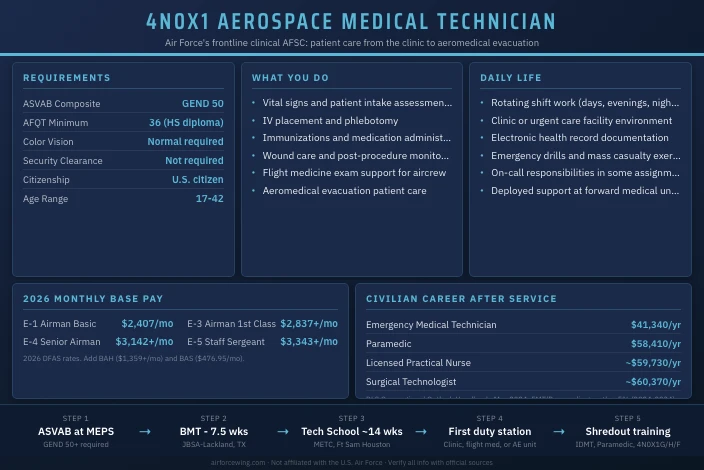
Job Role
4N0X1 Aerospace Medical Technicians provide direct patient care across the full spectrum of Air Force medical operations. They perform nursing procedures, assist physicians and nurses with clinical assessments, administer medications and immunizations, and support aeromedical evacuation missions. The role serves both garrison clinic environments and deployed settings where medical support may be the only care a patient can access.
Daily Tasks
A typical shift depends heavily on your assigned unit, but most 4N0X1 Airmen can expect to rotate through several of these tasks:
- Intake assessments: vital signs, medical history, patient interviews
- Administering immunizations and drawing blood samples
- Wound care, suture removal, and dressing changes
- Preparing and monitoring patients before and after procedures
- Dispensing medications under provider supervision
- Operating and maintaining diagnostic equipment
- Documenting patient encounters in electronic health records
- Supporting mass casualty drills and readiness exercises
Flight medicine clinics add an aviation-specific layer: monitoring aircrew health, conducting physical examinations for flight clearances, and tracking duty-limiting conditions that ground an aviator until resolved.
Specializations (Shredouts)
After initial qualification, Airmen can earn specialty suffixes based on assignment and additional training:
| Code | Specialization | Focus |
|---|---|---|
| 4N0X1B | Neurodiagnostic Technician | EEG, EMG, and neurodiagnostic equipment operations |
| 4N0X1C | Independent Duty Medical Technician | Expanded scope care at remote or austere locations |
| 4N0X1D | Allergy/Immunization Technician | Allergen immunotherapy, skin testing, vaccine programs |
| 4N0X1F | Flight and Operational Medicine Technician | Aircrew physical exams, medical waivers, flight clearances |
| 4N0X1G | Aeromedical Evacuation Technician | Patient care during fixed-wing medical transport missions |
| 4N0X1H | National Registry Paramedic | Advanced pre-hospital and emergency care at EMT-P level |
The 4N0X1C Independent Duty Medical Technician is one of the most demanding shredouts. IDMTs often serve as the sole medical provider at remote sites, managing everything from minor injuries to emergencies with limited backup. It requires additional coursework and significantly expands autonomous decision-making authority.
Mission Contribution
Medical readiness directly limits what the Air Force can do operationally. An installation that can’t keep its Airmen healthy can’t fly missions. Flight medicine units keep pilots and aircrew in the air. Aeromedical evacuation teams move critical patients across thousands of miles without losing them. 4N0X1 Airmen are embedded in all three parts of that chain.
Technology and Equipment
Day-to-day equipment includes vital signs monitors, EKG machines, phlebotomy supplies, digital X-ray interfaces, electronic health record systems (AHLTA and MHS GENESIS), autoclaves, and medication dispensing cabinets. Aeromedical evacuation specialists add portable ventilators, infusion pumps, and litter systems used on C-130, C-17, and KC-135 aircraft.
Salary
Base Pay
All active-duty pay is set by DFAS and applies uniformly across all branches. A new 4N0X1 Airman enters at E-1 and typically reaches E-4 (Senior Airman) within three to four years.
| Grade | Rank | Monthly Base Pay (2026) |
|---|---|---|
| E-1 | Airman Basic (AB) | $2,407 |
| E-2 | Airman (Amn) | $2,698 |
| E-3 | Airman First Class (A1C) | $2,837 - $3,198 |
| E-4 | Senior Airman (SrA) | $3,142 - $3,816 |
| E-5 | Staff Sergeant (SSgt) | $3,343 - $4,422 |
| E-6 | Technical Sergeant (TSgt) | $3,401 - $5,044 |
Base pay is the floor, not the ceiling. Most Airmen living off-base receive Basic Allowance for Housing (BAH), which varies by duty location and dependency status. A single E-4 at Joint Base San Antonio-Lackland, TX, receives $1,359/month in BAH. An E-4 with dependents at the same installation receives $1,728/month. Basic Allowance for Subsistence (BAS) adds a flat $476.95/month for all enlisted members regardless of rank or location.
Additional Benefits
Healthcare: Active-duty Airmen and their dependents are enrolled in TRICARE Prime at no cost. There are no enrollment fees, deductibles, or copays on the active-duty plan. Coverage includes medical, dental, vision, mental health, prescriptions, and hospitalization.
Education: Tuition Assistance covers up to $4,500 per year ($250 per semester hour) while on active duty. After separation, the Post-9/11 GI Bill covers full in-state tuition at public universities or up to $29,920.95 per academic year at private schools, plus a monthly housing allowance and up to $1,000 annually for books and supplies.
Retirement: The Blended Retirement System (BRS) provides a pension of 40% of your high-36 average basic pay at 20 years of service. The Thrift Savings Plan component provides automatic government contributions of 1% of basic pay plus matching up to 4%, for a maximum government contribution of 5%.
Work-Life Balance
Active-duty Airmen earn 30 days of paid leave per year, accruing at 2.5 days per month. Medical units operate on rotating shift schedules, which means some weekends and holidays are worked in rotation. Deployment tempo is lower than combat career fields but not zero.
Qualifications
Requirements Table
| Requirement | Details |
|---|---|
| Age | 17-42 at enlistment |
| Citizenship | U.S. citizen |
| Education | High school diploma (GED acceptable with AFQT 65+) |
| ASVAB Composite | General (GEND) 50 minimum |
| AFQT Minimum | 36 (HS diploma), 65 (GED) |
| Color Vision | Normal color vision required |
| Security Clearance | Not required for base qualification |
| Medical | Must meet Air Force accession medical standards |
The GEND composite draws from Word Knowledge, Paragraph Comprehension, Arithmetic Reasoning, and Mathematics Knowledge subtests. A GEND of 50 is achievable with solid math and reading preparation. Before your MEPS visit, review an ASVAB study guide to make sure your math and reading scores are where they need to be.
Application Process
- Contact an Air Force recruiter to begin the enlistment process
- Take the ASVAB at a Military Entrance Processing Station (MEPS)
- Complete the physical at MEPS (including color vision screening)
- Select 4N0X1 as your AFSC during the job selection process
- Sign your enlistment contract with a confirmed training seat
- Ship to BMT at Joint Base San Antonio-Lackland, TX
- Complete Tech School at the Medical Education and Training Campus (METC)
The typical timeline from MEPS to your first duty station runs six to nine months depending on training seat availability and any administrative processing delays.
Selection Competitiveness
4N0X1 is one of the more popular medical AFSCs because it offers broad clinical exposure without a single specialty focus. Training seats fill regularly. A GEND score above the minimum, a clean record, and good MEPS medical results give you the strongest application. Prior healthcare certifications or emergency response experience (EMT-Basic, CNA, first responder) are not required but demonstrate aptitude to recruiters.
Service Obligation
Enlistment contracts for 4N0X1 typically run four years for active duty. Some bonuses or specialized training tracks may come with longer commitments. Confirm your specific contract terms with your recruiter before signing.
Airmen enter the Air Force as E-1 Airman Basic. Most complete BMT and Tech School and report to their first permanent duty station as E-3 Airman First Class or E-4 Senior Airman, depending on prior civilian college credit or other accelerators.
Work Environment
Setting and Schedule
The 4N0X1 work environment is clinic-based, not primarily outdoors. You’ll spend most shifts in a hospital or medical group facility on or near an Air Force installation. Some assignments place you at smaller remote medical units or in aeromedical evacuation squadrons that operate from flight lines. Deployed positions can range from established theater hospitals to bare-base medical support elements.
Shift work is standard in most medical units. Panama schedules (12-hour shifts rotating across days and nights) are common in busier facilities. Clinics with regular business hours run more traditional schedules, but even those rotate on-call responsibilities.
Chain of Command and Feedback
Medical units are organized under Air Force Medical Group command structures, which run parallel to the standard wing/group/squadron hierarchy. You’ll receive direction from both the military chain of command and the clinical leadership (physicians, nurses, physician assistants). Enlisted Performance Reports (EPRs) are completed annually by your rater and reviewed by the senior rater. Feedback sessions are required before each EPR cycle, giving you a clear picture of where you stand and what development is expected.
Teamwork and Autonomy
Most patient care tasks require coordination with providers and other technicians. Early in your career, you’ll work closely under supervision. As you advance to SSgt and TSgt, your autonomy increases, and you’ll often be the senior enlisted member running a section or managing junior Airmen. Shredout qualifications like 4N0X1C (IDMT) grant expanded independent practice authority that mirrors mid-level civilian providers in some respects.
Job Satisfaction
Medical Airmen consistently report high job satisfaction tied to the direct impact of their work. The transition value is also a factor: few other enlisted specialties provide credentialing that transfers as cleanly to civilian employment as healthcare AFSCs. Retention rates in the medical field track with the broader Air Force, with experience and clinical skills tending to push Airmen toward reenlistment when civilian healthcare salaries are factored against total military compensation.
Training
Training Pipeline
| Phase | Location | Length | Focus |
|---|---|---|---|
| Basic Military Training (BMT) | JBSA-Lackland, TX | 7.5 weeks | Core military skills, discipline, fitness |
| Technical School (Tech School) | METC, JBSA-Fort Sam Houston, TX | ~98 days (approx. 14 weeks) | Clinical nursing skills, patient care, anatomy, pharmacology |
Tech School graduation also comes with a certification as a Nationally Registered Emergency Medical Technician (NREMT) at the EMT-Basic level. This credential is valid in most states and carries real weight in civilian EMS hiring. Preparing for the ASVAB before you enlist gives you the strongest chance of qualifying; an ASVAB prep course that covers math and reading will move your GEND score.
Advanced Training and Specializations
After reaching the 5-skill level (SSgt with on-the-job training complete), Airmen can apply for Advanced Training courses that lead to shredout qualifications. The Independent Duty Medical Technician (IDMT) course at METC takes approximately 26 weeks and qualifies Airmen to function as the primary medical authority at remote sites. The Aeromedical Evacuation Technician (4N0X1G) course adds specialized in-flight patient management skills. The National Registry Paramedic pathway (4N0X1H) allows qualified Airmen to earn their EMT-Paramedic certification, significantly expanding both military scope of practice and civilian employment options.
The Air Force also supports off-duty education through Tuition Assistance. Many 4N0X1 Airmen use TA to work toward an associate or bachelor’s degree in nursing, health sciences, or pre-medicine while on active duty.
Career Progression
Rank Progression
| Rank | Grade | Typical Time at That Level |
|---|---|---|
| Airman Basic (AB) | E-1 | BMT (6 weeks, exits at E-2 upon graduation) |
| Airman (Amn) | E-2 | ~6 months from enlistment |
| Airman First Class (A1C) | E-3 | ~16 months total service |
| Senior Airman (SrA) | E-4 | ~3 years total service (or below-the-zone earlier) |
| Staff Sergeant (SSgt) | E-5 | ~6 years total service (competitive promotion board) |
| Technical Sergeant (TSgt) | E-6 | ~11 years total service (competitive) |
| Master Sergeant (MSgt) | E-7 | ~17 years total service (highly competitive) |
Promotions to E-5 and above require passing a competitive promotion board based on EPR scores, decorations, education, and time in grade. Below-the-zone promotion to E-4 is available for exceptionally performing Airmen before the standard eligibility window.
Specialization and Role Flexibility
Career progression for 4N0X1 Airmen typically involves earning a shredout qualification at the 5- or 7-skill level. Moving from the general technician role to IDMT, Flight Medicine, or Paramedic tracks adds both military assignment options and post-service value. Airmen interested in officer commissions can apply for the Air Force’s Health Professions Scholarship Program (HPSP) or the Enlisted Commissioning Program (ECP) if they meet education requirements.
Retraining into other AFSCs is possible but competitive. Medical Airmen who want to shift to cyber, intelligence, or special operations careers typically need to build a strong EPR record and time in service before cross-training is approved.
Performance Evaluation
The Enlisted Performance Report (EPR) system rates Airmen on a 5-point scale. Scores of 5 (Exceeds Standards) drive promotion board scores. Your rater writes the EPR narrative, which must describe specific contributions with measurable impact. Clinical outcomes, leadership of junior Airmen, additional duties performed, and professional development activities all factor in. The most competitive technicians document continuing education, additional certifications, and volunteer contributions alongside duty performance.
To succeed long-term in this AFSC: build your shredout qualifications early, pursue college credits through TA, mentor junior Airmen, and volunteer for deployments or exercises that generate EPR-worthy accomplishments.
Physical Demands
Daily Physical Requirements
The clinical work in 4N0X1 is moderately demanding. Expect to be on your feet for extended periods, lift and reposition patients (frequently up to 50 lbs with team assistance for heavier patients), carry equipment, and maintain sustained attention during long shifts. Aeromedical evacuation missions add the physical demands of working in the confined fuselage of a military transport aircraft, moving litter patients, and managing equipment in tight spaces.
The job does not require the extreme physical conditioning demanded by special operations or security forces AFSCs, but maintaining above-average fitness makes the work easier and keeps your performance report competitive.
Air Force Fitness Assessment Standards
All Airmen take the Air Force Fitness Assessment (FA) annually. The FA is scored on a 100-point scale and consists of four components. Minimum passing composite score is 75, and each component has its own minimum standard.
| Component | Max Points |
|---|---|
| 1.5-Mile Run | 60 |
| Push-Ups (1 minute) | 10 |
| Sit-Ups (1 minute) | 10 |
| Waist Circumference / Body Composition | 20 |
Standards are age- and gender-normed. A score of 90 or higher earns an “Excellent” rating. Airmen who score between 75 and 89 pass but may receive additional fitness counseling if they show a trend toward the minimum. Failing any single component fails the entire assessment regardless of composite score.
Medical Evaluations
4N0X1 Airmen complete a thorough medical screening at MEPS before accession. Ongoing medical standards apply throughout service, with periodic evaluations as part of the readiness process. Airmen in aeromedical evacuation or flight medicine assignments must also meet flight duty medical standards, which include altitude chamber assessments and altitude physiology training at certain career points.
Deployment
Deployment Patterns
4N0X1 is a deployable AFSC. Medical units support Air Expeditionary Force (AEF) rotations, and most technicians can expect one or more deployments during a typical four-to-six-year enlistment. Deployment lengths commonly run 90 to 180 days. Theater positions range from established medical facilities at major overseas bases to contingency medical support in forward-deployed locations.
Aeromedical evacuation specialists (4N0X1G) have higher deployment frequency since their mission is specifically tied to moving critical patients from theater back to definitive care facilities.
Duty Stations
Major Air Force medical facilities are collocated with large installations. Common duty station options for 4N0X1 Airmen include:
- Joint Base San Antonio (TX): Wilford Hall Ambulatory Surgical Center, one of the largest military medical facilities in the country
- Lackland AFB / Randolph AFB (TX)
- Andrews AFB (MD), proximity to the National Capital Region
- Ramstein Air Base (Germany). Landstuhl Regional Medical Center, the largest US military hospital outside the continental US
- Travis AFB (CA): David Grant USAF Medical Center
- Wright-Patterson AFB (OH)
- Luke AFB (AZ), Tinker AFB (OK), and additional active-duty bases with medical groups
Assignment preferences are submitted through the Assignment Management System (AMS), but actual assignments depend on the needs of the Air Force and available positions.
Risk/Safety
Job Hazards
4N0X1 Airmen face the occupational hazards common to healthcare workers: bloodborne pathogen exposure, chemical exposure from medications and sterilization agents, lifting injuries from patient handling, and psychological stress from high-acuity patient care. Aeromedical evacuation adds altitude physiology concerns and the physical risks associated with military airlift operations.
Deployed environments introduce additional risks. Forward-deployed medical personnel operate in areas with variable force protection levels. While medical personnel are not combat roles, the distinction blurs in certain operational contexts.
Bloodborne pathogen exposure is a real and recurring risk in any clinical setting. 4N0X1 Airmen draw blood, start IVs, assist with procedures, and handle contaminated linens and instruments. Safety needle systems and proper sharps disposal protocols reduce but do not eliminate risk. Post-exposure response protocols require immediate reporting, baseline testing, and access to prophylactic treatment when appropriate.
Psychological stress from sustained high-acuity patient care is an occupational hazard that receives less attention than physical risks but can accumulate over time. Deployed 4N0X1 Airmen managing mass casualty events, pediatric trauma, or the deaths of fellow service members face cumulative stress that requires active attention. The Air Force provides access to mental health support through the medical group’s behavioral health element, and using those services does not automatically trigger fitness-for-duty reviews.
Safety Protocols
Personal protective equipment standards, sharps safety protocols, and bloodborne pathogen training (updated annually) govern the clinical environment. The Air Force follows OSHA standards adapted to military medical settings, enforced through medical unit safety officers and flight medicine oversight. Medication administration protocols include two-identifier verification before administration. Aeromedical evacuation Airmen receive altitude physiology and aircraft safety training specific to patient management in flight.
Security Clearance and Legal Obligations
A security clearance is not required for the base 4N0X1 qualification. Some specialized assignments, particularly those in support of sensitive operations or special operations forces, may require a clearance after assignment. Standard enlistment obligations apply: typically a four-year active-duty service commitment. Extensions, bonuses, and shredout training may modify the base obligation. Independent Duty Medical Technicians (IDMTs) operating under the 4N0X1C shredout function under expanded scope-of-practice authority, their legal framework requires careful documentation of clinical decisions and standing orders to protect both the patient and the provider.
Impact on Family
Family Considerations
Military medical careers involve shift work, periodic deployments, and the possibility of emergency recall during exercises or mass casualty events. Families living near a large installation with an active medical group benefit from TRICARE coverage, on-base resources, and the military support community. Airmen stationed at smaller bases with limited medical groups may face longer work hours due to smaller staff.
The Air Force provides family support through Military Family Life Counselors, the Airman and Family Readiness Center, and on-base childcare when space is available. Military OneSource offers financial counseling, relocation assistance, and 24/7 phone support for deployed members’ families.
Shift work creates real household friction. When one partner works evenings or nights regularly, family routines, shared meals, school pickups, weekend activities, require deliberate coordination. Families that plan around the rotating schedule from the start adapt better than those who treat it as a temporary inconvenience. Many 4N0X1 Airmen and their spouses report that the financial stability of military compensation, combined with TRICARE coverage eliminating health insurance costs, offsets much of the lifestyle difficulty of shift schedules compared to equivalent civilian healthcare jobs.
Deployment is the harder adjustment. A 90-to-180-day absence affects children, household management, and relationships in ways that require preparation. The Family Readiness Center at most major Air Force bases offers pre-deployment briefings for families, connecting spouses with support groups and practical resources before the Airman leaves. Aeromedical evacuation specialists (4N0X1G) deploy most frequently in this career field, families who choose this shred should go in with clear expectations about the tempo.
Relocation
PCS (Permanent Change of Station) moves occur every two to four years on average. The Air Force pays moving costs and provides a Dislocation Allowance (DLA) to offset the expense of setting up a new household. Families with school-age children face the typical challenges of frequent school changes. The Interstate Compact on Educational Opportunity for Military Children applies in most states, easing some of the administrative friction around mid-year enrollment and special education services.
Medical AFSC assignments are concentrated at installations with active medical groups, so the pool of duty stations is smaller than for many other career fields. That means less unpredictability about where you’ll end up, most 4N0X1 assignments fall at installations that are well-established, resourced communities with good school systems and employment options for military spouses. Spouse career continuity remains a challenge common to all military families, and the Air Force does not guarantee employment for military spouses at every location.
Reserve and Air National Guard
Component Availability
The 4N0X1 AFSC is available in both the Air Force Reserve and the Air National Guard. Most states have Medical Groups or Medical Readiness Squadrons within their Air National Guard wings that actively recruit for this AFSC. The Air Force Reserve maintains aerospace medical units at multiple reserve installations nationwide.
Drill Schedule and Training Commitment
Standard commitment is one weekend per month (Unit Training Assembly) plus two weeks per year (Annual Tour). Medical units often schedule additional training days for clinical recertification, equipment currency, and readiness exercises beyond the standard drill schedule. NREMT recertification requirements add a continuing education component that part-time Airmen must maintain on their own time.
Part-Time Pay
A Reserve or Guard E-4 Senior Airman earns pay for four Unit Training Assemblies (UTAs) per drill weekend. At $3,142 to $3,816 per month on the 2026 pay scale, a single drill weekend (4 UTAs) yields approximately $421 to $512 in base pay. That figure does not include BAH or BAS, which are typically not paid for standard drill weekends unless the member is on orders.
Component Comparison
| Factor | Active Duty | Air Force Reserve | Air National Guard |
|---|---|---|---|
| Commitment | Full-time | 1 wknd/mo + 2 wks/yr | 1 wknd/mo + 2 wks/yr |
| Monthly Base Pay (E-4) | $3,142-$3,816 | ~$421-$512/drill wknd | ~$421-$512/drill wknd |
| Healthcare | TRICARE Prime (free) | TRICARE Reserve Select (premiums apply) | TRICARE Reserve Select (premiums apply) |
| Education | TA up to $4,500/yr + full GI Bill after service | Federal TA + partial GI Bill | State tuition waivers vary + Federal TA |
| Deployment Tempo | Higher | Moderate (mobilizations every few years) | Moderate (state missions + federal mobilizations) |
| Retirement | 20-yr pension (BRS) | Points-based Reserve retirement | Points-based Reserve retirement |
Healthcare note: TRICARE Reserve Select requires monthly premiums (approximately $57/month for the member, $231/month for family coverage as of recent rates) compared to zero-premium TRICARE Prime on active duty.
Education note: Air National Guard Airmen may qualify for state-specific tuition waivers and the National Guard Educational Assistance Program (Chapter 1606) in addition to federal TA. Benefits vary significantly by state. Check your state’s adjutant general office for current rates.
Retirement note: Reserve and Guard members earn retirement points instead of time-based pension eligibility. A minimum of 20 qualifying years (each requiring 50 or more points) earns reserve retirement pay beginning at age 60, or earlier in some circumstances for members with federal active service.
Deployment and Mobilization
Reserve and Guard 4N0X1 Airmen typically mobilize every two to four years for deployments lasting 90 to 180 days, depending on Air Force medical needs and AEF rotation requirements. Mobilization frequency has varied historically based on operational tempo. During high-demand periods, reserve component medical Airmen have deployed more frequently than the standard rotation suggested.
Civilian Career Integration
4N0X1 Reserve and Guard service pairs well with civilian healthcare careers. The clinical skills maintained in the reserve component keep certifications current. Most civilian healthcare employers view Guard and Reserve service favorably. USERRA (Uniformed Services Employment and Reemployment Rights Act) protects civilian job rights during mobilization. Some healthcare employers actively recruit Guard and Reserve members for their military medical training.
Post-Service
Transition to Civilian Life
4N0X1 is one of the most directly translatable military medical AFSCs. The NREMT-Basic certification earned at Tech School is recognized across the country. Airmen who complete the Paramedic shredout (4N0X1H) leave with EMT-Paramedic credentials that command significantly higher civilian salaries. The clinical experience accumulated over a four-to-six-year enlistment is often viewed by civilian nursing programs and physician assistant schools as meaningful pre-professional preparation.
The Air Force Transition Assistance Program (TAP) provides separation counseling, resume assistance, and job placement support. The SkillBridge program allows Airmen to work with civilian employers during the final 180 days of service before separation, providing a paid bridge into civilian employment while still on active-duty status.
Civilian Career Prospects
| Civilian Career | Median Annual Wage | Job Outlook (2024-2034) |
|---|---|---|
| Emergency Medical Technician | $41,340 | +5% (faster than average) |
| Paramedic | $58,410 | +5% (faster than average) |
| Licensed Practical Nurse (LPN) | ~$59,730 | Varies by state/program |
| Surgical Technologist | ~$60,370 | Higher than average |
| Medical Assistant | ~$42,000 | Higher than average |
Wages reflect BLS Occupational Outlook Handbook May 2024 figures. Nursing and allied health projections vary by program and state licensing requirements.
Airmen who pursue nursing (ADN or BSN), physician assistant, or other advanced clinical programs after separation find that their 4N0X1 experience counts toward clinical hour requirements at many programs. Several nursing schools maintain formal articulation agreements with military training pipelines.
Discharge and Separation
Standard separation options include an honorable discharge at end of contract, reenlistment for another term, transition to the Reserve or Guard, or separation for other qualifying reasons. The character of discharge affects GI Bill eligibility and civilian employment. Airmen with an honorable discharge qualify for the full range of VA education, home loan, and healthcare benefits.
Is This a Good Job
Ideal Candidate Profile
4N0X1 works well for people who like working directly with patients, can stay calm when situations change fast, and want skills that translate to a civilian career without starting over. Strong candidates tend to be comfortable with both detail work (accurate documentation, medication dosages, infection control procedures) and physical tasks (patient transport, IV placement, long shifts on their feet).
If you’re already considering nursing, pre-medicine, or paramedic programs but want to build clinical experience first, this AFSC gives you a foundation that most civilian programs will recognize.
Potential Challenges
The shift schedule is the most common frustration. Rotating between days, evenings, and nights disrupts sleep patterns and complicates family life. Some assignments, particularly at large medical groups, have high patient volumes with limited staffing, creating pressure on individual technicians.
Deployment is real but not constant. Those who want to avoid any time away from home will find the uncertainty difficult. The clinical environment also involves emotionally demanding cases: trauma, pediatric emergencies, and deaths are part of the job at busier facilities and in deployed settings.
Career and Lifestyle Alignment
This role fits someone who wants meaningful clinical work, values the educational benefits, and can commit to shift work for several years. It’s less suited to someone who needs a completely predictable schedule or has strong location preferences that conflict with military assignment needs.
The certifications and experience earned here open post-service doors that few other enlisted paths can match. For anyone seriously considering a healthcare career, 4N0X1 is a legitimate on-ramp with pay and benefits attached.
More Information
Talk to an Air Force recruiter to confirm current ASVAB score requirements, available training seats, and any active enlistment bonuses for 4N0X1. Requirements and incentive programs change on a fiscal year cycle, and a recruiter will have current data. You can find a local recruiter through airforce.com or call the Air Force recruiting line directly.
An ASVAB study guide focused on math and reading will help you hit the GEND 50 threshold before your MEPS appointment.
Useful resources for further research:
- Medical Education and Training Campus (METC), joint-service training campus at Fort Sam Houston where 4N0X1 tech school takes place
- National Registry of Emergency Medical Technicians (NREMT), governs the EMT-Basic credential earned at tech school graduation
- Air Force Personnel Center: Career Fields, official AFSC classification documentation and requirements
- Bureau of Labor Statistics: EMTs and Paramedics, civilian job market outlook and salary data by credential level
- SkillBridge Program, allows Airmen to work with approved civilian employers for up to 180 days before separation while still on active duty
If you’re considering the Independent Duty Medical Technician (4N0X1C) track, research what additional schooling looks like, the IDMT course at METC is roughly 26 weeks of additional training on top of the base pipeline, and it significantly expands both your scope of practice and your post-service options. Discuss that pathway with a recruiter and, if possible, speak with an IDMT Airman currently serving to understand what the assignment looks like in practice.
This site is not affiliated with the U.S. Air Force or any government agency. Verify all information with official Air Force sources before making enlistment or career decisions.
Explore more Air Force medical careers to see all healthcare AFSC options in the enlisted medical career field.