4H0X1 Cardiopulmonary Laboratory
Airmen in the 4H0X1 career field run the cardiopulmonary laboratory, the department inside a military treatment facility that tests how well the heart and lungs work. They perform EKGs, pulmonary function tests, stress tests, echocardiograms, and assist during cardiac catheterizations and bronchoscopies. When a flight surgeon needs to clear a pilot for duty after a cardiac event, a 4H0X1 runs the tests that inform that decision.
The training pipeline is unusual for an enlisted AFSC. You must complete five college-level courses before entering tech school, and the program awards an Associate’s Degree upon graduation alongside two clinical certifications. That front-loaded investment pays off: this career field consistently produces one of the fastest promotion rates in the Air Force medical group, and the civilian job market for respiratory therapists and cardiovascular technologists is strong.
Qualifying requires specific ASVAB line scores. Our ASVAB study guide covers what to target and how to prepare.
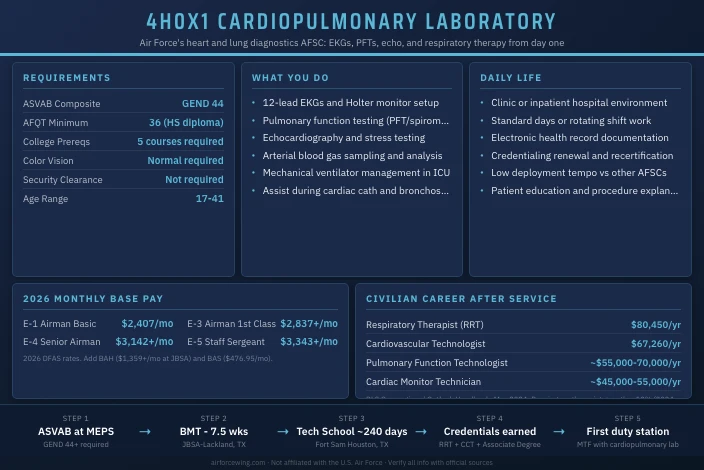
Job Role
Cardiopulmonary Laboratory Technicians perform diagnostic testing and provide therapeutic care for patients with heart and lung disease. They operate specialized equipment to measure pulmonary capacity, record cardiac rhythms, perform ultrasound imaging of the heart, and support invasive procedures such as cardiac catheterization and bronchoscopy. Their results directly guide physician treatment decisions for active-duty members, dependents, and retirees at Air Force medical treatment facilities.
Daily tasks
On a typical shift, a 4H0X1 will:
- Perform 12-lead electrocardiograms (EKGs) and Holter monitor setup
- Conduct pulmonary function tests (spirometry, diffusion capacity, lung volume measurements)
- Operate echocardiography equipment and prepare patients for stress testing
- Draw arterial blood gas samples and run critical-value analyses
- Set up and monitor mechanical ventilators and oxygen delivery equipment for patients in critical care
- Assist physicians during bronchoscopy and cardiac catheterization procedures
- Document all findings in the electronic health record
Specialized roles and codes
| Code | Description |
|---|---|
| 4H031 | Apprentice, entry-level, supervised clinical work |
| 4H051 | Journeyman, independent practice at most duty stations |
| 4H071 | Craftsman, supervisory responsibilities, quality assurance |
| 4H091 | Superintendent, career field management at senior NCO level |
There are no formal shredouts within 4H0X1, but Airmen can earn Special Experience Identifiers (SEIs) for advanced cardiac catheterization lab experience and critical care transport.
Mission contribution
Heart and lung disease affect patients across every Air Force career field and age bracket. Without 4H0X1s, flight surgeons would have no way to conduct the cardiac and pulmonary screening that keeps aircrew medically qualified. On the ground, these Airmen identify respiratory failure early, manage ventilator-dependent patients in the ICU, and keep diagnostic throughput moving in facilities that cannot afford a backlog.
Equipment
4H0X1s work with clinical-grade diagnostic hardware including:
- Electrocardiography systems (12-lead, Holter, event monitors)
- Echocardiography and Doppler ultrasound systems
- Pulmonary function testing equipment (spirometers, plethysmographs)
- Treadmill and pharmacological stress testing systems
- Mechanical ventilators and non-invasive positive pressure devices
- Bronchoscopy and cardiac catheterization support equipment
- Blood gas analyzers and point-of-care testing platforms
Salary
Military pay comes in layers. Base pay from DFAS is the taxable core; housing and food allowances sit on top, tax-free.
Base pay
| Rank | Grade | Base Pay (monthly) |
|---|---|---|
| Airman Basic | E-1 | $2,407 |
| Airman | E-2 | $2,698 |
| Airman First Class | A1C / E-3 | $2,837, $3,198 |
| Senior Airman | SrA / E-4 | $3,142, $3,816 |
| Staff Sergeant | SSgt / E-5 | $3,343, $4,422 |
| Technical Sergeant | TSgt / E-6 | $3,401, $5,044 |
2026 DFAS rates. Pay increases with years of service within each grade.
Allowances and additional benefits
Basic Allowance for Housing (BAH) varies by duty location, pay grade, and dependent status. A single E-4 at Joint Base San Antonio earns $1,359 per month in BAH; an E-4 with dependents receives $1,728. Rates at higher-cost installations are significantly higher.
Basic Allowance for Subsistence (BAS) is a flat $476.95 per month for all enlisted Airmen.
Beyond pay, active-duty Airmen receive:
- TRICARE Prime: zero-premium health, dental, and vision coverage for service members; low-cost options for dependents
- Tuition Assistance: up to $4,500 per year for college courses while on active duty
- Post-9/11 GI Bill: full in-state tuition at public schools (up to $29,920.95 per year at private schools) plus a monthly housing allowance, available after separation
- Thrift Savings Plan (TSP): the military’s 401(k) equivalent, with up to 5% government matching contributions under the Blended Retirement System
- 30 days paid leave per year plus 11 federal holidays
Work-life balance
Most 4H0X1 Airmen work standard daytime hours in outpatient clinic settings, though inpatient and critical care assignments carry shift rotation requirements. Larger facilities may run evening and weekend diagnostic services. Overnight call is rare but possible at smaller facilities with limited staffing. Because cardiopulmonary lab equipment is not deployed to the field frequently, this AFSC has a lighter deployment tempo compared to 4N0X1 generalists.
Qualifications
The 4H0X1 has entry requirements that go beyond the standard enlisted checklist. Read them carefully before talking to a recruiter.
Eligibility table
| Requirement | Standard |
|---|---|
| ASVAB composite | General (GEND) 44 minimum |
| AFQT minimum | 36 (high school diploma) |
| Education | High school diploma or GED |
| College prerequisites | 5 courses required (see below) |
| Citizenship | U.S. citizen |
| Age | 17 to 41 at enlistment |
| Security clearance | Not required |
| Color vision | Normal (no defects) |
College prerequisite courses
Before entering tech school, you must have completed these five college-level courses (minimum 3 credit hours each):
- English Composition I
- Speech or Communications
- College Algebra or higher mathematics
- Humanities (any discipline)
- Social Sciences (any discipline)
These do not need to come from a four-year institution. Community college courses accepted for transfer credit qualify. Many recruits complete these while still in high school through dual enrollment programs, which also shortens the gap between enlisting and shipping.
The college prerequisite requirement is a hard entry standard, not a waiverable preference. Applicants who do not have all five courses completed before arriving at MEPS cannot be processed into this AFSC.
Application process
- Contact an Air Force recruiter and confirm all five prerequisite courses are on transcript
- Take the ASVAB at a Military Entrance Processing Station (MEPS), you need GEND 44 or higher
- Complete the physical at MEPS, including color vision screening
- Receive a Job Reservation or delayed-entry commitment for 4H0X1
- Ship to BMT; tech school assignment follows automatically
Competitiveness and selection
Seats for this AFSC are limited relative to demand. Applicants with all prerequisites already completed and a strong ASVAB score have an advantage. The GEND composite draws on Word Knowledge, Paragraph Comprehension, Arithmetic Reasoning, and Mathematics Knowledge, the same academic skills tested in the college prerequisite courses. Strong academic preparation helps both.
Service obligation
Active-duty enlistment contracts for technical medical AFSCs typically carry a four-year obligation. Confirm the specific contract term with your recruiter at the time of enlistment.
See our ASVAB study guide for strategies to hit these line scores, or take the PiCAT from home if you are a first-time tester.
Work Environment
Cardiopulmonary labs operate inside military treatment facilities (MTFs), the hospitals and clinics found on Air Force bases worldwide. The physical environment is a clinical one: clean, controlled, and quiet relative to maintenance or security forces career fields.
Setting and schedule
Most Airmen work in the outpatient diagnostic department or inpatient wards of an MTF. Outpatient work runs Monday through Friday during clinic hours. Inpatient and ICU-based Airmen rotate through day and evening shifts. Weekends occur on a rotating basis at larger facilities.
The job requires prolonged standing, patient lifting, and precise fine-motor work during procedures. You will spend time explaining procedures to anxious patients and must maintain a calm, professional demeanor even when results are worrisome.
Chain of command and feedback
4H0X1s work under medical officers (typically internal medicine, pulmonology, and cardiology physicians) and report through an NCO chain within the medical group. Performance feedback follows the Enlisted Performance Report (EPR) cycle, an initial feedback session within 60 days of assignment and an annual EPR thereafter. In the medical group, EPR bullets often reflect certification maintenance, procedural volume, and patient care outcomes.
Team dynamics
The cardiopulmonary lab typically has a small crew, sometimes as few as three to five Airmen at smaller bases. You will know your coworkers well and operate with a high degree of independence once you reach the Journeyman (5-level) skill level. Senior Airmen and Staff Sergeants often run the lab with minimal officer supervision during routine operations.
Promotion rates for 4H0X1 are among the fastest in the medical career group. The career field’s small size and technical depth mean that qualified, certified Airmen move to Staff Sergeant and Technical Sergeant more quickly than in larger AFSCs.
Training
The 4H0X1 training pipeline is the longest among enlisted medical AFSCs. Plan for roughly ten months between completing BMT and arriving at your first duty station.
Training pipeline table
| Phase | Location | Duration | Focus |
|---|---|---|---|
| Basic Military Training (BMT) | JBSA-Lackland, TX | 7.5 weeks | Military fundamentals, fitness, discipline |
| Tech School, Phase I | Fort Sam Houston, TX | ~240 days | Cardiopulmonary theory, clinical skills, credentialing |
| Tech School, Phase II | Designated clinical facility | Integrated into program | Supervised patient care rotations |
The 240-day tech school program is one of the longest in the Air Force medical career field. It mirrors a civilian Associate Degree in Respiratory Care, and graduates earn both the Registered Respiratory Therapist (RRT) credential from the National Board for Respiratory Care and the Certified Cardiographic Technician (CCT) credential from the Cardiovascular Credentialing International.
Graduating with an Associate’s Degree and two nationally recognized clinical credentials before your first duty station is a significant advantage. Most civilian respiratory care programs take two years in a community college setting and do not include cardiac diagnostics coursework.
Advanced training and development
After reaching the Journeyman level, 4H0X1s can pursue:
- Advanced cardiac catheterization lab training: available at larger MTFs with invasive cardiology departments
- Critical care transport training for aeromedical evacuation support roles
- Registered Cardiovascular Invasive Specialist (RCIS) credential, voluntary but valued for senior NCO positions
- Tuition Assistance-funded coursework toward a bachelor’s degree in respiratory therapy, health sciences, or a related field
The Air Force encourages credential maintenance through study time, exam fee reimbursement programs, and scheduling accommodations for certification renewal coursework.
Everything starts with qualifying ASVAB scores. Our study guide covers what to study first.
Career Progression
Promotion in the 4H0X1 career field follows the Air Force enlisted system but tends to move faster than average due to the small career field population and the technical certification requirements that limit the eligible pool.
Rank progression table
| Rank | Grade | Typical Time-in-Service | Notes |
|---|---|---|---|
| Airman Basic | E-1 | Entry | BMT only |
| Airman | E-2 | ~6 months | Auto-promote |
| Airman First Class | A1C / E-3 | ~16 months | Auto-promote |
| Senior Airman | SrA / E-4 | ~3 years | May promote below-the-zone (BTZ) |
| Staff Sergeant | SSgt / E-5 | ~4.5, 6 years | Competitive board |
| Technical Sergeant | TSgt / E-6 | ~8, 12 years | Career field had ~4-year avg TIG to TSgt |
| Master Sergeant | MSgt / E-7 | ~14, 18 years | Senior NCO |
| Senior Master Sergeant | SMSgt / E-8 | ~20+ years | Limited positions |
| Chief Master Sergeant | CMSgt / E-9 | ~22+ years | Exceptional performers |
Career paths and specialization
Most 4H0X1s remain in the diagnostic cardiopulmonary path. Those assigned to intensive care units can develop critical care respiratory therapy skills that overlap significantly with civilian ICU respiratory therapist roles. Craftsmen (7-level) often move into quality assurance, equipment management, and flight medicine support coordination.
Role flexibility and retraining
Retraining into or out of 4H0X1 is possible but subject to career field manning levels. The Air Force publishes retraining eligibility windows annually. Retraining into this AFSC requires completing the college prerequisite courses if not already done. Officers who commission from an enlisted 4H0X1 background may pursue the 42N Health Services Administration or medical officer career fields.
EPR system
The Enlisted Performance Report evaluates Airmen on six factors: job performance, leadership, professional qualities, training and education, organizational commitment, and community involvement. In the medical group, strong EPRs typically reflect patient safety metrics, procedure counts, certification currency, and documented leadership in the lab or on the unit. Supervisors conduct a documented feedback session within 60 days of assignment and at least annually thereafter.
Physical Demands
The cardiopulmonary lab is not physically demanding in the way that maintenance or security forces roles are. The physical requirements center on patient care activities rather than heavy labor.
Daily physical demands
- Prolonged standing during procedures (often 30 to 90 minutes at a time)
- Assisting with patient transfers and positioning on procedure tables
- Fine-motor precision when placing electrode leads, arterial lines, and bronchoscopy equipment
- Carrying and positioning portable EKG and monitoring equipment within the facility
Air Force Fitness Assessment
All Airmen, regardless of AFSC, take the Air Force Fitness Assessment annually. Standards are age- and gender-normed, not AFSC-specific.
| Component | Maximum Points | Notes |
|---|---|---|
| 1.5-Mile Run | 60 | Timed; primary aerobic component |
| Waist Circumference | 20 | Body composition measurement |
| Push-Ups (1 minute) | 10 | Muscular fitness |
| Sit-Ups (1 minute) | 10 | Core fitness |
| Composite minimum | 75 / 100 | Must also meet per-component minimums |
Scores are normed by age bracket and gender. Airmen must meet the minimum on each individual component in addition to the 75-point composite floor.
Medical evaluations
4H0X1 requires normal color vision, a disqualifying condition at MEPS that cannot be waived. Beyond that, standard Air Force medical qualification applies. Periodic occupational health evaluations may be required at some assignments due to exposure to radiation (from fluoroscopy during cardiac catheterization) and chemical disinfectants.
Deployment
Typical duty stations
4H0X1 Airmen work at Air Force bases with military treatment facilities that have inpatient or specialty care capability. Common assignments include:
- Joint Base San Antonio, TX (Wilford Hall Ambulatory Surgical Center and Brooke Army Medical Center support)
- Travis AFB, CA (David Grant USAF Medical Center, one of the Air Force’s largest hospitals)
- Wright-Patterson AFB, OH (Wright-Patterson Medical Center)
- Ramstein Air Base, Germany (Landstuhl Regional Medical Center support; largest overseas military hospital)
- Scott AFB, IL, Keesler AFB, MS, Nellis AFB, NV, and other installations with MTFs
Larger MTFs offer more specialized procedural experience, which matters for career development and civilian job competitiveness after separation.
Deployment
Cardiopulmonary laboratory equipment is not typically part of forward-deployed expeditionary medical units. Most 4H0X1 Airmen deploy at lower rates than combat-support AFSCs. When deployments occur, they tend to support established military hospitals and Role 3 medical facilities rather than forward operating bases. Expect one deployment every three to five years on average, though this varies by global force management requirements.
Lower deployment tempo is one of the features that makes 4H0X1 attractive to Airmen with families. The trade-off is that your duty station options are limited to bases with qualifying MTFs, which restricts geographic flexibility compared to AFSCs with wider basing options.
Risk/Safety
Job hazards
The primary occupational hazards for 4H0X1 include:
- Radiation exposure during fluoroscopic cardiac catheterization procedures, mitigated by lead aprons, thyroid shields, and dosimeter monitoring
- Bloodborne pathogen exposure during blood draws, arterial line procedures, and bronchoscopy
- Chemical exposure from high-level disinfectants used on bronchoscopes and other reusable instruments
- Ergonomic risk from prolonged standing and patient transfers
The radiation hazard is the most distinctive. Fluoroscopy emits continuous X-ray during cardiac catheterization procedures, and cardiopulmonary lab technicians routinely stand in the room during these studies. Dose tracking through personal dosimetry badges is mandatory. When cumulative readings approach occupational limits, the Air Force removes the Airman from fluoroscopy duties temporarily and investigates the source of excess exposure. Badges are read quarterly or monthly depending on anticipated exposure level.
Bloodborne pathogen exposure is managed through a combination of engineering controls, safety needles, closed-system blood sampling devices, and PPE including gloves and eye protection for any procedure involving blood or secretions. Bronchoscopy carries additional aerosol exposure risk and requires added respiratory protection during procedures. Post-exposure protocols are well-established: immediate reporting, baseline testing, and prophylactic treatment if exposure occurs.
Safety protocols
Air Force medical facilities follow Air Force Occupational Safety and Health standards, Joint Commission requirements, and OSHA regulations. Dosimeters are worn during fluoroscopy. Personal protective equipment requirements are enforced. Occupational health referrals are available if threshold exposure levels are exceeded. Annual bloodborne pathogen training is required for all clinical personnel. Cardiopulmonary lab technicians also complete ventilator safety and equipment malfunction training as part of their continuing education requirements.
Security and legal requirements
No security clearance is required for 4H0X1. Standard military legal obligations apply: enlistment contract terms, UCMJ compliance, and professional standards of patient care. Clinical malpractice liability for active-duty Airmen is covered under the Federal Tort Claims Act, individual Airmen are not personally liable for clinical acts performed within their scope of duties. The Registered Respiratory Therapist (RRT) credential carries its own scope-of-practice obligations defined by the National Board for Respiratory Care and applicable state law. Airmen who allow their credentials to lapse may be restricted from performing certain procedures until the credential is reinstated. Maintaining certification currency is both a professional and a legal responsibility throughout the career.
Impact on Family
Family considerations
The predictable clinic-hours schedule at most duty stations makes 4H0X1 one of the more family-friendly enlisted medical AFSCs. Shift work occurs at inpatient and ICU-based assignments but is generally limited to day and evening rotations rather than overnight call. The lower deployment tempo means extended absences from home are less frequent than in many other Air Force career fields.
Air Force Family Support Centers, TRICARE benefits for dependents, and base school systems are available at all major duty stations. Permanent change of station (PCS) moves occur on a standard 2-to-3-year cycle.
The TRICARE coverage available to dependents is a significant financial benefit. Dependent family members are enrolled in TRICARE Prime at installations with MTFs. Copays are low, prescription coverage is included, and dental and vision plans are available at modest premiums. For families with children who have medical needs or ongoing specialist care, the military healthcare system provides access that would cost substantially more in the civilian insurance market.
Military OneSource offers 24/7 counseling and referral services for dependents, covering financial counseling, school transition support, relationship counseling, and deployment readiness resources. The Airman and Family Readiness Center on most large installations hosts programs specifically for families of medical personnel, including spousal employment assistance.
Relocation and flexibility
The constraint for this AFSC is that assignments are limited to bases with qualifying MTFs. You cannot be stationed at a small base without a hospital. That narrows the geographic pool but also tends to concentrate assignments at larger, well-resourced installations with strong family support infrastructure.
Voluntary assignment preference can be submitted through the Air Force Assignment Management System (AFAMS), but approvals depend on manning requirements at each facility. Geographic stability improves as you advance to the senior NCO ranks and can request a stabilized assignment.
PCS moves are a consistent reality for Air Force families. The government funds the full household goods shipment and provides a Dislocation Allowance (DLA) to offset setup costs at the new location. Families with school-age children benefit from the Interstate Compact on Educational Opportunity for Military Children, which most states have adopted, it eases enrollment timing, special education continuity, and credit transfer issues that otherwise complicate mid-year school moves. Most major Air Force MTF installations also have on-base Department of Defense Dependents Schools (DoDDS) or access to high-performing local school districts.
Reserve and Air National Guard
Component availability
4H0X1 is available in both the Air Force Reserve and the Air National Guard. Guard and Reserve units typically operate through medical groups attached to major installations or through standalone medical readiness units. Billet availability varies by state and unit, not every Guard or Reserve unit has a cardiopulmonary slot.
Drill schedule and training commitment
The standard Reserve and Guard commitment is one weekend per month (Unit Training Assembly, or UTA) plus two weeks of Annual Tour. For 4H0X1 Airmen, additional training days may be required to maintain clinical currency, credentialing hours, and equipment proficiency beyond the standard UTA schedule. Credentialing requirements for clinical practice at federal facilities require documented patient contact hours, which part-time status can be harder to satisfy.
Part-time pay
An E-4 Senior Airman earns four days of base pay per drill weekend (two training days, two periods each). At the 2026 rate of $3,142/month for an E-4 with less than two years of service, that works out to approximately $419 per drill weekend. Active-duty E-4s earn that same $3,142 monthly as their base pay before allowances.
Benefits comparison
| Feature | Active Duty | Air Force Reserve | Air National Guard |
|---|---|---|---|
| Commitment | Full-time | 1 WE/mo + 2 wks/yr | 1 WE/mo + 2 wks/yr |
| Monthly base pay (E-4) | $3,142+ | ~$419/drill WE | ~$419/drill WE |
| Healthcare | TRICARE Prime (free) | TRICARE Reserve Select (premium) | TRICARE Reserve Select (premium) |
| Education, federal | Tuition Assistance ($4,500/yr) | Limited TA availability | Limited TA availability |
| Education, state | N/A | N/A | State tuition waivers (varies) |
| Retirement | 20-yr pension (BRS) | Points-based Reserve retirement | Points-based Reserve retirement |
| Deployment tempo | Moderate | Lower; involuntary mobilizations possible | Lower; involuntary mobilizations possible |
Air National Guard Airmen may qualify for state tuition assistance programs in addition to federal benefits, check your state’s Guard education office for current rates.
Deployment and mobilization
Reserve and Guard 4H0X1 Airmen can be involuntarily mobilized to support active-duty MTFs during personnel shortfalls or contingency operations. Mobilization periods typically run 90 to 180 days. Voluntary deployment opportunities also exist. USERRA protects civilian employment during military activations, and many civilian healthcare employers view military service favorably when making hiring and scheduling decisions.
Civilian career integration
Part-time 4H0X1 service pairs naturally with civilian respiratory therapy or cardiovascular technology careers. The Registered Respiratory Therapist (RRT) credential earned in tech school is nationally recognized and accepted by civilian hospitals. Scheduling Guard or Reserve drill weekends around civilian clinical rotations or shift schedules requires coordination but is widely done in the healthcare sector.
Post-Service
The 4H0X1 training pipeline is specifically designed to produce credentialed civilian healthcare workers. The exit from the Air Force is smoother for this AFSC than for most.
Civilian certifications carried forward
Airmen leave with:
- Registered Respiratory Therapist (RRT): the gold standard credential for respiratory therapy employment
- Certified Cardiographic Technician (CCT): for cardiovascular diagnostic roles
- An Associate’s Degree in Respiratory Care from an accredited program
- Documented clinical hours in a high-volume military treatment facility
Most states require RRT licensure for civilian practice; the Air Force credential satisfies the examination requirement in most jurisdictions, though state-specific applications and fees apply.
Civilian career prospects
| Civilian Job Title | Median Annual Salary | Job Outlook (2024-2034) |
|---|---|---|
| Respiratory Therapist | $80,450 | +12% (much faster than avg) |
| Cardiovascular Technologist / Technician | $67,260 | +3% (average) |
| Cardiac Monitor Technician | ~$45,000, $55,000 | Stable demand |
| Pulmonary Function Technologist | ~$55,000, $70,000 | Stable demand |
Salary data: BLS Occupational Outlook Handbook, May 2024. Outlook projections for 2024-2034.
Respiratory therapy has particularly strong civilian demand driven by an aging population, rising rates of chronic obstructive pulmonary disease, and ongoing critical care staffing needs. Experienced military-trained RRTs often command pay above the national median.
Transition support
The Air Force Transition Assistance Program (TAP) provides career counseling, resume writing workshops, and job placement support. Credentialing assistance programs help cover exam fees and licensing costs during the separation process. The Hire Our Heroes program specifically targets healthcare veterans for civilian placement.
Is This a Good Job
Strong match
You’re a good fit for 4H0X1 if:
- You want clinical credentials that translate directly to a civilian healthcare career
- You’re comfortable working with patients who are anxious, acutely ill, or connected to life-support equipment
- You have (or are willing to complete) the five college prerequisite courses before shipping
- You prefer a predictable schedule over field operations and deployments
- You score well on academic aptitude tests, the GEND composite rewards the same skills as the prerequisite coursework
Poor fit
This AFSC will frustrate you if:
- You want frequent deployments or operational, high-tempo environments
- You expect quick results from training, the 240-day tech school is a commitment
- You haven’t completed the prerequisite courses and aren’t prepared to do so before enlisting
- You have color vision deficiency, this is a non-waiverable disqualifier
- You prefer working outdoors or in varied physical environments
Career and lifestyle alignment
The 4H0X1 is one of the few enlisted paths where the Air Force essentially funds a civilian healthcare degree and two national certifications in exchange for active-duty service. The trade-off is specificity: you will be doing heart and lung diagnostics, not general emergency medicine or surgical tech work. If that’s the clinical direction you want to build toward, the return on investment is hard to beat anywhere in the civilian or military healthcare field.
More Information
Talk to an Air Force recruiter to confirm current prerequisite course requirements, available duty station options, and any open enlistment bonuses for this AFSC. Recruiters have access to current accession timelines and can tell you how quickly slots are filling. You can also contact the Air Force Personnel Center classification office for official AFSC documentation.
When you speak with a recruiter, bring your transcripts if you’ve already completed some or all of the five prerequisite college courses. The recruiter needs to verify them before processing your application. If you still need to complete courses, ask about community college options near you or through an online accredited institution, both are accepted.
Useful resources for further research:
- National Board for Respiratory Care (NBRC), governs the RRT and other respiratory therapy credentials you’ll earn in tech school
- Cardiovascular Credentialing International (CCI), governs the CCT credential for cardiac diagnostic technicians
- Air Force Personnel Center (AFPC), official AFSC documentation and classification standards
- METC at Fort Sam Houston, the training campus where your tech school takes place
- Bureau of Labor Statistics: Respiratory Therapists, civilian job market outlook, salary data, and employment projections
An ASVAB study guide covering arithmetic reasoning and reading comprehension will prepare you for the General composite. The same academic skills tested on the ASVAB directly reflect the prerequisite coursework, strong preparation in one helps the other.
This site is not affiliated with the U.S. Air Force or any government agency. Verify all information with official Air Force sources before making enlistment or career decisions.
Explore more Air Force medical careers such as 4T0X1 Medical Laboratory Specialist and 4P0X1 Pharmacy Technician.