4C0X1 Mental Health Service
Mental health demand in the military has never been higher. Suicide prevention, combat stress, PTSD treatment, and substance abuse programs all run through the behavioral health clinic, and the 4C0X1 Mental Health Service technician is the enlisted backbone of that system. These Airmen conduct initial patient assessments, administer psychological screening tools, support licensed providers during therapy sessions, and manage the documentation that keeps a behavioral health unit running. The ASVAB requirement is higher than most medical AFSCs, which signals the cognitive load involved. If you want to build a foundation for a civilian mental health career without six figures in student debt, this is one of the cleaner paths available.
Qualifying requires specific ASVAB line scores. Our ASVAB study guide covers what to target and how to prepare.
Job Role
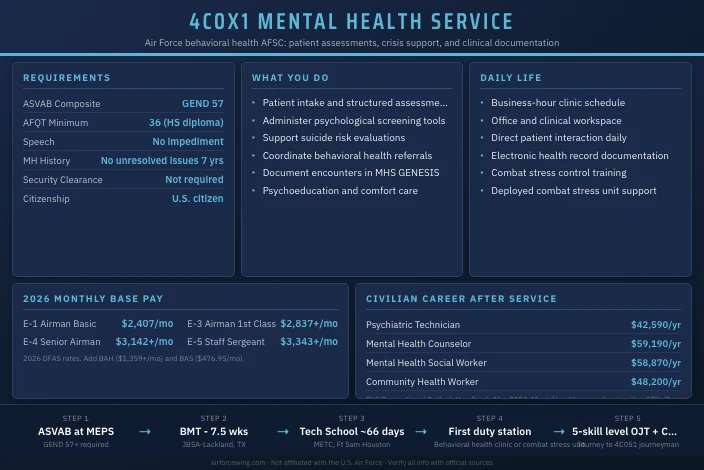
4C0X1 Mental Health Service technicians work in Air Force behavioral health clinics under the supervision of licensed psychologists, psychiatrists, social workers, and mental health officers. They conduct initial patient intake assessments, administer standardized psychological screening instruments, provide support and psychoeducation to patients and families, assist with emergency psychiatric evaluations, maintain treatment documentation, and coordinate care between behavioral health and other medical departments.
Daily Tasks
Most of a 4C0X1’s shift happens in a clinic setting. The work is a mix of direct patient interaction and behind-the-scenes clinical support. Typical daily tasks include:
- Conducting structured intake interviews and recording chief complaints
- Administering validated screening tools (PHQ-9, PCL-5, AUDIT-C) and scoring results
- Explaining behavioral health services and appointment expectations to new patients
- Preparing treatment rooms and assembling materials for group therapy sessions
- Coordinating referrals between behavioral health, primary care, and specialty services
- Managing scheduling systems and tracking no-show rates for population health reporting
- Documenting clinical encounters in MHS GENESIS
- Supporting suicide risk assessments under provider direction
- Participating in unit-level readiness exercises and deployment preparation
Deployed positions require a wider scope. Mental health technicians in theater may serve at combat stress control units, providing psychological first aid and helping commanders understand readiness impacts of behavioral health trends across their units.
Specializations
The 4C0X1 AFSC uses the standard Air Force skill level progression rather than named shredouts. Special Experience Identifiers (SEIs) may be awarded for specific assignments or capabilities:
| Designation | Description |
|---|---|
| 4C031 | Apprentice (3-skill level, Tech School graduate) |
| 4C051 | Journeyman (5-skill level, CDC completion + OJT) |
| 4C071 | Craftsman (7-skill level, 12+ months UGT as journeyman) |
| 4C091 | Superintendent (9-skill level, senior NCO leadership positions) |
No 7-level CDC exists for this AFSC. Technicians earn the 7-skill level through on-the-job qualification and demonstrated mastery, not a correspondence course.
Mission Contribution
The Air Force cannot fly missions with an unfit force. Behavioral health readiness directly affects aviation safety, nuclear surety programs, and the reliability of personnel in high-consequence positions. 4C0X1 technicians are embedded in the Personnel Reliability Program (PRP) screening process for nuclear-coded positions and support commanders who need accurate behavioral health status on their Airmen. That mission reaches beyond the clinic wall.
Technology and Equipment
Day-to-day tools include MHS GENESIS electronic health records, standardized psychological screening instruments (paper and electronic), behavioral health population tracking software, and secure communication systems for coordination with commanders and other medical departments. Some units use telehealth platforms for follow-up care, particularly at remote installations where face-to-face provider access is limited.
Salary
Base Pay
All active-duty pay comes from DFAS and applies uniformly across branches and career fields. A 4C0X1 Airman enters at E-1 Airman Basic and typically reaches E-4 Senior Airman within three to four years.
| Grade | Rank | Monthly Base Pay (2026) |
|---|---|---|
| E-1 | Airman Basic (AB) | $2,407 |
| E-2 | Airman (Amn) | $2,698 |
| E-3 | Airman First Class (A1C) | $2,837 - $3,198 |
| E-4 | Senior Airman (SrA) | $3,142 - $3,816 |
| E-5 | Staff Sergeant (SSgt) | $3,343 - $4,422 |
| E-6 | Technical Sergeant (TSgt) | $3,401 - $5,044 |
Pay figures reflect 2026 DFAS rates following the 3.8% across-the-board increase effective January 1, 2026.
Base pay is the floor. Airmen living off-base receive Basic Allowance for Housing (BAH), which varies by duty location and dependency status. A single E-4 at Joint Base San Antonio receives $1,359/month in BAH; an E-4 with dependents receives $1,728/month at the same installation. Basic Allowance for Subsistence (BAS) adds a flat $476.95/month for all enlisted members.
Additional Benefits
Healthcare: Active-duty Airmen enroll in TRICARE Prime at no cost, no enrollment fees, no deductibles, no copays. Coverage includes medical, dental, vision, mental health, prescriptions, and hospitalization for both the member and eligible dependents.
Education: Tuition Assistance covers up to $4,500 annually ($250 per semester hour) while on active duty. The Post-9/11 GI Bill after separation covers full in-state tuition at public universities or up to $29,920.95 per academic year at private schools, plus a monthly housing allowance and up to $1,000 annually for books and supplies.
Retirement: The Blended Retirement System (BRS) pension pays 40% of your high-36 average basic pay at 20 years of service. The Thrift Savings Plan adds automatic government contributions of 1% of basic pay plus matching up to 4%.
Work-Life Balance
Active-duty Airmen earn 30 days of paid leave per year (2.5 days per month). Behavioral health clinics generally operate on business-hour schedules rather than rotating shifts, which is meaningfully different from the shift-based schedules of 4N0X1 or 4T0X1 technicians. After-hours on-call coverage for urgent psychiatric needs does exist at some facilities, but the daily schedule is more predictable than most medical AFSCs.
Qualifications
Requirements Table
| Requirement | Details |
|---|---|
| Age | 17-42 at enlistment |
| Citizenship | U.S. citizen |
| Education | High school diploma (GED acceptable with AFQT 65+) |
| ASVAB Composite | General (GEND) 57 minimum |
| AFQT Minimum | 36 (HS diploma), 65 (GED) |
| Speech | No speech impediment |
| Mental Health History | No unresolved mental health concerns within the past seven years |
| Security Clearance | Not required for base qualification |
| Medical | Must meet Air Force accession medical standards |
The GEND composite at airforce.com is 57, higher than the GEND 50 threshold for 4N0X1 Aerospace Medical Technicians. The General composite draws from Word Knowledge, Paragraph Comprehension, and Arithmetic Reasoning subtests. Strong reading comprehension matters most here, the screening instruments, documentation protocols, and clinical communication demands of behavioral health work are heavily language-based. Before your MEPS visit, an ASVAB prep course focused on reading and verbal skills will move your GEND score.
The mental health history screening is specific to this AFSC and worth understanding before you apply. The Air Force requires that applicants show no unresolved mental health concerns in the past seven years. Past treatment does not automatically disqualify, but unresolved conditions, active prescriptions for psychiatric medications, or recent hospitalizations for mental health reasons will require a waiver or may disqualify. Talk to a recruiter honestly about your history before investing time in the process.
Application Process
- Contact an Air Force recruiter to begin the enlistment process
- Take the ASVAB at a Military Entrance Processing Station (MEPS)
- Complete the full MEPS physical, including the mental health screening review
- Select 4C0X1 as your AFSC during job selection
- Sign your enlistment contract with a confirmed training seat
- Ship to BMT at Joint Base San Antonio-Lackland, TX
- Complete Tech School at METC, Fort Sam Houston, TX
The timeline from MEPS to first duty station typically runs five to eight months depending on training seat availability.
Selection Competitiveness
Behavioral health AFSCs fill consistently because demand for mental health services across the Air Force has grown steadily over the past decade. The GEND 57 requirement screens out applicants who struggle with verbal reasoning. A clean record, solid ASVAB performance above the minimum, and documented interest or experience in counseling, social work, or mental health support will strengthen your application.
The mental health history review for this AFSC is more detailed than standard medical accession screening. If you have any history of mental health treatment, disclose it fully to your recruiter before MEPS. Incomplete disclosure creates problems later; honest disclosure often does not.
Service Obligation
Enlistment contracts for 4C0X1 typically run four years on active duty. Confirm your specific contract terms with your recruiter. Airmen enter as E-1 Airman Basic and typically report to their first duty station as E-3 Airman First Class or E-4 Senior Airman, depending on prior college credits or other accelerators.
Work Environment
Setting and Schedule
The 4C0X1 work environment is a behavioral health clinic within a military treatment facility. You’ll spend most of your time indoors, in office and clinical spaces, working business hours alongside licensed mental health providers. It is less physically demanding than flight-line or emergency medicine settings, but the emotional weight of working with patients in psychological distress is real and should not be underestimated.
At larger installations with high-volume behavioral health departments, the pace is brisk. Patient loads are heavy, documentation demands are constant, and coordination with other departments happens throughout the day. Smaller installations may have a slower pace but also fewer providers and support staff, meaning individual technicians carry more responsibility.
Deployed positions shift the environment entirely. Combat stress control units operate in forward environments where technicians support commanders and troops rather than individual outpatient cases, and the pace and intensity are significantly higher.
Chain of Command and Feedback
4C0X1 Airmen work within a dual chain: the standard military command structure and the clinical hierarchy led by behavioral health officers (typically psychologists or psychiatrists). Day-to-day clinical direction comes from licensed providers; administrative and military performance feedback comes from the NCO chain. Enlisted Performance Reports are completed annually. Your rater’s narrative must reflect specific, measurable contributions, well-documented clinical work, leadership of junior Airmen, and contributions to unit readiness all count.
Teamwork and Autonomy
Early in your career, most clinical work happens under direct provider supervision. As your skill level advances, you’ll take on more independent intake and screening functions. By the 7-skill level, senior technicians often manage the day-to-day operations of a behavioral health flight, supervising junior personnel and coordinating directly with commanders on readiness matters.
Job Satisfaction
Airmen in this AFSC frequently report that the work feels meaningful in a concrete way, they see the direct impact on patients’ lives. The clinic schedule is one of the most predictable in the medical career field, which contributes to higher-than-average quality of life ratings compared to shift-based medical AFSCs. The post-service credential value, particularly for those pursuing degrees in psychology, counseling, or social work, is a consistent retention factor.
Training
Training Pipeline
| Phase | Location | Length | Focus |
|---|---|---|---|
| Basic Military Training (BMT) | JBSA-Lackland, TX | 7.5 weeks | Military fundamentals, fitness, discipline |
| Technical School | METC, JBSA-Fort Sam Houston, TX | 66 days (~9-10 weeks) | Behavioral health principles, screening tools, clinical documentation, patient support |
Tech School for 4C0X1 is shorter than several other medical AFSCs, but the clinical learning continues at your first duty station through On-the-Job Training (OJT) and Career Development Courses (CDCs) required for the 5-skill level. Preparing your GEND composite before you ship helps with both AFSC qualification and the academic demands of Tech School; an ASVAB study guide focused on reading and vocabulary will give you the best return.
Advanced Training and Development
After earning the 5-skill level, Airmen can pursue additional professional development through Air Force-sponsored courses. Options include suicide prevention facilitator training, motivational interviewing workshops, and substance abuse counselor support courses offered through AFPC-managed Advanced Training programs. Some installations support off-duty coursework in psychology or counseling through Tuition Assistance, which covers up to $4,500 per year.
Airmen interested in commissioning can apply for the Enlisted Commissioning Program (ECP) if they’ve earned a bachelor’s degree, or pursue the Air Force Health Professions Scholarship Program (HPSP) for graduate-level mental health degrees leading to officer appointments.
Career Progression
Rank Progression
| Rank | Grade | Typical Time at That Level |
|---|---|---|
| Airman Basic (AB) | E-1 | BMT only |
| Airman (Amn) | E-2 | ~6 months from enlistment |
| Airman First Class (A1C) | E-3 | ~16 months total service |
| Senior Airman (SrA) | E-4 | ~3 years total service |
| Staff Sergeant (SSgt) | E-5 | ~6 years (competitive board) |
| Technical Sergeant (TSgt) | E-6 | ~11 years (competitive) |
| Master Sergeant (MSgt) | E-7 | ~17 years (highly competitive) |
Promotions to E-5 and above are competitive. EPR scores, decorations, education credits, and community involvement all factor into promotion board scores. Below-the-zone promotion to E-4 is available for exceptional performers before standard eligibility.
Career Flexibility
Retraining into this AFSC from another career field is possible and has been encouraged during periods of high behavioral health demand. Conversely, 4C0X1 Airmen with strong records can cross-train into adjacent fields like social work officer programs, special duty assignments (Military Training Instructor, First Sergeant), or civilian-facing roles in patient advocacy. The human relations and communication skills developed in this AFSC transfer broadly.
Performance Evaluation
The Enlisted Performance Report (EPR) rates Airmen on a 5-point scale. Scores of 5 drive promotion board competitiveness. Your EPR narrative needs specific, impact-based language, not “assisted with patient care” but “conducted 47 intake assessments supporting a 12% reduction in no-show rates for the behavioral health flight.” Clinical contributions, supervision of junior Airmen, additional duties, and professional development (college coursework, relevant certifications, suicide prevention training) all build a strong file.
Senior technicians at the 7-skill level and above often serve in superintendent roles managing entire behavioral health flights, advising behavioral health officers on enlisted force management, and representing the career field at the installation level.
Physical Demands
Daily Physical Requirements
The 4C0X1 role is not physically demanding by military standards. Work happens primarily in office and clinic spaces, seated or moving between rooms within a building. There is no requirement to lift heavy patients, work on a flight line, or operate in austere physical environments during normal garrison duty. Deployed environments may require carrying personal gear and working in field conditions, but the baseline physical demands are moderate.
The specific accession requirements include no speech impediment (clear verbal communication is essential for patient interviews) and no unresolved mental health concerns within the past seven years. Both are evaluated at MEPS.
Air Force Fitness Assessment Standards
Every Airman takes the Air Force Fitness Assessment (FA) annually, scored on a 100-point scale. The minimum passing composite is 75, and each component has its own minimum standard. The FA is not AFSC-specific, all Airmen are held to the same age- and gender-normed standards.
| Component | Max Points |
|---|---|
| 1.5-Mile Run | 60 |
| Push-Ups (1 minute) | 10 |
| Sit-Ups (1 minute) | 10 |
| Waist Circumference / Body Composition | 20 |
A score of 90 or higher earns an “Excellent” rating. Failing any single component fails the entire assessment, regardless of composite score.
Medical Evaluations
4C0X1 Airmen complete standard MEPS screening before accession. The mental health evaluation is more extensive for this AFSC than for most others. Ongoing readiness evaluations apply throughout service. Because behavioral health technicians work closely with patients in psychological distress, maintaining your own mental health and seeking support when needed is expected, the Air Force provides counseling through Military OneSource and on-base behavioral health resources.
Deployment
Deployment Patterns
4C0X1 is a deployable AFSC. Mental health technicians support Air Expeditionary Force rotations as part of medical units. Deployments typically last 90 to 180 days. In theater, technicians may serve at combat stress control units, embedded with combat or support units, or at established theater medical facilities. The deployment tempo is moderate, lower than security forces or special operations support roles but higher than many administrative specialties.
Combat stress control missions have high operational value. Behavioral health support during sustained combat operations affects unit cohesion, commander decision-making, and individual Airman readiness in ways that directly influence mission success.
Duty Stations
Major Air Force medical groups and military treatment facilities serve as the primary assignments. Common options include:
- Joint Base San Antonio (TX): Wilford Hall Ambulatory Surgical Center and JBSA medical groups
- Andrews AFB (MD): Malcolm Grow Medical Clinics and Surgery Center
- Travis AFB (CA): David Grant USAF Medical Center
- Wright-Patterson AFB (OH): Wright-Patterson Medical Center
- Ramstein Air Base (Germany). Landstuhl Regional Medical Center behavioral health division
- Elmendorf-Richardson (AK), Kadena AB (Japan), and other installations with mental health staffing requirements
Assignment preferences go through the Assignment Management System, but the Air Force’s needs determine actual placement.
Risk/Safety
Job Hazards
Working in behavioral health carries occupational risks that don’t appear in most military job descriptions. Patient contact in psychiatric settings can involve individuals in acute crisis, including those with active suicidal ideation or behavior, substance intoxication, or severe mental illness. De-escalation and personal safety protocols are part of the training, but the work is not risk-free. The emotional burden of sustained exposure to psychological suffering, particularly in high-volume or deployed settings, contributes to secondary traumatic stress and burnout at rates higher than in other medical AFSCs.
The Air Force Resilience programs, supervisor support requirements, and access to peer support specialists are designed to address this. But the risk is real and worth weighing before committing to the career field.
Safety Protocols
Behavioral health units follow established safe messaging guidelines, de-escalation protocols, and unit-level safety officer oversight. Technicians receive training in suicide risk assessment procedures, safe room management, and patient observation protocols. Access to clinical supervision is built into the role, no 4C0X1 technician operates independently in high-risk patient situations without licensed provider backup.
Security Clearance and Legal Obligations
A security clearance is not required for the base 4C0X1 qualification. Some assignments involving Personnel Reliability Programs or sensitive duty positions may require a clearance review after arrival. Standard four-year enlistment obligations apply. Behavioral health technicians who handle sensitive patient records are subject to HIPAA requirements adapted to the military health system, and unauthorized disclosure of patient information carries both military administrative and federal legal consequences.
Impact on Family
Family Considerations
The clinic-based schedule and business-hour norms make 4C0X1 one of the more family-friendly medical AFSCs. Spouses and partners generally face less shift-disruption than they would with a 4N0X1 or 4T0X1 member. Deployments still occur, and the emotional demands of the job can follow a technician home, particularly after difficult patient contacts.
TRICARE Prime covers the entire family at no cost on active duty. Military Family Life Counselors are available at most installations for family members dealing with deployment stress, relationship difficulties, or adjustment challenges. The Airman and Family Readiness Center provides relocation support, financial counseling, and community connection resources.
The secondary traumatic stress risk in this career field deserves honest consideration before enlisting. Behavioral health technicians regularly work with patients who are in acute crisis, active suicidal ideation, severe trauma responses, substance dependence, and severe psychiatric episodes. Over time, sustained exposure to this level of human suffering can accumulate, particularly for Airmen who don’t have strong personal support structures and self-care habits. The Air Force has built-in mitigation through clinical supervision, peer support programs, and access to the same behavioral health services that technicians provide to others. But the risk is real, and families notice when it is affecting the Airman at home.
Spouses and partners of 4C0X1 Airmen should understand that confidentiality obligations mean their Airman will often be unable to describe their workday in meaningful detail. This is a structural feature of behavioral health work, not evasiveness. Families who can tolerate that opacity, and who don’t take it personally, tend to report better relationship quality during demanding clinical assignments.
Behavioral health is among the career fields where the military’s expanding demand for services has outpaced staffing in some periods. During high-demand periods, clinics become understaffed relative to their patient load, and individual technicians carry heavier workloads. This affects work-life balance in ways that aren’t captured in the standard schedule description. Understanding that your clinic’s staffing situation may vary significantly by installation and duty cycle is useful context before selecting an assignment.
The Air Force provides access to the same services that technicians deliver to their patients. Military OneSource offers confidential counseling for active-duty members and their families at no cost. Airmen who recognize secondary traumatic stress or burnout symptoms are expected to seek support, the career field culture increasingly normalizes this rather than stigmatizing it.
Relocation
PCS moves occur every two to four years on average. The Air Force covers moving costs and provides a Dislocation Allowance. Behavioral health positions exist at most installations with medical groups, so the duty station pool for 4C0X1 is reasonably broad compared to more specialized AFSCs. Families with school-age children benefit from the Interstate Compact on Educational Opportunity for Military Children, which eases mid-year enrollment transitions in most states.
Reserve and Air National Guard
Component Availability
The 4C0X1 AFSC is available in both the Air Force Reserve and the Air National Guard. Most states with Air National Guard medical units have behavioral health positions, though the number of authorized billets is smaller than for broader medical AFSCs like 4N0X1. The Air Force Reserve maintains behavioral health technician positions at reserve medical units nationwide.
Drill Schedule and Training Commitment
Standard commitment is one weekend per month plus two weeks per year. Behavioral health positions may require additional training days for clinical recertification, readiness exercises, and continuing education requirements. Some units participate in community mental health missions and interagency exercises that add training days beyond the standard schedule.
Part-Time Pay
A Reserve or Guard E-4 Senior Airman earns pay for four Unit Training Assemblies (UTAs) per drill weekend. At the 2026 pay scale of $3,142 to $3,816 monthly for E-4, a single drill weekend yields approximately $421 to $512 in base pay. BAH and BAS are not paid for standard drill weekends unless the member is on orders.
Component Comparison
| Factor | Active Duty | Air Force Reserve | Air National Guard |
|---|---|---|---|
| Commitment | Full-time | 1 wknd/mo + 2 wks/yr | 1 wknd/mo + 2 wks/yr |
| Monthly Base Pay (E-4) | $3,142-$3,816 | ~$421-$512/drill wknd | ~$421-$512/drill wknd |
| Healthcare | TRICARE Prime (no cost) | TRICARE Reserve Select (premiums apply) | TRICARE Reserve Select (premiums apply) |
| Education Benefits | TA up to $4,500/yr + full Post-9/11 GI Bill | Federal TA + partial GI Bill | State tuition waivers vary + Federal TA |
| Deployment Tempo | Higher | Mobilizations every few years | State missions + federal mobilizations |
| Retirement | 20-yr BRS pension | Points-based Reserve retirement | Points-based Reserve retirement |
Air National Guard Airmen may qualify for state tuition waivers through the National Guard Educational Assistance Program (Chapter 1606) in addition to federal TA. Benefits vary by state. The Reserve retirement system requires 20 qualifying years (50+ points each) and pays benefits beginning at age 60.
Deployment and Mobilization
Reserve and Guard 4C0X1 Airmen typically mobilize every two to four years for deployments ranging from 90 to 180 days. Mental health demand during high-operational-tempo periods has historically driven mobilization of reserve component behavioral health personnel at higher-than-standard rates.
Civilian Career Integration
4C0X1 Reserve and Guard service pairs directly with civilian mental health careers. Many technicians work in civilian healthcare, social services, or substance abuse treatment between drills. The clinical skills and professional language developed in the Air Force translate to civilian behavioral health settings. USERRA protects civilian job rights during mobilization, and civilian behavioral health employers generally view military mental health experience favorably when evaluating candidates for supervisory or senior technician positions.
Post-Service
Transition to Civilian Life
4C0X1 experience opens direct doors into civilian behavioral health employment at a level most people can’t reach without a bachelor’s degree first. The clinical documentation skills, structured interviewing experience, and crisis response training are immediately recognized by behavioral health employers. Technicians who pursue a psychology, social work, or counseling degree during or after service find their military experience counts toward practicum and supervised hours requirements at many programs.
The Air Force Transition Assistance Program (TAP) provides separation counseling, resume assistance, and job placement support starting 365 days before your ETS date. The SkillBridge program lets Airmen work with civilian employers during the final 180 days before separation while still on active-duty pay, a significant advantage when entering competitive behavioral health hiring markets.
Civilian Career Prospects
| Civilian Career | Median Annual Wage | Job Outlook (2024-2034) |
|---|---|---|
| Psychiatric Technician | $42,590 | +16% (much faster than average) |
| Substance Abuse and Mental Health Counselor | $59,190 | +17% (much faster than average) |
| Mental Health and Substance Abuse Social Worker | $58,870 | +11% (faster than average) |
| Community Health Worker | $48,200 | +14% (much faster than average) |
Wage and outlook data from the BLS Occupational Outlook Handbook, May 2024 figures. The +16-17% growth projections reflect sustained national demand for behavioral health services, a trend that has accelerated since 2020 and shows no sign of reversing.
Military experience doesn’t replace licensure for independent clinical practice. Becoming a licensed counselor (LPC), licensed clinical social worker (LCSW), or licensed psychologist requires a graduate degree and supervised hours after the military. But 4C0X1 experience is a stronger foundation for that path than most civilian entry points available without a college degree.
Discharge and Separation
Standard separation at end of contract results in an honorable discharge, full GI Bill eligibility, and access to VA education, home loan, and healthcare benefits. Reenlistment and transition to Reserve or Guard components are both viable options. The character of discharge affects all post-service benefits, so maintaining a clean record throughout service matters more than most enlistees appreciate on day one.
Is This a Good Job
Ideal Candidate Profile
This AFSC fits people who are naturally drawn to listening, who stay calm in emotionally charged situations, and who can separate their own feelings from a patient’s without going cold or dismissive. You don’t need to want to be a therapist, but you need to be comfortable in spaces where people are suffering and not have the instinct to fix it immediately with action.
Strong verbal skills matter. The GEND 57 requirement reflects the reading and communication demands of the job. If you already have experience in crisis intervention, peer support, chaplain assistant work, or any form of counseling, even informal, that background will show up positively at MEPS and in Tech School.
Potential Challenges
The emotional toll is the most significant challenge in this career field. Chronic exposure to suicide risk, severe trauma histories, and treatment-resistant psychiatric conditions wears on people over time, particularly in high-volume or deployed settings. Technicians who don’t have strong personal support networks and healthy off-duty habits tend to struggle with burnout within a few years.
The 7-year mental health history screening is a real barrier for some otherwise qualified candidates. Applicants who have sought treatment for depression, anxiety, or adjustment issues in the past should discuss their history with a recruiter before investing significant time in the application process.
Career and Lifestyle Alignment
This role suits someone who wants a predictable schedule compared to other medical AFSCs, meaningful daily work with direct human impact, and a credential base for a civilian behavioral health career. It fits less well for someone who needs high physical activity during the workday, wants a technical specialty with a single-credential civilian path (like radiology or lab), or has personal history that may create friction during accession screening.
The civilian job growth projections for behavioral health roles are among the strongest in the entire healthcare sector. Someone who finishes a 4C0X1 enlistment with a GI Bill-funded bachelor’s in psychology, social work, or counseling is positioned well for meaningful civilian employment.
More Information
Talk to an Air Force recruiter to confirm current ASVAB score requirements, training seat availability, and any active incentives for 4C0X1. Requirements can shift on a fiscal year cycle, and a recruiter will have current data that this page cannot. Find a local recruiter or start online at airforce.com.
Official sources:
- airforce.com: Mental Health Service career page, official Air Force career listing with current ASVAB requirements, training details, and duty station information
- Medical Education and Training Campus (METC), the joint-service training campus at Fort Sam Houston where 4C0X1 Tech School is conducted
- Air Force Medical Service (AFMS), the Air Force medical organization that employs 4C0X1 Airmen; the website describes the medical career fields and mission
For civilian career research:
- BLS Psychiatric Technicians and Aides, median salary, employment outlook, and typical employer types for the primary entry-level civilian role from this AFSC
- Substance Abuse and Mental Health Services Administration (SAMHSA), the federal agency overseeing civilian behavioral health programs; career resources and treatment locator for post-service employment context
- NASW: National Association of Social Workers, professional association for social workers, including military and veterans services specialty sections; useful for understanding the civilian credentialing pathway from 4C0X1 experience toward LCSW licensure
Mental health history screening: This AFSC has a specific seven-year mental health history review as part of the accession process. The Air Force’s Accession Medical Standards Guide and DoDI 6130.03 govern what conditions are disqualifying versus waiverable. If you have any history of mental health treatment, discuss it fully with a recruiter before MEPS, not after. Honest disclosure early in the process is always the better approach.
If you’re preparing your ASVAB before your MEPS appointment, focus your study on verbal and reading comprehension, those subtests drive your GEND composite. An ASVAB study guide that covers Word Knowledge, Paragraph Comprehension, and Arithmetic Reasoning will give you the best return on study time for this AFSC.
This site is not affiliated with the U.S. Air Force or any government agency. Verify all information with official Air Force sources before making enlistment or career decisions.
Explore more Air Force medical careers alongside related healthcare AFSCs like 4N0X1 Aerospace Medical Technician and 4P0X1 Pharmacy Technician.