4B0X1 Bioenvironmental Engineering
Most people picture Air Force medical jobs as clinics and hospitals. Bioenvironmental Engineering is different. As a 4B0X1 specialist, you’re the person who figures out whether the air on a flight line is safe to breathe, whether the water at a deployed base is contaminated, or whether a maintenance shop’s noise levels are damaging Airmen’s hearing. You’re a scientist, an investigator, and a public health enforcer all at once.
The Air Force protects people from combat threats. Bioenvironmental Engineering protects them from the invisible ones, chemical exposures, radiation, industrial hazards, and waterborne pathogens. Every Air Force installation has a BE shop, and every BE shop needs trained specialists. This is a career that translates directly into some of the most in-demand civilian jobs in the country. If your ASVAB score needs work before you can qualify, an ASVAB study guide will show you exactly where to focus.
Job Role
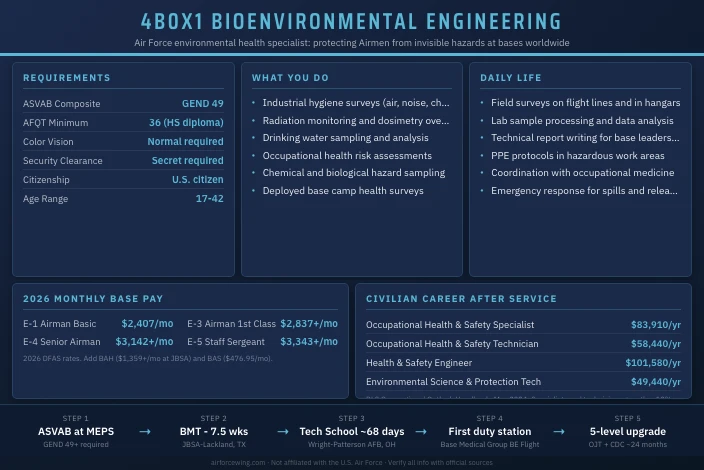
Bioenvironmental Engineering specialists (AFSC 4B0X1) assess and control occupational and environmental health hazards at Air Force installations worldwide. They conduct industrial hygiene surveys, monitor radiation levels, evaluate drinking water quality, and develop health risk assessments to protect Airmen and civilian workers from workplace hazards.
Daily Tasks
A typical day in a BE shop looks less like a hospital ward and more like a detective agency with lab equipment. You’ll spend time in the field running air sampling equipment in maintenance hangars, testing noise levels around jet engines, and checking water distribution systems for contamination. Back in the shop, you process samples, analyze data, and write up findings in reports that go to base leadership.
Core responsibilities include:
- Industrial hygiene surveys of shops, hangars, and work areas
- Air quality monitoring for chemical agents and combustion byproducts
- Radiological health surveys and dosimetry oversight
- Drinking water sampling and analysis at base water systems
- Occupational noise surveys with sound level meters and dosimeters
- Health risk assessments for new materials, processes, and equipment
- Deployment health surveys in austere or contingency environments
- Coordination with occupational medicine to refer Airmen with exposure concerns
Specific Roles
The 4B0X1 AFSC does not have formal shredouts at the enlisted level. Skill-level suffixes (1, 3, 5, 7, 9) mark progression from trainee to superintendent. Senior enlisted specialists may also hold Special Experience Identifiers (SEIs) for specific technical areas such as radiological health or chemical/biological defense.
Mission Contribution
Every aircraft that flies safely, every Airman who goes home without occupational disease, and every deployed unit with clean water is partly the result of BE work. The specialty sits at the intersection of public health and Air Force readiness. A maintenance crew that can’t work due to chemical exposure grounds aircraft just as surely as a mechanical failure. BE specialists identify and eliminate those risks before they become mission problems.
Technology and Equipment
The job is equipment-heavy and technically demanding. Specialists routinely operate:
- Direct-reading instruments for chemical agent detection (photoionization detectors, combustible gas detectors)
- Sound level meters and noise dosimeters
- Radiation survey meters and personnel dosimetry systems
- Water testing kits and field-portable laboratory equipment
- Air sampling pumps and filter cassette systems
- Computer-based health risk assessment and data management tools
- Geographic information system (GIS) software for environmental mapping
Salary
Pay starts at enlistment and grows with each promotion. The table below uses 2026 DFAS rates.
| Rank | Grade | Monthly Base Pay (Entry) |
|---|---|---|
| Airman Basic | E-1 | $2,407 |
| Airman | E-2 | $2,698 |
| Airman First Class | A1C / E-3 | $2,837 |
| Senior Airman | SrA / E-4 | $3,142 |
| Staff Sergeant | SSgt / E-5 | $3,343 |
| Technical Sergeant | TSgt / E-6 | $3,401 |
| Master Sergeant | MSgt / E-7 | $3,932 |
Base pay does not tell the full story. Most Airmen living off base add Basic Allowance for Housing (BAH), which varies by duty location, rank, and dependent status. At Joint Base San Antonio, TX, a single E-4 receives $1,359/month in BAH. Basic Allowance for Subsistence (BAS) adds a flat $476.95/month for all enlisted Airmen regardless of location.
Additional Benefits
Healthcare through TRICARE Prime costs nothing out of pocket for active-duty Airmen. Coverage includes medical, dental, vision, mental health, prescriptions, and hospitalization. The Post-9/11 GI Bill covers full in-state tuition at public schools and up to $29,920.95 per academic year at private schools. While serving, Tuition Assistance covers up to $4,500 per year toward college courses.
The Blended Retirement System (BRS) combines a 20-year pension at 40% of average basic pay with Thrift Savings Plan (TSP) matching of up to 5% of basic pay. Airmen who separate before 20 years keep their TSP contributions.
Work-Life Balance
Active-duty Airmen earn 30 days of paid leave per year, accruing at 2.5 days per month with a 60-day carryover cap. BE shop hours are generally standard day-shift work with some evening or weekend availability for urgent surveys. Deployments and exercises can disrupt regular schedules, but this AFSC does not typically involve around-the-clock shift work at home station.
Qualifications
The minimum AFQT score for Air Force enlistment is 36. The 4B0X1-specific composite requirement is higher. Start with the ASVAB practice tests well before your MEPS visit.
Qualification Requirements
| Requirement | Details |
|---|---|
| ASVAB Composite | GEND 49 (General score) |
| AFQT Minimum | 36 (high school diploma) |
| Education | High school diploma required; Algebra I required; Algebra II, chemistry, physics, and biology recommended |
| Citizenship | U.S. citizen |
| Age | 17-42 at enlistment |
| Color Vision | Normal color vision required |
| Driver’s License | Must qualify to operate government vehicles |
| Medical | Normal color vision; standard MEPS medical screening |
The GEND composite is calculated from Word Knowledge, Paragraph Comprehension, Arithmetic Reasoning, and Mathematics Knowledge. Strong math and science coursework in high school will directly raise your score.
Application Process
The process follows standard Air Force enlisted accession:
- Take the ASVAB at a Military Entrance Processing Station (MEPS) or Military Entrance Test (MET) site and achieve GEND 49+
- Complete the MEPS medical examination including color vision screening
- Work with your Air Force recruiter to request the 4B0X1 AFSC in your job selection list
- Receive a job offer contingent on available training slots
- Enlist and receive a ship date to Basic Military Training
AFSC availability depends on current Air Force manning requirements. Some test cycles have training seat shortages; others recruit actively. Talk with a recruiter about current availability.
Selection Criteria
This is a STEM-leaning specialty. Strong candidates have a background in math and natural sciences. No prior certifications are required, but experience in chemistry labs, environmental monitoring, or occupational safety will help you build context going into Tech School. The role demands attention to detail and an ability to write clear technical reports, those skills matter from day one.
Service Obligation
Enlisted Airmen incur a 4-year initial service obligation for this AFSC. Selectees enter at E-1 (Airman Basic) unless they have qualifying college credits, JROTC leadership, or other entitlement for advanced grade.
Work Environment
BE specialists work in a hybrid environment that is part laboratory, part field work, and part office. On any given day you might be in a maintenance hangar collecting air samples, inside a water treatment plant testing chlorine residuals, or sitting at a desk writing a health risk assessment. The job is not physically grueling, but it does require comfort working around industrial operations, chemical agents, and radiation sources.
Setting and Schedule
Most BE shops operate on a standard Monday-through-Friday day schedule at home station. However, urgent surveys, a fuel spill, a chemical release, a suspected contaminated water source, can pull specialists in at any hour. During large exercises or real-world contingency operations, the tempo increases significantly.
The work setting varies more than almost any other medical AFSC. One week you might be inside an engine test cell collecting exhaust samples. The next week you could be at a deployed location with nothing but a field kit and a GPS unit.
Leadership and Communication
BE specialists work within the base Medical Group and report to commissioned Bioenvironmental Engineering Officers (AFSC 43EX). Enlisted NCOs manage day-to-day survey scheduling and junior specialist development. Performance feedback comes through the Air Force Enlisted Performance Report (EPR) system, with formal feedback required at least twice per year for Airmen below SSgt and at every EPR cycle for NCOs.
Team Dynamics and Autonomy
Junior specialists (skill levels 3 and 5) work under direct supervision. At the 7-level, specialists often run surveys independently and may supervise teams during field operations. A Senior Airman with a 5-level conducting a standard industrial hygiene survey will often do it alone with minimal oversight. That degree of field autonomy is uncommon for an E-4 in most other AFSCs.
Job Satisfaction
BE tends to attract Airmen who like science, dislike sitting at a desk all day, and want work that connects directly to outcomes they can measure. Retention rates are solid, the AFSC is small enough that senior NCOs can see their entire field, and promotion opportunities in a technical AFSC with genuine civilian demand remain competitive.
Training
The entire pipeline from enlistment to first duty station runs approximately 4-5 months for most 4B0X1 Airmen. Tech School is at Wright-Patterson AFB, not a medical training center.
Training Pipeline
| Training Phase | Location | Duration | Focus Areas |
|---|---|---|---|
| BMT | JBSA-Lackland, TX | 7.5 weeks | Military fundamentals |
| Tech School | Wright-Patterson AFB, OH | ~68 days | Industrial hygiene, radiation, environmental health, chemical/bio sampling |
| 5-Level Upgrade | First duty station | ~24 months | OJT + CDC completion |
Advanced Training
After earning the 5-level, specialists become eligible for advanced courses through the Air Force Institute of Technology (AFIT) and the Defense Environmental Network and Information Exchange (DENIX) programs. Preparing for the PiCAT pre-enlistment test can give you a score advantage before you even step into MEPS. Courses cover advanced radiation dosimetry, environmental compliance, and chemical/biological defense. Some specialists pursue certified industrial hygienist (CIH) eligibility through on-the-job experience combined with voluntary college coursework. The Air Force supports degree completion through Tuition Assistance.
Career Progression
Rank Progression
| Rank | Grade | Typical Time |
|---|---|---|
| Airman Basic | E-1 | Enlistment |
| Airman | E-2 | 6 months |
| Airman First Class | E-3 | 16 months |
| Senior Airman | E-4 | 3 years |
| Staff Sergeant | E-5 | ~5 years (with testing) |
| Technical Sergeant | E-6 | ~12 years (competitive) |
| Master Sergeant | E-7 | ~17 years (competitive) |
| Senior Master Sergeant | E-8 | ~20 years (highly selective) |
| Chief Master Sergeant | E-9 | ~22 years (highly selective) |
Promotion to E-5 and above requires passing Air Force Promotion Fitness Examinations, accumulating EPR ratings, and competing Air Force-wide for available quotas. BE is a small AFSC, which can mean fewer total promotion slots but also tighter competition within a cohort of technically capable Airmen.
Specialization
The 4B0X1 specialty does not have formalized shredouts, but Senior NCOs often develop deep expertise in a specific technical area: radiological health, water quality, or chemical/biological defense. Some specialists cross-train into public health (4E0X1) or apply to direct commission as a 43E Bioenvironmental Engineering Officer after earning a qualifying degree.
Role Flexibility
Airmen who want to change career fields can apply for retraining at the midpoint of their enlistment, subject to Air Force needs and ASVAB eligibility. BE skills also position Airmen well for cross-training into related technical AFSCs in civil engineering (3E series) or other medical support roles.
Performance Evaluation
The Air Force EPR system rates Airmen on job performance, professional development, leadership, and community involvement. Airmen below SSgt receive a stratification score (e.g., “#1 of 5 Amn”) and a numeric rating. NCOs receive written performance narratives and a numeric rating. Strong EPRs and board scores drive promotion decisions for SSgt and above.
Physical Demands
The 4B0X1 AFSC is not physically intense compared to combat or special warfare roles, but the field work component requires sustained physical capability. You’ll walk flight lines, climb ladders to test ventilation systems, carry sampling equipment, and wear personal protective equipment in hot or confined spaces. Standard Air Force fitness standards apply.
Air Force Fitness Assessment Standards
All Airmen take the Air Force Fitness Assessment annually. Scoring is age- and gender-normed with a minimum composite passing score of 75 out of 100. Each component also has a minimum score that must be met separately.
| Component | Maximum Points | Notes |
|---|---|---|
| 1.5-Mile Run | 60 | Primary aerobic component |
| Waist Circumference / Body Composition | 20 | Tape measure or abdominal circumference |
| Push-Ups (1 minute) | 10 | Muscular endurance |
| Sit-Ups (1 minute) | 10 | Core strength |
Scoring thresholds vary by age group and sex. Check af.mil for current age- and gender-specific minimums before your assessment.
Medical Evaluations
Beyond the initial MEPS screening, 4B0X1 specialists who work with radiation sources are enrolled in the Air Force occupational dosimetry program and receive periodic radiation dose monitoring. Specialists regularly working with hazardous chemicals may be enrolled in a medical surveillance program with periodic laboratory testing. Standard Air Force periodic health assessments (PHAs) apply to all Airmen annually.
Deployment
Deployment Details
BE specialists deploy regularly. Every combat support wing, expeditionary medical group, and contingency response unit needs organic bioenvironmental capability. Typical deployments run 90 to 180 days, though this varies by mission. Deployed BE specialists conduct base camp surveys, source water testing, field sanitation assessments, and chemical/biological monitoring in areas where threat levels may be elevated.
Expect to deploy once every three to four years on a normal career track, with higher frequency during periods of elevated operational tempo.
Deployed BE work differs substantially from home station operations. Instead of a fully equipped lab and established reference files, you operate with a field kit, portable instruments, and the skills to make sound risk assessments with limited data. Source water quality at a deployed location may require field testing and improvised treatment before drinking water standards are met. Chemical threat screening around fuel storage areas or vehicle maintenance operations may need to happen on the same day the unit arrives. The pace and independence of deployed BE work accelerates professional development faster than any equivalent home-station assignment.
Before deploying, BE specialists complete deployment health assessments, verify current certifications for radiation worker status and chemical/biological monitoring equipment, and review theater-specific environmental health threat reports that are maintained at the unit level.
Location Flexibility
The Air Force Personnel Center manages AFSC assignments through the Automated Assignment System. Airmen submit preferred base lists and receive assignments based on rank, needs of the Air Force, and available openings. BE billets exist at nearly every major Air Force installation worldwide. Common duty stations include:
| Base | Location | Notes |
|---|---|---|
| Joint Base San Antonio | TX | Large medical group; training opportunity |
| Ramstein AB | Germany | USAFE medical group; European theater |
| Kadena AB | Japan | Pacific theater; large base operations |
| Eglin AFB | FL | Testing and evaluation environment; diverse hazards |
| Wright-Patterson AFB | OH | Home of tech school; some permanent BE billets |
| Travis AFB | CA | Air Mobility Command medical group |
| Nellis AFB | NV | Test and training range environmental health work |
The geographic spread of BE billets is broader than many other medical AFSCs, which gives Airmen more assignment options across their career. Bases with nuclear missions. Minot AFB, F.E. Warren AFB, Malmstrom AFB, maintain BE specialists with active radiation health programs, providing additional SEI development opportunities for Airmen interested in nuclear medicine.
Risk/Safety
Job Hazards
This specialty involves working around the same hazards you’re trying to protect others from. Occupational exposures include:
- Ionizing radiation (X-ray machines, radiological sources, nuclear-capable aircraft)
- Hazardous chemicals in maintenance and industrial shops
- Biological agents during disease outbreak investigations
- Asbestos and lead in older building stock
- High noise environments on flight lines and in engine test cells
Safety Protocols
BE specialists follow strict personal protective equipment (PPE) protocols calibrated to each exposure. Standard PPE includes respirators, chemical-resistant gloves, hearing protection, and dosimetry badges. Air Force occupational safety programs require documented hazard communication training before entering any industrial area. Radiation workers follow ALARA (As Low As Reasonably Achievable) principles with dose limits set by Air Force Instruction.
Security and Legal Requirements
The 4B0X1 AFSC requires a Secret security clearance for access to base facilities and sensitive environmental data. The clearance process includes a background investigation covering financial history, foreign contacts, and personal conduct. Processing typically takes several months. Losing a clearance means potential reassignment or separation.
Service members fulfill their contractual obligations or face formal administrative or judicial action under the Uniform Code of Military Justice (UCMJ). Voluntary early separation requires approval and may require repayment of bonuses or education benefits.
Impact on Family
Family Considerations
BE is not one of the high-deployment AFSCs, but periodic deployments are part of the job. At home station, the schedule is predictable, a significant advantage for families compared to many operational career fields. Military OneSource provides family support services including counseling, financial advising, and deployment readiness programs at no cost to active-duty families.
The Air Force benefits package covers the whole family. TRICARE covers the entire household at no cost. Base housing or BAH covers housing expenses. Schools, childcare, and recreation facilities are available at most installations.
The relative schedule stability of BE is one of the most consistently cited reasons enlisted medical specialists choose this AFSC over higher-tempo options. While deployments happen, the home-station rhythm follows a standard workday cycle that is predictable enough to support family routines, children’s activities, and spouse employment in ways that shift-based or high-deployment AFSCs cannot reliably offer.
Family Separation Allowance (FSA) provides $250/month during involuntary separations exceeding 30 days, which applies during most deployments. This allowance partially offsets the financial and operational disruption that deployments create for dual-income households.
The Airman and Family Readiness Center (AFRC) at each installation offers pre-deployment preparation programs, financial counseling, and post-deployment reintegration support. Families who use AFRC resources before a deployment, not just after, report significantly smoother transitions. Resources include childcare referrals, legal assistance for power-of-attorney documents, and connections to unit family support groups.
Relocation and Flexibility
Military life means permanent change of station (PCS) moves typically every two to four years. Each move comes with government-paid relocation, but frequent moves affect spouses’ careers, children’s schooling, and established social networks. Airmen can request specific bases through the assignment preference system, but final decisions rest with AFPC based on mission requirements. Accompanied tours allow families to move together to most overseas locations.
Because BE billets are distributed across nearly every major Air Force base, Airmen in this career field have more assignment options than those in highly specialized roles concentrated at a handful of locations. That geographic flexibility can directly benefit families who want to stay near specific regions of the country or who need to coordinate assignments with a military spouse. The Joint Spouse Program attempts to co-locate military couples, and the wide distribution of BE billets makes that coordination more achievable than in some other AFSCs.
Reserve and Air National Guard
The 4B0X1 AFSC is available in both the Air Force Reserve and the Air National Guard. The ANG operates at 90 bases across all 50 states and territories, making this one of the more geographically accessible medical AFSCs for part-time service.
Drill Schedule and Training Commitment
The standard Reserve/ANG commitment is one Unit Training Assembly (UTA) weekend per month plus 15 days of Annual Tour training per year. BE specialists may have additional certification requirements beyond the standard UTA, including annual refresher training for radiation worker qualification and occupational health survey proficiency.
Part-Time Pay
A Reserve or ANG E-4 (SrA) with the 4B0X1 AFSC earns approximately $628 for a standard drill weekend (4 drill periods at the E-4 base rate). By comparison, active-duty E-4 base pay starts at $3,142 per month. The gap is significant, but Reserve/ANG service can pair with a full-time civilian career in the same field.
Benefits Comparison
| Category | Active Duty | Air Force Reserve | Air National Guard |
|---|---|---|---|
| Commitment | Full-time | 1 UTA/mo + 15 days/yr | 1 UTA/mo + 15 days/yr |
| Monthly Base Pay (E-4) | $3,142+ | ~$628/drill weekend | ~$628/drill weekend |
| Healthcare | TRICARE Prime (free) | TRICARE Reserve Select (premium) | TRICARE Reserve Select or state plan |
| Education | Full TA + GI Bill | Federal TA + GI Bill (with qualifying service) | Federal TA + state tuition waiver (varies by state) |
| Deployment Tempo | 1 deployment per 3-4 years typical | Mobilization varies; lower baseline | Mobilization varies; state-mission focused |
| Retirement | 20-year pension (40% high-36) + TSP | Points-based Reserve retirement at age 60 | Points-based Reserve retirement at age 60 |
Deployment and Mobilization
Reserve and ANG BE specialists can be mobilized for federal contingency operations under Title 10 authority. ANG units also operate under Title 32 (state) authority for domestic emergencies. Typical mobilization lengths run 90 to 179 days. Mobilization frequency is lower than active duty on average, but varies with operational demand.
Civilian Career Integration
This AFSC pairs naturally with civilian careers in industrial hygiene, environmental health, or occupational safety. Many 4B0X1 Reserve Airmen work full-time as industrial hygienists, safety officers, or environmental compliance specialists for private employers or federal agencies. USERRA protections require employers to hold jobs for returning Reservists and prohibit discrimination based on Reserve service status.
Post-Service
The skills from 4B0X1 map directly onto some of the most in-demand occupations in the civilian environmental health and safety sector. The Air Force’s structured training and field experience can qualify departing Airmen for mid-level positions that typically require a four-year degree.
Civilian Career Prospects
| Civilian Job Title | Median Annual Wage | Job Outlook (2024-2034) |
|---|---|---|
| Occupational Health & Safety Specialist | $83,910 | +12% (much faster than average) |
| Occupational Health & Safety Technician | $58,440 | +12% (much faster than average) |
| Health & Safety Engineer | $101,580 | +5% (faster than average) |
| Environmental Science & Protection Tech | $49,440 | +5% (faster than average) |
Wage data from BLS Occupational Outlook Handbook, May 2024.
Certifications and Licensing
Separating 4B0X1 specialists often pursue the Certified Industrial Hygienist (CIH) credential through the American Board of Industrial Hygiene or the Certified Safety Professional (CSP) through the Board of Certified Safety Professionals. Military experience counts toward the professional practice hours required for both certifications. Federal employers, particularly the Department of Defense, Environmental Protection Agency, and Department of Veterans Affairs, actively recruit veterans with BE backgrounds.
Transition Programs
The Air Force’s Transition Assistance Program (TAP) provides job search workshops, resume assistance, and connections to civilian employers in the months before separation. The Hiring Our Heroes Corporate Fellowship Program places transitioning Airmen in civilian workplaces for hands-on experience before their separation date.
Is This a Good Job
Ideal Candidate Profile
This AFSC rewards a specific set of traits. You’ll do well in 4B0X1 if you:
- Genuinely like science and can handle math through algebra
- Prefer varied fieldwork over a fixed workstation
- Are comfortable writing technical reports and presenting findings to leadership
- Want a job where your work directly protects the people around you
- Like solving problems where the answer isn’t obvious until you measure it
Airmen with chemistry, biology, or environmental science coursework have an easier time in Tech School and accelerate faster through the skill-level progression.
Potential Challenges
This is not the right fit for everyone. Consider carefully if you:
- Want high-tempo, physically demanding work every day, the job involves lots of report writing
- Prefer working with large teams. BE flights are small, and you’ll often work alone in the field
- Are uncomfortable working around chemical or radiological hazards even with proper PPE
- Struggle with scientific or analytical coursework
The writing requirement catches some people off guard. A health risk assessment is a technical document that has to be defensible if a worker later claims an occupational illness. If you don’t like writing, the day-to-day job will feel heavier than the job description suggests.
Career and Lifestyle Alignment
For someone who wants a civilian career in industrial hygiene or environmental health, this AFSC is almost ideal pre-professional training. The Air Force pays you to learn skills that a civilian employer would charge you a master’s degree to acquire. If you are looking for an AFSC that provides direct skills transferability, strong STEM credentials, and a relatively stable home-station schedule, 4B0X1 is worth a serious look.
For someone who wants combat operations, a fast-paced medical environment, or extensive travel, this specialty may feel too methodical. It rewards patience and technical rigor more than speed and physical performance.
More Information
Talk to an Air Force recruiter to find out whether 4B0X1 slots are currently open and whether you qualify for any enlistment incentives. Recruiters can also tell you about current training seat availability at Wright-Patterson AFB and discuss how to maximize your GEND composite score before your MEPS visit. The recruiter’s job is to get you into the right AFSC, not just any AFSC, be direct about your interests in science and environmental health. Before that conversation, it pays to review an ASVAB study guide with practice tests so you walk in knowing your baseline score.
Official Resources
- Air Force 4B0X1 careers page: Official eligibility requirements, current bonus status, and career description
- Wright-Patterson AFB: Home of the 4B0X1 tech school; information on the bioenvironmental engineering training program
- Air Force Institute of Technology (AFIT): Advanced training courses in radiation health, environmental compliance, and occupational health that senior 4B0X1 NCOs can access
- American Board of Industrial Hygiene (ABIH): Administers the Certified Industrial Hygienist (CIH) credential; military experience counts toward the professional practice hours required for eligibility
- Board of Certified Safety Professionals (BCSP): Administers the Certified Safety Professional (CSP) and Associate Safety Professional (ASP) credentials; relevant for 4B0X1 veterans entering civilian occupational safety roles
- Bureau of Labor Statistics: Occupational Health and Safety Specialists: Current wage data and job outlook for the primary civilian career paths from this AFSC
When speaking with a recruiter, ask specifically: whether GEND 49 is still the current composite requirement (Air Force composites can change between ASVAB revision cycles), what the current initial service obligation is, whether any STEM-AFSC-specific bonuses are active, and what the typical training seat wait time is at Wright-Patterson. Seat availability varies by fiscal year and can affect your ship date by weeks to months.
This site is not affiliated with the U.S. Air Force or any government agency. Verify all information with official Air Force sources before making enlistment or career decisions.
Explore more Air Force medical careers such as 4N0X1 Aerospace Medical Technician and 4T0X1 Medical Laboratory Specialist.