4A2X1 Biomedical Equipment Technician
A ventilator fails during surgery. A patient monitor starts reading incorrect vitals. An MRI scanner goes offline at a deployed medical unit. The 4A2X1 Biomedical Equipment Technician is the person who fixes it, before the mission stops. Air Force BMETs maintain, calibrate, and repair the full spectrum of medical equipment used in military treatment facilities worldwide, from a $500 blood pressure cuff to a $3 million digital imaging system. The technical breadth rivals any STEM career in the enlisted force, and the civilian job market for trained BMETs is one of the strongest in healthcare.
If you score high on the ASVAB Electronics composite and want hands-on technical work with direct life-safety consequences, this AFSC is worth a serious look.
Qualifying requires specific ASVAB line scores. Our ASVAB study guide covers what to target and how to prepare.
Job Role
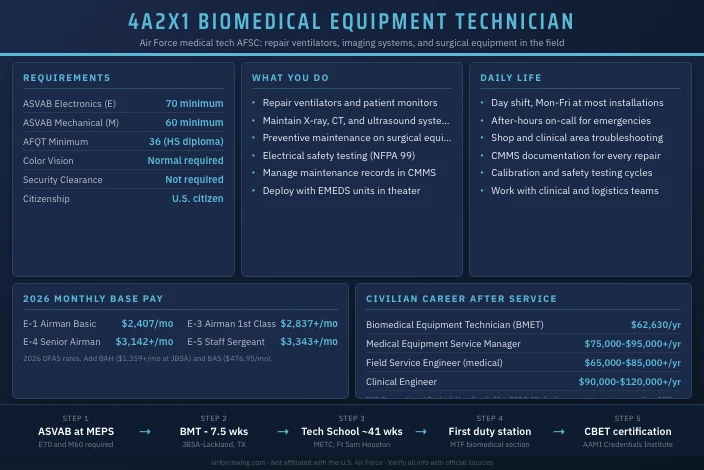
4A2X1 Biomedical Equipment Technicians install, maintain, calibrate, and repair diagnostic and therapeutic medical devices used across Air Force medical treatment facilities. They inspect equipment for safety and regulatory compliance, perform scheduled preventive maintenance, troubleshoot malfunctions to the component level, and manage maintenance documentation for every device in their section. The role spans clinical environments from primary care clinics to forward-deployed surgical units.
Daily Tasks
A typical workday starts with reviewing the maintenance work order queue. Technicians triage incoming repair requests, prioritize by clinical criticality, and dispatch to the equipment location. A non-functional patient monitor in a clinic gets same-day attention; a backup infusion pump with a minor calibration drift might be scheduled for the next maintenance window.
Beyond reactive repairs, preventive maintenance is a constant. Every piece of medical equipment has a defined service interval, and BMETs own that schedule. They run electrical safety tests per NFPA 99 standards, verify calibration against known reference standards, and document results in the computerized maintenance management system (CMMS). If a device fails inspection, it goes out of service until corrected.
A significant portion of the job is administrative. Every repair, calibration, and inspection is documented. Equipment records must withstand medical accreditation audits, which means technicians who get the paperwork wrong create problems that extend beyond their own section.
Specific Roles
| Code | Title | Description |
|---|---|---|
| 4A231 | Biomedical Equipment Technician (Apprentice) | Entry-level; repairs under direct supervision; completing OJT task certification |
| 4A251 | Biomedical Equipment Technician (Journeyman) | Fully qualified; works independently on most equipment categories |
| 4A271 | Biomedical Equipment Technician (Craftsman) | Senior technician or NCO supervisor; manages sections and complex troubleshooting |
| 4A291 | Biomedical Equipment Technician (Superintendent) | Senior enlisted leader for the Biomedical Equipment section; advises the Clinical Engineering officer |
There are no formal shredout codes within 4A2X1. Specialization happens through assignment and additional training. Some BMETs focus on diagnostic imaging systems, others on laboratory analyzers, and senior Airmen in the 78th Health Care Operations Squadron (HCOS) at Robins AFB support Air Force medical logistics and sustainment for the entire fleet.
Mission Contribution
Air Force medical readiness depends entirely on functional equipment. A deployed Expeditionary Medical Support (EMEDS) package carries surgical and critical care capability, but only if the equipment works. BMETs deploy with medical units to maintain that capability under field conditions where manufacturer service contracts don’t follow. On installations, they support care for active-duty members, their families, and retirees. Equipment failure in a military treatment facility can divert patients to civilian facilities, strain budgets, and delay care.
Technology and Equipment
The equipment range in this AFSC is wide. BMETs work on ventilators, patient monitors, infusion pumps, defibrillators, surgical instrument sets, sterilization equipment, laboratory analyzers (hematology, chemistry, blood bank), electrocardiograph systems, ultrasound units, digital X-ray systems, and computed tomography scanners. They also maintain facilities management systems such as medical gas systems and vacuum sources in clinical environments. Air Force BMETs must maintain an Air Force Network License to access IT systems used for maintenance management.
Salary
Base Pay and Allowances
Air Force BMETs receive the same base pay as all enlisted Airmen at equivalent rank and years of service. The 2026 DFAS pay tables show the following monthly base pay for the ranks most Airmen hold during their first enlistment:
| Rank | Grade | Monthly Base Pay (less than 2 years) |
|---|---|---|
| Airman Basic | E-1 | $2,407 |
| Airman | E-2 | $2,698 |
| Airman First Class | E-3 | $2,837 |
| Senior Airman | E-4 | $3,142 |
| Staff Sergeant | E-5 | $3,343 |
| Technical Sergeant | E-6 | $3,401 |
Base pay is only part of total compensation. The Basic Allowance for Subsistence (BAS) adds $476.95 per month for all enlisted members in 2026. The Basic Allowance for Housing (BAH) varies by duty location, pay grade, and dependent status. At Joint Base San Antonio, a single E-4 receives $1,359 per month in BAH; with dependents, that rises to $1,728. Both allowances are tax-free, which meaningfully increases the real value of the compensation package beyond what base pay alone suggests.
The Air Force pay calculator at airforce.com estimates total monthly compensation by rank and duty location.
Additional Benefits
All active-duty Airmen receive TRICARE Prime with no enrollment fees, no deductibles, and no copays for care at military treatment facilities. Coverage includes medical, dental, vision, mental health, prescriptions, and hospitalization. For an AFSC that works daily alongside clinical staff, understanding the system from the equipment side adds practical depth to that benefit.
The Post-9/11 GI Bill covers 100% of in-state tuition at public universities after 36 months of active service, or up to $29,920.95 annually at private institutions for the 2025-2026 academic year. A monthly housing allowance and $1,000 book stipend come with it. BMETs who want to pursue an associate’s or bachelor’s degree in biomedical technology after separation will find this benefit covers a large share of the cost.
Tuition Assistance covers up to $4,500 per year in tuition at $250 per semester credit hour, allowing technicians to work toward a degree while still on active duty.
Retirement and Work-Life Balance
The Blended Retirement System (BRS) combines a 20-year pension at 40% of high-36 average basic pay with Thrift Savings Plan (TSP) matching. The Air Force automatically contributes 1% of base pay to TSP after 60 days, and matches up to an additional 4% based on member contributions. Airmen who separate before 20 years keep their TSP balance.
Airmen accrue 30 days of paid leave annually with 11 federal holidays. BMET schedules at most installations follow a standard day-shift pattern, Monday through Friday, with on-call rotation for after-hours equipment failures. That schedule is more predictable than many medical specialties, which makes it easier to manage education and family commitments around duty.
Qualifications
Requirements Table
| Requirement | Minimum Standard |
|---|---|
| ASVAB Electronics (E) composite | 70 |
| ASVAB Mechanical (M) composite | 60 |
| AFQT (HS diploma) | 36 |
| AFQT (GED) | 65 |
| Age | 17-42 |
| Citizenship | U.S. citizen |
| Color Vision | Normal (required) |
| Security Clearance | None required |
| Medical | Normal, per accession standards |
The E70 and M60 composite requirement is the most distinctive qualification gate for 4A2X1. Most Air Force medical AFSCs qualify on a General (GEND) or Administrative (ADMI) composite. BMET is different, it demands strong Electronics and Mechanical scores, reflecting the actual technical content of the job. The Electronics composite draws from General Science, Arithmetic Reasoning, Mathematics Knowledge, and Electronics subtests. The Mechanical composite draws from General Science, Auto/Shop, Mathematics Knowledge, and Mechanical subtests.
The E70 threshold is above average for Air Force enlisted jobs. If your current Electronics composite is below 70, focused ASVAB prep on the Electronics and Mathematics Knowledge subtests is the fastest path to qualifying. An ASVAB study guide with Electronics practice sections will show you exactly where to focus.
High school coursework in algebra, trigonometry, mechanics, general sciences, and biology is noted as desirable in the CFETP. Applicants with that background typically find the Tech School curriculum more manageable.
Normal color vision is mandatory. BMETs read color-coded wiring diagrams, interpret color-coded calibration standards, and work with labeled medical device indicators where color differentiation directly affects safe operation.
No security clearance is required for 4A2X1.
Application Process
The path to 4A2X1 starts with the ASVAB at a Military Entrance Processing Station (MEPS). After the ASVAB, you’ll complete a physical examination at MEPS and submit your AFSC preferences to your recruiter. BMET seats are competitive because the AFSC requires a relatively high composite score and the training pipeline is long. Meeting the minimum score doesn’t guarantee selection, available training quotas and the needs of the Air Force determine who gets the slot.
From first recruiter contact to ship date, the timeline typically runs three to six months. Some applicants wait longer if BMET training class seats are limited.
Service Obligation
Enlisting as a 4A2X1 requires a minimum four-year active-duty service obligation. Airmen enter at E-1 (Airman Basic) unless they have qualifying college credits. Fifteen or more semester hours of college credit qualifies for E-2 entry; 45 or more hours qualifies for E-3. Prior service members may receive credit for previous time in grade.
If you’re still working on your ASVAB Electronics score, a PiCAT prep course can help you get ready for the verification test that determines your qualifying score.
Work Environment
Setting and Schedule
BMETs work in the Biomedical Equipment section of the Medical Maintenance Flight, which sits under the Medical Support Squadron of the host Medical Group. Unlike most medical jobs, BMETs spend significant time moving between multiple work areas rather than staying in one location:
- BMET shop: primary workspace with test benches, calibration standards, reference documentation, and specialized tools
- Clinical areas: patient care spaces throughout the MTF where equipment is installed and serviced on-site
- Operating rooms and sterile processing: for surgical equipment maintenance requiring strict infection control protocols
- Deployed EMEDS facilities: field medical units where equipment maintenance happens under austere conditions
The standard schedule is Monday through Friday, day shift, at most permanent installations. After-hours on-call rotation covers emergency equipment failures during evenings and weekends. Deployed environments eliminate the standard schedule entirely. BMETs in theater work when the mission requires it.
Leadership and Communication
BMETs work within the medical group structure but are more closely integrated with equipment officers and clinical engineers than with physician or nursing chains of command. The section NCOIC (typically a TSgt or MSgt) manages daily workflow, task assignments, and OJT progression for junior technicians. Performance feedback follows the Air Force Enlisted Performance Report (EPR) system, with formal performance counseling (ACA) at the E-3 and below level.
Communication requirements are broad. BMETs interact daily with clinical staff who need equipment returned to service, with medical logistics personnel who manage parts procurement, and with external service representatives on complex systems under manufacturer support contracts.
Team Dynamics
Small sections are standard for BMET. A medium-sized MTF might have 6 to 12 technicians covering several hundred pieces of equipment. That means each technician carries a broad portfolio of device types rather than specializing narrowly. Junior technicians work under direct supervision until they earn their 5-skill level, then operate more independently across the full equipment inventory.
Technicians who perform well here tend to be methodical, comfortable with electrical troubleshooting, and steady under pressure when clinical staff are waiting on a critical device. The job rewards people who read service manuals carefully and diagnose systematically rather than guessing.
Job Satisfaction
BMET tends to attract Airmen who want technical depth over patient-facing clinical work. The satisfaction comes from diagnosing a complex failure, fixing it cleanly, and returning a piece of equipment that the clinical team depends on. Retention in this AFSC is competitive relative to other medical fields because the skills are directly portable to a civilian career with strong demand. Airmen who earn the CBET (Certified Biomedical Equipment Technician) credential while in service consistently report stronger job satisfaction and higher confidence during civilian transition.
Training
Training Pipeline
| Phase | Location | Duration | Focus |
|---|---|---|---|
| Basic Military Training (BMT) | JBSA-Lackland, TX | 7.5 weeks | Military fundamentals, fitness, core values |
| Tech School (BMET Initial Skills) | METC, JBSA-Fort Sam Houston, TX | ~41 weeks (~207 days) | Electronics fundamentals, medical device systems, preventive maintenance, calibration, safety standards |
| On-the-Job Training (OJT) | First duty station | 12-18 months | Skill level upgrade from 3 to 5 under supervision |
After BMT, new Airmen report to the Medical Education and Training Campus (METC) at Joint Base San Antonio-Fort Sam Houston. METC runs the tri-service BMET program. Air Force, Army, and Navy students train together under the same curriculum. At 41 weeks, this is one of the longest initial skills training pipelines in the medical career field. The depth reflects the technical scope of the job.
The BMET curriculum covers electronics fundamentals (AC/DC circuits, semiconductors, signal processing), anatomy and physiology as it relates to medical instrumentation, patient safety standards (electrical safety testing per NFPA 99), calibration principles, preventive maintenance procedures, and system-level troubleshooting for each major equipment category. Students work on actual medical devices in hands-on lab environments throughout the course.
Upon completing Tech School, Airmen earn the 4A231 Apprentice designation and begin working under supervision at their first duty station.
Skill Level Upgrade
The 5-skill level upgrade happens at the first duty station through Career Development Courses (CDCs) and documented task qualification. CDCs are self-paced correspondence courses covering advanced biomedical equipment theory, Air Force medical maintenance policy, and systems management. Task qualification requires a supervisor to sign off on demonstrated proficiency across the full list of core BMET tasks.
Most technicians complete the 5-skill level upgrade within 12 to 18 months of arriving at their duty station.
Advanced Training Opportunities
Several development paths are available beyond the base 5-skill level:
- CBET certification: The Certified Biomedical Equipment Technician exam, administered through the AAMI Credentials Institute, is the industry-recognized credential for civilian BMETs. Air Force service provides direct preparation for this exam. Technicians who earn the CBET during service are significantly more competitive in the civilian job market.
- CompTIA certifications: A+, Network+, and Security+ certifications are recommended for 4A2X1 Airmen, particularly for those managing networked medical devices that connect to hospital information systems.
- Imaging-specific training: Some BMETs receive additional manufacturer or military training on specific modalities such as digital radiography, CT, or ultrasound systems.
- Advanced biomedical equipment courses: The Defense Health Agency and METC offer continuing education and advanced maintenance courses for senior NCOs.
College credits toward a Biomedical Equipment Technology degree are earned through the METC program. Tuition Assistance supports additional coursework during service, and many community colleges and universities offer articulation agreements that recognize the METC credential. An ASVAB study resource focused on Electronics and Math can help applicants who need to raise their composite score before shipping to BMT.
Career Progression
Rank and Skill Level Progression
| Skill Level | AFSC Code | Typical Rank | Typical Timeline |
|---|---|---|---|
| Apprentice (3-level) | 4A231 | Airman Basic to Airman First Class | Upon completing Tech School |
| Journeyman (5-level) | 4A251 | Senior Airman to Staff Sergeant | 12-18 months after Tech School |
| Craftsman (7-level) | 4A271 | Staff Sergeant to Technical Sergeant | After NCO rank and CDCs |
| Superintendent (9-level) | 4A291 | Senior Master Sergeant to Chief Master Sergeant | Senior leadership billet |
Promotion through E-4 (Senior Airman) is largely time-based for Airmen who meet performance standards. Above E-4, promotions are competitive and depend on Promotion Fitness Examination scores, EPR ratings, time in grade, and mandatory completion of professional military education (PME) at each level.
Career Flexibility
Retraining into 4A2X1 from another AFSC is possible after completing an initial enlistment, subject to available training quotas. Technicians can also move between active duty and Reserve or Guard components without retraining, retaining their AFSC and skill level. The 78th HCOS at Robins AFB, GA represents a specialized sustainment-focused career track for senior BMETs interested in Air Force-wide medical equipment logistics.
Performance Evaluation
The Enlisted Performance Report (EPR) rates performance across duty performance, leadership, and professional development. At E-3 and below, the ACA is the formal evaluation format. EPR ratings directly affect promotion eligibility for competitive grades (E-5 and above).
BMETs who build strong EPR records typically combine technical excellence with voluntary CBET certification, consistent PME completion, and mentorship of junior technicians. Section leaders who can demonstrate both equipment proficiency and personnel management skills accelerate through the Craftsman and Superintendent grades.
Physical Demands
Physical Requirements
BMET work is moderately physical. Technicians stand and move throughout clinical and shop environments for most of their shift, frequently kneel or crouch to access equipment at floor or under-desk level, and carry medical devices or test equipment weighing up to 50 pounds. Some large imaging system repairs require significant physical effort to access internal components. The job is not physically grueling, but it isn’t sedentary either.
All Airmen take the Air Force Fitness Assessment annually. The assessment scores four components on a 100-point scale, with a composite score of 75 or higher required to pass:
| Component | Maximum Points |
|---|---|
| 1.5-Mile Run | 60 |
| Push-Ups (1 minute) | 10 |
| Sit-Ups (1 minute) | 10 |
| Waist Circumference / Body Composition | 20 |
Standards are age- and gender-normed. Every component has a minimum threshold that must be met independently of the composite score. Failing the Fitness Assessment can affect EPR ratings and promotion eligibility.
Medical Evaluations
The initial accession exam at MEPS screens for disqualifying conditions. Normal color vision is mandatory and tested at MEPS. Once in service, periodic physical examinations follow Air Force Instruction intervals. BMETs who work with ionizing radiation-producing devices (X-ray and CT systems) may be enrolled in radiation monitoring programs with occupational health badge requirements.
Deployment
Deployment Details
4A2X1 Airmen deploy in support of Expeditionary Medical Support (EMEDS) packages and theater medical operations. A deployed EMEDS package requires full biomedical equipment maintenance support to function, which means BMETs deploy with the unit. Deployment lengths typically run 4 to 6 months, though specific mission requirements can vary.
Frequency depends on the unit’s deployment rotation. BMETs assigned to MTFs with active EMEDS associations will deploy more regularly than those at clinic-only facilities. Historically, Air Force medical personnel deploy less frequently than Army counterparts in equivalent roles, but rotational deployments to the Middle East, Africa, and Pacific theater are a realistic expectation across a full career.
Duty Stations
Duty stations follow the distribution of Air Force Medical Treatment Facilities. Installations with larger MTFs and medical centers generate more BMET billets:
- Wilford Hall Ambulatory Surgical Center, JBSA-Lackland/Fort Sam Houston, TX
- David Grant USAF Medical Center, Travis AFB, CA
- Wright-Patterson Medical Center, Wright-Patterson AFB, OH
- Mike O’Callaghan Federal Medical Center, Nellis AFB, NV
- Kirtland AFB, NM
- Ramstein AB, Germany (Europe’s primary USAF medical hub)
- Osan AB, South Korea
- Misawa AB, Japan
The 78th HCOS at Robins AFB, GA is a unique assignment for senior BMETs focused on Air Force-wide medical equipment sustainment and logistics rather than direct facility-level maintenance.
Risk/Safety
Job Hazards
BMETs face several occupational hazards during daily maintenance work:
- Electrical shock: Testing and repairing devices with line voltage or stored capacitor charge requires strict lockout/tagout procedures and appropriately rated test equipment
- Radiation exposure: Technicians who service X-ray, fluoroscopy, or CT equipment work near ionizing radiation sources and must follow dosimetry monitoring programs
- Biological contamination: Devices that have contacted patients carry infection risk; BMETs follow medical group biosafety and decontamination protocols before servicing
- Chemical exposure: Solvents, calibration gases, and cleaning agents used in equipment maintenance require proper ventilation and PPE
Deployed BMETs operate in the same threat environment as all deployed Air Force personnel, including potential exposure to combat hazards in forward or austere locations.
Safety Protocols
Air Force BMET operations follow NFPA 99 electrical safety standards, OSHA lockout/tagout requirements, and manufacturer-specific service procedures. Radiation work follows AFI 48-148 (Ionizing Radiation Protection). Infection control for contaminated devices follows medical group biosafety protocols. Test equipment calibration is traceable to national standards to ensure measurement accuracy.
Security and Legal Requirements
No security clearance is required to enter 4A2X1. All technicians must maintain an Air Force Network License to access the CMMS and networked medical device platforms. Network license requirements mean technicians comply with information assurance training and acceptable use policies, even though the role doesn’t require a formal clearance.
Technicians are responsible for maintaining accurate maintenance records. Documentation failures during a Joint Commission accreditation inspection can result in findings against the MTF, which creates command-level accountability.
Impact on Family
Family Considerations
BMET Airmen follow the standard Air Force permanent change of station (PCS) cycle, typically moving every two to four years. Families receive relocation support through Military OneSource, including moving allowances, temporary lodging, and access to installation family support services. On-base housing is available at most large installations, and BAH covers off-base costs.
The standard Monday-through-Friday day-shift schedule at most installations is more family-friendly than rotating clinical shifts. On-call rotation introduces some after-hours unpredictability, but the frequency is lower than roles with continuous shift coverage. Families should expect the after-hours call to pick up during periods of high equipment failure volume or prior to major inspections.
Key family support resources available to BMET Airmen:
- Military OneSource: Free 24/7 counseling, financial planning, and relocation assistance
- Airman & Family Readiness Center (A&FRC): On-installation support for PCS moves, spouse employment, and childcare referrals
- Military Spouse Employment Partnership: Connects spouses with employers who commit to hiring and retaining military spouses
- Exceptional Family Member Program (EFMP): Coordinates assignments to installations that can support family members with special medical or educational needs
Relocation and Flexibility
Airmen can submit assignment preferences through the Air Force Assignment Management System. Family hardship considerations factor into assignment decisions, though the needs of the Air Force take precedence. Spousal employment support is available through installation Family Support Centers and programs like the Military Spouse Employment Partnership. The BMET skill set is in demand nationwide, which means spouses who work in civilian healthcare facilities often find relevant employers near most major Air Force installations.
Deployment planning should start at the family level before the first PCS. Units with active EMEDS rotation schedules will brief Airmen and families on expected deployment cycles during in-processing.
Reserve and Air National Guard
Component Availability
4A2X1 is available in both the Air Force Reserve and the Air National Guard. Reserve and Guard BMETs fill positions at associated MTFs and medical units. The Air National Guard operates Biomedical Equipment sections at several state-level medical units, and some Guard states support civilian federal employee BMET positions associated with Guard medical facilities.
Drill Schedule and Training Commitment
The standard Reserve and Guard commitment is one Unit Training Assembly (UTA) weekend per month and two weeks of Annual Tour (AT) per year. For BMETs, this commitment generally aligns with the standard schedule. Some units require additional training days for equipment recertification or competency validation, particularly units supporting EMEDS or medical readiness exercises.
Component Comparison
| Factor | Active Duty | Air Force Reserve | Air National Guard |
|---|---|---|---|
| Commitment | Full-time | ~39 days/year minimum | ~39 days/year minimum |
| E-4 Monthly Pay (drill) | $3,142/mo base | ~$410/month (2 UTAs) | ~$410/month (2 UTAs) |
| Healthcare | TRICARE Prime (free) | TRICARE Reserve Select (premiums apply) | TRICARE Reserve Select (premiums apply) |
| Education | Full Tuition Assistance + GI Bill | Federal TA available; GI Bill after mobilization | State tuition waivers vary by state |
| Deployment tempo | Rotational, mission-dependent | Occasional mobilizations | Occasional mobilizations |
| Retirement | 20-year pension (BRS) | Points-based Reserve retirement | Points-based Reserve retirement |
TRICARE Reserve Select requires monthly premium payments, unlike active-duty TRICARE Prime. That gap in healthcare cost is the largest day-to-day benefit difference between components for most Airmen.
Guard BMETs in states with biomedical technology-focused educational partnerships may find the combined civilian income, Guard stipend, and state tuition benefit competitive with active-duty compensation if they’re simultaneously pursuing an associate’s or bachelor’s degree in biomedical equipment technology.
Civilian Career Integration
BMET is one of the Air Force specialties where Reserve or Guard service pairs exceptionally well with a civilian career in the same field. Civilian hospital BMET departments and independent service organizations employ Guard and Reserve technicians directly, and military maintenance experience, with its emphasis on documentation, safety standards, and broad equipment coverage, is viewed favorably by civilian clinical engineering managers. USERRA protections prevent civilian employers from discriminating against Guard and Reserve members for military service obligations.
Post-Service
Civilian Transition
4A2X1 training maps almost directly onto civilian BMET employment. Separating Airmen can enter civilian practice at the technician level immediately after service, and the CBET certification earned during service satisfies the credential requirement that most hospital systems and independent service organizations require for senior technician roles.
The Transition Assistance Program (TAP) provides counseling, resume support, and job placement resources for separating Airmen. Hiring Our Heroes connects transitioning service members with civilian employer fellowships, including healthcare system partners that actively recruit veterans with technical maintenance backgrounds.
Civilian Career Prospects
| Job Title | Median Annual Salary (May 2024) | Job Outlook (2024-2034) |
|---|---|---|
| Biomedical Equipment Technician (BMET) | $62,630 | +13% (much faster than average) |
| Clinical Engineer | $90,000-$120,000+ | Growing |
| Medical Equipment Service Manager | $75,000-$95,000+ | Growing |
| Field Service Engineer (medical devices) | $65,000-$85,000+ | Growing |
Salary and outlook data from the Bureau of Labor Statistics Occupational Outlook Handbook. About 7,300 medical equipment repairer job openings are projected annually through 2034, driven by the expansion of medical technology across hospitals, imaging centers, and outpatient facilities.
The 13% growth projection is exceptional, it’s well above the average for all occupations. An aging population, increased use of complex diagnostic equipment, and the expansion of ambulatory care settings are all driving demand for qualified BMETs. Veterans with 4A2X1 training and a CBET credential enter this market in a strong position.
Further Education Pathways
Military BMET experience opens several advanced civilian education paths:
- Associate’s degree in Biomedical Equipment Technology: METC training earns transferable credits; most programs can be completed in one to two additional years
- Bachelor’s degree in Clinical Engineering: extends into hospital-level equipment planning, capital budgeting, and program management
- Biomedical Engineering (BSBE or MSBE): for technicians interested in design and R&D rather than maintenance; GI Bill covers much of the cost at public universities
Is This a Good Job
Ideal Candidate Profile
4A2X1 fits Airmen who want technical depth and a direct civilian career payoff. You’re a good match if:
- Electronics and mechanics come naturally to you, the E70 composite is a meaningful bar
- You want STEM work without spending four years in a lab or research setting
- You’d rather fix things than treat patients
- You have patience for systematic troubleshooting when the problem isn’t immediately obvious
- You want a civilian career path that’s clear from day one and doesn’t require additional licensing after separation
Potential Challenges
The E70 Electronics composite requirement screens out a significant share of applicants. If you’re near the threshold, the Tech School curriculum will feel steep. The course is 41 weeks long, which is demanding relative to most enlisted technical programs. Some students find the combination of electronics theory, anatomy, and medical safety standards hard to absorb simultaneously.
The job itself can be frustrating when parts lead times are long and clinical staff are pressuring you to return equipment they’re short of. Documentation requirements are extensive, and accreditation inspections create periodic high-stress periods for the entire section. If you prefer varied work over repetitive processes, be aware that preventive maintenance cycles create a predictable, recurring workload that dominates much of the schedule.
Career advancement to senior NCO grades is competitive in a small AFSC. BMETs who want to advance to Chief Master Sergeant should proactively earn certification, pursue education, and take on supervisory roles early in their career rather than relying solely on technical proficiency.
Career and Lifestyle Alignment
If your goal is a civilian STEM career in healthcare technology, with solid pay, steady job growth, and a clear credential path, 4A2X1 is one of the most direct paths available to enlisted Airmen. You enter the civilian market with verified technical training, documented maintenance experience, and the CBET within reach. The work environment is more structured and predictable than clinical roles, which suits Airmen with families or who are pursuing a degree simultaneously.
If you want patient contact, emergency medicine exposure, or a path toward clinical licensure, a different medical AFSC is a better fit. 4A2X1 is specifically right for people drawn to the technology side of healthcare rather than the care delivery side.
More Information
Contact an Air Force recruiter to confirm current ASVAB score requirements, available training seats, and any active incentives for 4A2X1. Recruiter contact information is at airforce.com. If your Electronics composite isn’t at 70 yet, an ASVAB prep course with Electronics practice is the most direct way to close that gap before your MEPS appointment.
Official resources:
- airforce.com Biomedical Equipment Specialist, official entry requirements and career overview
- METC Biomedical Equipment Technician Program, joint service training campus where Air Force BMET Tech School is conducted
- BLS Medical Equipment Repairers outlook, civilian salary and job growth figures used in this guide
- O*NET Medical Equipment Repairers, detailed skills and knowledge requirements for civilian BMET roles
Practical next steps:
The E70 Electronics composite is built from General Science, Arithmetic Reasoning, Mathematics Knowledge, and Electronics subtests. If your current score is below 70, focus your ASVAB prep on the Electronics and Math subtests specifically.
Normal color vision is tested at MEPS and is non-waiverable for this AFSC. High school coursework in algebra, trigonometry, or electronics will reduce the learning curve in Tech School, if you have time before your ship date, those subjects are worth reviewing.
If you have prior experience in electronics repair, IT hardware, or industrial maintenance, discuss that background with your recruiter. While it doesn’t change the ASVAB requirement, it may support your case for a BMET training seat if slots are competitive.
This site is not affiliated with the U.S. Air Force or any government agency. Verify all information with official Air Force sources before making enlistment or career decisions.
Explore more Air Force medical careers such as the 4N0X1 Aerospace Medical Technician and the 4P0X1 Pharmacy Technician to compare clinical and technical career paths across the medical field.