4A0X1 Health Services Management
Every Air Force clinic and hospital runs on two tracks simultaneously: the clinical side where providers treat patients, and the administrative side that makes those encounters possible. The 4A0X1 Health Services Management specialist owns that second track. Patient admissions, medical records, TRICARE eligibility, appointment scheduling, healthcare budgets, and medical readiness data all flow through this AFSC. Without it, the clinical staff can’t do their jobs.
This is not a desk job that requires zero medical knowledge. Health services managers work directly with clinical providers, patients, and the Defense Health Agency’s data systems. The ASVAB threshold is one of the more accessible in the medical career field, but the job demands precision, data fluency, and the ability to manage competing administrative priorities under time pressure. If you want a healthcare career that builds directly transferable management skills, the 4A0X1 is one of the cleanest paths from enlisted service to civilian healthcare administration. An ASVAB study guide will help you hit the General composite score this AFSC requires before you sit at MEPS.
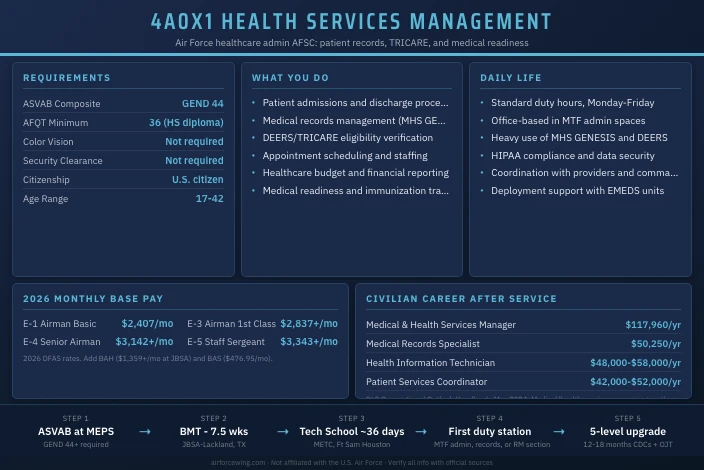
Job Role and Responsibilities
4A0X1 Health Services Management specialists administer the business operations of Air Force medical treatment facilities. They manage patient records, process admissions and discharges, handle financial statements and budget tracking, operate medical scheduling and staffing systems, and ensure healthcare data is accurate and complete. The role supports every patient encounter from check-in through post-visit documentation.
Daily Tasks
The core of the job is patient flow management. Health services managers handle admission and discharge paperwork, verify eligibility through the Defense Enrollment Eligibility Reporting System (DEERS), schedule appointments across multiple departments, and maintain the integrity of records in the Military Health System GENESIS electronic health record platform. A mistake in a patient record has real consequences for that patient’s care, so accuracy is a daily professional standard, not an occasional requirement.
Beyond direct patient administration, 4A0X1s manage financial data at the facility level. That means tracking healthcare budgets, preparing financial statements, and contributing to cost reports that inform command decisions about resource allocation. You won’t be the budget officer, but you’ll be working the data that budget officers rely on.
Medical readiness tracking is another significant piece of the role. Health services managers maintain deployment readiness records, monitor immunization and physical examination status for unit members, and generate reports that commanders use to assess mission readiness. If a squadron is about to deploy and someone’s medical records show a lapsed vaccination, that’s a 4A0X1 issue to flag and resolve.
IT security monitoring for medical computer systems rounds out the workload. Health services managers receive training on protecting patient data under HIPAA standards and the DoD’s health information security requirements. At smaller clinic locations, the 4A0X1 may be the de facto information system security point-of-contact for the medical unit.
Specialty Codes
| Code | Title | Description |
|---|---|---|
| 4A031 | Health Services Management (Apprentice) | Entry-level; completes initial skills training and begins on-the-job training at first duty station |
| 4A051 | Health Services Management (Journeyman) | Fully qualified; manages patient administration and records operations, may supervise junior personnel |
| 4A071 | Health Services Management (Craftsman) | Senior technician or NCO; oversees section operations, trains subordinates, advises on administrative policy |
| 4A091 | Health Services Management (Superintendent) | Senior enlisted leader; advises the Medical Support Squadron commander on all administrative operations |
There are no formal shredout codes for 4A0X1. Specialization happens through assignment, with some managers focusing on patient administration, others on medical records and HIM, and others on resource management functions at larger medical centers.
Mission Contribution
The Air Force Medical Service manages care for approximately 2.5 million beneficiaries. Every provider appointment, inpatient stay, referral, and prescription generates documentation and administrative data that has to be captured correctly. Health services managers are the people ensuring that data chain holds together. When a Medical Group commander needs a readiness report or a patient needs their records transferred for a PCS, the 4A0X1 makes it happen.
On the operational side, 4A0X1s deploy with Air Force Expeditionary Medical Support (EMEDS) packages. A theater medical unit without patient administration capability cannot track casualties, process medical records, or maintain readiness data for the supported force. Deployed health services managers fill that gap directly.
Technology and Equipment
The primary platform is MHS GENESIS, the DoD’s electronic health record system that replaced the legacy AHLTA system. Health services managers work in GENESIS daily for scheduling, records management, and clinical documentation support. They also use DEERS/RAPIDS for eligibility verification, CHCS (Composite Health Care System) components where still in use, and Defense Health Agency data systems for readiness reporting. These are enterprise-level healthcare IT platforms, not basic office software. Proficiency with them translates directly into civilian health information management careers.
Salary and Benefits
Base Pay and Allowances
4A0X1 Airmen receive the same base pay as all enlisted members at equivalent grade and years of service. Getting to this career field starts with a qualifying ASVAB score, and a study guide targeting the General composite is the most efficient preparation before MEPS. The 2026 DFAS pay tables show the following monthly base pay rates for the grades most health services managers hold during a first enlistment:
| Rank | Grade | Monthly Base Pay (less than 2 years) |
|---|---|---|
| Airman Basic | E-1 | $2,407 |
| Airman | E-2 | $2,698 |
| Airman First Class | E-3 | $2,837 |
| Senior Airman | E-4 | $3,142 |
| Staff Sergeant | E-5 | $3,343 |
| Technical Sergeant | E-6 | $3,401 |
Base pay is supplemented by tax-free housing and food allowances. The Basic Allowance for Subsistence (BAS) adds $476.95 per month for all enlisted members in 2026. The Basic Allowance for Housing (BAH) varies by duty location, grade, and dependent status. At Joint Base San Antonio, a single E-4 receives $1,359 per month in BAH; with dependents, that rises to $1,728. Both allowances are non-taxable.
The Air Force pay calculator at airforce.com estimates total monthly compensation including base pay, BAH, and BAS for any grade and duty location.
Additional Benefits
Active-duty Airmen receive TRICARE Prime at no cost: no premiums, no deductibles, no copays for care at military treatment facilities. Coverage includes medical, dental, vision, mental health, prescriptions, and hospitalization. For a healthcare administration career, working within TRICARE is genuinely useful background. You’ll understand the system you’ll later manage or work within as a civilian professional.
The Post-9/11 GI Bill covers 100% of in-state tuition at public universities after 36 months of service, or up to $29,920.95 per academic year at private schools for 2025-2026. A monthly housing allowance and $1,000 annual book stipend add to that. For Airmen planning to pursue a healthcare administration or health information management degree after separation, this benefit is substantial. While still on active duty, Tuition Assistance covers up to $4,500 per year at $250 per semester credit hour.
Retirement and Work-Life Balance
The Blended Retirement System (BRS) combines a pension at 40% of high-36 average basic pay after 20 years with Thrift Savings Plan matching. The Air Force automatically contributes 1% of base pay to TSP after 60 days and matches up to 4% more based on member contributions. Airmen who separate before 20 years keep their TSP balance.
Health services management operates on standard duty hours at most installations. This is not a shift-work role in the clinical sense. Daytime business hours are the norm, with some variation for 24-hour medical center environments. Airmen accrue 30 days of paid leave annually, with 11 federal holidays.
Qualifications and Eligibility
Requirements Table
| Requirement | Minimum Standard |
|---|---|
| ASVAB Composite | GEND 44 |
| AFQT (HS diploma) | 36 |
| AFQT (GED) | 65 |
| Age | 17-42 |
| Citizenship | U.S. citizen |
| Color Vision | Not specified as required |
| Security Clearance | None required at entry |
| Medical | Normal accession standards |
The qualifying composite is GEND 44. The Air Force General (GEND) composite draws from Word Knowledge, Paragraph Comprehension, Arithmetic Reasoning, and Mathematics Knowledge subtests. A 44 is an accessible threshold for well-prepared applicants, but it requires solid reading comprehension and basic math. If you’re starting below that number, an ASVAB prep course that covers the verbal and math sections can close the gap efficiently.
The GEND composite is one of the most commonly required composites in the Air Force. Preparing for it also improves your score on the Paragraph Comprehension and Word Knowledge subtests, which directly affect your AFQT overall. A higher AFQT keeps more AFSCs available to you during the selection process.
The Air Force GEND composite combines Word Knowledge, Paragraph Comprehension, Arithmetic Reasoning, and Mathematics Knowledge. The minimum for 4A0X1 is GEND 44. Strengthening your reading comprehension is the most effective study focus for this composite.
Application Process
The path to 4A0X1 starts with a recruiter, followed by the ASVAB at a Military Entrance Processing Station (MEPS) and a physical examination. You’ll work with your recruiter to list AFSC preferences. Medical administrative AFSCs are assigned based on your composite score, available training seats, and the needs of the Air Force. Meeting the minimum score does not guarantee selection; competitive applicants tend to score above the minimum.
From recruiter contact to ship date, the typical timeline is three to six months. That window can extend if training class seats for 4A0X1 are limited or if MEPS processing takes longer than expected.
Service Obligation
Enlisting as a 4A0X1 requires a minimum four-year active-duty service obligation. You enter at E-1 (Airman Basic) unless qualifying college credits apply. Airmen with 15 or more semester hours of college credit can enter at E-2; those with 45 or more hours enter at E-3. Prior service members may receive credit for time in grade.
ASVAB score requirements can change when the Air Force updates AFI 36-2101. Verify the current GEND composite requirement with your recruiter before preparing for the test. The figures here reflect the most recent publicly available data from official sources.
Work Environment
Setting and Schedule
Health services managers work in military treatment facility administrative spaces: patient registration desks, medical records rooms, resource management offices, and clinic coordination centers. The environment is office-based and indoors, quieter than clinical treatment areas. At large medical centers like David Grant USAF Medical Center at Travis AFB or Wilford Hall Ambulatory Surgical Center at JBSA, the section may have ten or more 4A0X1s working in specialized functions. At smaller installations, one or two managers may handle the entire administrative portfolio.
Standard duty hours are the norm. Most health services management positions operate on a Monday-through-Friday schedule during normal business hours, though some positions at facilities with extended care hours may require occasional early or late shifts. This is generally one of the more schedule-predictable AFSCs in the medical career field.
Leadership and Communication
4A0X1s work under the Medical Support Squadron (MDSS) within the Medical Group structure. The MDSS typically includes patient administration, medical records, resource management, and information management functions under a single commander. The AFSC’s NCO chain reports up through the MDSS superintendent to the MDSS commander, who is a commissioned officer. At larger facilities, each administrative function may have its own dedicated NCO chain.
Performance feedback follows the standard Air Force Enlisted Performance Report (EPR) system. Initial feedback comes at six months for new Airmen. Annual EPR ratings thereafter cover duty performance, leadership, and professional development.
Team Dynamics
Administrative work in a medical setting is interdependent. Patient registration errors affect billing. Records management failures affect care continuity. Budget reporting errors affect resource allocation decisions that go above the flight level. That interdependence means 4A0X1s work closely with other sections and with clinical staff. The job requires communication skills, not just data skills.
Individual accountability is real. Errors in patient records or DEERS eligibility can delay care or create compliance problems under HIPAA and DoD health information policies. Airmen who succeed in this role tend to be methodical, comfortable with data systems, and willing to own mistakes and correct them quickly.
Job Satisfaction
Health services management attracts Airmen who want to contribute to healthcare without working in a clinical treatment role. The work is consequential and measurable. The career skills, particularly EHR proficiency and healthcare data management, translate directly into civilian employment. Most Airmen in this AFSC report that the learning curve is steepest in the first year, when they’re building proficiency across multiple systems simultaneously. After the 5-skill level upgrade, the role becomes more autonomous and more supervisory.
Training and Skill Development
Training Pipeline
| Phase | Location | Duration | Focus |
|---|---|---|---|
| Basic Military Training (BMT) | JBSA-Lackland, TX | 7.5 weeks | Military fundamentals, fitness, Air Force core values |
| Tech School (Initial Skills) | METC, JBSA-Fort Sam Houston, TX | ~36 days (~5 weeks) | Patient administration, medical records, healthcare IT systems, HIPAA compliance, DEERS/GENESIS operations |
| On-the-Job Training (OJT) | First duty station | 12-18 months | Skill level upgrade from 3 to 5 under supervisor oversight |
Tech School for 4A0X1 is among the shortest in the Air Force medical career field at approximately 36 days. That means most new 4A0X1s arrive at their first duty station within about three months of leaving for BMT. The academic content covers patient admissions and discharge processing, medical records management standards, healthcare information systems, financial management basics, and HIPAA compliance. Students train alongside personnel from other services at the Medical Education and Training Campus (METC) at Joint Base San Antonio-Fort Sam Houston.
Completing Tech School earns the 4A031 apprentice designation. At this point, Airmen are qualified to work under supervision but have not completed the 5-skill level upgrade, which requires time and demonstrated task proficiency at the duty station.
Skill Level Upgrade
The 5-skill level upgrade (4A031 to 4A051) happens at the first duty station through Career Development Courses (CDCs) and supervisor-verified task qualification. CDCs are self-paced correspondence courses covering advanced health information management, operational administrative procedures, and Air Force medical policy. Task qualification requires a supervisor to certify proficiency across a defined list of core administrative tasks.
Most Airmen complete the upgrade within 12 to 18 months of arriving at their first duty station.
Advanced Training Opportunities
Senior 4A0X1s have several paths for professional development:
- Registered Health Information Technician (RHIT): The American Health Information Management Association (AHIMA) credential is attainable with an associate degree and RHIT exam passage. Air Force health services managers who pursue community college coursework while on active duty are well-positioned to test for this credential.
- Certified Healthcare Access Associate (CHAA): The National Association of Healthcare Access Management offers this credential for patient registration professionals, which aligns closely with the 4A0X1 journeyman scope of work.
- Defense Health Agency courses: DHA offers advanced courses in health information management, resource management, and operational medical administration for senior NCOs.
- Tuition Assistance supports off-duty coursework toward healthcare administration degrees. Airmen who start a health information management or healthcare administration associate or bachelor’s degree during service are ahead of civilian peers on the GI Bill path.
Before any of that starts, though, you need the ASVAB score to get in. A practice ASVAB resource that covers the General composite subtests is the most direct way to build the Word Knowledge, Paragraph Comprehension, and math skills that GEND 44 tests.
Career Progression and Advancement
Rank and Skill Level Progression
| Skill Level | AFSC Code | Typical Rank | Typical Timeline |
|---|---|---|---|
| Apprentice (3-level) | 4A031 | Airman Basic to Airman First Class | Upon completing Tech School |
| Journeyman (5-level) | 4A051 | Senior Airman to Staff Sergeant | 12-18 months after Tech School |
| Craftsman (7-level) | 4A071 | Staff Sergeant to Technical Sergeant | After NCO rank and CDC completion |
| Superintendent (9-level) | 4A091 | Senior Master Sergeant to Chief Master Sergeant | Senior leadership billet |
Promotion through E-4 (Senior Airman) is largely time-based for Airmen who meet performance standards. Above E-4, promotions are competitive and driven by Promotion Fitness Examination scores, EPR ratings, time in grade, and completion of Professional Military Education (PME). Health services management has historically been a competitive field for promotion because the administrative skill set is valued at senior NCO levels.
Career Flexibility
Retraining into 4A0X1 from another AFSC is possible after an initial enlistment. Requests go through the Air Force Assignment Management System and depend on available training quotas and service needs. Conversely, some 4A0X1 Airmen retrain into healthcare administration roles with more clinical exposure or into cyber or logistics fields where their data systems background applies.
Active-duty Airmen who separate and join the Air Force Reserve or Air National Guard can typically retain their AFSC and skill level without retraining, moving into equivalent positions at Guard or Reserve-associated medical units.
Performance Evaluation
The Enlisted Performance Report (EPR) is the formal performance record. For E-3 and below, it’s the ACA, the annual performance review for junior enlisted Airmen. At E-4 and above, the EPR rates duty performance, leadership, and professional development. EPR ratings directly affect promotion eligibility at E-5 and above, where promotions are competitive.
Airmen who advance quickly in this AFSC typically pursue RHIT or CHAA certification, volunteer for additional duties like section training manager or unit fitness program manager, complete PME ahead of required timelines, and take on supervisory responsibility for junior Airmen before the 7-level upgrade.
Physical Demands and Medical Evaluations
Physical Requirements
Health services management is primarily a sedentary-to-light-activity role. The daily physical demands are low: seated workstation time, walking between offices, occasional lifting of supply or records materials up to 40 pounds. There are no AFSC-specific physical fitness requirements beyond the standard Air Force Fitness Assessment, which applies to all Airmen.
The Air Force Fitness Assessment is administered annually and scores four components on a 100-point scale:
| Component | Maximum Points |
|---|---|
| 1.5-Mile Run | 60 |
| Push-Ups (1 minute) | 10 |
| Sit-Ups (1 minute) | 10 |
| Waist Circumference / Body Composition | 20 |
A composite score of 75 or higher is required to pass. Every component has a minimum threshold that must be met in addition to the composite. Standards are age- and gender-normed. An unsatisfactory Fitness Assessment score can appear on the EPR and directly affect promotion eligibility.
Medical Evaluations
The initial MEPS physical screens for any disqualifying conditions under Air Force accession medical standards. Once in service, periodic physical examinations are required at intervals set by Air Force Instruction. No special occupational health monitoring is required for 4A0X1 as a baseline. Airmen assigned to roles involving extended computer use may receive ergonomic assessments through base occupational health programs, but this is a standard workplace accommodation rather than a medical surveillance requirement.
Deployment and Duty Stations
Deployment Details
4A0X1s deploy in support of Air Force Expeditionary Medical Support (EMEDS) packages and other theater medical operations. Patient administration is a core function of any deployed medical unit, so health services managers deploy when their unit is tasked. Deployments are typically 4 to 6 months in length, though mission requirements vary.
Deployment frequency is lower than for many Air Force career fields. Administrative personnel at installations without primary EMEDS assignment may deploy less often than clinical staff. That said, rotational deployments to the Middle East, Africa, and Pacific theater locations are a realistic expectation over a full career.
Duty Stations
Assignments go where Air Force medical treatment facilities operate. Installations with larger MTFs and greater 4A0X1 billet density include:
- Joint Base San Antonio, TX (Wilford Hall Ambulatory Surgical Center)
- Travis AFB, CA (David Grant USAF Medical Center)
- Wright-Patterson AFB, OH (Wright-Patterson Medical Center)
- Keesler AFB, MS (81st Medical Group)
- Langley AFB / Joint Base Langley-Eustis, VA
- Overseas locations: Ramstein AB (Germany), Misawa AB (Japan), Osan AB (South Korea)
MTF size shapes the scope of the job. A large regional medical center offers exposure to inpatient admissions, resource management, and complex GENESIS operations. A smaller base clinic may have one or two 4A0X1s handling everything, which develops broad skills faster but with less depth in any single function.
Risk, Safety, and Legal Considerations
Job Hazards
Occupational exposure: Health services management carries no significant physical occupational hazards. Ergonomic risks from extended computer work are managed through standard workplace accommodation programs. There is no inherent combat-specific hazard to the role itself, though deployed 4A0X1s operate in the same general threat environment as all deployed Air Force personnel.
Safety Protocols
HIPAA compliance is the primary safety and compliance requirement for this AFSC. Patient health information is protected under HIPAA and DoD health information security policies. Key data security obligations include:
- Proper handling and storage of protected health information (PHI) in all formats
- Role-based access controls in MHS GENESIS and legacy health record systems
- Annual information assurance training and HIPAA refresher certification
- Reporting suspected data breaches through the chain of command and installation privacy officer
Violations can result in administrative action under Air Force Instruction or, in serious cases, legal consequences under federal law.
Security and Legal Requirements
No security clearance is required to enter 4A0X1. Most positions in this AFSC do not require a clearance, though access to sensitive medical records systems is controlled through information assurance credentials and role-based access in MHS GENESIS. Airmen with prior criminal history involving fraud or identity-related offenses may face additional scrutiny during the background investigation process given the nature of the data this role handles.
Impact on Family and Personal Life
Family Considerations
4A0X1 Airmen follow the same permanent change of station (PCS) cycle as all Air Force members, typically moving every two to four years. Relocation support comes through Military OneSource, the Air Force Aid Society, and installation Airman and Family Readiness Centers. On-base housing is available at most larger installations; BAH covers off-base housing costs.
The work schedule is one of the more family-friendly in the Air Force medical career field. Standard duty hours without shift rotation means evenings and weekends are generally protected. That predictability matters for families with school-age children or spouses with civilian employment. Extended deployments are a realistic variable to plan around, but the frequency is lower than for clinical specialties with higher EMEDS rotation rates.
Relocation and Flexibility
Assignment preferences can be submitted through the Air Force Assignment Management System. Family hardship considerations factor into assignment decisions, though the needs of the service take precedence. Key support resources for relocating families:
- Military Spouse Employment Partnership (MSEP): Connects military spouses with employers committed to hiring and retaining them across PCS moves
- Airman and Family Readiness Centers: Installation-level relocation counseling, financial planning, and community orientation
- Military OneSource: Free counseling, legal support, and transition assistance available regardless of duty location
Reserve and Air National Guard
Component Availability
4A0X1 is available in both the Air Force Reserve and the Air National Guard. Both components maintain health services management positions at medical units and at Reserve and Guard-associated MTF detachments. The Air National Guard, in particular, operates administrative positions at state-level medical units and may offer dual-status civilian technician positions for Guard members who want to work full-time in the same role they drill in.
Drill Schedule and Training Commitment
The standard commitment is one Unit Training Assembly (UTA) weekend per month plus two weeks of Annual Tour (AT). For 4A0X1, this commitment is generally consistent with the standard schedule. Medical records recertification and GENESIS system access renewal may require occasional additional training days beyond the standard drill weekend. Units assigned to active EMEDS-affiliated missions may have more frequent exercises.
Part-Time Considerations
A Reserve or Guard E-4 earns approximately $410 per month for two standard UTA drill days. Compared to active-duty E-4 base pay of $3,142 per month, the part-time financial package is a fraction of the active-duty total. But the civilian career integration potential is significant: a 4A0X1 Guard or Reserve member working in civilian healthcare administration during the week brings direct skill overlap between both roles.
Component Comparison
| Factor | Active Duty | Air Force Reserve | Air National Guard |
|---|---|---|---|
| Commitment | Full-time | ~39 days/year minimum | ~39 days/year minimum |
| E-4 Monthly Pay | $3,142/mo base | ~$410/month (2 UTAs) | ~$410/month (2 UTAs) |
| Healthcare | TRICARE Prime (no cost) | TRICARE Reserve Select (premiums apply) | TRICARE Reserve Select (premiums apply) |
| Education | Full TA + GI Bill | Federal TA available; GI Bill after mobilization | State tuition waivers vary by state |
| Deployment tempo | Rotational, mission-dependent | Occasional mobilizations | Occasional mobilizations |
| Retirement | 20-year BRS pension | Points-based Reserve retirement | Points-based Reserve retirement |
TRICARE Reserve Select requires monthly premium payments for Selected Reserve members not on active orders. The healthcare cost difference is the most significant day-to-day benefit gap between part-time and full-time service. Federal USERRA protections prevent civilian employers from discriminating against Guard and Reserve members for military obligations.
Civilian Career Integration
Health services administrators in the Guard or Reserve can work at civilian hospitals, outpatient clinics, health insurance companies, or medical billing organizations during the week. The skills overlap directly. GENESIS and DEERS proficiency may not map exactly to civilian EHR systems, but the health information management fundamentals transfer well. Many civilian healthcare employers view military medical administrative experience as a signal of reliability and data discipline.
Post-Service Opportunities
Civilian Transition
The 4A0X1 AFSC translates directly into civilian health information management and healthcare administration careers. The core skills, including EHR management, patient registration, HIPAA compliance, and healthcare data systems, are in consistent demand at hospitals, outpatient practices, insurance companies, and federal health agencies. Air Force health services managers who pursue RHIT or CHAA certification during service enter the civilian market as credentialed candidates, not just veterans with experience.
The Transition Assistance Program (TAP) provides counseling, resume workshops, and job search support for separating Airmen. The Hiring Our Heroes fellowship program connects transitioning service members with civilian employer internships, including healthcare system partners with strong veteran hiring records.
Civilian Career Prospects
| Job Title | Median Annual Salary (May 2024) | Job Outlook (2024-2034) |
|---|---|---|
| Medical and Health Services Manager | $117,960 | +23% (much faster than average) |
| Medical Records Specialist | $50,250 | +7% (faster than average) |
| Health Information Technician | $48,000-$58,000 | +7% (faster than average) |
| Patient Services Coordinator | $42,000-$52,000 | Steady growth |
Salary data sourced from the Bureau of Labor Statistics Occupational Outlook Handbook. The 23% growth projection for medical and health services managers through 2034 reflects an aging population, expanding healthcare system complexity, and increasing demand for professionals who can manage the data and administrative functions of healthcare delivery.
Entry-level roles like medical records specialist or patient services coordinator are the realistic first civilian position for most separating 4A0X1 Airmen. With a bachelor’s degree in health information management or healthcare administration plus a few years of civilian experience, the management-level salary range becomes achievable.
Further Education Pathways
Military health services management experience provides a direct foundation for:
- Bachelor of Science in Health Information Management (BS-HIM): AHIMA-accredited programs accept military experience as a component of the admissions application; GI Bill covers full tuition at public universities
- Registered Health Information Technician (RHIT): Associate-level AHIMA credential, testable after completing an accredited HIM program; maps directly to 4A0X1 duties
- Master of Health Administration (MHA) or Master of Business Administration with healthcare concentration: for Airmen targeting senior management roles in hospital systems or federal health agencies
- Certified Healthcare Access Associate (CHAA): offered by NAHAM; no degree required, aligns with patient registration and admissions experience from the 4A0X1 role
Is This a Good Job for You?
Ideal Candidate Profile
4A0X1 fits Airmen who want to contribute to healthcare without working in a clinical treatment role. You’re a strong match if:
- You’re detail-oriented and find errors in data before they become problems
- You’re comfortable working with multiple software systems simultaneously
- You want a clear civilian career path in healthcare administration or health information management
- You prefer structured, predictable duty hours over shift work or on-call schedules
- You like process and systems work alongside direct patient or team interaction
A healthcare background is not required. Strong reading comprehension, basic math, and an organized approach to administrative tasks are the practical prerequisites. The GEND 44 composite reflects that profile accurately.
Potential Challenges
This is not a clinical role. If you want to treat patients, perform procedures, or work in an emergency care environment, a different medical AFSC is the better fit. 4A0X1s support the clinical mission from the administrative side, which is consequential but is not the same as hands-on patient care.
The work can be repetitive during high-volume patient registration periods. Airmen who struggle with sustained attention to detail in data entry and documentation will find the error rate stressful. HIPAA compliance and health data security requirements are non-negotiable and carry real professional consequences if violated.
Career advancement to senior NCO grades in a purely administrative AFSC requires deliberate effort. Pursuing certification, completing PME early, and taking on supervisory responsibility before it’s required are the clearest differentiators.
Career and Lifestyle Alignment
If your goal is to leave military service with credentials and skills that translate directly into a civilian healthcare career, 4A0X1 is one of the most efficient paths available. The RHIT and CHAA credentials are achievable during service. Healthcare administration is one of the fastest-growing civilian sectors. The duty schedule supports educational progress during off-hours.
If your primary goal is clinical experience, emergency medicine exposure, or deployment medical operations in a treatment role, the 4N0X1 or 4H0X1 AFSCs are better choices. This AFSC is the right fit specifically for Airmen who want the healthcare environment with the administrative and management track.
More Information
Talk to an Air Force recruiter to confirm current ASVAB composite requirements, open training seat availability, and any active enlistment incentives for 4A0X1. Recruiter contact information and career details are at airforce.com. If you’re still building your GEND composite score, an ASVAB study guide with practice tests will help you target the Word Knowledge, Paragraph Comprehension, and math subtests that drive the General composite.
Official resources:
- airforce.com Health Services Management, official entry requirements and career overview
- Medical Education and Training Campus (METC), Tech School location and joint service medical training information
- BLS Medical and Health Services Managers, civilian salary and job outlook data referenced in this guide
- BLS Medical Records Specialists, entry-level civilian role salary and growth data
Practical next steps:
The GEND 44 composite is built from reading and math skills. Word Knowledge and Paragraph Comprehension carry significant weight. If you’re below 44, focus your ASVAB prep on vocabulary and reading comprehension before the test date.
If you have prior healthcare administrative experience in a civilian setting, mention it to your recruiter. It won’t change your entry rank, but it signals genuine preparation for the Tech School content and the first-duty-station learning curve.
This site is not affiliated with the U.S. Air Force or any government agency. Verify all information with official Air Force sources before making enlistment or career decisions.
Explore more Air Force medical careers including 4P0X1 Pharmacy Technician and 4N0X1 Aerospace Medical Technician to compare administrative and clinical tracks within the same career field.