2P0X1 Precision Measurement Equipment Laboratory
Every Air Force aircraft inspection, every avionics test, every torque spec on a critical fastener, all of it depends on test equipment that has been recently calibrated and certified. The 2P0X1 Precision Measurement Equipment Laboratory specialist is the person who makes that certification happen. PMEL technicians calibrate, repair, and modify test, measurement, and diagnostic equipment across the entire Air Force to standards traceable to the National Institute of Standards and Technology. If precision measurement and hands-on electronics work sound more interesting than turning wrenches on the flight line, this AFSC puts you at the intersection of engineering and quality assurance.
The job’s appeal goes beyond the Air Force itself. Calibration technicians are in steady demand across defense, aerospace, semiconductor manufacturing, and pharmaceuticals. The civilian salary data reflects it: the Bureau of Labor Statistics puts median pay for calibration technologists at $65,040 per year, with experienced specialists reaching well above $100,000. Military experience translates directly to those civilian credentials.
Before you can enlist for 2P0X1, you need an Electronics (E) composite score of 70 on the ASVAB, the highest electronics threshold in the maintenance career group. Our ASVAB study guide covers the General Science, Arithmetic Reasoning, Mathematics Knowledge, and Electronics subtests that make up the ELEC composite.
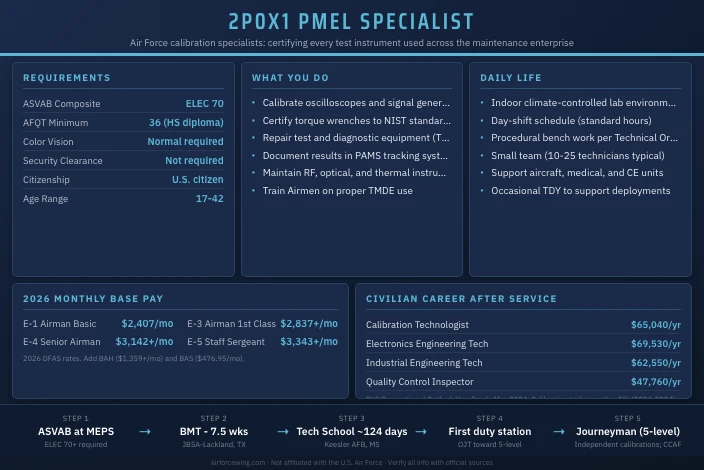
Job Role
2P0X1 PMEL specialists calibrate, repair, and modify test, measurement, and diagnostic equipment (TMDE) used across every Air Force maintenance discipline. They verify that instruments meet exact tolerances, record and report maintenance data, manage technical order distributions, and train other Airmen on proper use of measurement equipment. The AFSC covers electrical, mechanical, optical, pressure, and thermal measurement systems, essentially any instrument used to confirm that another piece of equipment meets its specifications.
Daily Tasks
The nature of PMEL work is methodical. A typical day involves pulling equipment from the unit’s test equipment inventory, performing calibration procedures against published standards, documenting results, and either returning certified equipment to service or flagging it for repair. Specific tasks include:
- Calibrating avionics test sets, oscilloscopes, multimeters, and signal generators
- Testing and certifying torque wrenches, pressure gauges, and flow measurement devices
- Repairing TMDE that falls outside tolerance specifications
- Documenting calibration results in the Air Force’s Test Measurement and Diagnostic Equipment Management System (PAMS)
- Maintaining calibration standards traceable to the National Institute of Standards and Technology (NIST)
- Developing workload schedules and managing the calibration due-date tracking system
- Disposing of hazardous calibration materials per environmental standards
- Training maintainers and technicians across supported units on proper TMDE use
Most PMEL labs serve multiple squadrons and shops across a wing or base. That means PMEL technicians interact with aircraft maintainers, civil engineers, medical personnel, and weapons technicians, essentially anyone who relies on calibrated equipment to perform their job safely.
Specializations
The 2P0X1 AFSC does not carry formal shredout codes the way some avionics AFSCs do, but PMEL technicians develop specialization through the equipment categories they work most heavily. Labs may align technicians by discipline (electrical/electronic vs. mechanical/thermal/optical) based on workload, and experienced Airmen often become the unit expert in specific high-complexity instruments.
| Code | Designation | Notes |
|---|---|---|
| 2P031 | PMEL Apprentice (3-level) | Entry; works under supervision |
| 2P051 | PMEL Journeyman (5-level) | Independently performs calibrations |
| 2P071 | PMEL Craftsman (7-level) | Supervisory authority; leads lab sections |
| 2P091 | PMEL Superintendent (9-level) | MAJCOM/HAF-level leadership |
| 2P000 | PMEL Superintendent Merge | Used at E-8/E-9 leadership level |
At the 7-level, the Senior Maintenance Badge with a star device becomes authorized, a visible indicator of craftsman status within the maintenance community.
Mission Contribution
If a torque wrench reads incorrectly, a flight-critical fastener gets overtightened or undertightened, neither outcome is acceptable on an airframe. If an avionics test set produces inaccurate readings, a technician may clear a fault that isn’t actually resolved, or ground an aircraft that is fully functional. PMEL is the quality backstop that keeps measurement error from cascading into maintenance errors. Every wing, every aircraft type, every weapons system depends on calibrated TMDE. Without functioning PMEL support, the entire maintenance operation loses its reference point.
Technology and Equipment
PMEL labs work with a wider range of instruments than almost any other AFSC in the maintenance group. Common equipment categories include:
- Electrical/electronic: oscilloscopes, spectrum analyzers, signal generators, power meters, multimeters
- Mechanical: torque wrenches, micrometers, pressure gauges, flow meters, force gauges
- Optical: laser power meters, optical power sources, photometers
- Thermal: thermocouples, temperature calibrators, pyrometers
- RF/microwave: frequency standards, network analyzers, antenna test sets
- Calibration standards traceable to NIST primary reference standards
Technicians reference Technical Orders for every calibration procedure and use PAMS to track every instrument’s calibration status and history. The job rewards precision and methodical attention to detail more than speed.
Salary
Base Pay
PMEL Airmen follow the same DFAS pay table as every other enlisted grade. Entry is at E-1; most Airmen reach E-4 (Senior Airman) within three to four years.
| Grade | Rank | Monthly Base Pay (2026) |
|---|---|---|
| E-1 | Airman Basic (AB) | $2,407 |
| E-2 | Airman (Amn) | $2,698 |
| E-3 | Airman First Class (A1C) | $2,837 - $3,198 |
| E-4 | Senior Airman (SrA) | $3,142 - $3,816 |
| E-5 | Staff Sergeant (SSgt) | $3,343 - $4,422 |
| E-6 | Technical Sergeant (TSgt) | $3,401 - $5,044 |
| E-7 | Master Sergeant (MSgt) | $3,932 - $5,537 |
Base pay is only part of the compensation picture. Most Airmen living off-base receive Basic Allowance for Housing (BAH), which varies by duty location and dependency status. At Joint Base San Antonio, a single E-4 receives $1,359/month in BAH; with dependents, that rises to $1,728/month. Basic Allowance for Subsistence adds a flat $476.95/month for all enlisted Airmen. Both allowances are tax-free.
Additional Benefits
Healthcare: Active-duty Airmen and their families enroll in TRICARE Prime at no cost, zero premiums, zero deductibles, zero copays for medical, dental, vision, prescriptions, mental health, and hospitalization.
Education: Tuition Assistance covers up to $4,500 per year ($250 per semester hour) while on active duty. After separation, the Post-9/11 GI Bill pays full in-state tuition at public colleges or up to $29,920.95 per academic year at private institutions, plus a monthly housing allowance and up to $1,000 annually for books.
Retirement: Airmen who entered after January 2018 fall under the Blended Retirement System (BRS). The Air Force automatically contributes 1% of basic pay to the Thrift Savings Plan after 60 days and matches up to 4% of basic pay on member contributions. A 20-year pension pays 40% of the high-36 average basic pay monthly for life.
Work-Life Balance
PMEL labs typically operate on a standard day-shift schedule tied to supported unit operations, which makes the work schedule more predictable than flight-line maintenance AFSCs. That said, surge periods, inspections, and large unit deployments requiring TMDE support can extend hours. The Air Force provides 30 days of paid leave per year, accruing at 2.5 days per month with a 60-day carryover cap.
Qualifications
Basic Qualifications
The 2P0X1 AFSC has one of the higher ASVAB thresholds in the 2A/2P career area. Normal color vision is a firm requirement with no available waiver, since many calibration procedures require distinguishing instrument indicator colors.
| Requirement | Standard |
|---|---|
| Age | 17-42 at time of enlistment |
| Citizenship | U.S. citizen required |
| Education | High school diploma (GED with AFQT 65+ accepted) |
| ASVAB Composite | Electronics (E) 70 minimum |
| AFQT Minimum | 36 (HS diploma); 65 (GED) |
| Color Vision | Normal color vision required; no waiver |
| Security Clearance | No clearance required |
| Physical | Qualifying MEPS physical examination |
The Electronics (E) composite draws from General Science, Arithmetic Reasoning, Mathematics Knowledge, and Electronics Information subtests. A score of 70 is meaningfully above the average for most maintenance AFSCs; solid math skills and a foundation in basic electronics principles are necessary. Applicants who prep specifically on these four subtests give themselves the best shot at qualifying.
Application Process
Selection Criteria
PMEL is a specialty career field, and the E-70 ASVAB requirement filters applicants to those with genuine aptitude in electronics and math. The Air Force does not score personality factors at accession; the primary gate is the ASVAB composite. Prior academic or vocational background in electronics, physics, or precision trades (machining, lab work, instrumentation) is not required but typically produces stronger performance in the training pipeline.
Service Obligation
Standard first-term enlistment is four years. No additional service obligation beyond the standard first-term contract is associated with this AFSC at present, though any active bonus contract may carry its own length requirement. Your recruiter will confirm specifics at contract signing.
If you’re building toward an E-70 Electronics score, our PiCAT lets you test from home with a verification exam at MEPS, a useful option for candidates who want to see their score before committing to MEPS scheduling.
Work Environment
Setting and Schedule
PMEL is an indoor, laboratory environment. Unlike flight-line AFSCs, technicians work in climate-controlled calibration labs, most of which are at fixed installations rather than forward operating locations. Labs are organized by calibration discipline, with dedicated benches, standards, and test equipment for each measurement category.
Work hours are generally aligned to supported unit operations. Day-shift schedules are standard for most PMEL labs, though urgent calibration requirements (equipment going downrange or needed for an exercise) can require overtime. The indoor environment makes PMEL one of the more physically comfortable work settings in the maintenance career group.
Leadership and Communication
PMEL labs are small by Air Force unit standards. A typical lab at a fighter wing may have a dozen to two dozen technicians, which means junior Airmen receive close mentorship from senior technicians and NCOs from early in their careers. A 5-level who demonstrates technical accuracy gets independent work assignments relatively quickly compared to larger maintenance units.
Performance feedback follows the standard Air Force Enlisted Performance Report (EPR) system. Annual EPRs evaluate performance against Air Force competencies, with supervisor stratification statements carrying significant weight at E-5 and above promotion boards.
Team Dynamics and Autonomy
PMEL technicians often work individually on a specific instrument, following a step-by-step Technical Order procedure and documenting results in PAMS. At the same time, the lab functions as a team, technicians collaborate on complex repairs, mentor apprentices, and share knowledge about unusual instruments. Autonomy increases significantly with skill level; a 5-level technician works with minimal supervision on standard calibrations, while a 7-level takes on supervisory duties and handles the more difficult troubleshooting cases.
Job Satisfaction
PMEL Airmen who discuss their careers consistently point to the intellectual depth of the work as a differentiator. The job requires genuine technical understanding, not just following checklists, and the range of instruments keeps the work from becoming repetitive. It also carries a clear civilian career runway, which many Airmen consider when weighing long-term plans. PMEL has a relatively high retention rate at mid-career compared to flight-line maintenance specialties, partly because the civilian market for calibration technicians is strong enough that veterans command competitive wages without feeling the urgency to separate at the first opportunity.
Training
Training Pipeline
All 2P0X1 Airmen complete BMT followed by the PMEL apprentice course at Keesler AFB, MS.
| Phase | Location | Length | Focus |
|---|---|---|---|
| Basic Military Training (BMT) | JBSA-Lackland, TX | 7.5 weeks | Core military skills, fitness, discipline |
| Airmen’s Week | JBSA-Lackland, TX | 1 week | Transition to technical training |
| PMEL Apprentice Course | Keesler AFB, MS | ~124 days (~25 weeks) | Electrical, mechanical, optical, thermal, and RF calibration principles and procedures |
| Upgrade Training (3-level to 5-level) | First duty station | 12-18 months | OJT on specific lab equipment; CDC completion |
Keesler AFB is home to the 81st Training Wing, the Air Force’s electronics training center of excellence. The 81st processes more than 28,000 students annually across 400 courses covering 37 career fields, 2P0X1 sits squarely within that electronics curriculum.
The PMEL apprentice course at 124 days is one of the longer Tech School pipelines in the maintenance career group. The curriculum covers electrical and electronic measurement principles, mechanical calibration techniques, optical and thermal measurement, RF and microwave fundamentals, Technical Order interpretation, and hands-on calibration lab practicals using actual TMDE. Graduates earn credits toward an Electronic Systems Technology degree through the Community College of the Armed Forces (CCAF).
Tech School graduation earns the 3-skill-level “apprentice” designation. You cannot independently certify calibrations until you complete upgrade training and earn the 5-skill-level “journeyman” at your first duty station. The upgrade process requires completing a Career Development Course (CDC) and accumulating a documented OJT qualification record. Expect 12-18 months from Tech School graduation to full journeyman status.
Advanced Training
After reaching journeyman status, several paths deepen a PMEL technician’s qualifications:
- 7-level (Craftsman): CDC completion, time-in-grade, and supervisor certification. Required for supervisory positions and Section Chief billets within the lab.
- PMEL Supervisor Course: Formal training for NCOs moving into lab management responsibilities.
- CCAF Associate Degree: Electronic Systems Technology degree is awarded on completion of 5-level training plus general education requirements.
- American Society for Quality (ASQ) certifications: Calibration Lab Technician (CLT) and Certified Quality Technician credentials align directly with PMEL skills and add significant value to a civilian resume.
- NCSL International membership: Many PMEL technicians join the National Conference of Standards Laboratories for professional development resources.
Every step builds on an ASVAB Electronics score, the foundation that gets you in the door.
Career Progression
Rank Progression
| Rank | Grade | Typical Timeline | Role |
|---|---|---|---|
| Airman Basic | E-1 | Entry | BMT |
| Airman | E-2 | ~6 months | Tech School |
| Airman First Class | E-3 | ~16 months | First duty station, OJT |
| Senior Airman | E-4 | ~36 months | Journeyman, independent calibrations |
| Staff Sergeant | E-5 | ~4-6 years | Lab section lead |
| Technical Sergeant | E-6 | ~12-14 years (avg.) | Lab NCOIC, quality oversight |
| Master Sergeant | E-7 | ~17-20 years | Flight chief, wing PMEL leadership |
| Senior Master Sergeant | E-8 | ~22+ years | MAJCOM staff or senior superintendent |
| Chief Master Sergeant | E-9 | ~26+ years | Command Chief or HAF-level advisory |
E-4 promotion is time-based in the first term. E-5 and above require board-competitive packages evaluating EPR scores, decorations, community involvement, and professional military education (PME) completion. PMEL NCOs who diversify their experience, staff assignments, deployed support roles, instructor duty at Keesler, build stronger promotion records than those who remain in a single lab throughout their career.
The 9-level Superintendent fills the highest positions within a flight, MAJCOM, or headquarters staff. Continued academic education through CCAF and higher-degree programs is expected at senior levels; the AF COOL (Credentialing Opportunities On-Line) program funds relevant civilian certifications during active duty.
Role Flexibility and Transfers
Retraining out of 2P0X1 is possible after the initial enlistment, subject to Air Force needs and the Career Job Reservation (CJR) process. The electronics aptitude and metrology background translates well to avionics AFSCs (2A0X1, 2A2X1), quality assurance roles, or logistics positions. Conversely, Airmen in avionics codes who want a more lab-focused environment sometimes pursue retraining into PMEL. Approval is never guaranteed; demand for trained PMEL technicians tends to keep retention pressure elevated.
Performance Evaluation
The Enlisted Performance Report evaluates Airmen annually across Air Force core competencies. The supervisor’s stratification statement, ranking the Airman against peers, carries the most weight in promotion boards at E-5 and above. In a small career field like PMEL, visibility is easier to achieve than in a 200-person maintenance squadron. A technically precise, mentor-oriented 5-level who takes on additional duties and earns strong EPRs in a lab environment can promote faster than the average in larger career fields.
Physical Demands
Physical Requirements
PMEL work is primarily bench work in a lab environment. Physical demands are lighter than flight-line maintenance specialties, but the job is not entirely sedentary. Technicians routinely:
- Lift and carry TMDE items up to 40-50 pounds (large oscilloscopes, test sets, calibration standards)
- Stand or sit at calibration benches for extended periods during complex procedures
- Move equipment between the lab and supported units across base
- Work in areas with chemical hazards requiring PPE (some calibration fluids and solvents)
The Air Force Fitness Assessment (FA) applies to all Airmen regardless of AFSC.
| Component | Max Points | Notes |
|---|---|---|
| 1.5-Mile Run | 60 | Primary aerobic component |
| Waist Circumference | 20 | Body composition measure |
| Push-Ups (1 min) | 10 | Muscular endurance |
| Sit-Ups (1 min) | 10 | Core endurance |
| Total | 100 | Minimum passing: 75 |
Scoring is age and gender-normed. Most Airmen are assessed annually. Failing the FA carries administrative consequences and can affect promotion eligibility, so physical fitness remains a priority regardless of how physically undemanding the daily job is.
Medical Evaluations
The initial MEPS physical screens for color vision, a firm requirement for this AFSC, and general fitness for duty. Periodic occupational health evaluations are required for technicians working with chemical calibration standards and solvents. Hearing conservation enrollment is standard where RF test equipment or high-output signal sources are in use.
Deployment
Deployment Details
PMEL technicians deploy less frequently than aircraft maintainers, but the AFSC is not deployment-exempt. Forward operating locations and contingency bases rely on calibrated TMDE just as home-station units do. When a wing deploys a significant portion of its aircraft, PMEL support either deploys with the unit or manages calibration requirements remotely. Typical TDY and deployment rotations run 90-120 days. Deployment frequency is lower than for 2A career codes, many PMEL Airmen complete a first term with one or two short deployments rather than the more frequent rotations common in tactical maintenance units.
During major exercises, PMEL technicians may deploy domestically to support calibration requirements at the exercise location, which counts as temporary duty away from home station.
Duty Stations
PMEL labs exist at every major Air Force installation because every wing’s maintenance operation requires calibration support. Major installations with established PMEL labs include:
- Keesler AFB, MS: 81st Training Wing; PMEL training center
- Tinker AFB, OK: Air Logistics Complex with large TMDE workload
- Hill AFB, UT: Ogden Air Logistics Complex; large PMEL presence
- Wright-Patterson AFB, OH: Air Force Materiel Command headquarters; research and logistics TMDE
- Lackland AFB (JBSA), TX: Large training base; multiple units requiring PMEL support
- Ramstein AB, Germany: Primary EUCOM hub with PMEL support for theater operations
- Kadena AB, Japan: INDOPACOM forward presence with full maintenance support complex
The PMEL career field is spread across the Air Force more evenly than fighter-focused AFSCs, which means assignment options tend to be geographically diverse.
Risk/Safety
Job Hazards
PMEL work in a lab environment presents a different risk profile than flight-line maintenance, but hazards still exist:
- Electrical hazards: High-voltage calibration standards and test equipment can deliver serious shocks if mishandled.
- RF/microwave energy: Some RF calibration procedures use live signal sources with output levels that require proper shielding and distance.
- Chemical exposure: Some calibration fluids, solvents, and chemical standards require PPE and proper handling.
- Ergonomic strain: Extended bench work on precision instruments requires sustained fine-motor control and can cause repetitive stress if workstation ergonomics are not managed.
- Equipment drop hazards: Heavy TMDE (large test sets, racks) requires proper lifting technique and two-person handling protocols.
Safety Protocols
Every calibration procedure references the applicable Technical Order. The Air Force’s TO compliance culture is strict, no calibration steps are performed from memory. Wing safety and occupational health programs conduct periodic inspections of PMEL labs to verify chemical storage, electrical safety, and ergonomic compliance. Lab supervisors maintain Material Safety Data Sheets for all chemicals on hand.
Security and Legal Requirements
The 2P0X1 AFSC does not require a security clearance. The National Agency Check and Local Agency Checks (NACLAC) conducted during enlistment processing are sufficient for base access and PMEL lab work. Calibration records documented in PAMS are official maintenance records; falsifying or improperly certifying calibration data carries the same UCMJ exposure as falsifying aircraft forms. Accuracy and integrity in record-keeping are non-negotiable in this career field.
Impact on Family
Family Considerations
The PMEL work environment is one of the more family-friendly arrangements in the maintenance career group. Day-shift hours, a fixed indoor lab environment, and lower deployment frequency than flight-line specialties give PMEL Airmen more schedule predictability. That said, PCS moves every three to four years are standard, and families should expect relocation to wherever the next assignment falls, domestically or OCONUS.
The Air Force provides on-base housing or BAH for off-base housing, CDC childcare, school-liaison support during PCS transitions, and Military Family Support Center resources at every installation. The Exceptional Family Member Program (EFMP) factors special medical or educational needs into assignment decisions where possible.
PMEL labs at remote or overseas locations. Kadena, Ramstein, include both accompanied and unaccompanied assignment options depending on current policy. Unaccompanied overseas tours (typically 12 months) qualify for family separation allowance.
Relocation
PCS moves occur roughly every three to four years. Because PMEL labs exist at virtually every major Air Force installation, assignment options span a wider geographic range than some platform-specific maintenance AFSCs. Overseas assignments are part of a normal career arc for many PMEL Airmen. The Air Force covers authorized moving expenses and pays a dislocation allowance to offset household relocation costs.
Reserve and Air National Guard
Component Availability
The 2P0X1 AFSC is available in both the Air Force Reserve and the Air National Guard. Reserve and Guard PMEL units support active-duty installations and, in some states, maintain their own calibration laboratory at the Guard installation. This makes PMEL one of the more viable AFSCs for part-time service with strong civilian career integration.
Drill Schedule and Training Commitment
Standard commitment is one weekend per month (Unit Training Assembly) plus two weeks per year (Annual Tour). PMEL technicians in Reserve and Guard units often require additional training days to maintain currency on specific calibration standards and instrument types, particularly if the unit supports a broad range of equipment. Annual recertifications on calibration procedures may add training days beyond the standard schedule.
Part-Time Pay
A Reserve or Guard E-4 drilling one UTA weekend earns approximately $212-$244 per drill day (4 drill periods per weekend = roughly $848-$976 per drill weekend) based on 2026 reserve drill pay rates.
Benefits Comparison
| Category | Active Duty | Air Force Reserve | Air National Guard |
|---|---|---|---|
| Commitment | Full-time | 1 weekend/mo + 2 wks/yr | 1 weekend/mo + 2 wks/yr |
| Monthly Pay (E-4) | $3,142-$3,816 | Per drill only | Per drill only |
| Healthcare | TRICARE Prime (free) | TRICARE Reserve Select (premiums) | TRICARE Reserve Select or state plan |
| Education | Tuition Assistance ($4,500/yr) | Federal TA available | Federal TA + state tuition waivers (many states) |
| GI Bill | Post-9/11 (full benefit) | Montgomery GI Bill-SR | Ch. 1606 or Post-9/11 (if activated) |
| Retirement | 20-yr pension (40% high-36) | Points-based at age 60 | Points-based at age 60 |
| Deployment Tempo | Periodic; lower than flight-line | Mobilization-dependent | Mobilization-dependent |
Civilian Career Integration
PMEL pairs exceptionally well with a civilian career in metrology or quality assurance. Many Reserve and Guard PMEL technicians work as calibration technicians, metrologists, or quality engineers during the week while maintaining their military skills on drill weekends. The overlap is nearly one-to-one: military calibration procedures and civilian laboratory practices draw from the same NIST traceability framework and similar Technical Order-style documentation. USERRA protects the civilian job during any activation, and civilian employers in the metrology field tend to view Guard and Reserve PMEL service as direct professional experience rather than an inconvenience.
Post-Service
Military PMEL experience translates to civilian careers with unusual directness. Calibration technicians, metrologists, and quality assurance engineers all share core technical foundations with the 2P0X1 skill set. The civilian market is not large in raw headcount, around 15,800 calibration technologist jobs nationally, but demand consistently outpaces supply, which keeps wages above average for the education level typically required.
| Civilian Career | Median Annual Salary | Job Outlook (2024-2034) |
|---|---|---|
| Calibration Technologist / Technician | $65,040 | +5% (faster than avg.) |
| Quality Control Inspector (Manufacturing) | $47,760 | Stable |
| Industrial Engineering Technologist | $62,550 | +5% (faster than avg.) |
| Electrical / Electronics Engineering Technician | $69,530 | +2% (stable) |
Salary data from BLS Occupational Outlook Handbook, May 2024 figures.
Experienced PMEL veterans, especially those who reach 7-level or higher and manage a lab, often move into metrologist or quality engineer roles at defense contractors, semiconductor fabs, aerospace manufacturers, and pharmaceutical calibration labs. Employers in these sectors actively recruit veterans because military PMEL training produces technicians who already understand NIST traceability, TO-style procedures, and the documentation requirements that govern ISO-accredited calibration labs.
The American Society for Quality offers the Calibration Laboratory Technician (CLT) certification that directly maps to the 2P0X1 skill set. Most PMEL veterans qualify to sit for this exam at separation. NCSL International’s Measurement Systems Accreditation Program (MSAP) is another pathway for technicians moving into civilian lab leadership.
The Air Force’s Transition Assistance Program (TAP) provides resume writing, job search, and interview preparation support during the final 180 days of service. Veterans with PMEL experience pursuing advanced roles can use the Post-9/11 GI Bill to complete a metrology degree, engineering technology bachelor’s degree, or professional certification while receiving the housing allowance.
Is This a Good Job
Ideal Candidate Profile
The 2P0X1 AFSC works best for people who:
- Have strong math and science aptitude and want a technical job that uses both
- Prefer indoor, methodical work over outdoor, high-physical-intensity environments
- Like working with precision instruments and have patience for detail-oriented procedures
- Want a clear, direct path into a well-paying civilian technical career
- Are interested in quality assurance, metrology, or engineering technology as a long-term field
- Prefer smaller team environments where individual technical contributions are visible
Background in electronics, physics, chemistry, or any precision trade, machining, instrumentation, lab technician work, gives applicants a head start in both the ASVAB prep and the Tech School curriculum.
Potential Challenges
This AFSC is not the right fit for everyone. Candidates who might struggle include:
- Those who prefer high-action, hands-on outdoor environments. PMEL is bench work, not flight-line work
- Airmen who get bored easily with detailed procedural tasks; calibration work is methodical by design
- Anyone who struggles with the Electronics and math sections of the ASVAB, the E-70 requirement exists because the job genuinely demands that foundation
- People seeking frequent large-unit camaraderie; PMEL labs are small and tight-knit, which some find limiting
The deployment frequency is lower than most maintenance AFSCs, which can be a draw or a drawback depending on what you’re looking for. If combat support or deployed operational environments are appealing, other maintenance codes offer more of that exposure.
Career and Lifestyle Alignment
People who thrive in PMEL often describe it as a rare combination: the structure and benefits of military service with job content that directly builds a civilian career. The indoor schedule, modest deployment tempo, and STEM-oriented daily tasks make it one of the more sustainable long-term maintenance billets. An Airman who serves eight years in PMEL, reaches the 7-level, and separates into a civilian calibration lab career can reasonably expect to start well above entry-level wages. The technical depth accumulates with each year of service.
For Airmen weighing whether to pursue a longer military career, the 9-level Superintendent track in PMEL offers genuine leadership influence at the MAJCOM level, a career arc that ends with shaping how calibration standards are applied across an entire Air Force command.
More Information
Talk with an Air Force recruiter to confirm current accession availability for 2P0X1, verify the E-70 ASVAB requirement, and ask about any active bonus programs. PMEL is a specialty field with limited annual accessions, so confirming open slots early in your process is worthwhile.
Official sources:
- airforce.com: PMEL career page, official Air Force career listing with current requirements and training details
- Keesler AFB 81st Training Wing, home of the PMEL apprentice course; general training information available on the public site
- Air Force Materiel Command, primary command for logistics and maintenance career fields including PMEL
For civilian career research:
- BLS Calibration Technologists and Technicians, median salary, employment trends, and top industries hiring calibration technicians
- O*NET 17-3028.00: Calibration Technologists and Technicians, detailed task and skill descriptions that map directly to 2P0X1 duties
Before you test: The E-70 Electronics composite draws from General Science, Arithmetic Reasoning, Mathematics Knowledge, and Electronics Information. These are four of the eight scored ASVAB subtests. An ASVAB study guide focused on these four areas, particularly Electronics Information and the math sections, is the most efficient path to qualifying for this AFSC.
This site is not affiliated with the U.S. Air Force or any government agency. Verify all information with official Air Force sources before making enlistment or career decisions.
Explore more Air Force maintenance careers such as 2A0X1 Avionics Test Station and Component and 2A2X1 SOF/PR Integrated Avionics, two other electronics-intensive AFSCs in the same career group.