2A7X3 Aircraft Structural Maintenance
Every aircraft that flies combat sorties, delivers cargo, or carries special operations forces has a structural skeleton holding it together. When that skeleton takes damage, a hard landing, a bird strike, corrosion eating through a spar, the mission stops until someone fixes it. That someone is a 2A7X3 Aircraft Structural Maintenance specialist. These Airmen repair the physical structure of military aircraft from the inside out: sheet metal panels, composite skins, bonded structural components, and the stealth coatings that keep certain aircraft off enemy radar. The work is precise, technical, and directly tied to aircraft airworthiness. One bad rivet or a missed crack can ground a jet indefinitely.
Qualifying requires specific ASVAB line scores. Our ASVAB study guide covers what to target and how to prepare.
Job Role
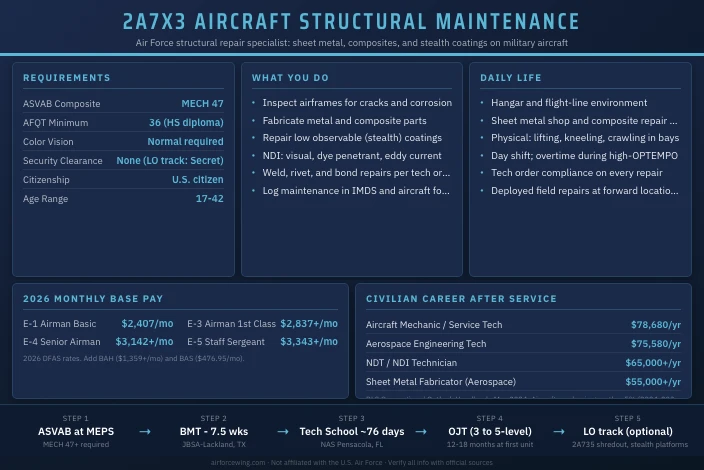
2A7X3 Aircraft Structural Maintenance specialists assess, repair, and fabricate aircraft structural components including metal, composite, and low observable materials. They perform damage inspections, corrosion removal, and structural modifications to restore aircraft to airworthy status. Specialists work on airframes ranging from mobility aircraft to advanced stealth platforms, applying technical orders and engineering data to every repair.
Day-to-Day Tasks
No two days are exactly alike in this AFSC, but most revolve around damage assessment and hands-on repair work. Common tasks include:
- Inspecting airframes for cracks, corrosion, impact damage, and structural fatigue
- Fabricating replacement metal and composite parts using lathes, mills, and precision hand tools
- Applying and repairing low observable (stealth) coatings on specialized aircraft
- Performing nondestructive inspection (NDI) techniques including visual, dye penetrant, and eddy current methods
- Welding, riveting, and bonding structural repairs per technical order specifications
- Documenting all maintenance actions in aircraft forms and maintenance information systems
- Operating sheet metal fabrication equipment to cut, form, and fit replacement panels
Much of the work happens in a hangar environment, though flight-line structural repairs are common when aircraft can’t be moved. Structural maintainers also deploy to forward operating locations where damage repair often happens under time pressure with limited tooling.
Specialization: Low Observable (2A735)
The 2A7X3 career field includes a notable specialization track. Airmen who complete the Low Observable Aircraft Structural Maintenance Apprentice course can earn the 2A735 shredout, which focuses on the non-reflective coatings and materials used on stealth aircraft such as the B-2 Spirit and F-22 Raptor. This specialization is in high demand and typically requires assignment to bases that host stealth platforms.
| AFSC Code | Title | Focus |
|---|---|---|
| 2A731 | Aircraft Structural Maintenance (Apprentice) | Entry-level structural repair |
| 2A751 | Aircraft Structural Maintenance (Journeyman) | Independent repairs, 5-level |
| 2A771 | Aircraft Structural Maintenance (Craftsman) | Supervision and quality control |
| 2A791 | Aircraft Structural Maintenance (Superintendent) | Flight-level supervision |
| 2A735 | Low Observable Aircraft Structural Specialist | Stealth coatings and LO materials |
Mission Contribution
Aircraft structural integrity is a flight safety matter, not just a maintenance one. A structural deficiency that goes undetected can cause catastrophic in-flight failure. Structural maintainers serve as the last line of defense before an aircraft takes off. On deployed operations, their ability to field-repair battle-damaged aircraft, a process called battle damage repair (BDR): keeps aircraft in the fight rather than waiting for depot-level maintenance thousands of miles away.
Tools and Equipment
Structural maintenance Airmen work with an extensive toolset. Sheet metal work requires shears, presses, rollers, and English wheels. Composite repairs involve vacuum bagging systems, autoclave ovens, and bond presses. NDI work uses eddy current equipment, borescopes, and dye penetrant kits. On the LO side, specialists handle specialized paint systems and coating application equipment. Maintenance data is tracked through the Air Force’s Integrated Maintenance Data System (IMDS) and digital technical orders on ruggedized tablets.
Salary
Structural maintenance Airmen earn the same base pay as all active-duty Airmen at their pay grade, set annually by Congress and paid by DFAS. Pay increases automatically with time in service and promotion.
Base Pay
| Rank | Pay Grade | Years of Service: 2 | Years of Service: 4 | Years of Service: 6 | Years of Service: 8 |
|---|---|---|---|---|---|
| Airman (Amn) | E-2 | $2,698 | $2,698 | $2,698 | - |
| Senior Airman (SrA) | E-4 | $3,303 | $3,659 | $3,816 | $3,816 |
| Staff Sergeant (SSgt) | E-5 | $3,599 | $3,947 | $4,109 | $4,299 |
| Technical Sergeant (TSgt) | E-6 | $3,743 | $4,069 | $4,236 | $4,613 |
Source: DFAS 2026 pay tables. Figures reflect the 2026 pay raise.
Allowances and Additional Compensation
Beyond base pay, Airmen receive tax-free allowances that significantly increase total compensation:
- Basic Allowance for Housing (BAH): Covers off-base housing costs. Varies by duty location, pay grade, and dependent status. A single E-4 at many installations receives $1,359 or more per month; an E-4 with dependents can receive $1,728 or more at the same location.
- Basic Allowance for Subsistence (BAS): $477 per month for enlisted Airmen, covering food costs.
- Special Duty Assignment Pay (SDAP) and Hazardous Duty Pay: Some structural maintenance positions at specialized units or in deployed environments may qualify for additional pays. Check with your unit’s finance office for current eligibility.
Benefits
Healthcare, housing support, and retirement are part of the total compensation package:
- TRICARE Prime: Free coverage for active-duty Airmen. No enrollment fee, no deductible, no copays for active-duty members. Covers medical, dental, vision, mental health, and prescriptions.
- Tuition Assistance (TA): Up to $4,500 per year toward college courses while on active duty, capped at $250 per semester hour.
- Post-9/11 GI Bill: After separation, covers full in-state tuition at public schools. The private school annual cap is $29,920.95 for the current academic year, plus a monthly housing allowance and up to $1,000 per year in book stipends.
- Blended Retirement System (BRS): Combines a pension at 20 years (40% of high-36 average basic pay) with Thrift Savings Plan matching. The government automatically contributes 1% and matches up to 4% of your contributions.
Work-Life Balance
Structural maintenance Airmen typically work standard day shifts when not deployed, though flight-line support can require swing or mid shifts during flying periods. Leave accrues at 2.5 days per month (30 days annually). High-OPTEMPO units and deployed rotations will cut into that balance, but most stateside assignments follow a predictable schedule with weekends off outside of exercises.
Qualifications
ASVAB line scores for Air Force AFSCs can change when AFI 36-2101 is updated. Verify current minimums with a recruiter or through the Air Force Enlisted Classification Directory (AFECD) before planning your preparation.
Qualification Table
| Requirement | Minimum Standard |
|---|---|
| ASVAB Composite | MECH 47 |
| AFQT (overall) | 36 (high school diploma) |
| AFQT (GED holder) | 65 |
| Age | 17-42 at enlistment |
| Citizenship | U.S. citizen |
| Education | High school diploma or GED |
| Security Clearance | Not required |
| Physical Profile | P-3, H-2, E-3 (no severe limitations) |
| Color Vision | Normal color vision required |
The MECH 47 minimum means you need at least a 47 on the Air Force Mechanical composite. That composite draws from the Mechanical Comprehension (MC), General Science (GS), and Auto and Shop Information (AS) subtests. Strong mechanical intuition and shop-class experience will help you reach that threshold. The ASVAB prep resources available through your recruiter include practice exams that break down the individual subtests.
Application and Selection Process
The process from decision to Tech School runs through several steps:
- Contact a recruiter and express interest in 2A7X3
- Take the ASVAB at a Military Entrance Processing Station (MEPS) and score MECH 47 or higher
- Complete the MEPS medical examination and meet physical standards
- Receive a job offer and sign your enlistment contract
- Report to BMT at Joint Base San Antonio-Lackland, TX (7.5 weeks)
- Graduate BMT and proceed to Tech School at Naval Air Station Pensacola, FL
No prior experience in sheet metal, welding, or aircraft maintenance is required. The Air Force trains you from scratch. That said, applicants with shop classes, auto body experience, or construction work often find the concepts in Tech School easier to absorb.
Waivers
Waivers are available for some disqualifying factors, including minor medical history and certain age restrictions. The recruiter initiates all waiver requests through MEPS. There is no guarantee of approval, and waiver timelines vary.
Service Obligation and Entry Rank
Most enlisted contracts for 2A7X3 are 4 years active duty. Airmen enter service at E-1 (Airman Basic) regardless of prior civilian credentials. Promotion to E-2 (Airman) is automatic after 6 months.
See our ASVAB study guide for strategies to hit these line scores, or take the PiCAT from home if you are a first-time tester.
Work Environment
Structural maintenance Airmen split their time between the flight line and structural maintenance shops. The shop is where most fabrication and complex repairs happen, equipped with metal-forming tools, composite repair ovens, and NDI equipment in a controlled environment. Flight-line work means outdoor conditions: heat, cold, rain, and jet exhaust, often while lying under an aircraft or working from stands.
Schedule and Shift Work
Active-duty units typically operate on day shifts (roughly 0700-1600) aligned with flying schedules. During high-tempo flying periods or when an aircraft goes down with structural damage, overtime and weekend work happen. Some bases use Panama schedules or rotating shifts to provide 24-hour coverage.
Team Dynamics
Structural maintenance functions within the Aircraft Maintenance Unit (AMU) or Maintenance Squadron (MXS), depending on the installation. Junior Airmen work under close NCO supervision until they achieve their 5-level (Journeyman) certification. At that point, they begin performing complex repairs independently. Craftsmen and Superintendents oversee entire work centers and review repairs for quality and technical order compliance.
The work demands precision and attention to detail. A sloppy repair on a non-critical panel is a quality issue. A sloppy repair on a wing attachment point is a safety emergency. That culture of accountability is reinforced from day one.
Job Satisfaction
Structural maintenance tends to attract Airmen who like physical, problem-solving work with visible results. You see the aircraft you fixed fly. That’s a concrete feedback loop most office jobs can’t match. Retention rates in this AFSC are generally solid because the civilian skill set. FAA airframe mechanic certification pathway, sheet metal fabrication, NDI certification, makes it a strong career foundation after service.
Training
Training Pipeline
| Phase | Location | Length | Focus |
|---|---|---|---|
| Basic Military Training (BMT) | JBSA-Lackland, TX | 7.5 weeks | Military foundation, fitness, discipline |
| Technical School (Initial Skills) | NAS Pensacola, FL | ~76 days (~11 weeks) | Structural repair, sheet metal, composites, NDI basics |
| On-the-Job Training (OJT) | First duty assignment | 12-18 months | 5-level upgrade, aircraft-specific tasks |
BMT
All enlisted Airmen begin at Joint Base San Antonio-Lackland, TX for 7.5 weeks of Basic Military Training. BMT covers physical conditioning, Air Force core values, weapons qualification, and initial military customs and courtesies. It is demanding but not specialized. Your AFSC training begins after graduation.
Tech School at NAS Pensacola
The 2A7X3 initial skills course runs approximately 76 days at Detachment 1, 359th Training Squadron, Naval Air Station Pensacola, FL. That makes it one of the longer entry-level maintenance Tech Schools. The curriculum covers:
- Aircraft structural theory and damage classification
- Sheet metal fabrication techniques (cutting, forming, riveting, welding)
- Composite material repair and bonding procedures
- Corrosion identification, treatment, and prevention
- Nondestructive inspection methods (visual, dye penetrant, eddy current)
- Technical order interpretation and documentation requirements
- Introduction to low observable materials (for candidates tracking toward 2A735)
Upon completion, graduates earn credits toward an Aircraft Structural Maintenance Technology credential and report to their first duty assignment as 3-level (Apprentice) Airmen.
Advanced Training and Skill Development
After reaching the 5-level, Airmen can pursue several paths:
- Low Observable Apprentice Course: Unlocks the 2A735 shredout and opens assignments on stealth aircraft
- Nondestructive Inspection (NDI) upgrade: Formal NDI training expands qualification on eddy current, ultrasonic, and radiographic inspection methods
- Welding certification programs: Some MAJCOMs sponsor formal welding certifications (AWS, or depot-standard qualifications)
- Community College of the Air Force (CCAF): The structural maintenance career field maps directly to an Associate of Applied Science in Aircraft Structural Technology through CCAF, earned while on active duty
The Air Force also funds voluntary education through Tuition Assistance, allowing Airmen to pursue bachelor’s degrees in fields like aviation maintenance management or materials science during off-duty hours.
Everything starts with qualifying ASVAB scores. Our study guide covers what to study first.
Career Progression
Rank and Progression Table
| Skill Level | AFSC Code | Rank (Typical) | Time-in-Grade |
|---|---|---|---|
| 3-Level (Apprentice) | 2A731 | E-1 to E-3 | 0-18 months |
| 5-Level (Journeyman) | 2A751 | E-4 (SrA) | 18 months to ~4 years |
| 7-Level (Craftsman) | 2A771 | E-5 to E-6 (SSgt/TSgt) | 4-10+ years |
| 9-Level (Superintendent) | 2A791 | E-7 to E-9 (MSgt-CMSgt) | Senior NCO |
Promotion from Airman Basic (E-1) to Senior Airman (E-4, SrA) happens mostly automatically in the early years. Advancement to Staff Sergeant (E-5, SSgt) and beyond is competitive, based on Enlisted Performance Reports (EPRs), physical fitness scores, professional military education (PME) completion, and a unit board process.
EPR System
The Air Force evaluates enlisted Airmen through EPRs written by supervisors and reviewed by senior raters. Ratings run from 1 (does not meet standards) to 5 (exceptional). A sustained record of 4s and 5s, combined with demonstrated leadership and PME completion, drives promotion. Airmen who want to advance quickly should seek additional duties, volunteer for deployments, and complete CCAF coursework early.
Specialization and Career Lateral Moves
The 2A7X3 career field offers clear specialization opportunities:
- Low Observable (2A735): Assignments to Whiteman AFB (B-2), Langley AFB (F-22), or other stealth platforms
- Depot-level assignments: Selected Airmen serve tours at Air Logistics Complexes (ALCs) such as Ogden ALC (Hill AFB, UT) or Warner Robins ALC (Robins AFB, GA), gaining depot-standard fabrication and heavy maintenance experience
- Instructor duty: Senior Airmen and NCOs can serve as technical school instructors at NAS Pensacola
- Retraining: Airmen can apply for retraining into related career fields such as 2A5X1 (Aerospace Maintenance) or 2A6X1 (Aerospace Propulsion) after completing their initial enlistment
Physical Demands
Daily Physical Requirements
Aircraft structural maintenance is physically demanding work. A typical day may involve:
- Bending, kneeling, and crawling inside aircraft bays and wheel wells
- Lifting panels, equipment, and fabricated components (frequently 40-70 lbs)
- Working overhead on stands and scaffolding
- Extended periods of kneeling or lying prone under aircraft
- Operating power tools and hand tools requiring sustained grip strength
- Wearing personal protective equipment including respirators during chemical processes
The physical demands are consistent, not episodic. Structural maintainers who keep themselves physically fit beyond the minimum fitness standards find the daily work considerably less taxing.
Air Force Fitness Assessment
All Airmen must pass the Air Force Fitness Assessment annually. The FA is not AFSC-specific and uses the same standards across the total force.
| Component | Maximum Points | Minimum to Pass |
|---|---|---|
| 1.5-Mile Run | 60 pts | Age/gender normed |
| Push-Ups (1 minute) | 10 pts | Age/gender normed |
| Sit-Ups (1 minute) | 10 pts | Age/gender normed |
| Waist Circumference | 20 pts | Age/gender normed |
| Composite Total | 100 pts | 75 pts minimum |
Standards are age- and gender-normed. Airmen must meet minimum thresholds on each component, not just the composite. Failure triggers a fitness improvement program and can affect promotion eligibility.
Medical Evaluations
Initial medical qualification happens at MEPS before enlistment. Ongoing requirements include periodic physical exams and immediate reporting of injuries that affect physical capability. Airmen with duty limitations must coordinate with their unit’s medical and personnel sections. Extended duty restrictions can affect upgrade training timelines and, in some cases, AFSC reassignment.
Deployment
Deployment Frequency and Duration
Structural maintenance Airmen deploy regularly. The Air Force operates aircraft in contingency locations worldwide, and aircraft take structural damage that can’t wait for depot repair. Typical deployments range from 60 to 180 days, with frequency depending on the unit’s mission and current operational requirements.
Most Active Duty units fall into a deployment rotation. Fighter aircraft units tend to deploy more frequently than mobility or training units. Expect at least one significant deployment per 2-3 year assignment cycle, though high-OPTEMPO units can exceed that pace.
Duty Station Options
The 2A7X3 AFSC exists across most of the Air Force’s flying wings. Installations with significant structural maintenance billets include:
- Sheppard AFB, TX: large training footprint, instructor billets
- Whiteman AFB, MO: B-2 Spirit, high demand for LO structural specialists
- Langley AFB, VA: F-22 Raptor, LO structural work
- Ramstein AB, Germany: major European hub with diverse airframe mix
- Kadena AB, Japan: Pacific theater, fighter aircraft
- Scott AFB, IL: mobility aircraft, more predictable schedule
Assignment preferences are submitted through the AFPC assignment system. First-assignment Airmen receive a preference worksheet but have limited control over their initial duty station.
Risk/Safety
Job Hazards
Structural maintenance carries genuine occupational hazards. The work involves:
- Chemical exposure: Corrosion inhibitors, adhesives, composite resins, and LO coating systems contain hazardous materials. Proper PPE and ventilation are mandatory.
- Composite fiber hazards: Carbon fiber dust from composite repairs is a respiratory hazard. Respirator use is required.
- Fall hazards: Working from stands and scaffolding at height requires adherence to fall protection procedures.
- Hearing damage: Aircraft engines and hangar power tools generate sustained high noise levels. Hearing protection is mandatory on the flight line.
- Heat and cold stress: Outdoor structural repairs in extreme temperatures are common, particularly at desert and arctic installations.
Safety Protocols
The Air Force enforces safety through Technical Orders (TOs), which specify step-by-step procedures for every maintenance action. Deviation from TOs without authorization is a serious disciplinary matter. Other key requirements:
- Occupational Safety and Health (OSHA) standards apply on Air Force installations
- Hazardous materials handling requires HAZMAT certification and documented training
- All structural repairs must be inspected and documented before the aircraft returns to flight status
Any structural repair signed off by a 2A7X3 Airman is traceable in the aircraft’s maintenance records for the life of the aircraft. Accuracy and honesty in documentation are legal and professional obligations.
Security and Legal Requirements
The 2A7X3 AFSC does not require a security clearance for the standard qualification. However, Airmen assigned to stealth platforms (B-2, F-22) in the 2A735 LO specialization typically require a Secret or higher clearance due to the classified nature of LO system specifications. Clearance eligibility depends on a background investigation and adjudication process that can take several months.
All Airmen serve under the Uniform Code of Military Justice (UCMJ) and sign an enlistment contract specifying their service obligation and assignment conditions.
Impact on Family
Structural maintenance is a field with significant deployment potential and shift-work demands. Families of 2A7X3 Airmen should plan around periodic absences of 2-6 months and the possibility of short-notice exercises that extend duty hours. The Air Force provides a full support infrastructure for families:
- Military Family Life Counselors (MFLCs): Free, confidential counseling available on most bases
- Airman and Family Readiness Centers: Deployment preparation, financial counseling, and reintegration support
- Child Development Centers (CDCs): On-base childcare at subsidized rates
- Spouse Employment Assistance: Resume support and job placement resources for partners navigating frequent moves
BAH allows most Airmen with dependents to afford quality off-base housing near their installation. On-base housing is also available at many bases, often at no out-of-pocket cost beyond the BAH offset.
The work schedule in structural maintenance is closer to standard business hours than in crew chief or flight-line roles, but it is not a predictable 9-to-5. Structural discrepancies requiring immediate attention don’t follow a schedule. An airframe crack found during preflight will hold the aircraft and call the structural maintenance shop, whenever that happens. Most experienced Airmen in this AFSC describe the schedule as predictably unpredictable: standard most of the time, with occasional surges that extend hours without much warning.
Dual-military couples can apply for joint-spouse assignments through AFPC, which attempts to co-locate active-duty spouses at the same or nearby installations. The program does not guarantee co-location, but it does factor into the assignment process. Given that 2A7X3 positions exist at most major flying wings, the pool of potential co-location options is broader than for highly specialized AFSCs.
Chemical and material exposure is worth discussing with family members who have respiratory sensitivities. Structural maintenance work involves epoxies, composite resins, solvents, and low observable coating systems. The work environment is managed with PPE and ventilation controls, but the Airman does bring some of that occupational exposure into daily life, residue on uniforms, smell, and the minor physical effects of shift work with those materials. This is not a significant health concern under normal protocols, but it is worth knowing about.
The Interstate Compact on Educational Opportunity for Military Children, enacted in most states, reduces friction when school-age children enroll in new schools following a PCS move. School-liaison officers at each installation help families manage enrollment, credit transfer, and extracurricular continuity during mid-year transitions.
Relocation
PCS (Permanent Change of Station) moves happen every 2-4 years for most Airmen. The Air Force pays most relocation costs. Frequent moves can disrupt spouse careers and children’s schooling, but many military families adapt by leveraging remote work options and online education. Airmen can submit assignment preferences through the Assignment Management System (AMS) and apply for join-spouse assignments to be stationed near a military spouse.
Reserve and Air National Guard
Component Availability
The 2A7X3 AFSC is available in both the Air Force Reserve and the Air National Guard. Reserve structural maintenance units support active-duty missions through augmentation and independent flying wing maintenance at installations like Peterson Space Force Base, CO (302nd Airlift Wing), Scott AFB, IL (932nd Airlift Wing), and Youngstown Warren ARS, OH (910th Airlift Wing). Guard units operate under state authority until federalized and maintain a full range of aircraft types.
Drill Schedule
The standard Reserve and Guard commitment is one weekend per month (Unit Training Assembly, or UTA) plus 15 days per year (Annual Tour). Structural maintenance UTAs typically include hands-on maintenance work on the unit’s aircraft, technical order review, and safety training. Some units require additional training days for platform-specific certifications.
Part-Time Pay
An E-4 (SrA) drilling in the Reserve or Guard earns 4 drill periods per UTA weekend, each paid at 1/30th of monthly base pay. At the 2026 rate of $3,142/month for E-4 with under 2 years service, one drill period = approximately $105. Four drill periods per weekend = approximately $419 per drill weekend, plus 15 days of Annual Tour pay at daily rates.
Benefits Comparison
| Feature | Active Duty | Air Force Reserve | Air National Guard |
|---|---|---|---|
| Commitment | Full-time | 1 wknd/mo + 15 days/yr | 1 wknd/mo + 15 days/yr |
| Monthly Pay (E-4) | $3,142+/mo | ~$419/drill wknd | ~$419/drill wknd |
| Healthcare | TRICARE Prime (free) | TRICARE Reserve Select (premium required) | TRICARE Reserve Select or state plan |
| Education Benefits | TA + GI Bill (active) | Federal TA + GI Bill (reserve rates) | Federal TA + state tuition waiver (state-dependent) |
| Retirement | 20-year pension (BRS) | Points-based reserve retirement (60-day annuity) | Points-based reserve retirement (60-day annuity) |
| Deployment Tempo | High (unit-driven) | Moderate (mobilization-based) | Lower (unless federalized) |
Air National Guard members in many states benefit from state tuition waivers that cover in-state public tuition, a significant financial advantage for Airmen pursuing college alongside their service commitment.
Civilian Career Integration
Structural maintenance pairs exceptionally well with civilian aviation careers. Sheet metal and composites skills are directly applicable to FAA Airframe and Powerplant (A&P) mechanic certification preparation. Many Reserve and Guard Airmen work for commercial airlines, MRO (maintenance, repair, and overhaul) shops, or defense contractors during the week, then apply those same skills on military aircraft on weekends. Employers in the aerospace sector generally support reserve component service because the military certification and training directly benefits their operations. USERRA protections guarantee job reinstatement and benefit continuation rights for reservists and Guard members during periods of mobilization.
Post-Service
The 2A7X3 AFSC is one of the strongest civilian transition pathways in the enlisted force. Commercial aviation, defense manufacturing, and aerospace MRO all face chronic technician shortages.
Civilian Career Options
| Civilian Job Title | Median Annual Wage (May 2024) | Outlook (2024-2034) |
|---|---|---|
| Aircraft Mechanic and Service Technician | $78,680 | +5% (faster than average) |
| Aerospace Engineering and Operations Technician | $75,580 | +6% |
| Industrial Production Manager (aerospace) | $108,660 | +3% |
The Bureau of Labor Statistics Occupational Outlook Handbook projects about 13,100 openings for aircraft mechanics and technicians annually through 2034.
Certifications and Licensing
Airmen with 2A7X3 experience who pursue FAA Airframe and Powerplant (A&P) certification gain one of the most portable credentials in aviation. The A&P certifies the holder to perform and sign off on airframe repairs and engine work on FAA-certificated aircraft, the civilian equivalent of what structural maintainers do on military aircraft daily. Eligibility requires 18 months of documented hands-on airframe experience, which most 5-level Airmen exceed.
Other valued credentials for post-service transition include:
- AWS Certified Welder credentials recognized by manufacturing employers
- ASNT Level II NDT certification for nondestructive inspection work
- OSHA 30-Hour Construction/General Industry for supervisory roles
Transition Programs
The Transition Assistance Program (TAP) provides pre-separation employment assistance, resume workshops, and job placement resources. The Hiring Our Heroes program facilitates connections between separating Airmen and civilian aerospace employers. Many defense contractors and MRO operators actively recruit separating 2A7X3 Airmen because their hands-on maintenance experience, technical order discipline, and safety culture are difficult to replicate from civilian training alone.
Is This a Good Job
Who Thrives Here
2A7X3 suits people who want work with tangible results and a clear technical skill progression. The job works particularly well if you:
- Like working with your hands and using precision tools
- Are detail-oriented and don’t mind meticulous documentation
- Want a skill set with direct civilian market value
- Can tolerate outdoor conditions, physical labor, and occasional shift work
- Have any background in auto body, construction, welding, or shop classes
The low observable specialization (2A735) is a good match for Airmen who want assignment to high-profile stealth platforms and are willing to pursue additional clearance and technical training.
Who Struggles Here
This AFSC is not a strong fit if you:
- Dislike confined spaces or working in awkward physical positions
- Want a predictable 9-to-5 with no weekend or deployment disruption
- Have respiratory sensitivities that complicate chemical/composite work
- Are strongly averse to documentation and procedural compliance
The pace and physical demands are real. Structural maintenance is not a desk job, and Airmen who approach it as one typically don’t thrive in the career field.
Long-Term Fit
The strongest argument for 2A7X3 is what you leave with. Four to six years in this career field produces a technician with sheet metal, composite, NDI, and aircraft maintenance documentation skills that commercial aviation employers pay well to hire. Combined with the A&P certification pathway, the transition from military structural maintainer to civilian aviation tech is one of the most direct in the Air Force. For someone who wants real skills, real pay after service, and meaningful work in the meantime, this AFSC delivers.
More Information
Talk to an Air Force recruiter to find out whether your ASVAB scores qualify you for 2A7X3 and whether duty station preferences or specialization tracks are available at the time of your enlistment. Recruiters can also clarify current bonus eligibility and enlistment options specific to structural maintenance.
Official sources:
- airforce.com: Aircraft Structural Maintenance career page, the official Air Force career listing with current ASVAB requirements and training details
- NAS Pensacola / Det 1, 359th Training Squadron, the location of the 2A7X3 Tech School
- Air Force Civil Engineer Center, for information on depot-level structural maintenance programs at Air Logistics Complexes
For civilian career research:
- FAA Airframe and Powerplant certification, 2A7X3 experience qualifies toward FAA A&P eligibility. The FAA requires 18 months of documented practical airframe experience; most 5-level Airmen exceed that threshold.
- BLS Aircraft Mechanics and Service Technicians, median salary data and employment projections for the primary civilian transition path
- ASNT Certifications, the American Society for Nondestructive Testing offers NDT certification programs directly relevant to 2A7X3 Airmen with inspection experience
- AWS Welding Certifications, American Welding Society certifications are recognized across aerospace, construction, and manufacturing employers
ASVAB preparation: The MECH 47 requirement draws from General Science, Mechanical Comprehension, and Auto and Shop Information subtests. Applicants with prior shop class, construction, or auto body experience typically find these subtests more intuitive. An ASVAB study guide that covers the mechanical and shop sections will give you the best return on preparation time for this AFSC.
This site is not affiliated with the U.S. Air Force or any government agency. Verify all information with official Air Force sources before making enlistment or career decisions.
Explore more Air Force maintenance careers such as 2A3X3 Tactical Aircraft Maintenance and 2A5X1 Aerospace Maintenance.