2A7X1 Aircraft Metals Technology
Every aircraft part that cracks, corrodes, or wears beyond tolerance has to be repaired or remade before the jet flies again. That is the job. Aircraft Metals Technology specialists are the Air Force’s machinists and welders, the people who fabricate replacement components, weld cracked structures, and reclaim parts that would otherwise ground aircraft for weeks waiting on supply chain. If you want a hands-on technical career where you build real things and directly affect mission readiness, 2A7X1 is one of the most tangible AFSCs in the maintenance career field. The ASVAB Mechanical composite is the gate, so prepare your scores before your recruiter conversation.
Job Role and Responsibilities
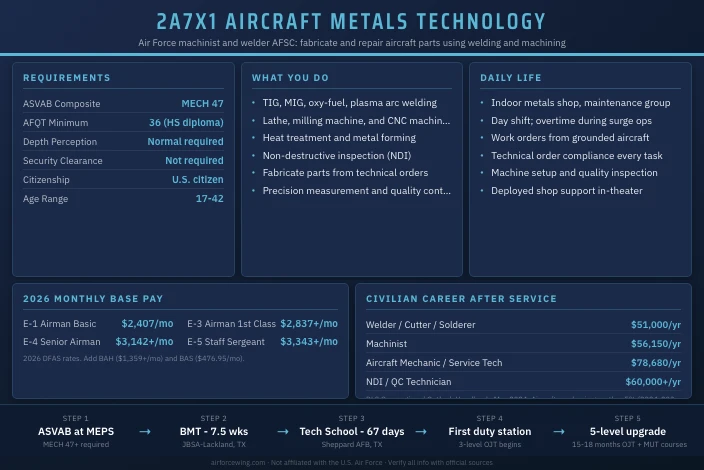
2A7X1 Aircraft Metals Technology specialists perform and manage aircraft metals technology functions including TIG welding, MIG welding, oxy-fuel cutting, plasma arc cutting, machining, heat treatment, metal forming, and non-destructive inspection. They fabricate, repair, and reclaim aircraft parts, support equipment components, and tooling using precision metalworking processes. The specialty supports every platform in the Air Force inventory wherever a structural or mechanical component requires metal fabrication or repair beyond what standard sheet metal maintenance covers.
Daily Tasks
No two days on the shop floor are identical. The work queue depends on what aircraft are grounded, what parts are in short supply, and what scheduled maintenance intervals are due. Typical daily tasks include:
- Reading engineering drawings and technical orders to determine fabrication specifications
- Measuring worn or damaged components with micrometers, calipers, and other precision instruments
- Setting up and operating lathes, milling machines, drill presses, and surface grinders
- Performing TIG, MIG, oxy-fuel, and plasma arc welding on aluminum, steel, and titanium
- Conducting heat treatment processes to restore metal properties after welding
- Fabricating replacement parts when supply chain delivery would cause unacceptable delays
- Inspecting finished work using non-destructive inspection (NDI) methods including dye penetrant and magnetic particle inspection
- Maintaining and calibrating shop equipment to keep tolerances within specification
The shop environment runs on technical orders. Every weld, every machined dimension, and every heat treat cycle is governed by Air Force Technical Orders and engineering drawings. Getting the numbers wrong isn’t an option, parts that don’t meet spec go back to the floor.
Specializations
2A7X1 is a single primary AFSC with no formal shredout suffixes. Career progression focuses on skill level advancement (3, 5, 7, and 9 levels) rather than separate specialty codes. At the SMSgt/E-8 and CMSgt/E-9 levels, 2A7X1 Airmen merge into the 2A790 senior NCOIC designation, which spans the broader 2A7 structural and metals maintenance career area.
| Code | Designation | Notes |
|---|---|---|
| 2A731 | Aircraft Metals Technology, 3-Level (Apprentice) | Entry-level after Tech School |
| 2A751 | Aircraft Metals Technology, 5-Level (Journeyman) | Qualified craftsman after OJT |
| 2A771 | Aircraft Metals Technology, 7-Level (Craftsman) | SNCO-level; supervises shop operations |
| 2A791 | Aircraft Metals Technology, 9-Level (Superintendent) | Senior NCOIC; merges into 2A790 |
Mission Contribution
Aircraft maintenance is a numbers game: the percentage of assigned aircraft that are fully mission capable on any given day determines what a wing can actually generate. When a structural component cracks or a machined fitting fails a tolerance check, the aircraft goes down. The metals shop is what turns a grounded jet back into a flyable one without waiting weeks for a depot shipment. That direct link between the shop floor and sortie generation is what makes 2A7X1 one of the more operationally critical specialties in the maintenance group.
Technology and Equipment
The shop is a mix of traditional trade equipment and modern CAM (computer-aided manufacturing) systems. Airmen work with:
- Manual lathes, CNC lathes, and milling machines
- TIG and MIG welding stations configured for aluminum, stainless, and titanium
- Oxy-fuel and plasma arc cutting systems
- Heat treatment ovens and furnaces for stress relief and annealing
- Surface grinders and precision measuring tools (micrometers, height gauges, optical comparators)
- CAM software for programming CNC machine operations
- NDI equipment including dye penetrant kits and magnetic particle inspection systems
- Digital technical orders (TOs) on ruggedized tablets for in-shop reference
CNC capability has grown in Air Force metals shops over the past decade. Airmen who are comfortable learning programming interfaces alongside traditional manual machining are well-positioned for the complex work orders.
Salary and Benefits
Base Pay
Pay follows the 2026 DFAS tables that apply uniformly to all active-duty service members. New Airmen enter at E-1 and typically reach E-4 (Senior Airman) within three to four years.
| Grade | Rank | Monthly Base Pay (2026) |
|---|---|---|
| E-1 | Airman Basic (AB) | $2,407 |
| E-2 | Airman (Amn) | $2,698 |
| E-3 | Airman First Class (A1C) | $2,837 - $3,198 |
| E-4 | Senior Airman (SrA) | $3,142 - $3,816 |
| E-5 | Staff Sergeant (SSgt) | $3,343 - $4,422 |
| E-6 | Technical Sergeant (TSgt) | $3,401 - $5,044 |
| E-7 | Master Sergeant (MSgt) | $3,932 - $5,537 |
Current rates are published at the DFAS Military Pay Tables page.
Additional Benefits
Base pay is only part of the compensation picture. Most Airmen living off-base receive Basic Allowance for Housing (BAH), which scales with duty location and dependency status. A single E-4 at Joint Base San Antonio-Lackland receives $1,359/month in BAH; with dependents that rises to $1,728/month. Basic Allowance for Subsistence adds a flat $476.95/month for all enlisted Airmen. Neither allowance is taxed.
Healthcare comes at no cost through TRICARE Prime: zero enrollment fee, zero deductible, and zero copays for active-duty members. Dental care at military treatment facilities is included. The Air Force also funds up to $4,500/year in tuition assistance while you’re serving, covering $250 per semester hour for up to 18 credit hours annually. Education benefits continue after separation through the Post-9/11 GI Bill, which covers full in-state tuition at public schools and up to $29,920.95/year at private institutions.
Retirement under the Blended Retirement System includes a pension at 20 years (40% of your high-36 average pay) plus government TSP contributions: 1% automatic and matching up to 4% for a total government contribution of up to 5%.
Work-Life Balance
The shop typically runs a standard day shift during peacetime, though deployment and surge operations change that picture. Shift work is possible at high-tempo installations. Airmen accrue 30 days of paid leave per year, with a maximum 60-day carryover. Federal holidays are observed.
Qualifications and Eligibility
Getting into 2A7X1 requires meeting a few hard minimums. The ASVAB Mechanical composite is the primary gate, and it tests exactly the skills the job demands.
| Requirement | Standard |
|---|---|
| ASVAB Composite | MECH 47 |
| AFQT Minimum | 36 (high school diploma) |
| AFQT Minimum (no diploma) | 65 |
| Age | 17-42 at time of enlistment |
| Citizenship | U.S. citizen |
| Security Clearance | Not required |
| Depth Perception | Normal required |
| Physical Profile | P3 or better required at accession |
Verify current requirements at the Air Force careers page for Aircraft Metals Technology.
Application Process
Selection Criteria and Competitiveness
2A7X1 is a consistently needed specialty across the Air Force inventory. The MECH 47 score is achievable for most applicants who study the mechanical comprehension and auto/shop sections seriously. Prior shop experience, even informal work with tools, welding, or manufacturing, gives your application context in the recruiter’s conversation, but it is not a formal requirement. The job does not require a security clearance, which shortens the processing timeline compared to intelligence or avionics AFSCs.
Service Obligation
Enlistment contracts for 2A7X1 are typically four years for active duty. Some accession contracts run longer depending on incentives tied to the offer. Check with your recruiter for the current contract length at the time of your enlistment.
Airmen access the Air Force at E-1 (Airman Basic) regardless of prior experience, though college credit may accelerate advancement to E-2 or E-3 before BMT.
Work Environment
Setting and Schedule
2A7X1 Airmen work in a metals technology shop, which is an indoor facility equipped with machine tools, welding stations, and heat treatment equipment. The shop is attached to a maintenance group on most major installations. You are not on the flight line every day, the work comes to you in the form of parts, components, and work orders generated by other maintenance shops and quality assurance.
The standard schedule during peacetime is a day shift operation with occasional overtime during surge periods or deployed operations. Shift work is possible at high-demand installations or during exercises. Unlike crew chief roles that are tied directly to the flying schedule, metals shop work is driven by the maintenance backlog, which creates a somewhat more predictable daily rhythm.
Shop Environment Quick Reference
- Location: Indoor metals technology shop within the maintenance group complex
- Typical hours: Day shift during peacetime; overtime during surges or exercises
- Primary equipment: Manual and CNC lathes, milling machines, TIG and MIG welding stations, heat treatment ovens
- PPE required: Arc flash protection, hearing protection, eye protection, and respiratory equipment depending on task
- Work driver: Maintenance backlog and work orders; not tied directly to the flying schedule
- Temperature: Elevated near welding arcs and heat treatment equipment; shop ventilation required by safety standards
Leadership and Communication
The metals shop is led by a Tech Sergeant or Master Sergeant who serves as the shop NCOIC. Work orders are tracked through the Integrated Maintenance Data System (IMDS), and every job has documentation from start to finish. Performance feedback for junior Airmen comes through informal feedback sessions and the formal annual Enlisted Performance Report process, which begins at E-4. The chain of command runs from shop NCOIC to Maintenance Supervision and up through the Maintenance Group Commander.
Team Dynamics and Autonomy
At the 3-level (Apprentice), you work under direct supervision until you demonstrate proficiency on each task in your career field education and training plan. By 5-level (Journeyman), you can perform most tasks independently and begin supervising trainees. The 7-level (Craftsman) manages the shop floor and signs off work as the qualified inspector. The progression from close supervision to full autonomy is structured and documented, there is no ambiguity about where you stand in the qualification process.
Job Satisfaction and Retention
Metals technology is a rare AFSC: the skills are genuinely marketable in civilian manufacturing and aerospace. Airmen who reach the 5 and 7 levels have completed a training pipeline that takes years in civilian apprenticeship programs. That pathway to post-service opportunity contributes to moderate retention. The work itself is tactile and concrete, you build something, inspect it, and either it meets spec or it doesn’t. That directness appeals to people who prefer measurable results over abstract outcomes.
Training and Skill Development
Initial Training Pipeline
| Phase | Location | Duration | Focus |
|---|---|---|---|
| Basic Military Training (BMT) | JBSA-Lackland, TX | 7.5 weeks | Military foundation, physical fitness, Air Force culture |
| Technical School (Tech School) | Sheppard AFB, TX | 67 days (~9.5 weeks) | Metalworking processes, welding, machining, NDI, technical orders |
BMT is the same for every enlisted Airman: 7.5 weeks at Joint Base San Antonio-Lackland, covering military customs and courtesies, physical conditioning, weapons qualification, and initial Air Force orientation.
Tech School at Sheppard AFB, TX, is where the actual metalworking training begins. At the 82nd Training Wing, students cover:
- Blueprint reading and technical order interpretation
- Basic through advanced welding: TIG, MIG, oxy-fuel, and plasma arc
- Lathe and milling machine operations (manual and CNC)
- Heat treatment processes and metal forming techniques
- Non-destructive inspection methods: dye penetrant and magnetic particle
- Precision measurement and quality control procedures
At the end of Tech School, Airmen earn the 3-skill level (Apprentice) and ship to their first duty station. Graduates also earn college credits toward a metals technology degree program through the Community College of the Air Force (CCAF). If you’re still working toward the MECH 47 minimum, an ASVAB study guide focused on Mechanical Comprehension and Auto/Shop is the most direct path to qualification.
Advanced Training
The 5-level (Journeyman) upgrade is completed through on-the-job training at the first duty station, typically taking 15-18 months of progressive task sign-offs under a qualified supervisor. Mandatory Upgrade Training (MUT) correspondence courses run alongside OJT. Promotion to SSgt and the Craftsman course (7-level) follows typically after four to six years of total service.
Advanced opportunities include:
- CNC programming courses through formal AETC training or unit-funded civilian equivalents
- Welding certifications through the American Welding Society (AWS), some units fund testing for D1.1 and aerospace welding certifications
- Non-Destructive Inspection additional qualification for Airmen interested in branching toward NDI-specific work orders
- CCAF Associate Degree in Metals Technology, earned by combining Tech School credits with on-duty coursework
Career Progression and Advancement
Career Path
Progression in 2A7X1 follows the standard Air Force enlisted pyramid. Time-in-grade requirements and Weighted Airman Promotion System (WAPS) scores govern advancement from E-4 upward.
| Grade | Rank | Typical Time in Service | Key Milestones |
|---|---|---|---|
| E-1 | Airman Basic (AB) | Entry | BMT graduation |
| E-2 | Airman (Amn) | ~6 months | Automatic with satisfactory performance |
| E-3 | Airman First Class (A1C) | ~1 year | Automatic with satisfactory performance |
| E-4 | Senior Airman (SrA) | 2-3 years | Below-the-zone promotion possible |
| E-5 | Staff Sergeant (SSgt) | 4-6 years | 5-level required; WAPS competitive |
| E-6 | Technical Sergeant (TSgt) | 8-12 years | 7-level required; highly competitive |
| E-7 | Master Sergeant (MSgt) | 12-18 years | Senior NCO; shop leadership |
| E-8 | Senior Master Sergeant (SMSgt) | 18-22 years | Merges to 2A790; wing-level oversight |
| E-9 | Chief Master Sergeant (CMSgt) | 22+ years | Rare; career field management |
Promotion to SSgt requires the 5-skill level and passing the WAPS, which scores on Promotion Fitness Examination (PFE) results, AFSC Specialty Knowledge Test (SKT), EPR ratings, time in grade, and decorations. The most competitive 2A7X1 Airmen accumulate additional duty accomplishments and off-duty education to build WAPS points.
Role Flexibility and Transfers
Airmen can apply for retraining into other AFSCs after completing their initial service commitment. The metals technology background provides a strong foundation for crossover to 2A7X3 (Aircraft Structural Maintenance), 2A6X1 (Aerospace Propulsion), or even civilian-facing roles in NDI or quality assurance. Formal cross-training requests go through the Airman’s unit and AFPC, with approval dependent on gaining AFSC needs.
Performance Evaluation
The Air Force uses the Enlisted Performance Report (EPR) system. Ratings run from 1 to 5, with 5 being the highest. EPR bullets document specific job accomplishments, additional duties, professional development, and community involvement. A single stratification line, where the supervisor rates you against peers (e.g., “#1 of 7 SrA”), carries significant weight. Airmen who want to compete for promotion need strong EPRs, consistent SKT preparation, and documented additional duties.
Physical Demands and Medical Evaluations
Physical Requirements
The metals shop is physically demanding in ways that are different from flight line work. You spend long periods standing at machines, lifting and positioning heavy stock material, and working in postures required by machining and welding setups. Specific physical demands include:
- Lifting and carrying metal stock, tooling, and fabricated parts, weights up to 50 lbs regularly, heavier with team lift protocols
- Standing for extended periods at machine tools and welding stations
- Fine motor control for precision measurement and machine setup
- Heat exposure near welding arcs and heat treatment ovens
- Eye protection required at all times in the shop environment (normal depth perception required)
The Air Force Fitness Assessment applies to all Airmen regardless of AFSC. It is not adjusted for occupational specialty.
| Component | What It Measures | Max Points |
|---|---|---|
| 1.5-Mile Run | Aerobic capacity | 60 |
| Push-Ups (1 min) | Upper body muscular endurance | 10 |
| Sit-Ups (1 min) | Core muscular endurance | 10 |
| Waist Circumference | Body composition | 20 |
Minimum passing composite score: 75 out of 100. Standards are age- and gender-normed. Each component has a minimum score that must be met independently. Assessments are conducted annually for most Airmen. Current standards are published at af.mil.
Medical Evaluations
Initial medical screening happens at MEPS before enlistment. The exam confirms depth perception (normal required), hearing, cardiovascular fitness, and overall medical eligibility. Periodic physical exams continue throughout a career as part of readiness requirements. Airmen with hearing loss or vision degradation from shop environments are evaluated for profile status that may limit certain duties.
Deployment and Duty Stations
Deployment Details
2A7X1 specialists deploy in support of Expeditionary Maintenance Squadrons and Air Expeditionary Wings. Deployed metals shops support aircraft sustainment in-theater, fabricating parts that can’t be sourced from supply channels in a combat environment. Deployment lengths typically run 60 to 180 days depending on the operation, with active-duty Airmen deploying on average every 18-24 months at a sustained operational tempo. During periods of high activity, rotations may come faster.
Deployed shops operate in a range of environments, hardened facilities, expeditionary tents, and containerized shop units. The work doesn’t change; the conditions around it do.
Duty Stations
2A7X1 is needed wherever aircraft are maintained. Common duty stations include:
- Sheppard AFB, TX: Training Wing; some graduates are retained as instructors
- Langley-Eustis AFB (JBLE), VA: ACC fighter wing
- Hill AFB, UT: F-35 and legacy fighter maintenance
- Eglin AFB, FL: Test and evaluation; mixed platform environment
- Kadena AB, Japan: Pacific theater; overseas tour
- Ramstein AB, Germany: USAFE; European theater
- Tinker AFB, OK: Air Logistics Complex; depot-level work available for senior Airmen
- Air Reserve and Air National Guard units across all 50 states
Assignments go through the Air Force Personnel Center (AFPC). First-term Airmen typically receive their first assignment through a needs-based process. By mid-career, performance record and voluntary preference listings carry more weight in where you land.
Risk, Safety, and Legal Considerations
Job Hazards
The metals shop has real hazards that require consistent attention:
- Welding fumes and arc flash: proper ventilation, respiratory protection, and arc flash PPE are mandatory
- Machine tool hazards: rotating equipment and cutting tools require strict lockout/tagout procedures and guarding compliance
- Chemical exposure: cutting fluids, cleaning solvents, and surface treatment chemicals require proper handling and PPE
- Heat and fire risk: welding, cutting, and heat treatment operations near flammable materials
- Noise: machining and grinding equipment generates noise levels requiring hearing protection
Safety Protocols
Air Force Technical Orders mandate specific PPE and safety protocols for every process. Shops conduct safety briefings, maintain written operating instructions for all hazardous equipment, and track mishap rates through the ground safety program. Airmen are trained on hazardous materials handling through initial qualification and recurring annual training. Lockout/tagout procedures are drilled and enforced, there is no informal bypass.
Security and Legal Requirements
2A7X1 does not require a security clearance. The enlistment contract specifies an eight-year total military obligation: the active-duty portion (typically four years) plus the Inactive Ready Reserve (IRR) component. Airmen who separate before completing their active commitment may face recoupment of certain bonuses or special pay received during service.
Impact on Family and Personal Life
Family Considerations
Metals technology is a maintainer AFSC. That means the deployment and TDY patterns of the broader maintenance career field apply. Families face periodic separations for deployments (typically 60-180 days) and shorter TDYs for exercises and training events. The Air Force recognizes these demands and provides a structured network of support programs at most active-duty installations.
On-installation family support resources:
- Airman and Family Readiness Center (AFRC): Financial counseling, deployment preparation classes, and reintegration support for returning service members and their families
- Military Family Life Counselors (MFLCs): Free, confidential short-term counseling available on most installations, no referral required and sessions do not go in the service record
- School Liaison Officers (SLOs): Assist military families navigating school enrollment, records transfer, and academic continuity after a PCS move
- TRICARE: Health coverage extends to all eligible dependents at no enrollment cost under TRICARE Prime on active-duty orders
- Basic Allowance for Housing (BAH): Dependency-based rates at most 2A7X1 duty stations cover competitive off-base rentals; a married E-4 at Hill AFB receives a meaningfully higher BAH rate than a single Airman
BAH at most installations covers competitive off-base housing. Larger installations with sizable 2A workforce populations (Hill AFB, Langley-Eustis, Eglin) have established communities of maintenance families, which many find makes the lifestyle more manageable. The shared experience of deployment cycles and PCS moves creates informal peer support networks that are a practical part of the military family support network.
Relocation and Flexibility
PCS (permanent change of station) moves typically occur every three to four years. First-term Airmen have limited input on their initial assignment but gain more weight in preference listings with seniority. The Air Force pays for moving household goods up to weight limits. Families with two working adults should research employment opportunities at likely assignments before signing on. The Airman and Family Readiness Center on each installation provides spouse employment assistance and job search support.
Reserve and Air National Guard
2A7X1 is available in both the Air Force Reserve (AFRC) and the Air National Guard (ANG). Reserve and Guard metals shops support their assigned flying units with the same fabrication and repair capabilities as active-duty equivalents. Some Guard units at installations with active depot operations (Tinker AFB area, for example) offer exposure to a broader range of aircraft types and work orders than a typical active-duty fighter wing.
| Feature | Active Duty | Air Force Reserve | Air National Guard |
|---|---|---|---|
| Commitment | Full-time | 1 weekend/mo + 2 wks/yr (minimum) | 1 weekend/mo + 2 wks/yr (minimum) |
| Monthly Pay (E-4) | $3,142+ (full-time) | ~$785/drill weekend (4 drill periods) | ~$785/drill weekend (4 drill periods) |
| Healthcare | TRICARE Prime (no cost) | TRICARE Reserve Select (premiums apply) | TRICARE Reserve Select (premiums apply) |
| Education | Federal TA ($4,500/yr) + Post-9/11 GI Bill | Federal TA + Post-9/11 GI Bill (pro-rated by service) | Federal TA + state tuition waivers (varies by state) |
| Retirement | 20-yr pension + BRS TSP matching | Points-based Reserve retirement | Points-based Reserve retirement |
| Deployment Tempo | Higher; average 1 deployment per 18-24 months | Lower; mobilizations less frequent but possible | Lower; state-controlled with federal mobilization authority |
The Air National Guard pairs especially well with civilian manufacturing and aerospace careers. A Guard 2A7X1 Airman who works as a civilian welder or machinist five days a week and drills one weekend a month is building parallel skills in both environments simultaneously. USERRA protections require civilian employers to hold positions for Guard and Reserve members during deployments.
Drill weekends for 2A7X1 are standard Unit Training Assemblies (UTAs). The technical work during drill mirrors active-duty shop operations: maintenance tasks, equipment inspections, and readiness training. Additional training days may be required for weapons qualification and exercise participation beyond the standard annual commitment.
Post-Service Opportunities
Transition to Civilian Life
The skills earned in 2A7X1 translate directly into well-paying civilian careers. Welding and machining certifications earned or supplemented during service open doors in aerospace manufacturing, defense contractors, oil and gas, heavy equipment, and general precision manufacturing.
| Civilian Career | Median Annual Salary | Job Outlook (2024-2034) |
|---|---|---|
| Welder, Cutter, Solderer | $51,000 | +2% (~45,600 openings/yr) |
| Machinist | $56,150 | -2% (~34,200 openings/yr) |
| Aircraft Mechanic / Service Tech | $78,680 | +5% (~14,400 openings/yr) |
| NDI / Quality Control Technician | $60,000+ (varies) | Stable; aerospace demand strong |
Figures from the Bureau of Labor Statistics Occupational Outlook Handbook, May 2024.
The aircraft mechanic pathway is the highest-paying and fastest-growing of the direct translations. Airmen who combine their metals tech background with FAA Airframe and Powerplant (A&P) certification study during their last year of service position themselves well for that market. A&P certification requires passing written, oral, and practical exams administered by the FAA, the on-the-job experience from 2A7X1 covers many of the practical competency areas.
The Community College of the Air Force (CCAF) associate degree in Metals Technology earned during service is a two-year credential that carries real weight with manufacturing employers who understand military training rigor. Transition assistance programs (TAP) on most installations include resume writing support, interview coaching, and connections to defense contractor hiring events.
Veteran Hiring Programs
Organizations such as Hiring Our Heroes run career fairs specifically connecting veterans with manufacturing and technical employers. Defense contractors with on-base operations often pipeline directly from separating maintainers into quality and production roles.
Is This a Good Job for You?
Ideal Candidate Profile
2A7X1 is built for people who are drawn to physical, precise, hands-on work. The best candidates tend to be:
- Detail-oriented: tolerances in machining and welding are measured in thousandths of an inch; sloppy work fails inspection
- Patient with process: technical orders govern every step; improvisation that bypasses a TO step is a safety violation
- Comfortable with heat and noise: welding and machining environments are not air-conditioned offices
- Mechanically curious: Airmen who actually enjoy understanding why metals behave differently under heat and stress learn faster and advance quicker
Prior exposure to shop class, fabrication, or automotive work is a genuine advantage here. It is not required, but someone who has never held a welding torch will have a steeper initial learning curve.
Potential Challenges
This job is not a fit for everyone. Consider these honestly:
- Repetitive physical demands: standing at machines and welding stations for full shifts adds up over time; chronic back and joint issues are a real occupational pattern in metals work
- Strict adherence to technical orders: people who prefer improvising solutions over following documented procedures will struggle; the TO is the authority
- Deployment realities: fabrication support deploys; families need to be prepared for periodic 60-180 day separations
- Civilian salary ceiling for welders: the general welding market median ($51,000) is lower than avionics or IT careers. The path to higher civilian earnings runs through aerospace-specific roles or management
Career and Lifestyle Fit
If you want a career that gives you a real skilled trade, a clear technical advancement path, and post-service credentials that open manufacturing and aerospace doors, 2A7X1 delivers all three. The Air Force funds the entire apprenticeship, training, certifications, and tools. That’s a pathway that costs tens of thousands of dollars to enter in the civilian world.
If you need flexible hours, remote work options, or a predictable schedule without deployments, this AFSC is not the right fit.
More Information
Talk to an Air Force recruiter to confirm current seat availability, contract lengths, and any active bonuses for the 2A7X1 specialty. Recruiters can pull real-time information on assignment locations and incentive programs that change from year to year. Before that conversation, sharpen your Mechanical composite score with an ASVAB prep course, hitting comfortably above the MECH 47 minimum keeps your options open.
This site is not affiliated with the U.S. Air Force or any government agency. Verify all information with official Air Force sources before making enlistment or career decisions.
Explore more Air Force maintenance careers such as 2A7X3 Aircraft Structural Maintenance and 2A6X1 Aerospace Propulsion.