2A6X6 Aircraft Electrical and Environmental Systems
Every time a pilot straps in, the cockpit temperature is regulated, the pressurization is set, and hundreds of electrical circuits across the airframe are ready to perform. None of that happens by accident. The 2A6X6 Aircraft Electrical and Environmental Systems specialist is the Airman responsible for all of it, from the generators that power the jet on the ground to the environmental control systems that keep the crew alive at altitude. It’s one of the more technically demanding maintenance AFSCs in the Air Force, and one of the most directly visible in its impact on every mission.
Job Role
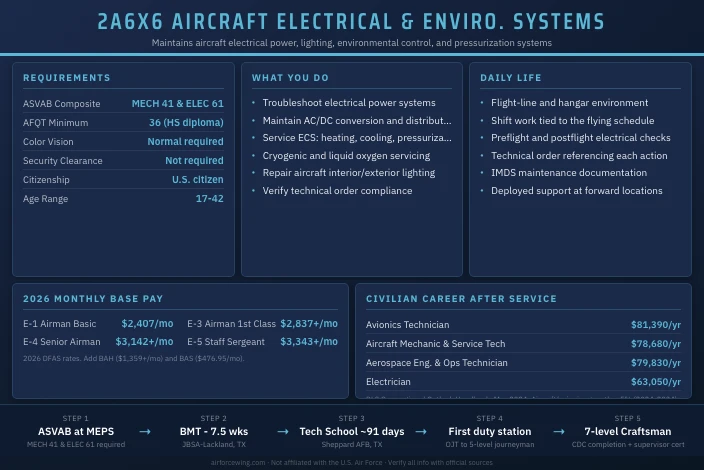
2A6X6 Aircraft Electrical and Environmental Systems specialists inspect, troubleshoot, and maintain the full range of electrical power generation, conversion, and distribution systems on military aircraft. They also own the environmental control systems (ECS) that regulate cabin temperature, pressurization, and airflow, as well as aircraft lighting and cryogenic support operations. No other AFSC in the maintenance world carries this particular combination of electrical depth and life-support systems responsibility.
Daily Tasks
A shift for a 2A6X6 specialist often starts and ends on the flight line, running pre- and post-flight checks on the aircraft’s electrical and ECS systems. Between those bookends, the work varies considerably by what discrepancies pilots have written up and what scheduled maintenance the aircraft is due.
Common daily tasks include:
- Troubleshooting generator control units, bus tie contactors, and AC/DC inverters
- Testing and replacing circuit breakers, relays, and wiring harnesses
- Servicing and testing environmental control packs, heat exchangers, and cabin pressurization regulators
- Performing liquid oxygen (LOX) servicing and cryogenic system maintenance
- Inspecting and repairing interior and exterior lighting, including formation lights and landing lights
- Referencing technical orders for every maintenance procedure, no exceptions
- Documenting completed and open discrepancies in the Integrated Maintenance Data System (IMDS)
- Preparing aircraft for scheduled phase or isochronal inspections
The work moves between the flight line, the hangar, and sometimes a back-shop environment depending on the complexity of the repair and the aircraft’s maintenance status.
Specializations
The 2A6X6 career field does not use prefix-based shredouts the way some Air Force AFSCs do. Platform depth and specialization come through unit assignment and on-the-job experience. Airmen assigned to fighter bases develop expertise on single-seat tactical aircraft electrical systems. Those at mobility wings build proficiency on wide-body transport aircraft with larger, more complex ECS installations.
| Code | Designation | Notes |
|---|---|---|
| 2A6X6 | Aircraft Electrical and Environmental Systems | Primary specialty code, all E&E specialists |
| 2A690 | Senior NCOIC Merge | Senior NCO designation at E-8/E-9 level |
Special Experience Identifiers (SEIs) are awarded to Airmen who document proficiency in specific platform systems or maintenance roles.
Mission Contribution
Modern military aircraft are complex electrical systems that happen to fly. A fighter jet can have dozens of miles of wiring, multiple generator systems, and environmental control hardware that must function within narrow tolerances at altitude. When any of those systems fail, the aircraft cannot fly the mission. The 2A6X6 specialist is the reason electrical discrepancies get fixed before the next sortie and the reason a two-ship of F-16s can push back on schedule.
The environmental control side carries its own urgency. At high altitude, cabin pressurization and temperature regulation are life-support functions. An ECS failure in flight is an emergency. Keeping those systems mission-ready on the ground is the entire point of this specialty.
Technology and Equipment
2A6X6 Airmen work with a range of specialized diagnostic and maintenance equipment:
- Electrical test equipment: Digital multimeters, megohmmeters, oscilloscopes, and wire harness testing sets
- Generator test panels: Equipment for running generator control unit (GCU) functional checks and verifying output voltage and frequency
- Environmental test sets: Air data test units, pressure test kits, and temperature calibration equipment for ECS components
- Cryogenic handling equipment: LOX converters, LOX carts, and low-temperature safety equipment
- Technical orders and electronic job guides: Paper and digital T.O. systems referenced for every maintenance step
- IMDS terminals: The Air Force’s primary maintenance documentation and tracking system
Salary
Base Pay
Active-duty 2A6X6 Airmen follow the same DFAS pay table as all enlisted Air Force personnel. Accessions enter at E-1 and typically reach E-4 within the first three to four years of service.
| Grade | Rank | Monthly Base Pay (2026) |
|---|---|---|
| E-1 | Airman Basic (AB) | $2,407 |
| E-2 | Airman (Amn) | $2,698 |
| E-3 | Airman First Class (A1C) | $2,837 - $3,198 |
| E-4 | Senior Airman (SrA) | $3,142 - $3,816 |
| E-5 | Staff Sergeant (SSgt) | $3,343 - $4,422 |
| E-6 | Technical Sergeant (TSgt) | $3,401 - $5,044 |
| E-7 | Master Sergeant (MSgt) | $3,932 - $5,537 |
Figures reflect 2026 DFAS military pay tables.
Base pay is only part of the picture. Most Airmen living off-base receive Basic Allowance for Housing (BAH), which varies by duty location and dependent status. A single E-4 at Joint Base San Antonio receives $1,359/month in BAH; with dependents, that rises to $1,728/month. Basic Allowance for Subsistence adds a flat $476.95/month for all enlisted Airmen. Neither allowance is taxable income.
Enlistment Bonus
The 2A6X6 AFSC does not carry a publicly posted active-duty enlistment bonus as of this writing, but bonus availability shifts by recruiting cycle. Air National Guard and Air Force Reserve contracts have offered bonuses for this specialty when units have open billets. Confirm current bonus status with a recruiter at contract time, do not assume availability based on prior-year information.
Additional Benefits
Healthcare: Active-duty Airmen and their dependents receive TRICARE Prime at no cost, zero premiums, deductibles, or copays for medical, dental, mental health, prescriptions, and hospitalization.
Education: Tuition Assistance covers up to $4,500 per year ($250 per semester hour) while on active duty. The Post-9/11 GI Bill pays full in-state tuition at public schools or up to $29,920.95 per academic year at private institutions, plus a monthly housing allowance and up to $1,000 annually for books. The Community College of the Armed Forces (CCAF) awards credit toward an Associate of Applied Science in Aircraft Electrical and Environmental Systems as Airmen progress through their career field.
Retirement: Airmen entering service after January 2018 fall under the Blended Retirement System (BRS). The Air Force auto-contributes 1% of basic pay to the Thrift Savings Plan (TSP) after 60 days of service, and matches up to 4% of basic pay on member contributions. At 20 years of service, the pension pays 40% of the high-36 average basic pay monthly for life.
Work-Life Balance
Aircraft maintenance schedules drive shift work. Day shift covers standard duty hours; swing shift supports afternoon and evening flying. During exercises, depot-level phase inspections, or contingency response, 10-12 hour days become routine. The Air Force provides 30 days of paid leave per year, accruing at 2.5 days per month with a 60-day carryover cap. Units with moderate flying tempos tend to protect leave windows more consistently than high-tempo fighter wings.
Qualifications
Basic Qualifications
| Requirement | Standard |
|---|---|
| Age | 17-42 at time of enlistment |
| Citizenship | U.S. citizen required |
| Education | High school diploma (GED with AFQT 65+ accepted) |
| ASVAB Composite | MECH 41 and ELEC 61 (both required) |
| AFQT Minimum | 36 (HS diploma); 65 (GED) |
| Color Vision | Normal color vision required |
| Security Clearance | Not required |
| Physical | Qualifying MEPS examination |
The MECH composite draws from General Science, Auto/Shop Information, Mathematics Knowledge, and Mechanical Comprehension. The ELEC composite draws from General Science, Arithmetic Reasoning, Mathematics Knowledge, and Electronics Information. Both must clear simultaneously, a high MECH score alone won’t qualify you for this AFSC.
If you need to strengthen either composite before testing, a focused ASVAB study guide covers both the Mechanical and Electronics subtests in a single resource.
Color vision is a firm requirement with no waiver available, given the color-coded wiring and circuit diagrams that are central to this work.
Application Process
Selection Criteria
The ELEC 61 composite minimum sets this AFSC apart from most other maintenance career fields, which typically require only a mechanical score. Applicants with a background in electrical work, electronics repair, HVAC controls, or avionics maintenance will have a meaningful advantage in Tech School. The career field rewards methodical troubleshooters who read and follow technical documentation precisely, improvising on electrical systems aboard aircraft is not an option.
Service Obligation
Standard first-term enlistment is four years. Bonus contracts, when offered, may carry a six-year obligation. Your recruiter will specify the exact terms before you sign.
Work Environment
Setting and Schedule
2A6X6 Airmen work in a combination of flight-line, hangar, and back-shop environments. Flight-line work is outdoors and weather-exposed; the hangar provides covered workspace for more involved repairs. Back-shop work on components removed from the aircraft happens in a controlled shop environment with test equipment and dedicated bench space.
Shift work follows the flying schedule. Day shift handles standard maintenance windows; swing shift covers afternoon sorties and late turns. Peak tempo during exercises or inspections extends hours significantly. The physical environment is demanding, especially in summer at bases in the Southwest or winter at northern installations.
Leadership and Communication
Aircraft maintenance sections are NCO-led. Staff Sergeants and Technical Sergeants supervise daily maintenance and sign off on completed work. New Airmen work directly under experienced NCOs from their first week at a duty station. The Production Superintendent (typically a Master Sergeant or Senior Master Sergeant) manages sortie generation and maintenance status reporting to the Maintenance Operations Center (MOC).
Performance feedback follows the Air Force Enlisted Performance Report (EPR) system. Annual EPRs evaluate performance across mission, teamwork, integrity, communication, and professional development. Stratification statements from the rating official carry the most weight at E-5 and above, when promotion boards compare Airmen within the same peer group.
Team Dynamics and Autonomy
Electrical systems troubleshooting is often a two-person effort. Tracing an intermittent wiring fault across a fuselage section benefits from one person monitoring test equipment while another checks connection points. Routine servicing tasks. LOX servicing, lighting replacements, can be one-person operations with a T.O. open. As skill levels increase, Airmen take primary responsibility for complex fault isolation and supervise junior Airmen on simpler tasks.
Job Satisfaction
The 2A6X6 AFSC consistently draws Airmen who have a specific interest in electrical systems and not just general mechanical work. The technical depth is real: understanding generator control circuits, AC/DC conversion theory, and pressurization system physics requires sustained study. That depth is also what makes the work engaging long-term and what makes the transition to civilian avionics or electrical roles so direct.
Training
Before the training pipeline starts, you have to get past the ASVAB. The ASVAB study guide covers the Mechanical and Electronics composites in a single focused resource, exactly what a dual-composite AFSC like 2A6X6 requires.
Training Pipeline
| Phase | Location | Length | Focus |
|---|---|---|---|
| Basic Military Training (BMT) | JBSA-Lackland, TX | 7.5 weeks | Military fundamentals, fitness, discipline |
| Airmen’s Week | JBSA-Lackland, TX | 1 week | Transition to technical training |
| Tech School (2A6X6) | Sheppard AFB, TX | 91 days (~13 weeks) | Aircraft electrical and ECS systems, diagnostics, cryogenics |
| Upgrade Training (3-level to 5-level) | First duty station | 12-18 months | Platform-specific OJT and qualification |
Tech School at Sheppard AFB covers the full scope of the career field: electrical power generation theory, AC and DC distribution systems, generator control units, environmental control system components, pressurization system operation, cryogenic handling, and aircraft lighting systems. Airmen work on representative training equipment and complete academic coursework that applies toward the CCAF Associate of Applied Science in Aircraft Electrical and Environmental Systems.
Graduating Tech School earns the 3-skill-level apprentice designation. Signing off maintenance actions independently requires completing upgrade training and earning the 5-skill-level journeyman designation at the first duty station, a process that typically takes 12-18 months of documented OJT covering a required task qualification list.
Advanced Training
After reaching journeyman status, several additional training paths become available:
- 7-level Craftsman: Requires Career Development Course (CDC) completion, time-in-grade, and supervisor certification. This is the gateway to section leadership and supervisory authority.
- Platform-specific technical courses: Some commands send E&E specialists to courses on specific aircraft type electrical systems, particularly for complex platforms like the B-52, C-130, or F-35. These courses are competitive and strengthen a promotion record.
- Quality Assurance (QA) Inspector: A competitive additional duty authorizing inspection of completed maintenance packages. QA experience is a notable differentiator in promotion competition.
- CCAF degree completion: Airmen who complete 5-level upgrade and meet general education requirements receive the CCAF Associate of Applied Science degree with no additional required coursework beyond normal career progression.
Career Progression
Rank Progression
| Rank | Grade | Typical Timeline | Role |
|---|---|---|---|
| Airman Basic | E-1 | Entry | BMT |
| Airman | E-2 | ~6 months | Tech School |
| Airman First Class | E-3 | ~16 months | First duty station, OJT |
| Senior Airman | E-4 | ~36 months | 5-level journeyman, primary E&E tech |
| Staff Sergeant | E-5 | ~4-6 years | Section supervisor, crew lead |
| Technical Sergeant | E-6 | ~12-14 years (avg.) | Flight chief, section NCOIC |
| Master Sergeant | E-7 | ~17-20 years | Maintenance Superintendent |
| Senior Master Sergeant | E-8 | ~22+ years | Group-level leadership |
| Chief Master Sergeant | E-9 | ~26+ years | Command Chief, wing-level |
Promotion through E-4 is largely time-based. E-5 and above require competitive board processes that weigh EPR ratings, decorations, education, and promotion test scores. 2A6X6 Airmen who pursue QA certifications, deployed assignments, and staff tours consistently build stronger promotion packages than those who remain in a single section throughout their career.
Role Flexibility and Transfers
Retraining from 2A6X6 into other maintenance AFSCs is possible through the Air Force Career Job Reservation (CJR) process. Airmen with 5-level and above qualifications who want to broaden their technical background sometimes move toward avionics AFSCs like 2A2X1 or 2A0X1. The electrical depth 2A6X6 Airmen build is viewed favorably in those communities. Retraining in the opposite direction, into 2A6X6 from a less electronics-intensive maintenance AFSC, is less common given the ELEC 61 prerequisite.
Performance Evaluation
The Air Force Enlisted Performance Report (EPR) evaluates Airmen annually across mission accomplishment, teamwork, service, integrity, communication, adaptability, and professional development. The stratification statement, how the rater ranks the Airman among peers, carries the most weight in promotion packages at E-5 and above. Building a record of accurate maintenance documentation, additional duty performance (QA, unit fitness monitor, mobility NCO), and consistent physical readiness produces the competitive profile this field rewards.
Succeeding in 2A6X6 over the long term requires three things: precise adherence to technical orders on every maintenance action, genuine electronics aptitude that deepens over time, and the habit of documenting work accurately every time, because the signature on a maintenance form is a legal certification.
Physical Demands
Physical Requirements
Aircraft electrical and environmental systems work is physically demanding, though less so on the heavy-lifting side than propulsion or structural maintenance. Daily physical requirements typically include:
- Reaching into confined spaces within fuselages and equipment bays to access wiring harnesses and components
- Prolonged kneeling, crouching, or standing on maintenance stands during aircraft inspections
- Carrying test equipment and component boxes weighing up to 50 pounds
- Working outdoors in all weather conditions, sun, wind, rain, and cold, during flight-line maintenance
- Operating on ladders and maintenance stands around aircraft at height
The Air Force Fitness Assessment (FA) applies to all Airmen regardless of AFSC. It consists of the 1.5-mile run, push-ups, sit-ups, and waist circumference, scored on a 100-point scale. The minimum passing composite is 75, with a component minimum required on each event.
| Component | Max Points | Notes |
|---|---|---|
| 1.5-Mile Run | 60 | Primary aerobic component |
| Waist Circumference | 20 | Body composition measure |
| Push-Ups (1 min) | 10 | Muscular endurance |
| Sit-Ups (1 min) | 10 | Core endurance |
| Total | 100 | Minimum passing: 75 |
Scores are age- and gender-normed. Most active-duty Airmen test annually.
Medical Evaluations
The initial MEPS physical screens for color vision, hearing, and any conditions that could preclude safe work around high-voltage electrical systems and cryogenic fluids. 2A6X6 Airmen who regularly handle LOX and hydraulic fluids are enrolled in occupational health surveillance programs. Hearing conservation is standard for those who work around running aircraft engines and APU systems. Periodic medical fitness reviews are part of normal active-duty health maintenance.
Deployment
Deployment Details
2A6X6 specialists deploy with their aircraft. Any time a flying unit deploys tactical, mobility, or bomber aircraft to a forward location, electrical and environmental systems support travels with it. Typical active-duty rotations run 90-120 days, with contingency operations and theater security package commitments extending that timeline.
Common deployment theaters include the INDOPACOM and CENTCOM areas of responsibility. Forward operating locations often run with reduced staffing, meaning deployed E&E specialists cover a broader range of discrepancies with less support than they have at home station. That autonomy accelerates skill development and builds the kind of troubleshooting confidence that’s hard to develop in a well-resourced home-station shop.
Domestic temporary duty (TDY) for exercises. Red Flag at Nellis AFB, Coronet or other mobility exercises, is common and builds operational experience that matters for both promotion records and post-service resumes.
Duty Stations
2A6X6 Airmen serve at any installation that operates powered military aircraft. Bases with significant E&E sections include:
- Sheppard AFB, TX: Tech School location; some Airmen remain as technical training instructors after their first assignment
- Nellis AFB, NV: Fighter and test operations, including Red Flag exercises
- Luke AFB, AZ: F-35A formal training unit with a large maintenance operation
- Kadena AB, Japan: High-demand INDOPACOM forward presence
- Ramstein AB, Germany: EUCOM airlift and mobility hub
- Travis AFB, CA: C-17 and KC-10 mobility mission
OCONUS assignments at Kadena or Ramstein typically run 24-36 months for accompanied tours and are considered operationally valuable in a promotion package.
Risk/Safety
Job Hazards
Aircraft electrical systems work carries specific hazards that require consistent attention:
- High-voltage electrical systems: Aircraft generators and bus systems operate at voltages and fault currents that can be lethal without proper lockout/tagout procedures
- Cryogenic fluids: Liquid oxygen handling requires specialized PPE and procedures. LOX contact with fuel, oil, or human tissue causes immediate serious injury
- Confined spaces: Many electrical components are buried in fuselage bays and wing sections that require awkward entry and limited visibility
- High-pressure systems: ECS components operate at significant pressures; improper disconnection can result in injury
- Fall hazards: Working on maintenance stands around aircraft presents fall risk during flight-line operations
Safety Protocols
Every maintenance procedure is performed with a current technical order open and referenced step by step. Lockout/tagout requirements apply to any work on aircraft electrical circuits. Cryogenic handling follows documented two-person procedures with dedicated PPE. The Wing Safety office and Bioenvironmental Engineering conduct periodic inspections of E&E shops and flight-line workspaces. Building the habit of T.O. compliance from the first day of duty station work is not optional, it’s the difference between a career and an accident report.
Security and Legal Requirements
The 2A6X6 AFSC does not require a security clearance. Airmen complete a National Agency Check and Local Agency Checks (NACLAC) as part of the standard enlistment background investigation. Maintenance documentation signed by E&E specialists constitutes a legal certification of completed work. Falsifying maintenance records or approving work that was not performed is a court-martial offense under the Uniform Code of Military Justice (UCMJ). Drug and alcohol testing applies to all active-duty Airmen per DoD policy.
Impact on Family
Family Considerations
Shift work is the most consistent family-life factor for 2A6X6 Airmen. Swing shift means arriving home after midnight; day shift requires an early departure. When flying operations demand both shifts, a section may run split schedules simultaneously, and an individual Airman’s shift can change on short notice based on the flying schedule.
Deployment is real and should be planned for. A 90-120 day rotation every 12-18 months reflects a realistic active-duty operational tempo at a fighter or mobility wing. During elevated contingency periods, frequency increases. The Air Force’s Military OneSource program provides counseling, financial advising, and deployment preparation resources at no cost to active-duty families.
Standard Air Force family benefits apply to 2A6X6 Airmen on the same terms as any other AFSC:
- TRICARE Prime: Full medical, dental, and mental health coverage for the Airman and all dependents at no cost
- Basic Allowance for Housing (BAH): Off-base housing stipend scaled to duty location and dependent status
- Child Development Centers (CDCs): On-base childcare at subsidized rates, with priority enrollment for shift workers
- Exceptional Family Member Program (EFMP): Mandatory enrollment and assignment coordination for families with special-needs dependents
Relocation
Permanent Change of Station (PCS) moves typically happen every three to four years. E&E sections exist at essentially every flying installation, which gives 2A6X6 Airmen broader assignment options than narrower platform-specific specialties. OCONUS assignments typically run 24-36 months for accompanied tours. The Air Force covers all authorized moving expenses and pays a dislocation allowance to offset household relocation costs. School-liaison officers at installations help families manage school transitions during each PCS.
Reserve and Air National Guard
Component Availability
The 2A6X6 AFSC is available in both the Air Force Reserve and the Air National Guard. Guard and Reserve units that fly aircraft require E&E specialists to maintain those aircraft to the same standard as active-duty units. Both components offer a path into this specialty, and Reserve and Guard Airmen work the same systems and platforms as their active-duty counterparts.
Drill Schedule and Training Commitment
Standard commitment is one weekend per month (Unit Training Assembly) plus two weeks per year (Annual Tour). Aircraft maintenance AFSCs may require additional training days for annual currency requirements, readiness exercises, and recertification on specific systems. Guard units co-located with active-duty flying wings sometimes perform cross-component maintenance support during UTAs.
Part-Time Pay
An E-4 Senior Airman drilling one UTA weekend earns approximately $212-$244 per drill day. Four drill periods per UTA weekend works out to roughly $848-$976 per drill weekend, based on 2026 reserve drill pay rates.
Benefits Comparison
| Category | Active Duty | Air Force Reserve | Air National Guard |
|---|---|---|---|
| Commitment | Full-time | 1 weekend/mo + 2 wks/yr | 1 weekend/mo + 2 wks/yr |
| Monthly Pay (E-4) | $3,142-$3,816 | Per drill only | Per drill only |
| Healthcare | TRICARE Prime (free) | TRICARE Reserve Select (premiums) | TRICARE Reserve Select or state plan |
| Education | Tuition Assistance ($4,500/yr) | Federal TA available | Federal TA + state tuition waivers (many states) |
| GI Bill | Post-9/11 (full benefit) | Montgomery GI Bill-SR | Ch. 1606 or Post-9/11 (if activated) |
| Retirement | 20-yr pension (40% high-36) | Points-based at age 60 | Points-based at age 60 |
| Deployment Tempo | Frequent | Mobilization-dependent | Mobilization-dependent |
Civilian Career Integration
Guard and Reserve service in this AFSC pairs naturally with civilian careers in avionics maintenance, commercial aviation, and electrical systems roles. Documented 2A6X6 maintenance experience supports FAA Aviation Mechanic Certificate eligibility under the military experience pathway. Many commercial aviation employers actively recruit military-trained E&E technicians. Employers are required to protect civilian jobs during activation periods under USERRA.
Post-Service
Skills built in the 2A6X6 career field translate directly to the civilian aviation and electrical industries. Avionics technicians and aircraft mechanics are consistently among the better-compensated non-degreed technical workers in the country.
| Civilian Career | Median Annual Salary | Job Outlook (2024-2034) |
|---|---|---|
| Avionics Technician | $81,390 | +5% (faster than avg.) |
| Aircraft Mechanic & Service Technician | $78,680 | +5% (faster than avg.) |
| Aerospace Engineering & Ops Technician | $79,830 | +8% (faster than avg.) |
| Electrician | $63,050 | +11% (much faster than avg.) |
Salary data from the BLS Occupational Outlook Handbook, May 2024 figures.
The commercial aviation sector faces a persistent shortage of qualified avionics and aircraft electrical technicians. Major airlines, regional carriers, MRO (maintenance, repair, and overhaul) shops, and defense contractors all compete for workers with documented electrical systems experience. A 2A6X6 veteran at the E-5 or E-6 level with a CCAF degree, a platform qualification, and a clean maintenance record will find that combination opens doors at nearly every civilian aviation employer.
The Air Force’s Transition Assistance Program (TAP) provides resume writing, interview preparation, and job placement resources during the final 180 days of service. The FAA’s military experience provision allows veterans with sufficient documented aircraft maintenance hours to complete an abbreviated process for the Aviation Mechanic Certificate, a credential that directly increases civilian earning potential.
Is This a Good Job
Ideal Candidate Profile
The 2A6X6 AFSC is a strong match for Airmen who:
- Have genuine interest in electrical systems, not just mechanical work, and want to understand how aircraft power generation and distribution works
- Are methodical by nature and comfortable following complex technical documentation step by step
- Want a career field with direct translation to well-paying civilian aviation careers
- Can handle shift work, outdoor conditions, and the physical demands of flight-line maintenance
- Want to work on aircraft systems that directly affect crew safety and mission success
A background in auto electrical work, residential or commercial wiring, HVAC electronics, or electronics repair will make the Tech School curriculum recognizable from the first week.
Potential Challenges
This AFSC may not be the right fit for people who:
- Want to work primarily on mechanical systems. The electronics requirement in this field is real and ongoing.
- Are uncomfortable working around high-voltage systems and cryogenic fluids. The hazard profile is specific and requires consistent attention.
- Need predictable schedules. Shift work tied to flying operations will disrupt conventional routines regularly.
- Struggle to meet the ELEC 61 ASVAB minimum. That bar exists because the job genuinely requires that aptitude level. Tech School will confirm it.
Deployment is also a realistic expectation. E&E specialists are part of the maintenance package that deploys with the aircraft.
Career and Lifestyle Alignment
For someone who wants to combine military service with a clear path to an aviation career, 2A6X6 is one of the more direct routes available through the enlisted ranks. The CCAF degree comes automatically. The civilian job market for avionics and aircraft electrical technicians is strong and growing. The ELEC 61 bar filters out candidates who aren’t genuinely suited to this work, which means the Airmen who do qualify and thrive tend to find the career consistently rewarding.
The Air Force invests heavily in training for this specialty, and that investment pays back directly for Airmen who use it. Few enlisted specialties offer as clear a bridge from military service to a high-skill, high-demand civilian career as 2A6X6.
More Information
Contact an Air Force recruiter to verify current MECH and ELEC score thresholds, confirm open accession slots for the 2A6X6 AFSC, and ask about any bonus programs active in the current recruiting cycle. AFSC availability and incentive pay change frequently, and the recruiter will have the most accurate picture.
Official sources:
- airforce.com: Aircraft Electrical and Environmental Systems career page, official qualification requirements, training details, and current incentives
- Sheppard AFB 82nd Training Wing, home of 2A6X6 Tech School
- Air Force Personnel Center Classification, AFSC classification guidance and career field information
Civilian career transition:
- BLS Aircraft and Avionics Equipment Mechanics and Technicians, salary, outlook, and employer types for the primary civilian career paths out of this AFSC
Before you test: The ASVAB study guide covers both the Mechanical and Electronics composites in one focused resource. The Electronics Information and General Science subtests carry the most weight for the ELEC 61 requirement.
This site is not affiliated with the U.S. Air Force or any government agency. Verify all information with official Air Force sources before making enlistment or career decisions.
Explore more Air Force aircraft maintenance careers including the 2A6X2 Aerospace Ground Equipment AFSC for ground support equipment work and the 2A6X1 Aerospace Propulsion AFSC for jet engine specialization.