2A6X2 Aerospace Ground Equipment
No aircraft flies without a working support fleet on the ground. The generators, hydraulic test stands, air conditioning units, and power carts that keep jets mission-ready are all the responsibility of one AFSC: the 2A6X2 Aerospace Ground Equipment specialist. These Airmen are the mechanics behind the mechanics, keeping the equipment that keeps the aircraft alive. It’s a career that sits at the intersection of diesel engines, hydraulics, electrical systems, and pneumatics, and it’s one of the more consistently in-demand jobs in the entire Air Force maintenance world.
Job Role
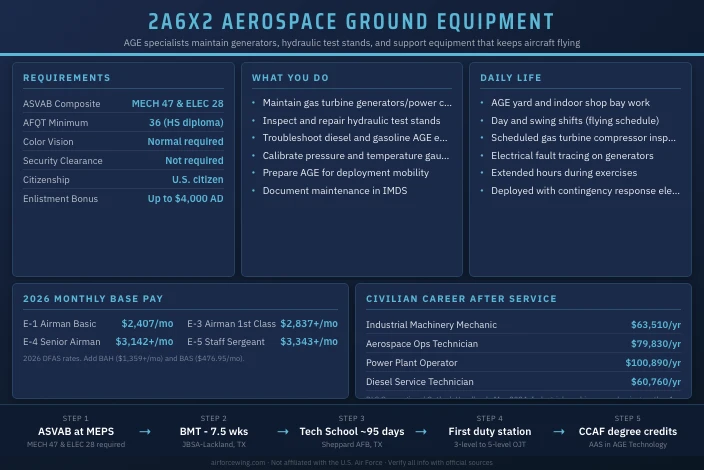
2A6X2 Aerospace Ground Equipment specialists inspect, maintain, troubleshoot, and repair the powered and non-powered support equipment that enables aircraft maintenance operations. Their equipment inventory spans gas turbine generators, aerospace ground power units, air conditioning and liquid oxygen carts, hydraulic and pneumatic test stands, bomb loaders, tow tractors, and dozens of other support items. Without functional AGE, the flight line grinds to a stop.
Daily Tasks
What a typical shift looks like depends heavily on the unit’s flying schedule and what equipment has been reported as down. Common work includes:
- Running scheduled maintenance inspections on gas turbine compressor (GTC) units and external power carts
- Diagnosing hydraulic pressure faults on test stands used by aircraft maintainers
- Performing engine oil changes and fuel system maintenance on diesel and gasoline-powered AGE
- Troubleshooting electrical wiring faults in generators and power conditioning equipment
- Calibrating pressure and temperature gauges on pneumatic test equipment
- Preparing AGE assets for deployment packing and mobility exercises
- Entering and closing maintenance discrepancies in the Integrated Maintenance Data System (IMDS)
- Performing periodic isochronal and phase maintenance inspections on long-cycle equipment
The AGE section operates somewhat differently from aircraft maintenance shops. Work tends to be split between an outdoor yard where equipment is staged and tested, and a shop bay where more involved repairs happen. You’ll frequently encounter both scenarios in a single shift.
Specializations
The 2A6X2 career field does not carry formal prefix-based shredouts the way some Air Force AFSCs do. Platform depth comes through on-the-job experience and unit assignment. Airmen who spend time at fighter bases develop expertise on high-demand jet start and hydraulic test equipment; those at mobility bases become more familiar with wide-body aircraft support equipment. Special Experience Identifiers (SEIs) are available for Airmen who build documented proficiency in specific equipment types or roles.
| Code | Designation | Notes |
|---|---|---|
| 2A6X2 | Aerospace Ground Equipment | Primary specialty code, all AGE specialists |
| 2A690 | Senior NCOIC Merge | Senior NCO designation at E-8/E-9 level |
Mission Contribution
Aircraft maintainers can’t do their jobs without functional support equipment. A crew chief who needs to run hydraulic pressure tests before signing off an aircraft requires a working test stand. A jet engine run requires a verified power cart. An aeromedical evacuation aircraft needs reliable air conditioning equipment to regulate cabin temperature for patients in flight. Every part of the Air Force’s flying mission depends on the support chain AGE specialists keep intact.
During deployed operations, AGE sections often support multiple aircraft types simultaneously with limited spare parts and no depot backup. The ability to improvise, cannibalize parts across similar equipment, and maintain serviceability under austere conditions makes this career field operationally critical.
Technology and Equipment
2A6X2 Airmen work across a wide range of equipment types, requiring knowledge of multiple systems:
- Gas turbine compressors and generators: Jet-fuel-powered ground power units that start aircraft engines and provide electrical power during maintenance
- Hydraulic test stands: Equipment that pressurizes and tests aircraft hydraulic systems to precise specifications
- Diesel and gasoline engines: Internal combustion engines powering tow tractors, heaters, and some portable generators
- Pneumatic and liquid oxygen carts: Pressurized support equipment requiring specific safety procedures
- Electrical test equipment: Multimeters, oscilloscopes, and specialized diagnostic tools for generator control circuits
- Digital maintenance data systems: IMDS and electronic technical orders for documentation and procedure reference
Salary
Base Pay
Active-duty 2A6X2 Airmen follow the same DFAS pay tables as all enlisted Air Force personnel. New Airmen enter at E-1 and typically reach E-4 within the first three to four years.
| Grade | Rank | Monthly Base Pay (2026) |
|---|---|---|
| E-1 | Airman Basic (AB) | $2,407 |
| E-2 | Airman (Amn) | $2,698 |
| E-3 | Airman First Class (A1C) | $2,837 - $3,198 |
| E-4 | Senior Airman (SrA) | $3,142 - $3,816 |
| E-5 | Staff Sergeant (SSgt) | $3,343 - $4,422 |
| E-6 | Technical Sergeant (TSgt) | $3,401 - $5,044 |
| E-7 | Master Sergeant (MSgt) | $3,932 - $5,537 |
Base pay is only part of the compensation picture. Most Airmen living off-base receive Basic Allowance for Housing (BAH), which varies by duty location and dependent status. A single E-4 at Joint Base San Antonio-Lackland receives $1,359/month in BAH; with dependents, that rises to $1,728/month. Basic Allowance for Subsistence adds a flat $476.95/month for all enlisted Airmen. Neither allowance is taxable.
Enlistment Bonus
The 2A6X2 AFSC currently offers an active-duty enlistment bonus of up to $4,000. Air National Guard contracts have offered up to $15,000, and Air Force Reserve contracts up to $20,000, reflecting the persistent demand for trained AGE specialists across all components. Bonus amounts are subject to change by recruiting cycle; confirm current figures with a recruiter before signing.
Additional Benefits
Healthcare: Active-duty Airmen and their dependents enroll in TRICARE Prime at zero cost, no premiums, deductibles, or copays for medical, dental, vision, mental health, prescriptions, and hospitalization.
Education: Tuition Assistance covers up to $4,500 per year ($250 per semester hour) while on active duty. The Post-9/11 GI Bill pays full in-state tuition at public schools or up to $29,920.95 per academic year at private institutions, plus a monthly housing allowance and up to $1,000 annually for books and supplies. The Air Force also awards credit toward an Associate of Applied Science in Aerospace Ground Equipment Technology through the Community College of the Armed Forces (CCAF) as part of the normal 2A6X2 training pipeline.
Retirement: Airmen who entered service after January 2018 fall under the Blended Retirement System (BRS). The Air Force automatically contributes 1% of basic pay to the Thrift Savings Plan (TSP) beginning after 60 days, and matches up to 4% of basic pay on member contributions. At 20 years of service, the pension pays 40% of the high-36 average basic pay monthly for life.
Work-Life Balance
AGE sections generally operate day and swing shifts to cover maintenance support across the flying schedule. During exercises and major inspections, hours extend significantly. The Air Force provides 30 days of paid leave per year, accruing at 2.5 days per month with a 60-day carryover cap. Weekend flying operations pull AGE support personnel in as needed; a clean flying weekend also tends to mean a cleaner schedule for the support sections.
Qualifications
Basic Qualifications
Entry into the 2A6X2 AFSC requires meeting the following standards:
| Requirement | Standard |
|---|---|
| Age | 17-42 at time of enlistment |
| Citizenship | U.S. citizen required |
| Education | High school diploma (GED with AFQT 65+ accepted) |
| ASVAB Composite | MECH 47 and ELEC 28 (both required) |
| AFQT Minimum | 36 (HS diploma); 65 (GED) |
| Color Vision | Normal color vision required |
| Security Clearance | Not required |
| Physical | Qualifying MEPS examination |
The dual composite requirement. MECH 47 and ELEC 28, is unusual in the maintenance career group. Most airframe AFSCs require only the MECH composite. The addition of an electronics minimum reflects the amount of electrical troubleshooting in this role. Generators, power conditioning circuits, and control panels require genuine electronics knowledge, not just mechanical aptitude.
The MECH composite draws from General Science, Auto/Shop Information, Mathematics Knowledge, and Mechanical Comprehension. The ELEC composite draws from General Science, Arithmetic Reasoning, Mathematics Knowledge, and Electronics Information. Applicants should prep both areas before testing.
Color vision is a firm requirement with no waiver available.
Application Process
Selection Criteria
2A6X2 is accessible by ASVAB standard, the dual composite requirement covers both mechanics and electronics, but neither minimum is particularly high. Applicants with hands-on experience in power equipment, diesel mechanics, HVAC, or any electrical trade will recognize a significant portion of what they encounter in Tech School. The career field is consistently understaffed relative to Air Force requirements, which makes it a reliable job choice for qualified applicants across recruiting cycles.
Service Obligation
Standard first-term enlistment is four years. Bonus contracts may carry a longer service obligation; your recruiter will specify the exact terms before signing.
See our ASVAB study guide for a focused review of the Mechanical and Electronics composites, or try the PiCAT if you’re a first-time tester who wants to test from home.
Work Environment
Setting and Schedule
AGE sections operate out of a dedicated yard and shop space on the installation. The yard, where equipment is staged, started, and tested, is outdoors and exposed to weather. The shop bay handles more involved repairs in a covered environment. Neither area looks like a conventional office, and neither should.
Key schedule characteristics:
- Day shift: Standard duty hours aligned to morning flight operations
- Swing shift: Afternoon and evening coverage for late flying windows
- Surge periods: Phase inspections and exercises routinely push shifts to 10-12 hours
- Deployed pace: Smaller crews support a broader aircraft mix, with fewer resources and less predictable hours
- Weather exposure: Outdoor yard work continues regardless of temperature, wind, or precipitation
Leadership and Communication
AGE sections are NCO-led. Staff Sergeants and Technical Sergeants supervise day-to-day operations and sign off on completed maintenance actions. New Airmen work directly under experienced NCOs from the first week at their duty station. The section chief is typically a Master Sergeant or Senior Master Sergeant who manages the section’s maintenance production and equipment status reporting to the maintenance operations center.
Performance feedback follows the Air Force Enlisted Performance Report (EPR) system. Annual EPRs assess performance across mission, teamwork, integrity, communication, and professional development. Stratification statements from the rating official become critically important at E-5 and above, when competitive promotion boards compare Airmen across the same peer group.
Team Dynamics and Autonomy
AGE work involves a mix of independent and team tasks. Routine inspections on a generator can be a one-person job with a technical order. More complex troubleshooting, tracing an intermittent electrical fault on a test stand, for example: typically involves a second set of eyes. As skill levels advance, Airmen take on primary responsibility for more complex tasks and supervise junior Airmen completing simpler ones.
Job Satisfaction
The AGE career field attracts Airmen who like variety. No two shifts look the same because the equipment inventory is so diverse. A maintainer who gets bored doing the same task repeatedly will find the 2A6X2 world considerably more engaging than a narrower specialty. The challenge is depth: AGE specialists must maintain general competency across a wide range of equipment types rather than developing deep expertise in one system. Airmen who prefer mastering a single platform sometimes find that breadth frustrating.
The field has a persistent manpower shortage that works in the individual Airman’s favor in some ways, deployment rotations, training opportunities, and competitive assignments tend to be accessible earlier than they might be in an oversupplied AFSC.
Training
Training Pipeline
| Phase | Location | Length | Focus |
|---|---|---|---|
| Basic Military Training (BMT) | JBSA-Lackland, TX | 7.5 weeks | Military fundamentals, fitness, discipline |
| Airmen’s Week | JBSA-Lackland, TX | 1 week | Transition to technical training |
| Tech School (2A6X2) | Sheppard AFB, TX | 95 days (~19 weeks) | AGE systems, engines, hydraulics, electrical, diagnostics |
| Upgrade Training (3-level to 5-level) | First duty station | 12-18 months | Platform-specific OJT and equipment qualification |
Tech School at Sheppard AFB runs approximately 95 days. The curriculum covers the full range of AGE systems: gas turbine engine principles, diesel and gasoline engine maintenance, hydraulic and pneumatic systems theory, electrical wiring and generator control circuits, and hands-on practicals on training equipment. Airmen also complete academic requirements that credit toward the CCAF Associate of Applied Science in Aerospace Ground Equipment Technology.
Graduating Tech School earns the 3-skill-level apprentice designation. Independent sign-off authority on AGE maintenance forms requires completing upgrade training and earning the 5-skill-level journeyman designation at the first duty station. That process takes roughly 12-18 months of documented OJT covering a required task list.
Advanced Training
After reaching journeyman status, several paths are available:
- 7-level Craftsman: Requires Career Development Course (CDC) completion, time-in-grade, and supervisor certification. This is the gateway to supervisory responsibilities and section leadership.
- Equipment-specific technical courses: Some Air Force commands send AGE specialists to manufacturer or depot courses on specific high-complexity equipment. Gas turbine compressor courses and hydraulic test stand courses are common examples.
- Quality Assurance (QA) Inspector: A competitive additional duty that authorizes review and inspection of completed AGE maintenance work packages. QA experience significantly strengthens a promotion record.
- CCAF degree completion: Airmen who complete the 5-level training and meet general education requirements receive an Associate of Applied Science from CCAF with no additional coursework required beyond normal career progression.
The ASVAB study guide covers both composites needed for this AFSC in a single prep resource.
Career Progression
Rank Progression
| Rank | Grade | Typical Timeline | Role |
|---|---|---|---|
| Airman Basic | E-1 | Entry | BMT |
| Airman | E-2 | ~6 months | Tech School |
| Airman First Class | E-3 | ~16 months | First duty station, OJT |
| Senior Airman | E-4 | ~36 months | Journeyman, primary AGE technician |
| Staff Sergeant | E-5 | ~4-6 years | Section supervisor, crew lead |
| Technical Sergeant | E-6 | ~12-14 years (avg.) | Flight chief, section NCOIC |
| Master Sergeant | E-7 | ~17-20 years | Maintenance Superintendent |
| Senior Master Sergeant | E-8 | ~22+ years | Group-level leadership |
| Chief Master Sergeant | E-9 | ~26+ years | Command Chief, wing-level |
Promotion through E-4 is largely time-based. E-5 and above require competitive board processes that weigh EPR ratings, decorations, education, and test scores. AGE specialists who diversify their experience. QA assignments, deployed billets, staff tours, consistently outperform peers who remain in a single section for their entire career.
Role Flexibility and Transfers
Retraining into 2A6X2 from other AFSCs is common, given the career field’s persistent manning shortfall. Experienced 2A6X2 Airmen who want to broaden their mechanical expertise sometimes retrain into 2A6X1 Aerospace Propulsion or 2A3X3 Tactical Aircraft Maintenance. Retraining approval depends on the Air Force Career Job Reservation (CJR) process, and 2A6X2’s chronic shortfall means the career field retains people aggressively.
Performance Evaluation
EPRs evaluate Airmen annually across seven areas: mission accomplishment, teamwork, service, integrity, communication, adaptability, and professional development. At E-5 and above, the stratification statement, how the supervisor ranks the Airman among their direct peers, carries the most weight in promotion board packages. A well-documented qualification record, QA certification, and a history of taking on additional duties are the clearest indicators of a competitive promotion package in this career field.
Succeeding in 2A6X2 long-term requires three things: technical accuracy on every maintenance form, consistent physical availability across the shift schedule, and a genuine interest in learning equipment you’ve never touched before. The breadth of the equipment inventory makes curiosity a professional asset.
Physical Demands
Physical Requirements
AGE work is physically demanding across multiple dimensions. Day-to-day physical requirements include:
- Lifting and moving equipment components weighing up to 70 pounds
- Working in confined spaces under equipment for oil drains and filter changes
- Prolonged standing and kneeling during inspections on large equipment
- Operating outdoors in heat, cold, rain, and wind for extended periods
- Performing tasks that require fine motor control for electrical connections and hydraulic fittings
- Starting and operating powered test equipment that produces significant noise
The Air Force Fitness Assessment (FA) applies to all Airmen regardless of AFSC. It includes the 1.5-mile run, push-ups, sit-ups, and waist circumference, scored on a 100-point scale. The minimum passing composite is 75, with a component minimum on each event.
| Component | Max Points | Notes |
|---|---|---|
| 1.5-Mile Run | 60 | Primary aerobic component |
| Waist Circumference | 20 | Body composition measure |
| Push-Ups (1 min) | 10 | Muscular endurance |
| Sit-Ups (1 min) | 10 | Core endurance |
| Total | 100 | Minimum passing: 75 |
Scores are age- and gender-normed. Most active-duty Airmen test annually. Failing the FA carries administrative consequences and can affect promotion eligibility.
Medical Evaluations
The initial MEPS physical screens for color vision deficiencies, hearing, and any conditions that could preclude safe work around powered industrial equipment. AGE specialists who work regularly with hydraulic fluids, fuels, and solvents are enrolled in periodic occupational health surveillance programs. Hearing conservation enrollment is standard for Airmen who operate gas turbine test equipment, which produces high noise levels during run operations.
Deployment
Deployment Details
2A6X2 specialists deploy with the aircraft they support. Any time a flying unit deploys tactical, mobility, or special operations aircraft to a forward location, AGE support travels with it. Typical active-duty deployment rotations run 90-120 days, though contingency operations and theater security package (TSP) commitments can extend that.
Deployments frequently go to locations in the INDOPACOM and CENTCOM areas of responsibility. Because AGE equipment is heavy and requires ground transport or airlift, AGE sections typically deploy as part of a larger maintenance package and are among the first support elements to arrive at a forward location.
Domestic temporary duty (TDY) assignments for exercises. Red Flag at Nellis AFB, Cope Thunder in the Pacific, Mobility Guardian, are common and build operational experience that helps with both promotion records and post-service resumes.
Duty Stations
2A6X2 Airmen serve at virtually every installation that operates aircraft. Major installations with significant AGE sections include:
- Sheppard AFB, TX: Tech School location; some Airmen remain as instructors after their first assignment
- Luke AFB, AZ: F-35A training wing with a large AGE section
- Kadena AB, Japan: High-demand INDOPACOM forward presence
- Ramstein AB, Germany: Major EUCOM hub supporting airlift and tanker operations
- Nellis AFB, NV: Fighter and test operations
- Travis AFB, CA: C-17 and tanker mobility mission
Overseas assignments at Kadena and Ramstein may be accompanied or unaccompanied depending on the installation and current policy. These tours are considered operationally valuable and tend to strengthen a promotion record.
Risk/Safety
Job Hazards
The AGE work environment involves a specific set of hazards that differ from aircraft maintenance:
- High-pressure hydraulic systems: Hydraulic test stands operate at pressures that can cause serious injection injuries if a fitting fails during connection or disconnection
- Rotating engine components: Gas turbine and piston engines present entanglement and blade-strike hazards during operation
- Chemical exposure: Hydraulic fluid, aviation fuel (JP-8), solvents, and battery acid require proper PPE and handling
- Electrical hazards: Generators and power conditioning units operate at voltages and currents that are immediately lethal without proper lockout/tagout procedures
- Noise: Gas turbine compressors and external power units produce sustained noise levels that require double hearing protection
Safety Protocols
Every AGE maintenance procedure is performed with a technical order open and referenced step by step, no exceptions. Lockout/tagout requirements govern any work on energized electrical systems. Two-person integrity (TPI) applies to high-risk tasks. The Wing’s Ground Safety and Bioenvironmental Engineering offices conduct periodic inspections of AGE shops and yards. Airmen who develop a habit of taking technical order shortcuts early in their career create risk for themselves and the Airmen they will later supervise.
Security and Legal Requirements
The 2A6X2 AFSC does not require a security clearance. Airmen complete a National Agency Check and Local Agency Checks (NACLAC) as part of the standard enlistment background investigation. Maintenance forms signed by AGE specialists are legal documents; falsifying or approving maintenance that was not performed can result in court-martial under the Uniform Code of Military Justice (UCMJ). Random drug testing applies to all Airmen on active duty.
Impact on Family
Family Considerations
Shift work is the most consistent family-life factor for AGE specialists. Swing shift means arriving home well after midnight; day shift means an early departure. When the flying schedule runs both shifts, the section may have Airmen on different cycles simultaneously, and your shift can change with the needs of the unit. Families who plan around a standard schedule need to recalibrate that expectation before the first duty station assignment.
Deployment is real but not unique to AGE. A 90-120 day rotation every 12-18 months is a realistic expectation in a fighter or mobility wing at normal operational tempo. During major contingencies, frequency increases.
Key family support resources available to 2A6X2 Airmen:
- Military OneSource: Free counseling, financial advising, and deployment readiness support for active-duty families
- TRICARE Prime: Full family medical, dental, and vision coverage at zero cost
- Child Development Centers: On-base childcare, priority access for shift workers
- School Liaison Officers: Help families manage school enrollment and transitions during PCS moves
- Exceptional Family Member Program (EFMP): Coordinates assignments and services for special-needs family members
- Base Housing and BAH: On-base housing or a tax-free BAH allowance sized to the duty location and dependent status
Relocation
Permanent Change of Station moves happen roughly every three to four years. AGE sections exist at essentially every flying installation, so duty station variety is higher in this AFSC than in narrower specialties. OCONUS assignments at Kadena, Misawa, or Ramstein typically run 24-36 months for accompanied tours. The Air Force covers all authorized moving expenses and pays a dislocation allowance to offset household relocation costs.
Reserve and Air National Guard
Component Availability
The 2A6X2 AFSC is available in both the Air Force Reserve and the Air National Guard. Given the manpower shortfall that exists on the active-duty side, both reserve components maintain active AGE sections that support their assigned flying units. Guard and Reserve AGE specialists work the same equipment as their active-duty counterparts and are subject to the same maintenance standards.
Drill Schedule and Training Commitment
Standard Reserve and Guard commitment is one weekend per month (Unit Training Assembly) plus two weeks per year (Annual Tour). AGE sections may require additional training days for annual equipment certifications, readiness exercises, and currency requirements on specific high-demand items. Guard units co-located with active-duty installations occasionally perform AGE maintenance on active-duty equipment during UTAs, which maintains currency and deepens the working relationship between components.
Part-Time Pay
An E-4 Senior Airman drilling one UTA weekend earns approximately $212-$244 per drill day (four drill periods per UTA weekend equals roughly $848-$976 per drill weekend) based on 2026 reserve drill pay rates.
Benefits Comparison
| Category | Active Duty | Air Force Reserve | Air National Guard |
|---|---|---|---|
| Commitment | Full-time | 1 weekend/mo + 2 wks/yr | 1 weekend/mo + 2 wks/yr |
| Monthly Pay (E-4) | $3,142-$3,816 | Per drill only | Per drill only |
| Healthcare | TRICARE Prime (free) | TRICARE Reserve Select (premiums) | TRICARE Reserve Select or state plan |
| Education | Tuition Assistance ($4,500/yr) | Federal TA available | Federal TA + state tuition waivers (many states) |
| GI Bill | Post-9/11 (full benefit) | Montgomery GI Bill-SR | Ch. 1606 or Post-9/11 (if activated) |
| Retirement | 20-yr pension (40% high-36) | Points-based at age 60 | Points-based at age 60 |
| Deployment Tempo | Frequent | Mobilization-dependent | Mobilization-dependent |
| Enlistment Bonus | Up to $4,000 | Up to $20,000 | Up to $15,000 |
Guard and Reserve bonus amounts for 2A6X2 significantly exceed the active-duty offer, reflecting the difficulty these components have filling AGE billets with qualified personnel. USERRA protects civilian employment during any activation or mobilization period.
Civilian Career Integration
2A6X2 pairs naturally with civilian careers in industrial maintenance, power generation, and aerospace support. Guard and Reserve service builds documented maintenance hours that support EPA, OSHA, and industry licensing requirements in related fields. Many defense contractors and airport ground support companies actively recruit AGE-trained technicians; serving in a Reserve or Guard 2A6X2 unit while working in a civilian maintenance role gives an Airman a resume that reads as both current and verified.
Post-Service
The skills 2A6X2 Airmen build transfer directly to several high-demand civilian fields. Gas turbine generator knowledge applies to power generation, oil and gas, and industrial facilities maintenance. Hydraulic systems expertise is directly applicable to construction equipment, industrial machinery, and aerospace ground operations. Electrical troubleshooting credentials open doors in manufacturing, aviation support, and utility maintenance.
| Civilian Career | Median Annual Salary | Job Outlook (2024-2034) |
|---|---|---|
| Industrial Machinery Mechanic | $63,510 | +13% (much faster than avg.) |
| Aerospace Engineering & Operations Technician | $79,830 | +8% (faster than avg.) |
| Power Plant Operator | $100,890 | Stable |
| Diesel Service Technician | $60,760 | +3% (as fast as avg.) |
Salary data from the BLS Occupational Outlook Handbook, May 2024 figures.
The industrial machinery mechanic outlook of +13% through 2034 is one of the stronger growth projections in the maintenance trades. Manufacturing expansion and aging infrastructure in industrial facilities are driving demand for workers who understand both mechanical and electrical systems, exactly the skill profile a 2A6X2 veteran brings.
Experienced 2A6X2 veterans at the E-6 and E-7 level often move into maintenance supervision, quality assurance, or facilities management roles. Defense contractors supporting Air Force bases frequently hire former AGE specialists into GSA maintenance contracts that involve, directly, the same equipment they maintained while in uniform.
The Air Force’s Transition Assistance Program (TAP) provides resume writing, job search, and interview preparation resources during the final 180 days of service. Veterans also qualify for VA education benefits to pursue engineering technology degrees or industry certifications during or after transition.
Is This a Good Job
Ideal Candidate Profile
The 2A6X2 AFSC suits people who:
- Like working on a wide variety of equipment rather than becoming an expert on one platform
- Are comfortable with both mechanical and electrical troubleshooting, this isn’t a purely wrench-turning job
- Want a career field that’s consistently in demand across active duty, Guard, and Reserve
- Have an interest in diesel engines, generators, hydraulics, or HVAC from a prior job or hobby
- Want a clear bridge to civilian maintenance careers with strong growth projections
People who worked in construction equipment repair, diesel truck maintenance, HVAC installation, or industrial plant maintenance before enlisting will find 2A6X2 extremely familiar from the first week of Tech School.
Potential Challenges
This AFSC may not be the right fit for people who:
- Want to work exclusively on aircraft. AGE specialists support aircraft but don’t touch them directly.
- Prefer mastering one system deeply. The equipment breadth is a strength for some and frustrating for others.
- Need predictable schedules. Shift work tied to flying operations will disrupt conventional routines.
- Are uncomfortable with chemical and high-pressure system hazards. The PPE requirements and safety culture are real and non-negotiable.
The deployment picture is also worth being clear-eyed about. AGE travels with the aircraft, which means when the unit deploys, the AGE section goes too.
Career and Lifestyle Alignment
For someone who came from a mechanical background and wants to deepen those skills in a structured, well-resourced environment, 2A6X2 delivers. The CCAF degree comes automatically. The enlistment bonus adds immediate compensation. The civilian career ceiling, particularly for Airmen who move into power generation or aerospace support contracting, is considerably higher than the BLS median for any comparable civilian entry-level role. And the consistent manpower shortage in this career field means qualified Airmen have more control over their assignment options and career timing than they would in a fully-manned AFSC.
More Information
Talk with an Air Force recruiter to confirm current MECH and ELEC score requirements, verify active bonus availability for the 2A6X2 AFSC, and check open accession slots in your preferred duty station region. Requirements and bonus amounts change by recruiting cycle, and a recruiter will have the most current information.
Official sources:
- airforce.com: Aerospace Ground Equipment Specialist career page, official qualification requirements, training details, and current bonus information
- Sheppard AFB 82nd Training Wing, home of 2A6X2 Tech School
- Air Force Personnel Center Classification page, AFSC classification guidance and career field information
Civilian career transition:
- BLS Industrial Machinery Mechanics, median salary, employment outlook, and employer types for the primary civilian transition path
- BLS Aerospace Engineering and Operations Technicians, salary and outlook for AGE specialists who move into aerospace industry support roles
Before you test: The 2A6X2 requires both the MECH and ELEC composites to clear simultaneously. The MECH composite draws from General Science, Auto/Shop, Mathematics Knowledge, and Mechanical Comprehension. The ELEC composite adds Electronics Information to a similar math and science base. An ASVAB study guide that covers both composites is the most efficient preparation for this AFSC.
This site is not affiliated with the U.S. Air Force or any government agency. Verify all information with official Air Force sources before making enlistment or career decisions.
Explore more Air Force aircraft maintenance careers including the 2A6X1 Aerospace Propulsion AFSC for jet engine work and the 2A5X1 Aerospace Maintenance AFSC for broad airframe maintenance roles.