2A6X1 Aerospace Propulsion
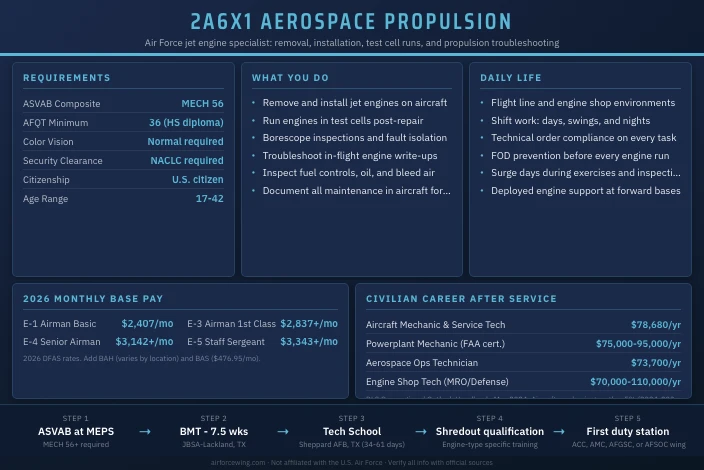
Every F-15, F-16, C-17, and B-52 that flies does so because a 2A6X1 signed off on the engine. Aerospace Propulsion specialists are the Air Force’s engine experts, the people who remove, install, troubleshoot, and test cell run the turbofan and turboprop engines that keep military aviation possible. No other job in the maintenance career field focuses this deeply on propulsion systems.
The 2A6X1 is one of the few maintenance AFSCs where your entire career centers on a single, highly complex subsystem. That depth creates real expertise fast. It also creates direct value in the civilian aviation job market, where FAA-certificated powerplant mechanics are consistently in short supply.
Qualifying requires a Mechanical composite score of at least 56 on the ASVAB. That threshold is higher than most airframe maintenance AFSCs, which puts a premium on preparation before testing.
Qualifying requires specific ASVAB line scores. Our ASVAB study guide covers what to target and how to prepare.
Job Role
2A6X1 Aerospace Propulsion specialists perform organizational and intermediate-level maintenance on aircraft engines and associated propulsion systems. They remove and install engines, troubleshoot propulsion discrepancies using diagnostic equipment and technical orders, run engines in test cells, and inspect, repair, and adjust engine components including fuel control units, lubrication systems, and exhaust systems. Their work directly determines whether an aircraft can fly.
Daily Tasks
The daily rhythm depends on what’s broken, what’s scheduled, and what the flying schedule demands. On a given day, a 2A6X1 might:
- Remove and install jet engines on fighter, bomber, or mobility aircraft
- Run engine diagnostics using borescopes and engine trending data
- Perform engine test cell runs to verify performance after repair
- Inspect and replace engine fuel controls, oil systems, and bleed air components
- Troubleshoot in-flight engine write-ups using Air Force technical orders
- Document all maintenance actions in aircraft forms and maintenance information systems
- Supervise junior Airmen on complex engine removal and installation tasks
High-ops periods compress everything. You’re turning engines on tight schedules to keep the flying program on track.
Shredout Specializations
The 2A6X1 career field divides into letter-suffix shredouts based on engine type. Your shredout is determined by Air Force needs at the time you enlist.
| Shredout | Engine Systems |
|---|---|
| 2A6X1A | TF33, JT3D, T56, TF41, and related turbofan/turboprop engines |
| 2A6X1B | T56 (C-130 Hercules turboprop engines) |
| 2A6X1C | CF6, F103, F108, F117, TFE-731, TF34, TF39, PW2040, F138 |
| 2A6X1D | F100, F101, F110, F118, F119, F135, TF34 (fighter/bomber engines) |
| 2A6X1E | R2800, R3350, PT6 (reciprocating and turboprop legacy engines) |
| 2A6X1F | F100, F110, and other advanced fighter engine series |
Fighter engine shredouts (2A6X1D/F) place Airmen at ACC and AFSOC bases working on F-15s, F-16s, F-22s, and F-35s. Mobility engine shredouts put you on C-17s, C-130s, and B-52s at AMC and AFGSC wings.
Mission Contribution
Aircraft availability is the Air Force’s most closely tracked maintenance metric. An aircraft with an engine grounded for repair isn’t available for combat, deterrence, or airlift missions. Propulsion specialists sit at the center of that equation. Engine failures are among the most mission-critical discrepancies in aviation maintenance, and 2A6X1 Airmen are the ones who fix them.
Equipment and Technology
The tools of this career field go well beyond hand wrenches. Daily equipment includes:
- Borescopes for internal engine inspection without disassembly
- Engine test cells for controlled performance verification runs
- Automated diagnostic systems for engine trending and fault isolation
- Specialized torque wrenches, engine stands, and lifting equipment
- Fuel control and hydromechanical test equipment
- Air Force technical orders governing every procedure step by step
Modern fighter engines like the F135 (F-35) and F119 (F-22) include embedded diagnostics that generate fault codes maintainers interrogate directly. The technology is sophisticated, and proficiency with it builds fast when you’re working on engines every day.
Salary
Pay starts the day you report to Basic Military Training. Base pay is the floor, not the ceiling, tax-free allowances and full military benefits bring total compensation well above the base pay table alone.
2026 Base Pay
| Rank | Grade | Monthly Base Pay |
|---|---|---|
| Airman Basic | E-1 | $2,407 |
| Airman | E-2 | $2,698 |
| Airman First Class | A1C (E-3) | $2,837, $3,198 |
| Senior Airman | SrA (E-4) | $3,142, $3,816 |
| Staff Sergeant | SSgt (E-5) | $3,343, $4,422 |
| Technical Sergeant | TSgt (E-6) | $3,401, $5,044 |
| Master Sergeant | MSgt (E-7) | $3,932, $5,537 |
Figures from DFAS 2026 pay tables. Ranges reflect years of service within each grade.
Most Airmen living off-base receive Basic Allowance for Housing (BAH), which is tax-free and varies by duty location and dependent status. At a base like Hill AFB, UT, home to a large F-35 fleet, an E-4 without dependents draws several hundred dollars more in BAH than the national minimum. Basic Allowance for Subsistence (BAS) adds $476.95 per month flat for all enlisted Airmen in 2026.
Healthcare, Education, and Retirement
Active-duty Airmen are covered under TRICARE Prime at zero cost: no enrollment fee, no deductible, and no copays for medical, dental, vision, and prescriptions.
The Post-9/11 GI Bill covers full in-state tuition at public universities or up to $29,920.95 per academic year at private schools, plus a monthly housing allowance tied to the school’s zip code. Air Force Tuition Assistance covers up to $4,500 per year for courses taken while on active duty, useful for knocking out college credits between deployments.
The Blended Retirement System (BRS) provides a pension at 20 years equal to 40% of your highest 36 months of base pay, plus government TSP matching up to 4% of basic pay.
Work-Life Balance
Airmen earn 30 days of paid leave per year, accruing at 2.5 days per month, plus 11 federal holidays. Actual time off depends on the flying schedule and unit tempo. Engine maintenance units run shift schedules, days, swings, and nights, and surge during exercises and pre-deployment build-ups. Planning leave in advance and communicating with supervisors matters in this career field.
Qualifications
The 2A6X1 is a technical specialty with a higher ASVAB threshold than most airframe maintenance codes. The Mechanical composite minimum is the key gate.
Qualification Requirements
| Requirement | Standard |
|---|---|
| ASVAB Composite | Mechanical (MECH) 56 minimum |
| AFQT Minimum | 36 (high school diploma); 65 (GED or alternative credential) |
| Citizenship | U.S. citizen |
| Age | 17-42 at enlistment |
| Security Clearance | National Agency Check with Local Agency Checks and Credit (NACLC) |
| Color Vision | Normal color vision required |
| Education | High school diploma or GED |
| Physical Profile | Must meet PULHES standards |
ASVAB composite and qualification data from airforce.com.
The MECH composite score combines Mechanical Comprehension (MC), General Science (GS), and twice the Auto and Shop Information (AS) subtest score. Focused study on mechanical principles and automotive basics is the most direct path to hitting MECH 56.
The MECH 56 requirement is higher than the MECH 47 floor for general aircraft maintenance AFSCs. That gap matters, a score that qualifies you for 2A3X3 or 2A5X1 may not qualify you for 2A6X1. The ASVAB study guide covers the mechanical subtests in depth and helps you understand where your score currently sits. Verify your composite scores with your recruiter before selecting this AFSC.
Application Process
Service Obligation and Entry Rank
First-term enlistees enter as Airman Basic (E-1) and typically reach Airman First Class (E-3) within the first year through automatic time-in-service promotions. The standard obligation is four years active duty. Applicants with qualifying college credits may enter at E-3.
Selection Competitiveness
The 2A6X1 is a high-demand AFSC, particularly for fighter engine shredouts supporting the F-35 fleet expansion at bases like Hill AFB, Luke AFB, and Eglin AFB. Availability fluctuates by fiscal year. Check directly with your recruiter for current bonus offers and slot availability, both change quarterly.
The shredout listed in your enlistment contract reflects current Air Force needs and may change before you ship to Tech School. Discuss this possibility with your recruiter before signing.
Work Environment
Setting and Schedule
Propulsion work happens in two main environments: the flight line and the engine shop. On the flight line, you’re exposed to all weather conditions, heat, cold, rain, and wind, while working around operational aircraft. Engine shop work is conducted indoors in a more controlled setting, but the hazard profile changes: you’re working with high-pressure fuels, hydraulic fluids, and precision components that require careful handling.
Test cell runs introduce a distinct environment. Engine test cells are purpose-built facilities where engines are mounted and run at full power to verify performance after maintenance. Inside a test cell, the noise is extreme and the vibration is physical. Proper PPE is non-negotiable.
Most propulsion units run shift schedules. Common models include:
- Day/swing/night rotation at most tactical and mobility wings
- 12-hour shifts during exercises, inspections, and deployments
- Extended duty days during engine removal and installation surges on grounded aircraft
Leadership and Communication
Propulsion shops run a tight chain of command. The section NCOIC manages daily tasking, and crew chiefs coordinate complex jobs. Performance feedback comes through the Enlisted Performance Report (EPR) system annually, with mandatory midterm counseling every six months.
Team Dynamics and Autonomy
At the 3-skill level, you work under direct supervision on engine removals and installations. The 5-skill level grants you the authority to independently perform and document maintenance actions. Senior Airmen and below typically pair with a more experienced Airman on major engine tasks, a safety requirement as much as a training one.
Job Satisfaction
Propulsion specialists often cite deep technical ownership as a career highlight. You become an expert in a specific engine type, which creates a level of professional identity that generalist maintenance AFSCs don’t always produce. Many 2A6X1 Airmen also find that the direct civilian applicability of their skills, toward FAA Powerplant certification, makes their time in service feel like dual investment.
Training
Initial Training Pipeline
| Phase | Location | Duration | Focus |
|---|---|---|---|
| BMT | JBSA-Lackland, TX | 7.5 weeks | Military fundamentals, fitness, discipline |
| Tech School (Core) | Sheppard AFB, TX | 34-61 days | Propulsion theory, engine systems, technical order use |
| Shredout Qualification | Sheppard AFB, TX or first duty station | Varies | Engine-specific removal, installation, and troubleshooting |
Tech School length varies by shredout. Fighter engine courses tend to run longer than mobility turboprop courses due to system complexity. After qualification, Airmen report to their duty station as a 3-skill level (apprentice) and complete upgrade training to 5-skill level (journeyman) through on-the-job tasks and a CDC (Career Development Course) correspondence program.
Tech School hours at Sheppard AFB can count toward transferable college credits through the Community College of the Air Force’s Aviation Maintenance Technology program. This credit translates directly to civilian A&P certification requirements after separation.
Advanced Training
After reaching the 5-skill level, Airmen pursue several advancement paths:
- 7-skill level (Craftsman): Requires Staff Sergeant rank and Craftsman correspondence course completion. Authorizes supervisory authority over maintenance documentation and junior Airmen.
- 9-skill level (Superintendent): Senior NCO level. Manages propulsion shop operations, personnel, and scheduling at the section or flight level.
- Engine-specific qualification courses: As the Air Force introduces new platforms (F-35, KC-46), dedicated upgrade courses qualify 2A6X1 Airmen on new engine types.
- Special Experience Identifiers (SEIs): Assigned to recognize operational experience, test cell certification, or specific engine platform expertise beyond standard qualifications.
The Air Force funds Tuition Assistance for off-duty coursework, and the Community College of the Air Force awards an Associate of Applied Science in Aviation Maintenance Technology based on your service training, at no cost to you.
Everything starts with qualifying ASVAB scores. Our study guide covers what to study first.
Career Progression
The 2A6X1 progression mirrors the broader Air Force enlisted system but has its own character. Technical depth matters early; leadership capacity determines how far you go past E-5.
Rank Progression Timeline
| Rank | Grade | Typical Time-in-Grade |
|---|---|---|
| Airman Basic | E-1 | 0-6 months |
| Airman | E-2 | 6 months |
| Airman First Class | E-3 | 16 months TIS |
| Senior Airman | E-4 | 3 years TIS |
| Staff Sergeant | E-5 | Promotion board; ~5-6 years TIS |
| Technical Sergeant | E-6 | Promotion board; ~10-12 years TIS |
| Master Sergeant | E-7 | Promotion board; ~14-17 years TIS |
| Senior Master Sergeant | E-8 | Promotion board; ~19-22 years TIS |
| Chief Master Sergeant | E-9 | Promotion board; top 1% of E-8s |
TIS = time in service (approximate). E-5 and above require competitive promotion board selection.
Specialization and Lateral Moves
Airmen who want to broaden beyond propulsion can cross-train into related maintenance AFSCs after their first term. The avionics path (2A0X1 or 2A2X1) requires a qualifying ELEC score. Airmen interested in quality assurance roles can apply for QA positions at the 7-skill level, where they inspect maintenance actions across the entire maintenance squadron.
Some 2A6X1 Airmen move into propulsion test cell certification roles, which carry a distinct technical status within the propulsion community.
Performance Evaluation
The Air Force EPR system rates Airmen annually on job performance, leadership, and professional development. In propulsion shops, strong EPRs emphasize engine availability rates, zero defect maintenance documentation, safety record, and development of junior Airmen. The EPR feeds directly into promotion board scores, a borderline performer at the 5-skill level will not make SSgt on the first look.
The most consistent guidance from propulsion NCOs: master the technical orders for your engine, take the CCAF degree seriously, and start developing the Airmen below you before you’re forced to.
Physical Demands
Daily Physical Requirements
This is a physically demanding specialty. On a standard shift, 2A6X1 Airmen routinely:
- Lift and maneuver engine components weighing 30-50+ pounds
- Work in confined nacelles and engine bays with limited clearance
- Stand and kneel for extended periods on hard concrete ramp surfaces
- Operate engine hoists, stands, and specialized lifting equipment
- Work in outdoor conditions including extreme heat, cold, rain, and wind
Engine removals on fighter aircraft require contorting into tight spaces around the airframe. Test cell environments add high noise and vibration exposure on top of normal flight line hazards. Hearing conservation compliance is mandatory from day one.
Air Force Fitness Assessment
All Airmen take the Air Force Fitness Assessment annually. Standards apply equally to all AFSCs, there are no 2A6X1-specific modifications.
| Component | Max Points | Notes |
|---|---|---|
| 1.5-Mile Run | 60 | Primary aerobic component |
| Waist Circumference | 20 | Body composition measure |
| Push-Ups (1 min) | 10 | Muscular endurance |
| Sit-Ups (1 min) | 10 | Core strength |
| Total | 100 | Minimum passing: 75 |
Standards are age- and gender-normed. Each component requires a minimum score individually. Current scoring details are published at af.mil.
Medical Standards
Color vision must remain normal throughout your career in this AFSC, there is no waiver available. Hearing tests are conducted regularly given occupational noise exposure. Periodic physical examinations assess overall fitness for duty. Any condition affecting your ability to meet the PULHES profile requirements triggers a medical review that may result in an AFSC change.
Deployment
Where You’ll Be Stationed
The 2A6X1 serves at bases across Air Combat Command (ACC), Air Mobility Command (AMC), Air Force Global Strike Command (AFGSC), and Air Force Special Operations Command (AFSOC). Major active-duty installations include:
- Hill AFB, UT: F-35A fleet; one of the largest fighter engine workloads in the Air Force
- Langley-Eustis AFB, VA: F-22 Raptor (F119 engines)
- Seymour Johnson AFB, NC: F-15E Strike Eagle (F100 engines)
- Kadena AB, Japan: F-15C/D (Pacific theater)
- Barksdale AFB, LA: B-52 Stratofortress (TF33/F108 engines)
- Dover AFB, DE: C-5M Super Galaxy (CF6 engines)
- Dyess AFB, TX: C-130J and B-1B (T56 and F101 engines)
- Ramstein AB, Germany: C-130J (European theater)
Shredout drives base options. Fighter engine Airmen end up at fighter wings; mobility engine Airmen end up at airlift and bomber bases. Overseas assignments are common and rotation-based.
Deployment Patterns
Propulsion specialists deploy in support of forward aircraft operations. Fighter wings deploy on Aerospace Expeditionary Force (AEF) cycles, typically 90-120 days in length. Mobility and bomber units have different deployment rhythms based on operational demand. AFSOC units may deploy on longer, less predictable schedules.
Expect deployments to the Middle East, Europe, and the Pacific throughout a career. Most active-duty propulsion Airmen deploy 1-2 times every 3-4 years as a baseline, though high-demand units exceed this. Forward-deployed maintenance is some of the most operationally intense work in the enlisted force, the jet has to fly, the environment is austere, and the logistical support is limited compared to home station.
Propulsion Airmen at fighter wings and AFSOC units consistently deploy at higher rates than the Air Force average. Research specific base tempo before listing station preferences.
Risk/Safety
Job Hazards
Engine maintenance carries a distinct hazard profile compared to airframe work:
- Fuel system exposure: Jet fuel and hydraulic fluids are toxic with skin contact; proper PPE and decontamination procedures are required
- Fire and explosion risk: Fuel system work and engine runs carry fire hazard; test cells are protected facilities with suppression systems, but discipline matters
- FOD (Foreign Object Debris/Damage): A tool, bolt, or screw ingested by a running engine can destroy it and potentially kill the crew. FOD prevention is the first principle of engine maintenance culture
- High-pressure systems: Engine fuel controls and bleed air systems operate at high pressure; improper depressurization before maintenance causes serious injury
- Noise and vibration: Test cell runs and hot engine maintenance expose Airmen to levels that exceed OSHA limits without proper PPE
- Fall hazards: Working on engine nacelles and pylons at height requires fall protection discipline
Safety Protocols
The Air Force maintenance safety program governs every action. Engines are shut down and the aircraft grounded before maintenance begins. Test cell operations follow strict run schedules with safety observers and abort procedures. Maintenance documentation must be accurate and complete, a missed entry on an engine forms document is not an administrative issue; it’s a safety failure.
Violations of safety procedures carry administrative, professional, and legal consequences. In cases of gross negligence, the Uniform Code of Military Justice applies.
Security and Legal Requirements
The 2A6X1 requires a National Agency Check with Local Agency Checks and Credit (NACLC) background investigation for a Secret-level clearance determination. The check covers criminal history, financial records, and character references.
All Airmen are bound by the UCMJ for the duration of their enlistment. Standard four-year enlistment contracts include conditions and procedures for early separation.
Impact on Family
Family Considerations
Propulsion is a shift-work career field. Days, swings, and nights rotate throughout the year, and the schedule expands during exercises, inspections, and deployments. Families that thrive in this environment tend to build strong connections within the installation community and develop their own routines independent of the Airman’s work schedule.
The Air Force provides extensive family support at most major maintenance bases:
- Airman and Family Readiness Centers for employment assistance, financial counseling, and deployment prep
- Military Family Life Counselors (MFLCs) for short-term confidential support without referral
- School Liaison Officers to manage transitions when PCS moves affect school-aged children
- Family Advocacy Programs for support during high-stress periods
Relocation
Permanent Change of Station (PCS) moves happen roughly every 3-4 years. The Air Force covers relocation costs, but the disruption to family routines, schools, and spouse careers is real. Fighter wings are often at well-established military communities. Hill AFB, Seymour Johnson AFB, and Langley-Eustis are large installations with mature support infrastructure.
One practical advantage of the 2A6X1: engine specialization is platform-specific, which means your next base is predictable once you know your shredout. If you’re on F-35 engines, you’ll be at an F-35 base, the list is known and finite.
Reserve and Air National Guard
Component Availability
The 2A6X1 exists in all three components: active duty, Air Force Reserve, and Air National Guard. Reserve and Guard units operate many of the same aircraft types as active-duty wings, particularly C-130s and F-16s. The Guard operates a significant portion of the total F-16 fleet, making that engine type (F100/F110) common at Guard propulsion shops.
Reserve units include propulsion positions at bases like March ARB, CA and Dobbins ARB, GA. Air National Guard 2A6X1 positions are distributed across nearly every state with fighter or airlift wings.
Drill Schedule and Commitment
The standard Reserve and Guard commitment is one Unit Training Assembly (UTA) weekend per month plus 15 days of Annual Tour per year. Propulsion isn’t a light-weekend specialty. Engine qualification currency requires periodic hands-on work, and many units schedule additional training days or participate in major exercises beyond the standard UTA schedule. Ask the specific unit about actual expectations before signing.
Part-Time Pay
A Reserve or Guard Senior Airman (E-4) with less than two years of service earns approximately $800-$900 per drill weekend (two training days) based on 2026 DFAS daily rates. Active-duty E-4 monthly base pay is $3,142-$3,816. Reserve pay supplements civilian income and does not replace it.
Active Duty vs Reserve vs Air National Guard
| Factor | Active Duty | Air Force Reserve | Air National Guard |
|---|---|---|---|
| Commitment | Full-time | 1 wkd/mo + 15 days/yr | 1 wkd/mo + 15 days/yr |
| Monthly Pay (E-4) | $3,142+ | ~$800-900/drill wkd | ~$800-900/drill wkd |
| Healthcare | TRICARE Prime (free) | TRICARE Reserve Select (premium) | TRICARE Reserve Select (premium) + state options |
| Education | Post-9/11 GI Bill, TA up to $4,500/yr | Montgomery GI Bill-SR | State tuition waivers vary; federal TA available |
| Deployment Tempo | Frequent (1-2 per 3-4 yrs) | Periodic; volunteer + mobilization | Periodic; state + federal missions |
| Retirement | 20-yr pension + TSP match | Points-based Reserve retirement | Points-based retirement |
| Civilian Career | Full-time military | Integrates with civilian aviation job | Integrates with civilian aviation job |
Air National Guard Airmen may access state-specific tuition benefits that vary significantly, some states offer full in-state tuition waivers at public universities for Guard members.
Civilian Career Integration
The 2A6X1 pairs particularly well with civilian aviation maintenance careers. Commercial airlines, MRO (maintenance, repair, and overhaul) shops, and defense contractors actively recruit former military engine specialists. FAA Powerplant certification experience is directly relevant to civilian employment, and Reserve or Guard service while working in civilian aviation is a common and respected career combination. Federal USERRA protections require civilian employers to hold positions and extend reemployment rights for up to five years of military service.
Post-Service
The most direct civilian benefit of the 2A6X1 is the path it creates to the FAA Airframe and Powerplant (A&P) certificate: specifically the Powerplant rating. Military engine maintenance experience can satisfy the 18 months of practical experience required for the Powerplant certificate (or 30 months for both A&P ratings together). Passing the FAA written, oral, and practical exams is still required, but documented military engine hours eliminate the civilian experience barrier.
Civilian Career Prospects
| Civilian Job Title | Median Annual Wage | Job Outlook (2024-2034) |
|---|---|---|
| Aircraft Mechanic and Service Technician | $78,680 | +5% (faster than average) |
| Powerplant Mechanic (FAA-certificated) | $75,000-$95,000+ | Strong; airline demand growing |
| Aerospace Engineering Operations Technician | $73,700 | Stable |
| Engine Shop Technician (MRO/Defense) | $70,000-$110,000+ | Contract-driven; steady |
Wage data from the BLS Occupational Outlook Handbook (May 2024). About 13,100 aircraft mechanic openings are projected annually through 2034.
The highest-paying civilian engine positions are at major airlines and defense prime contractors. Delta, American, and United airlines actively recruit separating military maintainers through programs like Hiring Our Heroes, and many provide paid type-rating training during qualification.
Transition Support
The Air Force Transition Assistance Program (TAP) includes résumé support, interview preparation, and employer connection events. The DoD SkillBridge program lets Airmen spend their final 180 days of service interning with civilian employers, including MRO facilities and aviation contractors, while still drawing military pay and benefits. For 2A6X1 Airmen, SkillBridge at an aviation employer is one of the most efficient paths to a job offer before separation day.
Is This a Good Job
Ideal Candidate Profile
This specialty attracts people who want deep expertise in one complex system rather than broad knowledge across many. If you’re drawn to how jet engines work at a mechanical and thermodynamic level, want a career field with clear civilian value, and can handle shift work and deployment cycles, the 2A6X1 is built for that profile.
The strongest candidates tend to share specific traits:
- Mechanical problem-solving instinct: you find engine diagnostics satisfying, not frustrating
- Precision under pressure: a small error in engine maintenance has consequences measured in lives and aircraft; you must be comfortable with that weight
- Physical stamina: tight nacelles, heavy components, and outdoor work in all conditions are daily realities
- Learning discipline: new engines, new platforms, and new technical orders require continuous study throughout a career
Potential Challenges
The MECH 56 requirement filters out some applicants who could handle airframe maintenance AFSCs. If your scores are borderline, focus ASVAB prep on mechanical comprehension and auto/shop before testing.
Shift work affects family life in ways that are hard to fully anticipate before enlisting. Swings and nights mean missing dinners, weekends, and holidays on a rotating basis. High-tempo units compound this with extended duty days and surge periods.
Career growth past E-6 requires a genuine shift toward people leadership. Airmen who want to stay purely technical will hit a ceiling. The Air Force promotes NCOs who develop the people under them, technical mastery is necessary but not sufficient at the senior NCO level.
Who Should Look Elsewhere
If you have a color vision deficiency, this AFSC is not available, no waiver exists. If you prefer generalist airframe work over engine-specific depth, the 2A5X1 or 2A3X3 career fields offer broader system exposure on the same airframes. If the idea of engine test cell work in high-noise environments sounds unappealing rather than engaging, consider whether propulsion is the right fit before committing.
This site is not affiliated with the U.S. Air Force or any government agency. Verify all information with official Air Force sources before making enlistment or career decisions.
More Information
Talk to an Air Force recruiter about current 2A6X1 shredout availability, bonus offers, and first-duty-station options. Recruiter contact is through airforce.com/contact-a-recruiter. Bring your ASVAB scores or a composite estimate, the recruiter can confirm qualification and available slots on the spot.
Official resources for research and verification:
- Sheppard AFB 82nd Training Wing, manages initial and shredout-specific propulsion training for all 2A6X1 courses
- airforce.com, official career overview with current entry requirements
- BLS Aircraft Mechanics data, civilian salary and job outlook figures for propulsion careers
Related career profiles on this site:
- Air Force maintenance careers hub, compare all maintenance AFSC options, including shredout structures and ASVAB requirements
- 2A5X1 Aerospace Maintenance, the full-aircraft crew chief track if you want broader system exposure rather than engine specialization
- 2A3X7 5th Generation Tactical Aircraft Maintenance, if working specifically on F-22 or F-35 platforms interests you
Practical preparation steps:
The MECH 56 composite is the key qualifier, and it is higher than the MECH 47 threshold for general airframe maintenance. If you’re close to 56 but not there yet, the ASVAB study guide covers the Mechanical Comprehension and Auto and Shop Information subtests that drive the score. The PiCAT lets you practice at home before committing to a MEPS appointment, useful if you want to confirm your score range without a formal test on record.
Normal color vision is required and tested at MEPS. If you have a known color deficiency, 2A6X1 is not available without a waiver, which does not exist for this requirement. Raise it with your recruiter early.
For shredout selection, fighter engine tracks (2A6X1D for F100/F110/F119/F135 engines) are competitive and in high demand as the F-35 fleet grows at Hill AFB, Luke AFB, and Eglin AFB. Mobility engine tracks have more consistent slot availability. Ask your recruiter which shredouts are currently open in the accession cycle when you enlist.
This site is not affiliated with the U.S. Air Force or any government agency. Verify all information with official Air Force sources before making enlistment or career decisions.
Explore more Air Force aircraft maintenance careers including 2A5X1 Aerospace Maintenance and 2A3X3 Tactical Aircraft Maintenance.