2A3X7 Tactical Aircraft Maintenance (5th Generation)
The F-22 Raptor and F-35 Lightning II are the two most capable combat aircraft the United States has ever fielded. Neither jet flies without a 2A3X7. These specialists are the crew chiefs and maintenance technicians who own the aircraft from the moment it parks until the moment it launches again, responsible for every inspection, every system check, and every sign-off that puts a pilot in the cockpit with confidence.
This AFSC is split into two shredouts: the A suffix for F-22 maintainers and the B suffix for F-35 maintainers. Both tracks require a Secret security clearance, MECH 47 on the ASVAB, and normal color vision. Neither is common. The Air Force operates roughly 180 F-22s and around 400 F-35s, which makes every qualified crew chief a genuinely scarce resource. Getting this AFSC puts you at the front of the Air Force’s most advanced flight lines.
Preparing to hit the MECH 47 minimum starts well before MEPS, the ASVAB study guide breaks down exactly which subtests drive the Mechanical composite.
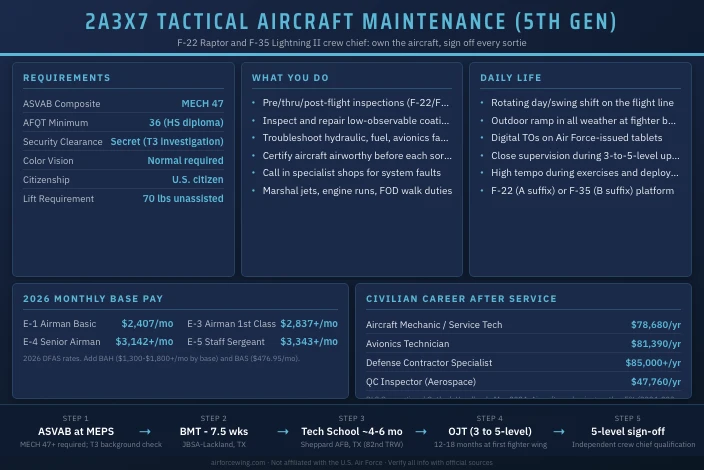
Job Role
2A3X7 Tactical Aircraft Maintenance (5th Generation) specialists perform organizational-level maintenance on F-22 and F-35 tactical aircraft. They conduct pre-flight, through-flight, and post-flight inspections; troubleshoot discrepancies using digital technical orders; coordinate specialist shops for system-specific repairs; and certify aircraft airworthy before every sortie. These Airmen serve as the primary point of accountability for their assigned aircraft.
Daily Tasks
What a shift looks like depends on the flying schedule, aircraft status, and what the pilot reported after the last mission. Common daily tasks include:
- Walking the jet for pre-flight: checking control surfaces, RAM (radar-absorbent material) coatings, engine intakes, landing gear, and hydraulic lines
- Running electronic pre-launch checklists and verifying avionics systems on a low-observable platform
- Coordinating with dedicated crew chiefs and specialist shops when discrepancies fall outside generalist scope
- Entering and closing maintenance write-ups in the aircraft’s digital forms
- Performing servicing: fuel, oil, hydraulic fluid, liquid oxygen, and nitrogen
- Marshaling aircraft on the ramp and assisting with engine runs after maintenance
- Conducting foreign object debris (FOD) walks before every flying period
Specialty Shredouts
The 2A3X7 AFSC has two suffix codes based on aircraft platform:
| Suffix | Platform | Primary Bases |
|---|---|---|
| 2A3X7A | F-22 Raptor | JB Langley-Eustis VA, Tyndall AFB FL, JB Elmendorf-Richardson AK, JB Pearl Harbor-Hickam HI |
| 2A3X7B | F-35 Lightning II | Eglin AFB FL, Luke AFB AZ, Hill AFB UT, Eielson AFB AK, Kadena AB Japan |
No SEI codes are required at initial entry. Advanced SEIs become available after qualifying on specific systems later in a career.
Mission Contribution
The F-22 is the Air Force’s premier air superiority fighter. The F-35 is the backbone of future strike operations across all services. Both aircraft use stealth coatings, sensor fusion systems, and software architectures that require specialized knowledge to maintain properly. A 2A3X7 specialist who understands the low-observable requirements of these platforms is not just turning wrenches, they’re sustaining the Air Force’s technological edge.
Technology and Equipment
Working on 5th-generation aircraft means regular contact with systems that have no direct precedent in older fleets. Daily tools and systems include:
- Digital technical orders (TOs) on Air Force-issued tablets and workstations
- Low-observable coating repair kits and RAM inspection equipment
- Hydraulic and pneumatic service carts specific to F-22 and F-35 systems
- Integrated maintenance data systems tied directly to the aircraft’s onboard diagnostics
- Specialized ground support equipment for landing gear, fuel systems, and environmental control
Salary
Pay starts the day you ship to Basic Military Training. The table below reflects 2026 DFAS rates.
| Rank | Grade | Monthly Base Pay (Entry) |
|---|---|---|
| Airman Basic | E-1 | $2,407 |
| Airman | E-2 | $2,698 |
| Airman First Class | A1C (E-3) | $2,837 |
| Senior Airman | SrA (E-4) | $3,142 |
| Staff Sergeant | SSgt (E-5) | $3,343 |
| Technical Sergeant | TSgt (E-6) | $3,401 |
Base pay does not tell the whole story. Most Airmen living off-post receive Basic Allowance for Housing (BAH), which varies by installation and dependency status. At a typical F-22 or F-35 base, a single E-4 might receive $1,300 to $1,800 per month in BAH depending on the location’s housing market. Add the flat-rate Basic Allowance for Subsistence (BAS) of $476.95 per month (2026 rate), and total compensation climbs well above base pay.
Additional Benefits
Active-duty Airmen receive TRICARE Prime with zero enrollment fees, zero deductibles, and zero copays for covered medical, dental, and mental health services. Education benefits include the Post-9/11 GI Bill (up to $29,920.95 per year toward private school tuition for the 2025-2026 academic year) and Tuition Assistance up to $4,500 per year while on active duty.
The Blended Retirement System (BRS) combines a 20-year pension worth 40% of your high-36 average basic pay with automatic and matched contributions to the Thrift Savings Plan (TSP). The government contributes up to 5% of basic pay in TSP matching once you are vested.
Work-Life Balance
Flight line maintenance runs on shift schedules tied to flying operations. Day shift, swing shift, and occasionally overnight shifts are common depending on the wing’s flying schedule. When operations surge, during exercises, deployments, or aircraft inspections, hours extend significantly. Leave accrues at 2.5 days per month (30 days annually), though actual leave use depends on unit tempo and advance planning.
Qualifications
The 2A3X7 requires a Secret security clearance. Any significant adverse background history, criminal record, financial delinquency, foreign contacts, or drug use, can disqualify you from this AFSC. Discuss your background candidly with a recruiter before selecting this code.
| Requirement | Standard |
|---|---|
| ASVAB Composite | MECH 47 minimum |
| AFQT Minimum | 36 (high school diploma) |
| Security Clearance | Secret (T3 investigation) |
| Citizenship | U.S. citizen |
| Color Vision | Normal color vision required |
| Physical | Must lift 70 lbs unassisted |
| Age | 17 to 42 at enlistment |
| Education | High school diploma or GED |
The MECH composite on the Air Force ASVAB combines scores from the General Science, Auto and Shop Information, Mathematics Knowledge, and Mechanical Comprehension subtests. Scoring 47 or above is achievable with focused preparation, but most candidates who reach that threshold study specifically for the mechanical and math subtests.
Application Process
The path from interest to assignment follows five steps:
Selection Criteria
This AFSC is not the highest-demand maintenance code at accession, but it is one of the more selective because clearance disqualifications reduce the eligible pool. Recruiters look for candidates with clean backgrounds, strong mechanical ASVAB scores, and physical fitness. Prior experience with engines, vehicles, or mechanical systems strengthens your application, though it is not required.
Service Obligation
Standard active-duty enlistment is four years. Some enlistment contracts offer a six-year option tied to specific incentives. Retraining into 2A3X7 from another AFSC incurs a service commitment calculated at the time of retraining approval.
Airmen enter service as an E-1 Airman Basic and will typically reach E-3 Airman First Class within 18 to 24 months given satisfactory performance.
See our ASVAB study guide for strategies to hit these line scores, or take the PiCAT from home if you are a first-time tester.
Work Environment
The flight line is an outdoor environment. Regardless of weather, freezing rain on an Alaskan ramp, 110-degree heat on an Arizona tarmac, or Gulf Coast humidity at Eglin, the aircraft still fly, which means the maintenance still happens. 2A3X7 Airmen work in direct proximity to running jet engines, loaded weapons systems, and active hydraulic systems. That combination requires constant situational awareness and strict adherence to safety procedures.
Setting and Schedule
Most 2A3X7 Airmen work rotating shifts aligned to their wing’s flying schedule. A typical flying day includes pre-launch preparations before first sortie and post-flight servicing and inspections after aircraft return. On heavy flying days, the shift can extend significantly past the scheduled end time. Non-flying days may focus on scheduled phase inspections, training requirements, or deferred maintenance.
The F-22 and F-35 are operationally demanding platforms. Low-observable coatings require inspection and periodic repair. Advanced sensor systems require regular software updates. These aircraft generate more maintenance work per flight hour than legacy platforms, which directly affects the workload for assigned crew chiefs.
Leadership and Team Dynamics
New Airmen work under close NCO supervision during their initial 3-to-5 level training period, typically 12 to 18 months at the first duty station. During that phase, you perform tasks under observation and sign off requirements with a qualified trainer’s oversight. Once 5-level qualified, you gain more independent responsibility for your assigned jet.
The flight line team structure is tight. Crew chiefs pair with dedicated aircraft, in some units, a specific tail number becomes your primary responsibility. Performance problems or aircraft discrepancies you miss trace directly back to you, which creates a strong culture of accountability.
Job Satisfaction
Maintainers working on 5th-generation platforms consistently report high job satisfaction tied to the prestige of working on the Air Force’s most advanced aircraft. The work is physically demanding, and tempo at operational fighter wings is high. Airmen who thrive here tend to be technically curious, detail-oriented, and comfortable with a high-pressure environment. Those who find the shift work or physical demands a poor fit often prefer maintenance positions on less operationally intense platforms.
Training
The 2A3X7 training pipeline starts at BMT, transitions to Sheppard AFB for platform fundamentals, then continues with 12 to 18 months of hands-on OJT at the first duty station before an Airman earns full 5-level qualification.
Initial Training
| Phase | Location | Duration | Focus |
|---|---|---|---|
| Basic Military Training (BMT) | JBSA-Lackland, TX | 7.5 weeks | Military foundations, physical fitness, discipline |
| Tactical Aircraft Maintenance Tech School | Sheppard AFB, TX | Varies by platform (~4-6 months) | Aircraft systems, technical orders, platform-specific maintenance |
| On-the-Job Training (OJT) | First duty station | 12-18 months | 5-level qualification, supervised hands-on maintenance |
BMT runs 7.5 weeks and covers Air Force culture, physical conditioning, and basic military skills. Tech School at Sheppard AFB is where the real technical education begins. The 82nd Training Wing runs the 2A3X7 initial skills course, which covers aircraft systems fundamentals, technical order use, low-observable maintenance procedures, and platform-specific hands-on work. F-22 and F-35 courses train on their respective aircraft; the exact course lengths vary and are subject to curriculum updates.
Advanced Training
After 5-level qualification, Airmen become eligible for advanced technical courses tied to specific aircraft systems or maintenance specialties. Unit-level upgrade training to the 7-skill level (Staff Sergeant and above) includes formal coursework, typically completed through AETC at Sheppard or via distance learning, combined with demonstrated on-the-job proficiency. Senior NCOs (E-7 and above) may complete the 9-level through advanced courses and practical evaluations.
The Air Force also offers community college credits through the Community College of the Air Force (CCAF), which automatically converts Tech School and OJT hours into college credits. Most 2A3X7 Airmen complete an Associate of Applied Science degree in Aviation Maintenance Technology as part of normal career progression, at no cost.
Everything starts with qualifying ASVAB scores. Our study guide covers what to study first.
Career Progression
| Rank | Grade | Typical Time-in-Grade | Primary Focus |
|---|---|---|---|
| Airman Basic | E-1 | 6 months | BMT and Tech School |
| Airman First Class | E-3 | 12-18 months post-Tech School | OJT, 3-to-5-level upgrade |
| Senior Airman | E-4 | ~3-4 years | 5-level qualification, primary crew chief duties |
| Staff Sergeant | E-5 | ~5-6 years total | 7-level upgrade, shift supervision, EPR writer |
| Technical Sergeant | E-6 | ~9-10 years total | Flight leadership, training program oversight |
| Master Sergeant | E-7 | ~13-15 years total | Production superintendent or section chief |
| Senior Master Sergeant | E-8 | ~17-19 years total | Maintenance superintendent |
| Chief Master Sergeant | E-9 | ~20+ years | Senior Enlisted Advisor, Maintenance Group level |
Role Flexibility
Retraining from 2A3X7 to other maintenance AFSCs is possible but depends on Air Force needs at the time of request. Retraining requests are submitted through the official AFPC portal and are generally approved based on projected manning requirements in the gaining AFSC. Airmen with strong performance records and a documented need are more competitive.
Officers can commission through Officer Training School or ROTC; some prior-enlisted 2A3X7 Airmen pursue acquisition or logistics officer roles after completing a degree.
Performance Evaluation
The Air Force uses the Enlisted Performance Report (EPR) to evaluate Airmen at E-4 and above. EPRs are written annually by the supervisor and reviewed by the rater’s rater. The grading scale runs from 1 to 5, with a 5 (“Truly Among the Best”) being the highest possible score. Promotion to Staff Sergeant and above is competitive and based on a combination of EPR ratings, time-in-grade, decorations, education, and a written promotion test score. On a competitive fighter wing, EPR inflation is low and top scores are genuinely selective.
Physical Demands
Daily work on the flight line is physically demanding in ways that go beyond standard fitness test metrics. A typical shift may involve:
- Lifting, carrying, or positioning components up to 70 lbs
- Repeated kneeling, crouching, and working in confined spaces around landing gear bays and engine compartments
- Standing for extended periods on concrete or asphalt ramps
- Working overhead to access upper fuselage panels
- Operating in extreme heat, cold, and wind depending on duty station
These demands do not diminish with seniority. Senior NCOs still walk the flight line and assist with inspections.
Air Force Fitness Assessment
All Airmen take the Air Force Fitness Assessment annually. Standards are age- and gender-normed. The minimum passing composite score is 75 out of 100. Each component also has its own minimum to pass.
| Component | Points Available |
|---|---|
| 1.5-Mile Run | 60 |
| Push-Ups (1 minute) | 10 |
| Sit-Ups (1 minute) | 10 |
| Waist Circumference / Body Composition | 20 |
| Total | 100 |
For under-25 male Airmen, the 1.5-mile run minimum is approximately 16:45 (varies slightly by exact age). For under-25 female Airmen, approximately 19:22. All 2A3X7 Airmen are subject to the same standards regardless of duty position.
Medical Evaluations
Normal color vision is required at accession and is tested at MEPS. Routine occupational health screenings may be required based on exposure to aviation fuels, hydraulic fluids, and composite materials used in low-observable coatings. Airmen working around jet engine exhaust are periodically monitored per OSHA and Air Force occupational health standards.
Deployment
Fighter wings deploy. How often depends on the unit’s tasking cycle, the theater situation, and Air Force-wide readiness requirements. F-22 and F-35 wings have deployed to the Pacific, Europe, and the Middle East. Expeditionary deployments typically run 90 to 180 days, though some theater security packages run shorter rotations of 30 to 60 days.
Deployment Details
During a deployment, 2A3X7 Airmen typically operate from a host-nation or forward base where the aircraft are temporarily stationed. The workload increases significantly compared to home station because dedicated specialist shops may not be available and crew chiefs absorb more tasks. Deployments are generally voluntary for the overall career but mandatory when assigned by the unit, you do not get to opt out of an ordered deployment.
Location Flexibility
Duty station assignments come from Air Force Personnel Center (AFPC) and are based on the Air Force’s manning needs, the aircraft suffix (A or B), and Airman preferences submitted via the assignment preference system. Common 2A3X7 duty stations include:
F-22 (2A3X7A) bases:
- JB Langley-Eustis, VA (1st Fighter Wing)
- Tyndall AFB, FL (325th Fighter Wing, rebuilding F-22 fleet after Hurricane Michael)
- JB Elmendorf-Richardson, AK (3rd Wing)
- JB Pearl Harbor-Hickam, HI (199th Fighter Squadron, ANG)
F-35 (2A3X7B) bases:
- Eglin AFB, FL (33rd Fighter Wing. F-35 schoolhouse)
- Luke AFB, AZ (56th Fighter Wing, largest F-35 training wing)
- Hill AFB, UT (388th / 419th Fighter Wings)
- Eielson AFB, AK (354th Fighter Wing)
- Kadena AB, Japan (18th Wing. Pacific theater forward presence)
Overseas assignments, especially Kadena, carry 12 to 24-month unaccompanied or 36-month accompanied tours depending on the specific position and family situation.
Risk/Safety
The flight line carries real hazards. Jet engine intake ingestion, exhaust burns, hydraulic fluid exposure, high-pressure tire explosions, and falls from aircraft maintenance stands are all documented injury categories in aviation maintenance. The Air Force has extensive safety programs to manage these risks.
Safety Protocols
All 2A3X7 Airmen receive flight line safety training before independent access to aircraft. Required practices include:
- Hearing protection within 100 feet of running engines
- Grounding procedures before electrical work
- Aircraft forms review before any maintenance action
- Tire inflation limits and safety cage use during servicing
- Fall protection when working on upper surfaces above certain heights
Security and Legal Requirements
The Secret clearance is required for award and retention of 2A3X7. Losing the clearance, whether through a security violation, criminal conviction, financial delinquency, or foreign contact issues, means losing the AFSC. The Air Force will attempt to retrain affected Airmen if clearance is revoked, but there is no guarantee.
Airmen are subject to the Uniform Code of Military Justice (UCMJ) for the duration of their service contract. This includes provisions that apply off-duty: misconduct that would not rise to a criminal level in civilian life can result in administrative action or discharge under the UCMJ.
Impact on Family
Fighter wing life is demanding on families. Deployments, long shift days during exercises, and remote overseas assignments are realities of this career field. The Air Force provides support resources including the Airman and Family Readiness Center (AFRC) at every major installation, Military OneSource, and TRICARE mental health services.
Family Considerations
BAH covers off-post housing for Airmen with dependents. On-post family housing is available at most installations but varies in availability and wait times. Child care is available through CDC (Child Development Center) facilities on most Air Force bases, though demand frequently exceeds capacity at major fighter wings.
Deployments average 90 to 180 days, but back-to-back deployments with short dwell time at home are possible during high operational periods. Families who build a support network at the installation, through unit Family Readiness Groups and neighbor relationships, report better quality of life than those who remain isolated.
Relocation and Flexibility
Permanent Change of Station (PCS) moves happen roughly every two to four years. Each move includes a government-funded household goods shipment and a Dislocation Allowance (DLA) payment. Spouses who work in licensed professions may face licensing challenges moving across state lines; the Interstate Compact for Military Spouses has improved this situation for many career fields. Frequent moves are a real cost to consider before selecting any active-duty AFSC.
Reserve and Air National Guard
The 2A3X7 AFSC exists in both the Air Force Reserve and the Air National Guard, though positions are limited compared to active-duty. The F-22 and F-35 are expensive platforms, and not every Reserve or ANG unit operates them. The Air National Guard has several F-35 units; the F-22 community is primarily active-duty.
Component Availability
| Component | Availability | Notes |
|---|---|---|
| Active Duty | Widely available | All major F-22 and F-35 wings |
| Air Force Reserve | Limited | Few Reserve units operate 5th-gen aircraft |
| Air National Guard | Available at select units | F-35 ANG units in several states |
Drill Schedule and Training Commitment
Standard Reserve and ANG commitment is one weekend per month (Unit Training Assembly, or UTA) plus 15 days of Annual Training per year. ANG units operating F-35s may require additional qualification training days beyond the standard schedule, particularly for Airmen maintaining currency on low-observable maintenance certifications.
Part-Time Pay
An E-4 with fewer than two years of service earns approximately $3,142 per month on active duty. For two drill periods (four training days) in a single weekend UTA, drill pay works out to roughly $420 to $470 per weekend depending on years of service, approximately 14 to 15% of active-duty monthly base pay for the same grade.
Benefits Differences
| Benefit | Active Duty | Air Force Reserve / ANG |
|---|---|---|
| Healthcare | TRICARE Prime (free) | TRICARE Reserve Select (premium-based) |
| BAH / BAS | Full monthly allowances | Only during active-duty periods |
| Tuition | Full Federal TA ($4,500/yr) | Federal TA available during active periods; ANG units may have state tuition waivers |
| GI Bill | Post-9/11 GI Bill (full benefit) | Montgomery GI Bill Selected Reserve; MGIB-SR lesser benefit than Post-9/11 |
| Retirement | 20-yr pension (40% high-36) | Points-based Reserve retirement; typically eligible at age 60 |
Deployment and Mobilization
Reserve and ANG Airmen in operational flying units can be mobilized under Title 10 orders. ANG F-35 units have deployed to overseas theaters. Mobilization frequency for Guard and Reserve 2A3X7 Airmen is lower than active-duty on average but has increased in recent years as 5th-gen fleet operational tempo has risen.
Civilian Career Integration
F-22 and F-35 maintenance experience is directly applicable to defense contractor positions with Lockheed Martin, Northrop Grumman, and L3Harris, among others. ANG service in this AFSC can run alongside a civilian career in aerospace or defense manufacturing without significant conflict. USERRA protects civilian jobs during military activations.
Post-Service
The civilian aviation industry has a documented shortage of qualified maintenance technicians. Aircraft mechanics and service technicians earn a median annual salary of $78,680 (BLS, May 2024), with projected employment growth of 5% from 2024 to 2034 and approximately 13,100 annual job openings projected over the decade.
Military maintenance experience does not automatically grant an FAA Airframe and Powerplant (A&P) certificate, but the hours and documented training from 2A3X7 service substantially reduce the time needed to meet FAA eligibility requirements under 14 CFR Part 65. Many veterans pass the A&P exam shortly after separation.
| Civilian Career | Median Annual Salary | Job Outlook |
|---|---|---|
| Aircraft Mechanic / Service Technician | $78,680 | +5% (2024-2034) |
| Avionics Technician | $81,390 | +6% (2024-2034) |
| Aerospace Engineering Technologist | $75,580 | Steady |
| Defense Contractor Maintenance Specialist | $85,000+ (varies) | High demand |
| Quality Control Inspector (Aerospace) | $47,760 | Stable |
Defense contractor roles working directly on F-22 or F-35 sustainment programs at Lockheed Martin, Northrop Grumman, or BAE Systems are a natural post-service path for experienced 2A3X7 veterans. Clearance holders move into these roles faster and at higher compensation than candidates without a clearance background.
Transition programs include the Transition Assistance Program (TAP), which provides pre-separation counseling, resume assistance, and job placement resources. The Hiring Our Heroes fellowship program offers fellowships at defense and aviation employers during the final months of active-duty service.
Is This a Good Job
The 2A3X7 is one of the most technically demanding enlisted maintenance roles in the Air Force. It suits a specific type of person.
Ideal Candidate Profile
- You are mechanically curious and want to understand how complex systems work at the component level
- You take personal pride in precision work and double-check everything before signing it off
- You’re comfortable working outdoors in variable conditions and physically demanding environments
- You want a career that transfers directly to high-demand civilian jobs in aerospace or defense
- You don’t mind shift work, long days during exercises, and the reality that jets don’t wait for convenient maintenance windows
Potential Challenges
The Secret clearance requirement eliminates candidates with adverse background history before they even reach training. The shift work and high operational tempo of a fighter wing is genuinely demanding, weeks during major exercises can run 12-hour shifts for days at a stretch. Overseas assignments and deployments are routine, not exceptional. If stability, predictable hours, and domestic assignments are your priorities, a different AFSC will be a better fit.
Working on low-observable aircraft adds a layer of complexity that older maintenance roles don’t have. RAM coatings must be inspected and maintained to exacting standards, and errors that would be cosmetic on a legacy jet can affect the F-22 or F-35’s radar cross-section. That responsibility is not for everyone.
Career and Lifestyle Alignment
If you want to work on the Air Force’s most advanced aircraft from day one of your career and build skills that defense contractors and major airlines actively seek, this AFSC delivers that. The combination of a Secret clearance, 5th-generation platform expertise, and documented military maintenance hours makes 2A3X7 veterans competitive in both government and private-sector roles at separation.
The lifestyle is fighter wing life: loud, fast-paced, and rewarding for people who want to be close to the operational edge of American airpower. It is genuinely demanding on families and personal schedules, and that’s a real factor to weigh before signing a contract.
More Information
Talk to an Air Force recruiter to confirm current 2A3X7 accession openings, platform suffix availability, and any enlistment incentives in effect. Recruiter information on clearance processing timelines and ASVAB preparation resources will be specific to your background. High MECH scores and a clean record are the two factors most in your control before you walk into that office, our ASVAB study guide and PiCAT prep guide can help you maximize both the score and the timeline.
Official resources for research and verification:
- Sheppard AFB 82nd Training Wing, manages the 2A3X7 Tech School curriculum for both F-22 and F-35 tracks
- AFPC career field manager listings, the career field manager for the 2A3X7 community can answer questions about training pipelines and AFSC-specific policies
- airforce.com 2A3X7 page, official recruiting overview including general entry requirements
Related career profiles on this site:
- Air Force maintenance careers hub, compare all maintenance AFSC options side by side
- 2A5X1 Aerospace Maintenance, the airlift and special mission aircraft maintenance track if 5th-gen platforms aren’t your priority
- 2A6X1 Aerospace Propulsion, if engine systems specifically interest you more than full-aircraft crew chief work
Practical preparation steps:
The Secret clearance background investigation takes several months. Anything in your background, financial delinquencies, prior drug use, foreign contacts, should be disclosed honestly to your recruiter early. A pre-application review of your background with a recruiter is more useful than discovering a disqualifier after you’ve already invested in the process.
For the MECH 47 composite, the Auto and Shop Information and Mechanical Comprehension subtests carry the most weight. The ASVAB study guide covers both in detail and is the most efficient way to close any gap before your MEPS appointment.
This site is not affiliated with the U.S. Air Force or any government agency. Verify all information with official Air Force sources before making enlistment or career decisions.
Explore more Air Force maintenance careers such as 2A3X3 Tactical Aircraft Maintenance and 2A5X1 Aerospace Maintenance.