2A3X3 Tactical Aircraft Maintenance
Every fighter jet that launches on a combat mission first goes through a 2A3X3. Tactical Aircraft Maintenance specialists are the last set of hands on the jet before the pilot straps in. They own the aircraft from nose to tail, preflight inspections, system checks, post-flight write-ups, and everything in between. If you want a technical career that puts you directly on the flight line working on some of the most capable military aircraft in the world, this AFSC is the most direct route.
Qualifying requires specific ASVAB line scores. Our ASVAB study guide covers what to target and how to prepare.
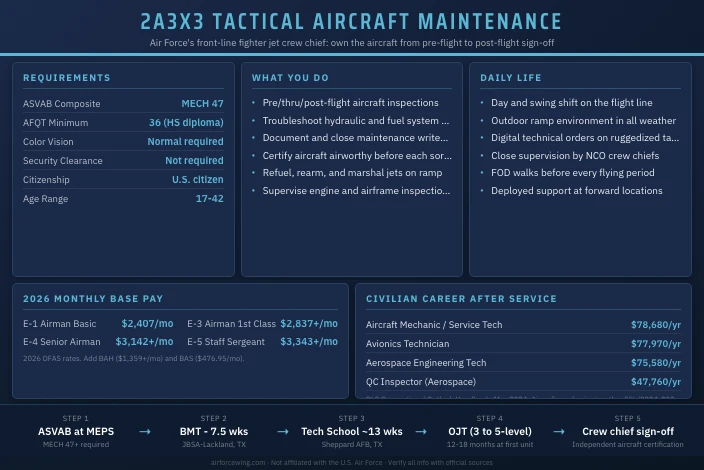
Job Role
2A3X3 Tactical Aircraft Maintenance specialists perform all ground-level maintenance required to keep tactical military aircraft mission-ready. They conduct pre-flight, through-flight, and post-flight inspections; troubleshoot discrepancies using automated technical data; supervise engine and airframe inspections; and certify aircraft as airworthy before every sortie. The AFSC covers a broad range of tactical platforms including the F-16, F-22, and A-10.
Daily Tasks
What you do on a given day depends on the flying schedule, the aircraft’s status, and what the pilot reported after the last mission. Common tasks include:
- Walking the jet for pre-flight: checking control surfaces, hydraulic lines, tires, and landing gear
- Running power-on checks to verify avionics and electrical systems before engine start
- Coordinating with specialist shops when a discrepancy falls outside generalist scope
- Entering and closing maintenance write-ups in the aircraft forms
- Refueling, rearming, and marshaling aircraft on the flight line
- Troubleshooting hydraulic, pneumatic, and fuel system faults
- Performing time-change tasks on components with scheduled replacement intervals
- Supporting post-flight inspection when the pilot debriefs a squawk
The flight line runs on a schedule. When the flying schedule calls for an 0600 launch, the crew chiefs are out well before that, sometimes hours before, walking aircraft and signing off on forms. This job runs on the aircraft’s calendar, not a standard 9-to-5.
Specializations
The 2A3X3 code is a broad tactical maintenance AFSC. Airmen assigned to specific platforms develop deep expertise on that aircraft. Key special experience codes relevant to this field track crew chief qualification and weapons loading clearances, though platform-specific certification comes through on-the-job training (OJT) at the first duty station rather than through a separate Tech School course.
| Code | Designation | Notes |
|---|---|---|
| 2A3X3 | Tactical Aircraft Maintenance | Broad tactical platform maintainer |
| 2A390 | Senior NCOIC Designation | Senior NCO skill-level merge code at E-8/E-9 |
Airmen often informally specialize by platform at their unit. A crew chief at Luke AFB who has worked F-35s for four years builds a resume that reads very differently from one who spent the same time on A-10s at Davis-Monthan.
Mission Contribution
Aircraft don’t fix themselves. The Air Force’s ability to generate sorties, and sustain them in combat, depends entirely on the maintainers behind the scenes. A fighter wing’s mission capability rate, the percentage of assigned aircraft that can fly on any given day, is a direct measure of what 2A3X3 Airmen accomplish. During exercises and actual contingencies, this number matters: low MC rates ground missions before the enemy can. Crew chiefs are the people responsible for keeping that number up.
Technology and Equipment
Day-to-day tools range from hand tools and torque wrenches to aircraft-specific diagnostic systems that interface directly with the jet’s avionics suite. Airmen use:
- Automated Inspection, Repair, Corrosion, and Overhaul (AIRCO) maintenance data systems
- Integrated Maintenance Data System (IMDS) for tracking aircraft forms and work orders
- Hydraulic test stands and pneumatic servicing carts
- Aircraft-specific ground support equipment (wheel and brake assemblies, engine run stands)
- Personal protective equipment rated for jet blast and noise environments
The move toward digital technical orders (TOs) means maintainers now reference maintenance procedures on ruggedized tablets at the aircraft rather than paper manuals. The data systems are constantly updated, and the ability to read, interpret, and apply technical data accurately is as important as physical mechanical skill.
Salary
Base Pay
Active-duty pay follows DFAS tables that apply uniformly across all branches. New 2A3X3 Airmen enter at E-1 and typically reach E-4 (Senior Airman) within three to four years of solid performance.
| Grade | Rank | Monthly Base Pay (2026) |
|---|---|---|
| E-1 | Airman Basic (AB) | $2,407 |
| E-2 | Airman (Amn) | $2,698 |
| E-3 | Airman First Class (A1C) | $2,837 - $3,198 |
| E-4 | Senior Airman (SrA) | $3,142 - $3,816 |
| E-5 | Staff Sergeant (SSgt) | $3,343 - $4,422 |
| E-6 | Technical Sergeant (TSgt) | $3,401 - $5,044 |
| E-7 | Master Sergeant (MSgt) | $3,932 - $5,537 |
Base pay doesn’t tell the full story. Most Airmen living off-base receive Basic Allowance for Housing (BAH), which scales with duty location and dependency status. A single E-4 at Joint Base San Antonio-Lackland receives $1,359/month in BAH; with dependents, that rises to $1,728/month. Basic Allowance for Subsistence adds a flat $476.95/month for all enlisted Airmen regardless of rank. Neither allowance is taxed.
Additional Benefits
Healthcare: Active-duty Airmen and dependents enroll in TRICARE Prime at no cost, no premiums, no deductibles, no copays. Coverage spans medical, dental, vision, mental health, prescriptions, and hospitalization.
Education: Tuition Assistance covers up to $4,500 per year ($250 per semester hour) while serving. After separation, the Post-9/11 GI Bill pays full in-state tuition at public schools or up to $29,920.95 per academic year at private institutions, plus a monthly housing allowance and up to $1,000 annually for books and supplies.
Retirement: Airmen who entered after January 2018 fall under the Blended Retirement System (BRS). The Air Force automatically contributes 1% of basic pay to the Thrift Savings Plan (TSP) starting after 60 days of service and matches up to 4% of basic pay on member contributions. At 20 years of service, a pension pays 40% of the high-36 average basic pay monthly for life.
Work-Life Balance
Maintenance Airmen work shift schedules tied to flying operations. A typical fighter wing runs day and swing shifts, with on-call availability during exercises and inspections. When flying operations stand down, weekends, holidays, or weather holds, maintainers often get time off. Deployments and surge periods change the calculus significantly; during high-op-tempo periods, 12-hour shifts and 6-day weeks are routine. The Air Force provides 30 days of paid leave per year, accruing at 2.5 days per month with a 60-day carryover cap.
Qualifications
Basic Qualifications
Entry into the 2A3X3 AFSC requires meeting the following criteria:
| Requirement | Standard |
|---|---|
| Age | 17-42 at time of enlistment |
| Citizenship | U.S. citizen required |
| Education | High school diploma (GED with AFQT 65+ accepted) |
| ASVAB Composite | MECH 47 minimum |
| AFQT Minimum | 36 (HS diploma); 65 (GED) |
| Color Vision | Normal color vision required |
| Security Clearance | National Agency Check (no clearance required) |
| Physical | Qualifying MEPS physical examination |
The MECH composite is derived from the General Science, Auto/Shop, Mathematics Knowledge, and Mechanical Comprehension subtests of the ASVAB. Applicants who score at or above 47 on that composite and meet all other standards are eligible for this AFSC. A 47 is not a high bar, but applicants who prep on mechanical reasoning and auto/shop questions before testing will have a wider selection of maintenance AFSCs available to them.
The MECH 47 requirement is confirmed by AFI 36-2101 and the official airforce.com career page. Color vision is a firm requirement, no waiver is available for this specific standard in this AFSC.
Application Process
Selection Criteria
2A3X3 is one of the more accessible maintenance AFSCs by ASVAB standard, and it consistently ranks among the higher-volume accession specialties in the 2A career group. That said, availability fluctuates by recruiting cycle. Applicants with prior hands-on mechanical experience, auto repair, equipment maintenance, construction trades, tend to perform better in the training pipeline and get stronger evaluations from supervisors in the first assignment.
Service Obligation
Standard first-term enlistment is four years. Some bonus contracts may carry a longer obligation. Airmen who enlist specifically for a training pipeline that requires additional coursework beyond Tech School may incur additional service requirements; your recruiter will specify any obligations at contract signing.
See our ASVAB study guide for strategies to hit these line scores, or take the PiCAT from home if you are a first-time tester.
Work Environment
Setting and Schedule
The flight line is an outdoor industrial environment. Most work happens on the ramp adjacent to aircraft shelters or in open revetments, exposed to weather year-round. Temperatures on the flight line in summer at Nellis AFB or Luke AFB can exceed 110 degrees Fahrenheit; at Eielson AFB or Elmendorf-Richardson in Alaska, winter operations mean working in extreme cold. There’s no indoor option when the aircraft is on the ramp.
Schedules follow the flying schedule. Day shift typically runs 0600-1600; swing shift runs 1400-2400 on heavy flying days. During exercises or real-world contingencies, shifts compress and extend. Maintainers working 12-hour days for two or three weeks straight is not uncommon during major deployments or phase inspections.
Leadership and Communication
The 2A3X3 career field is NCO-heavy by design. Senior Airmen and Staff Sergeants serve as crew chiefs with direct sign-off authority on aircraft forms. Technical Sergeants and Master Sergeants run flight-line sections. A new Airman will have close contact with experienced NCOs from day one, receiving constant OJT and feedback on both technical accuracy and professionalism.
Performance feedback follows the Air Force Enlisted Performance Report (EPR) system. Supervisors complete annual EPRs that assess performance against Air Force standards and unit mission requirements. EPR scores feed directly into promotion board packages; in a career field this competitive at the E-6 and E-7 levels, a single below-average EPR can derail a promotion cycle.
Team Dynamics and Autonomy
Maintenance is a team sport, but individual accountability runs high. Every time a crew chief signs a form to certify an aircraft airworthy, that signature carries legal weight. Junior Airmen work closely with their crew chief and debrief every discrepancy they find. As skill levels increase, autonomy increases proportionally. A 5-skill-level Staff Sergeant may be the primary on a two-person crew, making judgment calls on aircraft status with the pilot waiting in the cockpit.
Job Satisfaction
Maintainers who stay in the field often cite the same thing: watching the jet you just signed off on thunder down the runway and come back. The work is physical, the hours are long, and the stakes are real. Surveys of maintenance Airmen consistently show higher job satisfaction scores among those with strong NCO mentorship in their early assignments. The career field has a retention challenge at mid-career (E-5 to E-6) as airline and defense contractor hiring aggressively targets trained maintainers, but those who reach TSgt typically stay through retirement.
Training
Training Pipeline
| Phase | Location | Length | Focus |
|---|---|---|---|
| Basic Military Training (BMT) | JBSA-Lackland, TX | 7.5 weeks | Core military skills, fitness, discipline |
| Airmen’s Week | JBSA-Lackland, TX | 1 week | Transition to technical training |
| Tech School (AFSC 2A3X3) | Sheppard AFB, TX | ~13 weeks (varies by aircraft) | Aircraft systems, technical orders, inspections |
| Upgrade Training (3-level to 5-level) | First duty station | 12-18 months | Platform-specific OJT and qualification |
Tech School at Sheppard AFB runs approximately 13 weeks for most tactical aircraft platform tracks, though exact course length varies based on the aircraft type assigned. F-16 and F-15 tracks are well-established at Sheppard; newer platforms like the F-35 have training conducted at different locations or through supplemental pipeline programs. The curriculum covers aircraft systems (hydraulics, fuel, flight controls, landing gear), use of technical orders, aircraft forms documentation, and hands-on practicals on training airframes.
Tech School graduation earns the 3-skill-level “apprentice” designation. You cannot independently sign off on aircraft forms until you complete upgrade training and earn the 5-skill-level “journeyman” at your first duty station. Plan on 12-18 months of supervised OJT before reaching full independent status.
Advanced Training
After earning the 5-skill-level, Airmen can pursue several paths that deepen their qualifications:
- 7-level (Craftsman): Requires completion of a career development course (CDC), time-in-grade, and supervisor certification. This is the threshold for supervisory responsibilities and acting as a crew chief.
- Quality Assurance (QA) Inspector: Additional certification that allows review of maintenance work packages and inspection of completed tasks. QA billets are competitive and significantly increase an Airman’s technical credibility.
- Weapons Load Crew qualification: Some 2A3X3 Airmen cross-train into weapons loading tasks, which requires a separate certification and broadens their contribution on the flight line.
- CCAF degree: The Community College of the Armed Forces awards an Associate of Applied Science in Aviation Maintenance Technology to Airmen who complete their 5-skill-level training alongside general education requirements. No additional coursework is required beyond normal career progression.
Everything starts with qualifying ASVAB scores, our study guide covers what to study first.
Career Progression
Rank Progression
| Rank | Grade | Typical Timeline | Role |
|---|---|---|---|
| Airman Basic | E-1 | Entry | BMT |
| Airman | E-2 | ~6 months | Tech School |
| Airman First Class | E-3 | ~16 months | First duty station, OJT |
| Senior Airman | E-4 | ~36 months | Journeyman, crew chief trainee |
| Staff Sergeant | E-5 | ~4-6 years | Crew chief, section supervisor |
| Technical Sergeant | E-6 | ~12-14 years (avg.) | Flight chief, QA |
| Master Sergeant | E-7 | ~17-20 years | Maintenance Superintendent |
| Senior Master Sergeant | E-8 | ~22+ years | Group-level leadership |
| Chief Master Sergeant | E-9 | ~26+ years | Command Chief, wing-level |
Promotion to E-4 is time-based within the first term. E-5 and above require a competitive board process that evaluates EPR scores, decorations, community involvement, and test scores. Maintenance NCOs who earn strong EPRs and diversify their experience (QA, deployed billets, staff assignments) promote faster than those who stay in a single unit for their entire career.
Role Flexibility and Transfers
Retraining out of 2A3X3 is possible after completing the initial enlistment. Airmen interested in avionics can apply for retraining into 2A3X4, 2A0X1, or platform-specific avionics codes. Supervisory and management-minded maintainers sometimes crossflow into logistics (2S0X1) or acquire additional qualifications in maintenance supervision. The Air Force’s Career Job Reservation (CJR) process governs retraining eligibility, and approval is not guaranteed, demand for experienced 2A3X3 Airmen tends to keep retention pressure high.
Performance Evaluation
The Enlisted Performance Report evaluates Airmen annually across seven performance areas: mission accomplishment, teamwork, service, integrity, communication, adaptability, and professional development. Ratings are narrative and numeric. The most consequential factor at E-5 and above is the stratification statement from the rating official: where the supervisor ranks the Airman among their peers. “1 of 5 SSgts” in a competitive section carries significantly more weight than an equivalent rating without stratification.
Succeeding in 2A3X3 requires consistent technical accuracy (zero errors on aircraft forms), physical reliability (being where you’re needed when the flying schedule demands it), and willingness to pursue additional qualifications beyond the minimum. Airmen who volunteer for QA, off-station deployments, and cross-functional tasks build the kind of record that separates mid-career candidates during promotion boards.
Physical Demands
Physical Requirements
Tactical aircraft maintenance is one of the more physically demanding non-combat maintenance AFSCs. Crew chiefs routinely climb in and out of cockpits, crouch in wheel wells, reach into engine bays, and manually move heavy ground support equipment. Representative demands:
- Lifting and carrying loads up to 70 pounds (aircraft panels, toolboxes, ground equipment)
- Prolonged standing, kneeling, and working in confined spaces inside aircraft structures
- Operating in noise environments that require double hearing protection
- Standing, walking, or working on your feet for shifts of 8-12 hours
- Working outdoors in extreme heat, cold, rain, and wind
The Air Force Fitness Assessment (FA) applies to all Airmen regardless of AFSC. It tests aerobic endurance (1.5-mile run), body composition (waist circumference), and muscular endurance (push-ups and sit-ups). Scores are age and gender normed on a 100-point scale; the minimum passing composite is 75, with a component minimum on each event.
| Component | Max Points | Notes |
|---|---|---|
| 1.5-Mile Run | 60 | Primary aerobic component |
| Waist Circumference | 20 | Body composition measure |
| Push-Ups (1 min) | 10 | Muscular endurance |
| Sit-Ups (1 min) | 10 | Core endurance |
| Total | 100 | Minimum passing: 75 |
Most active-duty Airmen are assessed annually. Failing the FA can result in mandatory fitness programs, administrative action, and limitations on promotion eligibility. Maintainers who stay physically fit also perform better in the physical demands of the job itself.
Medical Evaluations
The initial MEPS physical screens for color vision, hearing, and any conditions that would preclude safe work around jet aircraft and high-noise environments. Periodic occupational health evaluations are required for Airmen who work with hazardous chemicals (hydraulic fluids, fuels, corrosion treatments) and those exposed to high noise levels. Hearing conservation enrollment is standard for most flight-line maintainers.
Deployment
Deployment Details
Tactical maintenance Airmen deploy regularly. The 2A3X3 AFSC supports deployed operations at forward operating locations whenever the Air Force sends tactical aircraft forward. Typical rotation lengths run 90-120 days for deployed units, though some Airmen on Theater Security Package (TSP) rotations or contingency assignments may serve longer. Deployment frequency depends heavily on the unit’s mission and the current operational tempo. Fighter units with high TSP commitments to INDOPACOM or EUCOM theaters may deploy a significant percentage of their maintainers annually.
Domestic deployments to support exercises at places like Red Flag at Nellis AFB, NV, or Green Flag at Barksdale AFB, LA, are also common and count as temporary duty away from the home station.
Duty Stations
2A3X3 Airmen are assigned wherever the Air Force operates tactical aircraft. Major installations include:
- Luke AFB, AZ: F-35A training wing, large 2A3X3 population
- Nellis AFB, NV: Multi-platform fighter wing and test/evaluation units
- Shaw AFB, SC: F-16 strike operations
- Langley-Eustis AFB, VA: F-22 Raptor units
- Spangdahlem AB, Germany: F-16 operations in EUCOM theater
- Kunsan AB / Osan AB, South Korea: High-priority forward-deployed fighter billets
- Kadena AB, Japan: F-15 and F-22 operations in INDOPACOM
Overseas assignments at Kunsan, Osan, and Kadena are unaccompanied (no dependents) or accompanied depending on the installation. These tours are considered high-priority billets and tend to accelerate an Airman’s career development due to the operational tempo.
Risk/Safety
Job Hazards
Flight-line work carries real occupational hazards. The primary risks include:
- Jet blast and foreign object debris (FOD): Ingested FOD can destroy a jet engine and injure ground personnel. FOD walks are a daily ritual on every flight line.
- High noise environments: Sustained exposure to jet engine noise causes permanent hearing loss without proper protection.
- Chemical exposure: Hydraulic fluid (Skydrol), aviation fuel (JP-8), lubricants, and corrosion treatments require proper PPE and handling procedures.
- Fall hazards: Work on top of aircraft requires fall protection when at heights.
- Electrical hazards: High-voltage systems on modern tactical aircraft are active during maintenance tasks if not properly de-energized.
Safety Protocols
The Air Force enforces a strict technical order compliance culture. No maintenance procedure is performed from memory; Airmen reference the applicable TO at every step. The Wing’s Quality Assurance section conducts random inspections of in-progress and completed maintenance. Ground safety programs track mishap trends, and the flight line operates under a two-person integrity (TPI) requirement for any safety-critical task.
Security and Legal Requirements
This AFSC requires a National Agency Check and Local Agency Checks (NACLAC) as part of the background investigation. No security clearance is required, but access to aircraft systems and technical orders still carries accountability requirements. Airmen who falsify aircraft forms or certify maintenance that wasn’t performed face potential court-martial under the Uniform Code of Military Justice (UCMJ), the aircraft forms are legal documents. The Air Force also conducts periodic random drug testing; a positive result is a career-ending event.
Impact on Family
Family Considerations
The flight-line schedule affects family life in ways that a standard office job doesn’t. Swing shifts, exercise surges, and deployments require a support structure that can absorb periods when the maintainer is simply not available. Families stationed at larger fighter bases. Luke, Langley, Nellis, generally find strong support through Military Family Support Centers, chapel programs, and unit family readiness groups.
The Air Force provides on-base housing (or BAH to live off-base), childcare through CDC programs, and school-liaison officers who help families manage school transitions during PCS moves. The Air Force also offers the Exceptional Family Member Program (EFMP) for families with special medical or educational needs, which factors into assignment decisions.
Shift work is one of the daily realities families adapt to fastest, or struggle with most. When the flying schedule runs a day shift and a swing shift, the Airman on swing finishes work at or after midnight. That affects meal timing, sleep schedules, and availability for evening family activities. Families who go in understanding the shift structure rather than assuming a 9-to-5 job find the adjustment considerably less jarring.
Phase inspections are another factor families should know about. Every fighter aircraft goes through a periodic programmed depot-level maintenance event and regular phase maintenance inspections at the unit level. During phase periods, the maintenance tempo spikes significantly, and Airmen work extended hours, sometimes 10-12 hours per day, six days a week, for weeks at a stretch. These periods are planned in advance and appear on the unit maintenance schedule, which allows families some predictability, but the workload is real.
Deployments to Korea (Kunsan or Osan) and Japan (Kadena) include both accompanied and unaccompanied tour options depending on the installation and the current Air Force personnel policy. Unaccompanied Korea tours, typically 12 months, are considered hardship assignments and earn a service credit. Families who cannot accompany a member to an OCONUS location may apply for family separation allowance, which helps offset the financial impact of maintaining two households during the tour.
The Military OneSource program provides counseling, financial advising, and deployment readiness resources at no cost to active-duty families. On-base Family Advocacy Programs offer confidential support for relationship and stress-related concerns that arise during high-tempo periods.
Relocation
Permanent Change of Station (PCS) moves happen roughly every three to four years. Fighter assignments tend to concentrate at a specific set of bases (the tactical aircraft community is not large), so some Airmen PCS between the same handful of installations over a 20-year career. Overseas assignments to Korea or Japan are single-tour commitments of 12-24 months. The Air Force covers all authorized moving expenses and pays a dislocation allowance to offset the costs of relocating a household.
Reserve and Air National Guard
Component Availability
The 2A3X3 AFSC is available in both the Air Force Reserve and the Air National Guard. Guard units in particular operate F-15s, F-16s, and F-35s at state installations, and their maintainers work the same aircraft as their active-duty counterparts.
Drill Schedule and Training Commitment
Standard Reserve and Guard commitment is one weekend per month (Unit Training Assembly, UTA) plus two weeks per year (Annual Tour). For 2A3X3, the nature of aircraft maintenance means additional training days are often required for currency on specific aircraft systems, annual recertifications, and readiness exercises. Airmen in Guard units co-located with active-duty installations sometimes work on active-duty aircraft during UTAs, keeping their skills sharp.
Part-Time Pay
An E-4 Senior Airman drilling one UTA weekend earns approximately $212-$244 per drill day (4 drill periods per UTA weekend = roughly $848-$976 per drill weekend) based on 2026 reserve drill pay rates.
Benefits Comparison
| Category | Active Duty | Air Force Reserve | Air National Guard |
|---|---|---|---|
| Commitment | Full-time | 1 weekend/mo + 2 wks/yr | 1 weekend/mo + 2 wks/yr |
| Monthly Pay (E-4) | $3,142-$3,816 | Per drill only | Per drill only |
| Healthcare | TRICARE Prime (free) | TRICARE Reserve Select (premiums) | TRICARE Reserve Select or state plan |
| Education | Tuition Assistance ($4,500/yr) | Federal TA available | Federal TA + state tuition waivers (many states) |
| GI Bill | Post-9/11 (full benefit) | Montgomery GI Bill-SR | Ch. 1606 or Post-9/11 (if activated) |
| Retirement | 20-yr pension (40% high-36) | Points-based at age 60 | Points-based at age 60 |
| Deployment Tempo | Frequent | Mobilization-dependent | Mobilization-dependent |
Guard units in states with F-35 or F-22 assignments (Vermont, Vermont ANG 158th FW, Virginia, Florida) have deployed to both EUCOM and INDOPACOM in recent years. Mobilization for Guard 2A3X3 Airmen has increased significantly since 2001; a one-weekend-per-month commitment is no longer a guarantee of minimal deployment exposure.
Civilian Career Integration
The 2A3X3 AFSC pairs exceptionally well with civilian aviation maintenance careers. FAA Airframe and Powerplant (A&P) certification can be pursued using military experience as a substitute for formal school requirements under 14 CFR Part 65. Guard and Reserve service in this AFSC strengthens a civilian aviation resume while the Airman simultaneously builds time toward an A&P certificate. USERRA protects the civilian job during any activation or mobilization, and many aviation employers actively recruit Guard and Reserve maintainers because they arrive with current military aircraft experience.
Post-Service
Military maintenance experience translates directly to civilian aviation. The FAA allows applicants to substitute verifiable military aircraft maintenance experience for portions of the 18-month practical experience requirement for an A&P certificate. Many 2A3X3 veterans sit for the A&P exam immediately after separation.
| Civilian Career | Median Annual Salary | Job Outlook (2024-2034) |
|---|---|---|
| Aircraft Mechanic / Service Technician | $78,680 | +5% (faster than avg.) |
| Avionics Technician | $77,970 | +7% (faster than avg.) |
| Aerospace Engineering & Operations Technician | $75,580 | +6% (faster than avg.) |
| Quality Control Inspector (Aerospace) | $47,760 | Stable |
Salary data from the BLS Occupational Outlook Handbook, May 2024 figures.
The civilian aviation maintenance market is in sustained demand. Approximately 13,100 annual openings are projected for aircraft mechanics and avionics technicians over the decade, driven by both growth and the retirement of an aging workforce. Major commercial airlines, defense contractors (Boeing, Lockheed, Northrop Grumman, L3Harris), and MRO (maintenance, repair, and overhaul) shops actively recruit veterans with tactical aircraft experience.
Beyond the A&P path, veterans with leadership experience at the E-6 and E-7 level often move into quality assurance, maintenance supervision, or program management roles at defense primes. The Air Force’s Transition Assistance Program (TAP) provides resume writing, job search, and interview preparation resources during the final 180 days of service. Veterans also qualify for VA education benefits to pursue an aviation maintenance technology degree or an A&P certificate at an FAA Part 147 school.
Is This a Good Job
Ideal Candidate Profile
The 2A3X3 AFSC works well for people who:
- Like working with their hands and want visible, concrete results from their effort
- Are comfortable outdoors in challenging weather conditions for long periods
- Have mechanical aptitude and want to build on it with structured training
- Can follow detailed technical procedures precisely without cutting corners
- Want a clear career path into civilian aviation after service
Prior experience in auto mechanics, HVAC, construction, or any trade where you regularly used hand tools and followed technical specifications is a genuine advantage. You don’t need that background. Tech School teaches the fundamentals from scratch, but people who already think mechanically tend to absorb the training faster.
Potential Challenges
This job is not a good fit for people who:
- Need a predictable schedule and regular weekends off. Flying operations don’t stop for holidays.
- Prefer indoor, climate-controlled work environments. The flight line is outside.
- Struggle with attention to detail on technical documentation. A missed step in an aircraft form is not just a paperwork problem, it’s a safety issue.
- Expect significant autonomy early in their career. Your first 12-18 months involve close supervision as you build a documented qualification record.
Deployment exposure is real. Some years are lighter; others are not. If extended time away from family is a firm non-starter, research the specific unit’s deployment history before signing a contract for that assignment.
Career and Lifestyle Alignment
People who thrive in this AFSC often describe their experience the same way: the work is hard, but the sense of ownership over an aircraft is unlike anything else. When a pilot lands and the jet is exactly where it needs to be, that result is directly traceable back to the crew chief. For Airmen who want tangible accountability and a skill set with obvious civilian value, 2A3X3 is one of the Air Force’s most direct paths to both.
The post-service financial ceiling is also real. An A&P mechanic working for a major airline or defense contractor in a high-demand market can earn well above the BLS median, particularly with fighter jet experience on a resume.
More Information
Talk with an Air Force recruiter to confirm current MECH score requirements, available aircraft platforms, and any active bonus programs for the 2A3X3 AFSC. Requirements change with each recruiting cycle; a recruiter can give you current availability and help you understand the ASVAB prep needed to qualify.
Official sources:
- airforce.com: Tactical Aircraft Maintenance career page, official Air Force career listing with current qualification requirements, training details, and assignment information
- Sheppard AFB 82nd Training Wing, home of 2A3X3 Tech School; general training information is publicly available
- Air Combat Command, the primary command employing F-15, F-16, F-22, and A-10 maintainers; public website describes wing missions and locations
For civilian career research:
- FAA Airframe and Powerplant (A&P) Certification, military aircraft maintenance experience can be applied toward FAA A&P eligibility under 14 CFR Part 65; most 2A3X3 Airmen with 18+ months of documented experience are eligible to sit for the practical exam
- BLS Aircraft and Avionics Equipment Mechanics, median salary, hiring outlook, and employer types for the primary civilian career path from this AFSC
- Hiring Our Heroes Aviation Fellowship, programs placing transitioning servicemembers with aviation and aerospace employers during terminal leave
Before you test: The MECH 47 requirement is the only ASVAB composite needed for 2A3X3. The MECH composite draws from General Science, Auto and Shop Information, Mathematics Knowledge, and Mechanical Comprehension. Applicants with any background in auto mechanics, construction, or shop classes typically find the Mechanical Comprehension and Auto/Shop subtests most familiar. An ASVAB study guide focused on those two subtests, along with a math review for the Mathematics Knowledge section, is the most efficient preparation for this AFSC.
This site is not affiliated with the U.S. Air Force or any government agency. Verify all information with official Air Force sources before making enlistment or career decisions.
Explore more Air Force aircraft maintenance careers including the 2A5X1 Aerospace Maintenance AFSC, which covers a broader range of airframes across the mobility and tanker fleet.