2A2X1 SOF/PR Integrated Communication/Navigation/Mission Systems
Special operations aviation runs on split-second communication, precision navigation, and mission systems that work every time. The Airmen who keep those systems functional are 2A2X1s, and their work directly determines whether crews flying into hostile territory can find the target, talk to each other, and get home.
This isn’t general aircraft maintenance. The 2A2X1 specialty focuses on a specific and demanding fleet: C-130 variants, HH-60 rescue helicopters, CV-22 Ospreys, and EC-130 platforms used for electronic warfare and psychological operations. These aircraft operate in environments where system failures aren’t maintenance write-ups, they’re mission failures with real consequences. That context shapes everything about the job, from the technical depth required to the security clearance you’ll hold before your first duty assignment.
If electronics fascinate you and you want your work to matter in a concrete, immediate way, this career field rewards that combination.
Qualifying requires specific ASVAB line scores. Our ASVAB study guide covers what to target and how to prepare.
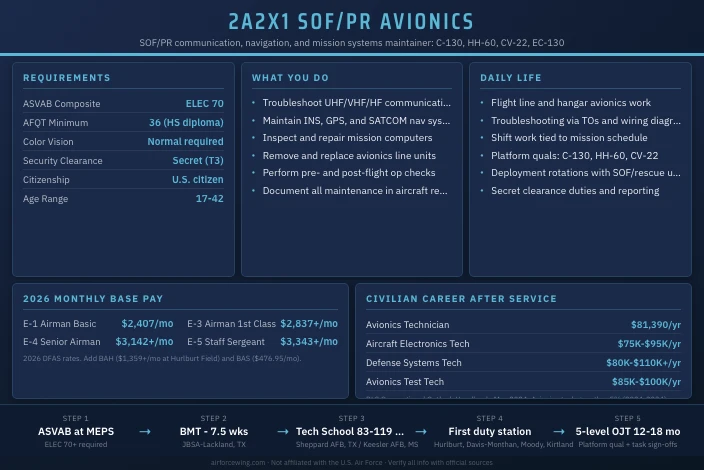
Job Role
The 2A2X1 AFSC. Special Operations Forces/Personnel Recovery (SOF/PR) Integrated Communication/Navigation/Mission Systems, covers the maintenance, inspection, troubleshooting, and repair of communication, navigation, and mission systems installed on SOF and personnel recovery aircraft. Specialists analyze malfunctions down to the component level, remove and replace line-replaceable units, perform operational checks, and certify systems as mission-ready. The work requires deep electronics knowledge and the ability to interpret complex wiring diagrams, technical orders, and aircraft maintenance manuals.
What You’ll Do Daily
Day-to-day work on the flight line involves a mix of scheduled inspections and unscheduled troubleshooting. Before a mission, 2A2X1s run operational checks on communication and navigation systems to confirm they function within tolerance. When a pilot or crew reports a discrepancy post-flight, you isolate the fault, repair or replace the failed component, and document the work in the aircraft’s maintenance records.
The systems you’ll work on include:
- UHF, VHF, and HF communication radios
- Inertial navigation systems (INS) and GPS receivers
- SATCOM terminals and datalinks
- Mission management computers
- Radar warning and threat detection systems
- Electronic countermeasure equipment on EC-130 variants
Aircraft Platforms
2A2X1 maintainers work on some of the Air Force’s most specialized aircraft. The C-130 family covers MC-130J Combat Talon and AC-130 gunships used by Air Force Special Operations Command (AFSOC). The HH-60 Pave Hawk is the Air Force’s primary combat search and rescue helicopter. The CV-22 Osprey is a tiltrotor used for long-range special operations infiltration. The EC-130H Compass Call handles electronic attack. Each platform has unique communication and mission system architectures, so deep familiarity with your assigned aircraft matters.
How This Role Fits the Mission
SOF and personnel recovery missions often operate in degraded or denied communications environments. A crew flying a combat rescue mission depends on their radio systems to coordinate with ground forces, their GPS to navigate to precise coordinates, and their SATCOM link to relay information back to a joint operations center. When those systems fail, the mission changes, or stops. The 2A2X1 specialist is the person who prevents that from happening.
Salary
Your pay as a 2A2X1 starts at the standard enlisted base pay rate and grows with rank and years of service. The figures below reflect 2026 DFAS pay tables.
Base Pay
| Rank | Grade | Monthly Base Pay (Entry) |
|---|---|---|
| Airman Basic | E-1 | $2,407 |
| Airman | E-2 | $2,698 |
| Airman First Class | A1C / E-3 | $2,837 |
| Senior Airman | SrA / E-4 | $3,142 |
| Staff Sergeant | SSgt / E-5 | $3,343 |
| Technical Sergeant | TSgt / E-6 | $3,401 |
| Master Sergeant | MSgt / E-7 | $3,932 |
Base pay is only part of total compensation. Most Airmen living off base also receive Basic Allowance for Housing (BAH), which varies by duty location, pay grade, and dependent status. At Hurlburt Field, FL, a single E-4 receives approximately $1,359/month in BAH. Basic Allowance for Subsistence (BAS) adds another $476.95/month for all enlisted members, regardless of rank or location.
Additional Benefits
Healthcare is covered under TRICARE Prime at no cost for active-duty Airmen. The plan includes medical, dental, vision, mental health, and prescription coverage with no enrollment fee, no deductible, and no copays when using military treatment facilities.
Education benefits include up to $4,500/year in Tuition Assistance while on active duty, covering up to $250 per semester hour. After service, the Post-9/11 GI Bill provides full in-state tuition at public universities, up to $29,920.95/year at private schools, a monthly housing allowance tied to the E-5 BAH rate at your school’s location, and a $1,000 annual book stipend.
Retirement under the Blended Retirement System (BRS) combines a 20-year pension at 40% of your high-36 average basic pay with a Thrift Savings Plan that the government matches up to 4% of your basic pay.
Leave and Work-Life Balance
Active-duty Airmen earn 30 days of paid leave per year accruing at 2.5 days per month. SOF support roles can involve irregular schedules tied to operational tempo, but the Air Force makes leave available during periods between deployments and exercises. Assignment to an active SOF wing means the pace is higher than a typical garrison assignment, which is worth knowing before you enlist.
Qualifications
Getting into the 2A2X1 career field requires a stronger ASVAB electronics score than most Air Force maintenance jobs.
Entry Requirements
| Requirement | Minimum Standard |
|---|---|
| ASVAB Electronics (ELEC) | 70 |
| AFQT (overall enlistment) | 36 (HS diploma) / 65 (GED) |
| Security Clearance | Secret (T3 Investigation) |
| Citizenship | U.S. citizen |
| Age | 17-42 at enlistment |
| Color Vision | Normal color vision required |
| Education | High school diploma or equivalent |
The ELEC composite combines your scores on General Science (GS), Arithmetic Reasoning (AR), Mathematics Knowledge (MK), and Electronics Information (EI) subtests. Scoring 70 or above requires solid performance across all four. Coursework in physics, electronics, and algebra during high school is the best preparation. A targeted ASVAB prep course that covers all four subtests is the most reliable way to hit that number.
The Secret clearance is a firm requirement. A T3 investigation, which covers your background, finances, foreign contacts, and personal conduct, must be completed before full award of the AFSC. An interim Secret clearance allows access while the investigation is ongoing, so you can start Tech School without waiting for final adjudication. Any history of significant financial problems, foreign contacts, or drug use can delay or disqualify a clearance application.
Application Process
The path into 2A2X1 starts at a Military Entrance Processing Station (MEPS). Your recruiter will confirm you meet age and citizenship requirements, schedule your ASVAB, and coordinate a physical exam. If your ELEC score hits 70 or above, the AFSC can be listed on your enlistment contract. The full selection process typically takes two to four months from initial contact to signing a contract, depending on recruiter availability and MEPS scheduling.
Waivers
Minor medical conditions may qualify for a waiver through MEPS. Prior drug use, financial issues, or certain criminal history can receive waivers on a case-by-case basis. The clearance component is what most applicants should focus on, if something in your background could complicate a Secret investigation, address it with your recruiter early.
Service Obligation
New enlistees in 2A2X1 typically sign a six-year initial contract due to the training investment involved. Verify the current obligation with your recruiter, as it can vary based on enlistment incentives or contract timing.
Entry Rank
All enlisted Airmen enter at E-1 (Airman Basic) unless they have prior college credits (up to E-3) or have completed certain JROTC programs.
The ELEC 70 score is a hard minimum, there are no waivers for the ASVAB composite. If you score below 70 on ELEC, you won’t qualify for 2A2X1 regardless of other scores. A study approach that targets General Science, Arithmetic Reasoning, Mathematics Knowledge, and Electronics Information is the most direct way to hit that threshold.
Work Environment
2A2X1 Airmen work in a high-tempo, operationally-focused environment that looks different from conventional maintenance units.
Setting and Schedule
Work happens in aircraft hangars, on the flight line, and inside parked aircraft. SOF and rescue aircraft are maintained at a handful of specialized wings, you won’t find this AFSC at every Air Force base. When aircraft are generating for a mission, maintainers work to schedule, but unscheduled maintenance can extend the shift without warning. Shift work is common, especially at units that keep aircraft on 24-hour alert status for combat search and rescue missions.
The physical environment ranges from climate-controlled avionics shops to the Florida heat or New Mexico altitude depending on where you’re assigned. Overseas deployments bring their own environmental conditions, from desert heat in the Middle East to the humidity of Southeast Asia.
Chain of Command and Feedback
2A2X1 Airmen work in maintenance squadrons under a Maintenance Operations Officer and a chief warrant or senior NCO chain that includes experienced 2A specialists. Feedback comes through the Air Force’s Enlisted Performance Report (EPR) system, with annual or more frequent written evaluations that rate performance, professional development, and promotion potential. In SOF units, a strong EPR is competitive and reflects real operational contributions.
Teamwork and Autonomy
Maintenance in SOF units is team-oriented but highly individual at the technical level. You may be the only 2A2X1 on a particular aircraft at any given time, which means your diagnosis and repair decision stands on its own. At more junior skill levels, a supervisor signs off on your work. As you reach the 7-skill level, you’ll supervise others and sign off on their maintenance documentation.
Job Satisfaction
The work is technically demanding and tied to missions that most people in the military never directly support. Retention among 2A2X1 Airmen tends to be higher than in more general maintenance fields because of the specialized training investment and the close connection to SOF operations. Many Airmen in this field report that the operational context makes daily maintenance work feel purposeful in a way that general aircraft work doesn’t always.
Training
The training pipeline for 2A2X1 is longer than most enlisted AFSCs because of the technical depth required.
Initial Training Pipeline
| Phase | Location | Length | Focus |
|---|---|---|---|
| Basic Military Training (BMT) | JBSA-Lackland, TX | 7.5 weeks | Fundamentals of Air Force service |
| Tech School | Sheppard AFB, TX / Keesler AFB, MS | 83-119 days | Communications, navigation, and mission systems maintenance |
| 3-Level On-the-Job Training (OJT) | First duty station | 12-18 months | Platform-specific qualifications and task sign-offs |
Basic Military Training at Joint Base San Antonio-Lackland is the same for all enlisted Airmen: seven and a half weeks covering physical conditioning, Air Force customs, core values, and basic military skills.
Tech School runs 83 to 119 days, with instruction split between Sheppard AFB in Texas and Keesler AFB in Mississippi. At Sheppard, students cover aircraft electrical fundamentals and system theory. Keesler focuses on communication and navigation systems. The curriculum includes both classroom instruction and hands-on lab work using actual aircraft systems trainers. Some students complete coursework at one location only, depending on their specific platform assignment. Expect long study days and technical testing throughout. Building a solid electronics base before you arrive, using a PiCAT prep resource to sharpen the same concepts, shortens the adjustment curve considerably.
After Tech School, you arrive at your first duty station as a 3-level Apprentice. The OJT phase involves working alongside experienced technicians, completing task qualification requirements, and building platform-specific knowledge. Most Airmen reach the 5-level Journeyman designation within 12 to 18 months of arriving at their unit.
Advanced Training
Once qualified, 2A2X1s have access to a range of advanced training opportunities:
- 7-level upgrade training prepares Airmen for supervisory roles and is typically completed at the E-5 to E-6 level
- Advanced avionics systems courses at Air Force technical training centers provide deeper knowledge on specific communication or navigation systems
- Platform-specific qualification courses for new aircraft (such as CV-22 or MC-130J) when the unit transitions to a new mission system
- CCAF (Community College of the Air Force) automatically enrolls Airmen and awards an Associate of Applied Science degree in Avionics Systems Technology upon completion of skill-level training and general education requirements
The Air Force also supports college degree completion through Tuition Assistance, which covers coursework toward a bachelor’s degree in electronics, aviation technology, or related fields. Strong electronics fundamentals before enlisting will also help you get through Tech School faster.
Career Progression
Advancement in 2A2X1 follows the standard Air Force enlisted progression, with skill levels tied to time-in-service, training completion, and testing performance.
Rank and Skill Level Progression
| Rank | Grade | Skill Level | Typical Timeline |
|---|---|---|---|
| Airman Basic | E-1 | 1-level | Enlistment / BMT |
| Airman | E-2 | 1-level | ~6 months |
| Airman First Class | E-3 | 3-level Apprentice | ~12 months |
| Senior Airman | E-4 | 5-level Journeyman | 2-3 years |
| Staff Sergeant | E-5 | 5-level / start 7-level | 4-6 years |
| Technical Sergeant | E-6 | 7-level Craftsman | 8-12 years |
| Master Sergeant | E-7 | 7-level Craftsman | 12-18 years |
| Senior Master Sergeant | E-8 | 9-level Superintendent | 18-22 years |
| Chief Master Sergeant | E-9 | 9-level Superintendent | 22+ years |
Promotion to Staff Sergeant (E-5) requires time-in-service, a passing score on the Weighted Airman Promotion System (WAPS) test, and EPR scores. Technical Sergeant (E-6) adds the requirement for a 7-skill level and 23 months time-in-grade at E-5. Master Sergeant (E-7) is competitive, only a percentage of eligible Airmen promote each cycle, selected based on WAPS scores, EPR points, and time-in-service.
Specialization and Shredouts
Within the 2A2X1 career field, platform assignments create de facto specializations. Airmen assigned to HH-60 units develop depth in helicopter communication and navigation systems. Those assigned to EC-130H Compass Call units work with specialized electronic attack mission systems. CV-22 assignments require additional tiltrotor-specific training. Some Airmen earn Special Experience Identifiers (SEIs) that reflect platform qualifications and can influence future assignment preferences.
Role Flexibility
Retraining to another AFSC is possible after completing your initial contract and meeting service commitments. The electronics and systems knowledge from 2A2X1 makes transitions into related fields, including 2A3X4, 2A9X4X, or certain cyber AFSCs, more feasible. Within the maintenance career group, experienced 2A2X1 Airmen can also apply for Quality Assurance (QA) inspector positions, which broaden oversight responsibilities across multiple aircraft systems.
Succeeding in This Career
The Airmen who advance fastest in 2A2X1 share a few patterns. They document their work correctly every time, maintenance records are auditable, and errors have consequences. They pursue CCAF and off-duty education consistently rather than waiting until re-enlistment decisions approach. They volunteer for deployments early in their career when competition for those billets is real. And they build relationships with the NCO chain, because EPR support from supervisors who know your work matters more than any single test score.
Physical Demands
2A2X1 maintenance work involves physical labor in demanding environments, but the job is not classified as a physically extreme specialty like special operations or aircraft rescue firefighting.
Daily Physical Requirements
Work on aircraft systems requires:
- Climbing in and out of aircraft (ladders, hatches, confined access panels)
- Working overhead inside equipment bays for extended periods
- Lifting and carrying avionics components and test equipment (some items exceed 50 lbs)
- Standing on flight lines for hours at a time in varying weather conditions
- Working in tight spaces inside fuselages and equipment bays
There is no color vision waiver for this AFSC, normal color vision is required because electrical wiring identification relies on color-coded insulation.
Air Force Fitness Assessment
All Airmen must pass the Air Force Fitness Assessment annually. The FA is the same for all Airmen and does not have AFSC-specific standards.
| Component | Max Points |
|---|---|
| 1.5-Mile Run | 60 |
| Push-Ups (1 min) | 10 |
| Sit-Ups (1 min) | 10 |
| Waist Circumference | 20 |
| Total | 100 |
The minimum passing composite score is 75, with minimum thresholds on each component. Standards are age- and gender-normed. Failing the FA can affect promotion eligibility and may lead to administrative action if failures are repeated.
Medical Standards
2A2X1 requires a standard Air Force medical examination at MEPS. Conditions that affect color vision, manual dexterity, or hearing at levels needed to work around aircraft are disqualifying. Security clearance investigations also screen for psychological health history relevant to trustworthiness and judgment. Periodic medical reviews occur throughout a career, though no annual aviation-specific physicals are required for ground maintainers.
Deployment
2A2X1 is one of the more deployment-intensive AFSCs in the maintenance career group, because the aircraft it supports exist to conduct operations in austere, forward-deployed environments.
Where You’ll Be Assigned
Duty station assignments concentrate at bases with SOF and personnel recovery missions:
- Hurlburt Field, FL: home of Air Force Special Operations Command (AFSOC) and the 1st Special Operations Wing
- Kirtland AFB, NM: hosts SOF and test and evaluation aviation units
- Davis-Monthan AFB, AZ: home of the 563rd Rescue Group with HH-60 and HC-130 rescue aircraft
- Moody AFB, GA: 347th Rescue Group, another major rescue wing
- Overseas: Kadena AB (Japan), Aviano AB (Italy), and forward-deployed locations in CENTCOM and INDOPACOM areas
Assignment preferences can be submitted, but the Air Force matches you to a location based on unit needs and available positions.
Deployment Expectations
Expect to deploy more often in 2A2X1 than in a conventional maintenance role. SOF and rescue aircraft support ongoing operations, and maintainers are needed forward to keep those aircraft mission-ready. A typical deployment runs 90 to 180 days, though rotations vary by mission. Some Airmen deploy multiple times in a four-year tour, particularly at Hurlburt Field and rescue wings. The Air Force Expeditionary Force (AEF) system cycles Airmen through deployment windows, but SOF units can generate additional requirements outside that cycle.
Location flexibility is limited compared to broader maintenance AFSCs because 2A2X1 positions only exist at bases with the relevant aircraft.
Risk/Safety
Working around military aircraft involves real hazards that require consistent attention and compliance with established procedures.
Job Hazards
Flight line and hangar environments carry several occupational risks:
- Electrical hazards: working on powered aircraft systems or with energized test equipment
- Jet blast and prop wash: operating near running aircraft creates pressure hazards
- Hydraulic fluid exposure: some aircraft systems use hydraulic lines routed near avionics bays
- Hearing damage: prolonged noise exposure on the flight line requires hearing protection
- Falls: working at height on ladders, stands, and aircraft access panels
Safety Protocols
The Air Force manages these hazards through Technical Order (TO) compliance, Personal Protective Equipment (PPE) requirements, and a mishap prevention program. Every maintenance action follows a written TO procedure, deviation is a safety violation, not a shortcut. Supervisors conduct regular spot inspections and Airmen participate in unit safety programs. Foreign Object Damage (FOD) prevention is a constant discipline: anything that could be ingested by an engine or interfere with flight controls is controlled and tracked.
Security and Legal Requirements
The Secret clearance is a legal and ongoing obligation. You’re required to report foreign contacts, significant financial changes, and travel outside the U.S. to your security manager. Failing to report is itself a security violation, independent of the underlying issue. The clearance is re-investigated periodically (currently every 10 years for Secret-level), and you maintain clearance access as long as your behavior and personal circumstances remain adjudicable.
Enlistment creates a legally binding service obligation. Breaking a contract without authorization can result in administrative or legal action. If circumstances change significantly during your service, medical issues, family hardship, the Air Force has formal processes for reviewing separation requests.
Impact on Family
SOF support is honest about the demands it places on personal life, and it’s worth going in clear-eyed.
Family Considerations
Deployment frequency is higher in this career field than in most enlisted maintenance roles. Families should expect periods of separation ranging from 90 to 180 days, potentially more than once per assignment cycle. The Air Force provides support resources including the Airman and Family Readiness Center (A&FRC) at each installation, which offers financial counseling, deployment support, and referrals to childcare and spouse employment programs. The Military OneSource program provides confidential counseling and support services available 24/7.
TRICARE Prime covers the entire family at no cost while the Airman is on active duty. On-base housing or BAH makes housing more affordable than comparable civilian housing in many locations.
The irregular work schedule is the part of this career field most families don’t fully anticipate before reporting to the first duty station. Unlike conventional maintenance wings where the flying schedule drives a reasonably predictable shift structure, SOF and rescue units operate with a more dynamic tempo. Alert posture for combat search and rescue missions means some personnel are on standby outside normal duty hours. An unscheduled rescue mission or last-minute aircraft discrepancy before launch can extend the duty day without warning. Families who understand this before it happens, rather than after, manage it considerably better.
The concentration of assignments at a small number of installations. Hurlburt Field, Davis-Monthan, Moody, Kirtland, creates a tight-knit community among 2A2X1 families that many spouses and partners find genuinely supportive. These bases have well-developed family readiness infrastructure because the tempo demands it. Unit family readiness groups at SOF wings are active and tend to be more tightly connected than at large, dispersed conventional wings.
The Exceptional Family Member Program (EFMP) is available for families with special medical or educational needs. EFMP enrollment is required for active-duty members with family members who have significant special needs, and it factors into assignment decisions. If your family has specific medical or educational requirements, enroll in EFMP early so AFPC can account for it during assignment processing.
Relocation
Because 2A2X1 positions exist only at bases with SOF and rescue aircraft, Permanent Change of Station (PCS) moves typically cycle between the same handful of installations: Hurlburt Field, Davis-Monthan, Moody, Kirtland, and potential overseas assignments. You have less geographic flexibility than Airmen in broader career fields. The Air Force covers moving expenses through the Permanent Duty Station (PDS) program, including reimbursement for household goods transport and temporary lodging.
Reserve and Air National Guard
The 2A2X1 AFSC exists in both the Air Force Reserve and Air National Guard, though positions are less numerous than in the active-duty force because the aircraft are concentrated at a limited number of units.
Component Availability
The Air Force Reserve maintains 2A2X1 positions at Reserve units that fly C-130 variants and HH-60s, including the 920th Rescue Wing at Patrick Space Force Base, FL, and Reserve Associate units at some active-duty SOF bases. The Air National Guard fields 2A2X1 personnel at Guard wings with rescue or SOF missions, such as the 106th Rescue Wing in New York and the 176th Wing in Alaska. Skill level ceilings in Reserve and Guard units are generally the same as active duty, though the path to senior NCO positions can be slower due to fewer available billets.
Drill Schedule and Commitment
The standard Reserve and Guard commitment is one weekend per month (Unit Training Assembly, or UTA) plus two weeks per year (Annual Tour, or AT). For 2A2X1, the technical complexity of the aircraft means some units require additional training days for annual recertification on specific aircraft systems. Overseas exercises and readiness drills can add beyond the baseline schedule, particularly at rescue wings that participate in joint exercises.
Part-Time Pay
An E-4 Senior Airman in the Reserve or Guard earns pay for four Inactive Duty Training (IDT) periods per drill weekend, currently $628/weekend based on 2026 E-4 base pay rates. Monthly drill pay across a full weekend is approximately $314-$628 depending on how periods are counted, compared to an active-duty E-4’s base pay of $3,142/month or more.
Reserve and Guard vs. Active Duty Comparison
| Category | Active Duty | Air Force Reserve | Air National Guard |
|---|---|---|---|
| Commitment | Full-time | 1 wknd/mo + 2 wks/yr | 1 wknd/mo + 2 wks/yr |
| Monthly Base Pay (E-4) | $3,142+ | ~$628/drill weekend | ~$628/drill weekend |
| Healthcare | TRICARE Prime (free) | TRICARE Reserve Select (premiums apply) | TRICARE Reserve Select (premiums apply) |
| Education | Full TA + Post-9/11 GI Bill | Federal TA + Reserve GI Bill | Federal TA + State tuition waivers (varies) |
| Deployment Tempo | High | Moderate (mobilization-dependent) | Moderate (mobilization-dependent) |
| Retirement | 20-yr pension (BRS) | Points-based at age 60 | Points-based at age 60 |
TRICARE Reserve Select provides medical and dental coverage for part-time members who pay monthly premiums, unlike active-duty TRICARE Prime which has no cost. Reserve and Guard members who deploy can access TRICARE Prime temporarily during activated periods. The Air National Guard offers state-specific tuition waivers at public institutions, which can be more valuable than the federal programs in states with strong tuition-waiver programs like New York or California.
Reserve retirement uses a points-based system: Airmen earn points for each drill period, annual tour day, and active-duty day served. Retirement pay begins at age 60 (or earlier with qualifying active-duty service), calculated from accumulated points rather than continuous years of active service.
Civilian Career Integration
2A2X1 skillsets translate well to civilian aviation maintenance. Reserve and Guard service in this AFSC can run parallel to a civilian career as an FAA-licensed avionics technician or airline avionics technician, since the systems knowledge directly applies. Many civilian employers, particularly airlines and MRO (maintenance, repair, and overhaul) shops, actively recruit from Guard and Reserve avionics backgrounds and are familiar with USERRA protections that require them to preserve the jobs of deployed personnel.
Post-Service
The technical training invested in a 2A2X1 career translates to strong civilian employment prospects.
Civilian Career Options
| Civilian Job Title | Median Annual Salary | Job Outlook (2024-2034) |
|---|---|---|
| Avionics Technician | $81,390 | +5% (faster than average) |
| Aircraft Electronics Technician | $75,000-$95,000 | Steady demand |
| Defense Systems Technician | $80,000-$110,000+ | Growing (DOD contracts) |
| Avionics Test Engineer Technician | $85,000-$100,000 | Growing |
BLS Occupational Outlook Handbook, 2024 data.
Civilian avionics technicians work for commercial airlines, cargo carriers, MRO facilities, and defense contractors. The FAA Airframe and Powerplant (A&P) certificate is the standard credential for civilian aircraft maintenance, and military maintenance experience can be applied toward FAA certification requirements. Many veterans pursue the A&P immediately after service, which opens doors to airline-rate pay and benefits.
Defense contractors supporting SOF aviation programs, including avionics upgrades on C-130, HH-60, and CV-22 platforms, specifically recruit former 2A2X1 Airmen because of their platform-specific knowledge. These positions often pay more than commercial airline avionics roles and may require maintaining an active security clearance, which former military members can often continue to hold.
Transition Programs
The Air Force’s Transition Assistance Program (TAP) provides workshops, resume support, and job placement assistance during the final year of service. The Hiring Our Heroes program connects separating service members with corporate fellowships and direct hiring events. Veterans with avionics backgrounds are in demand at companies actively participating in these programs.
The Post-9/11 GI Bill’s 36 months of education benefits can fund a bachelor’s degree in electronics engineering technology, aerospace engineering, or a related field, which opens advancement paths into engineering, program management, or technical specialist roles.
Is This a Good Job
2A2X1 is a specialized career that rewards specific people and challenges others.
The Right Fit
This AFSC works well for people who:
- Scored strongly in math, physics, and electronics, the ELEC 70 threshold weeds out people without genuine aptitude in this area
- Want their daily work tied to meaningful, operational outcomes rather than routine garrison maintenance
- Are comfortable with a security clearance obligation and the lifestyle discipline that comes with it
- Can handle irregular schedules and the possibility of more frequent deployment than other maintenance roles
- Enjoy deep technical work on complex systems rather than broad, general maintenance
The fact that this AFSC is tied to SOF and rescue aviation means you’re working alongside some of the most operationally demanding personnel in the Air Force. If that context motivates you, the day-to-day pressure feels like purpose rather than burden.
Potential Challenges
The job is wrong for people who:
- Want geographic flexibility in their assignments, the duty stations are limited and concentrated
- Prefer a predictable 8-to-5 schedule. SOF operational tempo creates irregular work hours
- Have background issues that could complicate a Secret clearance
- Scored below 70 on ELEC and don’t want to invest in serious ASVAB preparation before enlisting
Deployment frequency is a real consideration for anyone with family obligations they’re not prepared to manage during extended separations. The Air Force provides support, but the absences are real and the schedule unpredictable.
Long-Term Fit
If you stay for a full 20-year career, the path leads to senior NCO leadership in one of the more technically demanding and operationally relevant maintenance fields in the Air Force. If you separate after one or two terms, the civilian job market for avionics technicians is strong, median pay over $81,000, growth outlook above average, and specific demand for people with SOF platform experience. Either direction from this career field is financially and professionally viable.
More Information
Talk to an Air Force recruiter to confirm current ASVAB requirements, available duty stations, and enlistment incentives for 2A2X1. Requirements change periodically, and a recruiter can verify what’s current before you commit to a contract. You can also find official career details at airforce.com and afpc.af.mil. If you’re still building your electronics score, a PiCAT prep course can help you practice all four composite subtests before test day.
Official sources:
- airforce.com: SOF/PR Avionics career page, official Air Force career listing with current qualification requirements
- Air Force Special Operations Command (AFSOC), the primary command employing 2A2X1 Airmen; the public website describes the command’s aircraft and missions
- 920th Rescue Wing, Patrick SFB, FL, an Air Force Reserve rescue wing with 2A2X1 billets supporting HH-60 and HC-130 operations
For civilian career research:
- FAA Aviation Maintenance Technician (A&P) Certification, information on how military aviation maintenance experience can be applied toward FAA certification under 14 CFR Part 65
- BLS Aircraft Mechanics and Avionics Technicians, median salary and job outlook data for civilian avionics careers
- Hiring Our Heroes, fellowship programs connecting transitioning servicemembers with civilian aviation and defense employers
ASVAB preparation: The ELEC 70 requirement is among the highest in the enlisted Air Force. The four subtests that build your ELEC composite. General Science, Arithmetic Reasoning, Mathematics Knowledge, and Electronics Information, all require deliberate preparation. Weak math performance will pull the composite down even with strong electronics scores. A structured ASVAB prep course that covers all four subtests is the most effective way to reliably hit 70.
This site is not affiliated with the U.S. Air Force or any government agency. Verify all information with official Air Force sources before making enlistment or career decisions.
Explore more Air Force maintenance careers such as 2A3X3 Tactical Aircraft Maintenance and 2A5X1 Aerospace Maintenance.