2A0X1 Avionics Test Station and Components
Every fighter jet that launches from a runway carries radar, navigation computers, and weapons systems worth millions of dollars. If any of that electronics fails, the aircraft can’t fly the mission. The 2A0X1 Avionics Test Station and Components specialist is the person who keeps it all running, testing components, diagnosing faults, and certifying that the systems are working before the jet ever leaves the ground.
This is one of the more technical roles in the Air Force maintenance career field. You’ll need a strong electronics ASVAB score, and the training pipeline covers electrical theory, circuit diagnostics, and hands-on work with automated test equipment. The payoff is a skillset that holds serious value both in uniform and in the civilian aviation industry, where experienced avionics technicians earn well above the national median wage.
Qualifying requires specific ASVAB line scores. Our ASVAB study guide covers what to target and how to prepare.
Job Role
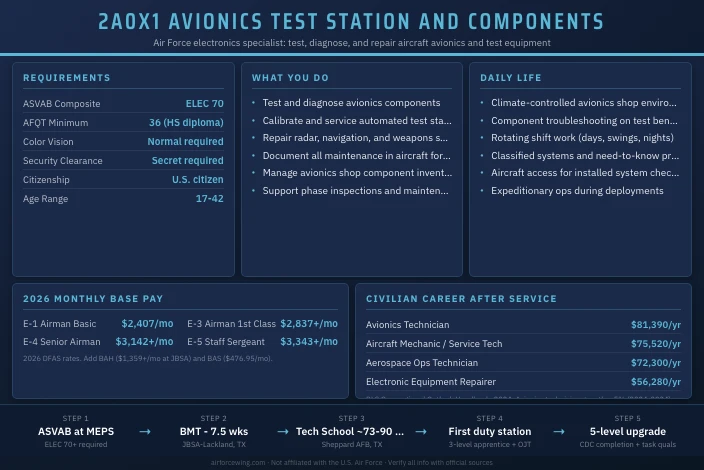
2A0X1 Avionics Test Station and Components specialists inspect, test, and repair aircraft electronic systems and the automated test equipment used to evaluate them. They work on radar systems, navigation equipment, weapons control electronics, and fire control systems, verifying that components meet exact operating specifications before returning them to service. This AFSC is responsible for both the aircraft systems and the test equipment used to check those systems.
Daily Tasks
The day-to-day work breaks into two main areas: component-level testing and test equipment maintenance.
On the component side, you’ll pull avionics line replaceable units from aircraft, run them through automated test stations, and interpret pass/fail results. When a unit fails, you troubleshoot to the circuit card or subassembly level, repair or replace the faulty part, and retest to confirm the fix. You’ll also perform operational checks on installed aircraft systems, tracing faults from the cockpit to the black box.
Test equipment maintenance is the other half of the job. The automated test stations themselves require calibration, software updates, and periodic servicing. If the test equipment drifts out of tolerance, every result it produces becomes unreliable. Keeping the test stations accurate is not optional.
Other regular tasks include:
- Documenting all maintenance actions in aircraft forms and electronic maintenance records
- Managing component inventory so the shop has the parts needed to keep aircraft flying
- Coordinating with other maintenance Airmen when a fault spans multiple systems
- Supporting periodic inspections and scheduled phase maintenance cycles
Specific Roles
| AFSC Code | Title |
|---|---|
| 2A031 | Avionics Test Station and Components (entry/apprentice) |
| 2A051 | Avionics Test Station and Components (journeyman) |
| 2A071 | Avionics Test Station and Components (craftsman) |
| 2A091 | Avionics Test Station and Components (superintendent) |
Craftsman-level and above Airmen take on supervisory duties and may qualify as Production Superintendents responsible for coordinating all maintenance activity on a flight line section.
Mission Contribution
Aircraft avionics are the nervous system of modern air power. A fighter without functioning radar can’t find targets. A jet with a broken navigation computer can’t fly low-level routes in bad weather. When a 2A0X1 specialist clears a component as serviceable, they’re directly enabling the mission that aircrew will fly hours later. The work is precise, documented, and matters.
Technology and Equipment
This AFSC puts you on some of the most sophisticated test equipment in the Air Force inventory. Automated test systems like the Consolidated Automated Support System (CASS) run complex diagnostics that would take hours to perform manually. You’ll work with digital multimeters, oscilloscopes, spectrum analyzers, and software-based diagnostic tools. Many of the avionics systems themselves are classified, so some hands-on training occurs only at the clearance level required.
Salary
Base Pay
Pay is the same across all branches for equivalent rank and time in service. These are 2026 DFAS rates.
| Rank | Grade | Monthly Base Pay (entry) |
|---|---|---|
| Airman Basic | E-1 | $2,407 |
| Airman | E-2 | $2,698 |
| Airman First Class | E-3 | $2,837 |
| Senior Airman | E-4 | $3,142 |
| Staff Sergeant | E-5 | $3,343 |
| Technical Sergeant | E-6 | $3,401 |
| Master Sergeant | E-7 | $3,932 |
Base pay does not include allowances. Most Airmen living off-base receive Basic Allowance for Housing (BAH), which varies by duty station and dependency status. A single E-4 at Joint Base San Antonio-Lackland receives $1,359/month; rates at larger metro installations run higher. The Basic Allowance for Subsistence (BAS) adds $476.95/month for all enlisted Airmen.
Additional Benefits
Healthcare through TRICARE Prime covers the Airman and their family at no cost while on active duty. That includes medical, dental, vision, mental health, and prescriptions. There are no premiums and no copays at military treatment facilities.
The Air Force covers up to $4,500 per year in tuition assistance for active-duty Airmen pursuing college degrees. The Post-9/11 GI Bill is available after service, covering full in-state tuition at public universities or up to $29,920.95 per academic year at private schools, plus a monthly housing allowance.
Retirement under the Blended Retirement System includes a 20-year pension at 40% of your average high-36 basic pay, combined with Thrift Savings Plan matching up to 4% of basic pay. Airmen who contribute 5% to TSP get the full government match from day one.
Work-Life Balance
Active-duty Airmen earn 30 days of paid leave per year. Flight line maintenance can involve shift work, with day, swing, and night shifts rotating depending on the unit’s flying schedule. When the mission surges, hours get long. During slower periods, the workload normalizes and 9-hour days are common.
Qualifications
Requirements Table
| Requirement | Details |
|---|---|
| ASVAB Composite | Electronics (ELEC): 70 |
| AFQT Minimum | 36 (high school diploma) |
| Citizenship | U.S. citizen |
| Age | 17-42 at enlistment |
| Color Vision | Normal color vision required |
| Security Clearance | Secret (National Agency Check, Local Agency Checks and Credit) |
| Physical | Normal MEPS physical standards |
The Electronics composite is calculated from General Science, Arithmetic Reasoning, Mathematics Knowledge, and Electronics Information. A score of 70 is competitive, most applicants who qualify for this AFSC have strong math and electronics aptitude. If you scored well in high school physics or electronics coursework, that background translates directly to the test.
Normal color vision is a firm requirement for this AFSC. A color vision deficiency cannot be waived. If you have difficulty distinguishing reds and greens, this specific code may not be available to you. Discuss this with your recruiter at MEPS.
Application Process
The path to 2A0X1 runs through a Military Entrance Processing Station (MEPS). At MEPS, you’ll take the ASVAB, complete a physical examination, and review job options with a classifier. If your ELEC score meets the 70 minimum and you pass the physical standards including the color vision test, the classifier can offer this AFSC as part of your enlistment contract.
The security clearance investigation begins after you enlist. You’ll complete an SF-86 form, and investigators will run background checks covering your financial history, foreign contacts, and character references. Most applicants with clean backgrounds receive a Secret clearance during or shortly after Tech School.
The full process from recruiter contact to shipping date typically runs two to four months, depending on the testing schedule and how quickly the background investigation progresses.
Selection and Competitiveness
This AFSC draws applicants who score well on the electronics portion of the ASVAB. Because the minimum is set at ELEC 70, the pool is smaller than maintenance AFSCs with lower cut scores. Applicants with prior coursework in electronics, electrical work, or avionics have an advantage, but the Tech School is designed to build the knowledge from the ground up. A security clearance disqualifier, past drug use, financial problems, or foreign national contacts, is the most common reason otherwise qualified applicants don’t make it through the process.
Service Obligation
Standard active-duty enlistment contracts run four to six years. The Air Force will specify the exact commitment in your enlistment contract based on any bonus or training obligation attached to your AFSC assignment.
New Airmen enter at E-1 (Airman Basic). Most reach E-3 (Airman First Class) within 28 months through automatic time-in-grade promotions.
Prepare for the ASVAB Electronics composite with focused study on circuit fundamentals, Ohm’s Law, and basic electronics principles. The ASVAB study guide covers the Electronics composite in detail.
Work Environment
Setting and Schedule
Most of the work happens in an avionics maintenance shop, climate-controlled, well-lit, and organized around test benches. This differs from line-maintenance roles where Airmen work outside on the flight line in all weather conditions. The 2A0X1 environment is more similar to a technical repair shop: structured, precision-focused, and indoors for the majority of the shift.
That said, some duty days take you to the aircraft. When a fault can’t be reproduced in the shop, you may need to run tests at the aircraft or troubleshoot in the cockpit area. Deployments can shift the environment dramatically, with field conditions requiring improvised work spaces and expeditionary resources.
Shift work is standard in most maintenance units. A typical rotation covers days and swings, with night shifts added when the flying schedule demands around-the-clock operations.
Leadership and Communication
New Airmen work directly under a journeyman (5-level) or craftsman (7-level) supervisor who provides on-the-job training (OJT) and signs off task qualifications. Performance feedback runs through the formal Enlisted Performance Report (EPR) system, supervisors and flight chiefs review it at set intervals, and Airmen are expected to communicate equipment status clearly and accurately in maintenance records.
Team Dynamics and Autonomy
At the apprentice level, most work is supervised. As you earn your 5-level qualification, you take on tasks independently and begin mentoring newer Airmen. The 7-level craftsman has the broadest autonomy and serves as the technical authority for the shop. Decision-making during testing is data-driven: if the test station says a component is out of spec, it comes off the aircraft, period.
Job Satisfaction
Avionics maintenance is a career that rewards precision. Airmen who take satisfaction in systematic troubleshooting, seeing a concrete fix validated by test data, and operating with professional accountability tend to find this work engaging. The stakes are real, a faulty radar on a combat aircraft is a mission-critical problem, and that reality gives the job weight.
Training
Training Pipeline
| Phase | Location | Length | Focus |
|---|---|---|---|
| BMT | JBSA-Lackland, TX | 7.5 weeks | Military fundamentals |
| Tech School | Sheppard AFB, TX | 73-90 days | Avionics systems, test equipment, electronics theory |
| OJT + CDCs | First duty station | ~12-18 months | Task qualification to 5-level journeyman |
Advanced Training
Journeyman Airmen can pursue specialized training on specific avionics platforms, automated test systems, or classified programs. Some units send 2A0X1 specialists through advanced courses on particular aircraft systems as those systems enter the Air Force inventory. Craftsmen and superintendents often attend the Airman Leadership School, Noncommissioned Officer Academy, and Senior NCO Academy as they advance.
The Air Force supports professional certification and college education through tuition assistance. The coursework from the 2A0X1 Tech School program may transfer as credit toward an associate’s degree in Avionics Systems Technology at Community College of the Air Force (CCAF), which is free for all enlisted Airmen.
Everything starts with qualifying ASVAB scores. Our study guide covers what to study first.
Career Progression
Rank Progression
| Rank | Grade | Typical Time-in-Service |
|---|---|---|
| Airman Basic | E-1 | Entry |
| Airman | E-2 | ~6 months |
| Airman First Class | E-3 | ~16 months |
| Senior Airman | E-4 | ~3 years |
| Staff Sergeant | E-5 | ~4-6 years (competitive) |
| Technical Sergeant | E-6 | ~8-11 years (competitive) |
| Master Sergeant | E-7 | ~13-17 years (competitive) |
| Senior Master Sergeant | E-8 | ~18-20 years (competitive) |
| Chief Master Sergeant | E-9 | ~22+ years (highly competitive) |
E-5 and above are promotion-board competitive. Promotion rates vary by year-group; the Air Force publishes annual promotion statistics on afpc.af.mil.
Specialization Options
Within the 2A0X1 career field, Airmen can develop expertise in specific weapons systems, classified programs, or test equipment families. Special Experience Identifiers (SEIs) allow individuals to document specific skills that make them competitive for particular assignments and career paths.
Experienced 2A0X1 NCOs can pursue the Production Superintendent path, becoming responsible for managing all scheduled and unscheduled maintenance for a flight of aircraft. Others move into technical training instructor roles at Sheppard AFB, which is a common path for highly qualified craftsmen who want a different type of challenge.
Role Flexibility
Retraining to a related avionics AFSC (such as 2A2X1 F-15 Avionics) is possible after completing initial service and meeting the gaining AFSC’s requirements. Cross-training is also available to unrelated fields if an Airman qualifies and the Air Force has a need. The retraining process requires supervisor recommendation and AFPC approval.
Performance Evaluation
The Air Force EPR system rates Airmen on a five-tier scale: Does Not Meet Standards, Meets Standards, Above Average, Excellent, and Exceptional. Airmen must rank Excellent or higher to be competitive for promotion to TSgt and above. EPRs are written annually and document technical performance, leadership contributions, and off-duty accomplishments like college courses or professional development.
Physical Demands
Physical Requirements
The 2A0X1 job involves regular lifting of test equipment and avionics components, which can weigh 20-50 pounds. Work in aircraft bays sometimes requires working in cramped positions. Sustained attention to detail during long test sequences is mentally demanding.
All Airmen must pass the Air Force Fitness Assessment annually. Standards are age- and gender-normed; the minimum passing composite score is 75 out of 100 points.
Air Force Fitness Assessment (Under 25, Minimum Passing Standards)
| Component | Male (Under 25) | Female (Under 25) |
|---|---|---|
| 1.5-Mile Run | 13:36 | 16:22 |
| Push-Ups (1 min) | 42 | 27 |
| Sit-Ups (1 min) | 42 | 38 |
| Waist Circumference | 35 in. max | 31.5 in. max |
| Composite Score Minimum | 75 | 75 |
These are minimum passing standards, not competitive targets. Most Airmen aiming for promotion score significantly above these thresholds. Run performance carries the most weight in the composite, 60 of 100 possible points.
Medical Evaluations
Normal color vision is required at accession and must be documented at MEPS. Subsequent periodic physicals occur as part of routine military health requirements. No special medical standards beyond the standard MEPS physical apply to this AFSC in non-flying status.
Deployment
Deployment Details
2A0X1 Airmen deploy in support of contingency operations, forward-deployed air operations, and exercises. Deployment length typically runs three to six months, and tempo varies with operational requirements. Some Airmen deploy multiple times over a career; others spend extended periods at their home station depending on assignment and unit type.
When deployed, the mission demands are compressed. Sorties fly at higher rates, which means more maintenance turns in shorter windows. The same precision required in garrison applies under expeditionary conditions. Expeditionary avionics work can mean improvised test environments, limited spare parts, and reduced access to depot-level support. Airmen who can troubleshoot resourcefully under those conditions are especially valuable in deployed locations.
Deployment frequency is higher at fighter-heavy bases with operational missions than at training or test-and-evaluation installations. Airmen assigned to units in Air Combat Command typically see more deployment rotations than those at Air Force Materiel Command installations.
Duty Stations
Avionics specialists are assigned wherever the Air Force bases tactical, combat, or support aircraft. Common installations include:
| Installation | Location | Aircraft / Mission |
|---|---|---|
| Hill AFB | Utah | F-35A production and test fleet |
| Luke AFB | Arizona | F-35A formal training unit |
| Nellis AFB | Nevada | Aggressor squadrons, test and evaluation |
| Seymour Johnson AFB | North Carolina | F-15E Strike Eagle |
| Eglin AFB | Florida | F-35A, multiple test and training programs |
| Kadena AB | Japan | Pacific theater, F-15C/D, multi-aircraft |
| RAF Lakenheath | United Kingdom | F-15E/EX, F-35A, European theater |
| Spangdahlem AB | Germany | A-10, F-16, European theater support |
Permanent Change of Station (PCS) moves typically happen every two to four years. Airmen can submit assignment preferences through the Air Force Personnel Center, but requirements of the service drive final decisions. First-assignment locations are largely determined by training pipeline completion timing and unit manning needs rather than applicant preference. OCONUS tours at Kadena and Lakenheath are available mid-career and typically run 18 to 24 months.
Risk/Safety
Job Hazards
Avionics test work involves electrical systems, some of which operate at high voltages. Test stations use potentially dangerous power levels during component testing. Radio frequency (RF) emissions from radar components in test environments carry exposure limits that require procedural compliance. Exposure to RF energy above established limits carries documented health risks; the Air Force sets permissible exposure limits and tests radar components in shielded test environments where required.
Other physical hazards include:
- High-voltage electrical systems: Some avionics components operate at several hundred volts. Test procedures require verifying component is de-energized before touching internal circuits.
- Composite materials: Some aircraft panels and structures contain carbon fiber composites that produce fine particulates during repair work. Respirators are required in those environments.
- Hydraulic fluid exposure: Although this AFSC is not primarily a hydraulic trade, coordination with airframe maintenance sometimes puts 2A0X1 Airmen near aircraft systems where exposure is possible.
Safety Protocols
Lockout/tagout procedures control electrical energy during maintenance. RF safety procedures govern work near transmitting antennas. Personal protective equipment is required for specific test operations. Supervisors enforce these standards, and violations are treated seriously. The Air Force conducts mishap investigations for any significant safety event, and 2A0X1 Airmen are expected to report near-misses and unsafe conditions through the Air Force Safety Management System.
Security and Legal Requirements
The Secret clearance required for this AFSC involves an ongoing obligation. Airmen must report foreign travel, changes in financial status, and other life events that could affect their clearance. Losing a clearance typically means the Airman cannot continue in the AFSC and will be retrained.
Classified avionics components are handled under strict need-to-know protocols. Specific systems may carry program security requirements beyond the standard Secret level. Airmen working on those systems receive additional access briefings and handling instructions. Unauthorized disclosure or removal of classified material is a federal offense under 18 U.S.C. § 793 and the Uniform Code of Military Justice, with consequences including federal prosecution and dishonorable discharge.
Impact on Family
Family Considerations
PCS moves every two to four years are the most significant lifestyle factor for families. Spouses and children relocate with the Airman, which means changing schools, jobs, and social networks. The Air Force provides relocation assistance, and military installations have schools, housing, childcare, and support services on or near base.
Deployments create extended periods of separation. Most units provide family readiness resources, including counseling and support networks. The Air Force Aid Society and Military Family Life Counseling programs are available at every major installation.
The 2A0X1 schedule includes shift work at most flight-line-supporting units. Day, swing, and night shifts rotate based on the flying schedule. This means some weeks an Airman works nights and weekends while their family is on a standard schedule. Families that communicate expectations clearly and take advantage of support programs manage this more effectively than those who don’t.
Financial Planning for Military Families
BAH provides housing allowance that covers a range of options near most Air Force installations. Families should factor in the cost of childcare, which is subsidized but not free through the Child Development Center on base. Military OneSource offers free financial counseling to active-duty families. Given the relatively competitive pay at senior enlisted grades combined with the total compensation package, many 2A0X1 families are in a stronger financial position than comparable civilian households, but managing PCS moving costs and transition gaps takes deliberate planning.
Relocation and Flexibility
Assignment preferences can be submitted but are not guaranteed. Airmen with strong performance records tend to have more options when approaching a PCS cycle. Remote overseas assignments to locations like Japan and the UK are common in the avionics career field given where tactical aircraft are based. OCONUS tours typically run 18 to 24 months. Families who accompany the Airman overseas can access Department of Defense school systems, on-base services, and Status of Forces Agreement provisions that govern housing and employment in the host nation.
Airmen and Family Readiness Centers at each installation provide PCS assistance, sponsor programs for incoming families, and transition resources. Using these services reduces the adjustment period at a new duty station significantly.
Reserve and Air National Guard
Component Availability
The 2A0X1 AFSC is available in both the Air Force Reserve and Air National Guard. Reserve and Guard units that operate tactical aircraft need avionics test specialists to maintain those systems. Specific unit availability depends on what aircraft the unit flies and where it is stationed.
Drill Schedule and Training Commitment
The standard Reserve/Guard commitment is one weekend per month and two weeks per year. Units that maintain high-readiness aircraft may schedule additional training days around major exercises, annual inspections, or readiness evaluations. Initial skills training (Tech School) is completed before joining the unit in most cases.
Part-Time Pay
An E-4 Senior Airman attending a monthly drill weekend (four Unit Training Assembly periods) earns approximately $397 per weekend at 2026 DFAS rates. Active-duty monthly base pay for an E-4 starts at $3,142.
Reserve vs. Active vs. Guard: Side-by-Side
| Feature | Active Duty | Air Force Reserve | Air National Guard |
|---|---|---|---|
| Commitment | Full-time | 1 weekend/mo + 2 wks/yr | 1 weekend/mo + 2 wks/yr |
| Monthly Base Pay (E-4) | $3,142+ | ~$397/drill weekend | ~$397/drill weekend |
| Healthcare | TRICARE Prime (free) | TRICARE Reserve Select (premiums apply) | TRICARE Reserve Select (premiums apply) |
| Education | TA + full GI Bill eligibility | Federal TA; GI Bill based on activation | State tuition waivers (varies) + GI Bill |
| Deployment Tempo | Moderate to high | Lower; tied to mobilization orders | Lower; can be state or federal mission |
| Retirement | 20-year pension (high-36) | Points-based Reserve retirement | Points-based Reserve retirement |
Civilian Career Integration
Guard and Reserve service pairs naturally with a civilian avionics career. Many commercial airlines and defense contractors actively recruit prior-military avionics technicians. The technical training and security clearance from the 2A0X1 program are directly marketable to employers like Boeing, Lockheed Martin, and commercial MRO (maintenance, repair, and overhaul) shops. Employers covered under USERRA are required to protect an Airman’s civilian job and benefits during military activation.
Post-Service
Transition to Civilian Work
The skills developed in 2A0X1 translate directly to civilian aviation maintenance and defense sector work. The FAA’s Airframe and Powerplant (A&P) certificate is the standard credential for civilian aircraft maintenance, and military maintenance experience can count toward the required experience hours for the exam. Many 2A0X1 Airmen transition to roles as avionics technicians at commercial airlines, regional carriers, or military contractors.
The DoD SkillBridge program allows Airmen within 180 days of separation to work full-time at participating civilian employers while still receiving military pay and benefits. This is an increasingly common bridge to a first civilian job.
Civilian Career Prospects
| Civilian Job Title | Median Annual Wage | Job Outlook (2024-2034) |
|---|---|---|
| Avionics Technician | $81,390 | +5% (faster than average) |
| Aircraft Mechanic / Service Technician | $75,520 | +5% |
| Aerospace Engineering & Operations Technician | $72,300 | +6% |
| Electronic Equipment Installer/Repairer | $56,280 | +4% |
BLS Occupational Outlook Handbook, 2024. Figures are national medians; actual compensation varies by employer, location, and experience.
The $81,390 median for avionics technicians puts this career well above the national median wage for all occupations. Defense contractors and airlines typically pay above the BLS median for Airmen with a security clearance and documented military maintenance experience.
Education and Certification Path
Community College of the Air Force (CCAF) offers a free associate’s degree in Avionics Systems Technology to 2A0X1 Airmen who complete the coursework requirements during their service. This degree provides a direct credential for civilian employment and can transfer toward a bachelor’s degree.
Is This a Good Job
Ideal Candidate Profile
This AFSC rewards people who are analytically precise, comfortable with electronics, and patient with systematic troubleshooting. You need to be the kind of person who doesn’t guess, you follow test procedures, interpret data, and draw conclusions from evidence. Strong math fundamentals matter. Comfort with classified material and security procedures is part of the job from day one.
People who thrive in 2A0X1 also tend to take their documentation seriously. Maintenance records are legal documents. An incomplete or inaccurate entry can have consequences for the aircraft and for your career.
Potential Challenges
This job is not for people who want to be outside all day or prefer varied physical work. Most of the shift is spent in a shop environment, running diagnostics and reading test data. The work is mentally demanding in a sustained way rather than physically demanding. If you scored well on the ASVAB electronics section but have never done electronics troubleshooting before, the learning curve in Tech School is steep. It’s manageable, but you have to engage with the material.
PCS moves and deployments affect everyone in this career field. If long-term geographic stability is a priority, active duty may be a difficult fit.
Career and Lifestyle Alignment
2A0X1 is a strong choice for someone who wants technical depth, a clear career ladder, strong civilian earning potential after service, and the ability to work on the aircraft that define modern air power. The Secret clearance opens additional career doors in defense and government contracting that aren’t accessible to the general public.
It’s less well-suited to someone who needs mission variety, wants a combat-focused role, or prefers outdoor work. If you’re drawn to electronics and aviation but aren’t sure about the full maintenance lifestyle, the Guard or Reserve path lets you build the skills while maintaining civilian flexibility.
More Information
Talk to an Air Force recruiter to confirm current ASVAB qualifying scores, available bonus programs, and open training slots for this AFSC. Recruiter contact is the fastest way to verify which information has changed and what options are on the table for your specific situation. Visit airforce.com to learn more directly from the Air Force.
Questions to Ask Your Recruiter
- What’s the current Electronics composite cutoff? The ELEC 70 minimum is the baseline. Some classes fill quickly; others have open seats. Timing and score both matter.
- Is there an enlistment bonus currently attached to 2A0X1? Bonus programs change by fiscal year. If an avionics specialty bonus is available, ask about the associated service obligation before agreeing to it.
- What aircraft is the unit at my likely first duty station flying? Your first assignment depends on Air Force needs, but knowing the aircraft type in advance lets you research the specific avionics systems you’ll maintain.
- What’s the timeline from signing to shipping? Background investigations for a Secret clearance can add time to the process. If you have financial or legal issues in your background, ask your recruiter how those are likely to affect your timeline.
Useful Official Sources
- Air Force Personnel Center, Assignments and career field information
- Community College of the Air Force, Free associate’s degree in Avionics Systems Technology
- FAA Airframe and Powerplant Certification, Civilian aviation maintenance credential pathway after service
- DFAS Pay Tables, 2026 base pay verification
Study for the ASVAB Electronics composite with our ASVAB study guide. The ELEC composite pulls from General Science, Arithmetic Reasoning, Mathematics Knowledge, and Electronics Information, targeted review in those areas raises your score more efficiently than general test prep.
This site is not affiliated with the U.S. Air Force or any government agency. Verify all information with official Air Force sources before making enlistment or career decisions.
Explore more Air Force maintenance careers such as 2A3X3 Tactical Aircraft Maintenance and 2A5X1 Aerospace Maintenance.