2T3X7 Fleet Management and Analysis
Every vehicle on a military installation has a maintenance record, a scheduled service interval, and a cost history. The 2T3X7 Fleet Management and Analysis specialist is the person who makes sure those records are accurate, schedules are current, and the data actually tells leadership what it needs to know. When a wing commander asks why vehicle availability is dropping or where budget overruns are coming from, a 2T3X7 Airman is the one who built the answer.
This is a data-focused logistics AFSC. You’re not turning wrenches, you’re tracking who did, when, and whether the numbers make sense. If you want a career that combines organizational skills, analytical thinking, and direct support to transportation operations, this specialty builds exactly that foundation. The Administrative composite score you need to qualify is achievable with the right preparation before your MEPS visit.
Job Role
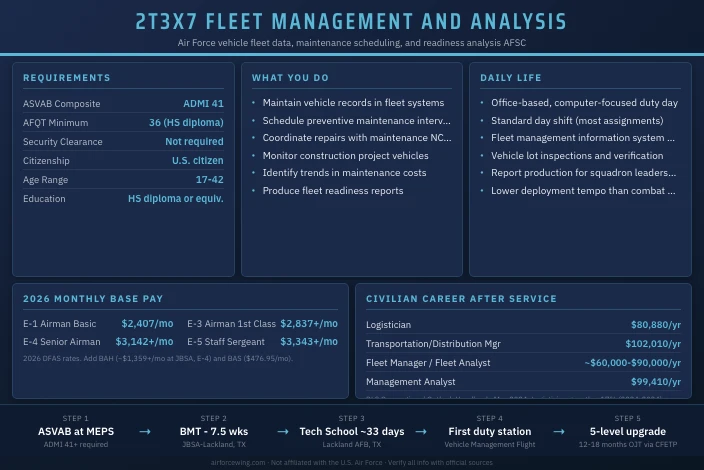
2T3X7 Fleet Management and Analysis specialists supervise and perform the scheduling and analysis of maintenance performed on vehicles and equipment. They manage fleet records, coordinate repairs with work center supervisors, monitor vehicles assigned to construction projects, and produce data reports that support readiness and budget decisions across the installation’s vehicle fleet.
Daily Tasks
The job divides roughly into records management, scheduling, and analysis work. On any given shift, a 2T3X7 Airman might pull a vehicle’s maintenance history to schedule an upcoming service, review repair orders from the Vehicle Maintenance shop, or build a report showing fleet availability rates by vehicle type.
Common daily responsibilities include:
- Maintaining vehicle and equipment records in the Air Force fleet management information system
- Scheduling preventive maintenance based on mileage, hours, and manufacturer intervals
- Coordinating with vehicle maintenance work center supervisors on repair prioritization
- Monitoring vehicles deployed to military construction projects and tracking usage data
- Identifying trends in maintenance costs, repeat failures, and out-of-service time
- Preparing readiness reports for squadron commanders and installation leadership
Specialization Codes
| Code | Description |
|---|---|
| 2T331 | Apprentice (3-skill level, Tech School graduate) |
| 2T351 | Journeyman (5-skill level, core duty qualified) |
| 2T371 | Craftsman (7-skill level, supervisory) |
| 2T391 | Superintendent (9-skill level, senior leader) |
The 2T3 career series also includes 2T3X1 (Vehicle Operations) and 2T3X2 (Vehicle Management and Analysis is sometimes called out as a distinct designation at certain billets), but 2T3X7 specifically owns the fleet data management and analysis function rather than direct vehicle operations or hands-on maintenance.
Mission Contribution
Air Force installations operate hundreds of vehicles ranging from administrative sedans to aircraft-towing tractors and fire trucks. Keeping that fleet mission-ready requires more than fixing breakdowns, it requires a predictive, data-driven approach to maintenance. A vehicle grounded on the flight line because a scheduled service was missed can delay aircraft recovery. A preventable trend that goes unnoticed in the data costs the installation real money.
2T3X7 Airmen are the analytics layer between the mechanics who turn wrenches and the commanders who approve budgets and measure readiness. They translate maintenance activity into reports that drive decisions, when to take a vehicle out of service, when to request fleet replacement, and where to focus limited maintenance resources.
Technology and Equipment
The primary tool is the Air Force Fleet Management Information System, which tracks vehicle assignments, maintenance records, and cost data across the installation. Fleet management Airmen also work with:
- Defense Property Accountability System (DPAS) for equipment accountability
- Air Force Portal reporting tools and Microsoft Office suite for data analysis and reporting
- Vehicle Management and Analysis (VM&A) databases and inspection tracking systems
- Government vehicle telematics systems at installations where GPS fleet tracking is deployed
The data skills you build here, database queries, trend analysis, report production, transfer directly to commercial fleet management software used by logistics companies, municipalities, and federal agencies. The ASVAB study guide can help you build the Administrative composite score you need before MEPS.
Salary
Base Pay
Pay is identical across all Air Force specialties at the same grade and years of service. The table below shows 2026 monthly base pay at key career points for a 2T3X7 Airman. All figures are from DFAS.
| Rank | Grade | Typical TIS | Monthly Base Pay |
|---|---|---|---|
| Airman Basic | E-1 | Entry | $2,407 |
| Airman First Class | E-3 | ~1-2 years | $2,837, $3,198 |
| Senior Airman | E-4 | ~2-4 years | $3,142, $3,816 |
| Staff Sergeant | E-5 | ~4-6 years | $3,343, $4,109 |
| Technical Sergeant | E-6 | ~8-12 years | $3,401, $5,044 |
| Master Sergeant | E-7 | ~13-17 years | $3,932, $5,537 |
Beyond base pay, active-duty Airmen receive a Basic Allowance for Subsistence (BAS) of $476.95 per month and a Basic Allowance for Housing (BAH) that varies by duty station and dependent status. At Joint Base San Antonio, an E-4 without dependents receives approximately $1,359/month in BAH. Both allowances are tax-free.
Additional Benefits
Healthcare coverage through TRICARE Prime costs active-duty Airmen $0 in enrollment fees, deductibles, or copays for most care. The plan covers medical, dental, vision, mental health, and prescriptions.
Education benefits include:
- Tuition Assistance (TA): Up to $4,500 per year for college courses taken while on active duty
- Post-9/11 GI Bill: Full in-state tuition at public universities after service, plus a monthly housing allowance and up to $1,000/year for books
- Community College of the Air Force (CCAF): Tech School credits and on-the-job training count toward an Associate of Applied Science in Transportation and Vehicle Maintenance
Retirement
Airmen who entered service after January 1, 2018, are covered by the Blended Retirement System (BRS). BRS provides a 20-year pension worth 40% of high-36 average basic pay, combined with automatic and matching Thrift Savings Plan (TSP) contributions. The government contributes 1% of basic pay automatically after 60 days of service and matches up to 4% more for a total of up to 5% in government contributions.
Work-Life Balance
Most 2T3X7 assignments follow standard duty hours, roughly 0730-1630 Monday through Friday, with some variation depending on the installation’s Vehicle Management Flight operational tempo. Physical inventory cycles, deployment preparations, and fiscal year-end reporting can push hours higher during peak periods. All Airmen receive 30 days of paid leave per year plus 11 federal holidays.
Qualifications
Requirements Table
| Requirement | Detail |
|---|---|
| ASVAB Composite | Administrative (ADMI) 41 |
| AFQT Minimum | 36 (high school diploma) / 65 (GED) |
| Security Clearance | None required |
| Citizenship | U.S. citizen |
| Education | High school diploma or equivalent |
| Age | 17-42 at enlistment |
| Physical Profile | Normal |
| Medical | No special requirements |
The ADMI 41 score is confirmed by airforce.com and cross-referenced with Military.com’s ASVAB job requirements list. The Administrative composite measures verbal and quantitative reasoning through Word Knowledge, Paragraph Comprehension, Arithmetic Reasoning, and General Science subtests.
A score of 41 on the ADMI is achievable with solid preparation, particularly in the verbal subtests. Airmen who read regularly and practice arithmetic reasoning typically clear this threshold without extensive study. That said, a higher score gives you more negotiating power when selecting your first duty station and strengthens your overall enlistment package. Our ASVAB and PiCAT study guide covers both the standard test and the PiCAT home version.
Application Process
Service Obligation and Entry Rank
The standard active-duty enlistment is four years, with six-year options available. All enlisted Airmen enter at E-1 (Airman Basic) unless they qualify for advanced enlistment rank through college credits, prior service, or applicable programs.
Selection Competitiveness
2T3X7 is a support career field present at nearly every installation. Competitiveness depends on ASVAB score and overall accession package quality. The field is not a highly restricted pipeline like special operations or cyber, but the Air Force controls slot availability based on manning needs by year and cycle. Prior experience in data entry, fleet operations, or administrative record-keeping can strengthen your application.
Work Environment
Setting and Schedule
2T3X7 Airmen work primarily in offices and administrative sections within the Vehicle Management Flight, which falls under the Logistics Readiness Squadron on most installations. The environment is climate-controlled and computer-focused. Some tasks require walking vehicle storage lots and maintenance bays to conduct physical inspections or verify vehicle identifiers against database records, but the majority of duty time is at a workstation.
Most units operate on a standard day shift. Larger Vehicle Management Flights at major bases may have staggered hours to cover extended operations, but night and weekend work is uncommon outside of exercise or deployment preparation periods.
Typical duty environment by task:
- Records management: workstation in the Vehicle Management Flight office, database-focused
- Maintenance scheduling: workstation with occasional coordination visits to the vehicle maintenance bay
- Vehicle inspections: outdoor vehicle storage lots and covered maintenance bays
- Report preparation: office setting, using Microsoft Office and Air Force reporting systems
- Commander briefings: conference rooms or squadron operations spaces at larger installations
Chain of Command and Feedback
2T3X7 Airmen fall within the Logistics Readiness Squadron’s Vehicle Management Flight. Direct supervision comes from an NCO Vehicle Management and Analysis supervisor, with flight-level leadership from a Senior NCO or commissioned officer Flight Commander. Performance is evaluated through the Enlisted Performance Report (EPR) system on an annual basis. Day-to-day feedback comes from section supervisors during task reviews and monthly counseling.
The work is transaction-heavy and measurable. Fleet availability rates, records accuracy percentages, and report completion timelines are visible outputs that supervisors and commanders track. This means your performance is quantifiable in ways that matter for EPR bullet writing, a significant advantage at promotion time.
Team Dynamics
The fleet management section is typically a small team of two to six Airmen, depending on the installation’s fleet size. You’ll work closely with the Vehicle Maintenance section (which handles the actual repairs) and the Vehicle Operations section (which dispatches drivers). Good working relationships across these three sections are what keep the data accurate and the mission running.
New Airmen work under close supervision initially, learning the databases and Air Force-specific processes that don’t appear in Tech School coursework at the same depth. As skill level increases, Airmen take on independent analysis tasks and eventually supervise the work of junior Airmen.
Job Satisfaction
Fleet management tends to attract Airmen who are organized, methodical, and comfortable with data work. Retention in this specialty is generally stable. The predictable schedule, manageable deployment tempo, and direct civilian career application give Airmen confidence that their service time is building toward a post-military career. Those who find administrative data work tedious may struggle with the pace, particularly at smaller bases where the fleet is limited and the work becomes highly repetitive.
Training
Initial Training
| Phase | Location | Duration | Focus |
|---|---|---|---|
| Basic Military Training (BMT) | JBSA-Lackland, TX | 7.5 weeks | Physical conditioning, military customs, core Airman skills |
| Technical School | Lackland AFB, TX | ~33 days | Fleet management systems, vehicle records management, maintenance scheduling, analysis procedures |
Tech School runs approximately 33 days at Lackland AFB, TX, which means 2T3X7 Airmen complete both BMT and Tech School at the same installation. Graduates earn the 3-skill level (Apprentice: 2T331) and proceed directly to their first duty assignment.
The curriculum covers Air Force vehicle management regulations, the fleet management information system, maintenance scheduling procedures, vehicle records documentation, and the data analysis workflows that fleet managers use to produce readiness reports. Training also includes the accountability standards that apply to government vehicles, which have legal and financial implications similar to property accountability in supply fields.
On-the-Job Training
The upgrade from 3-skill level to 5-skill level (Journeyman: 2T351) happens at the first duty station through a Career Field Education and Training Plan (CFETP) task list. Airmen work through documented tasks covering all fleet management functions, from records audits to maintenance trend analysis. Upgrade typically takes 12-18 months, depending on base tempo and supervisor certification pace.
Professional development opportunities during the upgrade period include:
- CCAF degree in Transportation and Vehicle Maintenance, with Tech School and OJT credits counting toward the degree
- Tuition Assistance for college coursework in logistics, business administration, data analytics, or related fields
- Defense Acquisition University (DAU) courses for those assigned to fleet management positions with acquisition or contracting interfaces
Advanced Training
Senior NCOs and 7-level craftsmen may attend fleet management advanced courses, logistics management schools, and leadership development programs through Air Education and Training Command. Airmen with strong analytical performance may be selected for positions supporting Air Force installation-wide vehicle fleet planning, which involves higher-level data work and direct interaction with leadership.
Our ASVAB and PiCAT prep guide has strategies for maximizing your Administrative composite before you visit MEPS.
Career Progression
Rank Progression
| Rank | Grade | Typical Time-in-Service | Primary Role |
|---|---|---|---|
| Airman Basic | E-1 | Entry | BMT |
| Airman | E-2 | ~6 months | Tech School / transition |
| Airman First Class | E-3 | ~1 year | 3-level learning at first unit |
| Senior Airman | E-4 | ~2-3 years | Journeyman upgrade, independent tasks |
| Staff Sergeant | E-5 | ~4-6 years | Section lead, junior Airman supervision |
| Technical Sergeant | E-6 | ~8-12 years | Flight NCO, installation fleet analysis lead |
| Master Sergeant | E-7 | ~13-17 years | Superintendent-track |
| Senior Master Sergeant | E-8 | ~17-20 years | Squadron-level logistics leadership |
| Chief Master Sergeant | E-9 | ~20+ years | Group and wing logistics leadership |
Promotion to E-5 and above is competitive. The Weighted Airman Promotion System (WAPS) incorporates EPR scores, a Promotion Fitness Examination (PFE), and an AFSC-specific test. Strong performance in fleet data accuracy and report quality produces EPR bullets that support competitive promotion packages.
Specialization and Career Branching
The 2T career series has a natural progression path from fleet management analysis into broader transportation and logistics roles. Airmen who demonstrate strong analytical performance can move into:
- 2T3 career field leadership: senior NCO positions overseeing vehicle operations and maintenance across an installation
- Logistics Readiness Squadron leadership: positions that manage the full spectrum of supply, fuels, and transportation missions
- Cross-training into 6C0X1 Contracting, 2G0X1 Logistics Plans, or other analytical career fields for Airmen interested in different mission sets
There are no formal shredout designations within 2T3X7, but Special Experience Identifiers (SEIs) recognize experience in areas such as vehicle fleet acquisition support and transportation contingency planning.
Performance Evaluation
The EPR system rates performance across five areas: job performance, leadership, professional qualities, community involvement, and base/unit involvement. For 2T3X7 Airmen, measurable fleet data outputs, vehicle availability percentages, records audit pass rates, cost variance identification, provide strong material for EPR bullets. The ability to quantify the mission impact of your work directly affects promotion outcomes. Learning to write effective EPR bullets early, with specific numbers and clear operational context, pays long-term dividends.
Physical Demands
Daily Physical Requirements
2T3X7 is not physically demanding by Air Force standards. The work is primarily sedentary or light-duty: seated at workstations, walking vehicle lots for inspections, and occasional bending and reaching to verify vehicle identification plates or inspect equipment. No regular heavy lifting or strenuous physical activity is inherent to the role. Airmen should be prepared for outdoor lot inspections in all weather conditions, which can range from cold flight-line environments in Alaska to summer heat at desert installations.
Air Force Fitness Assessment
All Airmen, regardless of AFSC, take the Air Force Fitness Assessment annually. The assessment uses a 100-point composite scale with a minimum passing score of 75. Each component must also meet its individual minimum threshold.
| Component | Maximum Points |
|---|---|
| 1.5-Mile Run | 60 |
| Push-Ups (1 minute) | 10 |
| Sit-Ups (1 minute) | 10 |
| Waist Circumference | 20 |
Standards are age- and gender-normed. Failing the overall assessment or failing any individual component results in an Unsatisfactory rating, which affects promotion eligibility. Current scoring standards are published at af.mil.
Medical Evaluations
2T3X7 has no flight-physical requirement and no specialized vision, hearing, or occupational health standard beyond the baseline MEPS physical. Airmen receive periodic medical and dental exams through TRICARE Prime. Pre-deployment medical readiness screenings include immunization updates and medical record reviews, which apply to all deploying Airmen regardless of AFSC.
Deployment
Deployment Details
Fleet management Airmen deploy in support of contingency operations, typically assigned to an Expeditionary Logistics Readiness Squadron or a deployed vehicle management function at a forward operating base. Deployed missions involve managing the vehicle fleet for the deployed force, tracking readiness, scheduling maintenance in austere environments, and producing data for deployed commanders.
Deployment frequency for 2T3X7 is moderate. Most Airmen can expect one to two deployments per enlistment at the junior enlisted level, with frequency potentially increasing at the NCO level. Deployment lengths typically run 90 to 179 days, though theater requirements can extend this. The deployment tempo is lower than combat-coded AFSCs.
Duty Station Options
2T3X7 is present wherever there is a Vehicle Management Flight, which covers most Air Force installations. Common duty locations include:
- CONUS: Barksdale AFB, LA; Dyess AFB, TX; Eglin AFB, FL; Eielson AFB, AK; Ellsworth AFB, SD; Fairchild AFB, WA; Joint Base Charleston, SC; Joint Base Elmendorf-Richardson, AK; Dover AFB, DE; Davis-Monthan AFB, AZ
- OCONUS: Aviano AB, Italy; Misawa AB, Japan; Osan AB, South Korea; RAF Lakenheath, UK; Ramstein AB, Germany
- Smaller installations: Altus AFB, OK; Cannon AFB, NM; F.E. Warren AFB, WY; Grand Forks AFB, ND; Holloman AFB, NM
Duty station preferences go through the Air Force assignment system, with the Air Force assigning based on manning needs. Requesting a particular region is possible but not guaranteed. OCONUS assignments typically add a Housing Cost of Living Adjustment or Overseas Housing Allowance on top of base pay.
Risk/Safety
Job Hazards
2T3X7 carries a low risk profile. The primary workplace hazards are ergonomic (extended computer use) and environmental (outdoor vehicle lot inspections in variable weather). Airmen assigned to installations with heavy vehicle fleets may occasionally visit maintenance bays where vehicle lifts, fluids, and equipment are in use, but 2T3X7 is not a hands-on maintenance role and direct exposure to those hazards is limited.
Known hazard categories for this AFSC:
- Ergonomic: extended seated computer use, monitor glare, repetitive keyboard and mouse tasks
- Environmental: outdoor lot inspections in heat, cold, rain, and high-wind conditions depending on duty station
- Incidental maintenance bay exposure: fumes, vehicle fluids, and overhead lift operations when coordinating with mechanics
- Deployed environments: additional hazards apply in contingency locations, including dust, vehicle traffic, and reduced infrastructure
Safety Protocols
Air Force safety programs require all Airmen to complete initial and recurring safety training applicable to their work environment. Vehicle management sections follow Air Force Safety Center guidance on office and vehicle lot procedures. Airmen entering maintenance bay areas must adhere to Personal Protective Equipment (PPE) requirements posted at those locations.
Security and Legal Requirements
2T3X7 does not require a security clearance at accession or at the standard skill level. Some installations or billet types involving access to sensitive vehicle assets, restricted flight line areas, or special program support may require a Secret or higher clearance, initiated separately during assignment. All Airmen are bound by the Uniform Code of Military Justice (UCMJ), and the accurate maintenance of government vehicle records carries financial accountability implications. Falsifying records or misrepresenting vehicle status can result in administrative action or Article 15 proceedings.
Impact on Family
Family Considerations
A standard 2T3X7 assignment at a major installation offers predictable hours, which supports family stability. Duty hours are largely daytime and weekday-focused, and the deployment tempo is moderate compared to operational or combat-support AFSCs. Families have access to the full range of on-installation support, including:
- On-base schools and childcare centers (DODEA-accredited schools where available)
- Commissary and exchange shopping at reduced prices
- Military OneSource counseling and family services
- Family Readiness Center programs and deployment support groups
- TRICARE Prime coverage for all family members at no enrollment cost
Deployments, typically 90 to 179 days every few years, are the main period of family stress. The Family Readiness Center and unit family support programs provide resources during these separations. Airmen with active-duty spouses can request a join-spouse assignment; the Air Force makes a reasonable effort to station couples together, though it is not guaranteed at every location.
Relocation
Permanent Change of Station (PCS) moves happen every two to four years on average. The Air Force covers moving expenses through the Defense Personal Property System (DPS), including household goods weight allowances based on grade. Each PCS move triggers a new BAH entitlement at the gaining installation’s rates, which can increase or decrease depending on local housing costs. For families with school-age children, the timing of a PCS matters significantly. Airmen can sometimes manage this by requesting a voluntary stabilization or short-tour extension at a current assignment, though approval depends on unit manning. Military installations near major cities generally offer better school district options and more spouse employment opportunities, factors worth weighing when submitting assignment preference paperwork.
Reserve and Air National Guard
2T3X7 is available in both the Air Force Reserve and the Air National Guard. Every Reserve and ANG wing that operates a significant vehicle fleet needs fleet management specialists, making this one of the more accessible logistics AFSCs in the part-time components.
Duty Commitment
The standard commitment is one Unit Training Assembly (UTA) weekend per month plus a two-week Annual Tour each year. Fleet management weekends focus on records currency, systems proficiency, and readiness training. Some units require additional training tied to fleet accountability cycles or exercise support, but the schedule is generally compatible with full-time civilian employment.
Part-Time Pay
A drill weekend consists of four Inactive Duty Training (IDT) periods. Each IDT period pays at 1/30th of the member’s monthly base pay rate. An E-5 (Staff Sergeant) with six years of service earns $3,343/month in 2026 base pay. At that rate, one IDT period pays approximately $111, and a four-period drill weekend pays approximately $445. An E-4 (Senior Airman) with three years of service earns roughly $3,303/month, putting a drill weekend at approximately $440.
Reserve vs. Active Duty Comparison
| Feature | Active Duty | Air Force Reserve | Air National Guard |
|---|---|---|---|
| Commitment | Full-time | 1 wknd/mo + 2 wks/yr | 1 wknd/mo + 2 wks/yr |
| Monthly Pay (E-4) | $3,142, $3,816 | ~$440-$490/drill weekend (4 IDT periods) | ~$440-$490/drill weekend (4 IDT periods) |
| Healthcare | TRICARE Prime (free) | TRICARE Reserve Select (premium) | TRICARE Reserve Select + state programs |
| Education Benefits | TA ($4,500/yr) + Post-9/11 GI Bill | TA + Selected Reserve GI Bill | TA + state tuition waivers (varies by state) |
| Deployment Tempo | Moderate | Lower; unit-dependent | Lower; unit-dependent |
| Retirement | BRS pension + TSP (20-yr) | Points-based at age 60 | Points-based at age 60 |
TRICARE Reserve Select covers Reserve and ANG members not on active orders, but requires a monthly premium unlike active-duty TRICARE Prime. Air National Guard members in most states can access state-funded tuition benefits at public universities, which vary significantly and are worth researching before choosing a component. The Reserve retirement system grants points for drills, Annual Tour days, and active service periods, with a reduced annuity available at age 60 after 20 qualifying years.
Civilian Career Integration
2T3X7 pairs naturally with civilian fleet management, logistics operations, and data analysis roles. Part-time service in this AFSC directly reinforces civilian work in the same domain, the software systems, records processes, and reporting standards all have commercial equivalents. Most fleet management employers view military logistics experience positively, and USERRA protections require civilian employers to grant leave for military duty and restore jobs upon return without discrimination based on service status.
Post-Service
Civilian fleet management is a real and growing career field. Companies with large vehicle fleets, utilities, municipalities, delivery companies, construction firms, and federal agencies, all need people who understand maintenance scheduling, cost analysis, and records management. A 2T3X7 Airman leaving service after one enlistment brings verifiable experience managing the same type of data that private-sector fleet managers handle daily.
Civilian Career Outlook
| Civilian Career | Median Annual Salary | Job Outlook (2024-2034) |
|---|---|---|
| Logistician | $80,880 | +17% (much faster than average) |
| Transportation, Storage & Distribution Manager | $102,010 | +6% (faster than average) |
| Fleet Manager / Fleet Analyst | Varies (~$60,000-$90,000) | Growing with demand for EV transition expertise |
| Management Analyst | $99,410 | +11% (faster than average) |
Salary data from the BLS Occupational Outlook Handbook. Fleet management specialists who add commercial fleet software certifications, data analytics skills, or professional logistics credentials stand out in the civilian market.
Certifications That Build on 2T3X7 Experience
- NPTC Certified Director of Fleet Management (CDFM): industry credential from the National Private Truck Council
- ASE Fleet Management certification: recognized by automotive service and fleet operations employers
- APICS CPIM (Certified in Production and Inventory Management): broader supply chain credential valued across logistics roles
- CompTIA Data+ or equivalent: for Airmen who develop data analytics skills in the role and want to formalize them
Federal civil service positions, particularly GS-series logistics analyst and transportation specialist roles at DoD installations, are a direct post-service career path. Veterans receive 10-point veterans’ preference on federal civil service exams, and 2T3X7 experience closely matches the qualification requirements for many GS-2130 series positions.
Transition Programs
The Air Force Transition Assistance Program (TAP) provides workshops on resume writing, federal employment applications, and civilian job search strategy. The Hiring Our Heroes program offers fellowship tracks specifically for separating veterans, including logistics and operations management pathways. Airmen separating into fleet management or logistics roles should connect with former colleagues in the field, as hiring in this sector relies heavily on referrals from people who understand military logistics backgrounds.
Is This a Good Job
Ideal Candidate Profile
2T3X7 suits people who are organized, detail-oriented, and genuinely interested in how data explains operational performance. You don’t need to love vehicles, you need to like working with records, finding patterns in maintenance histories, and producing reports that actually get used. Strong candidates for this AFSC typically have:
- A methodical, accuracy-focused approach to work
- Comfort with computer-based tasks for most of the duty day
- Interest in logistics operations, data analysis, or business administration
- Patience with documentation-heavy processes
- Ability to manage multiple records simultaneously without losing accuracy
The role is a good fit if you want a predictable schedule, prefer office-based work over physical or outdoor assignments, and want your military training to map cleanly to civilian employment.
Potential Challenges
The work is repetitive at home station. Between deployment cycles, a 2T3X7 Airman at a mid-sized base may run the same records review and maintenance scheduling workflow daily for months. Airmen who thrive on variety, physical activity, or high-tempo operational assignments will find this frustrating. The field has little operational excitement, that’s both its appeal and its limitation depending on what you’re looking for.
Career and Lifestyle Alignment
This is a strong choice for Airmen planning a post-service career in logistics, fleet management, supply chain operations, or federal service. The schedule is stable, the deployment tempo is manageable for families, and the skills transfer without a major credential gap into civilian roles that pay competitively.
It’s a poor fit if you want a physically active job, frequent variety, or an assignment profile with more operational intensity. Airmen who enter 2T3X7 with a clear post-service goal, whether that’s a federal GS-series logistics position, a municipal fleet management role, or a private-sector supply chain job, tend to get the most value from their time in this specialty.
More Information
Talk to an Air Force recruiter to get current slot availability, bonus information, and any policy changes since this guide was written. Recruiters can confirm whether your ASVAB scores qualify and walk you through the MEPS process step by step. Find a recruiter at airforce.com or call 1-800-423-USAF.
Current AFSC fact sheets, training pipeline details, and Career Field Education and Training Plan documents for 2T3X7 are maintained through official Air Force channels. Verify current ASVAB composite requirements directly with your recruiter, as these can change between fiscal years. For test prep, our ASVAB study guide covers the Administrative composite subtests in detail.
This site is not affiliated with the U.S. Air Force or any government agency. Verify all information with official Air Force sources before making enlistment or career decisions.
Explore more Air Force logistics careers such as 2G0X1 Logistics Plans and 2S0X1 Materiel Management.