2T1X1 Vehicle Operations
The aircraft gets the attention, but nothing moves on an Air Force installation without Vehicle Operations. Every convoy, every cargo run, every bus that picks up Airmen at 0400 depends on 2T1X1 specialists behind the wheel and at the dispatch desk. If you want a job that puts you in control of heavy equipment from day one, keeps you active and outdoors, and hands you a commercial driving edge the moment you separate, this AFSC is worth a close look.
The entry bar is lower than most Air Force jobs. The MECH 40 composite is one of the most accessible scores in the logistics career group. Tech School is just 30 days long. But don’t confuse ease of entry with ease of the job. Vehicle Operations Airmen drive in blackout conditions, move munitions and fuel in all weather, and dispatch fleets that support real-time flight line operations. The work is physical, time-sensitive, and tied directly to mission execution.
Qualifying requires specific ASVAB line scores. Our ASVAB study guide covers what to target and how to prepare.
Job Role
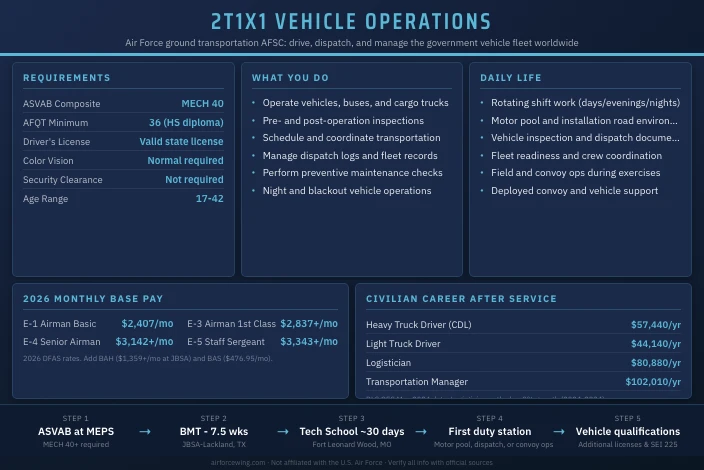
2T1X1 Vehicle Operations specialists operate, dispatch, and maintain the Air Force government vehicle fleet. They transport personnel, cargo, and equipment across installations and deployed locations, conduct pre- and post-operation vehicle inspections, coordinate transportation schedules, and investigate vehicle accidents and incidents. The specialty covers everything from driving 15-passenger buses to operating heavy cargo trucks and specialized aircraft-support vehicles.
Daily Tasks
A typical shift starts with a vehicle inspection. Before any Airman signs a vehicle out of the motor pool, a Vehicle Operations specialist checks fluid levels, tire condition, lights, and safety equipment, then documents the inspection on the appropriate form. From there, work splits between driving and dispatching depending on assignment.
Regular duties include:
- Operating passenger vehicles, buses, cargo trucks, and specialized military equipment
- Conducting pre- and post-operation inspections and documenting results
- Coordinating and scheduling transportation support for units
- Performing preventive maintenance checks and scheduling vehicles for service
- Investigating vehicle accidents and incidents and completing required reports
- Running night operations, including blackout driving with night-vision equipment
- Managing vehicle dispatch logs and maintaining fleet records
At larger bases, senior Airmen and NCOs spend the majority of their time managing dispatch operations rather than driving. They assign vehicles, track the fleet status, coordinate with units requesting transportation, and ensure drivers are properly licensed for the specific vehicle type.
AFSC Shredouts and Identifiers
The 2T1X1 specialty does not have formal shredouts at entry. Specialization develops through additional qualifications and licenses earned at the unit level.
| Code | Title | Notes |
|---|---|---|
| 2T1X1 | Vehicle Operations | Base code, all Airmen in this specialty |
| SEI 225 | Special Vehicles | Operators of specialized mission-support vehicles |
Mission Contribution
Every installation is essentially a small city, and Vehicle Operations runs its transportation network. That means moving aircrew to the flight line, hauling supplies to maintenance units, transporting patients to the hospital, and coordinating fuel and munitions convoys. Deployed, the mission expands. Vehicle Operations specialists support convoy operations, provide transportation in austere environments, and operate equipment that other career fields depend on to do their jobs. When a supply convoy needs to move at night through restricted terrain, a 2T1X1 Airman is the one driving it.
Technology and Equipment
The vehicle inventory across a typical Air Force installation includes:
- Passenger vehicles: sedans, minivans, 15-passenger buses, large transit buses
- Cargo vehicles: medium and heavy cargo trucks (M1085, LMTV class)
- Specialized equipment: aircraft tow tractors, de-icing trucks, fuel servicing vehicles, ambulances (non-medical operations)
- Dispatch systems: Air Force Vehicle Management software for fleet tracking and licensing records
Night operations add a layer of complexity. Drivers use blackout lighting configurations and may operate with night-vision equipment in field environments. The combination of vehicle variety and operational conditions means proficiency develops quickly but never stops.
Salary
The Air Force pays base salary on the same scale as every other branch. Entry rank is Airman Basic (E-1). Most Airmen reach Senior Airman (E-4) within four years. Pay increases with time in service and promotion.
2026 Base Pay by Rank
| Rank | Grade | Monthly Base Pay (Entry) |
|---|---|---|
| Airman Basic | E-1 | $2,407 |
| Airman | E-2 | $2,698 |
| Airman First Class | E-3 | $2,837 |
| Senior Airman | E-4 | $3,142 |
| Staff Sergeant | E-5 | $3,343 |
| Technical Sergeant | E-6 | $3,401 |
Pay figures reflect 2026 DFAS military pay tables.
Base pay is the floor, not the ceiling. Tax-free allowances add significantly:
- BAS (Basic Allowance for Subsistence): $476.95/month, flat national rate for all enlisted
- BAH (Basic Allowance for Housing): varies by duty station, dependency status, and pay grade. A single E-4 at Joint Base San Antonio-Lackland receives $1,359/month; a dependent E-4 receives $1,728/month. Rates are higher at high-cost installations.
An E-4 drawing base pay, BAH, and BAS at JBSA-Lackland brings in roughly $5,388/month in combined compensation before any special pays or bonuses. Most of that is tax-free.
No enlistment bonus has been consistently attached to 2T1X1 in recent fiscal years. Check with your recruiter for current-cycle incentive availability, as bonus programs change each fiscal year.
Additional Benefits
Active-duty Airmen receive TRICARE Prime at no cost. The coverage includes medical, dental, vision, mental health, and prescription drugs, with zero enrollment fees and zero copays for most care.
Education benefits are substantial. The Post-9/11 GI Bill covers full in-state tuition at public schools and up to $29,920.95 per academic year at private schools (2025-2026 cap), plus a monthly housing allowance and up to $1,000/year for books. Active-duty Airmen can also use Tuition Assistance for up to $4,500 per year toward college courses taken while serving.
The Blended Retirement System provides a 20-year pension at 40% of average high-36 basic pay, combined with Thrift Savings Plan contributions. The government matches up to 4% of basic pay through the TSP after 60 days of service.
Work-Life Balance
Vehicle Operations follows shift schedules at most bases. The motor pool typically runs around the clock, which means rotating shifts are common. Many Airmen work four days on, two off, or similar cycle schedules depending on installation size and mission tempo. Leave accumulates at 2.5 days per month, capping at 60 carry-over days, plus 11 federal holidays.
Qualifications
The entry requirements for 2T1X1 are among the most straightforward in the Air Force. The ASVAB composite is low relative to other logistics AFSCs, and there is no security clearance requirement.
Qualification Table
| Requirement | Standard |
|---|---|
| ASVAB Composite | MECH 40 minimum |
| AFQT Minimum | 36 (high school diploma); 65 (GED) |
| Citizenship | U.S. citizen |
| Age | 17-42 at enlistment |
| Driver’s License | Valid state license required |
| Color Vision | Normal color vision required |
| Security Clearance | None required at entry |
| Physical Profile | P3 or better |
| Medical | Must meet Air Force MEPS standards |
Requirements verified against airforce.com Ground Transportation and AFI 36-2101.
A valid state driver’s license is a hard requirement. If yours has been suspended or revoked, you will need to resolve that before accessing this AFSC. The Air Force will verify driving record history at MEPS.
The MECH composite on the Air Force ASVAB measures mechanical aptitude using scores from the Mechanical Comprehension, Auto and Shop Information, and General Science subtests. A score of 40 is attainable with focused preparation. The ASVAB study guide covers all five Air Force composites with practice questions targeted to the specific subtests that matter for each one.
Application Process
The path to 2T1X1 runs through a military recruiter and MEPS:
Service Obligation
The standard active-duty enlistment is four years. Some bonus contracts require a longer commitment. Reserve and Guard contracts vary; see the Reserve and Air National Guard section below.
Airmen enter at Airman Basic (E-1). Most receive an automatic promotion to Airman (E-2) at six months and Airman First Class (E-3) at 16 months, assuming no disciplinary issues.
Competitiveness
2T1X1 is not a competitive selection AFSC. It is open to any applicant who meets the MECH 40 threshold, passes the medical, and has a valid driver’s license. Availability is largely a function of training seat availability at Fort Leonard Wood. Your recruiter can tell you current pipeline timeline.
Work Environment
Vehicle Operations Airmen work outdoors more than most enlisted AFSCs. The motor pool, flight line, and installation roads are the primary workspaces. Weather does not stop the job. Drivers operate in rain, snow, extreme heat, and under field conditions during exercises and deployments.
Setting and Schedule
At a garrison installation, the motor pool is the hub. Airmen check vehicles in and out, perform inspections in the lot, and drive routes around the base throughout the shift. Dispatchers monitor a fleet board showing vehicle assignments, driver locations, and maintenance statuses. At deployed locations, the environment becomes more austere: dirt lots, temporary vehicle parks, and operations that may run around the clock.
Work schedules are shift-based. Days, evenings, and mids are all possible depending on assignment. Some bases run a Panama schedule (a rotating 12-hour pattern). Expect irregular hours, especially in exercises and higher-tempo periods.
Leadership and Accountability
Vehicle Operations NCOs manage dispatchers, drivers, and fleet records simultaneously. The senior dispatcher on any shift is responsible for the accuracy of all vehicle logs, the licensing status of every driver, and the readiness of the fleet. The Air Force evaluates performance through the Enlisted Performance Report (EPR) system, which rates Airmen annually on job performance, leadership, and professional development. A strong EPR is the primary driver of promotion from E-4 through E-9.
Team Dynamics
Drivers spend a lot of time alone in a vehicle cabin, but Vehicle Operations is not a solitary career field. The motor pool functions as a team. Dispatchers depend on drivers to communicate status accurately. Drivers depend on dispatchers to coordinate routes and resolve conflicts. Maintenance coordination requires constant back-and-forth with vehicle management units. The work rewards Airmen who communicate clearly and follow through reliably.
Job Satisfaction
Vehicle Operations has one of the more tangible feedback loops in the Air Force. You move people and cargo, and you see the result. Airmen who enjoy driving, prefer physical work over desk work, and want early proficiency in a marketable civilian skill tend to report high satisfaction in this specialty. The work is less technically complex than maintenance or cyber AFSCs, but its importance to mission execution is direct and visible.
Training
Initial Training Pipeline
| Phase | Location | Length | Focus |
|---|---|---|---|
| Basic Military Training (BMT) | JBSA-Lackland, TX | 7.5 weeks | Military customs, physical fitness, foundational skills |
| Ground Transportation Apprentice Course | Fort Leonard Wood, MO | ~30 days | Vehicle operations, dispatch, preventive maintenance |
BMT is the same for every enlisted Airman. The Ground Transportation course at Fort Leonard Wood covers vehicle operation fundamentals, pre- and post-operation inspections, dispatch procedures, accident reporting, and hands-on driving with military vehicle configurations. The course earns Airmen college credits applicable to a transportation or logistics degree.
At 30 days, this is one of the shortest Tech Schools in the Air Force. Total pipeline from ship date to first duty station is roughly four to five months, including BMT.
Advanced Training
After Tech School, most professional development happens at the unit level. Airmen earn qualifications on additional vehicle types as they advance in skill level:
- 3-skill level (Apprentice): entry, awarded after Tech School completion
- 5-skill level (Journeyman): awarded after completing on-the-job training tasks and an upgrade training package at the unit, typically 12-18 months
- 7-skill level (Craftsman): awarded at E-7 after completing advanced task certifications and leadership requirements
Additional formal training opportunities include the NCO Academy pipeline, the Air Force Vehicle Management and Analysis Course, and convoy operations training for units with deployment requirements. Airmen assigned to combat-coded units may attend specialized convoy security and field operations courses.
The Air Force’s Air Education and Training Command (AETC) manages the vehicle operations apprentice course. Updates to course length and content happen periodically, verify current details with your recruiter or at aetc.af.mil.
Everything starts with qualifying ASVAB scores. Our study guide covers what to study first.
Career Progression
Rank Progression Table
| Rank | Grade | Typical Time in Service |
|---|---|---|
| Airman Basic | E-1 | 0-6 months |
| Airman | E-2 | 6 months |
| Airman First Class | E-3 | 16 months |
| Senior Airman | E-4 | 3 years (with EPR) |
| Staff Sergeant | E-5 | 4-6 years (promotion board) |
| Technical Sergeant | E-6 | 8-12 years |
| Master Sergeant | E-7 | 14-18 years |
| Senior Master Sergeant | E-8 | 18-22 years |
| Chief Master Sergeant | E-9 | 22+ years |
Promotions through E-3 are automatic based on time-in-service and satisfactory performance. E-5 and above require competitive board selection based on EPR scores, decorations, professional military education, and fitness assessment results.
Specialization Options
As Airmen advance, they can pursue qualifications that differentiate their record:
- Special Experience Identifier (SEI) 225: special vehicle operations
- NCO supervisory roles: dispatcher section chief, vehicle operations flight sergeant
- Retraining opportunities: After four years, Airmen can apply to cross-train into higher-demand or higher-paying AFSCs. Vehicle Operations experience translates well into Logistics Plans (2G0X1) and Air Transportation (2T2X1).
Role Flexibility
Cross-training is available after the initial enlistment, subject to Air Force Force Management needs. Applications go through the Airman Development Plan process, with the most competitive applications paired with strong EPRs, fitness scores, and a recommendation from the unit commander. Airmen who want to move into logistics planning or transportation management positions should build toward a relevant civilian degree using Tuition Assistance during their first enlistment.
Performance Evaluation
The Enlisted Performance Report rates Airmen on job performance, leadership, followership, fitness, and professional development. A rating of “Promote” is expected. “Promote Now” is selective and carries significant weight at promotion boards. Airmen who want to reach MSgt and above should treat the EPR as a career document and actively track their performance bullets starting at the E-4 level.
Physical Demands
Vehicle Operations is physically demanding relative to many Air Force desk AFSCs. Drivers load and unload cargo, conduct physical vehicle inspections that require crawling under vehicles and climbing into cargo beds, and operate in outdoor conditions including heat, cold, and rain. Field and deployment operations add extended standing, walking, and manual handling.
Air Force Fitness Assessment
All Airmen take the Air Force Fitness Assessment annually, regardless of AFSC. The assessment is age- and gender-normed, scored on a 100-point scale with a minimum passing composite score of 75.
| Component | Max Points | Notes |
|---|---|---|
| 1.5-Mile Run | 60 | Primary aerobic component |
| Waist Circumference | 20 | Body composition measure |
| Push-Ups (1 min) | 10 | Muscular endurance |
| Sit-Ups (1 min) | 10 | Core strength |
A failing score on any single component fails the overall assessment regardless of the composite total. Standards vary by age group and gender; check af.mil for current scoring charts.
Medical Evaluations
Initial medical clearance happens at MEPS. Ongoing medical fitness is evaluated annually through physical exams coordinated by the installation medical unit. Normal color vision is a standing requirement because drivers operate vehicles with signal lights, colored markers, and night-vision devices that rely on color interpretation. A P3 physical profile or better is required for continued service in this AFSC.
Deployment
Deployment Details
Vehicle Operations is a deployable specialty. Deployment frequency varies by unit type. Airmen assigned to combat-coded units or Air Expeditionary Force (AEF) pools deploy more regularly than those at garrison support bases. Typical deployment lengths run three to six months, though some AEF rotations are shorter.
Deployed operations differ significantly from garrison. Drivers operate in austere conditions, conduct convoy operations, and may work in environments where vehicle movement is mission-critical and time-sensitive. Not every 2T1X1 Airman deploys frequently, but all maintain deployment eligibility.
Duty Station Options
Vehicle Operations exists at every Air Force installation worldwide. Common duty station types include:
- Large combat air bases: high vehicle inventory, diverse mission support, exposure to multiple vehicle types
- Logistics and airlift hubs: AMC installations like Travis AFB, Dover AFB, and McChord Field involve heavy cargo movement
- Overseas installations: Germany, Japan, Korea, and Guam all have vehicle operations flights
- Joint bases: shared-service installations may involve driving for other services
Assignment preferences can be submitted through the personnel system, but final assignments depend on Air Force needs. Airmen in high-demand locations and with strong performance records have more influence over their assignment options over time.
Risk/Safety
Job Hazards
The primary hazards in Vehicle Operations are vehicle accidents, cargo injuries, and environmental exposure. Driving military vehicles on installation roads and in field environments carries risk, particularly during night operations, adverse weather, and convoy movements. Heavy cargo loading and unloading creates ergonomic risk, including back injuries from improper lifting.
Safety Protocols
The Air Force manages vehicle safety under AFI 24-301, Ground Transportation. This instruction governs driver licensing requirements, vehicle inspection standards, accident reporting procedures, and operator training. Every driver must hold current qualification documentation for the specific vehicle type before operating it. Seat belts, speed limits, and inspection requirements are enforced by dispatch personnel and vehicle management supervisors.
The installation safety office conducts periodic vehicle safety assessments, and Vehicle Operations units complete annual defensive driving refreshers. Any accident or incident triggers a mandatory report and investigation regardless of severity.
Security and Legal Requirements
2T1X1 does not require a security clearance at entry or for most positions within the specialty. Some assignments involving munitions transport or access to restricted areas may require an interim Secret clearance, which the unit initiates on behalf of the Airman.
Standard military legal obligations apply: enlistment contract terms, Uniform Code of Military Justice compliance, and deployment availability requirements. Airmen who receive a civilian driving violation (DUI, reckless driving) while in service face potential administrative action and may lose their military driver’s license, which directly affects the ability to perform the job.
Impact on Family
Family Considerations
Shift work is the most common quality-of-life factor for families in this AFSC. Rotating schedules, including evenings and nights, can make family routines harder to plan. Deployment rotations of three to six months are a reality for combat-coded units. Families assigned to overseas bases will experience geographic isolation from extended family in the United States.
The Air Force provides support through Airman and Family Readiness Centers at every installation, which offer financial counseling, deployment preparation support, childcare coordination, and spouse employment assistance. TRICARE covers family members under the same zero-copay structure as the Airman.
Relocation and Flexibility
Permanent Change of Station (PCS) moves occur every two to four years on average. Families receive a housing allowance (BAH) calibrated to the cost of living at each duty station, and moving expenses are covered through the military household goods system. Assignment preferences can be submitted, and Airmen with strong performance records and language skills have the most flexibility in where they serve over a career.
Reserve and Air National Guard
Component Availability
2T1X1 is available in both the Air Force Reserve and the Air National Guard. Most Reserve and Guard wings maintain a vehicle operations flight to support local transportation requirements and deployment tasking. The Air National Guard tends to have more vehicle operations billets tied to state emergency management missions, including hurricane and disaster response transport.
Drill Schedule and Training Commitment
The standard Reserve/Guard commitment is one Unit Training Assembly (UTA) weekend per month and 15 days of Annual Tour each year. Vehicle Operations units may add additional training days for driver qualification refresher events, annual vehicle safety training, and readiness exercises. Annual certification requirements for certain vehicle types mean some 2T1X1 members train more than the standard schedule.
Part-Time Pay
An E-4 with this AFSC earns roughly four days of base pay per drill weekend (two UTA days count as four training periods). At 2026 rates, an E-4 earns $3,142/month on active duty. A drill weekend pays approximately $418, compared to the $3,142 monthly active-duty total.
Component Comparison
| Factor | Active Duty | Air Force Reserve | Air National Guard |
|---|---|---|---|
| Commitment | Full-time | ~38 days/yr | ~38 days/yr |
| Monthly E-4 Pay | $3,142 | ~$418/drill weekend | ~$418/drill weekend |
| Healthcare | TRICARE Prime (free) | TRICARE Reserve Select (premium) | TRICARE Reserve Select (premium) |
| Education | Tuition Assistance + GI Bill | Federal TA + GI Bill (limited) | State waivers + Federal TA |
| Retirement | 20-yr pension + TSP match | Points-based reserve retirement | Points-based reserve retirement |
| Deployment Tempo | Moderate | Lower; periodic mobilization | Lower; state missions + federal |
Civilian Career Integration
The Guard and Reserve pair well with a commercial driving career. A 2T1X1 Airman can work as a truck driver, dispatcher, or fleet manager during the week while maintaining their military proficiency on weekends. Employers in the transportation sector are generally familiar with military driver qualifications and tend to view Guard and Reserve service positively. USERRA protections guarantee job reinstatement after mobilization and prohibit discrimination based on military service.
Post-Service
Civilian Career Transition
Vehicle Operations translates to civilian employment more directly than most Air Force AFSCs. The skills are immediately recognizable to civilian employers: documented driving hours, vehicle inspection experience, dispatch operations management, and a clean driving record supported by official military documentation.
Former 2T1X1 Airmen commonly transition into:
| Civilian Title | Median Annual Salary | Job Outlook (2024-2034) |
|---|---|---|
| Heavy & Tractor-Trailer Truck Driver | $57,440 | +4% (avg growth) |
| Light Truck Driver | $44,140 | Stable |
| Logistician | $80,880 | +9% (faster than avg) |
| Transportation & Distribution Manager | $102,010 | +7% (faster than avg) |
Salary data from BLS OES May 2024 and the Occupational Outlook Handbook.
The heavy truck driving path is the most immediate. A Commercial Driver’s License (CDL) Class A is required for many civilian driving positions. The military driving background satisfies a large portion of the experience and skills requirements, and many CDL programs give credit for documented military vehicle operation hours. Some states offer expedited CDL pathways for veterans.
Airmen who spend their enlistment building toward dispatch supervision and logistics coordination have a strong path into logistician and transportation manager roles, especially with a college degree earned through Tuition Assistance. Logistics grew 9% in the most recent ten-year outlook, well above average.
Transition Programs
The Transition Assistance Program (TAP) is mandatory for separating Airmen and includes job search, resume writing, and civilian employer networking support. Hiring Our Heroes events at military installations connect service members with transportation and logistics employers before separation. The Helmets to Hardhats program specifically connects veterans to skilled trades and equipment operation careers, many of which align with Vehicle Operations experience.
Education and Certification
Separating Airmen retain Post-9/11 GI Bill eligibility for 15 years from their discharge date. Veterans pursuing logistics or supply chain management degrees will find that their Air Force experience satisfies many of the practical requirements for entry-level positions while they complete coursework. Certifications from ASCM (formerly APICS) in supply chain operations pair well with the vehicle management and dispatch background that senior 2T1X1 Airmen develop over a career.
Is This a Good Job
Who Thrives in This AFSC
The job suits people who prefer physical, hands-on work over desk assignments, want to build a civilian-marketable skill quickly, and enjoy variety in their daily tasks. Airmen who are comfortable operating heavy machinery, have strong situational awareness, and can follow strict procedures reliably will advance well.
Good indicators this AFSC fits:
- You already drive regularly and enjoy it
- You want to earn a CDL-equivalent credential through military service
- You prefer outdoor work and shift schedules over office environments
- You’re drawn to logistics and transportation as a long-term career path
- You want a short Tech School and a fast path to the fleet
Potential Challenges
Shift work is not for everyone. Rotating nights and weekends affect social schedules, family routines, and sleep patterns in ways that catch some Airmen off guard. Deployments to austere locations with convoy operations add physical and psychological stress. The work is repetitive in some assignments: the same inspection checklist, the same routes, the same vehicle types. Airmen who want technically complex or intellectually stimulating daily work tend to find this AFSC frustrating after the initial learning curve.
If you dislike driving as a primary activity or want a job that leads to a desk career after separation, a different logistics AFSC like 2G0X1 Logistics Plans or 2S0X1 Materiel Management may be a better fit.
Career and Lifestyle Alignment
2T1X1 is a strong pick for someone who wants a stable career path, clean civilian credentials, and the option to drive professionally after service without additional re-training. It’s not the best choice for someone aiming toward a commission, a cyber career, or a job that requires a security clearance. The physical demands and shift work require genuine tolerance, not just acceptance on paper.
More Information
Talk to an Air Force recruiter to find out whether 2T1X1 has open training seats in the next pipeline cycle. You can connect with a recruiter at airforce.com or by visiting a local recruiting office. Before you go, build your MECH composite score to at least 45 to leave margin, the ASVAB prep guide walks you through the Mechanical Comprehension and Auto and Shop subtests that drive this composite.
This site is not affiliated with the U.S. Air Force or any government agency. Verify all information with official Air Force sources before making enlistment or career decisions.
Explore more Air Force logistics careers such as 2S0X1 Materiel Management and 2G0X1 Logistics Plans.