2R1X1 Maintenance Management Production
Every aircraft that launches on time does so because someone planned it. A 2R1X1 Maintenance Management Production specialist is the person who builds that schedule, tracks what’s broken, and tells the maintenance crew what to fix and when. Without this AFSC, maintenance units would react to problems. With it, they get ahead of them.
The job sits at the intersection of planning, data, and aviation operations. You won’t be turning wrenches, but you’ll understand the workflow of every wrench-turner on the flight line. If you’re drawn to systems thinking, figuring out how pieces fit together so operations run without gaps, this career field is worth a serious look.
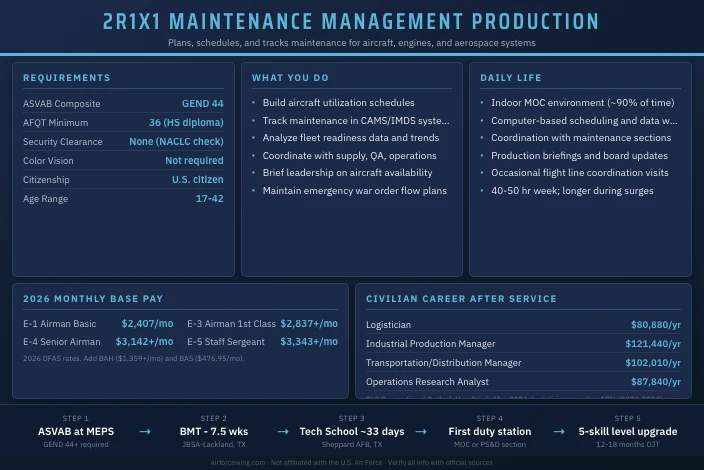
Job Role and Responsibilities
The 2R1X1 Maintenance Management Production specialist plans, schedules, and organizes the maintenance and repair of aircraft, engines, munitions, missiles, space systems, and aerospace ground equipment. They document and maintain maintenance records, manage production scheduling, analyze maintenance data, and develop visual presentations to inform leadership decisions about operational readiness.
Daily Tasks
Production management Airmen spend most of their time inside a Maintenance Operations Center (MOC) or a Plans, Scheduling, and Documentation (PS&D) section. The work is software-driven and deadline-oriented. A typical day involves reviewing outstanding maintenance actions, updating scheduling databases, and coordinating with maintenance crews to ensure tasks are sequenced correctly.
Specific responsibilities include:
- Building daily, weekly, monthly, quarterly, and annual utilization schedules for aircraft and associated equipment
- Inputting and tracking maintenance data using Air Force automated management systems
- Identifying scheduling conflicts and adjusting production plans to prevent mission gaps
- Analyzing maintenance trends to flag recurring problems before they become critical failures
- Preparing reports and briefings on fleet readiness and maintenance effectiveness
- Maintaining emergency war order (EWO) generation flow plans for wartime tasking
- Coordinating with supply, quality assurance, and operations sections to confirm parts and resources are available before scheduling work
Specialization Codes
| Code | Description |
|---|---|
| 2R031 | Apprentice (3-skill level, Tech School graduate) |
| 2R051 | Journeyman (5-skill level, duty-qualified) |
| 2R071 | Craftsman (7-skill level, supervisory) |
| 2R091 | Superintendent (9-skill level, senior leader) |
Special Experience Identifiers (SEIs) in the 2R career field recognize expertise in areas such as depot-level maintenance management and specific weapon system programs. SEIs are assigned based on documented experience and are relevant when competing for specialized assignments.
Mission Contribution
Air Force maintenance organizations are built around one metric: aircraft availability. A jet that’s grounded for unscheduled maintenance is a mission that didn’t happen. Production management Airmen are the people who keep maintenance units from firefighting, they build the schedule that prevents avoidable downtime and track the data that helps commanders understand whether their fleet is healthy.
This AFSC supports every platform the Air Force operates: fighters, bombers, tankers, cargo aircraft, helicopters, and space systems. The skills are platform-agnostic, which means Airmen can serve across multiple weapon systems throughout a career.
Technology and Equipment
The primary tool is the Air Force’s Core Automated Maintenance System (CAMS) and its successor platforms, which track every maintenance action, flight hour, and inspection requirement across the fleet. Airmen also work with:
- Integrated Maintenance Data System (IMDS) for aircraft records management
- G081 (CAMS for Mobility, later replaced by ALIS/IMDS in some fleets)
- Air Force Portal scheduling and reporting tools
- Microsoft Office Suite for briefings, spreadsheets, and data analysis
- Visual management boards and production control displays in the MOC
These systems mirror the production planning software used in commercial aviation and manufacturing, a direct advantage when transitioning to civilian careers.
Salary and Benefits
Base Pay
Pay is the same across all Air Force specialties at each grade and years-of-service bracket. The table below shows 2026 monthly base pay at common career milestones. All figures are from DFAS.
| Rank | Grade | Typical TIS | Monthly Base Pay |
|---|---|---|---|
| Airman Basic | E-1 | Entry | $2,407 |
| Airman First Class | E-3 | ~1-2 years | $2,837, $3,198 |
| Senior Airman | E-4 | ~2-4 years | $3,142, $3,816 |
| Staff Sergeant | E-5 | ~4-6 years | $3,343, $4,109 |
| Technical Sergeant | E-6 | ~8-12 years | $3,401, $5,044 |
| Master Sergeant | E-7 | ~13-18 years | $3,932, $5,537 |
Base pay is only part of total compensation. Active-duty Airmen receive a Basic Allowance for Subsistence (BAS) of $476.95 per month and a Basic Allowance for Housing (BAH) that varies by duty station and dependent status. At Joint Base San Antonio, an E-4 without dependents receives approximately $1,359/month in BAH. Both allowances are tax-free.
Additional Benefits
Healthcare is TRICARE Prime: $0 enrollment fee, $0 deductible, $0 copay for most care. Coverage includes medical, dental, vision, mental health, and prescriptions for active-duty members.
Education benefits include:
- Tuition Assistance (TA): Up to $4,500 per year for college courses taken while on active duty
- Post-9/11 GI Bill: Covers full in-state tuition at public universities after service, plus a monthly housing allowance and up to $1,000 per year for books
- Community College of the Air Force (CCAF): Tech School and duty performance credits count toward an Associate of Applied Science in Maintenance Production Technology
Retirement
Airmen who entered service after January 1, 2018, are enrolled in the Blended Retirement System (BRS). BRS combines a 20-year pension (40% of high-36 average basic pay) with automatic and matching Thrift Savings Plan (TSP) contributions. The government contributes 1% of basic pay automatically after 60 days of service and matches up to an additional 4%.
Work-Life Balance
Most production management Airmen work standard duty hours, roughly 0700-1600 Monday through Friday, with shift work in some larger Maintenance Operations Centers that run 24-hour operations. Workload spikes during exercises, inspections, and high-tempo operational periods when scheduling demands intensify. Thirty days of paid leave per year, plus 11 federal holidays, applies across all Air Force specialties.
Qualifications
Requirements Table
| Requirement | Detail |
|---|---|
| ASVAB Composite | General (GEND) 44 |
| AFQT Minimum | 36 (high school diploma) / 65 (GED) |
| Security Clearance | None required (National Agency Check) |
| Citizenship | U.S. citizen |
| Education | High school diploma or equivalent |
| Age | 17-42 at enlistment |
| Physical Profile | P2 or better (PULHES) |
| Strength Requirement | Ability to lift up to 50 lbs |
The GEND 44 minimum is a moderate threshold. The GEND composite combines Word Knowledge, Paragraph Comprehension, Arithmetic Reasoning, and Mathematics Knowledge, in practice, it rewards reading comprehension and basic math. Candidates who score well on the verbal and reasoning sections of the ASVAB typically clear this requirement. Raising your score above the minimum improves your standing when competing for training slots. If you want to understand exactly which subtests feed into the GEND composite and how they are scored, the ASVAB study guide breaks down each section in detail.
Before committing to a study plan, many candidates use the PiCAT as an at-home practice version to gauge where they stand before the official MEPS exam.
Waivers
Age waivers above 42 are rare. Medical waivers are possible depending on the condition and current Air Force manning needs. Your recruiter is the right contact for current waiver eligibility, as policy can change between accession cycles.
Application Process
Service Obligation and Entry Rank
The standard active-duty enlistment is four years, with six-year options available. All enlisted Airmen enter at E-1 (Airman Basic) unless they qualify for advanced enlistment rank through college credits, prior service, or other programs.
Selection Competitiveness
2R1X1 is a moderate-volume career field. Every Air Force installation with a flying mission needs production management Airmen, which means slots are available across most accession cycles. This is not a highly restricted pipeline like cyber or special operations, but the Air Force selects based on overall accession package quality. A score above the minimum and a solid recruiter interview improve your position.
Work Environment
Setting and Schedule
Production management Airmen work primarily indoors. The MOC and PS&D section environments are office-like: computer workstations, scheduling boards, and communications equipment. Some assignments involve brief time on the flight line to coordinate directly with maintenance crews, but the core work is data management and planning, not physical maintenance.
Typical daily environment characteristics:
- Primary setting: Indoor office space within the Maintenance Operations Center or Plans, Scheduling, and Documentation section
- Equipment: Computer workstations, scheduling displays, radio communications gear, and visual production boards
- Flight line exposure: Occasional, for direct coordination with maintenance crews; hearing protection required
- Work schedule: Standard day shift at most units; 24-hour rotating shifts at high-volume flying installations
- Surge conditions: Extended hours and elevated pace during exercises, operational inspections, and combat operations
During major exercises and operational surges, the pace is fast and scheduling decisions carry direct weight on the flying mission.
Chain of Command and Feedback
Production management Airmen work within a Maintenance Group or a Maintenance Operations Squadron (MOS), reporting through the MOS chain of command. Performance feedback comes through the Enlisted Performance Report (EPR) system, with formal reviews annually. Day-to-day supervision comes from NCO section chiefs and flight commanders.
One characteristic of this AFSC: performance is visible. Scheduling accuracy, fleet availability rates, and mission completion percentages are tracked and briefed to senior leaders. Good work shows up in the data. So do mistakes.
Team Dynamics
The role requires constant coordination across multiple sections, maintenance, operations, supply, and quality assurance. Production management Airmen function as the connective tissue between these sections, which means communication skills matter as much as technical proficiency. You’ll spend part of every day working the phones or the chat systems, resolving conflicts between competing maintenance priorities and operational demands.
Job Satisfaction
Airmen in this field often describe the work as intellectually engaging because the problem is never exactly the same twice. Each scheduling cycle presents different aircraft conditions, different operational requirements, and different resource constraints. Those who thrive here tend to enjoy problem-solving with structured data.
Training
Initial Training
| Phase | Location | Duration | Focus |
|---|---|---|---|
| Basic Military Training (BMT) | JBSA-Lackland, TX | 7.5 weeks | Military customs, physical conditioning, core Airman skills |
| Technical School | Sheppard AFB, TX | ~33 days | Maintenance management systems, scheduling procedures, aircraft records |
Tech School for 2R1X1 runs approximately 33 days at Sheppard Air Force Base in Wichita Falls, Texas. The curriculum covers Air Force maintenance management concepts, the automated systems used to track aircraft and equipment status, scheduling procedures, and technical order management. Graduates earn the 3-skill level (Apprentice: 2R031) and proceed to their first duty station.
Sheppard hosts a large cluster of Air Force technical training courses, so students will train alongside Airmen from multiple career fields. The 82nd Training Wing at Sheppard oversees the program.
On-the-Job Training
The real depth of this career field develops during the 3-to-5-skill level upgrade at the first duty station. New Airmen work through a CFETP task list under supervisor oversight, completing hands-on scheduling tasks across the production management sections. Upgrade to the 5-skill level (Journeyman: 2R051) typically takes 12 to 18 months.
During this period, Airmen can pursue:
- CCAF degree in Maintenance Production Technology: Tech School and on-the-job training credits accumulate automatically toward an Associate of Applied Science
- Tuition Assistance for college coursework in operations management, business, or aviation-related programs
- Air Force Institute of Technology (AFIT) correspondence courses for Airmen seeking academic depth in maintenance management
Advanced Training
Senior NCOs and those assigned to specialized or depot-level production management positions may attend advanced courses in maintenance planning, reliability and maintainability analysis, and Air Logistics Complex operations. Aircraft-specific formal training courses are available for Airmen assigned to unique platforms.
The CCAF degree program and civilian certifications in operations management (such as APICS CPIM) are the two professional credentials most worth building toward during service. Everything starts with getting your ASVAB scores where they need to be, our ASVAB study guide breaks down exactly which subtests matter for the GEND composite.
Career Progression
Rank Progression
| Rank | Grade | Typical Time-in-Service | Primary Role |
|---|---|---|---|
| Airman Basic | E-1 | Entry | BMT |
| Airman | E-2 | ~6 months | Tech School transition |
| Airman First Class | E-3 | ~1 year | 3-skill level learning |
| Senior Airman | E-4 | ~2-3 years | Journeyman upgrade, independent scheduling work |
| Staff Sergeant | E-5 | ~4-6 years | Section supervisor, scheduling lead |
| Technical Sergeant | E-6 | ~8-12 years | MOC NCOIC or PS&D chief |
| Master Sergeant | E-7 | ~13-17 years | Production superintendent |
| Senior Master Sergeant | E-8 | ~17-20 years | Squadron-level operations leadership |
| Chief Master Sergeant | E-9 | ~20+ years | Group or wing-level maintenance management |
Promotion to E-5 and above is competitive, driven by EPR scores, time-in-grade, and performance on the Weighted Airman Promotion System (WAPS). WAPS includes a Promotion Fitness Examination (PFE) on Air Force policy and an AFSC-specific knowledge test. For 2R1X1 Airmen, demonstrating measurable scheduling accuracy and fleet availability improvements in EPR bullets directly influences promotion outcomes.
Specialization and Career Branching
Airmen with strong analytical skills and a interest in depot-level work can seek assignments at Air Logistics Complexes at Tinker AFB, Robins AFB, or Hill AFB, where the scale of maintenance management work differs substantially from combat wing operations. These assignments provide exposure to wholesale-level maintenance planning across entire weapon system fleets.
Cross-training into adjacent fields is possible after completing initial service obligations. Related retraining opportunities include 2G0X1 Logistics Plans for Airmen drawn toward operational planning at the unit level.
Performance Evaluation
The EPR system rates Airmen across job performance, leadership, professional qualities, community involvement, and base involvement. For production management Airmen, quantifiable outputs, fleet availability percentages, scheduling accuracy rates, inspection pass rates, translate directly into strong EPR language. Airmen who track their metrics and write them clearly at EPR time have a distinct advantage.
Success in this career field means mastering the scheduling systems early, volunteering for high-visibility production control roles during exercises, and building a track record of keeping maintenance organizations on schedule.
Physical Demands
Daily Physical Requirements
2R1X1 is not physically demanding by military standards. The daily work is primarily sedentary: seated at workstations, walking within the MOC, and occasionally moving to the flight line for coordination. Airmen should be able to lift up to 50 lbs and stand for extended periods during exercises or shift handovers. The physical load is far lighter than maintenance, security forces, or special operations AFSCs.
Air Force Fitness Assessment
All Airmen, regardless of AFSC, take the Air Force Fitness Assessment annually. The assessment uses a 100-point composite scale with a minimum passing score of 75. You must also meet the minimum threshold on each individual component.
| Component | Maximum Points |
|---|---|
| 1.5-Mile Run | 60 |
| Push-Ups (1 minute) | 10 |
| Sit-Ups (1 minute) | 10 |
| Waist Circumference | 20 |
Standards are age- and gender-normed. Failing the overall composite or any individual component results in an Unsatisfactory rating, which affects promotion eligibility and can trigger a Fitness Improvement Program (FIP). Current scoring standards are published at af.mil.
Medical Evaluations
Beyond the initial MEPS physical, Airmen receive periodic medical and dental exams through TRICARE Prime. 2R1X1 has no flight physical requirement, no color vision standard, and no occupational health monitoring beyond standard base programs. Pre-deployment medical screenings apply when Airmen are assigned to mobility positions.
Deployment
Deployment Details
Production management Airmen deploy in support of expeditionary maintenance operations. A deployed 2R1X1 specialist typically supports an Expeditionary Maintenance Group (EMXG) or a contingency flying unit, managing the maintenance schedule for aircraft operating from an austere or forward location. Deployment lengths commonly run 90 to 179 days, with some assignments running longer depending on theater requirements.
Deployment frequency is moderate for this AFSC, lower than combat-coded fields like security forces or special warfare, but higher than many support specialties. Airmen at the SSgt level and above should expect roughly one deployment per two to three years of service, depending on operational tempo and unit assignment.
Duty Station Options
2R1X1 Airmen are assigned wherever the Air Force flies. Major concentration points include:
- Fighter/Attack Wings: Luke AFB, AZ; Langley AFB, VA; Mountain Home AFB, ID; Shaw AFB, SC
- Airlift/Tanker Wings: Travis AFB, CA; McChord AFB, WA; Dover AFB, DE; Scott AFB, IL
- Bomber Wings: Dyess AFB, TX; Ellsworth AFB, SD; Barksdale AFB, LA
- OCONUS: Ramstein AB, Germany; Kadena AB, Japan; Osan AB, South Korea; Aviano AB, Italy
- Air Logistics Complexes: Tinker AFB, OK; Robins AFB, GA; Hill AFB, UT (depot-level maintenance management)
Duty station preferences are submitted through the Air Force assignment system, but the Air Force assigns based on mission needs. Depot-level assignments at Air Logistics Complexes provide a different type of production management experience, managing large-scale, component-level maintenance programs rather than unit-level daily scheduling.
Risk/Safety
Job Hazards
2R1X1 carries a low physical risk profile compared to most maintenance and operations AFSCs. The work is primarily conducted indoors in an administrative environment, which limits exposure to many of the hazards found in hands-on maintenance roles. That said, specific risks are present depending on the assignment:
- Ergonomic strain: Extended hours at computer workstations are the most consistent occupational hazard. Repetitive strain injuries and eye fatigue are the most common complaints in production management sections.
- Noise exposure: Airmen who work in or near maintenance hangars or step outside to the flight line encounter aircraft engine noise. Hearing protection is mandatory in all designated noise-hazardous areas.
- Hazardous material proximity: Some MOC facilities are collocated with active maintenance hangars where aircraft fuels, hydraulic fluids, lubricants, and cleaning solvents are in use. Airmen in these facilities follow hazardous material storage and emergency response protocols.
- Cognitive load: During surge operations and exercises, the mental workload is high. Scheduling errors have direct consequences for the flying mission, which creates sustained pressure that can affect well-being if not managed.
- Shift work fatigue: Airmen in 24-hour MOC operations who rotate between day and night shifts face the same sleep disruption risks as other shift workers.
Safety Protocols
Air Force safety programs require hearing protection use on the flight line and in designated noise-hazardous areas. Production management Airmen in MOC environments follow Air Force Safety Center guidance on ergonomic workstation setup, rest breaks during extended operations, and emergency procedures for facilities adjacent to aircraft maintenance activity. Right of Way protocols and Personal Protective Equipment (PPE) requirements are briefed at unit level and enforced by section NCOs.
Security and Legal Requirements
2R1X1 does not require a security clearance at entry. The standard background check upon accession is a National Agency Check with Local Agency Checks (NACLC). Some specialized assignments, particularly those involving classified programs, space systems, or nuclear-related maintenance management, may require a Secret or higher clearance, which would be initiated at the unit level.
Airmen are bound by their enlistment contract and the Uniform Code of Military Justice (UCMJ). Accuracy in maintenance records is a legal obligation: falsifying aircraft maintenance documentation carries serious consequences up to and including court-martial. Integrity in the data is not a suggestion, it directly affects flight safety.
Impact on Family
Family Considerations
A production management assignment at a flying wing is generally stable, with three-to-four-year tours at most installations. The standard duty schedule is predictable outside of exercise periods, which is a meaningful quality-of-life advantage over AFSCs that involve irregular hours year-round.
Key family factors for 2R1X1 Airmen:
- On-base resources: School Liaison Officer, child development centers, Youth Programs, commissary, and exchange access at most installations
- Healthcare: TRICARE Prime covers the entire family at no enrollment cost on active duty
- Deployment stressor: A 90-to-179-day absence every two to three years is realistic at the SSgt level and above; Family Readiness Center programs and squadron family support coordinators provide resources during these periods
- Join-spouse: Active-duty couples can submit join-spouse assignment requests, but co-location is not guaranteed and depends on the Air Force’s needs at the time
- PCS frequency: Moves every two to three years are typical; the Air Force covers moving costs, but relocation is still disruptive, particularly for families with school-age children
The Military OneSource program (militaryonesource.mil) provides free counseling, financial planning, and deployment support services for all active-duty families.
Relocation
Permanent Change of Station (PCS) moves happen every two to four years on average. The Air Force covers moving expenses through the Defense Personal Property System (DPS), including household goods weight allowances. PCS orders trigger a new BAH entitlement at the gaining installation’s rates. The moves are managed but still disruptive, and families with school-age children weigh relocation frequency heavily in reenlistment decisions.
Reserve and Air National Guard
2R1X1 is available in both the Air Force Reserve and the Air National Guard. Reserve and ANG wings with flying missions, fighters, tankers, airlift, and special operations, all require production management Airmen to support their maintenance organizations.
Duty Commitment
The standard Reserve and ANG commitment is one Unit Training Assembly (UTA) weekend per month plus a two-week Annual Tour each year. Production management drill weekends focus on maintaining scheduling system proficiency, updating unit production databases, and participating in readiness exercises. Units that deploy frequently may require additional training days tied to pre-deployment certification requirements.
Part-Time Pay
A drill weekend consists of four Inactive Duty Training (IDT) periods. An E-4 with four years of service earns approximately $3,659/month in active-duty base pay, which translates to roughly $487 per IDT period or about $975 for a drill weekend.
Reserve vs. Active Duty Comparison
| Feature | Active Duty | Air Force Reserve | Air National Guard |
|---|---|---|---|
| Commitment | Full-time | 1 wknd/mo + 2 wks/yr | 1 wknd/mo + 2 wks/yr |
| Monthly Base Pay (E-4) | $3,142, $3,816 | ~$975/drill weekend | ~$975/drill weekend |
| Healthcare | TRICARE Prime (free) | TRICARE Reserve Select (premium) | TRICARE Reserve Select + state programs |
| Education Benefits | TA ($4,500/yr) + GI Bill | TA + Selected Reserve GI Bill | TA + state tuition waivers (varies by state) |
| Deployment Tempo | Moderate | Lower; depends on unit | Lower; depends on unit |
| Retirement | BRS pension + TSP (20 yr) | Points-based at age 60 | Points-based at age 60 |
TRICARE Reserve Select covers Reserve and ANG members not on active orders, but requires a monthly premium unlike active-duty TRICARE Prime. Air National Guard members in most states qualify for state-funded tuition benefits at public universities, which vary significantly by state.
Reserve and ANG retirement awards points for each drill weekend, Annual Tour day, and period of active service. Members become eligible for a reduced retirement annuity at age 60 after accumulating 20 qualifying years.
Civilian Career Integration
2R1X1 pairs naturally with civilian aviation maintenance planning and production scheduling roles. Reserve and ANG service in this AFSC directly supports a civilian career in aviation, defense contracting, or manufacturing operations. Airlines, defense contractors, and MRO (Maintenance, Repair, and Overhaul) organizations are familiar with Air Force maintenance management credentials and view them positively.
USERRA protections require civilian employers to grant leave for military duty and restore jobs upon return. The Employer Support of the Guard and Reserve (ESGR) program provides mediation and legal assistance when employer conflicts arise.
Post-Service
The skill set developed in 2R1X1 translates directly into civilian aviation, defense contracting, and manufacturing industries. Production schedulers and maintenance planners who understand complex, high-consequence scheduling environments are in demand across sectors that can’t afford unplanned downtime.
Civilian Career Outlook
| Civilian Career | Median Annual Salary | Job Outlook (2024-2034) |
|---|---|---|
| Logistician | $80,880 | +17% (much faster than average) |
| Industrial Production Manager | $121,440 | +2% (as fast as average) |
| Transportation, Storage & Distribution Manager | $102,010 | +6% (faster than average) |
| Operations Research Analyst | $87,840 | +22% (much faster than average) |
Salary data from the BLS Occupational Outlook Handbook. Production managers with military maintenance backgrounds frequently enter civilian roles at a supervisory level rather than starting at the bottom, the documentation discipline and operational tempo experience from the Air Force sets them apart from candidates with only civilian planning experience.
Certifications That Build on 2R1X1 Experience
- APICS CPIM (Certified in Production and Inventory Management): directly aligned with production scheduling and maintenance planning work
- Project Management Professional (PMP): applicable for Airmen who manage multi-week maintenance projects and inspection programs
- Certified Maintenance and Reliability Professional (CMRP): recognized credential in the maintenance management industry
- CCAF AAS in Maintenance Production Technology: earned during service, no additional coursework required to complete
Transition Programs
The Air Force Transition Assistance Program (TAP) includes workshops on resume writing, federal employment applications, and civilian job search strategy. The Hiring Our Heroes program runs fellowship programs for separating veterans, including operations and maintenance management tracks. Veterans also receive 10-point preference on federal civil service exams, opening GS-series positions in logistics, maintenance management, and operations analysis at defense agencies and depots.
Is This a Good Job
Ideal Candidate Profile
2R1X1 suits Airmen who think in systems, want to understand how an entire maintenance organization functions, and find satisfaction in keeping complex schedules running cleanly. Strong candidates typically bring:
- A methodical, detail-oriented approach to planning and data management
- Comfort with computer-based analytical work for extended periods
- Interest in aviation operations and how maintenance supports the flying mission
- The ability to stay calm when multiple priorities compete for limited resources
- Strong communication skills for coordinating across multiple sections simultaneously
Potential Challenges
The work is largely office-based and data-driven. If you’re looking for a career with physical variety, hands-on mechanical work, or outdoor activity, this isn’t the right fit. The planning cycles are repetitive by design, the schedule for next week looks a lot like the schedule for this week, adjusted for new inputs.
During exercises and high-tempo operational periods, the cognitive load is high. Scheduling errors have direct consequences for the flying mission. Some Airmen find this pressure motivating; others find it stressful in a way that isn’t sustainable over a career.
Career and Lifestyle Alignment
This is a strong choice if you want a transferable skill set, prefer indoor analytical work, and want a deployment tempo lower than combat-coded fields. The CCAF degree in Maintenance Production Technology, combined with APICS or PMP credentials earned during service, builds a competitive resume for roles in aviation MRO, defense contracting, and operations management.
It’s a poor fit if you want frequent physical challenges, outdoor assignments, or an adrenaline-heavy day job. The career rewards consistency and precision more than it rewards risk-taking.
More Information
Talk to an Air Force recruiter to get current slot availability, any applicable enlistment bonuses, and any policy changes since this guide was written. Recruiters can confirm whether your ASVAB scores qualify and walk you through the MEPS process. Find a recruiter at airforce.com or call 1-800-423-USAF.
Before your MEPS visit, review what the ASVAB study guide covers so you go in with your best scores on the GEND composite. Current AFSC fact sheets and training pipeline information are available through the Air Force Personnel Center at afpc.af.mil.
This site is not affiliated with the U.S. Air Force or any government agency. Verify all information with official Air Force sources before making enlistment or career decisions.
Explore more Air Force logistics careers alongside other readiness and supply chain AFSCs in this group, such as 2S0X1 Materiel Management and 2G0X1 Logistics Plans.