2G0X1 Logistics Plans
Most Air Force jobs are visible. Pilots fly, maintainers turn wrenches, medics treat patients. The 2G0X1 Logistics Plans specialist works mostly behind the scenes, but the entire deployment machine runs on their work. Every unit that moves, every aircraft that deploys, every war reserve stockpile that gets positioned before a crisis breaks relies on a logistics plans Airman who did the math and wrote the orders first.
This is the Air Force’s operational planning backbone at the enlisted level. The work is analytical, document-heavy, and highly consequential, a plan with a gap in it can strand a unit downrange without the fuel, parts, or equipment it needs. If you’re drawn to work that requires systematic thinking, strong writing, and real stakes, this AFSC is worth a close look.
Qualifying requires specific ASVAB line scores. Our ASVAB study guide covers what to target and how to prepare.
Job Role
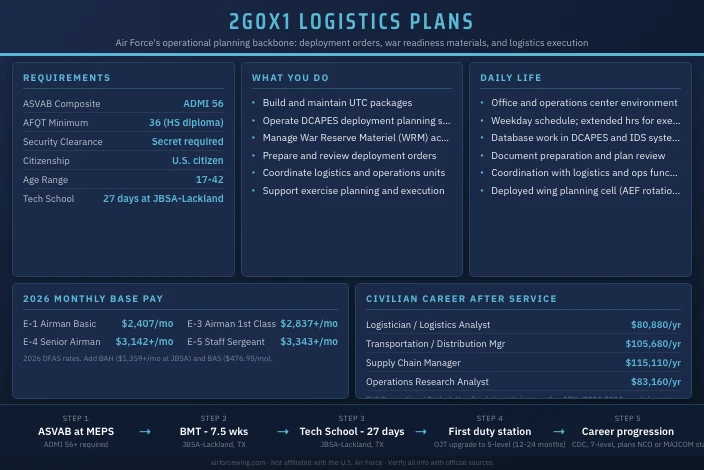
2G0X1 Logistics Plans specialists manage and execute Air Force logistics planning at the unit and installation level, preparing deployment orders, coordinating war readiness materials, and integrating logistics requirements into operational plans. They serve as the primary link between logistics systems and mission execution, ensuring units can deploy, sustain operations, and redeploy according to approved plans.
Daily Tasks
A typical day for a logistics plans Airman involves a mix of database work, document preparation, and coordination with other units. At the 3- and 5-skill levels, the job centers on maintaining planning systems, updating deployment records, and processing unit type code packages. At the 7-skill level and above, the focus shifts to supervising those processes and advising commanders on logistics feasibility.
Day-to-day tasks include:
- Building and maintaining Unit Type Code (UTC) packages and deployment orders
- Operating the Deliberate and Crisis Action Planning and Execution Segments (DCAPES) system
- Managing War Reserve Materiel (WRM) accounts and documenting equipment readiness
- Coordinating with logistics readiness, supply, and transportation functions
- Supporting exercise planning and evaluating unit deployment timelines
- Reviewing plans for completeness, feasibility, and compliance with Air Force standards
Specialization Codes
| Code | Description |
|---|---|
| 2G031 | Apprentice (3-skill level, Tech School graduate) |
| 2G051 | Journeyman (5-skill level, core duty qualified) |
| 2G071 | Craftsman (7-skill level, supervisory) |
| 2G091 | Superintendent (9-skill level, senior leader) |
Special Experience Identifiers (SEIs) within the 2G career series recognize expertise in areas such as adaptive planning, joint logistics operations, and contingency planning support.
Mission Contribution
The Air Force cannot project power without logistics. Before a wing deploys, someone has to calculate how many pallets of spare parts it needs, where they stage, how they move, and in what sequence. That work belongs to 2G0X1 specialists. They translate commander intent into executable logistics orders, and they track whether units have the materials and documentation to execute those orders when the call comes. An exercise that goes smoothly is usually evidence that a logistics plans Airman prepared it correctly weeks earlier.
Technology and Equipment
The centerpiece tool is DCAPES, the Air Force’s primary automated system for deployment planning and execution. Logistics plans Airmen also work with the Integrated Deployment System (IDS), the Air Force’s logistics module within the Defense Enterprise Accounting and Management System (DEAMS), and Microsoft Office products for plan documents and briefings. The work is primarily computer-based rather than hands-on with equipment.
Salary
Base Pay
Starting pay follows the standard military pay scale. An E-1 Airman Basic earns $2,407 per month. Most Airmen reach E-4 Senior Airman within two to three years, where base pay ranges from $3,142 to $3,816 per month depending on time in service. The table below shows 2026 DFAS base pay for the most common enlisted grades in this career field.
| Grade | Rank | Entry Pay | 4 Yrs | 8 Yrs |
|---|---|---|---|---|
| E-1 | Airman Basic | $2,407 | , | , |
| E-2 | Airman | $2,698 | , | , |
| E-3 | Airman First Class | $2,837 | $3,198 | , |
| E-4 | Senior Airman | $3,142 | $3,659 | $3,816 |
| E-5 | Staff Sergeant | $3,343 | $3,947 | $4,299 |
| E-6 | Technical Sergeant | $3,401 | $4,069 | $4,613 |
| E-7 | Master Sergeant | $3,932 | $4,663 | $5,105 |
The DFAS 2026 Military Pay Tables list all current rates. Base pay is taxable income; allowances are on top.
Additional Allowances
Beyond base pay, Airmen receive Basic Allowance for Housing (BAH): which varies by duty location, rank, and dependency status, and Basic Allowance for Subsistence (BAS) of $476.95 per month in 2026 for enlisted members. An E-4 at Joint Base San Antonio-Lackland receives $1,359/month BAH without dependents or $1,728/month with dependents. Total compensation for a mid-grade Airman typically exceeds $60,000 annually when all allowances are counted.
The Secret clearance this AFSC requires can also open doors to special duty assignments and higher-paying positions over a career.
Benefits Package
All active-duty Airmen receive zero-cost health coverage through TRICARE Prime, covering medical, dental, vision, and prescriptions with no enrollment fee or copay. The Post-9/11 GI Bill covers full in-state tuition at public universities after 36 months of active service, plus a monthly housing allowance. While serving, Tuition Assistance covers up to $4,500 per year in college courses.
The Air Force’s Blended Retirement System (BRS) combines a 20-year pension at 40% of high-36 average base pay with a Thrift Savings Plan (TSP) match of up to 5% of basic pay. Airmen also receive 30 days of paid leave per year.
Qualifications
Qualification Table
| Requirement | Standard |
|---|---|
| ASVAB Composite | ADMI 56 |
| AFQT Minimum | 36 (HS diploma); 65 (GED) |
| Citizenship | U.S. citizen |
| Age | 17-42 |
| Security Clearance | Secret |
| Physical Profile | Normal duty (no specific medical profile restrictions beyond standard enlistment) |
| Education | High school diploma or equivalent |
The ADMI 56 requirement is one of the higher administrative composite thresholds in the enlisted Air Force. The ADMI composite draws on Numerical Operations, Coding Speed, and Verbal Expression subtests from the ASVAB. Strong reading comprehension and basic math skills are the foundation. If your current ADMI score falls short, the PiCAT pre-screener guide covers the verbal and numerical subtests where the ADMI composite is built.
Application Process
The path to 2G0X1 starts at a Military Entrance Processing Station (MEPS). You’ll take the ASVAB, complete a physical examination, and meet with an Air Force classifier who will match your scores and preferences to available AFSCs.
Because 2G0X1 requires a Secret clearance, the classifier will initiate a background investigation at enlistment, covering financial history, criminal record, and personal conduct. The investigation typically concludes during or shortly after Tech School.
Enlistment contracts are typically four years for active duty. Reserve and Air National Guard contracts vary by unit.
Competitiveness
2G0X1 is a steady-demand AFSC rather than a high-competition specialty with a short recruiting window. The Secret clearance requirement and the ADMI 56 threshold filter applicants naturally. A clean background and a score above the minimum both improve your standing. Prior experience with logistics, supply chain work, or office administration can help, but the Air Force trains the technical skills from the ground up. If you want to maximize your score before visiting a recruiter, review what the ASVAB study guide covers for the Administrative composite.
Work Environment
Setting and Schedule
Logistics plans Airmen work primarily indoors in office and operations center environments. The job does not involve flight-line exposure, physical labor, or outdoor field work under normal circumstances. Standard duty hours follow a normal weekday schedule at most bases, though exercises and real-world operations can require extended hours and weekend work.
At wing-level plans offices, the environment is collaborative and documentation-driven. Communication with other logistics functions, the operations group, and higher headquarters is frequent. Deployed assignments or joint billets may place a 2G0X1 specialist in a more dynamic, fast-paced environment with compressed planning timelines.
Leadership and Communication
Performance feedback comes through the standard Enlisted Performance Report (EPR) system. EPRs are written annually and assess job performance, leadership, and personal qualities. A strong EPR is the primary engine of promotion in the Air Force enlisted force. In a logistics plans section, demonstrating attention to detail, plan quality, and the ability to brief complex logistics issues clearly tends to set top performers apart.
Logistics plans sections are typically small, with an officer or senior NCO supervising a handful of Airmen. Junior Airmen get exposure to real operational planning quickly, which accelerates learning compared to larger career fields where junior personnel can go unnoticed.
Job Satisfaction
This is a job for people who like organized systems and dislike ambiguity. When a plan is right, deployments execute smoothly and no one calls. When a plan has gaps, problems surface in the worst possible circumstances. Airmen who take ownership of that accountability tend to find the work satisfying.
Common satisfaction indicators for 2G0X1:
- Ownership of plans that affect real missions and real units
- Small-section environment where individual contributions are visible
- High transferability to civilian logistics and project management
- Predictable schedule compared to maintenance or flight-operations AFSCs
Training
Training Pipeline
| Phase | Location | Length | Focus |
|---|---|---|---|
| Basic Military Training (BMT) | JBSA-Lackland, TX | 7.5 weeks | Military foundations, physical fitness, Airman standards |
| Technical School (Initial Skills) | JBSA-Lackland, TX | 27 days | DCAPES operations, UTC management, WRM fundamentals, deployment planning |
| On-the-Job Training (OJT) | First duty station | 12-24 months | AFSC skill certification, 5-level upgrade |
BMT at Joint Base San Antonio-Lackland covers military customs, drill, weapons qualification, and the physical and mental foundations of Air Force service. The 7.5-week program is the same for all enlisted Airmen regardless of their eventual AFSC.
Tech School for 2G0X1 runs 27 days, also at JBSA-Lackland, making this one of the shorter initial skills courses in the Air Force. The compressed timeline means students move through material quickly. The course covers the DCAPES system, UTC package construction, WRM accountability, adaptive planning, and deployment execution fundamentals. Graduates leave with the 3-skill level (Apprentice) and a working knowledge of the planning systems they’ll use at their first unit. Before MEPS, use the ASVAB study guide to build the verbal and math skills the ADMI composite draws on.
On-the-Job Training and Upgrade
After Tech School, Airmen complete an OJT upgrade program to earn the 5-skill level (Journeyman). A qualification training package (QTP) guides the process, and a supervisor certifies each task. The 5-level upgrade typically takes 12 to 24 months at the first duty station. The 7-level (Craftsman) requires completion of a Career Development Course (CDC), a correspondence-based study program, combined with a written knowledge test and additional duty qualification.
Advanced Training
As Airmen progress, opportunities include the Logistics Plans Advanced Course, joint-duty planning assignments, and education programs through the Air Force Institute of Technology (AFIT). Senior NCOs in this field often attend Joint Professional Military Education (JPME) courses that cover joint logistics and operational planning at the theater level. The Air Force also supports degree completion through Tuition Assistance and the Community College of the Air Force (CCAF), which awards an Associate of Applied Science in Logistics Technology for completing in-residence and OJT requirements.
Career Progression
Rank Progression
| Rank | Grade | Typical Time in Career |
|---|---|---|
| Airman Basic | E-1 | Entry (BMT) |
| Airman First Class | E-3 | ~18 months |
| Senior Airman | E-4 | ~3 years (can be below-the-zone at 2 yrs) |
| Staff Sergeant | E-5 | ~5-7 years (first promotion board) |
| Technical Sergeant | E-6 | ~10-13 years (competitive) |
| Master Sergeant | E-7 | ~16-18 years (highly competitive) |
| Senior Master Sergeant | E-8 | ~20+ years |
| Chief Master Sergeant | E-9 | ~22+ years (top ~1% of enlisted force) |
Promotion from E-1 through E-4 is largely time-based. Staff Sergeant and above require a promotion board that scores EPRs, decorations, professional military education, and time in service. Logistics plans Airmen at the 7-level and above typically serve as NCOIC of a plans section, advising commanders and managing junior Airmen.
Specialization and Branching
Career options within 2G0X1 include assignments at base-level plans offices, major command (MAJCOM) staffs, Air Staff billets at the Pentagon, and joint-duty positions with combatant commands. Airmen with strong performance records can pursue Special Duty Assignment (SDA) opportunities such as Air Force Recruiting Service or the Air Force Academy Liaison program. Some 2G0X1 Airmen cross-train into adjacent logistics AFSCs or apply for Officer Training School (OTS) using their operational planning experience as a foundation.
The badge system reflects career milestones: wear the basic badge after Tech School, the senior badge upon award of the 7-skill level, and the master badge as a Master Sergeant or above with at least five years in the specialty from award of the 7-level.
Performance Evaluation
The Enlisted Performance Report is the annual record of an Airman’s performance. In a small career field like 2G0X1, the quality of plans produced, the absence of errors during exercises, and the ability to train junior Airmen are the most visible performance indicators. A single well-executed exercise, where a plans section prepared thorough, gap-free documentation, can drive a strong EPR and a decoration.
Physical Demands
Fitness Standards
All Airmen, regardless of AFSC, take the Air Force Fitness Assessment annually. The assessment has four components scored on a 100-point scale, and Airmen must earn a minimum composite score of 75 while meeting minimums on each component.
| Component | Max Points | Notes |
|---|---|---|
| 1.5-Mile Run | 60 | Primary aerobic component |
| Waist Circumference / Body Composition | 20 | Age- and gender-normed |
| Push-Ups (1 minute) | 10 | Minimum reps required |
| Sit-Ups (1 minute) | 10 | Minimum reps required |
Standards are age- and gender-normed. For the under-25 age group, run times and minimum repetition counts are among the most demanding on the scale. Verify current minimum passing scores for your age and gender bracket through official Air Force Fitness Assessment standards.
The day-to-day physical demands of this AFSC are low compared to maintenance or special warfare specialties. Most of the work happens at a desk or in a conference room. That said, deployed assignments can require physical exertion, and all Airmen are expected to maintain fitness year-round rather than training only before assessments.
Medical Requirements
No AFSC-specific medical waivers beyond standard Air Force enlistment medical requirements apply to 2G0X1. Applicants must pass the standard MEPS physical examination, which screens vision, hearing, and physical fitness. The Secret clearance investigation includes a review of any history that could create a counterintelligence risk, financial, legal, or personal conduct issues are the most common disqualifiers.
A Secret clearance does not require perfect credit, but unresolved debts or a pattern of financial irresponsibility can complicate the investigation. If you have credit issues, discuss them with a recruiter before committing to this AFSC.
Deployment
Deployment Patterns
Logistics plans Airmen deploy regularly but typically at a lower rate than combat-focused AFSCs. Deployments in support of Air Expeditionary Force (AEF) rotations run 4 to 6 months and place specialists in deployed wing planning sections or joint logistics cells at major air bases in the Middle East, Europe, or the Pacific. During high-tempo periods, the rate may increase.
The work during deployment mirrors home-station duties: building and updating deployment orders, tracking WRM, and coordinating logistics execution. The environment is faster-paced, but the tasks are familiar.
Duty Station Options
2G0X1 Airmen serve across all major Air Force commands. Because every wing needs a plans function, the geographic spread is wider than most enlisted AFSCs.
Representative duty station locations include:
- Bases supporting AMC: Scott AFB (IL), Travis AFB (CA), McGuire-Dix-Lakehurst (NJ)
- ACC: Langley-Eustis (VA), Shaw AFB (SC), Nellis AFB (NV)
- PACAF and USAFE: Kadena AB (Japan), Ramstein AB (Germany), Misawa AB (Japan)
- Air National Guard and Reserve wings across all 50 states
The Air Force operates a base preference program that allows Airmen to request preferred duty stations, though assignment officials balance those requests against Air Force needs. AFPC assignment management handles permanent change of station (PCS) orders.
Risk/Safety
Job Hazards
The 2G0X1 specialty carries minimal physical hazard in normal operations. The work is office-based and does not involve exposure to fuels, explosives, or heavy machinery. Deployed environments introduce general hazards associated with forward operating locations, but 2G0X1 Airmen in deployed locations are not typically in direct-contact roles.
The most common risks in this AFSC are administrative rather than physical:
- Mishandling classified information (legal and career consequences)
- Errors in deployment plans that affect mission execution
- Security clearance adjudication issues from undisclosed background factors
Security and Legal Requirements
A Secret security clearance is required to access the classified planning systems, deployment orders, and operational documents central to this AFSC. The investigation covers the preceding 10 years of background, including financial records, foreign contacts, criminal history, and personal conduct. An interim clearance typically permits access to systems during the investigation period.
Airmen with this clearance are legally bound to protect classified information throughout their service and beyond. Negligent or intentional disclosure is a federal crime under the Espionage Act. Annual security awareness training reinforces those obligations.
The clearance is adjudicated under the Defense Counterintelligence and Security Agency (DCSA) standards, and any change in personal circumstances, new foreign contacts, financial problems, legal issues, must be reported to a unit security manager.
Enlistment contracts establish a service obligation, typically four years for active duty. Separating early requires submitting a formal request and may involve repayment of certain bonuses or benefits depending on the contract terms.
Impact on Family
Family Considerations
Logistics plans is among the more family-friendly enlisted specialties in terms of day-to-day schedule. Regular business hours at most bases mean predictable time at home. The main disruption is the deployment cycle, which places Airmen away from family for four to six months at a time, and periodic exercises that require extended duty days for several weeks.
The Air Force provides significant support infrastructure for families. Key programs include:
- Airman and Family Readiness Center: financial counseling, relocation help, deployment preparation
- Military OneSource: confidential counseling and referral services, available 24/7
- TRICARE: health coverage for spouses and dependents at no cost
- School Liaison Program: helps families manage school enrollment at each new installation
Relocation
PCS moves occur roughly every three years. The Air Force covers moving costs through the household goods program, but each move interrupts schools, careers, and community ties. Families who plan ahead, building portable careers, maintaining savings, and investing in community at each base, tend to adapt better. A Secret clearance, paradoxically, can make job-hunting easier for the Airman between assignments because cleared civilian and contractor positions near major bases are in consistent demand.
Reserve and Air National Guard
2G0X1 exists in both the Air Force Reserve and the Air National Guard. Reserve units at major AMC and ACC installations maintain plans functions that mirror active-duty requirements. Air National Guard wings across all 50 states and territories also maintain logistics plans positions, particularly at flying wings that require full deployment planning capability.
Drill Commitment and Schedule
The standard Reserve commitment is one weekend per month (Unit Training Assembly, or UTA) plus 15 days of Annual Training (AT) per year. Some 2G0X1 positions may require additional training days for exercises or system certifications beyond the standard schedule. Air National Guard commitments follow the same baseline structure, though state missions can add domestic support obligations.
Component Comparison
| Feature | Active Duty | Air Force Reserve | Air National Guard |
|---|---|---|---|
| Service model | Full-time | Part-time (1 weekend/mo + 15 days/yr) | Part-time (1 weekend/mo + 15 days/yr) |
| E-4 monthly base pay | $3,142-$3,816 | ~$410-$500/drill weekend (4 drills) | ~$410-$500/drill weekend (4 drills) |
| Healthcare | TRICARE Prime (free) | TRICARE Reserve Select (premiums apply) | TRICARE Reserve Select (premiums apply) |
| GI Bill | Post-9/11 GI Bill | Montgomery GI Bill-Selected Reserve | State tuition waivers (Guard-specific) vary by state |
| Retirement | 20-year pension (high-36) | Points-based at age 60 | Points-based at age 60 |
| Deployment tempo | Moderate (AEF cycle) | Lower; voluntary or involuntary mobilization | Lower; state missions + federal mobilization |
Civilian Career Integration
2G0X1 Reserve and Guard Airmen pair well with civilian logistics, supply chain, and operations planning roles. The DCAPES and planning documentation skills transfer directly to enterprise resource planning (ERP) and project management work. Many employers value the clearance and the planning discipline that comes with this background. USERRA protects civilian jobs during military deployments, and most major employers with government contracts actively support Guard and Reserve service.
Post-Service
The skills built in 2G0X1 translate clearly to several well-paid civilian fields. Logistics analysts coordinate supply chains, analyze distribution networks, and manage inventory systems, work that draws directly on the planning and systems experience from this AFSC. Transportation and distribution managers oversee freight and warehousing operations. Supply chain managers direct procurement and logistics functions at the enterprise level.
Civilian Career Prospects
| Job Title | Median Annual Salary | Job Outlook (2024-2034) |
|---|---|---|
| Logistician / Logistics Analyst | $80,880 | +17% (much faster than average) |
| Transportation / Distribution Manager | $105,680 | +8% |
| Supply Chain Manager | $115,110 | +10% |
| Operations Research Analyst | $83,160 | +23% (much faster than average) |
The Bureau of Labor Statistics Occupational Outlook Handbook and O*NET Online track these roles. Figures are median annual wages from the most recent BLS data available.
The Secret clearance is a tangible asset at separation. Cleared logistics and planning positions with defense contractors, federal agencies, and government consulting firms pay above-market rates and often have active hiring pipelines for separating military members. Programs like the Transition Assistance Program (TAP) and Hiring Our Heroes offer structured support for the job search.
A Community College of the Air Force (CCAF) degree earned during service can transfer credits toward a bachelor’s in business, logistics, or supply chain management, reducing time and cost to complete a civilian degree.
Is This a Good Job
Ideal Candidate Profile
The people who do well in 2G0X1 tend to be detail-oriented, comfortable with database systems, and good at writing clearly under time pressure. Planning work requires holding a lot of moving parts in mind simultaneously, unit requirements, equipment availability, transportation timelines, and contingency variables all have to fit together without conflicts.
Strong-fit indicators:
- Naturally organized and systematic in how you approach problems
- Comfortable working in databases and producing written documents
- Prefer indoor, office-based work over physical or outdoor roles
- Want civilian careers in logistics, supply chain, or operations
- Interested in earning a Secret clearance and the career doors it opens
Strong candidates also tend to be organized communicators. A plan document that contains good analysis but poor structure will not survive a commander’s review. The ability to translate complex logistics data into clear, readable documentation is what separates good plans Airmen from great ones.
Potential Challenges
The job is desk-intensive, which does not suit everyone. Airmen who wanted a physical job, frequent variety in their environment, or high-adrenaline assignments will find this specialty quiet by comparison. The planning cycle can also feel abstract, you spend weeks building documentation for an event that may never happen or that executes without anyone knowing your role in it.
The ADMI 56 threshold is a real barrier. If strong test scores don’t come naturally, this AFSC requires preparation investment before MEPS.
Career Alignment
2G0X1 fits people who want a civilian career in logistics, supply chain, or operations management after service. The experience is directly applicable and the clearance adds value. It also suits those who want to apply for OTS later, since operational planning experience is viewed favorably by selection boards. For someone who wants to separate after four years with marketable skills and a clean transition to corporate logistics or federal contracting, this career field checks those boxes.
More Information
Talk to an Air Force recruiter to confirm current AFSC availability, bonus eligibility, and assignment options. They can pull up real-time job openings and help you understand whether your ASVAB scores qualify for 2G0X1 before you finalize an enlistment contract. Bring questions about duty station preferences and clearance timelines, those details vary and a recruiter can give you current answers.
If you want to strengthen your ADMI composite before that appointment, the PiCAT prep course covers the verbal and numerical reasoning sections where that score is built.
This site is not affiliated with the U.S. Air Force or any government agency. Verify all information with official Air Force sources before making enlistment or career decisions.
Explore more Air Force logistics careers such as 2S0X1 Materiel Management and 2F0X1 Fuels.