2F0X1 Fuels
Every flight starts with fuel. Before a pilot climbs into the cockpit, an Airman in a yellow vest has already verified the fuel quality, calculated the load, and operated tens of thousands of pounds of petroleum through specialized hoses, hydrant systems, and refueling trucks. That Airman holds the 2F0X1 Fuels AFSC, and without them, the entire flight line stops.
Fuels specialists manage one of the most safety-critical supply chains in the Air Force. They handle jet fuel, diesel, aviation gasoline, missile propellants, and cryogenic products like liquid oxygen and liquid nitrogen used in life support and propulsion systems. The job blends chemistry, mechanical operation, vehicle driving, and strict safety compliance into a single career that has no civilian equivalent built quite like it.
If you want hands-on technical work outdoors, a job that directly enables every aircraft sortie, and skills that translate into the civilian petroleum and aviation support industries, 2F0X1 is worth a close look.
Qualifying requires specific ASVAB line scores. Our ASVAB study guide covers what to target and how to prepare.
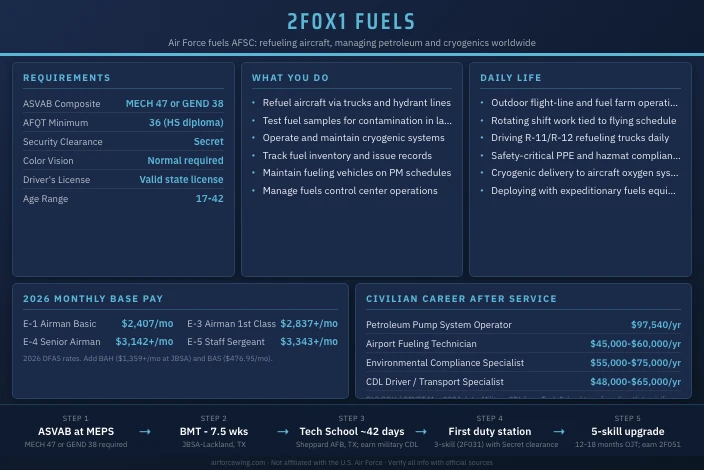
Job Role
Fuels specialists (AFSC 2F0X1) operate and maintain Air Force petroleum, oil, lubricant, and cryogenic facilities worldwide. They receive, store, test, and issue aviation fuel, ground fuel, and missile propellants, and they operate specialized mobile and fixed refueling equipment on flight lines and fuel farms. The AFSC exists across every flying wing, combat support wing, and contingency location where aircraft operate.
Daily Tasks
A typical shift depends heavily on the duty location and mission tempo. At a large flying base, fuels Airmen often rotate between three main areas: the fuels control center, the flight line, and the fuel storage area.
- Fuels control center: Receive and log all fuel requests from operations and maintenance units. Track issue records, reconcile inventory, and coordinate tanker truck dispatch.
- Flight-line refueling: Operate R-11 and R-12 refueling trucks, hydrant servicing vehicles, and fuel servicing systems to refuel aircraft before and after sorties.
- Lab and quality testing: Pull fuel samples from storage tanks and test for contamination, water, sediment, and off-spec conditions using field lab equipment.
- Preventive maintenance: Inspect and service refueling vehicles, pumping equipment, filters, and grounding systems on scheduled cycles.
- Cryogenic operations: Fill and deliver liquid oxygen and liquid nitrogen to aircraft oxygen systems and ground support equipment.
- Documentation: Maintain accurate receipt, issue, and inventory records in Air Force petroleum management systems.
Specializations
Within the career field, Airmen can develop expertise in several areas after earning the 5-skill level.
| Specialization | Description |
|---|---|
| Laboratory Technician | Focused on quality testing of petroleum products; includes advanced fuel analysis techniques |
| Agile Fuel Systems Operator | Supports expeditionary and contingency fueling using lightweight, deployable equipment sets |
| Cryogenics Specialist | Operates and maintains cryogenic production, storage, and distribution systems |
Mission Contribution
Aircraft sortie generation is the visible output of an Air Force flying unit, but fuel is what makes each sortie possible. A single F-15E can burn 14,000-plus pounds of JP-8 per flight. A B-52 requires tens of thousands of pounds before a long mission. Getting the right fuel to the right aircraft at the right time, with zero contamination and zero spillage, is what fuels Airmen do every working day.
Beyond flight operations, fuels Airmen support ground vehicle fleets, generators, heating systems, and contingency operations. In deployed environments where fuel resupply lines are contested, their role becomes even more directly tied to whether the mission continues.
Salary
Base pay is set by pay grade and years of service. All figures below reflect 2026 DFAS pay tables.
| Rank | Grade | Entry-Level Monthly Pay |
|---|---|---|
| Airman Basic | E-1 | $2,407 |
| Airman | E-2 | $2,698 |
| Airman First Class | E-3 | $2,837 |
| Senior Airman | E-4 | $3,142 |
| Staff Sergeant | E-5 | $3,343 |
| Technical Sergeant | E-6 | $3,401 |
Pay is only part of total compensation. Active-duty Airmen receive Basic Allowance for Subsistence (BAS) of $476.95 per month and Basic Allowance for Housing (BAH) that varies by duty location, pay grade, and dependency status. At Joint Base San Antonio, an E-4 without dependents receives $1,359/month in BAH. At higher-cost installations that figure rises significantly.
Healthcare under TRICARE Prime covers medical, dental, vision, mental health, and prescriptions with no enrollment fee and no copays for active-duty members.
Education benefits include Air Force Tuition Assistance covering up to $4,500 per year toward college coursework while on active duty, and the Post-9/11 GI Bill upon separation, which covers full in-state tuition at public universities plus a monthly housing allowance.
Retirement under the Blended Retirement System (BRS) combines a 20-year pension worth 40% of average basic pay with matching contributions to the Thrift Savings Plan (TSP).
Leave: 30 days of paid vacation per year from the first day of service.
Qualifications
| Requirement | Detail |
|---|---|
| ASVAB Composite | MECH 47 or GEND 38 |
| AFQT Minimum | 36 (high school diploma) |
| Color Vision | Normal color vision required |
| Driver’s License | Valid state license required at accession |
| Security Clearance | Secret (National Agency Check, Local Agency Checks, and Credit) |
| Citizenship | U.S. citizen |
| Age | 17-42 at enlistment |
| Education | High school diploma or equivalent |
The MECH 47 minimum is the primary qualifying composite. The Air Force ASVAB MECH composite combines General Science, Auto/Shop Knowledge, Mathematics Knowledge, and Mechanical Comprehension subtests. Applicants who score at least 47 on MECH or 38 on GEND (General) satisfy the aptitude requirement. If mechanical reasoning is the weak point, the Air Force ASVAB test prep guide gives you a structured way to build the MECH composite before MEPS.
Normal color vision is a firm requirement. The job involves reading color-coded fuel identification markings, pipeline tags, and safety labels. Color vision deficiency disqualifies an applicant without a waiver.
The Secret clearance involves a background investigation covering criminal history, financial records, foreign contacts, and drug use. Issues in any area can delay or prevent clearance approval, though minor isolated incidents may be addressable through the waiver process. Talk to a recruiter before assuming any past issue is disqualifying.
Recommended Academic Background
High school coursework in general science, chemistry, mathematics, and computer science strengthens preparation. The Tech School curriculum covers fuel chemistry, petroleum product identification, safety regulations, vehicle operation, and equipment maintenance. A science or math foundation helps.
Application Process
The path to 2F0X1 runs through a Military Entrance Processing Station (MEPS). You take the ASVAB, complete a physical, and meet with an Air Force recruiter to discuss career options. If your MECH or GEND score qualifies, a fuels contract is an option. The background investigation for the Secret clearance begins during the accession process. Most applicants go from initial contact to a ship date within 3-6 months depending on recruiter workload and open slots.
The initial service obligation for enlisted Airmen is typically 4 years active duty.
Recruits enter service at E-1 (Airman Basic) regardless of prior civilian experience.
Normal color vision is a hard medical requirement. The color vision test is administered at MEPS. There is no waiver for this restriction in the 2F0X1 AFSC.
Work Environment
Fuels is an outdoor, physical job. At a typical flying installation, Airmen spend most of their shift outside at the flight line, fuel storage areas, or fuel farms. The work happens in all weather conditions, from desert heat at Edwards AFB to sub-zero winters at Minot AFB. Shifts are structured around flight operations, which rarely follow a standard 8-to-4 schedule.
Most fuels flights run shift work, often on a rotating schedule covering 24 hours. Panama schedules (two on, two off) and fixed day/swing/night rotations are both common depending on the installation’s sortie tempo. During flying surge periods or exercises, fuels Airmen can expect extended duty hours.
Working with Hazardous Materials
Jet fuel (JP-8), aviation gasoline, and cryogenic liquids are all hazardous. The job requires daily compliance with safety standards, proper PPE usage, and strict spill prevention protocols. Airmen work around flammable vapors and high-pressure systems. Anyone uncomfortable with that environment should consider other logistics specialties.
Team Structure
Fuels flights operate under a hierarchical structure with NCOs supervising small teams of junior Airmen at each duty position. The fuels control center supervisor coordinates all aircraft and ground fuel requests and communicates directly with operations and maintenance leadership. Junior Airmen at the E-3 and E-4 level execute most hands-on operations under close supervision until they complete upgrade training.
Job satisfaction among fuels Airmen tends to be closely tied to the operational tempo of the host unit. On a busy flying wing, the work has visible, immediate impact. At lower-tempo installations, routines can feel repetitive. Many Airmen report that the technical depth of the career field and the driving/equipment aspects keep the work engaging.
Training
| Phase | Location | Length | Focus |
|---|---|---|---|
| Basic Military Training (BMT) | JBSA-Lackland, TX | 7.5 weeks | Core military skills, fitness, discipline |
| Tech School (2F031) | Sheppard AFB, TX | ~42 days | Fuel operations, cryogenics, vehicle operation, lab testing |
| On-the-Job Training (OJT) | First duty station | 12-18 months | Upgrade to 5-skill level (2F051) |
BMT is the first stop for all enlisted Airmen. After 7.5 weeks at JBSA-Lackland, fuels trainees travel to Sheppard Air Force Base, Wichita Falls, Texas, home of the 82nd Training Group and the Air Force Petroleum Officer School. The 42-day course covers petroleum product identification, fuel farm and flight-line operations, quality surveillance procedures, cryogenic system operations, vehicle operation and maintenance, and safety and environmental compliance.
Graduates of the basic fuels course earn the 3-skill level (2F031), a military Commercial Driver’s License (CDL), and college credits applicable toward a logistics degree.
The military CDL earned during Tech School is a significant benefit. It satisfies testing requirements that civilian CDL holders pay hundreds of dollars to complete, and it carries over to civilian employment after separation.
Advanced Training
After earning the 5-skill level, Airmen can compete for advanced courses:
- Advanced Fuels Management Course: Covers operations-level supervision, resource management, and deployment planning for fuels flights
- Petroleum Laboratory Technology Course: Specialized certification for Airmen assigned to lab technician positions
- Cryogenics Operator Course: Focused training on liquid oxygen/liquid nitrogen production, storage, and hazard management
- Noncommissioned Officer Leadership Courses: Required for promotion to TSgt and MSgt
The Air Force also supports college coursework through Tuition Assistance while on active duty. Many fuels NCOs pursue degrees in logistics, business, or environmental management.
Everything starts with qualifying ASVAB scores. Our study guide covers what to study first.
Career Progression
| Rank | Grade | Typical TIG/TIS | Role |
|---|---|---|---|
| Airman Basic | E-1 | Entry | Initial training |
| Airman First Class | E-3 | ~1 year | Apprentice (3-skill) |
| Senior Airman | E-4 | 2-3 years | Journeyman after OJT (5-skill) |
| Staff Sergeant | E-5 | 4-6 years | Team lead, craft director |
| Technical Sergeant | E-6 | 8-12 years | Flight supervisor, NCOIC |
| Master Sergeant | E-7 | 14-18 years | Superintendent, senior NCO |
| Senior Master Sergeant | E-8 | 18-22 years | Senior enlisted manager |
| Chief Master Sergeant | E-9 | 22+ years | Senior fuels advisor |
Promotion through E-4 is largely time-based. E-5 and above require a competitive Enlisted Performance Report (EPR), passing a Promotion Fitness Examination (PFE), and an overall promotion score that factors in time in service, decorations, and developmental education.
The EPR is the primary performance document. Supervisors write narrative evaluations scored on a five-tier scale. Strong EPRs are essential for competitive promotion. Airmen who consistently deliver results, take on additional duties, and pursue professional military education (PME) move up faster.
Career Track Options
By the 5-skill level, fuels Airmen start developing expertise in one of several functional tracks: flight line operations, cryogenics, lab/quality surveillance, or fuels management systems. NCOs with broad experience across multiple areas and strong EPRs are the best positioned for superintendent and Chief roles.
Retraining into other logistics specialties (2G0X1, 2S0X1, 2T1X1) or into maintenance fields is possible after completing an initial enlistment, subject to Air Force Force Development needs and open retraining seats.
Physical Demands
The 2F0X1 career field involves regular physical activity. Fuels Airmen walk extended distances across flight lines and fuel storage areas daily, lift heavy hose assemblies and equipment, climb on and off refueling vehicles, and work in confined storage tank environments for some maintenance tasks.
| Physical Demand | Frequency |
|---|---|
| Walking/standing extended periods | Daily |
| Lifting hoses, nozzles, equipment (up to 50 lbs) | Daily |
| Climbing vehicle steps and equipment ladders | Daily |
| Working outdoors in all weather conditions | Daily |
| Operating large refueling vehicles | Regular |
The Air Force Fitness Assessment is the standard fitness test for all Airmen. It is not AFSC-specific. The assessment scores on a 100-point scale with a minimum passing composite of 75.
| Component | Points Available |
|---|---|
| 1.5-Mile Run | 60 |
| Push-Ups (1 minute) | 10 |
| Sit-Ups (1 minute) | 10 |
| Waist Circumference | 20 |
Standards are age- and gender-normed. Each component has a minimum threshold that must be met regardless of composite score. Assessments are conducted annually for most Airmen.
Periodic medical evaluations include annual hearing tests (relevant given equipment noise exposure) and occupational health screenings tied to hazardous material exposure. Airmen working in cryogenic areas may be subject to additional respiratory health monitoring.
Deployment
Fuels is one of the most frequently deployed specialties in the logistics career group. Aircraft cannot operate without fuel, and deployed air bases need fuels Airmen before they can support a single sortie. The Air Force Expeditionary Force (AEF) rotation system means most fuels Airmen deploy at least once per enlistment, often more.
Typical deployments run 4-6 months, though some contingency assignments run shorter or longer. Locations span the Middle East, Europe, the Pacific, and wherever Air Force aircraft are operating in support of combatant commands.
Common duty stations for fuels Airmen include every major Air Force flying installation in the United States and overseas. Among the most frequently assigned:
- Sheppard AFB, TX (also serves as a training base)
- Seymour Johnson AFB, NC
- Mountain Home AFB, ID
- Spangdahlem AB, Germany
- Kadena AB, Japan
- Incirlik AB, Turkey
- Al Udeid AB, Qatar
Duty station assignments are made by the Air Force Personnel Center (AFPC) based on Air Force needs, open authorizations, and personal preference inputs (Assignment Preference Statements). First-term Airmen have limited say in their initial assignment but can submit preferences.
Risk/Safety
The 2F0X1 career field carries genuine workplace hazards that require daily attention.
Fuel vapor inhalation is a risk during refueling operations and tank entry. Airmen use respiratory protection when required and follow strict fuel farm entry procedures. Spills create fire and vapor exposure hazards requiring immediate response.
Fire and explosion potential is present wherever fuel is stored, transferred, or dispensed. All fuels operations require bonding and grounding equipment to prevent static discharge. No smoking policies, designated hot spots, and fire suppression systems are all part of the standard safety framework.
Cryogenic hazards include extreme cold burns and oxygen-enriched atmospheres that increase combustion risk. Cryogenic operations require specialized PPE including face shields, cryogenic gloves, and proper ventilation.
Vehicle operations on flight lines require special awareness. Flight-line access involves coordination with air traffic control and strict vehicle movement rules in active aircraft areas.
The Secret clearance is a continuous obligation. Drug use, undisclosed foreign contacts, financial delinquency, or criminal activity can result in clearance revocation and AFSC reassignment. Airmen must report changes in personal circumstances that could affect their clearance eligibility.
Impact on Family
Shift work is the biggest adjustment for families. Rotating schedules mean missed evenings, weekends, and holidays. During flying surge periods or exercises, duty hours extend with little notice. Partners and families benefit from connecting with the installation’s Airman and Family Readiness Center early in an assignment.
Deployment tempo is another consideration. One deployment per enlistment is realistic for most Airmen; two or more is common for those in highly active career fields or stationed at expeditionary-focused wings. Return-home timelines can shift with little advance notice, which strains long-term planning for families.
Permanent Change of Station (PCS) moves every 3-4 years are normal in the Air Force. Some fuels Airmen find that rotations between flying bases, training bases, and overseas assignments give their families exposure to new cities and countries. Others find the repeated moves difficult. The Air Force provides PCS allowances (dislocation allowance, moving costs) to offset relocation expenses.
On the positive side, the schedule discipline that comes with shift work creates predictable off-days that many Airmen use productively. And the housing allowance at most installations allows families to live in solid off-base communities rather than crowded base housing.
Reserve and Air National Guard
| Feature | Active Duty | Air Force Reserve | Air National Guard |
|---|---|---|---|
| Commitment | Full-time | 1 weekend/mo + 2 wks/yr | 1 weekend/mo + 2 wks/yr |
| Monthly Base Pay (E-4) | $3,142+ | ~$1,676/weekend (4 drills) | ~$1,676/weekend (4 drills) |
| Healthcare | TRICARE Prime (free) | TRICARE Reserve Select (premium) | TRICARE Reserve Select (premium) |
| Education | Full Tuition Assistance + Post-9/11 GI Bill | Federal Tuition Assistance | State tuition waivers vary; Federal TA available |
| Retirement | 20-year pension + TSP match | Points-based Reserve retirement | Points-based Reserve retirement |
| Deployment tempo | High (AEF rotations) | Moderate (mobilization-based) | Moderate (state + federal) |
The 2F0X1 specialty is available in both the Air Force Reserve and the Air National Guard. Many Reserve and ANG units support flying wings and require qualified fuels Airmen to support their aircraft maintenance and operations missions.
The standard Reserve and Guard commitment is one Unit Training Assembly weekend per month (two 4-hour periods = 4 drill periods) plus a 2-week Annual Training per year. Fuels units may schedule additional training days around exercises or major inspections.
Part-time pay: An E-4 earns 4 days of base pay per drill weekend, calculated at the monthly rate divided by 30. At $3,142/month, that’s roughly $419 per drill day or approximately $1,676 for a full drill weekend. It is not a substitute for a civilian salary, but it supplements income and builds military retirement points.
TRICARE Reserve Select costs a monthly premium (roughly $50-$55 for individual coverage as of recent rates; check tricare.mil for current figures) versus zero-premium active-duty TRICARE Prime. Coverage is comparable but the cost-sharing model differs.
Reserve retirement uses a points system. Every drill weekend earns points, and 20 qualifying years make an Airman eligible for a retirement pension that begins at age 60, not at separation. State GI Bill programs for Air National Guard members vary significantly; many states offer tuition waivers at state universities.
Civilian integration: Fuels Airmen working part-time can hold civilian jobs in petroleum, transportation, logistics, environmental compliance, or airport ground support. The military CDL earned during Tech School is directly transferable to civilian driving jobs, and the fuel-handling certifications have civilian equivalents. Most civilian employers view military training favorably, and USERRA protects your civilian employment rights during military activations.
Post-Service
The 2F0X1 career field produces technically qualified, safety-conscious professionals who are in demand across several civilian industries.
| Civilian Job Title | Median Annual Salary | Job Outlook |
|---|---|---|
| Petroleum Pump System Operator / Refinery Operator | $97,540 | Stable (limited growth) |
| Aircraft Fueler / Airport Fueling Technician | $45,000-$60,000 | Steady with aviation growth |
| Environmental Compliance Specialist | $55,000-$75,000 | 7% growth (2024-2034) |
| Hazardous Materials Technician | $50,000-$70,000 | Stable |
| CDL Driver / Transportation Specialist | $48,000-$65,000 | 3-5% growth |
The military CDL is the most broadly transferable credential out of this AFSC. Combined with the fuel-handling and hazmat certifications earned during service, many fuels veterans move directly into airport fueling roles with airlines and fixed-base operators (FBOs), petroleum pipeline operations, or environmental compliance roles with energy companies.
Transition programs like Hiring Our Heroes connect separating Airmen with civilian employers, and many energy and aviation companies have specific veteran hiring tracks. The Air Force Transition Assistance Program (TAP) provides resume building, job search coaching, and VA benefits briefings before separation.
Is This a Good Job
The Right Fit
Fuels is a strong match if you want physical, outdoor work with direct operational impact. You’re a good candidate if you:
- Prefer hands-on technical work over desk-based roles
- Are comfortable working around hazardous materials with proper training
- Like shift work and the operational rhythm of a flying base
- Want a portable civilian credential (CDL) built into your training
- Are willing to deploy when the mission requires it
Strong candidates tend to have mechanical aptitude, attention to safety detail, and a comfort level with following strict procedures precisely. The job rewards people who are reliable and methodical rather than creative or improvisational.
The Wrong Fit
This career may not suit you if you:
- Have color vision deficiency (disqualifying requirement)
- Strongly prefer predictable day-shift schedules
- Want to avoid deployment
- Are not comfortable around flammable materials or hazardous environments
Bottom Line
Few Air Force careers place you this close to actual flight operations. Every aircraft that takes off fueled its tanks through equipment that a 2F0X1 Airman operated and verified. The work is demanding, safety-critical, and immediately consequential. For someone who wants to be essential to the mission rather than adjacent to it, this AFSC delivers.
More Information
Talk to an Air Force recruiter to check current open slots for 2F0X1 and confirm your ASVAB scores qualify. Recruiters can also initiate the background investigation process early and walk you through what a fuels contract looks like before you ship. If you’re preparing for the ASVAB, focus on the Mechanical Comprehension, General Science, and Auto/Shop subtests to build your MECH composite score.
- Prepare for the ASVAB with our study guide to make sure your line scores qualify
This site is not affiliated with the U.S. Air Force or any government agency. Verify all information with official Air Force sources before making enlistment or career decisions.
Explore more Air Force logistics careers such as 2S0X1 Materiel Management and 2G0X1 Logistics Plans.