5J0X2 Legal Services
When you purchase through links on our site, we may receive compensation at no extra cost to you.
The courtroom gets the attention, but most Air Force legal work is won or lost before anyone ever stands in front of a judge. Files have to be built correctly, deadlines have to be tracked, and the office has to move cases without losing control of the record. That is the lane 5J0X2 Legal Services fits. It is the administrative and case-management side of the legal career field, built for Airmen who are organized, calm under deadline pressure, and comfortable handling sensitive records all day. If you want legal work in uniform but prefer office control and document flow over research-heavy courtroom prep, this is the role to understand.
Before you ship to MEPS, build your General score with the ASVAB study guide so you are competitive for administrative Air Force jobs.
Job Role and Responsibilities
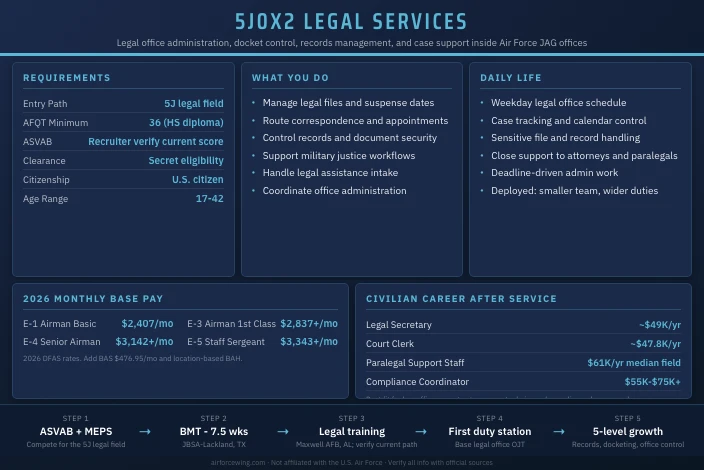
5J0X2 Legal Services supports Judge Advocate offices through case intake, legal correspondence, docket control, records management, and office administration. Airmen in this role keep military justice, legal assistance, and administrative law workflows moving by maintaining files, routing actions, scheduling appointments, and safeguarding official legal records.
Daily Work
Most of the work happens inside a base legal office. A normal day can include opening and routing new cases, preparing correspondence for signature, maintaining suspense trackers, updating docket calendars, and making sure paper and digital files match. The job is procedural, but the stakes are not small. A missing signature, a lost exhibit, or a wrong suspense date can delay a court-martial, an Article 15 package, or a power-of-attorney request for a deploying Airman.
Typical tasks include:
- Receiving and routing legal assistance requests
- Maintaining military justice and claims files
- Drafting cover letters, appointment notices, and office correspondence
- Tracking suspense dates for attorneys and paralegals
- Coordinating witness schedules and client appointments
- Managing records retention and document security procedures
Where It Fits In The Legal Office
The current public recruiting site highlights 5J0X1 Paralegal as the direct-entry enlisted legal AFSC. In practice, 5J0X2 describes the more administration-heavy side of the same mission set. That matters for applicants. If a recruiter discusses 5J accessions, you should ask whether the legal-services workload is assigned as a separate billet, an internal duty position, or a follow-on role inside the broader legal career field.
Mission Contribution
Legal offices run on process discipline. Attorneys and paralegals can only do effective legal work when case files are complete, appointments are properly scheduled, and official records are controlled from start to finish. That makes 5J0X2 work a real readiness function. Deploying members still need wills and powers of attorney. Commanders still need legal reviews. Courts-martial still move on deadlines. This role keeps that machinery from slipping.
Salary and Benefits
Base Pay
5J0X2 follows the standard 2026 enlisted pay table published by DFAS.
| Grade | Rank | Monthly Base Pay |
|---|---|---|
| E-1 | Airman Basic (AB) | $2,407 |
| E-2 | Airman (Amn) | $2,698 |
| E-3 | Airman First Class (A1C) | $2,837-$3,198 |
| E-4 | Senior Airman (SrA) | $3,142-$3,816 |
| E-5 | Staff Sergeant (SSgt) | $3,343-$4,422 |
| E-6 | Technical Sergeant (TSgt) | $3,401-$5,044 |
Most Airmen in legal billets live on the same compensation model as the rest of the force. Base pay rises with time in service and promotion. The civilian value comes later, when documented legal office experience helps with jobs in law firms, courts, and administrative offices.
Allowances And Benefits
Add the standard enlisted allowances on top of base pay:
- BAS: $476.95 per month
- BAH: location-based; a single E-4 at Joint Base San Antonio receives $1,359 per month
- Healthcare: TRICARE Prime with no enrollment fee for active duty
- Education: Tuition Assistance up to $4,500 per year and Post-9/11 GI Bill benefits after service
This is not a bonus-heavy AFSC. The financial upside is predictability, benefits, and direct civilian transfer value rather than special pay.
Work-Life Balance
Legal offices usually run weekday business hours. Trial prep, commander deadlines, and deployment processing can extend the day, but 24-hour shift work is not the norm. Compared with flight-line or maintenance jobs, it is a more stable schedule.

Qualifications and Eligibility
Entry Standards
| Requirement | Current Guidance |
|---|---|
| Age | 17-42 at enlistment |
| Citizenship | U.S. citizen |
| Education | High school diploma; GED usually requires AFQT 65 |
| AFQT Minimum | 36 with diploma |
| ASVAB Composite | Separate current public minimum not published; verify with recruiter |
| Clearance | Secret eligibility expected for legal office work |
| Keyboard / Writing | Strong written communication and office software skills are important |
| Conduct | No serious history involving fraud, theft, or integrity issues |
The public recruiting site does not currently publish a separate 2026 ASVAB line score for 5J0X2 the way it does for 5J0X1. The safe assumption is that the legal field still screens heavily on verbal and reasoning ability. If legal work is your goal, aim to clear the same General-heavy standard you would target for paralegal accessions instead of trying to sneak in at the minimum.
See our ASVAB study guide for the verbal and arithmetic sections that drive strong General scores.
Application Process
The accessions path usually starts the same way every enlisted legal job starts:
- Meet with a recruiter and discuss legal field availability.
- Take the ASVAB and complete the MEPS physical.
- Start the background screening for Secret clearance eligibility.
- Review whether the legal opening is a direct accession seat or a field assignment after initial legal training.
Because public recruiting materials focus on 5J0X1, ask direct questions about how 5J0X2 billets are filled today. That is the single most important thing an applicant can do before signing a contract.
Competitiveness
Small office career fields are always tighter than large maintenance or support fields. Strong writing, good organizational habits, and a clean background matter here more than almost anywhere else. Legal offices trust junior Airmen with sensitive records early.

Work Environment
Setting And Schedule
The job is almost entirely indoors. Expect desks, secure file areas, conference rooms, printers, and case management systems rather than tools or field equipment. Most assignments follow weekday hours, with tempo spikes around courts-martial, deployment surges, or inspection periods.
Legal offices are not the same as business offices. The confidentiality standard is higher. Conversations about cases, client information, and attorney-client privileged matters happen inside the office and stay there. Airmen who cannot maintain that boundary do not last long in the legal career field, regardless of their technical skill.
Workload spikes are tied to the military justice calendar. When a court-martial is scheduled, the days before it can be long and demanding as the office prepares witness notifications, exhibits, case files, and logistics. Deployment surges also create spikes in legal assistance demand because deploying Airmen need wills, powers of attorney, and SCRA counseling before they leave. An Airman assigned to a legal office near a large flight line or forward-deploying wing will feel that surge every rotation cycle.
Systems And Tools
Legal offices use case management systems to track clients, appointments, and case status. At the Wing level, the Air Force Legal Assistance Website (AFLAS) and military justice case management tools are common. Airmen who learn these systems and keep data current reduce the administrative burden on attorneys and paralegals significantly.
Secure printing, controlled document handling, and electronic case file management are daily realities. These are not optional skills. The accuracy and completeness of legal records is subject to attorney oversight and, in military justice cases, potential court review. Errors in the administrative record of a case can become legal issues.
Leadership And Communication
5J0X2 Airmen work under a mix of attorneys, paralegals, and senior enlisted supervisors. That means communication standards are high. You are expected to route correct documents, follow office procedure, and keep quiet control of sensitive information. Feedback tends to be direct because legal offices run on deadlines and accuracy.
Team Dynamics
The legal shop is small by Air Force standards. That cuts both ways. Good performers get trusted quickly. But mistakes are also obvious. The best Airmen in this role are steady, precise, and easy to work with under pressure.
Training and Skill Development
Training Pipeline
| Phase | Location | Length | Focus |
|---|---|---|---|
| Basic Military Training | JBSA-Lackland, TX | 7.5 weeks | Air Force fundamentals, discipline, fitness |
| Legal career field training | Maxwell AFB, AL | Verify current pipeline | Legal office systems, records, office process, military law support |
| First duty station OJT | Unit of assignment | 12-18 months | Local office procedures, case tracking, records control |
The legal career field trains at Maxwell AFB, and the publicly advertised path is the 35-day paralegal course. For 5J0X2-style legal-services work, recruiters and career field managers are the best source for whether the current pipeline is a separate course seat, an internal assignment after 5J training, or a local qualification track at the first base.
Training at Maxwell gives Airmen the basics of Air Force legal office operations, records procedures, and the framework of military law. That foundation covers the UCMJ structure, military justice processes, legal assistance categories, and how claims and administrative law work flows through a base-level legal office. The actual depth of any particular specialization comes from on-the-job experience at the first assignment, where real cases and real clients are the training environment.
If legal work is your goal, get the ASVAB piece solved early. The ASVAB study guide is the cleanest way to avoid losing the job at the testing stage.
Skill Development
The growth path is straightforward: office administration, records control, docket management, then section-level coordination. The Air Force will also give you experience with records systems, legal correspondence, and executive support skills that transfer directly to civilian law offices.
Airmen who invest in their professional development during their first enlistment build faster. CCAF coursework in legal studies, paralegal certificate programs through affiliated schools, and notary certification all add resume depth while you are still on active duty. These credentials do not replace the OJT that makes a legal Airman competent, but they signal the kind of professional intentionality that promotion boards and civilian employers respond to.
At the senior NCO level, the growth shifts toward office management, mentorship of junior Airmen, and supporting the staff judge advocate in running a functional legal operation. That combination of case knowledge, administrative discipline, and personnel leadership is what makes a strong NCOIC in this field.
Career Progression and Advancement
Promotion Timeline
| Rank | Grade | Typical Timeline | Role Focus |
|---|---|---|---|
| Airman Basic | E-1 | Entry | BMT and arrival |
| Airman | E-2 | ~6 months | Office support basics |
| Airman First Class | E-3 | ~16 months | Case handling and records work |
| Senior Airman | E-4 | ~3 years | Independent legal office admin |
| Staff Sergeant | E-5 | ~5-6 years | Section lead, training junior Airmen |
| Technical Sergeant | E-6 | ~10-12 years | NCOIC and office management |
Long-Term Growth
The ceiling in this field depends on how much responsibility you take for office flow. Airmen who become strong at records control, suspense management, and commander-facing support become the people a legal office cannot run without. That matters on EPRs and promotion boards.
Related Moves
5J0X2 experience also supports later movement into paralegal-heavy work, administrative law support, executive support, or civilian legal administration. For the right Airman, it can also be a stepping stone toward 5J0X1-style work or a later degree path into law.
Physical Demands and Medical Evaluations
Daily Physical Requirements
This is a low-physical-demand AFSC. Most of the day is spent at a workstation, in meetings, or moving files and records around an office. There is no flight-line or industrial physical burden attached to the job itself.
Fitness Assessment
Every Airman still takes the Air Force Fitness Assessment.
| Component | Max Points |
|---|---|
| 1.5-mile run | 60 |
| Push-ups | 10 |
| Sit-ups | 10 |
| Waist or body composition | 20 |
The minimum passing composite remains 75, with age- and gender-normed standards. Office AFSCs do not get reduced fitness requirements.
Medical Standards
No unique medical standard is publicly listed for 5J0X2 beyond normal enlistment screening and worldwide qualification. The more meaningful gate is integrity and security screening, not specialized physical testing.
Deployment and Duty Stations
Deployment Tempo
Legal offices do deploy, but not at the same pace as high-ops fields. When legal support goes forward, the workload shifts toward legal assistance, military justice processing, and commander support with fewer people on hand.
Duty Stations
Any installation with a Judge Advocate office can potentially host this work. That gives the field wide geographic reach: major CONUS bases, Europe, Pacific assignments, and contingency rotations all remain possible.
Risk, Safety, and Legal Considerations
Main Risks
The biggest risks are professional, not physical:
- Mishandling protected legal documents
- Missing suspense dates or filing actions incorrectly
- Failing records-control procedures
- Losing trust inside a very small office
Safety And Security Controls
Legal offices rely on secure storage, controlled access, case routing procedures, and supervisor review of sensitive actions. Secret clearance screening and routine information-protection rules are part of daily life.
Impact on Family and Personal Life
Compared with many operational AFSCs, this role offers a more predictable home schedule. That helps with family planning, child care, and off-duty education. The tradeoff is that deadline-heavy office work can still spill late when a court-martial or deployment action is active.
PCS moves remain part of Air Force life, so the family impact comes more from relocation than from constant field time.
Day-To-Day Family Stability
Legal offices run weekday business hours. There are no shift rotations, no 24-hour on-call requirements, and no flight-line schedules that turn mornings into evenings and evenings into early morning crew shows. For families with children in school, that weekday predictability makes a meaningful difference.
The exceptions are court-martial trial preparation periods and deployment surges. During those windows, late evenings are possible. But those periods are bounded. They end when the case closes or when the deployment cycle settles. It is not a permanent tempo.
Off-Duty Education
Legal work is one of the better Air Force AFSCs for pursuing an associate degree, paralegal certification, or pre-law coursework while still on active duty. The weekday schedule and stable hours create the space for evening classes or online programs. Tuition Assistance covers up to $4,500 per year. The CCAF General Studies degree can be completed alongside 5J career field credits.
Airmen who want to pursue law school after service start building their credentials now. A strong GPA in legal studies or political science coursework, combined with documented legal office experience and LSAT preparation, makes a competitive law school application. The ASVAB study guide will not help with the LSAT, but starting with a strong verbal and reasoning score in the military signals the academic foundation you will need for law school later.
Reserve and Air National Guard
Component Availability
Public recruiting materials clearly advertise 5J0X1 Paralegal across active duty, Reserve, and Guard components. Separate 5J0X2-style billets are less visible publicly and may be filled internally within the same legal offices. Applicants interested in part-time legal work should confirm actual unit manning rather than assume a standalone accession slot exists.
Part-Time Pay And Benefits
An E-4 drill-status Airman earns drill pay rather than active-duty monthly base pay. The draw of this field in a Reserve or Guard context is civilian compatibility: office schedules, legal admin experience, and USERRA job protections work well with civilian employer expectations.
Civilian Integration
This is one of the easier AFSCs to pair with a civilian administrative or legal office job. The skills align well with law firms, court clerks’ offices, compliance teams, and municipal administration.
Post-Service Opportunities
Civilian Career Paths
| Civilian Role | Median Pay | Outlook |
|---|---|---|
| Legal Secretary / Administrative Assistant | About $49,500 | Stable demand in law offices and government |
| Court Clerk | About $47,800 | Steady local and state government hiring |
| Paralegal support staff | $61,010 median for paralegals and legal assistants | Faster than average through 2033 |
| Records or compliance coordinator | Varies widely by industry | Strong in healthcare, government, and defense |
Legal office workflow is one of the more direct military-to-civilian translations in the Air Force. The job teaches discipline around files, deadlines, confidentiality, and office systems that private employers understand immediately.
Transition Support
Tuition Assistance, CCAF credit, and the GI Bill all help if you want to move from legal support into paralegal certification or a bachelor’s degree after service.
Is This a Good Job for You? The Right (and Wrong) Fit
5J0X2 is a strong fit if you like structure, records, and keeping an office running accurately. It is not a strong fit if you want field work, technical hardware, or a fast-moving operational setting. The work matters, but it matters in a quiet way. If you like being the person who keeps the process under control while everyone else is moving fast, this field makes sense.
Your ASVAB composite scores decide which AFSCs you can qualify for. See our ASVAB study guide for a 30-day plan focused on MAGE, ELEC, MECH, ADMI, and GEND prep.
Or go straight to an ASVAB study course.

More Information
- Review the Air Force’s public Paralegal career page for the current enlisted legal accession baseline
- Learn how legal officers are trained through the Air Force JAG page
- Use the ASVAB study guide if you are targeting a legal-field General score
Explore more Air Force legal careers including 5J0X1 Paralegal if you want the courtroom-facing side of the field.