5J0X1 Paralegal
Most enlisted jobs keep you away from the courtroom. The 5J0X1 Paralegal puts you inside it. Air Force paralegals work directly alongside Judge Advocate officers on courts-martial, legal assistance cases, and military justice proceedings, work that directly affects the careers and lives of fellow Airmen. The training pipeline is short compared to most AFSCs, and the skills earned translate directly into civilian paralegal work the day you separate.
Qualifying requires specific ASVAB line scores. Our ASVAB study guide covers what to target and how to prepare.
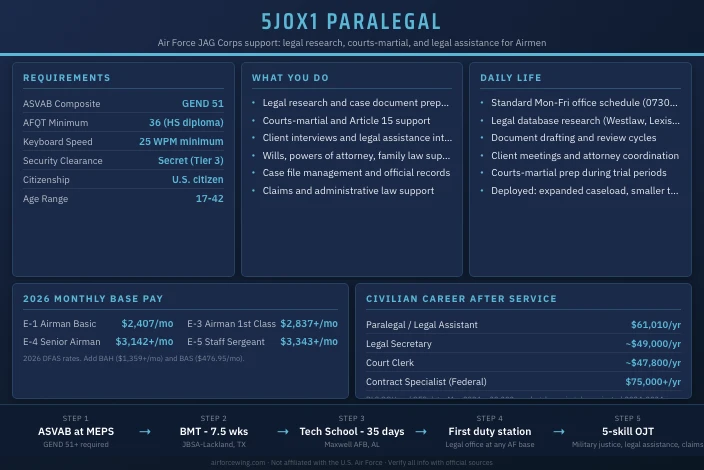
Job Role
5J0X1 Paralegals support the Air Force Judge Advocate General’s Corps by conducting legal research, preparing court documents, interviewing clients, and providing administrative support for judicial and nonjudicial proceedings. They work under the supervision of Judge Advocate officers and handle sensitive legal matters ranging from individual legal assistance to formal courts-martial proceedings.
Daily Tasks
A typical workday in a legal office covers a wide range of tasks:
- Conducting legal research using military and civilian legal databases
- Drafting and reviewing documents for courts-martial, Article 15 proceedings, and legal assistance clients
- Interviewing clients to determine eligibility for legal assistance
- Maintaining case files, legal correspondence, and official records
- Supporting the Staff Judge Advocate with administrative legal functions
- Preparing trial exhibits, witness lists, and pretrial documents
- Processing legal assistance requests covering wills, powers of attorney, and family law matters
- Assisting with military justice actions including nonjudicial punishment packages
Deployed paralegals often handle a broader workload with fewer people. One Airman may support both the prosecution and administrative sides of a legal office on a smaller contingency base.
Specializations
The 5J0X1 career field does not have traditional AFSC shredouts in the same way that medical or aviation jobs do. Instead, experienced paralegals develop specialized expertise through assignment. Common specialization areas include:
| Specialty Area | Focus |
|---|---|
| Military Justice | Courts-martial support, Article 32 hearings, nonjudicial punishment |
| Legal Assistance | Wills, powers of attorney, family law, consumer protection |
| Claims | Personal property claims, tort claims, foreign claims |
| Administrative Law | Inspector General matters, separations, administrative boards |
| Contract/Fiscal Law | Support for contracting officers and fiscal law reviews |
Special Experience Identifiers (SEIs) may be awarded after documented experience in specific legal functional areas, particularly for military justice work. Paralegals who qualify for the Air Force JAG Corps Paralegal of the Year award are typically recognized across the field.
Mission Contribution
The Air Force legal system depends on enlisted paralegals to keep it running. Judge Advocate officers handle the legal analysis and courtroom advocacy, but paralegals manage the case infrastructure. Without them, courts-martial would stall, legal assistance clients would go unserved, and administrative law actions would back up. At smaller bases, a paralegal may be the first legal contact an Airman has, which makes their ability to listen, assess eligibility, and route cases correctly a direct readiness function.
Technology and Equipment
5J0X1 Airmen work primarily with legal case management software, legal research databases (Westlaw and LexisNexis are used in Air Force legal offices), document management systems, and standard productivity software. Military justice paralegals use the Air Force’s Military Justice Information System (MIJS) and Case Management System (CMS) to track proceedings from initial report to final judgment. Good typing speed matters: the 25 words per minute keyboard requirement at accession is a floor, not a target.
Salary
Base Pay
Pay for 5J0X1 follows the standard DFAS enlisted pay table. A new paralegal enters at E-1 and typically reaches E-4 within three to four years.
| Grade | Rank | Monthly Base Pay (2026) |
|---|---|---|
| E-1 | Airman Basic (AB) | $2,407 |
| E-2 | Airman (Amn) | $2,698 |
| E-3 | Airman First Class (A1C) | $2,837 - $3,198 |
| E-4 | Senior Airman (SrA) | $3,142 - $3,816 |
| E-5 | Staff Sergeant (SSgt) | $3,343 - $4,422 |
| E-6 | Technical Sergeant (TSgt) | $3,401 - $5,044 |
Base pay does not reflect total compensation. Most Airmen living off-base receive Basic Allowance for Housing (BAH), which varies by duty station and dependency status. A single E-4 at Joint Base San Antonio-Lackland, TX receives $1,359/month in BAH; with dependents at the same installation, that figure rises to $1,728/month. Basic Allowance for Subsistence (BAS) adds a flat $476.95/month for all enlisted Airmen.
Additional Benefits
Healthcare: TRICARE Prime covers active-duty Airmen and their dependents at no cost. There are no enrollment fees, deductibles, or copays. The plan covers medical, dental, vision, mental health, prescriptions, and hospitalization.
Education: Tuition Assistance pays up to $4,500 per year ($250 per semester hour) while on active duty. After separation, the Post-9/11 GI Bill covers full in-state tuition at public universities or up to $29,920.95 per academic year at private schools, plus a monthly housing allowance and up to $1,000 annually for books.
Retirement: The Blended Retirement System (BRS) provides a pension of 40% of high-36 average basic pay at 20 years of service, with Thrift Savings Plan matching up to 5% of basic pay.
Work-Life Balance
Legal office hours typically run Monday through Friday on a standard duty schedule, which is one of the more predictable schedules in the enlisted force. Courts-martial and legal assistance surges can push work into evenings, particularly when trial dates approach. Deployed positions often require longer hours. Still, the legal career field has a lower operational tempo than combat support AFSCs, and shift work is not the norm.
Active-duty Airmen earn 30 days of paid leave per year at 2.5 days per month.
Qualifications
Requirements
| Requirement | Details |
|---|---|
| Age | 17-42 at enlistment (18-42 for direct accessions) |
| Citizenship | U.S. citizen |
| Education | High school diploma (GED with AFQT 65+ acceptable) |
| ASVAB Composite | General (GEND) 51 minimum |
| AFQT Minimum | 36 (HS diploma), 65 (GED) |
| Keyboard Speed | 25 words per minute minimum |
| Security Clearance | Secret (Tier 3 Investigation) |
| Medical | Must meet Air Force accession medical standards |
| Conduct | No significant substance abuse, domestic violence, or court-martial history; civilian convictions limited to minor traffic violations |
| Mental Health | No history of significant emotional instability or personality disorder |
The GEND composite draws from Word Knowledge (WK), Paragraph Comprehension (PC), and Arithmetic Reasoning (AR). A minimum of 51 is higher than the baseline for many enlisted AFSCs, reflecting the reading comprehension and analytical demands of legal research. Before heading to MEPS, an ASVAB prep course covering verbal and reasoning sections will move your GEND score the most.
The keyboard speed requirement is tested at MEPS. 25 words per minute is achievable with basic preparation. Free online typing practice tools can get you there in a few weeks if you’re starting from scratch.
Application Process
Total time from shipping to MEPS to arriving at your first duty station typically runs four to five months.
Selection Competitiveness
5J0X1 is a smaller career field with a focused mission. Training seats are available but limited. A GEND score above the minimum, a clean background, and strong reading and writing skills give you the best application. The Tier 3 Investigation for Secret clearance takes time; any unresolved financial issues, drug history, or criminal record will create delays or disqualification. Applicants with prior legal office experience, court clerk work, or administrative backgrounds demonstrate relevant aptitude, though none of that is required.
Service Obligation
Standard enlistment contracts for 5J0X1 run four years for active duty. Service obligations may be extended if you receive additional specialized training or reenlistment bonuses. Confirm terms with your recruiter before signing.
Airmen enter as E-1 Airman Basic. Most complete training and arrive at their first permanent duty station as E-3 Airman First Class.
Work Environment
Setting and Schedule
Air Force legal offices are indoor, office-based environments located in the legal services building on each installation. The physical setting is consistent: desks, computers, case files, and meeting rooms. The work pace varies by installation size, larger bases with high Airman populations and active courts-martial dockets run at a faster tempo than smaller installations.
Most legal offices operate on standard duty hours, typically 0730-1630 Monday through Friday. Courts-martial preparation disrupts that schedule when trial dates approach. Deployments shift the setting entirely, deployed legal offices may operate in austere conditions with reduced staff and expanded case responsibilities.
Chain of Command and Feedback
5J0X1 Airmen work in legal offices commanded by Judge Advocate officers. The senior paralegal NCO (typically a TSgt or MSgt) supervises the enlisted legal team. Day-to-day direction comes from the attorneys assigned to each functional area, military justice, legal assistance, claims, or administrative law. Enlisted Performance Reports (EPRs) are completed annually, with mandatory feedback sessions before each cycle.
Teamwork and Autonomy
Paralegal work requires close collaboration with JAG officers, but experienced NCOs operate with significant autonomy in managing case files, client intake, and office administration. Junior Airmen work closely under attorney supervision, especially on active cases. As you advance to SSgt and above, you’ll manage junior paralegals, lead the office’s administrative systems, and brief the Staff Judge Advocate on case status.
Job Satisfaction
5J0X1 Airmen who stay in the field consistently report high satisfaction tied to the intellectual nature of the work and the direct impact on clients. Helping an Airman through a difficult legal situation, a will before deployment, a custody issue, a wrongful discharge appeal, is the kind of work that has a clear human stake. The civilian certification value is also a meaningful factor: paralegals who separate with 4+ years of legal office experience can enter the civilian job market with credentials that require no additional training in many cases.
Training
Training Pipeline
| Phase | Location | Length | Focus |
|---|---|---|---|
| Basic Military Training (BMT) | JBSA-Lackland, TX | 7.5 weeks | Military customs, discipline, fitness, weapons familiarization |
| Paralegal Apprentice Course | Maxwell AFB, AL | 35 days (~5 weeks) | Military law, legal research, document prep, courtroom procedure |
The 35-day tech school is one of the shorter technical training pipelines in the enlisted force. That means you’ll arrive at your first duty station earlier, but with a more focused knowledge base. Most of the advanced skill development happens on the job.
Advanced Training
After completing on-the-job training and reaching the 5-skill level, paralegals can pursue advanced training through Air Force-sponsored legal courses. These include trial advocacy workshops, military justice advanced courses, and legal assistance specialty training. The Air Force JAG School at Maxwell AFB hosts seminars and continuing legal education (CLE) programs that paralegals can attend alongside JAG officers.
Tuition Assistance is available for off-duty college coursework. Many 5J0X1 Airmen use TA to pursue associate or bachelor’s degrees in paralegal studies, criminal justice, or pre-law. Credits earned at Maxwell toward a paralegal degree often transfer to civilian programs. An ASVAB study guide covering verbal reasoning will help you hit the GEND 51 threshold before your MEPS visit.
Career Progression
Rank Progression
| Rank | Grade | Typical Time at That Level |
|---|---|---|
| Airman Basic (AB) | E-1 | BMT only |
| Airman (Amn) | E-2 | ~6 months |
| Airman First Class (A1C) | E-3 | ~16 months |
| Senior Airman (SrA) | E-4 | ~3 years (earlier possible below-the-zone) |
| Staff Sergeant (SSgt) | E-5 | ~6 years (competitive board) |
| Technical Sergeant (TSgt) | E-6 | ~11 years (competitive) |
| Master Sergeant (MSgt) | E-7 | ~17 years (highly competitive) |
Promotions to E-5 and above are board-based and competitive. EPR scores, decorations, community involvement, education, and time in grade all feed into the promotion score. Below-the-zone promotion to E-4 is available for exceptionally performing Airmen ahead of the standard window.
Specialization and Role Flexibility
Advanced experience in military justice, legal assistance, or administrative law builds distinct expertise that influences assignment choices and promotion competitiveness. Paralegals who develop strong trial support skills are often assigned to installations with active courts-martial dockets, while those who excel in legal assistance administration find opportunities at larger JAG offices with high client volume.
Retraining into other AFSCs is possible but requires competitive application, current EPR scores, and Air Force needs. Some 5J0X1 Airmen with college degrees pursue the Enlisted Commissioning Program (ECP) to earn a commission, and a legal background is an asset for JAG Corps officer candidacy.
Performance Evaluation
The Enlisted Performance Report (EPR) rates Airmen on a 5-point scale. A score of 5 (“Exceeds Standards”) is what drives competitive promotion. The EPR narrative must document specific contributions with measurable impact. For paralegals, that means quantifying caseload, listing courts-martial supported, documenting client outcomes where privacy permits, leading office improvements, and mentoring junior Airmen. The most competitive paralegals build a record that shows both technical mastery and leadership growth at every skill level.
To succeed long-term: pursue advanced legal training early, use TA to build your degree, and document your contributions in ways the EPR narrative can use.
Physical Demands
Daily Physical Requirements
Paralegal work is office-based and not physically demanding by military standards. You’ll spend most of your shift sitting at a desk or in a conference room. The physical requirements of the job itself are minimal compared to combat or maintenance AFSCs.
That said, all Airmen must maintain physical fitness standards and pass the annual Air Force Fitness Assessment. Deployed assignments can introduce more physically demanding conditions: carrying equipment, working longer hours in austere environments, and occasionally responding to base security situations.
Air Force Fitness Assessment
All Airmen take the Air Force Fitness Assessment (FA) annually. The FA uses a 100-point scale with a minimum passing composite of 75. Each component also has its own minimum standard.
| Component | Max Points |
|---|---|
| 1.5-Mile Run | 60 |
| Push-Ups (1 minute) | 10 |
| Sit-Ups (1 minute) | 10 |
| Waist Circumference / Body Composition | 20 |
Standards are age- and gender-normed. Failing any single component fails the entire assessment regardless of composite score.
Medical Evaluations
5J0X1 Airmen complete standard medical screening at MEPS before accession. The role has no aviation medical requirements. Routine readiness medical evaluations apply throughout service. The Tier 3 Investigation for Secret clearance includes a mental health and conduct review, but there is no ongoing psychological testing requirement for the base AFSC.
Deployment
Deployment Patterns
5J0X1 is a deployable AFSC. Legal support is required at deployed locations, and Air Force legal offices rotate paralegals through Air Expeditionary Force (AEF) deployments. Most deployments run 90 to 179 days. Frequency varies by career stage and Air Force operational tempo, but paralegals in active assignments should expect at least one deployment during a standard four-to-six-year enlistment.
Deployed legal offices typically operate with a small team, sometimes one paralegal alongside a JAG officer, which expands the individual workload considerably compared to a garrison office with multiple attorneys and support staff.
Duty Stations
Air Force legal offices exist at every active-duty installation, giving 5J0X1 Airmen a wider range of duty station options than many specialized AFSCs. Common assignments include:
- Joint Base San Antonio-Lackland (TX), large JAG office, high training throughput
- Joint Base Andrews (MD), proximity to Air Force headquarters legal functions
- Ramstein Air Base (Germany), largest U.S. Air Force installation in Europe
- Joint Base Pearl Harbor-Hickam (HI)
- Joint Base Lewis-McChord (WA)
- Eglin AFB (FL) and Hurlburt Field (FL)
- Wright-Patterson AFB (OH)
- Kadena Air Base (Japan)
Preferences are submitted through the Assignment Management System (AMS), but actual placement depends on Air Force needs. Early-career Airmen have less say over initial assignments.
Risk/Safety
Job Hazards
The 5J0X1 career field carries low physical occupational hazard. The primary risks are psychological: exposure to difficult legal cases involving sexual assault, domestic violence, crimes against children, and Airman misconduct can accumulate over time. Legal office work also requires handling classified and sensitive personal information, which carries professional risk if confidentiality is breached.
Deployed positions introduce the physical and security risks common to all deployed Airmen, including force protection posture requirements and potential exposure to hostile environments.
Safety Protocols
Legal office safety procedures focus primarily on information security rather than physical hazard mitigation. Sensitive legal files, client communications, and classified materials must follow Air Force records management standards and privacy regulations. Physical safety procedures at deployed locations follow the same force protection requirements as all deployed Airmen.
Security Clearance and Legal Obligations
5J0X1 requires a Secret security clearance at the Tier 3 Investigation level. This involves a National Agency Check with Local Agency Checks and Credit (NACLC) review. The investigation examines financial history, criminal record, drug use, foreign contacts, and character references. Maintaining the clearance requires ongoing conduct standards throughout your career.
The clearance investigation begins before accession. Unresolved financial debts, drug history, or undisclosed foreign contacts can delay or prevent clearance approval. Be transparent with your recruiter about your background before the process starts.
Standard service obligations apply: typically a four-year active-duty commitment. Paralegals handling classified or sensitive legal matters are subject to handling and storage requirements governed by Air Force records management instructions and the Privacy Act.
Impact on Family
Family Considerations
Legal office schedules are among the most predictable in the enlisted force. Standard Monday-through-Friday hours mean families can build consistent routines around the duty day, school pickup, shared meals, and evening activities are more reliable here than in shift-work AFSCs. Courts-martial surges and deployment preparation disrupt that rhythm, but they are the exception rather than the norm during most assignments.
Deployed paralegals are typically gone 90 to 179 days. Families have access to the same support network as any deployed Airman: Military Family Life Counselors, the Airman and Family Readiness Center, and Military OneSource for financial, legal, and counseling resources.
TRICARE Prime covers the family at no cost during active service, which removes a significant household expense compared to civilian employment.
Relocation
PCS moves happen every two to four years. The Air Force pays moving costs and provides a Dislocation Allowance (DLA) to offset setup costs at the new installation. Legal office positions exist at most active-duty Air Force bases, so the pool of potential duty stations is broader than for specialized technical AFSCs. Families with school-age children can apply the Interstate Compact on Educational Opportunity for Military Children to ease mid-year enrollment and special education transfers.
Spouse employment continuity remains a challenge at any installation, but legal office assignments at larger bases tend to correlate with installation-rich environments that offer civilian job markets. The predictable schedule also helps military spouses who work civilian jobs maintain consistent employment.
Reserve and Air National Guard
Component Availability
The 5J0X1 AFSC is available in both the Air Force Reserve and the Air National Guard. Most state Air National Guard wings have legal offices with active paralegal billets. The Air Force Reserve’s legal units include both installation legal offices and judge advocate squadrons that support operations and deployments. The 908th Airlift Wing’s legal office (Maxwell AFB) is one example of a reserve legal unit with active paralegal positions.
Drill Schedule and Training Commitment
Standard Reserve and Guard commitment is one weekend per month (Unit Training Assembly, or UTA) plus two weeks per year (Annual Tour). Legal offices rarely require significant training days beyond the standard schedule, though deployment exercises and legal readiness events can add occasional commitments.
Part-Time Pay
A Reserve or Guard E-4 Senior Airman earns pay for four UTAs per drill weekend. At 2026 rates of $3,142 to $3,816 per month for E-4, one drill weekend yields approximately $421 to $512 in base pay. BAH and BAS are typically not paid for standard drill weekends unless the member is on extended orders.
Component Comparison
| Factor | Active Duty | Air Force Reserve | Air National Guard |
|---|---|---|---|
| Commitment | Full-time | 1 wknd/mo + 2 wks/yr | 1 wknd/mo + 2 wks/yr |
| Monthly Base Pay (E-4) | $3,142-$3,816 | ~$421-$512/drill wknd | ~$421-$512/drill wknd |
| Healthcare | TRICARE Prime (free) | TRICARE Reserve Select (premiums apply) | TRICARE Reserve Select (premiums apply) |
| Education | TA up to $4,500/yr + full GI Bill after service | Federal TA + partial GI Bill | State tuition waivers (vary by state) + Federal TA |
| Deployment Tempo | Higher | Moderate (mobilizations vary) | Moderate (state + federal missions) |
| Retirement | 20-yr BRS pension | Points-based Reserve retirement | Points-based Reserve retirement |
Healthcare note: TRICARE Reserve Select requires monthly premiums compared to zero-cost TRICARE Prime on active duty.
Education note: Air National Guard members may qualify for state-specific tuition benefits in addition to federal Tuition Assistance. Benefits vary significantly by state. Check your state’s adjutant general office for current figures.
Retirement note: Reserve and Guard members earn retirement points. A minimum of 20 qualifying years (each requiring 50 or more points) earns reserve retirement pay beginning at age 60, or earlier for members with qualifying active federal service.
Deployment and Mobilization
Reserve and Guard 5J0X1 Airmen mobilize for operational deployments and legal support missions. Frequency depends on Air Force needs and the unit’s deployment history. During high-demand periods, reserve component legal Airmen have mobilized annually. Outside of those surges, mobilizations every two to four years is a reasonable expectation.
Civilian Career Integration
5J0X1 Reserve and Guard service pairs exceptionally well with a civilian legal career. Civilian paralegal employers typically view military legal experience as directly relevant, and many legal offices actively seek candidates with military background. USERRA protections cover civilian job rights during mobilization. Part-time paralegal service also keeps military legal knowledge current, which reinforces rather than conflicts with civilian legal office work.
Post-Service
Transition to Civilian Life
5J0X1 Airmen enter the civilian job market with practical legal experience that many college-educated paralegal candidates lack. Four or more years in a military legal office, drafting documents, supporting courts-martial, conducting legal research, and managing case files, is substantive work experience that civilian employers recognize. Many state and national paralegal certification programs (NALA, NFPA) count military legal experience toward their experience requirements.
The Air Force Transition Assistance Program (TAP) provides resume assistance, job placement support, and separation counseling. The SkillBridge program allows Airmen to work with approved civilian employers, including law firms and legal services organizations, during the final 180 days of service while still receiving military pay and benefits.
Civilian Career Prospects
| Civilian Career | Median Annual Wage | Job Outlook (2024-2034) |
|---|---|---|
| Paralegal / Legal Assistant | $61,010 | Little or no change; ~39,300 openings/yr |
| Legal Secretary / Administrative Assistant | ~$49,000 | Little or no change |
| Court Clerk | ~$47,800 | Steady demand |
| Contract Specialist (Federal) | $75,000+ | Strong federal demand |
| Compliance Officer | $77,000+ | Faster than average growth |
Median salary data sourced from BLS Occupational Outlook Handbook and OES survey figures. Federal government paralegal positions often pay above the national median, particularly for candidates with security clearances.
Paralegals with a Secret clearance are marketable to federal agencies, defense contractors, and law firms with government contracts. That clearance is an asset that takes years and money to obtain, civilian employers in the federal sector recognize its value immediately.
Airmen who leave with a bachelor’s degree in paralegal studies or a related field, plus military legal experience, are competitive candidates for law school. Several law school admission committees count substantive paralegal experience as meaningful preparation.
Discharge and Separation
Standard separation options include honorable discharge at end of contract, reenlistment, transition to the Reserve or Guard, or discharge for other qualifying reasons. An honorable discharge qualifies you for the full range of VA benefits: the GI Bill, VA home loan guaranty, and VA healthcare enrollment. Character of discharge matters, protect it.
Is This a Good Job
Ideal Candidate Profile
This AFSC rewards people who like reading, writing, and working through complex problems at a desk. If you were the person in high school who actually enjoyed research papers and debates, and you can type faster than 25 words per minute, the daily work will feel natural. Strong candidates tend to be methodical, discreet (you’ll handle sensitive personal information constantly), and comfortable working in an environment where accuracy matters more than speed.
A genuine interest in law is a significant advantage. You don’t need a law degree, but curiosity about how legal systems work will keep the job engaging across a full enlistment.
Potential Challenges
The work is detail-intensive and document-heavy. If you find extended desk work draining or need physical activity built into your workday, the office-based reality of this job will be a friction point. Courts-martial preparation creates deadline pressure that can be stressful, particularly when attorneys are pushing for completed documents and trial preparation simultaneously.
Exposure to difficult case content is real. Military justice work involves sexual assault prosecutions, crimes against children, and other serious misconduct. The caseload at a busy installation can expose paralegals to a steady stream of difficult human situations. That’s not a reason to avoid the field, but it’s worth going in with clear expectations.
Career and Lifestyle Alignment
5J0X1 fits someone who wants meaningful knowledge-work in a stable schedule, values a direct path to a civilian career, and is comfortable with a detail-oriented, document-driven workday. It’s a poor fit for anyone who needs constant physical engagement, dislikes paperwork, or struggles with the confidentiality requirements that legal work demands.
The post-service value is real and specific. Unlike some military skills that require translation to civilian equivalents, paralegal experience speaks directly to civilian legal employers. For anyone considering law school or a civilian legal career, this AFSC builds a foundation that few other enlisted paths can match.
More Information
Your Air Force recruiter can confirm current GEND score requirements, available training seats, and any active enlistment bonuses for 5J0X1. Incentive programs change on a fiscal year cycle, so current data comes from a recruiter, not a website. Find a local recruiter through airforce.com.
Working on your GEND score before your MEPS appointment is time well spent. An ASVAB study guide focused on verbal reasoning and reading comprehension will target the exact subtests that drive the General composite.
Useful resources:
- Air Force JAG Corps: Paralegal Career, official career overview and current requirements
- Air Force Personnel Center: AFSC List, official classification data and career field documents
- BLS Occupational Outlook Handbook: Paralegals, civilian job market data, salary ranges, and outlook
- O*NET: Paralegal and Legal Assistant, detailed civilian task and skill crosswalk
If you’re already considering law school after service, talk to a JAG officer or senior paralegal NCO at a legal office during a base visit or open house. They can describe what the career trajectory actually looks like from the inside and give you a realistic read on what assignments, deployments, and advancement look like for 5J0X1 Airmen.
This site is not affiliated with the U.S. Air Force or any government agency. Verify all information with official Air Force sources before making enlistment or career decisions.
Explore more Air Force legal careers to see all paralegal and legal services AFSC options in the enlisted legal career field.