1N8X1 Targeting Analyst
Every Air Force strike starts with a target package. Someone has to build it. The 1N8X1 Targeting Analyst is the Airman who does that work, researching facilities, characterizing threats, identifying aim points, and handing off finished intelligence products to strike planners. The analysis happens before the first aircraft ever leaves the ground.
This is one of the most operationally connected intelligence roles in the Air Force. Targeting analysts work at the junction of intelligence and airpower, translating raw data into strike guidance commanders can use. If you want a career in military intelligence and you want your work to have a direct, visible impact on combat operations, 1N8X1 is worth a serious look.
The entry bar is high. You’ll need a Top Secret/SCI clearance, a qualifying ASVAB score, and the ability to process complex information under time pressure. The ASVAB General composite is the key gate, strong scores on the verbal and math subtests open the door. The payoff is a skill set that transfers directly into federal government and defense contractor careers that routinely pay well above six figures.
Job Role
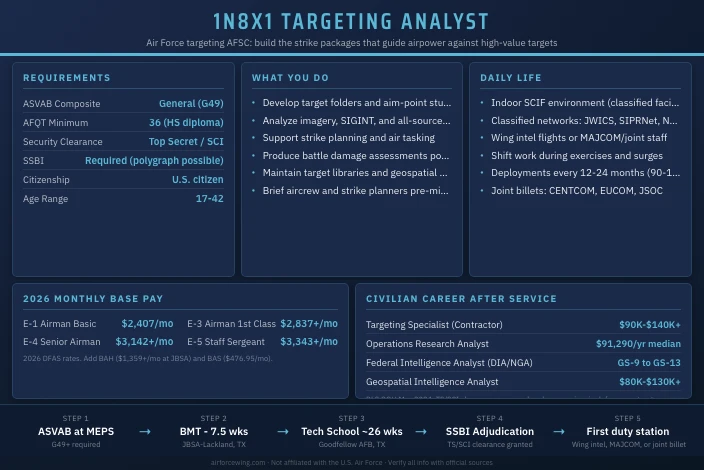
The 1N8X1 Targeting Analyst develops target intelligence products used to plan and execute Air Force strike and non-kinetic operations. Targeting analysts identify, locate, and characterize potential targets by synthesizing imagery, signals intelligence, all-source reporting, and geospatial data into finished products that allow commanders and strike planners to act with precision. Their work directly shapes what gets struck, when, and how.
Daily Tasks
A typical day in the 1N8X1 career field depends heavily on assignment, but the core work is consistent: gather data, analyze it, and produce a product that someone else uses to make a decision.
Common day-to-day responsibilities include:
- Researching target characteristics using classified databases and multi-source intelligence reporting
- Producing target folders, aim-point studies, and battle damage assessment (BDA) products
- Maintaining and updating target libraries and geospatial reference files
- Coordinating with imagery and signals intelligence analysts for source data
- Briefing target nominations and supporting strike planning cells
- Reviewing and processing requests for targeting support from supported units
- Contributing to joint targeting cycles in support of combatant command priorities
Specific Roles and Specializations
The 1N8X1 specialty uses the standard Air Force skill-level progression: 3-level (Apprentice), 5-level (Journeyman), 7-level (Craftsman), and 9-level (Superintendent). Shredouts and Special Experience Identifiers (SEIs) exist within the career field for Airmen who develop focused expertise.
| Designation | Type | Description |
|---|---|---|
| 1N8X1 | Primary AFSC | Targeting Analyst (core specialty) |
| SEI 252 | Special Experience Identifier | Targeting Officer/NCO Qualification |
| SEI 369 | Special Experience Identifier | Special Operations Forces Targeting Support |
Airmen assigned to joint targeting cells, Special Operations Task Forces, or combatant command staffs frequently earn SEIs that document their specialized experience for future assignment consideration.
Mission Contribution
The Air Force targeting process feeds the joint targeting cycle used across all branches of the U.S. military. Without accurate target intelligence, precision munitions lose their precision. A 1N8X1 Airman working a time-sensitive target may have only hours to compile, verify, and deliver a package that a pilot will use to take out a specific facility or system while minimizing collateral damage.
At the strategic level, targeting analysts support campaign planning and help build the target sets that shape air campaign design. At the operational level, they support daily air tasking order execution. At the tactical level, they may brief individual crews before a mission and process BDA immediately after.
Technology and Equipment
The job is almost entirely computer-based, but the tools are highly specialized and classified. Targeting analysts work inside Sensitive Compartmented Information Facilities (SCIFs) on classified networks. Core systems include:
- JWICS (Joint Worldwide Intelligence Communications System) for Top Secret traffic
- SIPRNet for Secret-level work and coordination
- National Geospatial-Intelligence Agency (NGA) tools for geospatial and imagery analysis
- Modernized Integrated Database (MIDB) and Joint Targeting Toolbox (JTT) for target management
- Precision Strike Suite for Special Operations Forces (PSS-SOF) at applicable units
The specific tool set expands with assignment type. Airmen supporting special operations or combatant command staffs will encounter additional classified platforms beyond what Tech School covers.
Salary
Air Force pay is based on grade and time in service. All 2026 figures come from DFAS pay tables.
Base Pay
| Rank | Grade | Monthly Base Pay (Entry) |
|---|---|---|
| Airman Basic | E-1 | $2,407 |
| Airman | E-2 | $2,698 |
| Airman First Class | E-3 | $2,837 |
| Senior Airman | E-4 | $3,142 |
| Staff Sergeant | E-5 | $3,343 |
| Technical Sergeant | E-6 | $3,401 |
| Master Sergeant | E-7 | $3,932 |
Pay increases with time in service at each grade. An E-5 with six years earns $4,109 per month in base pay. Promotion to Staff Sergeant typically happens between three and five years of service for competitive Airmen.
Allowances and Special Pay
Base pay is only part of the picture. Airmen also receive:
- Basic Allowance for Housing (BAH): Varies by duty location, pay grade, and dependent status. An E-4 without dependents at Joint Base San Antonio earns $1,359/month in BAH; with dependents that rises to $1,728/month. Assignments to high cost-of-living areas (Northern Virginia, Hawaii, Guam) carry significantly higher BAH rates.
- Basic Allowance for Subsistence (BAS): $476.95/month for all enlisted Airmen, regardless of rank or location.
- Special Duty Assignment Pay (SDAP): Available for select billets such as recruiting, drill instructor, or joint special operations assignments.
Enlistment bonuses for 1N8X1 vary by fiscal year. Contact an Air Force recruiter for current bonus amounts, as figures change annually.
Additional Benefits
Healthcare: Active duty Airmen and their families are covered by TRICARE Prime at no cost. Coverage includes medical, dental, vision, mental health, prescriptions, and hospitalization with zero premiums, deductibles, or copays.
Education: The Air Force covers up to $4,500 per year in tuition assistance for college courses taken while on active duty. After separation, the Post-9/11 GI Bill covers full in-state tuition at public schools or up to $29,920.95 per academic year at private schools, plus a monthly housing allowance and $1,000 annual book stipend.
Retirement: The Blended Retirement System (BRS) combines a 20-year pension at 40% of your high-36 average base pay with a Thrift Savings Plan (TSP) that includes up to 5% government matching.
Leave: 30 days of paid leave per year.
Qualifications
The 1N8X1 is among the more selective enlisted AFSCs due to its clearance requirements and analytical demands. Check current requirements at airforce.com and verify with a recruiter before applying.
Qualification Table
| Requirement | Minimum Standard |
|---|---|
| ASVAB Composite | General (GEND): G49 |
| AFQT Minimum | 36 (high school diploma) |
| Security Clearance | Top Secret / SCI (SSBI required) |
| Citizenship | U.S. citizen |
| Age | 17-42 |
| Vision | Normal color vision; depth perception required |
| Drug Use | No disqualifying history |
| Education | High school diploma or equivalent |
The GEND composite is calculated from the Word Knowledge, Paragraph Comprehension, Arithmetic Reasoning, and Mathematics Knowledge subtests. Targeting Analyst candidates who score well above G49 will be more competitive for this AFSC, as the selection process considers the full candidate pool.
The SSBI is a thorough background investigation. Any history of foreign contacts, financial irresponsibility, drug use, or dishonesty can disqualify an applicant for TS/SCI. Waivers exist for some issues, but the clearance process has no shortcuts. Start early and be thorough with your recruiter.
Application Process
Selection Criteria and Competitiveness
This AFSC is moderately to highly competitive. The analytical nature of the work means that recruiters and classification officials look at the full ASVAB profile, not just the minimum G49 composite. Strong performance on Paragraph Comprehension and Arithmetic Reasoning is a signal of the pattern-recognition and logical reasoning skills the job requires.
No prior intelligence or military experience is required for initial enlistment. Any background in geography, history, mathematics, or computer applications is helpful and worth mentioning on your application.
Service Obligation
Initial enlistment contracts for 1N8X1 are typically four to six years, depending on bonus eligibility and recruiter guidance. Airmen retraining into the career field from another AFSC serve the remaining obligation on their current contract plus any additional obligation tied to retraining.
New enlistees enter at E-1 (Airman Basic) and are promotable to E-2 (Airman) after six months and E-3 (Airman First Class) after a total of 16 months with satisfactory performance.
Work Environment
Targeting analysts work almost exclusively indoors, inside SCIFs at Air Force bases, joint facilities, or deployed locations. The environment is classified by nature: access-controlled rooms, classified computer terminals, and a strict need-to-know culture govern daily life.
Setting and Schedule
Most stateside billets follow a standard duty day, though the work stretches around operational tempo. During exercises and real-world contingencies, shifts extend and rest cycles compress. Some assignments, particularly those supporting 24/7 operations centers or deployed joint staffs, involve rotating shifts.
The two primary assignment types look very different:
- Wing-level intelligence flight: Work directly supports flying units. Pre-mission briefings, post-mission BDA, and daily threat updates for aircrew are routine. The schedule largely tracks the flying schedule.
- MAJCOM or combatant command staff: More deliberate, analytic work on strategic target sets. Less real-time tempo, more long-cycle analysis and target development.
Both environments require the ability to work quietly and independently for long stretches, then shift quickly to rapid-turnaround products when operations demand it.
Leadership and Communication
The 1N8X1 career field falls under the intelligence flight or squadron, typically led by an intelligence officer. Enlisted targeting analysts receive performance feedback through the Enlisted Performance Report (EPR) system, with annual EPRs becoming the primary record of job performance for promotion boards. Day-to-day guidance comes from the NCO chain and section officer in charge (OIC).
Communication with supported units (aircrew, strike planners, special operations elements) is a core part of the job. The ability to brief complex information clearly and concisely to non-intelligence audiences, particularly aircrew under time pressure, separates good targeting analysts from great ones.
Team Dynamics
Targeting work is collaborative at the research stage and individual at the production stage. Analysts typically work in teams to collect and verify source data, then write and quality-check their own products. Peer review is standard practice; errors in target data carry serious consequences.
The intelligence community culture rewards intellectual honesty. Analysts who flag uncertainty or conflicting information, rather than papering over it, are trusted. Those who guess and present conclusions with false confidence create problems.
Training
Training Pipeline
| Phase | Location | Duration | Focus |
|---|---|---|---|
| Basic Military Training (BMT) | JBSA-Lackland, TX | 7.5 weeks | Military fundamentals, fitness, discipline |
| Targeting Analyst Course (Tech School) | Goodfellow AFB, TX | ~26 weeks | Target development, intelligence analysis, geospatial tools, classified systems |
| SSBI Adjudication | Concurrent with training | Variable | TS/SCI clearance processing |
| On-the-Job Training (OJT) | First duty station | 12-18 months | 5-level upgrade, unit-specific systems |
Goodfellow AFB in San Angelo, Texas is the primary training hub for Air Force intelligence, surveillance, and reconnaissance career fields. The base houses the 517th Training Group, which runs courses for multiple 1N AFSCs. Targeting Analyst training at Goodfellow is roughly six months long, the longest initial skills training in the intelligence career group.
What Tech School Covers
The Targeting Analyst Course introduces students to the entire targeting process from the ground up. Coursework includes:
- Joint targeting doctrine (JP 3-60) and the kill chain framework
- Imagery and geospatial analysis for target identification and characterization
- Collateral damage estimation methodology
- Target development standards and documentation requirements
- Operation of classified targeting tools and databases
- Restricted operations zone (ROZ) and no-strike list management
- Practical exercises producing target folders under time constraints
The course is academically demanding. Students who struggle with spatial reasoning or who find it hard to work with ambiguous, incomplete information tend to have difficulty. Students who enjoy puzzle-solving and can write clearly under pressure typically thrive. Strong verbal and math scores going into Tech School, the same skills tested on the ASVAB’s General composite, make the coursework more manageable.
Advanced Training
After reaching the 5-level, Airmen can pursue several advanced courses:
- Advanced Targeting Course at Goodfellow or Air Force targeting schoolhouses
- Dynamic Targeting and time-sensitive targeting courses (often joint-service)
- Special Operations Forces (SOF) targeting support qualifications for units supporting AFSOC or JSOC
- Instructor duty at the 315th Training Squadron after accumulating 2 years of career field experience and a 7-level rating
Professional military education (PME). Airman Leadership School (ALS), the Noncommissioned Officer Academy (NCOA), and the Senior NCO Academy (SNCOA), is required at key promotion points and contributes to promotion consideration.
Career Progression
Promotion Timeline
| Rank | Grade | Typical Time-in-Service |
|---|---|---|
| Airman Basic | E-1 | Entry |
| Airman | E-2 | 6 months |
| Airman First Class | E-3 | 16 months |
| Senior Airman | E-4 | 3 years |
| Staff Sergeant | E-5 | 4-6 years |
| Technical Sergeant | E-6 | 8-12 years |
| Master Sergeant | E-7 | 13-17 years |
| Senior Master Sergeant | E-8 | 18-22 years |
| Chief Master Sergeant | E-9 | 22+ years |
Promotion to Staff Sergeant (E-5) is the first competitive promotion board. EPR scores, skill level completion, and PME attendance all factor into the board score. Targeting analysts with strong EPRs and key assignments, particularly joint or special operations billets, tend to be competitive for promotion.
Specialization Paths
After earning the 5-level, Airmen can pursue assignments that develop focused expertise:
- Joint targeting cell billets at CENTCOM, EUCOM, or INDOPACOM give exposure to strategic-level targeting across large theaters
- Special operations support roles at Air Force Special Operations Command (AFSOC) or as part of a JSOC task force
- Weapons and Tactics assignments where targeting integrates with advanced strike planning
- Intelligence staff positions at Air Force headquarters or joint staff
Each of these paths builds qualifications recognized by both the Air Force and civilian employers in the defense sector.
Enlisted Performance Reports
The EPR is the primary promotion tool for enlisted Airmen. Raters assess performance on a 1-5 scale; in practice, promotion-competitive EPRs cluster at 4 and 5. Written narratives describing specific accomplishments carry significant weight. Targeting analysts who can document measurable contributions, products delivered, missions supported, training delivered, write stronger EPRs.
The bottom line for career success in 1N8X1: seek the tough assignments, complete PME on time, earn the 7-level ahead of the minimum timeline, and write accomplishments in concrete, results-oriented language for your EPR.
Physical Demands
Fitness Standards
The 1N8X1 is not a physically demanding AFSC in terms of daily job tasks. All physical demands come from the Air Force Fitness Assessment, which applies equally to every Airman regardless of career field.
Air Force Fitness Assessment. Minimum Passing Standards (Under 25)
| Component | Male Minimum | Female Minimum | Max Points |
|---|---|---|---|
| 1.5-Mile Run | Varies by age/gender | Varies by age/gender | 60 |
| Push-Ups (1 min) | Age/gender normed | Age/gender normed | 10 |
| Sit-Ups (1 min) | Age/gender normed | Age/gender normed | 10 |
| Waist Circumference | Age/gender normed | Age/gender normed | 20 |
| Composite Minimum | 75/100 | 75/100 | 100 |
Fitness Assessment standards are age- and gender-normed. The minimum passing composite score is 75 out of 100, and Airmen must meet a minimum on each individual component as well. Current scoring tables are published at af.mil. Most Airmen are assessed annually.
The daily physical demands of the targeting analyst job are minimal, this is a desk-based, SCIF-based role. Long hours, shift work, and sustained mental focus are the primary physical stressors.
Medical Evaluations
Beyond initial MEPS screening, Airmen undergo periodic medical evaluations throughout their service. For 1N8X1, the specific ongoing requirements include:
- Normal color vision is a hard requirement, verified at accession and noted in medical records
- Depth perception standards must be met and are checked during the MEPS physical
- Annual fitness assessments and periodic medical check-ins are standard for all Airmen
No aviation or aircrew medical standards apply to the 1N8X1 AFSC.
Deployment
Where Targeting Analysts Are Assigned
1N8X1 Airmen serve at installations with intelligence or strike missions. Common duty stations include:
- Joint Base Langley-Eustis, VA (Air Combat Command headquarters, 1st Fighter Wing)
- Ramstein Air Base, Germany (603d Air and Space Operations Center, USAFE-AFAFRICA)
- Hurlburt Field, FL (Air Force Special Operations Command, high demand for SOF targeting support)
- Offutt AFB, NE (USSTRATCOM, global targeting mission)
- Nellis AFB, NV (Air Force Warfare Center, weapons and tactics)
- MacDill AFB, FL (CENTCOM headquarters)
- Shaw AFB, SC (9th Air Force, 20th Fighter Wing)
Deployments
Targeting analysts deploy regularly. Demand is consistent across combatant commands, particularly CENTCOM and AFRICOM, where targeting support is built into ongoing operations. Typical deployments run 90 to 180 days, and it’s common to deploy every 12 to 24 months depending on assignment and unit posture.
Airmen assigned to Air Expeditionary Force (AEF) rotations cycle in and out of deployed locations on scheduled rotations. Those at AFSOC units or joint task forces may deploy on shorter notice and at higher frequency.
The nature of deployed targeting work differs markedly from garrison assignments. In theater, targeting analysts support a live air tasking cycle rather than a deliberate, multi-week planning process. Time-sensitive targeting, processing a fleeting target opportunity within a narrow window, requires faster product turnover and more compressed quality control. The tools are largely the same, but the pace compresses from days to hours or less.
Some 1N8X1 Airmen deploy to Combined Air Operations Centers (CAOCs), which are large joint facilities that coordinate the entire air campaign for a theater. CAOC assignments are high-visibility billets that involve direct coordination with officers from multiple countries and services. Strong EPR support from a CAOC tour is common because the visibility is high and the contributions are measurable.
AFSOC-aligned targeting analysts, those assigned to or attached to Air Force Special Operations Command units, may deploy more frequently and to more austere locations than counterparts at conventional flying wings. These assignments often involve smaller teams, broader individual responsibilities, and closer integration with ground forces who are executing missions in real time. They are among the most sought-after operational billets in the 1N8X1 career field.
Preparing for a first deployment starts well before orders arrive. Clearance validation, weapons qualification, theater-specific system access, and medical readiness must all be in order before departure. Most units run a formal deployment preparation sequence that gives Airmen 30 to 90 days of lead time to complete required processing. Staying current on recurring training requirements throughout your assignment reduces last-minute scrambles when deployment orders appear.
Risk/Safety
Job Hazards
The physical risk profile for 1N8X1 is lower than most combat support AFSCs. The primary risk is stress, sustained cognitive load, high-stakes decisions under time pressure, and the ethical weight of work that directly enables lethal force. Airmen who underestimate the psychological demands of targeting work sometimes find the reality more challenging than they expected.
Deployed locations carry force protection risks standard to any overseas military presence. Targeting analysts in deployed settings are not exempt from the physical security environment.
Safety Protocols
SCIF access controls and information security protocols are rigorous. Violation of classified material handling rules carries legal consequences under the Uniform Code of Military Justice (UCMJ) and federal law. The Air Force enforces these standards seriously; clearance holders are trained on them throughout their career.
Security Clearance
This AFSC requires a Top Secret clearance with Sensitive Compartmented Information (SCI) access, obtained through a Single Scope Background Investigation (SSBI). The investigation covers the last 10 years of your life: employment, education, finances, foreign contacts, drug and alcohol history, and any criminal record. Polygraph examinations may be required depending on the specific assignment or unit.
The clearance is initiated by your recruiter and runs concurrently with your training in most cases. You must have your clearance adjudicated before working on classified systems. Any lapse or revocation can result in reassignment or separation.
Legal obligations: Enlistment contracts create a legal commitment to serve the full term. Early separation requires a formal process and may result in recoupment of any bonus paid. Deliberate misrepresentation during the SSBI is a federal crime.
Impact on Family
Family Considerations
The 1N8X1 career field is not unusually hard on families compared to other Air Force specialties, but it comes with the standard military lifestyle trade-offs: PCS moves every 2-4 years, deployments that pull Airmen away from home for months at a time, and duty hours that expand during operational surges.
The work itself is classified. Family members will not always know exactly what their Airman is working on, which some spouses and partners find difficult. Compartmentalized work is the norm, not the exception.
Air Force family support resources include the Airman and Family Readiness Center (AFRC), Military Family Life Counseling, on-base childcare, and TRICARE-covered mental health services. These resources exist at every major installation and are available to spouses and dependents as well as active-duty members.
Relocation
PCS moves are determined by Air Force needs, not personal preference. Preferred assignment requests (known as dream sheets) are submitted but are not guaranteed. High-priority billets, particularly joint and special operations positions, sometimes offer more stability because they are staffed for longer tours. Remote assignments and accompanied overseas tours (Germany, Japan, South Korea, UK) are part of the normal assignment flow for 1N8X1.
Families who adapt well to military life typically build strong social networks on base and treat each assignment as a new opportunity rather than an interruption.
Reserve and Air National Guard
Component Availability
The 1N8X1 AFSC is available in both the Air Force Reserve and the Air National Guard. Targeting analyst positions exist at select Reserve and ANG units with intelligence missions, though the number of billets is smaller than the active component and competition for available slots is high.
Drill Schedule and Training Commitment
The standard Reserve and ANG commitment is one weekend per month (Unit Training Assembly) plus two weeks per year (Annual Tour). For 1N8X1 Airmen, additional days may be required for:
- Annual clearance reinvestigation requirements
- AFSC-specific recurrency training on classified systems
- Exercises that require intelligence support beyond a standard weekend
TS/SCI clearances require periodic reinvestigation regardless of component. Reserve and ANG members maintain the same clearance standards as active-duty counterparts.
Part-Time Pay
An E-4 Senior Airman in the Reserve or ANG earns approximately $251-$293 per drill period (one weekend equals four drill periods), based on 2026 DFAS drill pay rates. A full drill weekend generates roughly $1,000-$1,200 in base pay before taxes and other factors.
Active-duty E-4 monthly base pay starts at $3,142, providing context for the substantial difference between full-time and part-time compensation.
Component Comparison
| Factor | Active Duty | Air Force Reserve | Air National Guard |
|---|---|---|---|
| Commitment | Full-time | 1 weekend/mo + 2 wks/yr | 1 weekend/mo + 2 wks/yr |
| Monthly Base Pay (E-4) | $3,142+ | ~$1,000-$1,200/weekend | ~$1,000-$1,200/weekend |
| Healthcare | TRICARE Prime (free) | TRICARE Reserve Select (premium) | TRICARE Reserve Select or state plan |
| Education Benefits | Full TA ($4,500/yr) + GI Bill | Partial GI Bill eligibility | Full GI Bill (if Title 10 activated) + state tuition waivers |
| Deployment Tempo | Regular (6-12 mo cycles) | Episodic; can be mobilized | Episodic; state and federal missions |
| Retirement | 20-yr pension (40% high-36) | Points-based reserve retirement | Points-based reserve retirement |
State tuition waivers for Air National Guard members are a significant benefit that varies by state. Many states waive in-state tuition entirely for full-time ANG members. USERRA protections ensure civilian employers cannot penalize ANG or Reserve members for military service.
The Guard and Reserve path pairs especially well with a civilian career in defense contracting or federal intelligence. Maintaining an active TS/SCI clearance through a Reserve or ANG billet can significantly increase a candidate’s value to employers in the cleared contractor market.
Post-Service
Civilian Career Transition
The 1N8X1 skill set translates directly into some of the most in-demand positions in the national security workforce. An active or recently-maintained TS/SCI clearance alone is worth tens of thousands of dollars annually in salary premium in the defense contractor market.
| Civilian Job Title | Median Annual Salary | Outlook |
|---|---|---|
| Intelligence Analyst (Federal, GS-9 to GS-13) | $60,000-$112,000 | Stable, high demand |
| Targeting Specialist (Defense Contractor) | $90,000-$140,000+ | Strong demand |
| Operations Research Analyst | $91,290 | +21% growth, 2024-2034 |
| Geospatial Intelligence Analyst (Contractor/Government) | $80,000-$130,000 | Strong demand |
| All-Source Intelligence Analyst (DIA, CIA, NSA) | GS-9 to GS-14 | Consistent hiring |
Federal agencies that hire former targeting analysts include the Defense Intelligence Agency (DIA), National Geospatial-Intelligence Agency (NGA), National Security Agency (NSA), and Central Intelligence Agency (CIA). Defense contractors supporting these agencies routinely hire separating 1N8X1 Airmen with maintained clearances into senior analyst positions.
The Transition Assistance Program (TAP) prepares Airmen for civilian employment in the 180 days before separation. Resume writing, interview preparation, and federal application guidance are all covered. Hiring Our Heroes runs fellowship programs that connect transitioning veterans with private-sector employers.
Certifications
Several professional certifications align with 1N8X1 skills and are recognized by federal hiring authorities and defense contractors:
- Certified Intelligence Professional (CIP): issued by the International Association for Intelligence Education
- GEOINT Professional Certification (GPC): offered by the United States Geospatial Intelligence Foundation (USGIF)
- Defense contractor employers often value these credentials when combined with clearance and operational experience
Is This a Good Job
Ideal Candidate Profile
The Airmen who do best in 1N8X1 share a few consistent traits:
- Pattern recognition: You naturally look for what’s out of place. In targeting, small discrepancies in imagery or reporting matter.
- Analytical writing: You can translate complex findings into clear, concise products under a deadline.
- Intellectual patience: Target development is methodical. Rushing to a conclusion before the data supports it causes serious problems.
- Ethical clarity: This work enables lethal force. People with a strong internal compass handle that weight better than those who compartmentalize it.
- Comfort with ambiguity: Intelligence rarely comes in complete packages. The ability to work with fragmentary information and document uncertainty honestly is a core skill.
Background in geography, mathematics, history of warfare, or computer science provides a useful foundation but is not required.
Potential Challenges
This career is not a good fit if you need constant physical variety, dislike extended periods of desk work, or find it difficult to hold sensitive information confidentially outside of work. The SCIF environment is restrictive. You’ll spend most of your career in controlled spaces with limited ability to discuss your work with family or friends.
The clearance investigation itself is a barrier for some candidates. Financial irresponsibility, extensive drug use history, or significant foreign contacts can disqualify an applicant even before attending training.
Deployments are real. If you need near-total location stability, the tempo of this career field may create friction with personal obligations.
Career and Lifestyle Fit
The 1N8X1 is a strong fit for people who:
- Want their analysis to have concrete, operational impact rather than informing decisions abstractly
- Are drawn to national security work and comfortable with classified environments
- Have a realistic view of the military lifestyle, including PCS moves and deployments
- Want a career field with strong post-service prospects in a competitive market
It’s a poor fit for people who need high physical activity in their daily work, prefer open and transparent communication about their job, or are not prepared to commit to the background investigation process.
More Information
Talk to an Air Force recruiter to confirm current ASVAB score requirements, bonus availability, and open AFSC slots for the 1N8X1. Requirements and incentives change by fiscal year, and a recruiter will have the most current information on what’s available for your enlistment timeline.
Official sources:
- airforce.com: Targeting Analyst, the official Air Force career page with current qualification details and training information
- Goodfellow AFB and the 517th Training Group, hosts the 1N8X1 Tech School; the base website includes general training information
- AFPC Career Broadening, for current Airmen exploring the career field or assignment options
- DCSA, Defense Counterintelligence and Security Agency, which manages the TS/SCI investigation process
For civilian career research:
- Intelligence Careers at ODNI, the Office of the Director of National Intelligence maintains a job portal for the entire intelligence community, including DIA, NGA, NSA, and CIA
- USGIF Careers, the United States Geospatial Intelligence Foundation provides career resources, scholarship opportunities, and a job board for GEOINT professionals; particularly relevant for 1N8X1 Airmen with geospatial analysis experience
- BLS Operations Research Analysts, the closest BLS occupational category to targeting analysis; includes salary and growth data
ASVAB preparation: The GEND composite for 1N8X1 draws from Word Knowledge, Paragraph Comprehension, Arithmetic Reasoning, and Mathematics Knowledge. Strong verbal skills matter more in this AFSC than in most technical maintenance jobs. The reading comprehension demands of the work, processing intelligence reports, writing target folders, briefing complex findings, are reflected in the test requirements. An ASVAB study guide that prioritizes vocabulary and reading will move your GEND composite most efficiently.
This site is not affiliated with the U.S. Air Force or any government agency. Verify all information with official Air Force sources before making enlistment or career decisions.
Explore more Air Force intelligence careers such as the 1N0X1 All Source Intelligence Analyst and 1N2X1 Signals Intelligence Analyst.