1N7X1 Human Intelligence Specialist
Most intelligence collection happens through sensors, satellites, and signals intercepts. The 1N7X1 Human Intelligence Specialist does something fundamentally different: they collect intelligence through people. Debriefings, source operations, and direct human contact in austere environments, this is the Air Force’s front line for human-derived intelligence. The AFSC was formally established in 2015 after years of operating as a special duty assignment, and it carries one of the most demanding clearance and vetting processes in the enlisted force.
Job Role
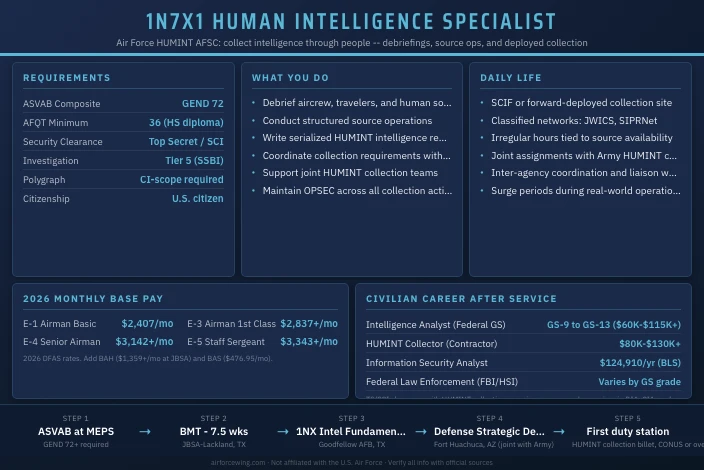
1N7X1 Human Intelligence Specialists plan and conduct human intelligence collection operations in support of Air Force, joint, and national-level intelligence requirements. They conduct debriefings, source operations, and direct intelligence collection through human contact in deployed and garrison environments, then document and report collected information through finished intelligence products.
Daily Tasks
The day-to-day work varies significantly based on whether you’re at a home station garrison billet or deployed forward. Across both settings, 1N7X1 Airmen regularly:
- Debriefing aircrew, travelers, and other personnel who have recently operated in or transited through areas of intelligence interest
- Conducting structured interviews to elicit information that fills gaps in the current intelligence picture
- Writing serialized HUMINT reports that flow into national intelligence databases
- Coordinating collection requirements with supported commanders and intelligence consumers
- Attending inter-agency meetings, diplomatic events, or trade venues in support of collection objectives
- Supporting source operations, including contact development and source validation
- Maintaining operational security across all collection activities
At forward-deployed locations, Airmen may work alongside Army HUMINT collectors and Defense Intelligence Agency personnel within joint collection teams. At home station, garrison assignments often support theater-level collection requirements from a fixed facility, but the work remains inherently people-focused rather than sensor-based.
Specializations
The 1N7X1 AFSC does not publish formal shredouts, but Airmen develop operational depth across two broad tracks as their careers progress:
| Track | Focus |
|---|---|
| Tactical Collection | Direct debriefings, source operations, forward-deployed collection support |
| Strategic / Operational | Theater-level collection management, liaison assignments, inter-agency coordination |
Special Experience Identifiers (SEIs) document skills like foreign language proficiency, CI polygraph training, or experience with specific joint or inter-agency collection programs. Assignment history is the primary credential.
Mission Contribution
Intelligence collection from humans fills gaps that technical means cannot. A satellite can photograph a facility. It cannot tell you what decision was made inside it. A signals system can intercept a communication. It cannot assess the intent or reliability of the person who sent it. The 1N7X1 Airman addresses that gap directly, producing reporting that feeds directly into all-source products and supports decisions at the commander level and above. In an era when Air Force operations increasingly occur in politically complex environments, human intelligence is consistently underfunded relative to its operational value, which means every qualified Airman in this career field matters.
Technology and Equipment
The tools of this trade are not primarily technical, but there is a classified infrastructure behind every collection effort. 1N7X1 Airmen work on classified networks including JWICS and SIPRNet to access collection management systems, reporting templates, and intelligence databases. They use standardized HUMINT reporting formats and tools that feed into the Defense Intelligence Agency’s HUMINT database infrastructure. Translation tools and language aids support work in foreign-language environments. All work is performed in or in support of accredited sensitive compartmented information facilities (SCIFs).
Salary
Base Pay
Pay follows the DFAS military pay scale applicable to all branches. A new 1N7X1 Airman enters at E-1 and typically reaches E-4 within three to four years. Getting to this pay grade starts with the ASVAB, and a study guide targeting the General composite is the most efficient preparation before MEPS.
| Grade | Rank | Monthly Base Pay (2026) |
|---|---|---|
| E-1 | Airman Basic (AB) | $2,407 |
| E-2 | Airman (Amn) | $2,698 |
| E-3 | Airman First Class (A1C) | $2,837 - $3,198 |
| E-4 | Senior Airman (SrA) | $3,142 - $3,816 |
| E-5 | Staff Sergeant (SSgt) | $3,343 - $4,422 |
| E-6 | Technical Sergeant (TSgt) | $3,401 - $5,044 |
Base pay is the floor. Most Airmen living off base receive Basic Allowance for Housing (BAH), which varies by duty location and dependency status. A single E-4 at Joint Base San Antonio-Lackland, TX, receives $1,359/month in BAH; an E-4 with dependents receives $1,728/month. Basic Allowance for Subsistence (BAS) adds a flat $476.95/month for all enlisted Airmen regardless of rank or location.
Additional Benefits
Healthcare: Active-duty Airmen and dependents are covered under TRICARE Prime at no cost. No enrollment fees, deductibles, or copays for medical, mental health, prescriptions, and hospitalization.
Education: Tuition Assistance covers up to $4,500 per year ($250 per semester hour) while on active duty. After separation, the Post-9/11 GI Bill covers full in-state tuition at public universities or up to $29,920.95 per academic year at private institutions, plus a monthly housing allowance based on the E-5 with dependents BAH rate at the school’s ZIP code, and up to $1,000 annually for books and supplies.
Retirement: The Blended Retirement System (BRS) provides a pension equal to 40% of your high-36 average basic pay after 20 years. The Thrift Savings Plan component adds automatic government contributions of 1% of basic pay plus matching up to 4%, for a maximum government contribution of 5%.
Work-Life Balance
Active-duty Airmen earn 30 days of paid leave per year, accruing at 2.5 days per month. The HUMINT career field is small, which means individual Airmen carry significant operational weight. Deployed periods can run 90 to 180 days, with frequency driven by operational demand. Home station schedules vary considerably based on your unit’s mission. Some billets run standard hours with periodic surge periods; others operate with irregular hours tied to collection cycles and traveler debriefing windows.
Qualifications
Requirements Table
| Requirement | Details |
|---|---|
| Age | 17-42 at enlistment |
| Citizenship | U.S. citizen (mandatory for TS/SCI) |
| Education | High school diploma; GED requires AFQT 65+ |
| ASVAB Composite | General (GEND) 72 minimum |
| AFQT Minimum | 36 (HS diploma), 65 (GED) |
| Security Clearance | Top Secret / SCI, Tier 5 investigation required |
| Polygraph | Counterintelligence-scope polygraph required |
| Medical | No speech disorders; meet Air Force accession standards |
| Other | No prior drug use; clean financial history essential |
The GEND composite draws from Word Knowledge, Paragraph Comprehension, Arithmetic Reasoning, and Mathematics Knowledge. A minimum of 72 is higher than most enlisted AFSCs, reflecting the written and verbal communication demands of source debriefing and intelligence report writing. Study the verbal and reading sections hard. A practice ASVAB course that covers word knowledge and paragraph comprehension will move your GEND score the most before your MEPS appointment.
The 1N7X1 clearance process is among the most thorough in the enlisted force. A Tier 5 Investigation reviews your finances, foreign contacts, personal conduct, and employment history in depth. Prior drug use, even recreational and years before enlistment, can be disqualifying. Foreign contacts or complicated financial histories significantly slow the process or end eligibility entirely. Honesty during the investigation carries as much weight as a clean record.
Application Process
Selection Competitiveness
The 1N7X1 career field is one of the smallest in the Air Force intelligence community, with a very limited number of active billets relative to other 1N AFSCs. Accession directly into 1N7X1 from civilian life is uncommon; historically, many Airmen entered through retraining after establishing themselves in another 1N AFSC. Check with your recruiter on whether direct accession is currently available. Regardless of entry path, a strong GEND composite, completely clean background, and excellent communication skills are table stakes.
Service Obligation
Standard enlistment contracts run four years of active duty. Because the Tier 5 Investigation and clearance represent a substantial government investment, some contract configurations carry obligation extensions tied to training completion. Confirm the specific terms with your recruiter before signing. Airmen enter service at E-1 Airman Basic and typically arrive at their first permanent duty station as E-3 Airman First Class, depending on college credit and other accelerators.
Work Environment
Setting and Schedule
The 1N7X1 work environment shifts more dramatically by assignment than almost any other intelligence AFSC.
| Factor | Garrison | Deployed |
|---|---|---|
| Location | SCIF, classified networks | Forward operating bases, austere field sites |
| Schedule | Standard duty hours with on-call windows | Irregular; driven by source availability |
| Physical demands | Sedentary desk work | Variable; foot patrols, convoy movement possible |
| Infrastructure | Full base support | Limited; may lack reliable communications |
Traveler debriefings happen when the traveler is available, not when the work schedule says so. Source contact cycles don’t follow standard duty hours. The job rewards adaptability over routine.
Chain of Command and Feedback
1N7X1 Airmen typically work within specialized intelligence sections, often under an Operations Support Squadron or a dedicated theater-level collection element. Some billets embed with joint organizations, placing Air Force Airmen under Army or DIA command structures. The military rank structure remains in place, but working relationships across service and agency lines are part of the daily environment. Enlisted Performance Reports are completed annually, with midterm feedback sessions required to give you clear performance expectations before the formal report is written.
Teamwork and Autonomy
Junior 1N7X1 Airmen work under direct supervision from experienced senior collectors. As you advance to SSgt and beyond, you run your own collection cycle and may mentor junior Airmen or manage a small team’s reporting output. The job requires genuine independence of judgment, especially in deployed environments where you may be the senior intelligence collector in the room. That autonomy is earned through assignment history, not just rank.
Job Satisfaction
The 1N7X1 career field tends to attract Airmen who place a high value on consequential, non-routine work. The mission is unique in the enlisted intelligence community. The clearance is valuable. The post-service career options in federal intelligence agencies and defense contracting are strong. The challenge is the limited billet count, which means career advancement requires strong EPR documentation, geographic flexibility, and a willingness to take assignments that others may not want because of their location or operational tempo.
Training
Training Pipeline
| Phase | Location | Length | Focus |
|---|---|---|---|
| Basic Military Training (BMT) | JBSA-Lackland, TX | 7.5 weeks | Military fundamentals, discipline, fitness |
| 1NX Intelligence Fundamentals Course | Goodfellow AFB, TX | ~2 weeks | ISR tradecraft fundamentals, classified systems, core 1N skills |
| Defense Strategic Debriefing Course | Fort Huachuca, AZ | 4-6 weeks | HUMINT collection methodology, debriefing techniques, source operations, reporting standards |
After graduating the pipeline, expect additional weeks of on-the-job training under supervision at your first permanent duty station. The formal training pipeline covers the theory and methodology; operational proficiency builds during your first one to two years of applied collection work. Before shipping to BMT, an ASVAB prep course targeting verbal reasoning will strengthen your GEND composite.
Advanced Training and Development
Senior 1N7X1 Airmen have access to advanced opportunities tied to their operational experience:
- Joint HUMINT collector courses that build interoperability with Army and Marine Corps collectors
- Language training through the Defense Language Institute (DLI) for Airmen who develop foreign language requirements linked to their collection assignments
- CI polygraph examiner training for select Airmen who move into polygraph support roles
- Advanced inter-agency liaison assignments at DIA, CIA, or combatant command intelligence centers
- Instructor positions at Goodfellow AFB or Fort Huachuca supporting the next generation of HUMINT collectors
The Air Force supports off-duty education through Tuition Assistance. Degrees in political science, international relations, foreign area studies, or psychology complement the people-focused nature of HUMINT work and strengthen post-service credentials.
Career Progression
Rank Progression
| Rank | Grade | Typical Time at That Level |
|---|---|---|
| Airman Basic (AB) | E-1 | BMT (exits at E-2 upon graduation) |
| Airman (Amn) | E-2 | ~6 months from enlistment |
| Airman First Class (A1C) | E-3 | ~16 months total service |
| Senior Airman (SrA) | E-4 | ~3 years total service (or below-the-zone earlier) |
| Staff Sergeant (SSgt) | E-5 | ~6 years total service (competitive board) |
| Technical Sergeant (TSgt) | E-6 | ~11 years total service (competitive) |
| Master Sergeant (MSgt) | E-7 | ~17 years total service (highly competitive) |
Promotions to E-5 and above are competitive, scored on EPRs, decorations, time in grade, and education. The small billet count in the 1N7X1 career field makes assignment breadth and documented collection output especially important for competitive promotion boards.
Specialization and Role Flexibility
Career depth in 1N7X1 is built through assignment variety: tactical forward-deployed collection, garrison theater-support billets, joint intelligence elements, and inter-agency liaison roles. Senior NCOs often serve as collection managers or superintendents overseeing small HUMINT sections. The Enlisted Commissioning Program (ECP) is available to qualified Airmen who complete a bachelor’s degree, with the 14N Intelligence Officer career field as a natural commission path.
Retraining between 1N AFSCs is possible for Airmen who develop interest in a related intelligence discipline, though the small 1N7X1 community means retraining into it from another 1N AFSC may require specific manning authorizations and commander endorsement.
Performance Evaluation
The Enlisted Performance Report (EPR) system rates Airmen on a 5-point scale. A score of 5 (“Exceeds Standards”) is the only score that meaningfully advances promotion board standing. EPR narratives for 1N7X1 Airmen need to document intelligence impact while respecting classification constraints, which requires skill in writing precise, meaningful bullets that convey operational contribution without revealing sensitive details. Senior raters place individual performance in the broader unit context. The most competitive records combine strong EPRs, education credentials, diverse assignments, and documented mentorship of junior Airmen.
To advance: seek varied collection assignments, pursue a relevant degree through Tuition Assistance, volunteer for joint and inter-agency tours, and ensure every collection effort you lead or contribute to is documented accurately in your performance record.
Physical Demands
Daily Physical Requirements
The 1N7X1 role is not physically intensive by design. Garrison billets are office-based inside secured facilities. Deployed billets carry more variable physical demands depending on the operating environment, including movement between locations in austere conditions and the baseline fitness required to function in forward areas.
The Air Force Fitness Assessment (FA) applies to all Airmen regardless of AFSC, and FA scores factor into promotion board standing.
Air Force Fitness Assessment Standards
All Airmen take the FA annually. The assessment uses a 100-point scale across four components. Minimum passing composite score is 75, and each component carries its own minimum standard.
| Component | Max Points |
|---|---|
| 1.5-Mile Run | 60 |
| Push-Ups (1 minute) | 10 |
| Sit-Ups (1 minute) | 10 |
| Waist Circumference / Body Composition | 20 |
Standards are age- and gender-normed. Scoring 90 or higher earns an “Excellent” rating. Failing any single component fails the entire assessment.
Medical Evaluations
Standard Air Force accession screening at MEPS applies. No speech or communication deficiencies are permitted given the debriefing nature of the role. Ongoing periodic readiness assessments continue throughout service. Deployed assignments may require additional in-theater medical readiness documentation beyond standard garrison requirements.
Deployment
Deployment Patterns
1N7X1 is a deployable AFSC. The role was designed from the beginning with forward-deployed collection in mind. Airmen can expect deployment rotations supporting joint task forces, Air Expeditionary Forces, and theater-level collection elements in active operational areas. Deployment frequency and length vary by operational demand, typically ranging from 90 to 180 days per rotation. Given the small billet count, individual Airmen may carry higher deployment frequency than their counterparts in larger career fields.
Deployed environments for HUMINT collectors are often less structured than garrison billets. Some forward assignments place Airmen in austere locations with minimal infrastructure, shared with Army and other service collectors working toward the same collection objectives.
Duty Stations
1N7X1 billets are not as broadly distributed as larger AFSCs. Assignments tend to cluster around major intelligence commands and joint collection elements. Common locations include:
- Langley AFB / Joint Base Langley-Eustis, VA: ACC intelligence functions and theater-support elements
- Hurlburt Field, FL: Special operations intelligence support
- Shaw AFB, SC: AFCENT-area collection support
- Peterson SFB / Schriever SFB, CO: Space and strategic intelligence functions
- Overseas theater billets in the Indo-Pacific, European, and Central Command areas of responsibility
- Washington, D.C. area: DIA, combatant command J2, and inter-agency liaison assignments
Assignment preferences are submitted through the Air Force Personnel Center (AFPC), but the small number of 1N7X1 positions means you must be flexible on location throughout your career.
Risk/Safety
Job Hazards
HUMINT collection carries hazards not common to most other Air Force intelligence specialties:
- Physical threat in deployed environments: Indirect fire, hostile surveillance, and adversary counterintelligence operations targeting collection teams
- Diplomatic and political risk: Operating in politically sensitive environments where a misstep affects bilateral relationships
- Legal and ethical exposure: Source operations involve interpersonal manipulation under strict legal frameworks, and violations carry federal criminal consequences
- Counterintelligence targeting: HUMINT collectors are themselves high-value targets for foreign intelligence services attempting to recruit or compromise U.S. personnel
- Sustained operational stress: Classification constraints limit what you can discuss with family, friends, or even peers outside the program
The interpersonal nature of source operations introduces complexity absent from technical collection work.
Security violations in this career field carry the same criminal exposure as other intelligence AFSCs: the Espionage Act, UCMJ, and federal law apply to any unauthorized disclosure. But the stakes are higher when disclosure compromises a human source rather than a database record.
Occupational stress is a genuine hazard. HUMINT work involves sustained interpersonal operations under classification constraints, often in environments that are physically or politically stressful. The Air Force provides mental health services through the Military Family Life Counselor program and installation behavioral health resources, and using them is not a career-ending decision.
Safety Protocols
SCIF access controls, need-to-know principles, and source handling protocols govern all collection activity. The policy framework for HUMINT operations is defined by Department of Defense directives and inter-agency agreements. Initial training covers these legal and operational boundaries in depth, and compliance is an ongoing professional requirement. Annual security refresher training is mandatory for all TS/SCI-cleared personnel.
Security Clearance and Legal Obligations
This AFSC requires Top Secret clearance with Sensitive Compartmented Information access (TS/SCI), obtained through a Tier 5 Investigation. A counterintelligence-scope polygraph is required before SCI access is granted. Periodic reinvestigation occurs approximately every five years for TS/SCI holders.
Signing the SF-312 Non-Disclosure Agreement is mandatory and binds you for life: your legal obligation to protect classified information does not end at separation. Unauthorized disclosure of classified material is prosecutable under federal law regardless of intent. The consequences include federal imprisonment, loss of all government retirement benefits, and permanent clearance revocation.
Impact on Family
Family Considerations
HUMINT work imposes classification constraints similar to other intelligence AFSCs, with an additional layer. Airmen cannot discuss operational details, source activities, or specific collection work with family members or civilian friends. This opacity is permanent and can be difficult for families who don’t have a frame of reference for what intelligence operations involve. The Air Force supports families through the Airman and Family Readiness Center (AFRC) at every installation, Military OneSource, and Military Family Life Counselors.
The small size of the 1N7X1 community means fewer Air Force families around you face the same constraints. Building relationships with other intelligence community families, across services and agencies, not just within the Air Force, provides a more realistic support network for navigating the classification dimension of family life.
Deployed absences require practical preparation before any deployment cycle begins. Most rotations run 90 to 180 days, but operational demand can extend them.
- Establish financial power of attorney
- Set up automatic bill payment for recurring expenses
- Identify childcare contingency plans if applicable
- Update beneficiary and emergency contact records
Relocation
PCS moves occur every two to four years. The Air Force covers moving costs through the Permanent Change of Station allowance and pays a Dislocation Allowance (DLA). The limited number of 1N7X1 billets means geographic flexibility is not optional, it is a career requirement. Families with school-age children face the standard mid-year enrollment challenges. The Interstate Compact on Educational Opportunity for Military Children applies in most states to ease some of that friction.
Spousal employment is a persistent challenge for families in small-career-field AFSCs. Because 1N7X1 billets cluster at specific intelligence-heavy installations, not all assignment locations offer strong civilian job markets for working spouses. The installation AFRC’s spouse employment support program is a starting point, but results vary significantly by duty station.
Reserve and Air National Guard
Component Availability
The 1N7X1 AFSC exists in both the Air Force Reserve and the Air National Guard, though billets are very limited compared to larger intelligence AFSCs. Reserve and Guard 1N7X1 positions tend to concentrate at wings and units with established intelligence collection relationships or formal DIA partnership agreements. Availability varies significantly by state and unit. Contact an Air Force Reserve recruiter or your state adjutant general’s office to confirm current billet availability before counting on this AFSC in a Reserve or Guard context.
Drill Schedule and Training Commitment
Standard commitment is one weekend per month (Unit Training Assembly) plus two weeks per year (Annual Tour). 1N7X1 Reserve and Guard Airmen typically carry additional training requirements to maintain collection proficiency and TS/SCI access currency, which may include periodic classified exercises, inter-agency training events, and clearance reinvestigation compliance beyond the standard drill calendar.
Part-Time Pay
A Reserve or Guard E-4 earns pay for four Unit Training Assemblies (UTAs) per drill weekend. At the 2026 DFAS rate of $3,142 to $3,816 per month for E-4, a single drill weekend yields approximately $421 to $512 in base pay. BAH and BAS are not included on standard drill weekends unless the member is on orders.
Component Comparison
| Factor | Active Duty | Air Force Reserve | Air National Guard |
|---|---|---|---|
| Commitment | Full-time | 1 wknd/mo + 2 wks/yr | 1 wknd/mo + 2 wks/yr |
| Monthly Base Pay (E-4) | $3,142 - $3,816 | ~$421 - $512/drill wknd | ~$421 - $512/drill wknd |
| Healthcare | TRICARE Prime (free) | TRICARE Reserve Select (premiums apply) | TRICARE Reserve Select (premiums apply) |
| Education | TA up to $4,500/yr + full GI Bill after service | Federal TA + partial GI Bill | State tuition waivers vary + Federal TA |
| Deployment Tempo | Moderate to high | Mobilizations every few years | State missions + federal mobilizations |
| Retirement | 20-yr pension (BRS) | Points-based Reserve retirement | Points-based Reserve retirement |
Air National Guard Airmen may qualify for state-specific tuition waivers and the National Guard Educational Assistance Program (Chapter 1606). Benefits vary by state; check your state adjutant general’s office for current rates.
Reserve and Guard 1N7X1 Airmen who maintain active TS/SCI clearances through part-time service carry a significant advantage in the federal contractor job market. USERRA protections apply during mobilizations, and many national security employers treat Reserve and Guard service as an employment asset.
Deployment and Mobilization
Reserve and Guard 1N7X1 Airmen mobilize to support Air Expeditionary Force rotations and joint collection requirements. Frequency varies by operational demand, typically every few years for a standard 90 to 180-day rotation. During periods of elevated collection requirements, mobilization pace can increase. The small billet count means individual Reserve and Guard Airmen may mobilize more frequently than those in larger career fields when Air Force HUMINT requirements spike.
Post-Service
Transition to Civilian Life
The post-service market for 1N7X1 veterans is strong relative to most enlisted career fields. TS/SCI clearance, documented human intelligence collection experience, and HUMINT-specific training are in consistent demand at the Defense Intelligence Agency, CIA’s Directorate of Operations, FBI, and across the defense contracting sector. The SkillBridge program lets Airmen work for civilian employers during their final 180 days on active duty, providing a direct bridge to employment before separation. The Air Force Transition Assistance Program (TAP) offers resume workshops, federal hiring guidance, and separation counseling.
Airmen who complete relevant degrees while on active duty through Tuition Assistance, particularly in political science, international relations, or behavioral psychology, leave service as stronger candidates for GS-11 and GS-12 federal positions. Many 1N7X1 veterans land in cleared contractor roles before pursuing federal positions as clearance sponsor requirements become more familiar.
Civilian Career Prospects
| Civilian Career | Median Annual Wage | Job Outlook |
|---|---|---|
| Intelligence Analyst (Federal GS) | GS-9 to GS-13 ($60K-$115K+, varies by locality) | Consistent demand across DIA, CIA, FBI, NSA |
| Human Intelligence Collector (Contractor) | $80,000 - $130,000+ | Strong demand in cleared defense sector |
| Information Security Analyst | $124,910 | +29% (2024-2034), per BLS Occupational Outlook Handbook |
| Federal Law Enforcement (FBI, HSI) | Varies by agency and GS grade | Active recruitment of HUMINT-experienced candidates |
Federal intelligence analyst positions use the GS pay system. Entry-level GS-9 positions start around $60,000 to $70,000 depending on locality; senior GS-13 positions exceed $110,000 in high-cost areas. Defense contractors recruiting cleared HUMINT specialists in the Washington, D.C. corridor routinely offer $90,000 to $130,000 or more for candidates with documented operational experience. Your clearance sponsors that value directly.
Is This a Good Job
Fit Assessment
| Strong Fit | Poor Fit |
|---|---|
| Clear verbal and written communicator | Uncomfortable with ambiguous social interactions |
| Reads interpersonal dynamics well | Needs predictable daily routine |
| Composure in high-stakes situations | Prefers large career field with geographic flexibility |
| Patient, analytical, builds credibility quickly | Finds classification restrictions on personal life isolating |
| Long-term career orientation toward national security | Wants to discuss work openly with family and friends |
Strong verbal and reading skills are essential. The GEND 72 requirement reflects that directly. Written communication matters as much as spoken: every collection effort produces a report, and the quality of that report determines how useful your work is to the intelligence consumers who rely on it.
Potential Challenges
The small career field size limits assignment flexibility compared to larger AFSCs. You won’t have the same geographic range of options as a maintenance or medical Airman. The classification constraints on what you can discuss with family and friends are real and ongoing.
The clearance is an asset, but it is also a leash. Financial problems, complicated foreign associations, or personal conduct issues can revoke your clearance and end your career in the field with no transition time. That accountability doesn’t go away after your first investigation; it’s continuous throughout service and into civilian life.
Career and Lifestyle Alignment
This career field rewards people who want work that matters, doesn’t follow a routine, and produces post-service credentials that open doors in national security work for decades. It’s a strong fit for someone with a long-term career orientation who values consequential work over schedule predictability.
It’s a harder match for someone who needs to explain their job to people outside the cleared community, wants predictable hours, or prefers the geographic flexibility of a larger career field. The interpersonal intensity of HUMINT collection also means the work follows you mentally in a way that technical intelligence analysis typically does not.
More Information
Talk to an Air Force recruiter to confirm whether 1N7X1 is currently available as a direct accession AFSC or through retraining, and to check on any active enlistment or reenlistment bonuses. HUMINT billet counts and training seat availability change by fiscal year, and the recruiting pipeline for this career field is not as straightforward as larger AFSCs. Find a recruiter at airforce.com or call the Air Force recruiting line directly.
Your GEND composite is the first gate. An ASVAB study guide focused on verbal reasoning and reading comprehension is the most direct way to move that score before your MEPS appointment.
Official Resources
- Air Force Personnel Center (AFPC): Manages assignments, bonus programs, and career field manning for 1N7X1
- Goodfellow AFB, 17th Training Wing: Home of the 1NX Intelligence Fundamentals Course
- U.S. Army Intelligence Center of Excellence at Fort Huachuca: Hosts the Defense Strategic Debriefing Course that all 1N7X1 Airmen attend
- DFAS Military Pay Tables: Current-year base pay for all enlisted grades
- Defense Intelligence Agency (DIA) Careers: Primary federal employer for HUMINT veterans; listings posted on USAJobs.gov
- Community College of the Air Force (CCAF): Tech School credits count toward an Intelligence Studies and Technology associate degree
When speaking with your recruiter, ask specifically about: whether direct accession into 1N7X1 is currently open, the current Tier 5 investigation timeline, whether a full-scope or counterintelligence-scope polygraph is required at accession, and any fiscal year incentives active for the career field. These details shift between recruiting cycles.
This site is not affiliated with the U.S. Air Force or any government agency. Verify all information with official Air Force sources before making enlistment or career decisions.
Explore more Air Force intelligence careers such as the 1N0X1 All Source Intelligence Analyst and 1N4X1 Fusion Analyst.