1N5X1 Electronic Signals Intelligence Exploitation
AFSC status note: 1N5X1 (Electronic Signals Intelligence Exploitation) was consolidated into 1N2X1 (Signals Intelligence Analyst) as a career field merger. The ELINT exploitation specialty now exists within 1N2X1 as the 1N2X1A Electronic Non-Communications Analyst shredout, a highly competitive NSA assignment track. If you are actively recruiting, confirm current accession options with your recruiter. This profile covers the ELINT exploitation mission, qualifications, and career path as it exists today under the 1N2X1/1N2X1A designation.
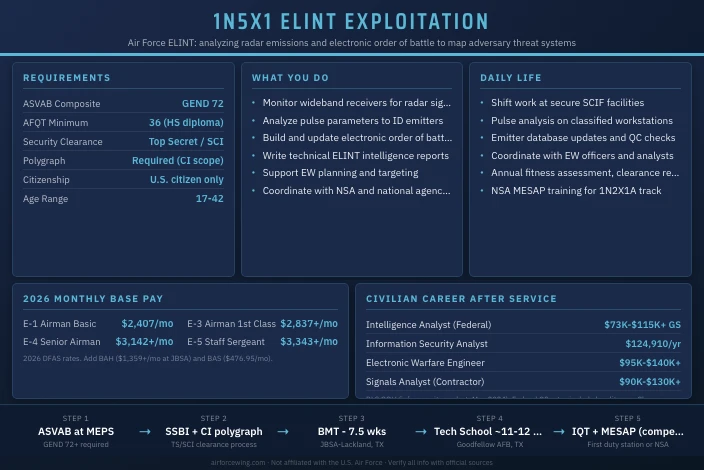
Every surface-to-air missile system, airborne intercept radar, and naval fire control emitter sends out radio frequency signals. The Airmen who specialize in ELINT exploitation. Electronic Intelligence, make it their job to collect those emissions, decode their technical parameters, and build the electronic order of battle that tells commanders exactly what threat systems an adversary has deployed and how they operate. This work is different from broader signals intelligence collection: it is specifically about non-communications emitters, radars and weapon systems, rather than voice or data intercepts. The analytical product is a technical intelligence report, not a transcript.
The career field has a long history under the 1N5X1 AFSC designation. That code was merged into 1N2X1 as part of a consolidation of Air Force SIGINT specialties. Today, Airmen who focus specifically on ELINT exploitation pursue the 1N2X1A shredout, which is awarded after competitive assignment to the National Security Agency’s Military ELINT Signals Analysis Program (MESAP). Understanding this structure is the first step to recruiting into the right track.
Job Role
1N2X1A / 1N5X1-legacy Airmen operate and manage electronic signals intelligence exploitation operations. They collect radar and non-communications emissions across the radio frequency spectrum, analyze signal parameters to identify and characterize adversary emitters, and produce technical intelligence reporting that feeds national threat assessments, electronic warfare planning, and strike targeting packages. Their findings directly shape the countermeasures that protect U.S. aircraft in contested airspace.
Daily Tasks
At a fixed ground station or NSA ELINT facility, the daily work is methodical and deeply technical. Airmen spend significant time at collection and analysis workstations processing incoming signal data. The work varies by assignment, but common tasks include:
- Monitoring wideband receivers across assigned frequency ranges and recording detected signals
- Measuring signal parameters including frequency, pulse width, pulse repetition interval, scan rate, and polarization
- Comparing collected data against classified electronic order of battle (EOB) databases to identify known emitters and flag unknowns
- Writing technical intelligence reports documenting new emitter parameters or changes to existing systems
- Coordinating reporting with NSA, Defense Intelligence Agency (DIA), and other national-level consumers
- Maintaining and troubleshooting signal collection and processing equipment
- Supporting electronic warfare planners who use ELINT data to develop jamming and suppression tactics
In deployed or airborne collection environments, Airmen operate similar equipment but under operational tempo, missions run on defined cycles with pre-mission preparation and post-mission reporting. Some assignments involve working alongside other SIGINT specialists and EW officers to coordinate real-time collection priorities.
Specialized Roles
The ELINT exploitation specialty sits within the broader 1N2X1 career field, with the following designations applicable to ELINT-focused Airmen:
| AFSC Designation | Title | Description |
|---|---|---|
| 1N2X1 | Signals Intelligence Analyst | Base designation, all SIGINT Airmen enter here |
| 1N2X1A | Electronic Non-Communications Analyst | ELINT-specific shredout; awarded upon assignment to NSA MESAP track |
The 1N2X1A shredout is not an entry-level designation. Airmen earn it after selection to the NSA’s Military ELINT Signals Analysis Program, a multi-year advanced training track. Entry-level Airmen begin as 1N2X1 generalists and may specialize into ELINT later in their careers. Some positions hold a legacy identification against the 1N5X1 history in older unit documentation.
Mission Contribution
ELINT fills a gap that no other intelligence discipline can. A communications intercept tells you what an adversary said. A human source tells you what they planned. ELINT tells you what systems they actually have operating in the field, where they are, and how capable they are. The electronic order of battle derived from ELINT collection is the foundation for Air Force electronic warfare planning and directly shapes every mission brief that addresses radar threats in denied airspace. When Air Force aircraft fly into a new operating area, ELINT analysis determines the threat picture they’re flying into.
Technology and Equipment
ELINT exploitation relies on specialized technical collection systems, most of which are classified. The general categories include:
- Wideband receivers and spectrum analyzers that scan radio frequency ranges for emitter activity
- Direction-finding systems that determine the geographic origin of a signal
- Pulse analysis tools that extract precise timing and frequency parameters from radar emissions
- Classified database systems containing the technical signatures of known emitters worldwide
- Signals processing workstations running specialized analysis software
- JWICS and SIPRNet classified network access for coordination with national intelligence agencies
Salary
Base Pay
Pay follows the standard DFAS military pay tables applicable to all Air Force enlisted personnel. A new Airman entering the SIGINT career field begins at E-1 and typically reaches E-4 within three to four years. Getting to this pay grade starts with the ASVAB, and a study guide targeting the General composite is the most efficient preparation before MEPS.
| Grade | Rank | Monthly Base Pay (2026) |
|---|---|---|
| E-1 | Airman Basic (AB) | $2,407 |
| E-2 | Airman (Amn) | $2,698 |
| E-3 | Airman First Class (A1C) | $2,837 - $3,198 |
| E-4 | Senior Airman (SrA) | $3,142 - $3,816 |
| E-5 | Staff Sergeant (SSgt) | $3,343 - $4,422 |
| E-6 | Technical Sergeant (TSgt) | $3,401 - $5,044 |
| E-7 | Master Sergeant (MSgt) | $3,932 - $5,537 |
Base pay is the floor. Most Airmen living off base collect Basic Allowance for Housing (BAH), which depends on duty location and dependent status. A single E-4 at Joint Base San Antonio-Lackland, TX, receives $1,359/month in BAH; the same Airman with dependents receives $1,728/month. Basic Allowance for Subsistence (BAS) adds a flat $476.95/month for all enlisted Airmen.
Special Pay and Bonuses
The Air Force has placed intelligence specialties on its list of high-priority retention career fields. Retention bonuses for SIGINT Airmen, particularly those with 1N2X1A ELINT qualifications and NSA assignments, can reach significant amounts tied to reenlistment commitments. Specific eligibility and bonus amounts change by fiscal year. Confirm current bonus availability with a recruiter before signing any contract.
Additional Benefits
Healthcare: Active-duty Airmen and their dependents receive TRICARE Prime coverage at zero cost. No premiums, no deductibles, and no copays apply to medical, mental health, prescriptions, or hospitalization.
Education: Tuition Assistance covers up to $4,500 per year ($250 per semester hour) for coursework completed while on active duty. After separation, the Post-9/11 GI Bill covers full in-state tuition at public universities with no dollar cap, or up to $29,920.95 per academic year at private schools, plus a monthly housing allowance at the E-5 with dependents BAH rate at the school’s ZIP code, and up to $1,000 annually for books and supplies.
Retirement: The Blended Retirement System (BRS) provides a pension equal to 40% of your high-36 average basic pay at 20 years. The government automatically contributes 1% of basic pay to your Thrift Savings Plan account after 60 days of service and matches up to 4% of additional contributions, for a maximum government contribution of 5% of basic pay.
Work-Life Balance
Active-duty Airmen earn 30 days of paid leave per year, accruing at 2.5 days per month. SIGINT and ELINT units frequently run 24/7 collection operations, which means shift work and rotating schedules are common. Panama-style (12-hour alternating) schedules appear at many fixed sites. NSA-assigned Airmen in the MESAP program operate on a more academic schedule during formal training phases, transitioning to operational shift work during assignment rotations.
Qualifications
Requirements Table
| Requirement | Standard |
|---|---|
| Age | 17-42 at enlistment |
| Citizenship | U.S. citizen (mandatory, no exceptions for SIGINT/ELINT) |
| Education | High school diploma; GED requires AFQT 65+ |
| AFQT Minimum | 36 (HS diploma), 65 (GED) |
| ASVAB Composite | GEND 72 minimum (General composite) |
| Security Clearance | Top Secret / SCI, Tier 5 Investigation required |
| Polygraph | Counterintelligence-scope polygraph required |
| Medical | No record or history of temporomandibular joint (TMJ) pain or disorder |
| Other | No prior drug use; clean financial and foreign contact history |
The GEND composite (General) draws from Word Knowledge, Paragraph Comprehension, and Arithmetic Reasoning subtests. A minimum of 72 is above average for enlisted AFSCs and reflects the analytical and reporting demands of the specialty. Prep your ASVAB reading comprehension and arithmetic sections hardest, those two areas move the GEND score most.
Academic background in electronics, physics, algebra, or trigonometry is listed as desirable in Air Force qualification documents. It won’t substitute for the ASVAB minimum, but Airmen with this background typically progress through the technical training content faster.
Use an ASVAB prep course that covers verbal reasoning and arithmetic before your MEPS appointment. For candidates who have taken the ASVAB before, the PICAT preparation program is worth reviewing.
Application Process
Selection Competitiveness
Entry into the 1N2X1 career field is selective. The ASVAB minimum, TS/SCI investigation, and polygraph requirement eliminate a substantial portion of applicants. Beyond initial accession, selection for the 1N2X1A ELINT track through the MESAP program is highly competitive, annual selection cycles are announced each fall, with reporting dates the following summer. Airmen selected for MESAP receive a three-year active-duty service commitment upon program completion. Prior drug use, complicated foreign contacts, and financial problems are the most common disqualifiers across both the clearance and polygraph stages.
Service Obligation
Standard enlistment in the 1N2X1 career field typically requires a six-year active-duty commitment. MESAP program completion adds a three-year commitment beyond the program end date. Confirm the specific contract terms with your recruiter. Airmen enter service as E-1 Airman Basic and generally arrive at their first duty station as E-3 Airman First Class, depending on college credit and other accelerators.
Work Environment
Setting and Schedule
ELINT exploitation work happens almost entirely indoors, in secure climate-controlled facilities. The work environment varies by assignment type:
| Assignment | Setting | Typical Schedule |
|---|---|---|
| Fixed ground station (NSA, intel squadron) | SCIF; workstations, multiple monitors, classified terminals | 24/7 rotating shifts (Panama or similar) |
| NSA MESAP formal training | NSA campus, Ft. Meade | Structured academic schedule during training phases |
| Airborne ISR platform | Aircraft mission stations | Pre-mission/mission/post-mission cycle; flight schedule-driven |
| Deployed collection element | Forward SCIF or temporary secure facility | Mission-based; tied to collection windows |
Shift work is the norm rather than the exception at fixed sites. Deployed assignments carry mission-based schedules tied to collection windows and supported commander requirements.
Chain of Command and Feedback
ELINT Airmen work within intelligence squadrons or Operations Support Squadrons, typically under an ISR group or a joint intelligence element at NSA-aligned positions. NCOs manage shift scheduling and report production. The mission is largely independent at the Airman level, you make collection decisions in real time, but senior NCOs review finished reports and provide technical mentorship. Enlisted Performance Reports (EPRs) are completed annually, with midterm feedback sessions required. Because the community is small, performance stands out in either direction.
Team Dynamics and Autonomy
Junior Airmen operate under direct supervision while learning emitter libraries and report formats. As you reach E-4 and above, you run independent collection cycles and own the quality of your reporting. The most technically skilled Airmen often become subject-matter experts for specific emitter types or geographic regions, which gives them influence in analytical decisions well beyond their formal rank. That expertise is built through cumulative hours at the collection systems, not through any single course.
Job Satisfaction
ELINT exploitation tends to attract Airmen with genuine interest in the technical side of intelligence. The work rewards persistence, signals don’t always resolve cleanly, and the most valuable products often come from extended analysis of ambiguous data. Retention rates in SIGINT career fields are generally high relative to the broader enlisted force, driven by the unique mission, the clearance’s post-service value, and the professional community that forms among Airmen working on the same complex problems.
Training
Training Pipeline
| Phase | Location | Duration | Focus |
|---|---|---|---|
| Basic Military Training (BMT) | JBSA-Lackland, TX | 7.5 weeks | Military fundamentals, discipline, fitness |
| Electronic Signals Intelligence Course | Goodfellow AFB, TX | ~11-12 weeks | Signal theory, emitter analysis, collection systems, EOB methodology, report writing |
| Initial Qualification Training (IQT) | First duty station | Varies by unit | Mission systems, platform-specific procedures, emitter library development |
An ASVAB study guide focused on verbal reasoning and math is the most direct preparation investment before MEPS. After the MEPS qualification, the training pipeline itself is challenging but structured.
Advanced Training and Development
The career field’s most significant advanced development path is the NSA MESAP program:
- MESAP (Military ELINT Signals Analysis Program): Multi-year advanced ELINT training at NSA/CSS, combining formal academic coursework and individually tailored operational assignments. Acceptance into MESAP results in award of the 1N2X1A shredout. Annual selection is competitive and requires a strong performance record, supervisor endorsement, and clearance currency.
- Middle Enlisted Cryptologic Career Advancement Program (MECCAP): Multi-year internship at NSA for mid-career 1N Airmen across several SIGINT career fields, including ELINT specialists.
- Airborne platform qualifications: Some ELINT Airmen receive assignment to airborne ISR platforms, earning aircrew status and flight pay while conducting airborne collection missions.
- Advanced signal analysis courses: Additional classified technical training tied to specific emitter families or geographic collection requirements.
- Collegiate education: Tuition Assistance supports off-duty degree programs. Electrical engineering, computer science, and physics degrees complement ELINT technical skills and improve competitive standing for MESAP selection.
Career Progression
Rank Progression
| Rank | Grade | Typical Time at That Level |
|---|---|---|
| Airman Basic (AB) | E-1 | BMT; exits as E-2 upon graduation |
| Airman (Amn) | E-2 | ~6 months from enlistment |
| Airman First Class (A1C) | E-3 | ~16 months total service |
| Senior Airman (SrA) | E-4 | ~3 years total service (or below-the-zone earlier) |
| Staff Sergeant (SSgt) | E-5 | ~6 years total service (competitive board) |
| Technical Sergeant (TSgt) | E-6 | ~11 years total service (competitive) |
| Master Sergeant (MSgt) | E-7 | ~17 years total service (highly competitive) |
| Senior Master Sergeant (SMSgt) | E-8 | ~20+ years (very competitive) |
| Chief Master Sergeant (CMSgt) | E-9 | ~22+ years (extremely competitive) |
Promotions to E-5 and above are competitive. The Air Force scores promotion boards on EPRs, decorations, time in grade, fitness scores, and education. In SIGINT career fields, documented technical expertise and diverse assignment history carry significant weight because the community is small enough that individual performance is visible.
Specialization and Role Flexibility
ELINT Airmen with strong technical records can pursue the MESAP assignment at NSA, which fundamentally changes the career trajectory toward deep technical expertise and advanced analytical leadership. Senior NCOs often serve as emitter-type specialists or collection managers responsible for coordinating ELINT requirements across multiple units. The Enlisted Commissioning Program (ECP) is available to qualified Airmen who complete a bachelor’s degree; the 14N Intelligence Officer and 17D Cyberspace Operations Officer career fields are natural commission paths for SIGINT-experienced Airmen.
Performance Evaluation
The Enlisted Performance Report (EPR) system rates Airmen on a five-point scale. A rating of 5 (“Exceeds Standards”) is the only score that meaningfully advances promotion board competitiveness. EPR narratives for ELINT Airmen require precision: conveying operational impact without revealing classified collection details demands skill in writing factually accurate bullets within classification constraints. Senior raters add institutional context. The most competitive records combine strong EPRs, MESAP or advanced assignment history, relevant education, and a documented pattern of mentoring junior Airmen.
To succeed in this career: seek MESAP selection once you’re eligible, pursue a technical degree through Tuition Assistance, volunteer for airborne or joint collection assignments, and document every significant collection product you contribute to.
Physical Demands
Daily Physical Requirements
ELINT exploitation is not a physically demanding job in daily operations. The work is sedentary, workstations, screens, and analysis equipment in secure facilities. Deployed assignments add some variability depending on the operating environment, but the core collection and analysis function remains office-based.
The Air Force Fitness Assessment applies to all Airmen regardless of AFSC, and fitness scores factor into promotion consideration.
Air Force Fitness Assessment Standards
All Airmen take the Fitness Assessment annually. The assessment uses a 100-point scale across four components. Minimum passing composite score is 75, and each component carries its own minimum standard.
| Component | Maximum Points |
|---|---|
| 1.5-Mile Run | 60 |
| Push-Ups (1 minute) | 10 |
| Sit-Ups (1 minute) | 10 |
| Waist Circumference / Body Composition | 20 |
Standards are age- and gender-normed. Scoring 90 or above earns an “Excellent” rating. Failing any single component fails the overall assessment regardless of composite score.
Medical Evaluations
Standard Air Force accession medical screening at MEPS applies. The specific disqualifier for ELINT and SIGINT specialties is a history of temporomandibular joint (TMJ) pain or disorder, this affects hearing and the ability to work with headset-based collection equipment. Ongoing periodic medical readiness evaluations continue throughout service. TS/SCI holders undergo clearance reinvestigation approximately every five years.
Deployment and Duty Stations
Deployment Patterns
SIGINT and ELINT specialties are deployable. Airmen support Air Expeditionary Force rotations, joint task forces, and theater-level collection elements. Fixed ground station assignments tend to have lower individual deployment frequency; airborne and forward-positioned collection assignments run at higher operational tempo. Typical deployment rotations run 90 to 180 days. During elevated operational demand, frequency can increase. Working with national agencies like NSA may involve assignments to joint forward elements for defined periods rather than traditional deployment cycles.
Duty Stations
ELINT Airmen cluster at installations with ISR and intelligence missions. Common locations include:
- Fort Meade, MD: NSA headquarters; home of MESAP and advanced ELINT training
- Goodfellow AFB, TX: Initial training and some permanent party intelligence positions
- Langley AFB / Joint Base Langley-Eustis, VA: ACC intelligence functions
- Offutt AFB, NE: Strategic intelligence and global ISR support
- Hickam Field / JBPHH, HI: Indo-Pacific intelligence support
- Ramstein AB, Germany: European theater ISR and intelligence operations
- Kadena AB, Japan: Pacific theater SIGINT and ELINT collection
- Various forward locations in CENTCOM, INDOPACOM, and EUCOM areas of responsibility
Duty station assignments are submitted through the Air Force Personnel Center (AFPC). A Stated Preference, Assignment Availability Code, and assignment history all factor into placement. Geographic flexibility across your career improves access to the most operationally significant ELINT positions.
Risk, Safety, and Legal Considerations
Job Hazards
For most ELINT Airmen, occupational hazards fall into several categories:
- Physical/ergonomic: Extended periods at workstations, repetitive strain from sustained keyboard and mouse use, and irregular sleep cycles from rotating shift schedules
- Cognitive: Sustained analytical concentration over long shifts where a missed signal parameter or incorrect report could corrupt threat databases used by operational units
- Deployed environment: Forward operating locations add indirect fire risk, travel in austere conditions, and reduced medical access compared to garrison assignments
- Counterintelligence exposure: ELINT collection is a high-value intelligence activity, and adversary counterintelligence operations actively target SIGINT personnel and facilities. Security awareness is an active professional requirement, not a background formality
Safety Protocols
SIGINT facilities enforce multiple layers of security and safety:
- SCIF physical security with biometric or badge-controlled access
- Need-to-know access controls for specific collection programs
- Communications security (COMSEC) protocols governing all collection and reporting activity
- Annual security refresher training mandatory for all TS/SCI-cleared personnel
- Insider threat awareness programs and anomaly reporting systems active at all SIGINT facilities
Security Clearance and Legal Obligations
This career field requires a Top Secret clearance with Sensitive Compartmented Information access (TS/SCI), obtained through a Tier 5 Investigation. A counterintelligence-scope polygraph is mandatory before SCI access is granted. Clearance reinvestigation occurs approximately every five years.
The SF-312 Non-Disclosure Agreement is a binding legal obligation that persists after separation. Your obligation to protect classified information does not end when you leave the Air Force, it continues for life. Unauthorized disclosure of classified material is prosecutable under the Espionage Act and UCMJ regardless of intent or time elapsed. Consequences include federal imprisonment, forfeiture of government retirement benefits, and permanent clearance revocation.
Impact on Family and Personal Life
Family Considerations
SIGINT work carries the same classification constraints as other intelligence specialties. You cannot discuss your collection targets, specific technical work, or operational details with family members or friends outside the cleared community. This is permanent, not temporary, and it can be challenging for families who want to understand what you do.
Key lifestyle factors for ELINT families:
| Factor | Impact | Support Available |
|---|---|---|
| Classification constraints | Cannot discuss work details at home; permanent, not temporary | A&FRC, Military Family Life Counselors |
| Shift work | Nights, weekends, holidays on rotating schedules | Deliberate family schedule planning; unit support programs |
| PCS frequency | Every 2-4 years; clustering at SIGINT-heavy installations | Dislocation Allowance, A&FRC relocation assistance |
| Social network | Cleared-community social circles at installations like Ft. Meade | Larger SIGINT communities reduce isolation from classification constraints |
The Air Force supports families through the Airman and Family Readiness Center (A&FRC) at each installation, Military OneSource, and Military Family Life Counselors. Families at SIGINT-heavy installations like Fort Meade often have the advantage of a larger cleared-community social network, which can reduce the isolation that classification constraints sometimes create.
Relocation
PCS moves occur every two to four years. The Air Force pays moving costs through the Permanent Change of Station allowance and provides a Dislocation Allowance (DLA). ELINT positions concentrate at specific installations. Fort Meade, Langley, Offutt, and overseas Pacific and European theaters, so some geographic clustering is likely across a career. Spousal employment support is available through the installation AFRC, and the Interstate Compact on Educational Opportunity for Military Children eases school enrollment for families with children in mid-year PCS moves.
Reserve and Air National Guard
Component Availability
The 1N2X1 SIGINT career field exists in both the Air Force Reserve and Air National Guard, but ELINT-focused positions are limited and not uniformly available across units. Reserve and Guard intelligence positions tend to concentrate at wings with established ISR missions or formal NSA partnership relationships. Contact an Air Force Reserve or Guard recruiter directly to confirm whether an ELINT billet exists in your region before planning around this specialty.
Drill Schedule and Training Commitment
Standard Reserve and Guard commitment is one weekend per month (Unit Training Assembly) plus two weeks per year (Annual Tour). SIGINT specialties carry additional training requirements beyond the standard drill calendar, including annual refresher training to maintain technical currency and TS/SCI clearance compliance. Some MESAP-qualified 1N2X1A Airmen in the Reserve maintain NSA relationships that require additional on-site training periods above the standard drill schedule.
Part-Time Pay
A Reserve or Guard E-4 earns pay for four Unit Training Assemblies per drill weekend. At the 2026 DFAS rate of $3,142 to $3,816/month for E-4, a single drill weekend yields approximately $421 to $512 in base pay. BAH and BAS are not included on standard drill weekends unless the member is on orders.
Component Comparison
| Factor | Active Duty | Air Force Reserve | Air National Guard |
|---|---|---|---|
| Commitment | Full-time | 1 wknd/mo + 2 wks/yr | 1 wknd/mo + 2 wks/yr |
| Monthly Base Pay (E-4) | $3,142 - $3,816 | ~$421 - $512/drill wknd | ~$421 - $512/drill wknd |
| Healthcare | TRICARE Prime (free) | TRICARE Reserve Select (premiums apply) | TRICARE Reserve Select (premiums apply) |
| Education | TA up to $4,500/yr + full GI Bill after service | Federal TA + partial GI Bill | State tuition waivers vary + Federal TA |
| Deployment Tempo | Moderate; elevated at NSA billets | Mobilizations every few years | State missions + federal mobilizations |
| Retirement | 20-yr pension (BRS) | Points-based Reserve retirement | Points-based Reserve retirement |
Air National Guard Airmen may qualify for state-specific tuition waivers and the National Guard Educational Assistance Program (Chapter 1606). Benefits vary significantly by state. Check your state adjutant general’s office for current rates.
Reserve and Guard SIGINT Airmen who maintain active TS/SCI clearances through part-time service carry a measurable advantage in the federal contractor job market. USERRA protections apply during mobilizations, and many national security employers actively value Reserve and Guard service in cleared SIGINT positions.
Deployment and Mobilization
Reserve and Guard 1N2X1 Airmen mobilize to support Air Expeditionary Force rotations and joint collection requirements. Frequency for SIGINT specialties is roughly one mobilization every two to three years during normal operational periods, with 90 to 180-day typical rotation lengths. ELINT-qualified Airmen with 1N2X1A credentials may mobilize more frequently when national ELINT collection requirements increase.
Post-Service Opportunities
Transition to Civilian Life
The post-service market for cleared SIGINT and ELINT specialists is strong. TS/SCI clearance, documented technical collection experience, and NSA-aligned training are in consistent demand at the National Security Agency itself, DIA, CIA’s Directorate of Science and Technology, and across the defense contracting sector. The SkillBridge program lets Airmen work for civilian employers during their final 180 days on active duty, providing a direct bridge to post-service employment. The Air Force Transition Assistance Program (TAP) offers resume workshops, federal hiring guidance, and separation counseling through the installation Military OneSource program.
Airmen who complete technical degrees through Tuition Assistance while serving, particularly in electrical engineering, computer science, or physics, leave service as stronger candidates for GS-12 and GS-13 federal positions. Cleared contractor roles for ELINT analysts in the Washington, D.C. corridor routinely offer compensation substantially higher than federal GS salaries for personnel with demonstrated NSA-caliber analytical experience.
Civilian Career Prospects
| Civilian Career | Median Annual Wage | Job Outlook |
|---|---|---|
| Intelligence Analyst (Federal GS) | GS-11 to GS-13 ($73K - $115K+, varies by locality) | Consistent demand at NSA, DIA, CIA, NRO |
| Information Security Analyst | $124,910 | +29% (2024-2034), per BLS Occupational Outlook Handbook |
| Electronic Warfare Engineer (Contractor) | $95,000 - $140,000+ | Strong demand in cleared defense sector |
| Computer Systems Analyst | $103,800 | +11% (2024-2034), per BLS |
| Signals Analyst (NSA / CISA contractor) | $90,000 - $130,000+ | Active recruitment of cleared SIGINT veterans |
Federal intelligence positions use the GS pay system. Locality pay for the Washington, D.C. area adds roughly 33% above base GS rates. A TS/SCI clearance alone is estimated to add 20-30% to a contractor salary compared to similar roles in the uncleared commercial sector.
The Community College of the Air Force (CCAF) awards an Intelligence Studies and Technology associate degree based on Tech School credits, which counts toward bachelor’s degree completion at most colleges.
Is This a Good Job
Ideal Candidate Profile
The 1N5X1 / 1N2X1A ELINT track fits people who think analytically, have genuine curiosity about how technical systems work, and can sustain attention on detailed, repetitive analytical work without losing precision. The job rewards the type of person who finds signal analysis genuinely interesting rather than merely tolerable, because hours of emitter monitoring produce, at best, incremental findings that accumulate into something significant over time.
| Trait | Why It Matters for ELINT |
|---|---|
| Analytical thinking | Signal parameters require precise measurement and cross-referencing against classified databases |
| Math/science aptitude | Radar physics, frequency analysis, and orbital mechanics underpin the technical work |
| Documentation discipline | An incorrect pulse parameter in a report could corrupt threat databases used by operational units |
| Sustained attention | Hours of emitter monitoring produce incremental findings that accumulate over time |
| Curiosity about technical systems | Understanding how emitters work makes analysis meaningful rather than mechanical |
Strong math and science aptitude are assets. The GEND 72 requirement is a verbal reasoning benchmark, but Airmen who progress fastest in ELINT typically combine verbal ability with comfort around physics-level technical concepts. An understanding of how radar systems work, how frequency, power, and scan patterns relate to the tactical purpose of an emitter, makes the analysis meaningful rather than mechanical.
Potential Challenges
Shift work is a persistent lifestyle factor. Extended periods at fixed collection stations, often with irregular hours, suit some people well and wear others down over time. If you need predictable evening and weekend schedules, ELINT and SIGINT careers are not an easy fit.
The clearance is both a benefit and a constraint. It creates strong civilian earning potential after service, but it also means your personal life is continuously subject to scrutiny. Financial problems, foreign contacts, and certain personal associations that wouldn’t affect most careers can terminate yours. That accountability is continuous, not one-time.
Deployment frequency is moderate, but the missions are often at locations that are not on most people’s preference lists. NSA assignments at Fort Meade are desk-work intensive. Forward ELINT collection positions can be austere.
Career and Lifestyle Alignment
This is a strong match for someone drawn to the technical intersection of intelligence and electronic warfare, who values post-service career options in national security, and who can live within the classification constraints that define the lifestyle. The combination of technical depth, ELINT-specific expertise, and an active TS/SCI clearance represents one of the more consistently employable profiles in the defense contracting sector.
It’s a harder match for someone who wants to easily explain their work at a family dinner, who needs geographic flexibility across their career, or who dislikes shift-based schedules. The analytical nature of the work also means that people seeking frequent visible action may find the daily rhythm unsatisfying.
More Information
Talk to an Air Force recruiter to confirm current accession options for the 1N2X1 career field and whether direct accession with an ELINT track preference is available in the current recruiting cycle. Bonus eligibility, training seat availability, and MESAP program specifics change by fiscal year. Find a recruiter at airforce.com or contact your local recruiting station directly.
Your GEND composite is the first gate. An ASVAB study guide targeting verbal reasoning and reading comprehension is the most direct preparation before your MEPS appointment.
Official Resources
- Air Force Personnel Center (AFPC): Assignments, bonus programs, and career field manning for 1N2X1
- Goodfellow AFB, 17th Training Wing: Home of the Electronic Signals Intelligence course and primary Air Force intelligence training installation
- NSA Careers: The primary employer of 1N2X1A ELINT Airmen through the MESAP program
- DFAS Military Pay Tables: Current-year base pay for all enlisted grades
- Community College of the Air Force: Tech School credit toward an Intelligence Studies and Technology associate degree
- Air Force Transition Assistance Program (TAP): Separation counseling and civilian employment support
This site is not affiliated with the U.S. Air Force or any government agency. Verify all information with official Air Force sources before making enlistment or career decisions.
Explore more Air Force intelligence careers such as the 1N2X1 Signals Intelligence Analyst and 1N8X1 Targeting Analyst.