1N4X1 Fusion Analyst
The Air Force calls it intelligence. Commanders call it survival. Fusion Analysts are the people who turn raw signals, network traffic, and intercepted communications into answers that drive real decisions. If an adversary is planning something, a 1N4X1 is likely one of the first people to know.
This isn’t a job where you move equipment or fly aircraft. You work inside a Sensitive Compartmented Information Facility (SCIF), pulling threads from multiple intelligence streams and producing assessments that reach the highest levels of command. The technical bar is high, the clearance requirements are serious, and the training pipeline is longer than most enlisted jobs. But Airmen who make it through build skills that are in demand everywhere from the NSA to the private sector.
Qualifying requires specific ASVAB line scores. Our ASVAB study guide covers what to target and how to prepare.
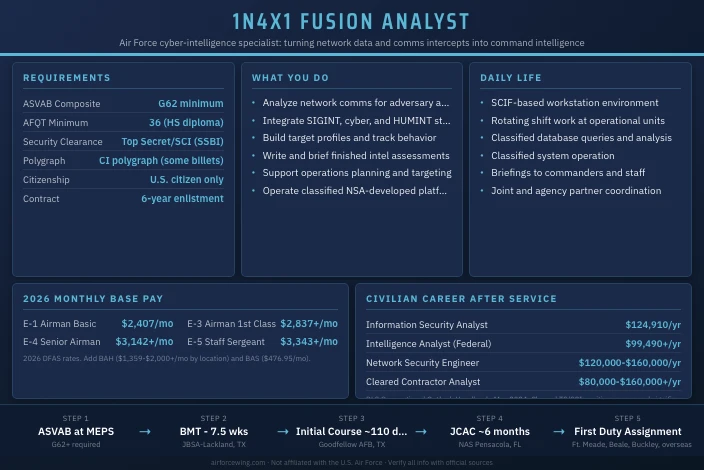
Job Role
Fusion Analysts collect and analyze intelligence from target network communications to identify adversary activity, assess intent, and deliver findings to decision-makers. They integrate data from multiple intelligence disciplines, including signals, cyber, and human sources, to produce finished intelligence products used in operations planning, targeting, and threat assessment.
What Fusion Analysts Do Day to Day
The core task is combining information from different collection sources and making sense of it. On a typical shift, that means monitoring network activity, running queries against intelligence databases, and writing assessments that strip out noise and surface what matters. You’ll also build target profiles, track patterns of activity over time, and brief supervisors or commanders on what you’ve found.
Depending on assignment, the work can lean toward cyber threat analysis, counterterrorism, or foreign military intelligence. The common thread is synthesis: taking data from multiple sources and producing a coherent picture when no single source tells the full story.
Specializations and Shredouts
The 1N4 career field splits into two tracks after the initial shared training at Goodfellow AFB:
| AFSC Code | Shredout | Focus Area |
|---|---|---|
| 1N4X1A | Signals/Communications Intelligence | SIGINT collection, network traffic analysis |
| 1N4X1B | Cyber Intelligence | Digital network exploitation, malware analysis, adversary infrastructure |
Both shredouts require the same entry qualifications, but the downstream training and assignment patterns differ. Your assigned shredout depends on Air Force needs and your aptitude scores coming out of the entry course.
Mission Contribution
Every military operation depends on intelligence to allocate forces, time strikes, and avoid surprises. Fusion Analysts sit at the intersection of collection and command. When a combatant commander needs to know whether a network anomaly represents a threat or noise, that answer comes from this career field. The fusion piece is literal: 1N4X1s combine inputs that no single analyst from a narrower specialty could connect alone.
Technology and Equipment
Work happens inside classified networks on government-provided hardware. Analysts use NSA-developed tools, Air Force intelligence platforms, and classified databases that aren’t referenced publicly. Proficiency in pattern analysis, database queries, and technical reporting is built during training and refined on the job. You won’t learn these tools in a civilian setting before you enlist.
Salary
Base pay follows DFAS military pay tables and is the same across all branches. These are 2026 rates.
| Rank | Grade | Starting Monthly Pay |
|---|---|---|
| Airman Basic | E-1 | $2,407 |
| Airman First Class | E-3 | $2,837+ |
| Senior Airman | E-4 | $3,142+ |
| Staff Sergeant | E-5 | $3,343+ |
| Technical Sergeant | E-6 | $3,401+ |
Base pay is only part of total compensation. Add the Basic Allowance for Subsistence (BAS) of $476.95/month for food, plus Basic Allowance for Housing (BAH) based on your duty location and dependency status. At Joint Base San Antonio-Lackland, an E-4 without dependents receives approximately $1,359/month in BAH. At higher-cost installations like Fort Meade, MD, BAH runs significantly higher.
Additional Benefits
TRICARE Prime covers medical, dental, vision, and prescriptions at no cost on active duty. Retirement through the Blended Retirement System (BRS) includes a pension at 20 years (40% of your average high-36 months of base pay) plus automatic Thrift Savings Plan (TSP) contributions. The government contributes up to 5% of base pay into your TSP when you contribute at least 5%.
Education benefits include Air Force Tuition Assistance, which covers up to $4,500 per year toward college courses while serving. The Post-9/11 GI Bill covers full in-state tuition at public schools plus a monthly housing allowance after separation.
Work-Life Balance
Active-duty Airmen earn 30 days of paid leave per year. Intelligence units often run shift schedules, particularly at operational commands, which can mean rotating day/night cycles. At some assignments the schedule is relatively standard; at high-tempo units, 50-plus-hour weeks during elevated threat periods aren’t unusual.
Preparing for the ASVAB is the first real step toward this career. A strong General score opens the door to competitive intelligence and cyber AFSCs that offer some of the best post-service career transitions in the enlisted force.
Qualifications
| Requirement | Details |
|---|---|
| Minimum ASVAB Score | General (G) 62 |
| Security Clearance | Top Secret with SCI access (SSBI required) |
| Polygraph | CI polygraph may be required for some assignments |
| Citizenship | U.S. citizen only |
| Education | High school diploma or GED (GED requires AFQT 65+) |
| Age | 17-42 at time of enlistment |
| Vision | Correctable to 20/20 acceptable; no color vision waiver |
| Medical | PULHES standards per AFI 36-2101; no disqualifying conditions |
The AFQT minimum for Air Force enlistment is 36 with a high school diploma. The 1N4X1-specific requirement is the General composite score of 62, which combines Word Knowledge, Paragraph Comprehension, Arithmetic Reasoning, and Mathematics Knowledge. This is one of the higher score thresholds in the enlisted force, reflecting the analytical demands of the job.
Security Clearance Process
A Top Secret clearance with access to Sensitive Compartmented Information (SCI) is mandatory. This requires a Single Scope Background Investigation (SSBI), which covers finances, foreign contacts, drug use, criminal history, and psychological screening going back a decade or more. Expect the investigation to take six months to a year or longer. Any significant derogatory information, foreign contacts, or financial problems can delay or disqualify.
The security clearance investigation starts early in the enlistment process. Applicants with significant foreign contacts, recent drug use, or serious financial problems should discuss these with a recruiter before testing. Waivers exist for some issues, but the TS/SCI threshold is strict.
Application Process
The 1N4X1 requires a 6-year enlistment contract due to the extended training pipeline. Most enlisted jobs require four years; the additional two years reflect the time and cost the Air Force invests in clearance processing and follow-on training.
Selection Competitiveness
This AFSC is modestly competitive. The G62 requirement filters out a significant portion of applicants, and slots are constrained by security clearance timelines and billet availability. Demonstrating academic strength in math, science, or a technical subject and having no significant financial or legal history will strengthen your application.
See our ASVAB study guide for strategies to hit these line scores, or take the PiCAT from home if you are a first-time tester.
Work Environment
Fusion Analysts work almost entirely indoors in SCIFs. There is no flight line exposure, no heavy equipment, and no outdoor physical labor tied to the daily mission. The work environment is controlled but not quiet in the way an office is: intelligence units run around the clock, and the atmosphere during high-threat periods can be intense.
Schedule and Shifts
Many 1N4X1 units operate on rotating shift schedules, covering 24/7 operations. Panama schedules (two-day/two-night/four-off rotation) are common at operational intelligence squadrons. At staff-level positions or training units, a more standard Monday through Friday schedule is possible. Expect shift work, especially at your first duty assignment.
Team Dynamics
Fusion Analysts work in teams, often alongside officers, contractors, and personnel from other intelligence specialties. Individual work and collaborative production both matter. You’ll be expected to brief your findings verbally and in writing; clear communication is part of the job, not an afterthought.
Autonomy and Decision-Making
Junior Airmen follow established collection and reporting procedures. As you promote and build experience, there’s more latitude in how you approach analytical problems, which sources you prioritize, and how you structure your assessments. Senior NCOs often own the relationship with supported units and have significant influence over how the shop operates.
Job Satisfaction
Intelligence work tends to attract people who like solving puzzles under pressure. The clearance and the classified nature of the work create a sense of purpose and exclusivity that many Airmen report as a motivator. The main friction points are shift work and, at high-demand units, sustained operational tempo. Retention in intelligence AFSCs has historically been lower than average due to strong civilian hiring of clearance-holders.
Training
| Phase | Location | Length | Focus |
|---|---|---|---|
| Basic Military Training (BMT) | JBSA-Lackland, TX | 7.5 weeks | Military fundamentals |
| 1N4X1 Initial Skills Course | Goodfellow AFB, TX | ~110 days | Intelligence analysis, collection fundamentals, systems |
| Joint Cyber Analysis Course (JCAC) | Pensacola, FL (NAS Pensacola) | ~6 months | Cyber threat analysis, network forensics, advanced tools |
| First Duty Assignment | Various | Ongoing | On-the-job qualification and skill level upgrade |
The full pipeline from BMT completion to qualified, cleared analyst at a first duty station typically runs 12 to 15 months, depending on clearance adjudication timing. JCAC is a joint school, meaning you’ll train alongside personnel from other services and potentially civilian intelligence community members. It’s technically demanding and academically rigorous.
Advanced Training
After establishing in your first assignment, 1N4X1s can pursue advanced training tied to specific platforms, collection techniques, or analytical methods. Leadership development programs, NCO academies, and professional military education (PME) continue through the career. Some senior analysts attend professional development courses at the National Intelligence University or joint intelligence schools. Commissioning programs are available for exceptional NCOs who meet officer education requirements.
JCAC is a significant technical training investment. Airmen who arrive with a background in networking, programming, or computer science typically find the material more manageable. Self-study in network fundamentals before you ship can make a real difference.
Everything starts with qualifying ASVAB scores. Our study guide covers what to study first.
Career Progression
| Rank | Grade | Typical Timeline | Role |
|---|---|---|---|
| Airman Basic | E-1 | Entry | BMT and Tech School |
| Airman | E-2 | ~6 months | Tech School completion |
| Airman First Class | E-3 | ~16 months | Early assignment, 3-skill level tasks |
| Senior Airman | E-4 | ~3 years | Full duty performance, 5-skill level upgrade |
| Staff Sergeant | E-5 | ~5 years | Team lead, section supervision |
| Technical Sergeant | E-6 | ~10-13 years | Flight chief functions, production oversight |
| Master Sergeant | E-7 | ~16-20 years | Senior NCO, unit-level leadership |
Promotion to Senior Airman is relatively fast; competition increases significantly at Staff Sergeant and above. Promotion boards evaluate performance reports (EPRs), decorations, professional military education completion, and community involvement.
Performance Evaluation
The Enlisted Performance Report is the primary career document. EPRs use a five-tier rating scale, with the top tier reserved for a small percentage of the eligible population. Strong EPRs require documented specific accomplishments with measurable impact, not vague descriptions of duties. Senior NCOs write bullets that quantify outcomes: missions supported, products delivered, personnel trained. Those numbers matter.
Succeeding in This Career
Analytical rigor and clear writing are what separate good Fusion Analysts from great ones. Get comfortable writing concise, structured assessments early. Learn the classified databases deeply; most of the job is knowing where to look and what to ask. Build relationships across the intelligence community because the 1N4X1 mission depends on collaboration with other specialties and agencies. Promote early and consistently by taking on duties beyond your job description, finishing PME ahead of schedule, and volunteering for high-visibility taskings.
Physical Demands
The 1N4X1 job itself has minimal daily physical demands. Work is sedentary and desk-based inside a SCIF. But all Airmen must meet Air Force fitness standards regardless of career field.
| Fitness Assessment Component | Maximum Points | Min Score (Under 25, Male) | Min Score (Under 25, Female) |
|---|---|---|---|
| 1.5-Mile Run | 60 | Must pass (component minimum) | Must pass (component minimum) |
| Push-Ups (1 min) | 10 | Must meet minimum | Must meet minimum |
| Sit-Ups (1 min) | 10 | Must meet minimum | Must meet minimum |
| Waist Circumference | 20 | Must meet maximum | Must meet maximum |
| Composite Passing Score | 100 | 75 | 75 |
The Air Force Fitness Assessment is scored on a 100-point scale. A passing composite score is 75, and each component must meet its individual minimum. Standards are age- and gender-normed. Assessments are annual for most Airmen.
Medical Standards
A current SSBI clearance investigation includes a psychological evaluation component. Beyond the initial MEPS physical, periodic medical reviews are standard. Airmen with significant vision problems should ensure their condition is correctable to 20/20, as clearance-bearing intelligence positions often have specific visual standards. Check with a recruiter for current vision waiver guidance specific to this AFSC.
Deployment
Fusion Analysts deploy, but at a lower rate than combat-oriented AFSCs. The nature of the work means some missions are accomplished remotely without deploying personnel forward. When deployments occur, they tend to be 90 to 180 days in support of operational commands, often to Air Operations Centers or combined intelligence fusion elements in theater.
Shredout can influence deployment patterns. 1N4X1A (Signals/Communications Intelligence) Airmen may deploy in direct support of signals collection operations, while 1N4X1B (Cyber Intelligence) specialists are more commonly deployed to support cyber task forces and joint information operations elements. Both shredouts deploy less frequently than combat AFSCs, but deployment possibilities are real and should factor into career planning.
Where You’ll Be Stationed
The 1N4X1 AFSC is concentrated at installations with major intelligence missions. Common duty stations include:
| Installation | Location | Mission |
|---|---|---|
| Fort George G. Meade | Maryland | NSA/CSS proximity, national-level SIGINT |
| Beale AFB | California | 9th Reconnaissance Wing, ISR support |
| Buckley Space Force Base | Colorado | Space-based collection, intelligence fusion |
| Kadena AB | Japan | Pacific theater hub, primary OCONUS assignment |
| Ramstein AB | Germany | European theater intelligence |
| Langley AFB | Virginia | Air Combat Command intelligence support |
Assignment is based on Air Force needs and skill level, with some input from Airmen through the Assignment Management System (AMS) preference process. The career field has fewer available bases than generalist AFSCs, so flexibility in preferred location is important. Airmen who are willing to go OCONUS to Kadena or Ramstein generally have more assignment options than those who restrict preferences to CONUS only.
First-assignment locations are typically determined by training pipeline completion timing and unit manning gaps rather than applicant preference. Preference submissions carry more weight after your first PCS.
Risk/Safety
The occupational risks for 1N4X1 are primarily classified in nature rather than physical. Working with Top Secret/SCI information carries significant legal responsibility. Unauthorized disclosure, even inadvertent, can result in criminal prosecution under the Espionage Act and separation from the Air Force.
Security Obligations
Classified information handling is governed by strict need-to-know and access protocols. Violations, even minor ones, can result in security clearance revocation, which effectively ends the career field assignment. Security violations are taken seriously at all levels. Airmen are trained extensively on proper handling procedures and sign binding non-disclosure agreements.
A CI polygraph may be required for access to specific programs or assignment to particular units. These are different from the initial SSBI and can occur at any point in the career. Failing or refusing a CI polygraph can result in loss of access to specific programs, which may limit assignment options and promotion competitiveness.
Ongoing Legal Obligations
The non-disclosure agreements signed at enlistment and during any program access grants remain legally binding after separation from the Air Force. There is no expiration date. Discussing classified information with anyone who does not have a verified current need-to-know, including former colleagues who have left the service, violates these agreements.
Information covered by these obligations includes not just the content of intelligence reports, but also the methods, systems, locations, and personnel involved in collection and analysis. Over-sharing in casual conversation, in private writing, or on social media platforms is a recurring source of security violations by veterans in intelligence career fields. Annual security briefings during service reinforce these boundaries.
Any contact from individuals seeking information about collection methods or mission details, regardless of how the inquiry is framed, must be reported immediately to the unit security manager.
Deployment Safety
Forward-deployed Fusion Analysts are generally not in direct combat roles, but deployment locations carry inherent risks. Analysts may support operations from defended operating locations but are not typically assigned to small forward bases with high exposure to direct threat. Force protection awareness training is part of pre-deployment preparation for all personnel regardless of role.
Impact on Family
The clearance requirement has a direct effect on family life: foreign national spouses or family members with significant foreign ties can complicate the clearance process and may affect assignment options. This isn’t a disqualifier in all cases, but it needs to be addressed early and honestly with a recruiter. The SSBI investigates the Airman’s foreign contacts, which includes close family members. Spouses may be interviewed as part of the process. Understanding this before enlistment reduces surprises during the investigation.
Shift Work and Home Life
Shift-based operations mean some 1N4X1 Airmen work nights, weekends, and holidays on rotating schedules. During high-threat periods or surge operations, tempo increases and personal time compresses quickly. Families who enter this career field expecting a standard Monday-through-Friday schedule may find the operational reality different from their expectations. At staff-level positions and training units, schedules are more predictable, but those assignments typically don’t occur until mid-career.
The classified nature of the work also means Airmen cannot debrief at home. A spouse asking “how was your day” may get a genuine “I can’t discuss it” as the honest answer. This is not evasion, it’s a legal requirement. Military Family Life Counseling (MFLC) programs, familiar with the intelligence community context, provide confidential support for this dynamic at no cost.
Relocation
Fusion Analyst assignments are concentrated at a limited set of bases, so PCS moves tend to stay within the same small cluster of major intelligence installations. Families who put down roots at one of these locations may find stability over time. Conversely, if family ties to a specific region make remote intelligence bases impractical, the limited assignment pool is worth considering before committing to this AFSC. Kadena AB in Okinawa and Ramstein AB in Germany are OCONUS assignments that come up for mid-career 1N4X1 Airmen, families at these locations can generally find on-base or authorized housing nearby.
Support Systems
Air Force Family Support programs, Airman and Family Readiness Centers, and TRICARE mental health coverage are available at all installations. The demanding work environment of intelligence units, combined with clearance-related restrictions on discussing the job, can create communication barriers at home. Families adjust, but the secrecy that comes with classified work is a real lifestyle factor that’s worth planning for rather than discovering after reporting to the first duty station.
Reserve and Air National Guard
| Factor | Active Duty | Air Force Reserve | Air National Guard |
|---|---|---|---|
| Commitment Model | Full-time | 1 weekend/month + 2 weeks/year | 1 weekend/month + 2 weeks/year |
| Monthly Base Pay (E-4) | $3,142+/mo | ~$785+ per drill weekend | ~$785+ per drill weekend |
| Healthcare | TRICARE Prime (free) | TRICARE Reserve Select (premiums apply) | TRICARE Reserve Select or state programs |
| Education Benefits | Full TA + GI Bill | Federal TA + GI Bill (reduced eligibility) | State tuition waivers (varies by state) + GI Bill |
| Deployment Tempo | Moderate (mission-dependent) | Lower, but mobilization possible | Lower, but mobilization possible |
| Retirement | 20-year active pension (BRS) | Points-based Reserve retirement | Points-based Reserve retirement |
The 1N4X1 is available in both the Air Force Reserve and Air National Guard. Reserve and ANG units with intelligence missions, including cyber and ISR-focused squadrons, do carry this AFSC. Clearance requirements apply equally; Reserve and ANG Airmen must maintain their clearances continuously.
Drill Weekend Differences
Some intelligence units require additional training days beyond the standard one-weekend-per-month schedule, particularly for annual certifications and access renewals tied to classified systems. Prospective Guard and Reserve Airmen should confirm the training tempo with the specific unit before committing.
Civilian Career Integration
The 1N4X1 pairs exceptionally well with civilian careers in cybersecurity, intelligence contracting, and federal law enforcement. An active TS/SCI clearance held through a Reserve or ANG unit dramatically increases a cleared civilian employee’s marketability. Many cleared contractors specifically target Reserve and Guard intelligence analysts because of the clearance and the access it provides. USERRA protections give Guard and Reserve members the right to return to their civilian jobs after mobilization.
Post-Service
The combination of a TS/SCI clearance, intelligence analysis training, and experience with classified networks makes 1N4X1 veterans among the most sought-after veterans in the federal contractor and government agency hiring market.
| Civilian Job Title | Median Annual Salary | Job Outlook (2024-2034) |
|---|---|---|
| Information Security Analyst | $124,910 | +29% (much faster than average) |
| Intelligence Analyst (Federal) | $99,490+ | Stable, high demand |
| Network Security Engineer | $120,000-$160,000 | Strong growth |
| Cleared Defense Contractor Analyst | $80,000-$160,000+ | Varies by clearance level and specialty |
The BLS Occupational Outlook Handbook (May 2024) tracks information security analyst data; federal pay scales vary by agency and grade.
An active TS/SCI clearance alone is worth significant value in the job market. Many cleared positions pay a 20-30% premium over equivalent roles without clearance requirements. Veterans transitioning from 1N4X1 typically do not need to start entry-level: prior experience with intelligence platforms, analysis methods, and reporting procedures translates directly to GS-7 through GS-11 federal positions or equivalent contractor roles.
The Transition Assistance Program (TAP) helps separating Airmen connect with employers and work through the federal hiring process. The NSA, DIA, CIA, and FBI all actively recruit veterans with SCI access.
Is This a Good Job
You’ll thrive as a 1N4X1 if you are:
- Analytically oriented: You like finding patterns in complex data and writing clear explanations of what you found
- Detail-focused: Small errors in intelligence products can have large consequences
- Comfortable with ambiguity: Incomplete information is the norm, not the exception
- Patient with process: Classified work environments have strict rules; some people find them stifling
- Motivated by mission: The work is meaningful but the stakes are real; that motivates some people and weighs on others
The wrong fit looks like this: someone who wants variety in physical environments, dislikes desk-based work, struggles with shift schedules, or has a lifestyle that makes maintaining a TS/SCI clearance difficult.
Potential Challenges
Shift work is the most consistent friction point. Night shifts, weekend coverage, and 24/7 operational demands are realities at most intelligence units. The classified environment also means you can’t discuss your work with family or friends, which is a lifestyle adjustment that affects relationships differently for different people. The 6-year initial contract is a longer commitment than most enlisted jobs, and the specialized nature of the work means there’s less latitude to cross-train early in your career.
Career and Lifestyle Alignment
If your goal is a cleared government or contractor career after the Air Force, few enlisted jobs give you a better foundation. If your goal is early flexibility, a shorter commitment, or a physically active job, this AFSC isn’t the right fit. People who stay in often describe it as genuinely engaging work; the intelligence community is not static, and the threats Fusion Analysts track evolve constantly.
More Information
Talk to an Air Force recruiter before you make any decisions. They can tell you whether slots are open, confirm current bonus status, and walk you through what the clearance process looks like for your specific background. The recruiter can also confirm whether your ASVAB scores qualify you for this AFSC or whether retesting would help.
Questions to Ask Your Recruiter
Before signing, get specific answers to these:
- Are 1N4X1 training seats currently available? JCAC in Pensacola has limited capacity. Slot availability changes with each training cycle.
- What’s the current service obligation for the 6-year contract? The 6-year commitment is standard for this AFSC. Confirm whether any bonus program is attached and what additional obligation that would create.
- What shredouts are currently being assigned? 1N4X1A and 1N4X1B assignments depend on Air Force needs. You may not be able to select your shredout at the time of enlistment.
- What does my background look like for a TS/SCI? Be honest with your recruiter about any foreign contacts, financial issues, or past drug use. They’ve seen complicated backgrounds before and can give you a realistic assessment.
Useful Official Sources
- Air Force Personnel Center, Career field management and assignment information
- National Security Agency: Careers, NSA hiring pathways for intelligence veterans
- Defense Intelligence Agency, Federal civilian hiring for cleared analysts
- Joint Cyber Analysis Course, Information on the joint training pipeline at Pensacola
Start preparing for the ASVAB General composite now with our ASVAB study guide. The G62 minimum is a real filter for this AFSC, going in well above the floor gives you more options at MEPS.
This site is not affiliated with the U.S. Air Force or any government agency. Verify all information with official Air Force sources before making enlistment or career decisions.
Explore more Air Force intelligence careers such as the 1N0X1 All-Source Intelligence Analyst and the 1N2X1 Signals Intelligence Analyst.