1N3X1 Cryptologic Language Analyst
The Air Force sits Airmen in front of foreign-language audio feeds that no one else can decipher and trusts them to turn raw intercepts into intelligence. That’s the job of a 1N3X1 Cryptologic Language Analyst. You study a language from scratch. Arabic, Chinese, Korean, Russian, or several others, at the Defense Language Institute, then spend a career listening to, translating, and analyzing foreign communications for national security customers. The training pipeline is one of the longest in the enlisted Air Force. The security clearance you’ll need is one of the hardest to get. And the civilian demand for cleared military linguists is, year in and year out, exceptionally strong. If you can qualify, this AFSC sets you up for a career that very few people ever have access to.
Qualifying requires specific ASVAB line scores. Our ASVAB study guide covers what to target and how to prepare.
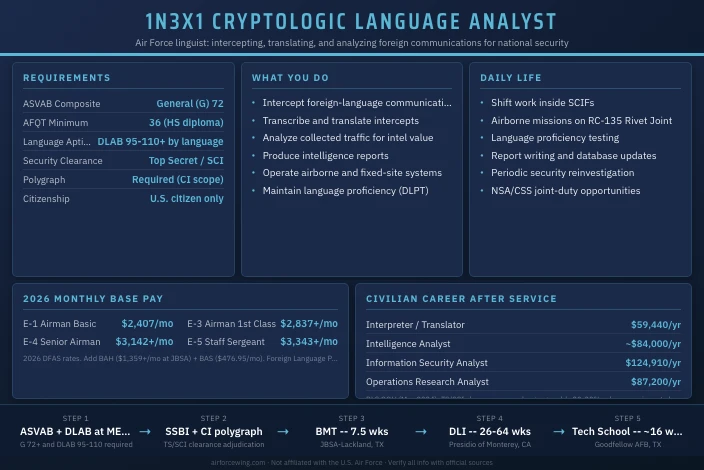
Job Role
The 1N3X1 Cryptologic Language Analyst performs and supervises the collection, transcription, translation, and analysis of foreign-language communications. Airmen in this AFSC intercept voice and graphic transmissions from adversary systems, produce intelligence reports from those intercepts, and support targeting and electronic warfare planning. The work is done at classified facilities, on airborne platforms, or at national-level intelligence sites.
What You Do Every Day
The core task is listening. 1N3X1s monitor assigned frequencies and communication channels, recording transmissions that fall within their collection parameters. Once intercepted, the material is transcribed, translated, and evaluated against existing intelligence databases. If a transmission indicates new activity, a unit moving, a leader communicating, a capability being tested, that analysis goes into a formal report.
Daily work varies by assignment. Fixed-site operators run shifts at secure ground stations, processing large volumes of collected traffic. Airborne mission specialists fly on platforms like the RC-135 Rivet Joint, operating collection equipment in real time and feeding intelligence directly to mission commanders. Some 1N3X1s are assigned to the National Security Agency at Fort Meade, Maryland, supporting national-level collection and reporting.
Specializations and Related Codes
The 1N3X1 AFSC carries language-specific shredouts that appear in your assignment record. Your shredout is determined by the language you train in at DLI. Common languages offered include:
- Arabic
- Chinese (Mandarin)
- Korean
- Russian
- Spanish
- Persian Farsi
- Hebrew
- Pashto
- Urdu
Special Experience Identifiers (SEIs) can be added to your record as you gain proficiency in additional tasks, airborne systems operations, reporting, or technical collection specialties. These identifiers make you more competitive for follow-on assignments and high-demand billets.
Mission Contribution
Cryptologic language work feeds directly into targeting, electronic warfare planning, and strategic warning. When an adversary commander speaks on an unsecured channel, an 1N3X1 is the Airman who captures and translates that conversation. The information may alter a strike package, expose a new capability, or confirm an adversary’s order of battle. Without this AFSC, significant portions of the Air Force’s signals intelligence picture would simply go dark.
Technology and Equipment
1N3X1s operate secure communication intercept equipment, digital recording systems, voice transcription tools, and intelligence production software. On airborne platforms, the equipment is considerably more complex, multi-system collection suites aboard aircraft like the RC-135 require proficiency in both the platform systems and the target language simultaneously. Language analysis tools, including government databases and reporting systems, are common across all 1N3X1 assignments.
Salary
Base Pay and Special Pays
All Air Force enlisted pay comes from DFAS 2026 tables. A new Airman enters as an E-1 and typically reaches E-4 by the time the long 1N3X1 training pipeline finishes. Language proficiency pay is available on top of base pay for qualified linguists.
| Rank | Pay Grade | Monthly Base Pay (Entry) | Monthly Base Pay (4 yrs) |
|---|---|---|---|
| Airman Basic | E-1 | $2,407 | $2,407 |
| Airman | E-2 | $2,698 | $2,698 |
| Airman First Class | E-3 | $2,837 | $3,198 |
| Senior Airman | E-4 | $3,142 | $3,659 |
| Staff Sergeant | E-5 | $3,343 | $3,947 |
| Technical Sergeant | E-6 | $3,401 | $4,069 |
Base pay does not include allowances. Foreign Language Proficiency Pay (FLPP) can add up to $1,000 per month for Airmen who maintain required proficiency scores on the Defense Language Proficiency Test. That bonus alone adds up to $12,000 annually for a qualified SSgt or TSgt.
Allowances and Total Compensation
Every Airman living off base draws Basic Allowance for Housing (BAH), which varies by location and dependency status. A single E-4 at Joint Base San Antonio-Lackland receives $1,359 per month; with dependents, that figure rises to $1,728. Airmen assigned to higher cost-of-living areas draw more. Basic Allowance for Subsistence (BAS) is a flat $476.95 per month for enlisted Airmen in 2026.
Additional Benefits
Active-duty Air Force benefits include:
- TRICARE Prime: zero enrollment fee, zero deductible, zero copays for medical, dental, vision, and prescriptions
- Post-9/11 GI Bill: full in-state tuition at public universities after 36 months of active duty; private school cap of $29,920.95 per academic year
- Tuition Assistance: up to $4,500 per year for college courses taken while on active duty
- 30 days paid leave annually, accruing at 2.5 days per month
- Blended Retirement System: a 20-year pension at 40% of high-36 average basic pay, plus government TSP matching up to 4% of basic pay
Foreign Language Proficiency Pay is a significant income multiplier for 1N3X1s. Maintaining a high DLPT score throughout your career adds meaningful monthly income and is a competitive differentiator for promotion.
Qualifications
Requirements Table
| Requirement | Standard |
|---|---|
| ASVAB Composite | General (G) 72 |
| AFQT Minimum | 36 (HS diploma); 65 (GED) |
| Security Clearance | Top Secret / SCI |
| Polygraph | Required (Counterintelligence scope) |
| Citizenship | U.S. citizen only |
| Age | 17-42 at enlistment |
| Education | High school diploma or GED |
| Language Aptitude | DLAB score required (minimum varies by target language category) |
| Speech | No speech disorders or noticeable communication deficiencies |
| Medical | Normal color vision; no disqualifying hearing loss |
ASVAB and Language Aptitude
Before testing at MEPS, work through the ASVAB study guide to strengthen the Verbal Expression and Arithmetic Reasoning subtests that feed the G composite.
The minimum ASVAB composite is General (G) 72. The G composite draws from Verbal Expression (Word Knowledge and Paragraph Comprehension) and Arithmetic Reasoning. If your practice scores land below 72 on the G composite, spend additional study time on those three subtests before testing at MEPS.
Beyond the ASVAB, 1N3X1 candidates must take the Defense Language Aptitude Battery (DLAB). This test measures your ability to learn a foreign language, not your knowledge of any particular one. The minimum DLAB score to qualify for languages varies by category:
- Category I languages (Spanish): minimum 95
- Category II languages: minimum 100
- Category III languages: minimum 105
- Category IV languages (Arabic, Chinese, Korean): minimum 110
The language you’re assigned at DLI depends on your DLAB score and the Air Force’s current collection requirements. Candidates who want to study Arabic, Chinese, or Korean need the strongest DLAB scores.
Application Process
The selection process for 1N3X1 is more involved than for most enlisted AFSCs. The combination of a high G score, an acceptable DLAB score, and a clean background all have to line up before a contract is offered.
Service Obligation and Entry Rank
First-term 1N3X1 Airmen enter as E-1 Airman Basic and serve a standard initial enlistment. The extended training pipeline means most Airmen reach the fleet as E-3s or E-4s. Because of the investment the Air Force makes in language training, the service obligation for this AFSC is typically longer than the standard 4-year enlistment, confirm the exact obligation with your recruiter at the time of contracting.
Work Environment
Setting and Schedule
The typical work setting depends almost entirely on assignment type. Fixed-site Airmen work inside Sensitive Compartmented Information Facilities (SCIFs), windowless, climate-controlled rooms with no cell phones or internet access. Shift work is standard at collection facilities; you may work nights, weekends, and holidays on a rotating schedule.
Airborne 1N3X1s are assigned to ISR squadrons that fly platforms like the RC-135. Their schedule alternates between ground-based training, mission planning, and actual flight missions that can run 10 or more hours. Deployment tempo is higher for airborne billets.
Some 1N3X1s are assigned to NSA or other national-level agencies, where the environment is more office-like but still inside cleared facilities. These assignments typically come after you’ve built proficiency and a track record at a unit-level billet.
Team Dynamics
Most mission work is done in small shifts of two to six Airmen under a senior NCO shift lead. Teamwork is constant because intercept collection is a shared task, one Airman may capture a transmission while another handles translation and a third writes the report. Individual accountability is high. An error in translation can carry consequences up the intelligence chain.
Your immediate supervisor is a Staff Sergeant or Technical Sergeant who has worked the same collection mission. Feedback on language performance comes regularly, both through unit evaluations and periodic Defense Language Proficiency Tests that you’re expected to pass throughout your career.
Job Satisfaction and Retention
The 1N3X1 AFSC historically shows strong reenlistment rates, driven in part by the significant investment Airmen make in language training and the civilian marketability that comes with a TS/SCI clearance. Airmen who reach the 6-to-8-year mark have logged two or more operational assignments, have a proven clearance, and carry proficiency in a high-demand language, a profile that’s worth significant money in the cleared contractor market.
Training
Training Pipeline Overview
| Phase | Location | Duration | Focus |
|---|---|---|---|
| Basic Military Training (BMT) | JBSA-Lackland, TX | 7.5 weeks | Foundational military skills |
| Defense Language Institute (DLI) | Presidio of Monterey, CA | 26-64 weeks | Target language immersion |
| Tech School | Goodfellow AFB, TX | ~110 days (~16 weeks) | Cryptologic skills, collection systems |
| First Duty Station | Various | Ongoing | Qualification training, IQT |
The total pipeline from BMT through Tech School is one of the longest in the enlisted Air Force. A Cat IV language like Arabic or Chinese adds 64 weeks at DLI alone, meaning a new 1N3X1 can spend close to two years in training before arriving at their first operational unit.
Defense Language Institute
DLI at the Presidio of Monterey is a DoD institution operated by the U.S. Army as executive agent for military foreign language training. Classes run Monday through Friday, often with evening study requirements. The program targets ILR skill level L2/R2/S1+: a reading and listening proficiency level that qualifies Airmen for operational collection work.
Language training at DLI is demanding. Students who fall below proficiency benchmarks may be recycled to a lower-language category or separated from the program. Consistent daily study, outside of classroom hours, is expected and necessary.
Tech School at Goodfellow AFB
Following DLI, Airmen attend Technical School at Goodfellow AFB in San Angelo, Texas. The approximately 110-day program covers:
- Cryptologic systems operation
- Intercept and collection techniques
- Report writing and intelligence production
- Applicable laws and policies governing signals collection
Goodfellow is the Air Force’s primary intelligence training base. Airmen earn college credits through the program, applicable toward Intelligence Studies and Technology degrees.
Advanced Training and Ongoing Development
After reaching their first duty station, 1N3X1s complete unit-level Initial Qualification Training (IQT) on mission-specific systems. Advanced training opportunities include airborne mission specialization, NSA workforce development programs, and language sustainment courses. The Air Force routinely sends linguists back for language refresher training when proficiency drops.
The NSA/CSS runs a 3-year internship program for 1N2XX, 1N3XX, and 1N4XX Airmen. This program provides advanced collection experience and strong career development for mid-career 1N3X1s.
Everything starts with qualifying ASVAB scores. Our study guide covers what to study first.
Career Progression
Rank Progression Table
| Rank | Pay Grade | Typical Time to Achieve | Notes |
|---|---|---|---|
| Airman Basic | E-1 | Entry | BMT entry |
| Airman | E-2 | ~6 months | Automatic |
| Airman First Class | E-3 | ~12 months | Automatic |
| Senior Airman | E-4 | ~36 months | Time-in-grade + fitness |
| Staff Sergeant | E-5 | ~5-7 years | Promotion board |
| Technical Sergeant | E-6 | ~8-12 years | Promotion board |
| Master Sergeant | E-7 | ~14-18 years | Promotion board (competitive) |
| Senior Master Sergeant | E-8 | ~18-22 years | Highly competitive |
| Chief Master Sergeant | E-9 | ~22+ years | Highly competitive |
Promotion to SSgt and above is board-competitive. Airmen who maintain high Defense Language Proficiency Test scores, accumulate diverse operational experience, and score well on Enlisted Performance Reports advance at a stronger rate. Language proficiency is weighted in the 1N3X1 community, it directly affects what billets you can fill.
Specialization and Lateral Moves
Experienced 1N3X1s can pursue additional language training if collection requirements shift, and some Airmen earn proficiency in a second target language over a full career. Lateral retraining into sister AFSCs like 1N2X1 Signals Intelligence Analyst or 1N4X1 Fusion Analyst is possible after your initial obligation. Officer commissioning programs are open to qualified enlisted Airmen; the intelligence officer career field values operational enlisted experience.
Performance Evaluation
The Air Force Enlisted Performance Report (EPR) is the primary promotion document. EPRs are written annually by your rater and reviewed by a senior rater. Stratification statements, language that ranks you among peers, carry significant weight at promotion boards. Strong EPRs for 1N3X1s typically document language proficiency scores, reporting production, mission impact, and leadership of shift operations.
Physical Demands
Daily Physical Demands
The daily physical demands of an 1N3X1 are modest compared to tactical career fields. Most of the work is sedentary, monitoring audio, working at computer stations, writing reports. Airborne 1N3X1s log more physical activity due to mission preparation and the demands of extended flights, but this remains a cognitively intensive rather than physically strenuous AFSC.
Air Force Fitness Assessment Standards (2026)
All Airmen take the Air Force Fitness Assessment annually. Standards are age- and gender-normed. The table below shows minimum passing scores for the under-25 age bracket.
| Component | Maximum Points | Minimum Passing (Male, Under 25) | Minimum Passing (Female, Under 25) |
|---|---|---|---|
| 1.5-Mile Run | 60 | Varies by age/gender (see af.mil) | Varies by age/gender (see af.mil) |
| Push-Ups (1 min) | 10 | 33 reps | 18 reps |
| Sit-Ups (1 min) | 10 | 42 reps | 32 reps |
| Waist Circumference | 20 | Within standards | Within standards |
| Composite | 100 | 75 minimum to pass | 75 minimum to pass |
Verify current component minimums and run time standards at af.mil before your assessment.
Medical Standards
1N3X1 requires normal hearing and no speech disorders, both disqualifying for a job that depends on audio intercept. Standard MEPS physical standards apply at accession, and periodic physicals continue throughout a career. Airborne 1N3X1s who fly on ISR platforms must meet additional flight medicine standards for crew duty.
Deployment
Deployment Patterns
Deployment frequency for 1N3X1 depends heavily on assignment type. Fixed-site Airmen at CONUS installations may deploy on six-month to twelve-month rotations to overseas locations where collection missions are active. Airborne mission specialists have a higher operational tempo, their unit’s flying schedule dictates when and where they go.
Deployments are most commonly to locations in the Middle East, Pacific, and Europe, tracking language-relevant collection priorities. Individual deployments typically run 90 to 180 days for fixed-site operators. Cumulative time away from home over a career is significant and should factor into family planning decisions.
Deployment patterns by language specialty differ significantly:
- Arabic and Persian Farsi specialists frequently support Middle East theater operations, with higher deployment rates than regional peers.
- Chinese and Korean specialists concentrate at Pacific-focused installations, with significant time at OCONUS bases.
- Russian specialists often support European theater missions, with assignments to Germany and potentially other NATO-aligned locations.
Airborne 1N3X1s assigned to RC-135 platforms can expect significantly more cumulative time away from home station than fixed-site operators. These Airmen fly extended missions that may last 10 or more hours, and operational periods can compress multiple missions into a short deployment window.
Duty Stations
Common 1N3X1 duty locations include:
| Installation | Location | Mission Focus |
|---|---|---|
| Goodfellow AFB | Texas | Training base, some operational billets |
| Fort Meade (NSA/CSS) | Maryland | National-level SIGINT collection and reporting |
| Offutt AFB | Nebraska | Strategic intelligence support |
| Misawa AB | Japan | Pacific theater collection, Korean/Chinese specialties |
| Ramstein AB | Germany | European theater, Russian/regional language support |
| Osan AB | South Korea | Korean Peninsula focused collection |
Language proficiency and collection priorities drive assignment availability. Airmen who maintain high DLPT scores and hold sought-after language specialties have more assignment options. The NSA at Fort Meade is one of the larger employers of 1N3X1 Airmen outside of unit-level assignments and is generally available to Airmen with proven proficiency.
Risk/Safety
Job Hazards
Fixed-site 1N3X1 billets carry minimal physical risk. The primary hazard is occupational: extended exposure to audio headsets can cause hearing fatigue or long-term hearing issues if proper hearing protection protocols aren’t followed. Hearing conservation programs are standard at Air Force collection facilities. Audiological exams are part of regular occupational health monitoring for Airmen in this career field, and hearing protection is issued and required during sustained monitoring operations.
Airborne 1N3X1s accept the inherent risks of military aviation. RC-135 crews fly in contested environments during some missions, and the aircraft is large and not highly maneuverable. Mishap rates for Air Force ISR platforms are low, but the risk exists. Extended-duration flights at altitude also carry fatigue-related risks; crew rest regulations and physiological training address these.
Security and Legal Requirements
The Top Secret/SCI clearance required for this AFSC comes with ongoing obligations. You are subject to periodic reinvestigation every five years, lifestyle polygraphs may recur, and foreign contacts or travel must be reported. Violations of security protocols carry severe legal consequences under the Uniform Code of Military Justice.
The Foreign Intelligence Surveillance Act (FISA) and other legal frameworks govern what signals 1N3X1s can collect and how the intelligence is handled. Tech School covers these legal boundaries in detail. Operating outside them is a serious violation, every Airman in this field understands that distinction before they reach an operational unit.
Non-Disclosure Obligations
Non-disclosure agreements signed at the start of 1N3X1 service cover the classified programs, collection methods, and intelligence outputs you work with. These agreements do not expire when you leave the Air Force. Even decades after separation, unauthorized disclosure of classified information from your service remains a federal criminal matter. This is not a formality, it is a standing legal obligation that applies to conversations with family, interviews with journalists, and content posted online. Annual security briefings during service reinforce these boundaries and document that you’ve been informed of your obligations.
Any contact from someone seeking information about your work, whether a recruiter for an unknown contractor, a journalist, or someone claiming to be a government official, should be reported to your unit security manager immediately.
Impact on Family
Family Considerations
The 1N3X1 training pipeline requires more than a year of school, during which family stability can be challenging for Airmen with spouses or children. DLI at the Presidio of Monterey allows families to relocate there, and on-base housing is available. Tech School at Goodfellow AFB is shorter, and many Airmen choose to have family join them there as well.
Once at a duty station, shift work is a persistent factor. Night shifts, weekend duty, and non-standard schedules are normal for collection operations. Families adjust, but this is a realistic expectation to set before enlistment. Air Force Family Support Centers, Military OneSource, and chaplain services provide resources for families managing the demands of this career.
The Secrecy Factor
One lifestyle aspect that families of 1N3X1 Airmen often don’t expect is the daily reality of a spouse who cannot discuss their work. The classified nature of collection operations means Airmen cannot debrief at home about a frustrating shift, explain why they were called in on a weekend, or describe what they actually do for a living. This requires communication adjustment within the family. Some families handle it easily; others find the persistent information gap creates friction. It’s worth discussing openly before enlistment.
Military Family Life Counseling (MFLC) programs provide confidential counseling support at no cost. Counselors who work with intelligence community families are familiar with the clearance-related stressors specific to this career field.
Relocation
Permanent Change of Station (PCS) moves every two to four years are standard. Given the specialized nature of 1N3X1 assignments, duty stations tend to cluster at ISR-heavy installations rather than large joint bases. OCONUS tours to Japan, Germany, or other overseas locations are common mid-career. Families at OCONUS locations have access to Department of Defense Dependents Schools (DoDDS) for school-age children and can typically live on the installation or in authorized housing areas nearby.
Spouses of 1N3X1 Airmen face the same PCS disruption challenges as military families across career fields, career interruptions, school transitions, social network rebuilding. The Airman and Family Readiness Center at each installation provides spouse employment assistance and PCS transition resources at no charge.
Reserve and Air National Guard
Component Availability
The 1N3X1 AFSC is available in both the Air Force Reserve and the Air National Guard. Both components operate intelligence units with collection missions, and cleared linguists are consistently in demand. The Air Force Reserve lists 1N3X1 as an eligible AFSC for bonus incentives.
Drill Schedule and Training Commitment
Reserve and Air National Guard 1N3X1s follow the standard one-weekend-per-month drill schedule plus two weeks of Annual Tour. However, language proficiency requires ongoing sustainment that goes beyond the standard drill weekend. Expect additional training days for DLPT preparation and annual language recertification. Falling below proficiency standards can result in reassignment.
Part-Time Pay
An E-4 with under 2 years of service earns approximately $3,142 per month on active duty. At a standard drill weekend (two days of duty pay), the same E-4 earns roughly $418 for the weekend (four drill periods at $104.73 each). Annual training adds two weeks of full active-duty pay.
Benefits Comparison
| Category | Active Duty | Air Force Reserve | Air National Guard |
|---|---|---|---|
| Commitment | Full-time | 1 weekend/month + 2 wks/yr | 1 weekend/month + 2 wks/yr |
| Monthly Pay (E-4) | $3,142+ | ~$418/drill weekend | ~$418/drill weekend |
| Healthcare | TRICARE Prime (free) | TRICARE Reserve Select (premiums apply) | TRICARE Reserve Select (premiums apply) |
| Education | Full Tuition Assistance + GI Bill | Federal TA + GI Bill (partial) | State tuition waivers (varies by state) + GI Bill |
| Retirement | 20-yr active pension (BRS) | Points-based Reserve retirement | Points-based Reserve retirement |
| Deployment Tempo | High (mission-driven) | Moderate (mobilization-dependent) | Moderate (mission/state-dependent) |
Civilian Career Integration
Reserve and Air National Guard 1N3X1s pair extremely well with civilian careers in the cleared intelligence community. Linguist skills and a maintained TS/SCI clearance are valuable at NSA, CIA, DIA, and dozens of defense contractors. USERRA protects civilian employment during military activations, and most national security employers actively support Guard and Reserve service among their employees.
Post-Service
Civilian Career Prospects
The cleared linguist skill set is in persistent short supply in the federal government and defense contracting community. Exiting 1N3X1s with active TS/SCI clearances and a proven language can expect job offers before they separate. The clearance alone carries a salary premium of 20-30% at major defense contractors.
| Civilian Job Title | Median Annual Salary | Job Outlook (2024-2034) |
|---|---|---|
| Interpreter / Translator | $59,440 | +2% (slower than average) |
| Intelligence Analyst | ~$84,000 | Stable; federal demand strong |
| Information Security Analyst | $124,910 | +33% (much faster than average) |
| Operations Research Analyst | $87,200 | Growing |
BLS Occupational Outlook Handbook figures (May 2024). Federal government linguist roles often pay above private-sector medians due to clearance requirements and specialized language scarcity.
Transition programs like the Transition Assistance Program (TAP) and Hiring Our Heroes connect exiting service members with employers actively seeking cleared candidates. Many 1N3X1 separatees move directly into GS-7 to GS-11 federal civilian positions or cleared contractor roles at NSA partner companies.
Education Benefits
The Post-9/11 GI Bill covers full in-state tuition at public universities, with a private school cap of $29,920.95 per academic year. Combined with the language and intelligence credentials from military service, veterans in this AFSC often pursue degrees in international affairs, linguistics, area studies, or national security policy. Several universities offer credit for military training and DLI language coursework.
Is This a Good Job
Who Thrives Here
The 1N3X1 is built for people who are drawn to language, can sit with ambiguity, and want work that genuinely matters to national security. If you enjoyed foreign language classes in high school and want to go much deeper, not just conversational fluency but technical collection and intelligence analysis, this AFSC delivers that. Patience is essential. Intercept missions can be long, the material can be technically dense, and the pace of operational feedback is often slow.
Strong candidates for this role typically have:
- High verbal scores on standardized tests
- Demonstrated interest in language or linguistics
- Tolerance for shift work and classified environments
- A clean personal history and no foreign contacts that would complicate an SSBI
Who Should Look Elsewhere
If you want a physically active job or need to work in a setting with a lot of social interaction, this AFSC will feel confining. SCIFs are tight spaces. Shift work at odd hours is a given. The training pipeline is nearly two years long before you see an operational assignment, that’s a real commitment when you’re 18 or 19 years old.
If your background includes foreign contacts, prior drug use, financial problems, or other factors likely to surface in a thorough background investigation, this AFSC is not a realistic path. The clearance requirements are non-negotiable and the investigation is thorough.
Career and Lifestyle Alignment
This is one of the best-positioned AFSCs in the Air Force for post-service employment in national security fields. It pays well during service, pays better afterward, and the language skill is genuinely rare. The tradeoff is the long, demanding training pipeline and the lifestyle constraints that come with a high-level clearance and shift-based operations. For the right person, that tradeoff is well worth it.
More Information
Talk to an Air Force recruiter about your eligibility for the 1N3X1 AFSC, including current DLAB testing availability and whether your language background might give you an advantage in the selection process. Ask specifically about the current training pipeline timeline and service obligation for first-term 1N3X1 contracts.
Questions to Ask Your Recruiter
- Is the DLAB currently being scheduled at your MEPS? The DLAB is not available at all MEPS locations on demand. Some applicants need to travel to a different testing site. Confirm the schedule early.
- Which language categories have open training seats? Arabic, Chinese, and Korean slots are limited and fill quickly. If you score high enough for a Category IV language but no seats are available, you may be offered a lower-category language.
- What’s the current service obligation for first-term 1N3X1 contracts? Because the training pipeline is unusually long, first-term service obligations for this AFSC are often longer than the standard four-year enlistment. Confirm the exact commitment in writing before signing.
- Are there bonus programs currently available? The Air Force periodically offers enlistment bonuses for hard-to-fill language specialties. Availability changes by fiscal year and language demand.
Useful Official Sources
- Defense Language Institute, Official DLI website with language program information
- National Security Agency: Careers, NSA hiring for veterans and transitioning 1N3X1 Airmen
- Air Force Personnel Center, Career field management and assignment information
- DFAS Pay Tables, Current-year base pay and FLPP rates
Build the ASVAB General composite score you need with our ASVAB study guide before your MEPS testing date.
This site is not affiliated with the U.S. Air Force or any government agency. Verify all information with official Air Force sources before making enlistment or career decisions.
Explore more Air Force intelligence careers such as 1N2X1 Signals Intelligence Analyst and 1N0X1 All Source Intelligence Analyst.