1N2X1 Signals Intelligence Analyst
Every radar that sweeps the sky, every satellite phone that transmits across a border, every electronic signal an adversary emits, 1N2X1 Signals Intelligence Analysts are listening. They collect and decode electronic emissions to tell commanders what adversary systems exist, where they are, and what they’re capable of. The work happens in secure facilities, aboard aircraft, and at forward positions worldwide, but the core skill is always the same: turn radio frequency noise into intelligence that changes decisions.
The Air Force trains a limited number of people for this specialty each year. The entry bar is high, a strong General composite score, a Top Secret clearance with SCI eligibility, and a polygraph test before training even begins. But for those who qualify, 1N2X1 is one of the most technically sophisticated, analytically demanding, and professionally transferable AFSCs on the enlisted side of the Air Force.
Qualifying requires specific ASVAB line scores. Our ASVAB study guide covers what to target and how to prepare.
Job Role
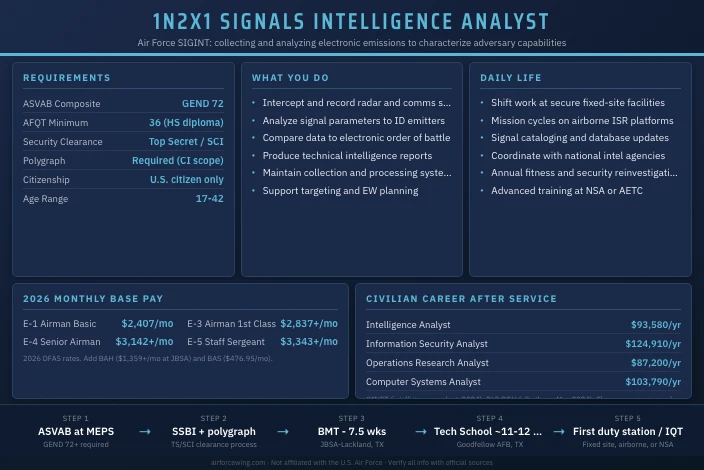
1N2X1 Signals Intelligence Analysts collect, process, and analyze electronic emissions from radar, communication systems, and other signal-emitting devices to characterize adversary capabilities. They identify, intercept, and report on electronic signals in support of national intelligence requirements and theater combat operations. Their analysis feeds directly into targeting packages, electronic warfare planning, and strategic assessments at every command level.
Day-to-Day Tasks
The daily rhythm of a 1N2X1 depends heavily on assignment type. At a fixed ground station, the work is methodical, monitoring equipment, cataloging signals, and building technical reports. At an airborne intelligence unit, operations run on mission cycles with pre-mission briefings, flight execution, and post-mission reporting.
Core tasks across most assignments include:
- Intercepting and recording electronic signals from radar, navigation systems, and communication emitters
- Analyzing signal parameters (frequency, pulse width, scan rate) to identify and characterize unknown emitters
- Comparing collected data against existing electronic order of battle databases
- Producing technical and operational intelligence reports for supported commanders
- Maintaining collection equipment and troubleshooting signal processing systems
- Collaborating with 1N0X1 all-source analysts, 1N4X1 fusion analysts, and national-level agencies to contextualize findings
Specialized Roles and Shredouts
The 1N2X1 career field uses both a base designation and an advanced shredout for personnel assigned to the National Security Agency.
| Designation | Title | Description |
|---|---|---|
| 1N2X1 | Signals Intelligence Analyst | Base AFSC, all SIGINT Airmen enter at this level |
| 1N2X1A | Electronic Non-Communications Analyst | Advanced designation for Airmen assigned to NSA; focuses on ELINT (electronic intelligence from non-communications emitters such as radar) |
The 1N2X1A assignment at NSA involves the Military ELINT Signals Analysis Program (MESAP), a multi-year advanced training track that prepares Airmen for technically demanding ELINT analyst positions.
Mission Contribution
SIGINT is one of the primary intelligence disciplines that feeds the national intelligence community. When 1N2X1 Airmen identify a new adversary radar system or track changes in an emitter’s operational pattern, that reporting can update national threat assessments, trigger electronic countermeasure development, and directly shape the tactics that Air Force pilots use in contested airspace. The work is invisible to most, but the effect shows up in every mission brief that references electronic threats.
Technology and Equipment
1N2X1 Airmen work with some of the most sensitive technical collection systems in the U.S. inventory. Ground-based equipment includes direction-finding receivers, spectrum analyzers, and signals processing workstations running classified collection software. Airborne platforms include reconnaissance aircraft that carry dedicated SIGINT sensor suites. Much of the specific hardware is classified, but the underlying technology involves wideband receivers, digital signal processors, and database systems that catalogue emitter parameters across the electromagnetic spectrum.
Salary
Base Pay
Pay is the same across all Air Force enlisted specialties at equivalent rank and time in service. The table below uses 2026 DFAS rates.
| Rank | Grade | Example Time in Service | Monthly Base Pay |
|---|---|---|---|
| Airman Basic | E-1 | Entry | $2,407 |
| Airman First Class | A1C | ~1.5 years | $2,837 |
| Senior Airman | SrA | ~3-4 years | $3,142-$3,659 |
| Staff Sergeant | SSgt | ~5-6 years | $3,343-$4,109 |
| Technical Sergeant | TSgt | ~9-11 years | $3,908-$4,759 |
| Master Sergeant | MSgt | ~14-16 years | $4,663-$5,268 |
Base pay is the floor, not the ceiling. Most Airmen living off base receive Basic Allowance for Housing (BAH), which varies by duty location and dependent status. At Joint Base San Antonio, a single E-4 receives $1,359/month in BAH; an E-4 with dependents receives $1,728/month. Basic Allowance for Subsistence (BAS) is $476.95/month for all enlisted Airmen regardless of rank.
Special Pay and Bonuses
The Air Force has listed 1N2X1A (Electronic Non-Communications Analyst) on its retention bonus list for highly skilled career fields. Retention bonuses in this specialty can reach into six figures over the course of a career. Specific amounts depend on current incentive program guidance, years of service, and commitment length, your recruiter can confirm current eligibility at time of enlistment.
Additional Benefits
Active-duty Airmen receive TRICARE Prime at no cost, no enrollment fee, no deductible, no copay for medical, dental, vision, mental health, or prescriptions. Housing and food allowances come on top of base pay. The Blended Retirement System (BRS) includes a pension at 20 years (40% of average high-36 base pay) plus automatic TSP contributions: the government contributes 1% of base pay automatically and matches up to 4% more if you contribute. Total government TSP contribution maxes at 5% of base pay.
For education, active-duty Airmen can use Tuition Assistance: up to $4,500 per year for college coursework. After separation, the Post-9/11 GI Bill covers full in-state tuition at public schools with no dollar cap, or up to $29,920.95 per academic year at private institutions, plus a monthly housing allowance and annual book stipend.
Work-Life Balance
Air Force leave policy grants 30 days of paid leave per year, accruing at 2.5 days per month. Work schedules vary significantly by unit. Fixed-site SIGINT operations often run rotating shifts to maintain 24/7 collection coverage. Airborne units operate around mission schedules that can be irregular. When not deployed or in an exercise cycle, most 1N2X1 Airmen work standard duty hours.
Qualifications
Requirements Table
| Requirement | Standard |
|---|---|
| Age | 17-42 at time of enlistment |
| Citizenship | U.S. citizen (no exceptions for SIGINT) |
| Education | High school diploma or equivalent |
| AFQT Minimum | 36 (HS diploma); 65 (GED or non-alternate credential) |
| ASVAB Composite | GEND 72 (General composite) |
| Security Clearance | Top Secret with SCI eligibility (SSBI required) |
| Polygraph | Required, must pass a counterintelligence-scope polygraph |
| Medical | No record or history of temporomandibular joint (TMJ) pain or disorder |
The GEND 72 requirement is above average for enlisted AFSCs. The General composite pulls from Word Knowledge, Paragraph Comprehension, and Arithmetic Reasoning subtests. Focus your ASVAB prep on reading comprehension and arithmetic, these two areas determine whether you qualify.
ASVAB Detail
The GEND composite (General) combines scores from the Verbal Expression (Word Knowledge + Paragraph Comprehension) and Arithmetic Reasoning subtests. A score of 72 puts you solidly in the upper third of applicants. There is no waiver for the ASVAB minimum, you must score 72 or higher to be considered. An ASVAB study guide that focuses on these two subtests is the most direct way to prepare.
Desirable academic preparation includes courses in electronics, physics, algebra, trigonometry, and computer science. These don’t replace the ASVAB requirement, but Airmen with this background typically move through Tech School faster.
Application Process
The clearance process is the longest variable in the timeline. A routine SSBI takes several months; anything that requires additional investigation can extend that significantly. Applicants with a clean financial record, no foreign national contacts, and no prior drug use move through fastest.
Selection Criteria
1N2X1 is a selective AFSC. The Air Force recruits a limited number of Airmen for this specialty each cycle. Competition comes from the combination of ASVAB score, clean background (the SSBI is thorough), and the polygraph result. There are no waivers for the citizenship requirement or the polygraph.
Service Obligation
Enlistment in the 1N2X1 career field requires a six-year active-duty commitment. Airmen enter service as an Airman Basic (E-1) and are promoted to Airman (E-2) within six months assuming good standing, then follow the standard enlisted promotion timeline.
Work Environment
Setting and Schedule
Most 1N2X1 Airmen spend their careers in one of two primary environments. Fixed ground stations are typically secure, climate-controlled facilities with shift-based operations running around the clock. The work environment is quiet and technical, long periods of focused analysis punctuated by reporting cycles and equipment maintenance. Airborne assignments are more physically varied, with the added demands of aircraft environments and mission-based scheduling.
Shift work is common across the career field. Many 1N2X1 units run Panama schedules (alternating 12-hour shifts) or rotating day/night schedules to maintain continuous collection. Holiday and weekend work comes with the territory.
Chain of Command and Feedback
1N2X1 units are typically organized under intelligence squadrons or ISR (Intelligence, Surveillance, and Reconnaissance) groups. NCOs manage day-to-day collection schedules and report production. Senior NCOs mentor junior analysts through skill development and technical certifications. Performance feedback follows the Air Force Enlisted Performance Report (EPR) system, annual written evaluations that feed directly into promotion consideration.
Team Dynamics
The work requires both individual technical precision and team coordination. An analyst working a collection shift operates largely independently, making real-time decisions about what to collect and how to catalog it. But the finished product, the intelligence report, often requires coordination with other analysts, deconfliction with national-level databases, and review by senior technicians. You’ll develop deep expertise in specific signal types while relying on teammates for adjacent disciplines.
Job Satisfaction
1N2X1 has consistently strong retention among technically focused Airmen. The work is genuinely engaging for people who like solving signal puzzles, the clearance creates real earning potential after service, and the community is small enough that performance is noticed. Airmen who stay in the field often cite the combination of technical challenge and mission significance as the primary retention factors.
Training
Training Pipeline
| Phase | Location | Duration | Focus |
|---|---|---|---|
| Basic Military Training (BMT) | JBSA-Lackland, TX | 7.5 weeks | Military fundamentals, physical conditioning, Air Force culture |
| Technical School | Goodfellow AFB, TX | 74-84 days (~11-12 weeks) | Electronic Signals Intelligence course; signal analysis, collection systems, reporting |
| Initial Qualification Training (IQT) | First duty station | Varies | Mission-specific systems and procedures for the assigned unit |
Goodfellow AFB in San Angelo, Texas is the Air Force’s primary intelligence training hub. The 17th Training Wing hosts the Electronic Signals Intelligence course for 1N2X1 Airmen, covering signal theory, emitter analysis, collection system operation, and intelligence report writing. Completion of the Tech School course earns college credit toward an Intelligence Studies and Technology degree program.
1N2X1 Tech School is on the shorter end for an intelligence AFSC. But the learning curve doesn’t flatten at graduation. Most Airmen describe the first 12-18 months at their duty station as the real training period, where they build operational competency on actual mission systems.
Advanced Training
After initial qualification, 1N2X1 Airmen can pursue several advanced development paths:
- NSA assignment (1N2X1A shredout): Highly competitive assignment to the National Security Agency at Fort Meade, Maryland. Airmen accepted into MESAP receive several years of advanced technical training in ELINT signals analysis.
- Middle Enlisted Cryptologic Career Advancement Program (MECCAP): A multi-year internship program at NSA for mid-career 1N2XX, 1N3XX, and 1N4XX Airmen that develops advanced analytical and leadership skills.
- Airborne assignments: Some 1N2X1 Airmen receive aircrew qualification for SIGINT platforms, adding flight pay and a significantly different operational profile.
- Collegiate education: Tuition Assistance covers coursework while on active duty. Many 1N2X1 Airmen complete degrees in computer science, electrical engineering, or intelligence studies while serving.
Everything starts with qualifying ASVAB scores. Our study guide covers what to study first.
Career Progression
Promotion Timeline
| Rank | Grade | Typical Time in Service |
|---|---|---|
| Airman Basic | E-1 | Entry |
| Airman | E-2 | 6 months |
| Airman First Class | A1C | 16 months |
| Senior Airman | SrA | 3 years |
| Staff Sergeant | SSgt | ~5-6 years (by board) |
| Technical Sergeant | TSgt | ~9-11 years (by board) |
| Master Sergeant | MSgt | ~14-16 years (by board) |
| Senior Master Sergeant | SMSgt | ~20 years (by board) |
| Chief Master Sergeant | CMSgt | ~22+ years (by board) |
Promotions through E-4 (Senior Airman) are largely automatic based on time in service and good standing. From E-5 (Staff Sergeant) upward, promotions are competitive and driven by EPR scores, time in grade, and a whole-person evaluation that includes education, leadership, and job performance.
Specialization and Lateral Moves
1N2X1 Airmen who want to shift focus have several paths available. Retraining into 1N4X1 (Fusion Analyst) is a natural lateral move for Airmen who want to work multi-source analysis at a faster operational tempo. Some Airmen cross into cyber or electronic warfare career fields. Officer commissioning programs, including Officer Training School, are available to enlisted Airmen who complete a degree and meet the requirements.
Performance Evaluation
The Enlisted Performance Report (EPR) is the Air Force’s primary performance evaluation tool. EPRs are written annually by the immediate supervisor, reviewed up the chain, and locked in as the permanent record used by promotion boards. Stratification language ("#1 of X Airmen") carries significant weight, being ranked first among your peers in a competitive unit is the clearest signal to a promotion board. Technical certifications, ancillary duties like unit training manager or dorm NCO, and professional military education (PME) completion all contribute to a competitive EPR package.
Physical Demands
Physical Requirements
The 1N2X1 AFSC does not have physical requirements beyond the standard Air Force Fitness Assessment. The job itself is predominantly cognitive and sedentary, collection operations and analysis work do not involve heavy lifting or sustained physical exertion. Airborne assignments add the physical demands of the aircraft environment, but aircrew medical standards are handled separately through flight physicals.
All Airmen take the Air Force Fitness Assessment annually. The assessment includes a 1.5-mile run, push-ups, sit-ups, and waist circumference. Scores are age- and gender-normed on a 100-point scale. The minimum passing score is 75. Each component has its own minimum that must be met regardless of total score.
| Component | Max Points |
|---|---|
| 1.5-Mile Run | 60 |
| Waist Circumference / Body Composition | 20 |
| Push-Ups (1 minute) | 10 |
| Sit-Ups (1 minute) | 10 |
The run accounts for 60% of the total score. Maintaining cardiovascular fitness year-round is the single most effective way to pass consistently, even when the day job is desk-based.
Medical Evaluations
Beyond the initial MEPS physical, 1N2X1 Airmen complete periodic medical evaluations as required by their unit and Air Force policy. Airmen assigned to airborne platforms undergo flight physicals at regular intervals. The TMJ disqualification identified during initial screening is reviewed during MEPS and is not revisited unless symptoms develop during service.
Deployment
Deployment Details
1N2X1 is a deployable career field. Deployment frequency and duration depend on assignment type, unit tempo, and global demand for SIGINT support. Fixed-site Airmen may deploy 3-6 months every 18-24 months; airborne units can operate at higher tempos. Deployments include both established bases in the Pacific, Europe, and the Middle East, as well as expeditionary locations that require operating in austere conditions.
Overseas permanent change of station (PCS) assignments are common for 1N2X1 Airmen, particularly at major SIGINT collection sites in the Pacific and Europe.
Deployed SIGINT analysts operate within theater intelligence architectures, feeding collection data to joint intelligence centers and national-level databases. The deployed work environment can range from a well-equipped SCIF at a large air base to a forward position with minimal infrastructure. Airmen assigned to airborne platforms face additional deployment considerations, aircraft maintenance schedules, aircrew rest requirements, and mission timelines shape the work cycle in ways that differ entirely from ground-based operations.
Pre-deployment requirements for 1N2X1 Airmen include currency training on deployed collection systems, completion of security awareness refreshers, and any theater-specific training required by the supported combatant command. Airmen who are not current on required certifications may be held back until they complete the training.
Duty Station Assignments
Major 1N2X1 duty stations include installations across the continental United States, Europe, the Pacific, and the Middle East. Because SIGINT collection is a persistent mission requirement, units exist at a broader range of locations than many other intelligence AFSCs. Common assignment locations include:
| Base | Location | Mission Focus |
|---|---|---|
| Fort Meade, MD | MD | NSA headquarters; 1N2X1A MESAP assignment |
| Goodfellow AFB | TX | Training; some permanent instructor billets |
| Misawa AB | Japan | Pacific SIGINT collection hub |
| Royal Air Force Menwith Hill | UK | European SIGINT collection |
| Ramstein AB | Germany | USAFE intelligence operations |
| Peterson SFB | CO | Space and signals intelligence support |
| Hurlburt Field | FL | AFSOC airborne SIGINT platforms |
NSA assignment at Fort Meade, Maryland is the signature advanced assignment in this career field. Selection for the 1N2X1A MESAP track is highly competitive and represents one of the most technically sophisticated development paths available to any enlisted intelligence Airman.
Assignment preferences are submitted through the Air Force Personnel Center (AFPC). Career field managers consider the needs of the Air Force first, but voluntary assignment preferences are factored in when there are multiple qualified candidates for an available position.
Risk/Safety
Job Hazards
At fixed ground stations, physical risk is minimal. The primary occupational health concern is extended exposure to computer monitors and electronic equipment, which is standard across most office-based military specialties. Airborne assignments introduce the inherent risks associated with military aviation, including the possibility of mishap during flight operations.
Safety Protocols
Units with SIGINT collection equipment follow standard Air Force occupational safety programs. Airborne personnel receive ejection seat and aircraft emergency training before any flight assignment. Personal protective equipment and hearing conservation programs apply where relevant.
Security and Legal Requirements
The security requirements for 1N2X1 are among the most stringent in the enlisted force. After the initial TS/SCI clearance and polygraph, Airmen undergo periodic reinvestigation every five years to maintain access. Any changes in financial status, foreign contacts, or personal behavior that could represent a security risk must be self-reported to the unit security manager.
The legal obligations are equally clear: unauthorized disclosure of classified SIGINT material carries criminal penalties under the Espionage Act and Uniform Code of Military Justice (UCMJ). Airmen receive annual security awareness training and sign non-disclosure agreements that remain in effect after separation. The clearance creates real responsibilities that follow you into civilian life.
The polygraph requirement eliminates a significant percentage of otherwise-qualified applicants. Be honest throughout the process, inconsistencies between the background investigation and polygraph results are treated as a security concern regardless of the underlying facts.
Impact on Family
Family Considerations
SIGINT work affects family life primarily through three mechanisms: shift work schedules, deployment cycles, and PCS moves. Shift rotations can make predictable family schedules difficult, particularly at units running 24/7 collection operations. Deployments require planning and support, the Air Force provides Military OneSource counseling, Family Readiness Centers, and spouse employment assistance programs on most major installations.
The security restrictions carry a social dimension too. 1N2X1 Airmen cannot discuss their work in detail with family, friends, or civilian colleagues. For some families, the opacity of the job takes adjustment.
Shift work is the most immediate family impact for many 1N2X1 Airmen. Collection units running Panama schedules or rotating day-night cycles produce unpredictable household hours. Night shift rotations affect sleep, energy, and availability for family activities in ways that accumulate over months. Families who succeed long-term in this environment tend to build routines specifically around the shift cycle rather than fighting it, scheduling family meals, exercise, and social commitments around whatever the current rotation demands.
The Family Separation Allowance (FSA) of $250/month applies during involuntary separations exceeding 30 days, including most deployments. Combat zone deployments also make basic pay tax-exempt for the months served in a designated combat zone. These additions partially offset the financial disruption of deployment cycles.
Military OneSource provides 12 free counseling sessions per family member per issue per year. Sessions are confidential and do not affect security clearance status. This resource is particularly relevant for SIGINT families because the intelligence community’s security constraints create stressors that general-population counselors may not fully understand. Military-specific counselors are available through OneSource.
Relocation and Time Away
PCS moves occur on average every 2-3 years. Most intelligence assignments cluster at major installations with solid base infrastructure, which eases the practical burden of relocation. Base housing wait lists and BAH rates vary by location; the AFPC assignment system provides advance notice to help families plan. Remote and overseas assignments may limit the ability to have dependents accompany the Airman.
NSA assignment at Fort Meade is one of the most family-friendly from a stability standpoint, it is a multi-year assignment in the Washington, D.C. metro area with extensive career development and minimal deployment exposure. For Airmen selected for MESAP, that assignment represents a rare combination of professional advancement and family stability.
Reserve and Air National Guard
Component Availability
1N2X1 is available in both the Air Force Reserve and the Air National Guard. Several Air National Guard units operate ISR missions with 1N2X1 positions, and Reserve squadrons support national SIGINT requirements. Not every Guard or Reserve unit has SIGINT positions, availability varies by wing, and the TS/SCI clearance requirement applies equally to part-time service.
Drill Schedule and Training Commitment
The standard commitment is one weekend per month (Unit Training Assembly) plus two weeks of Annual Tour each year. 1N2X1 Airmen may face additional requirements: currency training on classified collection systems, annual certification exercises, and occasional weekend drills tied to real-world mission support. Some Guard units integrate directly with active-duty missions, which can increase training frequency during high-demand periods.
Part-Time Pay
A Reserve or Guard E-4 (Senior Airman) earns approximately $236-$293 per drill day at 2026 rates, or roughly $944-$1,172 for a standard four-drill weekend. This compares to $3,142-$3,659 per month for an active-duty E-4. Part-time service pays a fraction of active-duty base pay but adds no housing or subsistence allowances.
Component Comparison
| Feature | Active Duty | Air Force Reserve | Air National Guard |
|---|---|---|---|
| Commitment | Full-time | 1 wknd/mo + 2 wks/yr | 1 wknd/mo + 2 wks/yr |
| Monthly Pay (E-4) | $3,142-$3,659 | ~$944-$1,172/drill wknd | ~$944-$1,172/drill wknd |
| Healthcare | TRICARE Prime (free) | TRICARE Reserve Select (premiums apply) | TRICARE Reserve Select (premiums apply) |
| Education Benefits | Tuition Assistance ($4,500/yr) + Post-9/11 GI Bill | Federal TA eligible; GI Bill proportional to activation | Federal TA + state tuition waivers (state-specific) |
| Deployment Tempo | Moderate to high | Lower; mission-dependent mobilization | Lower; state mission + federal activation possible |
| Retirement | 20-year pension (BRS) | Points-based Reserve retirement at age 60 | Points-based Reserve retirement at age 60 |
Civilian Career Integration
The 1N2X1 skill set maps directly to cleared intelligence and cybersecurity contractor positions that are compatible with part-time military service. Many Guard and Reserve Airmen in this field work full-time for defense contractors or federal agencies during the week and maintain their SIGINT skills through unit service. USERRA protects civilian employees from discrimination based on military service and requires employers to hold positions during activation periods.
Post-Service
Civilian Transition
1N2X1 training and experience transfers well to the civilian intelligence community. The TS/SCI clearance maintained throughout service is the most valuable single credential an exiting Airman carries, cleared positions at NSA, DIA, CIA, and defense contractors pay significantly more than equivalent uncleared roles.
The Transition Assistance Program (TAP) helps separating Airmen connect with federal hiring preference programs, resume writing, and civilian employer networking events.
Civilian Career Prospects
| Civilian Title | Median Annual Wage | Job Outlook (2024-2034) |
|---|---|---|
| Intelligence Analyst | $93,580 | ~7,800 annual openings projected |
| Information Security Analyst | $124,910 | +29% (much faster than average) |
| Operations Research Analyst | $87,200 | +23% (much faster than average) |
| Computer Systems Analyst | $103,790 | +9% (faster than average) |
The BLS Occupational Outlook Handbook provides 2024 wage data for the related civilian occupations listed above; O*NET Online covers the intelligence analyst classification specifically.
The clearance premium is real and significant. Cleared intelligence analyst positions at defense contractors in the DC metro area frequently pay 20-30% above the median for equivalent uncleared roles. Veterans with operational SIGINT experience and an active clearance rarely have difficulty finding post-service employment.
Federal positions under the General Schedule (GS) system, particularly at three-letter agencies, offer competitive salaries, civil service protections, and continued access to mission work that many former 1N2X1 Airmen find preferable to contractor life. Veterans’ preference provides a hiring advantage in the federal application process.
Certifications and Professional Development
Separating 1N2X1 Airmen with a technical background often pursue certifications that translate military SIGINT experience into civilian credentials:
- CompTIA Security+: a baseline cybersecurity certification that satisfies DoD 8570 requirements for many cleared positions
- Certified Information Systems Security Professional (CISSP): for Airmen moving into security architecture roles
- GEOINT/SIGINT analysis certifications available through the National Geospatial-Intelligence Agency (NGA) and NSA for personnel with appropriate clearance and experience
Is This a Good Job
The Ideal Candidate
1N2X1 works best for people who genuinely enjoy technical problem-solving. The job is largely about pattern recognition, identifying a signal, comparing it to known parameters, and drawing conclusions from incomplete information. If you’ve ever found yourself debugging code at midnight because the problem is interesting, or if you’re the person who reads the manual before asking for help, this AFSC is worth pursuing seriously.
Strong candidates also have:
- A clean background with no foreign national entanglements or financial trouble
- Comfort working with classified material and strict information security rules
- Patience for methodical, repetitive analytical work during low-activity periods
- Ability to produce accurate written reports under time pressure during high-activity periods
- A genuine interest in electronic systems and signals technology
Potential Challenges
The polygraph and clearance process alone eliminate many otherwise-qualified candidates. Even Airmen who pass both tests find that the ongoing security requirements shape their social and professional lives in ways that take adjustment. Discussing your work with family or civilian friends isn’t possible in any operational detail, and that limitation is permanent.
Shift work is a real lifestyle factor. 24/7 collection units run rotating schedules that disrupt sleep, social rhythms, and family routines. Some Airmen adapt easily; others find the long-term impact on health and relationships difficult to manage.
The work is primarily sedentary and office-based. If your primary motivation for joining the Air Force is physical challenge or frequent outdoor operations, 1N2X1 will disappoint.
Career Alignment
1N2X1 is one of the best enlisted AFSCs for post-service earning potential, specifically because of the clearance and the technical specialization. It’s a poor fit if you want highly visible military service, physical challenges, or a job you can describe at a dinner party. It’s an excellent fit if you want a career that builds genuine expertise, keeps you at the center of national security decisions, and opens well-paid civilian doors after service.
More Information
Your Air Force recruiter is the best starting point for current ASVAB requirements, bonus eligibility, and available training slots for 1N2X1. You can also explore the official Air Force careers page for 1N2X1 for an overview of the position. For study resources to hit the GEND 72 threshold, the ASVAB study guide at the test-prep section of this site covers the reading comprehension and arithmetic subtests that determine your General composite score.
Official Resources
- Air Force 1N2X1 careers page: Official Air Force eligibility requirements, current bonus status, and career overview
- Goodfellow AFB, 17th Training Wing: Host of the Electronic Signals Intelligence tech school; information on the 1N2X1 training program
- National Security Agency (NSA) Careers: Civilian and military career information at NSA, including information about the MESAP program and 1N2X1A assignment options
- Air Force Personnel Center (AFPC): Assignment preferences, career field management, and bonus eligibility verification
- DFAS Military Pay Tables: Current-year base pay for all enlisted grades
- Community College of the Air Force (CCAF): Tech School credit tracks toward an Intelligence Studies and Technology associate degree; transcript is available online throughout service
When you speak with a recruiter, confirm: the current GEND composite cutoff (composite scoring occasionally changes with ASVAB revision cycles), the enlistment obligation length for 1N2X1, whether a retention bonus is currently active, and the timeline for the polygraph requirement. The polygraph is often the longest variable in the accession process, and recruiters can give you a realistic timeline estimate based on current processing volumes.
This site is not affiliated with the U.S. Air Force or any government agency. Verify all information with official Air Force sources before making enlistment or career decisions.
Explore more Air Force intelligence careers to find other ISR and SIGINT specialties in the 1N career group.