1N1X1 Geospatial Intelligence Analyst
Satellites overhead, unmanned aircraft circling at altitude, sensors collecting terabytes of data every hour, none of that information means anything until someone analyzes it. That’s the job. The 1N1X1 Geospatial Intelligence Analyst is the Air Force’s expert at turning raw imagery into battlefield decisions, target coordinates, and mission-critical intelligence products. You don’t fire the weapon. You find the target.
This role requires a Top Secret/SCI clearance, sharp analytical thinking, and the ability to stay focused through long stretches of detailed work. In return, you get access to the most advanced imagery systems in the world and a clearance that’s worth serious money when you leave the service.
Qualifying requires specific ASVAB line scores. Our ASVAB study guide covers what to target and how to prepare.
Job Role
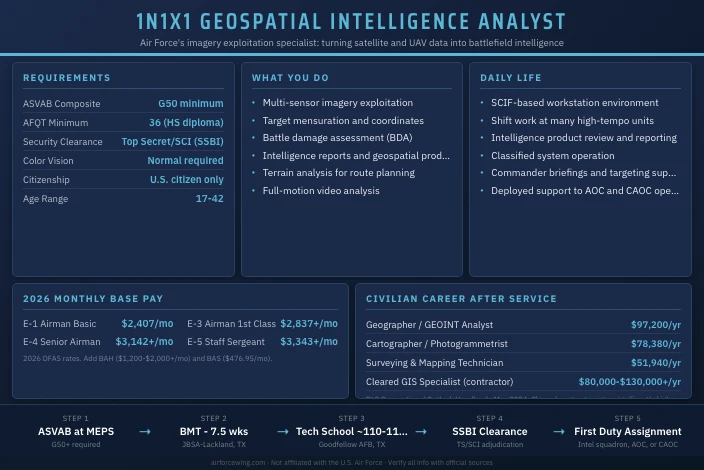
1N1X1 Geospatial Intelligence Analysts collect, exploit, and report on imagery and geospatial data gathered from satellites, unmanned aerial vehicles, and manned reconnaissance aircraft. They produce intelligence products used to support targeting, battle damage assessment, route planning, and force protection decisions across all levels of military operations.
What You Do Day to Day
The work centers on imagery exploitation, pulling useful intelligence from multi-sensor data feeds. On any given shift, an analyst might measure a building’s dimensions for a targeting brief, assess post-strike damage from the night before, or build a terrain analysis for a special operations team planning an entry route.
Core daily tasks include:
- Analyzing multi-spectral, electro-optical, synthetic aperture radar, and full-motion video imagery
- Producing standardized intelligence reports and geospatial products
- Maintaining imagery databases and geospatial data repositories
- Supporting targeting processes with mensuration and feature extraction
- Briefing commanders and intelligence officers on findings
- Coordinating collection requirements when existing imagery doesn’t cover the target
Shredouts and Specializations
The 1N1X1 AFSC has several specialized shredouts that develop deeper expertise in specific mission areas.
| Code | Specialization |
|---|---|
| 1N1X1 | Geospatial Intelligence (base AFSC) |
| 1N1X1A | Targeting and mensuration specialization |
Special Experience Identifiers (SEIs) document specific skills such as GEOINT collection management, advanced exploitation, and theater-specific regional expertise. These carry real weight during assignments and career advancement boards.
Mission Contribution
Every strike package, every convoy route, every special operations raid depends on accurate imagery intelligence. Analysts in this AFSC are directly integrated into the Air Operations Center (AOC), Intelligence Squadrons, and Combined Air and Space Operations Centers (CAOC). When targeting decisions are made, the data supporting those decisions often comes from this career field.
Technology and Equipment
The tools in this field are genuinely impressive. Analysts work daily with advanced exploitation workstations, classified geospatial software systems, and national-level imagery databases. You’ll process data from U-2 reconnaissance aircraft, Global Hawk unmanned systems, commercial satellite feeds, and theater-level collection assets. The software environment includes tools like SOCET GXP, ArcGIS, and mission-specific exploitation platforms used across the intelligence community.
Salary
Base Pay
Military pay is the same across all branches and grades. What varies is how fast you advance. Analysts who perform well get promoted sooner, which compounds over a career.
| Rank | Grade | Monthly Base Pay (entry) |
|---|---|---|
| Airman Basic | E-1 | $2,407 |
| Airman | E-2 | $2,698 |
| Airman First Class | E-3 | $2,837 |
| Senior Airman | E-4 | $3,142 |
| Staff Sergeant | E-5 | $3,343 |
| Technical Sergeant | E-6 | $3,401 |
Pay figures from DFAS 2026 military pay tables. Base pay only; allowances are additional.
Allowances and Special Pay
Basic Allowance for Housing (BAH) varies by duty location, pay grade, and dependency status. A single E-4 at many intelligence-heavy installations can expect BAH in the range of $1,200 to $2,000+ per month. Basic Allowance for Subsistence (BAS) adds $476.95 per month for all enlisted members in 2026.
Intelligence career fields sometimes carry special duty assignment pay or proficiency pay tied to clearance maintenance and specialized skills. Check with your recruiter for current special pay eligibility.
Additional Benefits
- Healthcare: TRICARE Prime with zero enrollment fee, zero deductible, and zero copays for active-duty members and covered family members
- Education: Up to $4,500 per year in Tuition Assistance while on active duty; Post-9/11 GI Bill covers full in-state tuition at public schools after service
- Retirement: Blended Retirement System combines a 20-year pension (40% of high-36 average basic pay) with TSP matching up to 5% of basic pay
- Leave: 30 days of paid leave annually
Work-Life Balance
Schedule varies widely by assignment. Analysts at a stateside intelligence squadron typically work standard duty hours with some weekend exercises. Those supporting deployed operations, or assigned to units on continuous operations cycles, will work shift rotations. The nature of intelligence work means coverage is required around the clock at many units.
Qualifications
Requirements at a Glance
| Requirement | Standard |
|---|---|
| Minimum AFQT | 36 (high school diploma) |
| ASVAB Composite | General (G): 50 minimum |
| Security Clearance | Top Secret with SCI eligibility (SSBI required) |
| Citizenship | U.S. citizen only |
| Age | 17-42 at enlistment |
| Color Vision | Normal color vision required |
| Medical | Qualifying MEPS physical |
Requirements verified against airforce.com and military.com.
The Top Secret/SCI clearance requirement is non-negotiable. Any disqualifying criminal history, significant foreign contacts, financial issues, or drug use will end your eligibility before you start Tech School. Be honest during the background investigation, adjudicators weigh honesty more heavily than the underlying issue in many cases.
The Application Process
The process from enlistment to first day of Tech School runs roughly four to nine months, depending on recruiting pipeline timing and background investigation processing.
Competitiveness
This is a selective AFSC. The clearance requirement alone screens out a significant portion of applicants. Beyond that, the analytical nature of the work means the Air Force looks for candidates who score well on the verbal and reasoning portions of the ASVAB. Strong academic records, prior GIS coursework, and demonstrated attention to detail all help.
Service Obligation and Entry Grade
Enlisted members enter at Airman Basic (E-1) and progress to E-2 upon completion of Basic Military Training. The standard initial enlistment contract is four years for active duty, though specific terms depend on the contract your recruiter offers. Reserve and Guard components may differ.
Before heading to MEPS, a good ASVAB study guide can meaningfully raise your General composite score, the subtest that matters most for this AFSC.
Work Environment
Setting and Schedule
Most of the work happens in secure, temperature-controlled facilities called SCIFs (Sensitive Compartmented Information Facilities). These are windowless rooms with strict security protocols, no personal phones, no outside devices, no casual visitors. You badge in, work your shift, badge out.
At stateside units, workdays often run standard duty hours with some variation based on mission tempo. Units supporting active combat operations run 24/7 coverage rotations, which means shift work, weekend duty, and holiday coverage are all part of the job at some assignments. Panama schedules and rotating 12-hour shifts are common in high-tempo units.
Leadership and Communication
Intelligence squadrons follow standard Air Force organizational structure. Analysts report to their flight NCOIC (Non-Commissioned Officer in Charge), who reports to the flight commander and squadron leadership. Communication within the unit tends to be direct and mission-focused.
Enlisted Performance Reports (EPRs) are completed annually and are the primary mechanism for evaluating performance. Supervisors typically schedule mid-cycle feedback sessions to keep Airmen informed of standing and areas to develop.
Team Dynamics and Autonomy
Analytical work involves both independent and collaborative elements. You’ll frequently work alongside other 1N1X1s sharing a workload, but the responsibility for an individual product, a report, a target brief, rests with the analyst who produced it. At senior enlisted grades, you’ll also manage teams, review junior analysts’ products, and interface directly with the intelligence officers who present findings to commanders.
Job Satisfaction
Analysts who stay tend to describe the work as genuinely engaging. The clearance, the access to classified systems, and the direct connection to real-world operations set this AFSC apart from most civilian equivalents. The biggest frustrations cited are shift work at high-tempo units and the adjustment to secure facility environments after years of smartphone access.
Training
Training Pipeline
| Phase | Location | Duration | Focus |
|---|---|---|---|
| Basic Military Training | JBSA-Lackland, TX | 7.5 weeks | Military customs, discipline, fitness, basic weapons |
| Geospatial-Imagery Analysis Course | Goodfellow AFB, TX | ~110-112 days | Imagery exploitation, geospatial tools, intelligence reporting |
| First Duty Assignment | Varies | Ongoing | Mission qualification, unit-specific systems and procedures |
Tech School at Goodfellow AFB covers the full range of geospatial intelligence tradecraft. Students learn to operate imagery exploitation workstations, apply mensuration techniques to calculate target coordinates, and produce standardized intelligence products that meet national and theater reporting standards. The curriculum also covers the legal and policy frameworks governing imagery collection and reporting.
Advanced Training Opportunities
After establishing a performance record, analysts can compete for advanced programs and additional qualifications:
- GEOINT Career Advancement Program (GCAP): A highly selective 36-month developmental program for E-4 to E-5 analysts with 4-12 years of active service. Selected members develop deep technical expertise in targeting and advanced exploitation methods.
- Advanced Skills Training: Units send high-performing analysts to specialized schools covering topics such as advanced SAR analysis, full-motion video exploitation, and collection management.
- Cross-training into officer roles: High-performing enlisted members can apply for Officer Training School through the Airman Commissioning Programs, with intelligence and related fields being natural paths.
- College coursework: Completing the Geospatial Intelligence Analyst course at Goodfellow earns college credits toward an Intelligence Studies and Technology degree, and Tuition Assistance supports further coursework while on active duty.
Everything starts with qualifying ASVAB scores. Our study guide covers what to study first.
Career Progression
Rank and Progression
| Grade | Rank | Typical Time to Reach |
|---|---|---|
| E-1 | Airman Basic | Entry |
| E-2 | Airman | 6 months |
| E-3 | Airman First Class | 16 months total service |
| E-4 | Senior Airman | 3 years total service |
| E-5 | Staff Sergeant | Competitive board, ~5-8 years |
| E-6 | Technical Sergeant | Competitive board, ~10-14 years |
| E-7 | Master Sergeant | Competitive board, ~14-18 years |
| E-8 | Senior Master Sergeant | Highly competitive, ~18-22 years |
| E-9 | Chief Master Sergeant | Extremely competitive, ~22+ years |
Promotions through E-4 are essentially time-based with performance thresholds. From Staff Sergeant upward, promotions are competitive and depend heavily on EPR scores, decorations, and professional military education completion.
Specializations and SEI Codes
Senior analysts can pursue targeted specializations by qualifying for specific SEI codes documenting skills in collection management, theater-specific GEOINT, advanced targeting, or full-motion video. These codes affect assignment eligibility and make some high-demand billets accessible only to holders.
Role Flexibility and Retraining
Retraining into other intelligence AFSCs, such as 1N0X1 (Operations Intelligence) or 1N2X1 (Intelligence Analysis), is possible after completing a first enlistment and meeting the gaining AFSC’s requirements. Retraining into unrelated fields is also possible through the Air Force’s formal retraining program, though competition varies by the gaining AFSC’s manning levels.
EPR and Performance Evaluation
The Enlisted Performance Report runs on an annual cycle. Supervisors rate performance across multiple duty description categories. Top-third placement on the EPR is a practical threshold for promotion board competitiveness at SSgt and above. Volunteering for additional duties, completing Community College of the Air Force coursework, and earning AFSC-specific certifications all strengthen an annual EPR package.
Physical Demands
Daily Physical Requirements
The 1N1X1 is a desk-based analytical role. You’re sitting at a workstation the majority of each shift. Long periods of focused screen time, attention to fine image detail, and precise reporting are the daily physical demands, not heavy lifting or outdoor field work. Color vision requirements exist because imagery analysis relies on accurate color discrimination across multi-spectral data.
Air Force Fitness Assessment Standards
All Airmen take the Air Force Fitness Assessment annually. The 100-point assessment has four components, and you must meet minimum thresholds on each one.
| Component | Max Points |
|---|---|
| 1.5-Mile Run | 60 |
| Waist Circumference / Body Composition | 20 |
| Push-Ups (1 minute) | 10 |
| Sit-Ups (1 minute) | 10 |
Minimum passing composite score is 75 out of 100. Standards are age- and gender-normed. The fitness standards for 1N1X1 are the same as for all Air Force enlisted members, there are no AFSC-specific physical minimums above or below the Air Force standard.
Medical Standards
Beyond the standard MEPS physical, analysts must maintain the medical standards required to hold a Top Secret/SCI clearance. Any psychiatric treatment, substance abuse history, or medical condition that could affect reliability or judgment under stress will be evaluated during the security clearance process as well as at periodic reinvestigations.
Deployment
Deployment Patterns
Intelligence analysts deploy regularly in support of combatant command requirements. Typical deployment lengths run 90 to 180 days depending on the theater and unit. Air Force intelligence units support operations in the Middle East, Europe, the Indo-Pacific, and other regions as directed by combatant commanders.
Deployments can be to established bases with full facilities or to more austere forward operating locations, depending on mission requirements. Analysts at high-demand units may see deployment tempo of one deployment every 18-24 months.
Deployed 1N1X1 Airmen typically work inside a theater SCIF, a Joint Intelligence Support Element, or an Air Operations Center. The deployed environment compresses timelines: products that would take days to research and draft at home station may need to be finished in hours. That production tempo is one of the most professionally demanding aspects of deployed GEOINT work, and it is also where Airmen develop the most analytic capability the fastest.
Pre-deployment requirements include completing required security training, maintaining current certifications on deployed exploitation systems, and passing a pre-deployment medical and dental screening. Some assignments deploy Airmen with units from other services or partner nations, adding joint and combined operational context to their experience.
Duty Station Options
Most 1N1X1 billets concentrate at major Air Force bases with significant intelligence missions. Common assignment locations include:
| Base | Location | Mission |
|---|---|---|
| Langley-Eustis AFB | VA | ACC headquarters; major GEOINT operations |
| Beale AFB | CA | U-2 and RQ-4 Global Hawk reconnaissance hub |
| Offutt AFB | NE | USSTRATCOM intelligence support |
| Hurlburt Field | FL | AFSOC and special operations ISR support |
| Ramstein AB | Germany | USAFE European intelligence operations |
| Osan AB | South Korea | Korea theater ISR and GEOINT |
| Creech AFB | NV | RPA intelligence and ISR mission analysis |
| NGA Fort Belvoir | VA | Joint duty assignment for advanced analysts |
Beale AFB is the signature 1N1X1 assignment for Airmen interested in advanced imagery platforms. Working alongside U-2 missions and Global Hawk operations provides exposure to collection systems and targeting processes unavailable at most other bases.
Assignment preferences are submitted through the Air Force assignment system. Preferences are considered but the Air Force fills unit requirements first. Senior Airmen and NCOs who have built documented platform expertise through their assignment history have more influence in the preference process than junior analysts.
Risk/Safety
Job Hazards
The physical risks in this AFSC are minimal compared to operational career fields. The primary occupational risk is repetitive strain from extended keyboard and screen work. Some units with high operational tempo also present risks associated with deployment to active combat zones, where the SCIF may be located at a forward base subject to indirect fire or other threats.
Security and Legal Requirements
The TS/SCI clearance creates significant ongoing legal obligations. Analysts are required to report foreign contacts, foreign travel, and any changes in financial circumstances to their security manager. Failing to report is a serious violation and can result in clearance revocation, which effectively ends the career.
Polygraph examinations may be required for certain assignments or contractor positions after service. Compartmented accesses, the “SCI” portion of the clearance, require periodic reinvestigation, typically every five years. All classified work is governed by AFI 31-401 and applicable national security regulations.
Conflict Zone Deployments
When deployed to active combat zones, analysts fall under the same LOAC (Law of Armed Conflict) obligations and rules of engagement as all military personnel. The intelligence products they produce directly inform kinetic decisions, which places a high ethical burden on analytical accuracy and source attribution.
Impact on Family
Family Considerations
The SCIF environment creates a genuine challenge for families. The nature of the work means you can’t discuss what you do at the dinner table. Spouses and family members won’t always understand why you came home stressed or distracted after a shift. Organizations like the Military OneSource program offer counseling and support specifically designed for this dynamic.
Shift work at high-tempo units affects family schedules significantly. Night shifts, weekend rotations, and extended deployment absences are real tradeoffs. Units with strong family readiness programs help, but the fundamental tension between operational tempo and family stability is something to plan for honestly.
Military OneSource provides 12 free counseling sessions per family member per issue per year, available by phone, video, or in person. These sessions are confidential and do not affect your security clearance. For intelligence Airmen carrying operational stress they cannot share with family, the mental health support option is particularly valuable.
The SCIF lifestyle has a social dimension beyond work. Intelligence Airmen often build their closest personal relationships inside the cleared community, colleagues who understand the work and can speak about it openly. Families stationed at large intelligence installations like Langley or Fort Meade tend to report better social integration than those at smaller bases where the intelligence community is more isolated.
Spouses of 1N1X1 Airmen deal with the same relocation challenges as any military family, plus the specific limitation that intelligence billets cluster at a narrower set of bases. The Airman and Family Readiness Center (AFRC) at each installation offers spouse employment assistance, resume workshops, and connections to local employer networks. Results vary significantly by location, large metro areas near major intelligence installations generally offer more civilian employment opportunities for working spouses than remote bases.
Relocation
The Air Force typically reassigns members every two to four years through Permanent Change of Station (PCS) moves. Intelligence billets concentrate at a smaller set of bases than some other career fields, which limits geographic flexibility compared to more widely distributed AFSCs. Families with roots in specific regions may find repeated reassignments difficult.
The Air Force covers PCS moving costs through the Joint Travel Regulations, but out-of-pocket costs for housing transitions, school changes, and spousal employment disruption add up. Families should budget accordingly. The Dislocation Allowance (DLA) provides a partial offset for these costs but rarely covers them entirely. Planning for two to three months of out-of-pocket relocation costs per PCS move is a reasonable baseline assumption.
Reserve and Air National Guard
Component Availability
The 1N1X1 AFSC is available in both the Air Force Reserve and the Air National Guard. Intelligence units exist across multiple ANG wings, and Reserve intelligence squadrons operate at several locations. Component availability depends on unit manning requirements at any given time.
ANG units at states with significant intelligence missions, such as those supporting NORAD or theater ISR requirements, tend to have more active 1N1X1 positions than smaller states.
Drill Schedule and Training Commitment
The standard Reserve/Guard commitment is one Unit Training Assembly weekend per month (typically 16 hours) plus a 15-day Annual Tour. 1N1X1 members in the Reserve and Guard also require ongoing security clearance maintenance, annual training exercises, and periodic system recertification events that may add drill days beyond the standard schedule.
Part-Time Pay
An E-4 Senior Airman earns $3,142 per month on active duty (2026 base pay at under-2 years). A drill weekend (four training assemblies) at the same grade pays approximately $418 for the weekend. Reserve and Guard members with civilian careers in intelligence, GIS, or defense contracting often find this AFSC directly complements their day job.
Component Comparison
| Category | Active Duty | Air Force Reserve | Air National Guard |
|---|---|---|---|
| Commitment | Full time | 1 wknd/mo + 15 days/yr | 1 wknd/mo + 15 days/yr |
| Monthly Base Pay (E-4) | $3,142+ | ~$418/drill wknd | ~$418/drill wknd |
| Healthcare | TRICARE Prime (free) | TRICARE Reserve Select (premium) | TRICARE Reserve Select + state options |
| Education | Tuition Assistance + Post-9/11 GI Bill | Partial GI Bill eligibility; Federal TA available | State tuition waivers vary; Federal TA available |
| Deployment Tempo | Moderate to high | As mobilized (varies) | As mobilized (varies) |
| Retirement | 20-year pension + BRS | Points-based Reserve retirement | Points-based Reserve retirement |
Civilian Career Integration
The 1N1X1 clearance and GIS expertise pair extremely well with defense contracting and federal intelligence agency careers. Many Guard and Reserve analysts hold civilian jobs at agencies like NGA (National Geospatial-Intelligence Agency), DIA, or at defense firms supporting those agencies. USERRA protections prevent civilian employers from penalizing members for Reserve or Guard service.
Post-Service
Transition to Civilian Life
A TS/SCI clearance with GEOINT experience is one of the most marketable credentials in the cleared defense community. Defense contractors, federal intelligence agencies, and commercial geospatial companies all actively recruit former 1N1X1 Airmen.
The Transition Assistance Program (TAP) and Hiring Our Heroes both offer resources specifically oriented toward transitioning intelligence community veterans. The DoD SkillBridge program also allows final-year active-duty members to intern with cleared employers before separation.
Civilian Career Prospects
| Job Title | Median Annual Salary | Job Outlook |
|---|---|---|
| Geographer / GEOINT Analyst | $97,200 | -3% (2024-2034) |
| Cartographer / Photogrammetrist | $78,380 | +6% (2024-2034) |
| Surveying and Mapping Technician | $51,940 | +5% (2024-2034) |
| GIS Specialist (federal/contractor) | Varies | High demand in cleared sector |
Salary data from the BLS Occupational Outlook Handbook, May 2024 figures.
The “GIS Specialist” federal/contractor category often pays significantly more than the BLS medians when clearance is factored in. Cleared GIS and imagery positions at major defense contractors routinely post at $80,000 to $130,000+ depending on experience level and location.
Post-Service Certifications
Several professional credentials align directly with 1N1X1 experience:
- GISP (GIS Professional): Recognized by ASPRS and GIS industry employers; requires documented experience that active-duty service easily satisfies
- GEOINT Certificate Programs: NGA and several universities offer graduate certificates in GEOINT specifically designed for veterans entering the civilian sector
- CAE (Certified Imagery Analyst): Industry-recognized credential from the United States Geospatial Intelligence Foundation (USGIF)
Is This a Good Job
Who Fits This Role
This AFSC suits people who are genuinely curious about how the world works at a detailed level. If you’re the type who reads maps for fun, finds satellite imagery fascinating, or gravitates toward research and analysis over physical tasks, this career will hold your attention.
Strong candidates tend to be:
- Detail-oriented and comfortable with repetitive precision work
- Able to sit with uncertainty and draw defensible conclusions from incomplete data
- Discreet by nature, the clearance lifestyle is not for everyone
- Interested in geopolitics, geography, or technology
- Self-motivated enough to sustain focus through long analytical shifts
Potential Challenges
The SCIF environment is real. You will spend years of your life in rooms with no windows and no personal devices. Some people adapt easily; others find it genuinely difficult over the long term. Be honest with yourself about this before enlisting.
Deployment frequency varies but is consistent at most active-duty units. If predictable home time is a priority, the tempo at high-demand intelligence squadrons can be jarring. The Reserve and Guard components offer much more schedule stability for people with families or civilian careers they want to maintain.
Shift work is standard at many units. If you have medical conditions worsened by irregular sleep schedules, factor that into the decision.
Career Alignment
This AFSC sets up an excellent long-term career in the intelligence community, GIS sector, or defense contracting. If your plan is to serve four to six years, build a clearance, and transition into a cleared civilian role, 1N1X1 is one of the most direct paths available. If you want a 20-year career, the promotion rates and technical depth support advancement to senior NCO grades with genuine leadership responsibility.
What it doesn’t suit is someone who wants outdoor work, high physical demands, or frequent visible engagement with the public. The work is often classified, results are frequently invisible to the outside world, and the validation of knowing your products made a difference comes through indirect channels.
More Information
Talk to an Air Force recruiter to confirm current 1N1X1 manning levels, bonus availability, and your personal eligibility before committing to any course of action. Requirements and incentive programs change regularly. A recruiter with current access to the assignments system can give you accurate, real-time guidance, including whether this AFSC has openings in the enlistment window you’re targeting.
Before your MEPS appointment, work on raising your General composite score with a focused ASVAB study guide. The G:50 minimum is a low bar, but stronger scores open more options if 1N1X1 isn’t immediately available in a given recruiting cycle.
Official Resources
- Air Force 1N1X1 careers page: Official eligibility requirements, current incentive programs, and career description
- Goodfellow AFB, 17th Training Wing: Host installation for 1N1X1 tech school; training program information
- National Geospatial-Intelligence Agency (NGA): Primary federal employer for post-service GEOINT analysts; civilian positions posted on USAJobs.gov
- United States Geospatial Intelligence Foundation (USGIF): Professional organization for the GEOINT community; offers scholarships, certification programs (including the CAE credential), and career development resources for current and former intelligence professionals
- Air Force Personnel Center (AFPC): Assignment preferences, bonus programs, and career field manning data
- Community College of the Air Force (CCAF): 1N1X1 tech school earns credit toward an Intelligence Studies and Technology associate degree; transcript access is available throughout service
When speaking with a recruiter, ask specifically: whether the G:50 composite is still current (composite requirements occasionally change), what the current initial enlistment obligation is, and whether any GEOINT-specific bonuses or assignment incentives are active. These factors change by fiscal year and can significantly affect the value of a given enlistment contract.
This site is not affiliated with the U.S. Air Force or any government agency. Verify all information with official Air Force sources before making enlistment or career decisions.
Explore more Air Force intelligence careers to find other analytical and collection AFSC options within the intelligence career group.