1N0X1 All Source Intelligence Analyst
Most enlisted Airmen support operations from the flight line or the hangar. The 1N0X1 All Source Intelligence Analyst does it from inside a classified facility, building the intelligence picture that every mission depends on. You’ll pull reporting from human sources, imagery, signals, and open-source collection, then fuse it into products that tell commanders what they’re facing and where threats are moving. The work is analytical, the stakes are real, and the security clearance you earn carries direct value in the civilian workforce the moment you separate.
Qualifying requires specific ASVAB line scores. Our ASVAB study guide covers what to target and how to prepare.
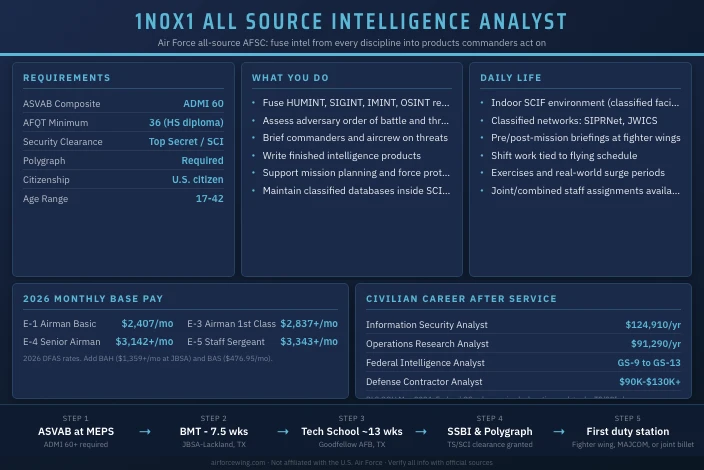
Job Role
1N0X1 All Source Intelligence Analysts collect, evaluate, and integrate intelligence from multiple collection disciplines to produce finished assessments for Air Force commanders and joint warfighting elements. They analyze enemy order of battle, track threat capabilities, support mission planning, and produce force protection products that keep Airmen informed of risks at home station and in deployed environments.
Daily Tasks
A typical day depends heavily on your unit’s mission, but most 1N0X1 Airmen cycle through a mix of these responsibilities:
- Reviewing and correlating incoming intelligence reports from SIGINT, HUMINT, IMINT, and open-source feeds
- Updating threat databases and maintaining the current intelligence picture
- Preparing and delivering classified briefings to commanders, aircrew, and joint partners
- Writing finished intelligence products: threat assessments, target studies, country overviews
- Supporting mission planning by identifying adversary air defense systems, surface threats, and electronic warfare capabilities
- Maintaining continuity files and tracking changes in adversary order of battle
- Participating in exercises that simulate intelligence support to combat operations
At a fighter wing, the work runs close to the flight schedule. Briefers prepare intel products before missions and debrief aircrew afterward. At a major command headquarters or joint intelligence support element, the tempo is steadier but the scope is broader, covering theater-wide analysis rather than a single sortie.
Specializations
The 1N0X1 AFSC uses a skills-based progression model rather than formal shredouts. Airmen build expertise through assignment variety, with some concentrating on:
| Specialty Area | Focus |
|---|---|
| Operations Intelligence (OI) | Tactical threat support, mission planning, pre/post-mission briefs |
| Force Protection Intelligence | Base defense threat assessments, insider threat analysis |
| All-Source Targeting Support | Intelligence preparation for strike planning |
| Joint Intelligence Operations | Combined/joint staffs, multi-echelon analysis |
Special Experience Identifiers (SEIs) may be awarded for documented expertise in specific analytical areas. Your assignment history and EPR documentation are the primary record of specialization.
Mission Contribution
Intelligence is the Air Force’s first mover. Before a pilot flies into contested airspace, a 1N0X1 Analyst has mapped every radar, identified every surface-to-air missile site, and estimated how the adversary will respond. Without that product, the mission is a guess. The 1N0X1 AFSC sits upstream of almost every combat operation, providing the situational awareness that makes airpower effective rather than just dangerous.
Technology and Equipment
Day-to-day tools include classified networks (SIPRNet, JWICS), all-source analytical platforms like Palantir and Analyst’s Notebook, geographic information systems, multi-source database systems, and presentation software used to build classified briefing products. Some assignments involve specialized collection management systems or targeting tools. All work is performed on classified systems in accredited sensitive compartmented information facilities (SCIFs).
Salary
Base Pay
Pay is set by DFAS and is the same across all branches. A new 1N0X1 Airman enters at E-1 and typically reaches E-4 (Senior Airman) within three to four years.
| Grade | Rank | Monthly Base Pay (2026) |
|---|---|---|
| E-1 | Airman Basic (AB) | $2,407 |
| E-2 | Airman (Amn) | $2,698 |
| E-3 | Airman First Class (A1C) | $2,837 - $3,198 |
| E-4 | Senior Airman (SrA) | $3,142 - $3,816 |
| E-5 | Staff Sergeant (SSgt) | $3,343 - $4,422 |
| E-6 | Technical Sergeant (TSgt) | $3,401 - $5,044 |
Base pay is the floor. Most Airmen living off-base receive Basic Allowance for Housing (BAH), which varies by duty location and dependency status. A single E-4 at Joint Base San Antonio-Lackland, TX, receives $1,359/month in BAH. An E-4 with dependents at the same installation receives $1,728/month. Basic Allowance for Subsistence (BAS) adds a flat $476.95/month for all enlisted members, regardless of rank or location.
Additional Benefits
Healthcare: Active-duty Airmen and their dependents are covered under TRICARE Prime at no cost. No enrollment fees, deductibles, or copays. Coverage includes medical, dental, vision, mental health, prescriptions, and hospitalization.
Education: Tuition Assistance covers up to $4,500 per year ($250 per semester hour) while on active duty. After separation, the Post-9/11 GI Bill covers full in-state tuition at public universities or up to $29,920.95 per academic year at private institutions, plus a monthly housing allowance and up to $1,000 annually for books and supplies.
Retirement: The Blended Retirement System (BRS) provides a pension equal to 40% of your high-36 average basic pay at 20 years. The Thrift Savings Plan component provides automatic government contributions of 1% of basic pay plus matching up to 4%, for a maximum government contribution of 5%.
Work-Life Balance
Active-duty Airmen earn 30 days of paid leave per year, accruing at 2.5 days per month. Intelligence units at fighter wings can be shift-based, with hours tied to the flying schedule. Major command and headquarters assignments run closer to standard business hours with periodic surge periods around exercises or real-world events. Deployment tempo for 1N0X1 is generally lower than combat support career fields, though it varies by assignment type and operational demand.
Qualifications
Requirements Table
| Requirement | Details |
|---|---|
| Age | 17-42 at enlistment |
| Citizenship | U.S. citizen (required for TS clearance) |
| Education | High school diploma; GED requires AFQT 65+ |
| ASVAB Composite | Administrative (ADMI) 60 minimum |
| AFQT Minimum | 36 (HS diploma), 65 (GED) |
| Security Clearance | Top Secret / SCI (SSBI required; polygraph required) |
| Speech | No speech disorders or noticeable communication deficiencies |
| Medical | Must meet Air Force accession medical standards |
The ADMI composite draws from General Science, Paragraph Comprehension, Word Knowledge, and Arithmetic Reasoning subtests. A score of 60 rewards Airmen who read well and reason accurately. Start with an ASVAB prep course that covers verbal and reading comprehension before your MEPS appointment.
The clearance investigation for 1N0X1 is thorough. A Single Scope Background Investigation (SSBI) reviews your finances, foreign contacts, employment history, and personal conduct going back ten or more years. Drug use, even prior to enlistment, is a disqualifying factor for most intelligence positions. Honesty during the investigation matters as much as a clean history.
Application Process
Selection Competitiveness
Intelligence AFSCs attract competitive applicants. A strong ADMI score, clean personal history, and good MEPS results give you the most direct path. Recreational drug use, financial problems, or foreign contacts increase clearance processing time and can disqualify you entirely. Recruiters will screen for these factors early because a failed investigation wastes everyone’s time.
Service Obligation
Enlistment contracts for 1N0X1 typically run four years on active duty. Because the clearance investment is significant, some contracts or training tracks include service obligation extensions. Confirm your specific terms before signing.
Airmen enter service as E-1 Airman Basic. Most report to their first permanent duty station as E-3 Airman First Class or E-4 Senior Airman, depending on college credit or other accelerators.
Work Environment
Setting and Schedule
The 1N0X1 work environment is almost entirely indoors, inside classified facilities. You spend your career in SCIFs: air-gapped, badge-controlled rooms where classified work is the only activity. Some assignments are at large intelligence centers with hundreds of analysts. Others put you in a small Operations Support Squadron (OSS) attached to a fighter wing, where you might be one of a handful of enlisted analysts supporting the entire flying mission.
Shift work is common at operational units tied to a 24/7 flying schedule. Headquarters and major command positions run more like standard day jobs, though exercises and real-world events can drive surge hours regardless of assignment type.
Chain of Command and Feedback
At the wing level, 1N0X1 Airmen typically work within an Intelligence Flight inside an Operations Support Squadron. The squadron commander and flight chief define the chain of command. Civilian intelligence contractors and government civilians sometimes work alongside Airmen in the same facility, though the military rank structure remains distinct. Enlisted Performance Reports are completed annually by your rater and reviewed by the senior rater, with mandatory midterm feedback sessions that give you clear performance expectations before the report is written.
Teamwork and Autonomy
Junior 1N0X1 Airmen work closely under supervision from more senior analysts. As you advance to SSgt and TSgt, you take on production oversight, supervise junior Airmen, and manage the analytical workflow for your section. The job requires consistent attention to detail and the ability to work under classification constraints that limit what you can discuss with people outside your cleared community, including family members.
Job Satisfaction
Intelligence work typically shows high retention among Airmen who enjoy analytical problem-solving and want a career field with strong post-service value. The clearance is the most tangible asset. Defense contractors, federal agencies, and private sector intelligence firms specifically recruit candidates with active TS/SCI clearances. Airmen who leave at four years often find their clearance and analytical experience valued at a premium.
Training
Training Pipeline
| Phase | Location | Length | Focus |
|---|---|---|---|
| Basic Military Training (BMT) | JBSA-Lackland, TX | 7.5 weeks | Military fundamentals, discipline, fitness |
| Technical School (Tech School) | Goodfellow AFB, TX | ~90.5 days (approx. 13 weeks) | Intelligence theory, collection disciplines, analytical methods, classified systems |
Your first permanent duty station follows Tech School graduation. Expect several additional weeks of on-the-job training under supervision from senior analysts before you’re fully integrated into the production cycle. The formal training pipeline for 1N0X1 is intentionally front-loaded; the real development happens over your first two to three years of applied work at an operational unit. Before shipping out, an ASVAB study guide targeting the verbal and reasoning subtests will sharpen your ADMI composite.
Advanced Training and Development
After reaching the 5-skill level, 1N0X1 Airmen can pursue advanced opportunities through:
- Analyst development programs at the National Intelligence University or Defense Intelligence Agency contractor pipelines
- Joint duty assignments at DIA, NSA, NGA, or combatant command intelligence centers that broaden analytical depth
- Instructor positions at Goodfellow AFB teaching the next generation of intelligence Airmen
- Advanced targeting courses that link all-source analysis to kinetic strike planning
The Air Force supports off-duty education through Tuition Assistance. Many 1N0X1 Airmen pursue degrees in political science, international affairs, data analytics, or cybersecurity that complement their analytical work and strengthen post-service credentials.
Career Progression
Rank Progression
| Rank | Grade | Typical Time at That Level |
|---|---|---|
| Airman Basic (AB) | E-1 | BMT (exits at E-2 upon graduation) |
| Airman (Amn) | E-2 | ~6 months from enlistment |
| Airman First Class (A1C) | E-3 | ~16 months total service |
| Senior Airman (SrA) | E-4 | ~3 years total service (or below-the-zone earlier) |
| Staff Sergeant (SSgt) | E-5 | ~6 years total service (competitive board) |
| Technical Sergeant (TSgt) | E-6 | ~11 years total service (competitive) |
| Master Sergeant (MSgt) | E-7 | ~17 years total service (highly competitive) |
Promotions to E-5 and above require a competitive promotion board scored on EPRs, decorations, time in grade, and education. Below-the-zone promotion to E-4 is available for high performers before the standard eligibility window opens.
Specialization and Role Flexibility
Career progression for 1N0X1 Airmen involves building operational breadth through varied assignments, from tactical fighter support to strategic headquarters work to joint intelligence operations. Senior NCOs in this career field often serve as Intelligence Flight Chiefs or Superintendents, managing entire analytical sections. The Enlisted Commissioning Program (ECP) is available to qualified Airmen who complete a bachelor’s degree and want to pursue an officer commission into the 14N Intelligence Officer career field.
Retraining into other AFSCs is possible but requires a strong EPR record. Intelligence Airmen with technical backgrounds sometimes retrain into cyber or signals intelligence. Movement into special operations intelligence support roles is another documented path for high-performing 1N0X1 Airmen.
Performance Evaluation
The Enlisted Performance Report (EPR) system rates Airmen on a 5-point scale. Scores of 5 (“Exceeds Standards”) drive competitive promotion board scores. Your rater writes the narrative, which must quantify your impact: products produced, briefings delivered, analytical problems solved, Airmen supervised. The most competitive 1N0X1 EPRs document classified contributions in enough detail to be meaningful without violating security protocols. Senior raters can add narrative that places your performance in the context of the broader unit.
To advance in this career field: seek diverse analytical assignments, pursue education through TA, volunteer for joint tours, and build a documented record of briefing senior leaders with finished intelligence products.
Physical Demands
Daily Physical Requirements
The 1N0X1 role is sedentary by nature. Daily work is almost entirely office-based inside secured facilities. The physical demands of the job itself are low, and you won’t be required to carry equipment, work in extreme weather, or perform physically demanding tasks as part of your core duties.
That said, the Air Force Fitness Assessment applies to all Airmen regardless of AFSC, and your score contributes to promotion board competitiveness. Physical fitness is still a professional requirement even when the job itself doesn’t demand it.
Air Force Fitness Assessment Standards
All Airmen take the Air Force Fitness Assessment (FA) annually. The assessment uses a 100-point scale with four components. Minimum passing composite score is 75, and each component has its own minimum standard.
| Component | Max Points |
|---|---|
| 1.5-Mile Run | 60 |
| Push-Ups (1 minute) | 10 |
| Sit-Ups (1 minute) | 10 |
| Waist Circumference / Body Composition | 20 |
Standards are age- and gender-normed. A score of 90 or higher earns an “Excellent” rating. Failing any single component fails the entire assessment.
Medical Evaluations
1N0X1 Airmen complete standard Air Force accession screening at MEPS. No speech disorders or communication deficiencies are permitted. Ongoing periodic readiness assessments apply throughout service. There are no aviation or altitude physiology requirements specific to this AFSC.
Deployment
Deployment Patterns
1N0X1 is a deployable AFSC. Intelligence Airmen support Air Expeditionary Force (AEF) rotations at theater intelligence cells and forward-deployed joint intelligence support elements. Deployment tempo is generally lower than combat career fields like security forces or special operations, but it is not zero. Most Airmen with a standard four-to-six-year enlistment can expect at least one deployment lasting 90 to 180 days. Operational tempo and Air Force needs drive frequency more than a fixed schedule.
Intelligence support functions in deployed environments are consistently staffed, so 1N0X1 Airmen are regularly represented in theater, particularly at airbases with active flying missions or special operations activity.
Duty Stations
1N0X1 Airmen are assigned wherever Air Force flying and operations units are located. Common assignment locations include:
- Langley AFB / Joint Base Langley-Eustis, VA: ACC headquarters, fighter wings, major command intelligence functions
- Nellis AFB, NV: Warfare center, exercise and evaluation intelligence
- Shaw AFB, SC: Air Forces Central Command (AFCENT) intelligence functions
- Misawa AB, Japan: Pacific theater intelligence support
- Ramstein AB, Germany: US Air Forces in Europe (USAFE) intelligence
- Hurlburt Field, FL: Special operations intelligence support
- Various CONUS fighter wings including Moody AFB, Mountain Home AFB, Seymour Johnson AFB
Assignments to joint intelligence organizations at the Defense Intelligence Agency (DIA), National Security Agency (NSA), or combatant command J2 staffs are also available to mid-career 1N0X1 NCOs.
Risk/Safety
Job Hazards
The physical hazards in 1N0X1 are minimal. The primary risks are occupational: the psychological weight of working with classified information at the highest levels, the stress of producing intelligence products that directly influence operations, and the professional and legal consequences of mishandling classified material.
Security violations, even unintentional ones, can end a career and result in criminal prosecution under federal law. The responsibility is genuine and constant.
When deployed to forward locations, the physical risk profile increases. Intelligence facilities at forward operating bases can be subject to indirect fire, rocket attacks, or other threats from adversaries who understand the value of disrupting intelligence operations. Deployed SCIF security protocols and force protection procedures address these risks, but they do not eliminate them entirely.
Occupational health considerations include the mental and physical effects of sustained shift work and high-stress analytical periods. Intelligence units at operational wings often run around-the-clock schedules that require analysts to rotate through night shifts. Long-term night shift work is associated with sleep disruption, cardiovascular risk, and mental health strain. The Air Force provides access to mental health services and recognizes occupational stress as a legitimate health concern, but individual Airmen bear responsibility for managing their own readiness.
Safety Protocols
SCIF access controls, need-to-know principles, and classification handling procedures govern the work environment. All classified material must be stored, transmitted, and destroyed according to strict protocols. Initial security training covers these procedures, but compliance is an ongoing professional obligation, not a one-time class.
Annual security refresher training is required for all personnel with clearance access. The unit security manager tracks compliance and is required to report deficiencies up the chain of command. Airmen who fail to complete required training can lose access to classified systems until the requirement is fulfilled.
Security Clearance and Legal Obligations
The security clearance required for this AFSC is Top Secret with access to Sensitive Compartmented Information (TS/SCI), obtained through an SSBI. A counterintelligence-scope polygraph is required before SCI access is granted. Clearance reinvestigations occur periodically throughout your career, typically every five years for TS/SCI.
Standard active-duty service commitments apply, typically four years. Signing a non-disclosure agreement (SF-312) is required and legally binding for life, meaning your obligation to protect classified information does not end when you separate from the Air Force. Unauthorized disclosure of classified material is prosecutable under the Espionage Act and the Uniform Code of Military Justice (UCMJ), regardless of intent. The consequences include federal imprisonment, loss of retirement benefits, and permanent revocation of clearance eligibility.
Impact on Family
Family Considerations
Intelligence work involves classified information that you cannot share with family members, including operational details and sometimes your specific duties. This creates a layer of opacity that can be difficult for some families to adjust to, particularly spouses or partners who want to understand what their Airman does at work. The Air Force provides support through the Airman and Family Readiness Center, Military OneSource, and Military Family Life Counselors at every installation.
Shift work at operational wings can disrupt family schedules. The unpredictability of surge periods and real-world events adds to that friction. Families stationed at larger installations benefit from more on-base resources, childcare, and the support of a larger intelligence community.
The security dimension affects family social life in ways that aren’t always obvious before joining. You cannot discuss your work with civilian friends, you cannot explain a missed commitment that came from a real-world surge, and you may carry operational stress that you cannot fully process in conversation with people outside the cleared community. Families who build strong connections with other intelligence families on base report significantly better adjustment outcomes than those who try to maintain primarily civilian social networks.
Military OneSource offers 12 free counseling sessions per family member per issue per year, available by phone, video, or in person. Sessions are confidential and do not require a referral. This is a frequently underused resource that can make a meaningful difference during difficult deployments or high-stress operational periods.
Deployed absences are manageable but require advance planning. Most 1N0X1 deployments are 90 to 180 days. Families should establish financial power of attorney arrangements, set up automatic bill payment, and identify childcare backup plans before any deployment cycle begins.
Relocation
PCS moves occur every two to four years. The Air Force covers moving costs and provides a Dislocation Allowance (DLA). Intelligence-related assignments are often at specific installations with accredited facilities, which limits the geographic range compared to broader career fields. Families with school-age children deal with the standard challenges of mid-year enrollment changes. The Interstate Compact on Educational Opportunity for Military Children applies in most states to ease some of that friction.
Spousal employment is one of the most significant challenges for 1N0X1 families. Intelligence billets concentrate at a limited set of bases, and not all of those locations have robust civilian job markets for working spouses. The Air Force Spouse Employment Program at each installation’s AFRC provides job search support and employer connections, but results vary significantly by location.
Reserve and Air National Guard
Component Availability
The 1N0X1 AFSC is available in both the Air Force Reserve and the Air National Guard. Most states with active flying wings maintain intelligence sections that recruit for this AFSC. The Maryland Air National Guard’s 175th Wing, the Arkansas Air National Guard, and numerous other state wings have documented 1N0X1 billets. Reserve intelligence units are attached to Air Reserve Wings and assist with theater intelligence support during mobilizations.
Drill Schedule and Training Commitment
Standard commitment is one weekend per month (Unit Training Assembly) plus two weeks per year (Annual Tour). Intelligence units often schedule additional classified training days and exercises to maintain analytical proficiency and systems currency. Maintaining TS/SCI clearance access requires ongoing compliance with security protocols and periodic reinvestigation processes, which add administrative requirements beyond the standard drill schedule.
Part-Time Pay
A Reserve or Guard E-4 Senior Airman earns pay for four Unit Training Assemblies (UTAs) per drill weekend. At $3,142 to $3,816 per month on the 2026 DFAS pay scale, a single drill weekend (4 UTAs) yields approximately $421 to $512 in base pay. BAH and BAS are not paid for standard drill weekends unless the member is on orders.
Component Comparison
| Factor | Active Duty | Air Force Reserve | Air National Guard |
|---|---|---|---|
| Commitment | Full-time | 1 wknd/mo + 2 wks/yr | 1 wknd/mo + 2 wks/yr |
| Monthly Base Pay (E-4) | $3,142-$3,816 | ~$421-$512/drill wknd | ~$421-$512/drill wknd |
| Healthcare | TRICARE Prime (free) | TRICARE Reserve Select (premiums apply) | TRICARE Reserve Select (premiums apply) |
| Education | TA up to $4,500/yr + full GI Bill after service | Federal TA + partial GI Bill | State tuition waivers vary + Federal TA |
| Deployment Tempo | Higher | Mobilizations every few years | State missions + federal mobilizations |
| Retirement | 20-yr pension (BRS) | Points-based Reserve retirement | Points-based Reserve retirement |
Healthcare note: TRICARE Reserve Select requires monthly premiums compared to zero-premium TRICARE Prime on active duty.
Education note: Air National Guard Airmen may qualify for state-specific tuition waivers and the National Guard Educational Assistance Program (Chapter 1606). Benefits vary by state. Check your state adjutant general’s office for current rates.
Retirement note: Reserve and Guard members earn retirement points. A minimum of 20 qualifying years (each requiring 50 or more points) earns reserve retirement pay beginning at age 60, or earlier for members with substantial federal active service.
Deployment and Mobilization
Reserve and Guard 1N0X1 Airmen typically mobilize for deployments lasting 90 to 180 days every few years, depending on Air Force intelligence requirements and AEF rotation needs. During periods of elevated operational demand, mobilization frequency increases beyond the standard rotation cycle.
Civilian Career Integration
1N0X1 Reserve and Guard service pairs exceptionally well with civilian intelligence and security careers. Defense contractors, federal agencies, and private-sector analytical firms actively recruit cleared Airmen. Maintaining an active TS/SCI clearance through part-time service gives Guard and Reserve members a significant advantage in the federal contractor job market. USERRA protections apply during mobilizations, and many intelligence-sector employers view Guard and Reserve service as an employment asset rather than a scheduling conflict.
Post-Service
Transition to Civilian Life
Few enlisted career fields translate as directly to high-value civilian employment as 1N0X1. The TS/SCI clearance, all-source analytical skills, and experience working inside SCIFs are in constant demand at the Defense Intelligence Agency, National Geospatial-Intelligence Agency, NSA, CIA, and across the defense contracting industry. The SkillBridge program lets Airmen work for civilian employers during their final 180 days on active duty, providing a paid transition bridge before separation. The Air Force Transition Assistance Program (TAP) offers resume workshops, job placement support, and separation counseling.
Airmen who complete relevant degrees while on active duty through Tuition Assistance leave service as competitive applicants for GS-9 and GS-11 federal analyst positions. The combination of clearance, education, and operational experience shortens the federal hiring timeline considerably compared to civilian applicants without a cleared background.
Civilian Career Prospects
| Civilian Career | Median Annual Wage | Job Outlook |
|---|---|---|
| Intelligence Analyst (Federal) | Varies (GS-9 to GS-13 range) | Consistent demand across federal agencies |
| Information Security Analyst | $124,910 | +29% (2024-2034), much faster than average |
| Operations Research Analyst | $91,290 | Strong demand in defense and government sectors |
| Geospatial/Data Analyst | Varies | Growing demand in defense contracting |
Federal intelligence analyst positions fall under the General Schedule (GS) pay system. Entry-level positions at GS-9 start around $60,000 to $70,000 depending on locality, with senior GS-13 positions exceeding $110,000 in high-cost areas. Information security analyst wages from the BLS Occupational Outlook Handbook reflect the broader cleared-analyst market that many 1N0X1 veterans enter.
Clearance brokerage is real. Contractors routinely pay $90,000 to $130,000 or more for mid-level cleared analysts in the Washington, D.C. and Northern Virginia corridor. Your clearance is an asset that compounds with experience.
Discharge and Separation
Standard separation options include honorable discharge at end of contract, reenlistment, transition to Reserve or Guard, or other qualifying separations. An honorable discharge preserves full access to VA benefits, GI Bill, and home loan guaranty. Your non-disclosure agreement obligations remain in force regardless of how you separate.
Is This a Good Job
Ideal Candidate Profile
1N0X1 works best for people who like working with large amounts of information, can identify patterns under pressure, and are comfortable operating inside strict security protocols. The job rewards analytical curiosity, written clarity, and the discipline to produce accurate work when the stakes are high.
If you enjoy research, can synthesize complex reporting into clear conclusions, and want a career field where your clearance is a lifelong professional asset, this is a strong match. You don’t need a technical background coming in, but strong verbal and reading aptitude is essential.
Potential Challenges
The classified nature of the work is isolating in ways some Airmen don’t anticipate. You cannot discuss specifics with friends or family. After a shift involving sensitive material, you process it alone. Some Airmen find this professionally rewarding. Others find it personally draining over time.
The work is also largely sedentary, which doesn’t suit everyone. If you want a physically active career, a flight line job, or a role that puts you outdoors regularly, the SCIF environment will feel confining. And clearance maintenance is a permanent accountability: financial problems, foreign travel complications, or lapses in personal conduct can revoke your clearance and end your career in the field.
Career and Lifestyle Alignment
This AFSC fits someone with a long time horizon. The clearance becomes more valuable the longer you hold it. The analytical skills compound across assignments. Veterans who make it to six or eight years in this field leave with credentials that translate into six-figure civilian salaries in defense contracting or federal service.
It’s a harder fit for someone who wants visible, physical work, a lot of schedule flexibility, or a career that doesn’t depend on a government-managed clearance. Short-service Airmen who leave at four years still benefit, but the compounding value of the clearance grows with time in the career field.
More Information
Talk to an Air Force recruiter to confirm current ASVAB score requirements, available training seats, and any active enlistment bonuses for 1N0X1. Clearance timelines and program availability change by fiscal year. You can find a recruiter through airforce.com or call the Air Force recruiting line directly.
Your ADMI composite determines your eligibility. An ASVAB study guide that focuses on verbal reasoning and reading comprehension will move that score before your MEPS appointment.
Official Resources
- Air Force 1N0X1 careers page: Official description of the role, current eligibility criteria, and enlistment information
- Goodfellow AFB, 17th Training Wing: Home of 1N0X1 tech school; describes the intelligence training program and installation
- Air Force Personnel Center (AFPC): Manages assignments, bonus programs, and career field manning
- DFAS Military Pay Tables: Current-year base pay for all enlisted grades
- Community College of the Air Force (CCAF): 1N0X1 tech school earns credit toward an Intelligence Studies and Technology associate degree; you can view your transcript at any point during service
- Defense Intelligence Agency (DIA): One of the primary federal employers that recruits 1N0X1 veterans for civilian analyst positions; job listings are posted on USAJobs.gov
When you speak with a recruiter, ask specifically about: current ADMI composite requirements, whether a full-scope or counterintelligence-scope polygraph is required at accession, and whether any fiscal year incentives are active for 1N0X1. These specifics change from one recruiting cycle to the next and can affect both eligibility and compensation.
This site is not affiliated with the U.S. Air Force or any government agency. Verify all information with official Air Force sources before making enlistment or career decisions.
Explore more Air Force intelligence careers such as the 1N1X1 Geospatial Intelligence Analyst and 1N2X1 Signals Intelligence Analyst.