3F5X1 Administration
Every commander depends on someone who handles the paperwork, manages the mailroom, and keeps records straight. In the Air Force, that someone is a 3F5X1 Administration specialist. These Airmen support wing-level operations by managing official correspondence, processing postal and official mail, maintaining organizational records, and providing executive staff support to unit leadership. If you’re organized, detail-driven, and want a career that translates directly to high-demand civilian office roles, this AFSC is worth a serious look.
Job Role and Responsibilities
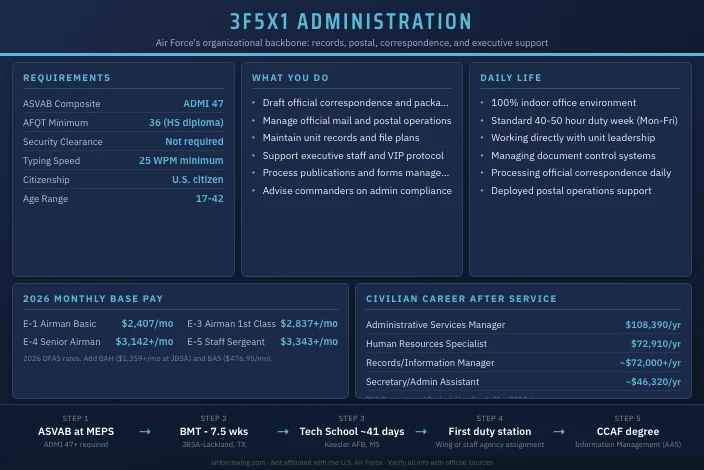
3F5X1 Administration specialists provide administrative and clerical support to Air Force organizations, handling human resources support, executive staff operations, postal and official mail services, records management, and publications management. They serve as the administrative backbone of squadrons, groups, and wings, ensuring that official communications meet legal and regulatory standards and that organizational records remain accurate and accessible.
Daily Tasks
The day-to-day work is primarily office-based. Administration Airmen draft and process official correspondence, manage unit filing systems, coordinate Distinguished Visitor protocol requirements, and process incoming and outgoing official mail and postal items. On any given day a 3F5X1 might prepare briefing materials for a commander, process Freedom of Information Act requests, maintain accountable mail logs, or manage publications and forms libraries.
Specific recurring tasks include:
- Drafting official letters, memoranda, and staff summary packages
- Managing official postal accounts and applying postage through approved systems
- Maintaining and updating records management systems and file plans
- Supporting unit leadership with calendaring, travel coordination, and visitor management
- Processing legal and administrative documents under supervision of senior NCOs
- Advising commanders and unit leadership on administrative regulatory requirements
Specialized Roles
The 3F5X1 career field does not carry formal shredout codes in the same way as technical career fields, but experienced Administration specialists can earn Special Experience Identifiers (SEIs) for executive support, postal operations, and records management. Senior NCOs often specialize as unit postal officers, official mail managers (OMMs), or executive assistants at the squadron and wing level.
Mission Contribution
Administration specialists free up officers and senior NCOs to focus on mission execution rather than paperwork. A commander who relies on a capable 3F5X1 can trust that correspondence goes out correctly, that records are legally defensible, and that the unit’s administrative posture is ready for any inspection. At deployed locations, Administration Airmen stand up field postal operations and ensure mail service reaches forward-deployed personnel, which is a genuine morale function.
Technology and Equipment
The job centers on computers, administrative software, and official Air Force records systems. Airmen work daily in the Air Force’s Document Management and Records system (AFRIMS) for records management, Defense Connect Online and official communication platforms for correspondence, and the Military Postal Service systems for official mail. Typing speed matters: the Air Force requires at least 25 words per minute as a qualification threshold.
Salary and Benefits
Pay starts at E-1 Airman Basic and grows with rank and time in service. The table below reflects 2026 DFAS base pay rates.
| Rank | Grade | Monthly Base Pay (entry) |
|---|---|---|
| Airman Basic | E-1 | $2,407 |
| Airman | E-2 | $2,698 |
| Airman First Class | E-3 | $2,837 |
| Senior Airman | E-4 | $3,142 |
| Staff Sergeant | E-5 | $3,343 |
| Technical Sergeant | E-6 | $3,401 |
Base pay does not tell the full financial story. Add Basic Allowance for Housing (BAH), which varies by duty station and dependency status. At Joint Base San Antonio, TX, an E-4 without dependents receives $1,359/month in BAH. Basic Allowance for Subsistence (BAS) adds a flat $476.95/month for all enlisted Airmen in 2026. Both allowances are tax-free.
Additional Benefits
Healthcare through TRICARE Prime is free for active duty Airmen: zero enrollment fee, zero deductible, zero copay for medical, mental health, prescriptions, and hospitalization. Annual eye exams and dental care at military treatment facilities are included.
The Post-9/11 GI Bill (Chapter 33) covers full in-state tuition at public universities or up to $29,920.95 per academic year at private schools. The monthly housing allowance equals an E-5-with-dependents BAH rate at your school’s zip code. Active duty Airmen can also use Tuition Assistance (TA) while serving: up to $4,500/year, $250 per semester hour, covering the cost of college courses.
Retirement under the Blended Retirement System (BRS) pays 40% of your high-36 average basic pay at 20 years of service. The government matches up to 4% of basic pay in your Thrift Savings Plan (TSP) account and contributes an automatic 1% regardless of member contributions.
Work-Life Balance
Administration is a Monday-through-Friday career field in most assignments. Deployments and exercises can compress that schedule, but the baseline is a standard duty day without shift work or weekend rotations. Airmen accrue 30 days of paid leave per year (2.5 days/month), plus 11 federal holidays.
Qualifications and Eligibility
The 3F5X1 AFSC is accessible to most enlistees. Requirements are moderate and focused on administrative aptitude rather than physical or technical thresholds.
| Requirement | Minimum Standard |
|---|---|
| ASVAB Composite | ADMI 47 |
| AFQT (HS diploma) | 36 |
| AFQT (GED) | 65 |
| Age | 17-42 at enlistment |
| Citizenship | U.S. citizen |
| Security Clearance | Not required for entry |
| Typing Speed | 25 WPM minimum |
| Physical Lifting | Ability to lift 40 lbs |
The Administrative (ADMI) composite draws from the General Science, Paragraph Comprehension, Word Knowledge, and Arithmetic Reasoning subtests of the ASVAB. Strong verbal and reading comprehension scores push this composite up the fastest. If you’re studying for the test, targeted ASVAB prep resources covering those subtests can make a measurable difference.
Application Process
You qualify for 3F5X1 at MEPS (Military Entrance Processing Station) after taking the ASVAB and meeting the typing and physical requirements. A recruiter can run your ASVAB scores against the ADMI composite formula to confirm eligibility before you ship. There is no security clearance requirement for entry, which means the background investigation process does not add time to your pipeline.
Selection Criteria
The 3F5X1 AFSC is consistently available as a recruiting option because the Air Force needs Administration Airmen across every installation worldwide. Competition for the career field is moderate. Applicants with prior administrative or office experience, strong verbal ASVAB subscores, and clean backgrounds tend to have the smoothest path through accession. No civilian certifications are required, though prior experience with records management software or document processing is useful context.
Service Obligation
Enlisted Airmen in 3F5X1 enter service at E-1 (Airman Basic) and commit to a standard 4-year active duty contract. The Air Force may offer shorter or longer contract terms depending on recruiting needs and incentive programs in effect at the time of enlistment.
Work Environment
Administration Airmen work indoors, in office environments, nearly 100% of the time. Typical settings include Military Personnel Sections, wing executive offices, postal facilities, and staff agency offices. The work environment is climate-controlled and document-focused, not physically demanding on a daily basis.
Setting and Schedule
The baseline schedule is a standard 40-50 hour duty week with no rotating shift work in most assignments. During high-tempo periods, exercises, or inspector general visits, that can extend temporarily. Deployed assignments may add weekend duty. Unlike operations or maintenance career fields, 3F5X1 does not carry an inherent requirement for midnight shifts or Panama rotations.
Leadership and Communication
Administration specialists report through a standard squadron chain of command. In smaller units, the 3F5X1 may be the only Administration specialist on the floor, working directly with an officer supervisor and NCO officer-in-charge. In larger staff agencies, you’ll work under a flight chief or section NCOIC. Feedback comes through semi-annual performance counseling sessions and the formal Enlisted Performance Report (EPR) system.
Team Dynamics and Autonomy
New Airmen at the 3-skill level work under close supervision. As they progress to the 5-skill level and complete upgrade training, they handle routine correspondence and records tasks with minimal oversight. Senior 3F5X1 NCOs at the 7- and 9-skill levels operate with significant autonomy and advise commanders directly on administrative compliance. The job rewards people who can manage multiple competing priorities without constant hand-holding.
Job Satisfaction
Administration is rarely a career field that attracts Airmen for the adrenaline. The satisfaction comes from organizational competence: running a clean records program, keeping a commander’s administrative workload manageable, and knowing the unit’s official correspondence meets regulatory standards. Airmen who enjoy precision, process, and professional writing find the field rewarding. Those who need physical activity or rapid mission tempo typically find it frustrating.
Work Environment at a Glance
Key characteristics that define the 3F5X1 work setting:
- Location: Primarily indoors in office suites, staff agencies, and postal facilities at Air Force installations worldwide
- Schedule: Standard Monday-through-Friday duty week in garrison; exercises and deployed operations can extend hours temporarily
- Physical intensity: Low; the work centers on desk operations, computer use, and occasional handling of mail containers or records boxes
- Team size: Ranges from a single-specialist section in smaller squadrons to multi-Airman administrative flights at major wings
- Supervisory access: Daily contact with officers and senior NCOs; the 3F5X1 often works closer to squadron leadership than most enlisted career fields
- Inspection tempo: Administrative programs are inspected by Inspector General teams and higher headquarters staff, so accuracy standards matter year-round
Training and Skill Development
All enlisted Airmen complete Basic Military Training (BMT) at Joint Base San Antonio-Lackland, TX before attending technical school.
| Phase | Location | Length | Focus |
|---|---|---|---|
| BMT | JBSA-Lackland, TX | 7.5 weeks | Military discipline, fitness, core skills |
| Tech School | Keesler AFB, MS | 41 classroom days | Administrative procedures, records management, postal operations, correspondence |
| First Duty Station | Varies | Ongoing | On-the-job training for 3-skill level tasks |
Tech School at Keesler AFB, Mississippi covers the full scope of 3F5X1 duties: official correspondence formats, Air Force records management procedures, postal and official mail operations, publications management, and executive support protocols. The 81st Training Wing at Keesler runs the Air Force’s primary administrative and support training programs.
Upon completing Tech School, graduates earn Community College of the Air Force (CCAF) credit toward an Associate of Applied Science degree in Information Management. That degree pathway continues through on-the-job experience and additional courses taken on personal time, typically completed within a first enlistment. Before you reach this stage, the ASVAB study guide can help you target the Administrative composite subtests that determine eligibility.
Advanced Training
Beyond the initial pipeline, 3F5X1 Airmen can pursue:
- Formal school courses on records management, executive communications, and postal operations through Air Force-sponsored professional development
- CCAF degree completion in Information Management, which provides a foundation for civilian certifications
- Civilian education through Tuition Assistance while serving, applicable toward HR, business administration, or public administration degrees
- Professional Military Education (PME) at Airman Leadership School (SSgt), Noncommissioned Officer Academy (TSgt), and Senior NCO Academy (SMSgt/CMSgt)
The 3F5X1 Enlisted Developmental Team (EDT) tracks senior NCO development and provides vector recommendations for key leadership and developmental positions across the force. Strong performers get visibility for wing-level executive support and staff agency assignments.
Career Progression and Advancement
Administration Airmen follow the standard Air Force enlisted progression, with skill-level upgrades tied to time-in-service, completion of upgrade training, and demonstrated competency.
| Rank | Grade | Typical Timeline | Skill Level | Role Focus |
|---|---|---|---|---|
| Airman Basic | E-1 | Entry | 3 (trainee) | BMT/Tech School |
| Airman First Class | E-3 | ~1 year | 3 | Learning tasks under supervision |
| Senior Airman | E-4 | ~3 years | 5 | Independent administrative tasks |
| Staff Sergeant | E-5 | ~5-6 years | 7 | Section NCO, mentoring junior Airmen |
| Technical Sergeant | E-6 | ~10-11 years | 7 | Flight NCOIC responsibilities |
| Master Sergeant | E-7 | ~14-16 years | 9 | Superintendent, wing-level staff |
| Senior Master Sergeant | E-8 | ~19-20 years | 9 | Career field manager, command staff |
| Chief Master Sergeant | E-9 | ~22+ years | 9 | Senior enlisted advisor, force development |
The Air Force Enlisted Performance Report (EPR) drives promotion eligibility. EPRs are stratified by commanders: a “1 of 5” on a competitive EPR means the commander rates you the top performer out of five eligible members. Stratification language, job performance bullets, and additional duties all factor into whether you make the promotion board. Administration NCOs who seek challenging assignments, take on additional duties, and complete education voluntarily build stronger records.
Role Flexibility
Administration Airmen can apply for retraining after their first enlistment, subject to Air Force Force Development needs. Retraining into adjacent career fields such as 3F0X1 Personnel or 3F2X1 Education and Training is a common pathway for Airmen who want to stay in the Force Support community but expand their focus. Cross-training into logistics, finance, or legal support fields is also possible depending on manpower authorizations. If you are planning to enter through the ASVAB, the ASVAB study guide covers the Administrative composite subtests that determine your eligibility for 3F5X1 and adjacent Force Support career fields.
Physical Demands and Medical Evaluations
The 3F5X1 AFSC does not carry unusual physical requirements. Daily work involves sitting at a desk, operating computers, and occasionally moving boxes of files or mail pouches. The Air Force requires the ability to lift 40 lbs, which covers handling mail containers and records boxes.
All Airmen, regardless of career field, must pass the Air Force Fitness Assessment (FA) annually.
| FA Component | Max Points | Notes |
|---|---|---|
| 1.5-Mile Run | 60 | Primary aerobic component |
| Waist Circumference | 20 | Body composition measure |
| Push-Ups (1 minute) | 10 | Muscular fitness |
| Sit-Ups (1 minute) | 10 | Core strength |
| Total | 100 | Minimum passing score: 75 |
Scoring is age- and gender-normed. Each component has its own minimum threshold; failing any single component fails the overall assessment regardless of composite score. Most Airmen test annually; commanders can direct more frequent testing for members in remediation programs.
Medical Evaluations
No AFSC-specific medical requirements apply to 3F5X1 beyond standard Air Force accession medical standards. Airmen complete periodic physical exams at the frequency set by their unit’s medical unit commander policy.
Deployment and Duty Stations
Administration Airmen serve at Air Force installations worldwide. Because every wing-level organization needs administrative support, 3F5X1 billets exist across a broad range of duty station options.
Duty Stations
Common assignment locations include major Air Force Main Operating Bases across the continental United States and overseas. Popular CONUS installations include:
- Joint Base San Antonio, TX (largest Air Force installation complex)
- Joint Base Langley-Eustis, VA
- Eglin AFB, FL
- Scott AFB, IL (Air Mobility Command headquarters)
- Peterson Space Force Base, CO
Overseas assignments include installations in Germany (Ramstein AB, Spangdahlem AB), Japan (Misawa AB, Kadena AB), South Korea (Osan AB, Kunsan AB), and the United Kingdom (RAF Lakenheath, RAF Mildenhall).
Assignment preferences are submitted through the Air Force’s Assignment Management System. The Air Force balances personal preferences against Air Force needs, and first-term Airmen typically have less assignment flexibility than those on second or later enlistments.
Deployment Details
Deployment frequency for 3F5X1 is lower than for combat support career fields, but it is not zero. Administration Airmen deploy to support Contingency Operations, Air Expeditionary Force rotations, and Combined Air Operations Centers. Typical deployment lengths range from 90 to 180 days. In deployed settings, 3F5X1 Airmen stand up postal operations, process official correspondence, and support wing-level staff functions at forward locations. The Air Force’s deployment rate for Force Support career fields is generally lower than for operations or maintenance AFSCs.
Risk, Safety, and Legal Considerations
The 3F5X1 AFSC carries minimal occupational hazards. Office environments do not expose Airmen to flight-line noise, toxic chemicals, or physical danger in garrison. Deployed environments introduce the same force-protection risks that apply to all deployed personnel, including base security protocols and potential threat exposure at forward operating bases.
Safety Protocols
Standard workplace ergonomics and computer workstation safety apply to Administration offices. Records facilities follow fire suppression and environmental control standards to protect official documents. Postal operations require handling potentially unknown packages, which triggers established screening protocols for suspicious mail. All Administration Airmen complete annual workplace safety training covering ergonomic best practices, emergency procedures, and postal security awareness.
Security and Legal Requirements
3F5X1 does not require a security clearance for initial entry. However, Airmen in this career field regularly handle For Official Use Only (FOUO) materials, Privacy Act-protected records, and controlled correspondence. Training on information protection requirements is part of Tech School and recurring annual training requirements.
The service contract for enlisted Airmen is legally binding. Separation before the end of the obligation period requires command approval and may trigger recoupment of incentive pay in certain circumstances. The Air Force handles early separations through formal administrative channels with legal representation available through the Staff Judge Advocate office.
Risk Profile Summary
A quick comparison of the major risk categories for this AFSC:
- Physical hazard (garrison): Very low; the office environment involves standard ergonomic and fire-safety considerations only
- Physical hazard (deployed): Moderate; all deployed personnel face the same force-protection exposure at forward locations
- Occupational health: Minimal; no chemical, noise, or radiation hazards are present in standard assignments
- Information security risk: Present; daily handling of FOUO and Privacy Act materials requires strict compliance with AFI 33-332 and annual data protection training
- Legal and contractual: Standard enlistment obligation applies; early separation requires formal administrative processing
- Inspection/audit exposure: Higher than most career fields; administrative programs are regularly reviewed by IG teams and higher headquarters inspectors
Impact on Family and Personal Life
Administration is one of the more family-friendly career fields in the Air Force, based on schedule predictability and deployment tempo. The standard duty week runs Monday through Friday, which makes school schedules and childcare easier to manage than shift-based career fields. Most assignments are at established installations with full base support services available. For families weighing the demands of military life, the 3F5X1 career field presents a comparatively stable picture across most assignment options.
Family Support Resources
The Airman and Family Readiness Center (AFRC) at every installation provides relocation assistance, financial counseling, employment help for spouses, childcare referrals, and deployment support. The Military OneSource program extends confidential counseling and support services available 24 hours a day regardless of duty station.
Key resources available to 3F5X1 Airmen and their families:
- AFRC relocation assistance: Pre-arrival installation briefings, housing referrals, and community connection support for new arrivals
- Spouse employment programs: Resume workshops, job fair access, and federal employment application coaching at installation AFRCs
- School liaison officers: Coordinate school enrollment and academic record transfers for military children during PCS moves
- Military OneSource: 24/7 access to financial counseling, mental health referrals, and family support regardless of location
- Child Development Centers (CDCs): On-installation childcare with subsidized rates based on total family income
- Exceptional Family Member Program (EFMP): Enrollment support and assignment coordination for families with special-needs members
Relocation
Active duty Airmen receive Permanent Change of Station (PCS) orders every 2-4 years on average, with the actual frequency depending on Air Force manning needs and individual assignment history. PCS moves are funded through the government-paid Household Goods program. Families with school-age children can request school liaison support at gaining and losing installations. While 3F5X1 has worldwide assignments, most billets are at established Main Operating Bases rather than remote or isolated locations, which limits the most disruptive assignment scenarios.
Reserve and Air National Guard
The 3F5X1 Administration AFSC is available in both the Air Force Reserve (AFR) and the Air National Guard (ANG). Every Reserve and Guard wing needs administrative support, and the career field exists across units in most states.
Drill Schedule and Training Commitment
The standard Reserve and Guard commitment is one weekend per month (Unit Training Assembly, or UTA) plus 15 days per year (Annual Tour). 3F5X1 does not require additional training days or certifications beyond the standard schedule for most units. Some units with high administrative tempo may schedule additional UTAs during peak periods.
Component Comparison
| Feature | Active Duty | Air Force Reserve | Air National Guard |
|---|---|---|---|
| Commitment | Full time | 1 wknd/mo + 15 days/yr | 1 wknd/mo + 15 days/yr |
| E-4 Monthly Base Pay | $3,142+ | ~$430-$475 per drill wknd | ~$430-$475 per drill wknd |
| Healthcare | TRICARE Prime (free) | TRICARE Reserve Select (premiums apply) | TRICARE Reserve Select (premiums apply) |
| Education | Tuition Assistance + GI Bill | Federal TA + GI Bill (Montgomery or Post-9/11 if mobilized) | State tuition waivers + Federal TA |
| Retirement | 20-yr pension (40% high-36) | Points-based (age 60 draw) | Points-based (age 60 draw) |
| Deployment Tempo | Moderate | Lower; voluntary + involuntary mobilization | Lower; state mission + federal mobilization |
TRICARE Reserve Select requires monthly premiums (individual or family) compared to zero-cost TRICARE Prime on active duty. ANG members may qualify for state tuition waivers that fully cover in-state public university tuition, a benefit that varies significantly by state and is separate from federal GI Bill eligibility.
Reserve and Guard retirement uses a points system: Airmen accumulate points for drill attendance, active service, and training days. A reservist with 20 qualifying years (at least 50 points per year) can draw retirement pay starting at age 60, compared to immediate draw for active duty retirees.
Civilian Career Integration
3F5X1 pairs exceptionally well with civilian administrative, HR, and records management careers. The part-time service commitment typically does not conflict with civilian office jobs, and many employers support Guard and Reserve membership. USERRA (Uniformed Services Employment and Reemployment Rights Act) protects your civilian position and seniority during military leave, including mobilizations. Federal government civilian positions in administrative and HR support roles often award veterans’ preference points that directly improve hiring outcomes.
Post-Service Opportunities
Few military career fields translate as directly to civilian employment as Administration. The skills built in 3F5X1 are in demand across every industry that needs organizational structure, document control, and executive support.
| Civilian Career | Median Annual Salary | 10-Year Outlook |
|---|---|---|
| Administrative Services Manager | $108,390 | +4% (avg) |
| Human Resources Specialist | $72,910 | +8% (faster than avg) |
| Secretary/Administrative Assistant | ~$46,320 | Declining, but ~400K openings/yr |
| Records and Information Manager | ~$72,000+ | Stable/growing with compliance demand |
| Executive Assistant | ~$65,000-$90,000 | Varies by industry |
Salary figures from Bureau of Labor Statistics (BLS) May 2024 data.
Certifications and Credentials
The CCAF degree in Information Management earned through the 3F5X1 pipeline provides a credential recognized in hiring decisions for administrative and records positions. Civilian certifications that complement 3F5X1 experience include:
- Certified Records Manager (CRM) through the Institute of Certified Records Managers
- Professional in Human Resources (PHR) through HRCI (for those who expand into HR roles)
- Certified Administrative Professional (CAP) through the International Association of Administrative Professionals
Transition Programs
The Transition Assistance Program (TAP) provides job search coaching, resume writing, interview preparation, and industry connection events for separating Airmen. The Hiring Our Heroes corporate fellowship program places transitioning service members in corporate internships before separation, and administrative professionals are commonly placed in HR, operations, and executive support roles.
Is This a Good Job for You? The Right (and Wrong) Fit
Ideal Candidate
3F5X1 is a strong fit if you are organized to a fault, comfortable working in formal regulatory environments, and genuinely interested in the mechanics of how large organizations communicate officially. You need to enjoy writing and editing, because a significant part of the job is getting correspondence exactly right. Detail orientation is not optional in this field; a misaddressed official letter or incorrect records disposition has real consequences.
Strong 3F5X1 candidates tend to:
- Score well on verbal ASVAB subtests (Paragraph Comprehension, Word Knowledge)
- Have prior office, clerical, or customer service experience
- Be comfortable working directly with senior officers and NCOs
- Enjoy working with databases, filing systems, and process documentation
Potential Challenges
The work is almost entirely desk-based, which frustrates Airmen who need variety or physical engagement in their daily routine. Deployed environments add operational context, but garrison duty is genuinely office-oriented for most of a career. The field also requires consistent regulatory compliance: every correspondence format, every records retention schedule, and every postal procedure has a governing instruction. Airmen who resist working inside tight procedural constraints will find this frustrating.
The career field is not a path to high-risk or operationally exciting assignments. It is a path to professional competence in organizational administration, and that competence has long-term value in the civilian workforce.
Long-Term Fit
For someone who wants a stable, office-based military career with direct civilian transferability, 3F5X1 is a practical and underappreciated option. The deployments are moderate, the schedule is predictable, and the skills built translate immediately into HR, operations, and administrative management careers after service. It’s also a career field where a Chief Master Sergeant (CMSgt) who spent 20+ years mastering organizational administration walks out the gate into a legitimate management-level civilian role without needing additional credentialing.
More Information
Talk to an Air Force recruiter for current availability, contract terms, and assignment options for 3F5X1. Recruiters can run your ASVAB scores against the ADMI composite formula before you test, so you know exactly where you stand. If you prefer to study at home first, the PiCAT guide explains the online pre-screening version of the ASVAB. You can find a recruiter through the official Air Force website or call the Air Force Recruiting Service directly.
This site is not affiliated with the U.S. Air Force or any government agency. Verify all information with official Air Force sources before making enlistment or career decisions.
Explore more Air Force Force Support careers such as 3F0X1 Personnel and 3F2X1 Education and Training.