3F3X1 Manpower
Most people who join the Air Force want to fly jets or protect a base. The 3F3X1 Manpower specialist does something different: they determine whether the units flying those jets actually have enough people to accomplish the mission. It’s an analytical career that sits at the intersection of organizational management, data research, and military planning. If you want a job where the output isn’t a physical product but a recommendation that reshapes how a command is structured, this is one of the few enlisted career fields built for that kind of work.
Qualifying requires specific ASVAB line scores. Our ASVAB study guide covers what to target and how to prepare.
Job Role
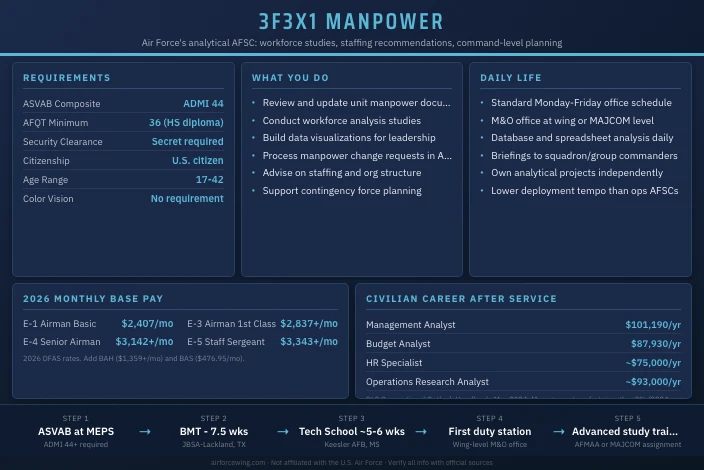
3F3X1 Manpower specialists conduct workforce analysis studies to determine how many people Air Force units need and what skills those positions require. They analyze organizational structures, develop staffing recommendations, manage unit manpower documents, and advise commanders on workforce requirements and workload distribution. The career field supports every major command and functional area across the Air Force.
Daily Tasks
Work varies by assignment, but most 3F3X1 Airmen operate inside a Manpower and Organization (M&O) office and handle a steady mix of analytical and administrative functions:
- Reviewing unit manpower documents (UMDs) for accuracy and currency
- Conducting manpower studies that measure workload against authorized positions
- Building data visualizations and briefing slides for leadership
- Processing manpower change requests and position actions through the Air Force Manpower Information System
- Advising unit commanders on organizational structures and staffing options
- Supporting contingency and deployment planning by projecting force requirements
- Collaborating with financial management offices on budget-driven workforce decisions
- Maintaining records for special experience identifiers and duty positions
The analytical side of this job is real. Studies require you to gather data from multiple sources, interview supervisors and workers, document task frequencies, and build a case for whether a unit is over-staffed, under-staffed, or mis-structured. The output goes directly to leadership.
Specializations
The 3F3X1 AFSC does not use formal shredout suffixes the way some other career fields do, but there are distinct functional paths based on assignment.
| Assignment Type | Focus Area |
|---|---|
| Wing-level M&O | Unit manpower documents, position management, local studies |
| MAJCOM/HAF | Enterprise-level workforce analysis, policy development |
| Air Force Manpower Analysis Agency (AFMAA) | Deep analytical studies, manpower standards development |
| Contingency planning billets | Force deployment planning, UTC structure |
Senior Airmen and NCOs who earn Special Experience Identifiers (SEIs) in manpower standards or contingency planning carry those qualifications to subsequent assignments.
Mission Contribution
The Air Force cannot build a budget, design a deployment package, or justify staffing requests to Congress without accurate manpower data. Manpower specialists provide the foundation for those decisions. When a wing commander asks whether the unit can absorb a new mission, 3F3X1 Airmen are the ones who calculate whether the people are there to do it. They also support force development through contingency UTC (Unit Type Code) construction, determining what positions a deployed package needs before anyone boards a plane.
Technology and Equipment
Day-to-day tools include the Air Force Manpower Information System (AFMIS), the Manpower Data System (MDS), Microsoft Excel and PowerPoint at a professional level, and enterprise analytics tools such as Power BI. Senior specialists at the MAJCOM level and above may work with advanced statistical modeling platforms. The job demands comfort with spreadsheet analysis, data presentation, and working inside government database systems.
Salary
Base Pay
All active-duty pay is set by DFAS and applies uniformly across all branches. A new 3F3X1 Airman enters at E-1 and typically reaches E-4 (Senior Airman) within three to four years.
| Grade | Rank | Monthly Base Pay (2026) |
|---|---|---|
| E-1 | Airman Basic (AB) | $2,407 |
| E-2 | Airman (Amn) | $2,698 |
| E-3 | Airman First Class (A1C) | $2,837 - $3,198 |
| E-4 | Senior Airman (SrA) | $3,142 - $3,816 |
| E-5 | Staff Sergeant (SSgt) | $3,343 - $4,422 |
| E-6 | Technical Sergeant (TSgt) | $3,401 - $5,044 |
Base pay is the floor, not the ceiling. Most Airmen living off-base receive Basic Allowance for Housing (BAH), which varies by duty location and dependency status. A single E-4 at Joint Base San Antonio receives $1,359/month in BAH. An E-4 with dependents at the same installation receives $1,728/month. Basic Allowance for Subsistence (BAS) adds a flat $476.95/month for all enlisted members.
The 3F3X1 career field does not currently appear on the Air Force’s selective reenlistment bonus list. Pay growth comes through promotion and time-in-service increases rather than specialty bonuses.
Additional Benefits
Healthcare: Active-duty Airmen and their dependents enroll in TRICARE Prime at no cost. There are no enrollment fees, deductibles, or copays on the active-duty plan. Coverage includes medical, dental, vision, mental health, prescriptions, and hospitalization.
Education: Tuition Assistance covers up to $4,500 per year ($250 per semester hour) while on active duty. After separation, the Post-9/11 GI Bill covers full in-state tuition at public universities or up to $29,920.95 per academic year at private schools, plus a monthly housing allowance based on the school’s ZIP code and up to $1,000 per year for books.
Retirement: The Blended Retirement System (BRS) combines a 20-year pension at 40 percent of high-36 average basic pay with Thrift Savings Plan (TSP) contributions. The government contributes 1 percent of basic pay automatically and matches up to 4 percent more based on member contributions.
Work-Life Balance
The 3F3X1 job runs primarily on standard Monday-through-Friday business hours in garrison. Shift work is uncommon outside of deployment. Most M&O offices follow a 40-hour week structure, though tempo increases around annual manpower data validation cycles and major command reviews. The schedule is one of the more predictable in the enlisted force.
Qualifications
Requirements Table
| Requirement | Standard |
|---|---|
| Citizenship | U.S. citizen |
| Age | 17-42 (active duty enlistment) |
| Education | High school diploma (or GED with AFQT 65+) |
| ASVAB Composite | Administrative (ADMI) 44 |
| Security Clearance | Secret |
| Color Vision | No specific requirement |
| Physical Profile | Normal (no disqualifying conditions) |
The Administrative (ADMI) composite is built from four ASVAB subtests: General Science, Paragraph Comprehension, Word Knowledge, and Arithmetic Reasoning. Focused preparation on verbal and arithmetic reasoning sections gives you the strongest return on study time for this composite. An ASVAB study guide focused on those four subtests covers everything you need to qualify for this specialty.
The minimum AFQT for Air Force enlistment is 36 with a high school diploma. The ADMI 44 composite is the qualifying score for 3F3X1 specifically. The Secret clearance requires a Single Scope Background Investigation (SSBI) covering financial history, personal references, employment history, and any foreign contacts or travel.
Application Process
Candidates go through the standard Air Force enlistment pipeline:
- ASVAB testing at a Military Entrance Processing Station (MEPS)
- Medical and physical evaluation at MEPS
- Background investigation for Secret clearance eligibility
- AFSC selection and job assignment through the Air Force Recruiter Assistance Program
- Delayed Entry Program (DEP) enrollment while awaiting a training seat
The clearance process runs concurrently with DEP in most cases. Candidates with clean financial and legal records typically have no significant delays. Foreign contacts or dual citizenship may require additional adjudication.
Selection Criteria
3F3X1 is not a high-demand critical specialty with a waiting list. Selection depends primarily on meeting the ADMI composite threshold and qualifying for the Secret clearance. Applicants with prior analytical, administrative, or data management experience may be competitive for early specialty assignments. No civilian certifications are required for entry.
Service Obligation
Standard active-duty enlistment is four years. Selectees enter at E-1 (Airman Basic) unless they qualify for advanced paygrade based on prior college credits, JROTC, or other qualifying programs.
Work Environment
Setting and Schedule
Almost all 3F3X1 work happens in office environments: M&O offices on installations, MAJCOM headquarters buildings, or the Air Force Manpower Analysis Agency at Joint Base San Antonio-Randolph, TX. Physical labor is minimal. Shift work is rare. Most assignments follow a normal duty day with flexible telework options available at select duty stations.
The work is intellectually demanding rather than physically demanding. You spend significant time inside databases, spreadsheets, and briefing documents. Strong analytical focus and attention to data detail matter more than any physical attribute.
Leadership and Communication
Manpower offices are small, typically staffed by a handful of enlisted specialists and at least one officer (often a 38P Manpower and Organization officer). NCOs in this career field work directly with squadron commanders, group commanders, and functional area managers. Communication is professional and frequent, including briefings to senior leaders. Performance feedback follows the Air Force’s standard Enlisted Performance Report (EPR) system, with initial feedbacks at least 180 days before the closeout report and formal EPRs annually for E-5 and above.
Team Dynamics and Autonomy
By Air Force standards, 3F3X1 Airmen operate with notable autonomy. Once you reach the 5-skill level and demonstrate competency, you often own study projects from data collection through final briefing. There’s a direct line between your individual work product and a commander’s decision. Senior NCOs serve as supervisors and technical reviewers, but junior specialists regularly manage their own project timelines and analytical tasks.
Job Satisfaction and Retention
Retention in this career field is moderate. Airmen who stay beyond a first enlistment often do so because the skills have clear civilian value and because the work itself is intellectually engaging compared to many other enlisted jobs. Those who leave early typically cite the limited number of assignments and the administrative overhead that comes with managing unit records.
Training
Training Pipeline
| Phase | Location | Duration | Focus |
|---|---|---|---|
| Basic Military Training (BMT) | JBSA-Lackland, TX | 7.5 weeks | Military fundamentals, discipline, fitness |
| Manpower Apprentice Course (Tech School) | Keesler AFB, MS | ~5-6 weeks | Manpower concepts, AFMIS, study methodology, organizational analysis |
| On-the-Job Training (OJT) at first duty station | Varies | ~12 months | Skill-level qualification, unit-specific systems |
Tech School at Keesler AFB covers the core competencies needed for the 3-skill level: understanding manpower standards, navigating Air Force information systems, conducting basic study methods, preparing manpower documents, and supporting unit management functions. The course is classroom-focused with practical exercises in database navigation and study design.
Keesler AFB, MS, is the Air Force’s primary training center for Force Support AFSCs. The 81st Training Wing at Keesler hosts courses for multiple 3F-series specialties, so you’ll share the installation with Airmen from related career fields during Tech School.
Advanced Training and Development
After reaching the 5-skill level (typically around year three), NCOs can pursue:
- Manpower standards development courses through the Air Force Manpower Analysis Agency
- Force Development Engineering training for contingency UTC construction and deployment planning
- Advanced analytics training through Air University courses and partnerships with civilian institutions
- Civilian education: the Air Force supports bachelor’s and master’s degrees in management, public administration, and quantitative analysis that directly reinforce 3F3X1 competencies
Airmen who pursue a degree in business, operations research, or public policy while serving position themselves well for both promotion and post-service employment. The PiCAT exam is worth knowing about before MEPS, as it lets you complete the ASVAB before your appointment and potentially speed up the enlistment process.
Career Progression
Rank Progression
| Rank | Grade | Typical Timeline | Key Milestones |
|---|---|---|---|
| Airman Basic (AB) | E-1 | Entry | Ship to BMT |
| Airman (Amn) | E-2 | ~6 months | Complete BMT |
| Airman First Class (A1C) | E-3 | ~16 months | Tech School complete |
| Senior Airman (SrA) | E-4 | ~3 years | 5-skill level, full qualification |
| Staff Sergeant (SSgt) | E-5 | ~5-6 years | NCO, test + board |
| Technical Sergeant (TSgt) | E-6 | ~11 years (avg) | Senior NCO, EPR board |
| Master Sergeant (MSgt) | E-7 | ~17 years (avg) | Senior leadership, AFMAA eligible |
Promotion to E-5 requires passing the Weighted Airman Promotion System (WAPS) test and meeting time-in-grade requirements. EPR scores, decorations, and professional military education completion all factor into promotion points. Manpower NCOs who produce strong analytical products and brief regularly to senior leadership tend to accumulate above-average EPR scores.
Role Flexibility and Transfers
Retraining into 3F3X1 from another AFSC requires meeting the ADMI composite and clearance eligibility. The opposite also works: 3F3X1 Airmen with a technical aptitude sometimes retrain into budget, financial management, or acquisition support roles. The Air Force Assignment System (AFAS) manages duty station moves, with Airmen submitting preferences and the Air Force balancing requirements.
Performance Evaluation
Airmen E-5 and above receive annual EPRs. The EPR system rates performance across job performance, leadership, and whole-person development. Manpower specialists who complete major studies, earn academic credentials, and actively develop junior Airmen typically rate competitively. The career field is small enough that standout performance is visible across the community.
Physical Demands
Fitness Standards
3F3X1 is an administrative specialty with minimal physical demands. The job does not require lifting heavy equipment, working outdoors in extreme conditions, or performing physically strenuous tasks. Standard office ergonomics and extended desk work are the norm.
All Airmen, regardless of AFSC, must pass the Air Force Fitness Assessment. The assessment is scored on a 100-point scale with a minimum passing composite of 75. Scores are age- and gender-normed.
| Component | Weight | Minimum Passing Standard (Under 25, per AF norms) |
|---|---|---|
| 1.5-Mile Run | 60 pts | Must meet minimum time for age/gender bracket |
| Push-Ups (1 min) | 10 pts | Must meet minimum reps for age/gender bracket |
| Sit-Ups (1 min) | 10 pts | Must meet minimum reps for age/gender bracket |
| Waist Circumference | 20 pts | Must meet maximum measurement for age/gender bracket |
Assessments are conducted annually for most Airmen. Verify current scoring tables with official Air Force fitness standards.
Medical Evaluations
Standard Air Force enlistment medical processing applies. No occupation-specific physical requirements exist beyond the standard MEPS evaluation and ongoing periodic health assessments. Vision, hearing, and general medical fitness are evaluated at accession and at regular intervals throughout a career.
Deployment
Deployment Details
3F3X1 Airmen deploy primarily in support roles. Manpower specialists support deployed headquarters and joint task force staffs, where accurate position management and workforce analysis remain necessary even in contingency environments. Deployment frequency is lower than combat-coded AFSCs. Most 3F3X1 Airmen can expect one deployment every two to four years depending on global posture requirements.
Deployment lengths typically run 90 to 180 days for most assignments. Some MAJCOM-level billets have longer dwell times between deployments. The career field does not typically deploy to forward combat positions.
Duty Stations
3F3X1 Airmen are assigned to installations with Manpower and Organization offices, which exist at most major Air Force bases. Common duty stations include:
- Joint Base San Antonio-Randolph, TX (Air Force Manpower Analysis Agency headquarters)
- Wright-Patterson AFB, OH
- Joint Base Langley-Eustis, VA
- Scott AFB, IL
- Tinker AFB, OK
- Overseas assignments at USAFE and PACAF headquarters
Assignment preferences are submitted through AFAS. Overseas tours are available and count toward career broadening. First-term Airmen are generally assigned based on Air Force needs, with preference weighting increasing after the first reassignment cycle.
Risk/Safety
Job Hazards
The 3F3X1 job carries minimal physical risk in garrison. Standard office workplace hazards (ergonomic strain, eye fatigue from extended screen use) represent the primary concerns. Deployment assignments carry the same general risks as any overseas Air Force mission but without a direct combat role.
Safety Protocols
Air Force installation safety programs cover all Airmen regardless of AFSC. Workplaces follow Occupational Safety and Health standards for office environments. No AFSC-specific hazardous materials or specialized safety equipment are required for 3F3X1.
Security and Legal Requirements
3F3X1 requires a Secret security clearance. Access to sensitive manpower data, classified organizational structures, and personnel information is a routine part of the job at certain assignments. The clearance investigation covers employment history, financial records, personal references, and foreign travel or contacts.
Clearance holders have an ongoing legal obligation to report changes in personal circumstances, including foreign contacts, financial hardships, and legal issues. Violation of security protocols is a career-ending offense and may carry criminal penalties under the Uniform Code of Military Justice (UCMJ). All Air Force personnel serve under the UCMJ, which governs conduct both on and off duty.
Impact on Family
Family Considerations
The regular business-hours schedule makes 3F3X1 one of the more family-friendly enlisted AFSCs. Extended TDYs and long irregular hours are uncommon in garrison. Deployment tempo is lower than most operational AFSCs. Families benefit from the predictable daily schedule, access to on-base resources, and BAH entitlements that cover off-base housing.
The Air Force maintains strong family support programs: Family Support Centers, school liaison programs, childcare on most installations, and spouse employment assistance programs. Military OneSource provides 24/7 support for a wide range of personal and family needs at no cost to the member.
Relocation and Flexibility
Permanent Change of Station (PCS) moves occur every two to four years on average. Families should expect relocations roughly every assignment cycle, which means school changes and job transitions for spouses are recurring realities. The Air Force covers authorized moving costs and provides a Dislocation Allowance (DLA) to help offset relocation expenses.
The 3F3X1 career field has assignments spread across the continental United States and overseas, giving members reasonable geographic diversity over a career.
Reserve and Air National Guard
Component Availability
3F3X1 Manpower is available in both the Air Force Reserve and the Air National Guard. Reserve and Guard units maintain manpower functions at their respective commands and use this AFSC for organizational analysis and unit documentation management.
Drill Schedule and Training Commitment
Standard commitment is one Unit Training Assembly (UTA) weekend per month and a 15-day Annual Tour per year. Manpower functions in Reserve and Guard units may require additional annual training for database certifications, AFMIS refresher training, and command-level manpower review cycles. Individual Mobilization Augmentee (IMA) positions for 3F3X1 exist at MAJCOMs and HAF-level commands.
Part-Time Pay
An E-4 Senior Airman earns approximately $3,142 to $3,816 per month on active duty. For a standard two-day drill weekend (four Unit Training Assembly periods), that same E-4 earns roughly $421 to $511 for the weekend based on four daily drill rates. The comparison illustrates why most Reserve Airmen hold civilian jobs and treat drill pay as supplemental income.
Benefits Comparison
| Category | Active Duty | Air Force Reserve | Air National Guard |
|---|---|---|---|
| Commitment | Full-time | 1 weekend/mo + 15 days/yr | 1 weekend/mo + 15 days/yr |
| Monthly Pay (E-4) | $3,142-$3,816 | Drill pay only (~$421-511/weekend) | Drill pay only (~$421-511/weekend) |
| Healthcare | TRICARE Prime (no cost) | TRICARE Reserve Select (premiums apply) | TRICARE Reserve Select (premiums apply) |
| Education | Tuition Assistance ($4,500/yr) + GI Bill | Federal TA + GI Bill (service-contingent) | State tuition waivers (many states) + GI Bill |
| Deployment Tempo | Higher | Lower (mobilization-dependent) | Lower (mobilization-dependent) |
| Retirement | 20-year pension (BRS) | Points-based at age 60 | Points-based at age 60 |
Air National Guard Airmen in most states benefit from state tuition assistance programs that can cover undergraduate tuition entirely, which is a significant financial advantage for Guard-focused career paths.
Deployment and Mobilization
Reserve and Guard Airmen in the 3F3X1 AFSC face lower mobilization rates than operational AFSCs. When mobilized, they typically support MAJCOM headquarters, CONUS installations during Active Duty shortfalls, or overseas contingency headquarters. Mobilization lengths generally run 90 to 180 days.
Civilian Career Integration
The analytical skills from 3F3X1 transfer well to civilian workforce planning, HR analytics, and management consulting roles. Guard and Reserve service pairs naturally with civilian careers in human resources, operations management, or government contracting. USERRA protections require civilian employers to hold positions for deployed service members and prohibit discrimination based on military service. The Employer Support of the Guard and Reserve (ESGR) program provides employer education and mediation if conflicts arise.
Post-Service
Transition to Civilian Life
The 3F3X1 skill set maps directly to several high-demand civilian fields. Organizational analysis, workforce planning, data visualization, and management consulting are all areas where 3F3X1 veterans arrive with real project experience rather than just academic credentials. The Air Force’s Transition Assistance Program (TAP) provides job placement workshops, resume writing support, and civilian interview preparation before separation.
Veterans with a Secret clearance can also pursue federal civilian positions through the GS system, where manpower-related roles exist at the GS-9 through GS-13 levels in many agencies.
Civilian Career Prospects
| Civilian Job Title | BLS Median Salary (2024) | 10-Year Outlook |
|---|---|---|
| Management Analyst | $101,190/year | +9% (faster than average) |
| Budget Analyst | $87,930/year | +1% (slower than average) |
| Human Resources Specialist | ~$75,000/year | +8% (faster than average) |
| Operations Research Analyst | ~$93,000/year | +12% (much faster than average) |
Management analyst is the strongest direct equivalent, and the growth rate reflects real demand. Large consulting firms, federal agencies, and defense contractors actively recruit veterans with analytical project experience. A bachelor’s degree in business, public administration, or quantitative analysis adds significant weight for mid-level and senior roles.
Veterans who transition to federal civilian employment may qualify for Veterans’ Preference points during the hiring process, which can make a meaningful difference in competitive GS selections.
Is This a Good Job
Ideal Candidate Profile
3F3X1 suits people who genuinely enjoy analytical work, can synthesize data into a clear recommendation, and communicate findings confidently to senior leaders. If you find satisfaction in solving organizational problems on paper rather than in the field, this career field delivers that consistently. The job rewards intellectual precision, structured thinking, and professional writing ability.
People with strong math and verbal reasoning scores, an interest in business or public administration, and a preference for office-based work over physical or technical environments tend to succeed here.
Potential Challenges
The career field is small. That means fewer assignment locations, a smaller professional network, and a promotional environment where every evaluation matters. If you joined the Air Force for hands-on technical work, rapid operational tempo, or physical variety, this job will feel administrative. The pace in garrison is deliberate rather than urgent, and some Airmen find the analytical cycle of collecting data, building studies, and waiting for decisions to be slower-moving than expected.
The Secret clearance requirement also means your financial and personal history will be scrutinized. Any significant debt, recent legal issues, or foreign ties can complicate or disqualify the clearance process.
Career and Lifestyle Alignment
3F3X1 is a strong fit for someone who wants a military career with a clear post-service trajectory. The work builds a portfolio of analytical projects that translate directly into management consulting or federal civilian resumes. The schedule supports education and family life in ways that high-operational AFSCs cannot match. If your long-term goal is a career in business analysis, workforce planning, or government management, three to six years in 3F3X1 gives you experience that civilian entry-level candidates don’t have.
More Information
Talk to an Air Force recruiter about current openings for 3F3X1, your ASVAB composite score, and the clearance process. The official Air Force recruiting website provides information about current enlistment incentives, test preparation resources, and recruiter contacts by ZIP code. Recruiters can confirm current availability and whether the specialty is open for accessions in your enlistment window. If you’re still preparing to test, an ASVAB study guide focused on verbal and arithmetic reasoning will directly strengthen your Administrative composite score for this career field.
This site is not affiliated with the U.S. Air Force or any government agency. Verify all information with official Air Force sources before making enlistment or career decisions.
Explore more Air Force Force Support careers such as 3F0X1 Personnel and 3F2X1 Education and Training.