3F2X1 Education and Training
Every Airman who attends a professional military education course, enrolls in a tuition assistance program, or gets scheduled for a mandatory unit training event does so because a 3F2X1 made it happen. The Education and Training AFSC sits behind the scenes of Air Force professional development, managing records, coordinating schooling, tracking completion, and making sure the right person gets to the right course at the right time. It’s administrative work with real career consequences for every Airman in the unit. If you’re looking for a lateral move that builds credentials in learning and development without leaving the Air Force, this is one of the clearest paths in the Force Support career group.
Qualifying requires specific ASVAB line scores. Our ASVAB study guide covers what to target and how to prepare.
Job Role
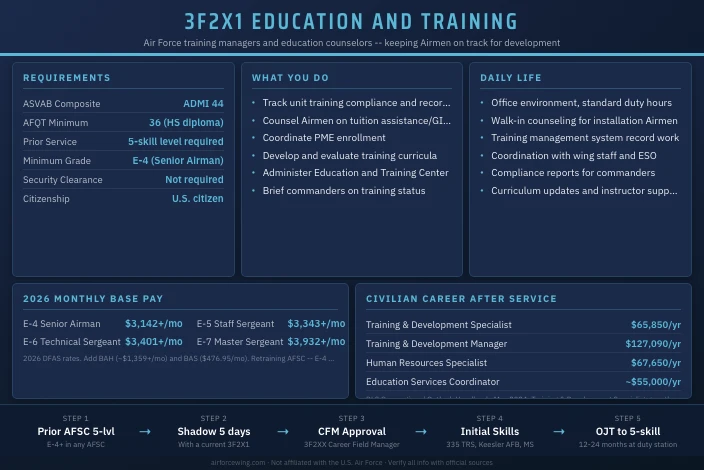
The 3F2X1 Education and Training technician manages the training and education programs that keep an Air Force unit mission-ready and professionally developed. These Airmen maintain training records, administer tuition assistance and professional military education processes, develop and evaluate training curricula, and advise Airmen and commanders on education entitlements and requirements.
Daily Tasks
Day-to-day work centers on two main areas: unit training management and education services. On the training side, a 3F2X1 tracks completion of ancillary, qualification, and mission-essential training for every assigned Airman. They work directly with commanders and supervisors to identify training gaps, schedule courses, and ensure the unit meets readiness requirements.
Education services cover a different set of responsibilities. Technicians counsel Airmen on degree programs, tuition assistance, the GI Bill, credentialing opportunities, and professional military education requirements. At most installations, a 3F2X1 runs the base Education and Training Center, which serves as the primary walk-in resource for Airmen with questions about schooling, certifications, and career development.
Curriculum development is a less visible but equally important function. Experienced technicians build and update training materials, write lesson plans, and certify instructors. At wing or command level, this work expands into managing training schedules and compliance across multiple squadrons.
Specialty Codes
| Code | Title | Notes |
|---|---|---|
| 3F2X1 | Education and Training | Primary specialty code |
| 3F271 | Education and Training, Craftsman | E-5/E-6 level; direct supervision of programs |
| 3F291 | Education and Training, Superintendent | E-7 through E-9; wing or major command level management |
Special Experience Identifiers (SEIs) may be awarded for specific functional expertise such as instructor certification or curriculum development. Check the current CFETP for the active SEI list.
Mission Contribution
Unit readiness depends on Airmen being current on mandatory training. If a pilot misses a required course or a maintainer is overdue for certification, the unit’s mission capability takes a hit. A 3F2X1 is the person who prevents that by keeping the training program organized and the records accurate. On the education side, these technicians directly influence retention. Airmen who understand their tuition assistance benefits and education pathways are more likely to pursue degrees and stay in the Air Force. That counseling function has a measurable effect on the force.
Technology and Equipment
3F2X1 Airmen work heavily with the Advanced Distributed Learning Service (ADLS) and the Air Force’s training management systems to track course completions and generate compliance reports. They also use the Education Services Officer (ESO) network tools, the Virtual Education Center, and standard productivity software for record maintenance. Curriculum developers work with learning management platforms to build and deploy digital training content.
Salary
Pay for 3F2X1 Airmen follows the standard military pay scale, which applies across all Air Force specialties. Since this AFSC requires prior service at E-4 or above, most members enter the retraining pipeline already carrying several years of service, which means higher base pay from day one compared to someone entering a first-term AFSC.
Base Pay
| Rank | Grade | Monthly Base Pay (2026) |
|---|---|---|
| Senior Airman | E-4 | $3,142, $3,816/mo |
| Staff Sergeant | E-5 | $3,343, $4,422/mo |
| Technical Sergeant | E-6 | $3,401, $5,044/mo |
| Master Sergeant | E-7 | $3,932, $5,537/mo |
| Senior Master Sergeant | E-8 | $5,867, $7,042/mo |
2026 DFAS rates. Ranges reflect years-of-service steps within grade.
Additional Pay and Allowances
Beyond base pay, Airmen assigned off-base receive Basic Allowance for Housing (BAH), which varies by duty location, rank, and dependent status. A single E-4 at Keesler AFB receives approximately $1,359/mo without dependents. Basic Allowance for Subsistence (BAS) adds a flat $476.95/mo for all enlisted members. Both allowances are tax-free.
No selective reenlistment bonus is currently associated with 3F2X1. Verify current incentive status with your recruiter or the Air Force Personnel Center.
Additional Benefits
Active-duty Airmen receive TRICARE Prime health coverage with no premiums, deductibles, or copays, covering medical, dental, vision, mental health, and prescriptions. Military housing or BAH, 30 days of paid leave annually, and commissary and exchange access round out the compensation package.
The Post-9/11 GI Bill covers full in-state tuition at public schools and up to $29,920.95 annually at private institutions for eligible members. Tuition Assistance provides up to $4,500 per year while on active duty, and the Air Force actively encourages 3F2X1 Airmen to pursue degrees in education, organizational management, or human resources.
The Blended Retirement System (BRS) combines a pension at 20 years (40% of average high-36 basic pay) with automatic and matching contributions to the Thrift Savings Plan, up to 5% of basic pay.
Work-Life Balance
3F2X1 is a standard duty-hours AFSC. Most assignments run Monday through Friday during normal installation hours, with little shift work or extended on-call obligations. This makes it one of the more family-friendly specialties in Force Support. Deployments happen, but the tempo is lower than operational career fields. Airmen generally have predictable schedules, which supports degree completion while on active duty.
Qualifications
Qualification Table
| Requirement | Detail |
|---|---|
| ASVAB Composite | Administrative (ADMI): 44 |
| Prior Service | Required: 5-skill level (or 3-skill if no 5-skill exists) in any AFSC |
| Minimum Grade | E-4 (Senior Airman) |
| Citizenship | U.S. citizen |
| Security Clearance | None required |
| Physical Profile | PULHES 333333 or better |
| Speech | Must speak distinctly |
| Shadowing Requirement | 5 duty days with a current 5- or 7-level 3F2X1 |
ASVAB composite sourced from airforce.com and verified against AFI 36-2101.
3F2X1 is a retraining AFSC, not open to first-term enlistees. You must already hold a 5-skill level (or a 3-skill level in an AFSC that has no 5-skill level) and be at least an E-4 before applying. Fresh enlistees cannot enter this specialty directly from BMT.
ASVAB Composite
The Administrative (ADMI) composite drives qualification. It draws from Word Knowledge, Paragraph Comprehension, Arithmetic Reasoning, and General Science. A score of 44 is the minimum. The ADMI composite rewards strong verbal and reading comprehension skills, which align directly with the counseling and written-communication demands of the job. An ASVAB prep resource that targets those four subtests will prepare you for the ADMI and every other 3F-series AFSC simultaneously.
Application and Selection Process
Retraining into 3F2X1 involves several steps beyond a standard AFSC application.
The selection process is competitive. The Career Field Manager reviews applications against career field requirements and available billets. A strong application includes demonstrated organizational skills, a clean record, and ideally some background in administrative or training-related duties from your previous AFSC.
Service Obligation
Retraining into a new AFSC typically generates a service obligation. Confirm the current length of that obligation with your career advisor before submitting a retraining request, as it varies based on training length and policy at the time of approval.
Waivers
Some physical profile waivers may be available depending on the specific disqualifying condition. Contact the Air Force Recruiting Service or your unit career advisor for current waiver guidance.
Work Environment
Setting and Schedule
3F2X1 Airmen work primarily in office environments: Education and Training Centers, wing staffs, Force Support Squadrons, and headquarters-level manpower and personnel shops. The work environment is climate-controlled, desk-based, and heavily computer-dependent. There is no flight line, hazardous materials, or shift work in most assignments.
Work schedules are standard duty hours, typically Monday through Friday. Some positions in large Education and Training Centers handle walk-in traffic from Airmen throughout the day, so the pace can vary depending on the installation size. Field operating agencies and headquarters assignments may carry heavier administrative workloads than squadron-level positions.
Chain of Command and Communication
A 3F2X1 reports to the Force Support Squadron (FSS) commander or the Education and Training superintendent, depending on the installation. At wing level, they interact regularly with the Education Services Officer (ESO) and the squadron commander’s staff. Communication with Airmen and supervisors across the installation is a daily requirement, writing counseling memos, responding to entitlement questions, and briefing unit leadership on training compliance.
Performance feedback follows the standard Enlisted Performance Report (EPR) system. EPRs are completed annually and assess performance across core competencies. For 3F2X1s, strong EPR narratives typically reflect training program compliance rates, numbers of Airmen counseled, curriculum projects completed, and any awards or recognition from the units served.
Team Dynamics and Autonomy
Within an Education and Training section, the team is typically small, often just two to four Airmen at a squadron or wing level. That means individual workloads are real and accountability is high. You’ll own your section’s compliance reports and answer directly for gaps. At the same time, the job gives you consistent direct interaction with Airmen from across the installation, which provides variety that a purely internal administrative role does not.
Decision-making autonomy increases with skill level. A 3-skill level trainee operates under close supervision. A 5-skill level craftsman manages daily operations with minimal oversight. Senior NCOs at the 7-level and above set policy, advise commanders, and manage the career field at the installation or command level.
Job Satisfaction
3F2X1s who stay in the career field tend to report high satisfaction tied to the direct impact of their work. When you help an Airman work through the GI Bill, enroll in a degree program, or get scheduled for a career development course, the result is visible and immediate. The administrative workload can be heavy during peak periods (promotion cycles, inspection preparation), but the day-to-day variety keeps the work from feeling repetitive.
Training
Training Pipeline
| Phase | Location | Length | Focus |
|---|---|---|---|
| Basic Military Training (BMT) | JBSA-Lackland, TX | 7.5 weeks | Already completed (retraining AFSC) |
| Initial Skills Training | 335 TRS, Keesler AFB, MS | Varies, verify with AFPC | Education services, training management, curriculum development |
| On-the-Job Training (OJT) | First duty station | 12-24 months | 5-skill level upgrade |
BMT is already complete for anyone retraining into 3F2X1. The Initial Skills course at the 335th Training Squadron, Keesler AFB, MS covers the core competencies of the career field: education services counseling, training program management, curriculum development basics, and Air Force training management systems. Exact course length should be confirmed with AFPC at the time of application, as it can shift with curriculum updates.
After Tech School, the trainee returns to a duty station and enters the OJT phase to earn the 5-skill level. This period typically runs 12 to 24 months and involves working through the Career Field Education and Training Plan (CFETP) task list under a qualified 5- or 7-level supervisor.
Advanced Training
The 7-level upgrade course is a correspondence or resident course that prepares senior NCOs to manage education and training programs at the wing or major command level. Topics include advanced curriculum design, instructor certification management, and program evaluation.
Opportunities for additional instructor qualification (Instructor Badge) are available for 3F2X1s who want to formally certify as military instructors. That credential translates directly into civilian learning and development careers. Some members pursue civilian certifications like the ATD Certified Professional in Talent Development (CPTD) concurrently with their Air Force career, as the job experience maps closely to that credential’s requirements.
The Air Force also supports professional development through Tuition Assistance, allowing Airmen to pursue degrees in education, instructional design, or human resources while on active duty.
Everything starts with qualifying ASVAB scores. Our study guide covers what to study first.
Career Progression
Rank Progression
| Rank | Grade | Typical Time in Service | Key Milestone |
|---|---|---|---|
| Senior Airman | E-4 | Entry requirement | Must hold this rank to enter AFSC |
| Staff Sergeant | E-5 | 3-6 years total | 5-skill level; section-level supervisor |
| Technical Sergeant | E-6 | 8-11 years total | Craftsman; manages training programs independently |
| Master Sergeant | E-7 | 13-17 years total | Flight chief or senior training manager |
| Senior Master Sergeant | E-8 | 17-21 years total | Installation-level program oversight |
| Chief Master Sergeant | E-9 | 20+ years total | Career field functional manager or command superintendent |
Promotion in the Air Force uses a combination of EPR scores, time in service, time in grade, and whole-airman-concept factors. 3F2X1 is not a high-density career field, which means competition for senior NCO grades can be tight. Airmen who build a record of strong training compliance rates, sustained superior EPR markings, and additional duties (career advisor, unit deployment manager) position themselves well.
Retraining and Transfers
Because 3F2X1 itself is entered through retraining, Airmen who want to change career fields again will follow the standard retraining process. Some members use the 3F2X1 platform to transition toward other Force Support specialties, officer commissions via OTS, or civilian federal service roles.
Performance Evaluation
EPRs are written annually. For 3F2X1s, evaluators look at the number and quality of Airmen counseled, unit training compliance metrics, curriculum or program improvements made, and any additional duties performed. Strong performance in a small section requires visible ownership of results, vague language about “supporting” training programs will not stand out. Specific numbers and outcomes make the difference.
Physical Demands
3F2X1 is a low-physical-demand AFSC. The daily work is office-based, involving sitting, typing, and occasional standing for briefings or instruction. There are no specific physical requirements beyond the Air Force-wide fitness standard that applies to all Airmen.
Air Force Fitness Assessment
All Airmen, regardless of AFSC, take the Air Force Fitness Assessment annually. It is scored on a 100-point scale, with a minimum passing score of 75.
| Component | Max Points | Minimum Score Required |
|---|---|---|
| 1.5-Mile Run | 60 | Component minimum applies |
| Waist Circumference / Body Composition | 20 | Component minimum applies |
| Push-Ups (1 minute) | 10 | Component minimum applies |
| Sit-Ups (1 minute) | 10 | Component minimum applies |
Standards are age- and gender-normed. Each component has its own passing threshold in addition to the composite minimum. Refer to af.mil for current scoring tables by age group.
Medical Evaluations
Entry requires a standard MEPS medical evaluation confirming a PULHES profile of 333333 or better. Periodic medical evaluations occur throughout the career at intervals determined by the Air Force’s health assessment schedule. No special aviation, altitude, or physiological requirements apply to this AFSC.
Deployment
Deployment Details
3F2X1 Airmen deploy, but less frequently than career fields tied to combat or operational support. In deployed environments, they typically serve in Expeditionary Force Support Squadron roles, maintaining unit training records and providing education counseling to deployed Airmen who want to take online courses while downrange. Deployment lengths run 4 to 6 months in most cases, though this varies by theater and mission requirements.
Duty Stations
This AFSC exists at every major Air Force installation, wherever there is a Force Support Squadron with an Education and Training section. Common duty locations include:
- Joint Base San Antonio, TX
- Joint Base Langley-Eustis, VA
- Joint Base Andrews, MD
- Ramstein AB, Germany
- Kadena AB, Japan
- Peterson SFB, CO
Assignments are managed through the Air Force Personnel Center assignment system. Members can submit preferences, and assignment teams try to balance personal preferences with Air Force needs. Overseas tours typically run 2 to 3 years; stateside tours run 3 years for most assignments.
Risk/Safety
Job Hazards
3F2X1 carries minimal physical hazard. The work is indoor, administrative, and non-industrial. Ergonomic risks from extended computer work are the most common concern, and most installations have occupational health programs that address workstation setup.
Safety Protocols
Standard Air Force safety programs apply, including occupational health screenings and workplace safety inspections. No specialized protective equipment or hazardous material handling applies to this AFSC.
Security and Legal Requirements
No security clearance is required to enter or hold the 3F2X1 AFSC. However, some duty positions at specialized units or headquarters may require a clearance as a condition of the assignment. If a clearance becomes necessary, the Airman would go through the standard investigation process.
Legal obligations are those of any enlisted Air Force member: the terms of the enlistment contract, adherence to the Uniform Code of Military Justice (UCMJ), and compliance with the retraining service obligation generated at the time of AFSC change. Commanders retain authority to deploy members as mission needs require, including to locations where conditions are austere.
Impact on Family
Family Considerations
The predictable schedule of a 3F2X1 assignment, standard duty hours, low operational tempo, rare shift work, is a meaningful quality-of-life advantage for Airmen with families. Spouses and dependents have time to build routines, and the Airman is generally home in the evenings and on weekends during non-deployment periods.
The Air Force provides family support through the Airman and Family Readiness Center (AFRC), which offers financial counseling, deployment preparation resources, and community programs. Military families also have access to on-base child development centers, school liaison officers, and family support groups.
Relocation
Permanent Change of Station (PCS) moves occur every 3 to 4 years on average, which is consistent with most Air Force career fields. The assignment system provides some opportunity to express location preferences, and 3F2X1 positions exist at installations worldwide. Frequent relocation can disrupt a spouse’s civilian career and require children to change schools, which is a known challenge across the military.
Accompanied tours (where dependents can travel with the member) are common for this AFSC. Unaccompanied short tours to remote or isolated locations are less frequent than in operational career fields.
Reserve and Air National Guard
Component Availability
3F2X1 is available in both the Air Force Reserve and the Air National Guard. Education and Training technicians are found at every wing-level installation with a Force Support Squadron. In the Guard and Reserve, these positions often carry dual-status titles (full-time AGR or technician) alongside traditional part-time billets.
Drill Schedule and Training Commitment
The standard Reserve commitment is one Unit Training Assembly (UTA) weekend per month plus two weeks of Annual Tour per year. 3F2X1 part-time members typically manage the same training records and education counseling functions as their active-duty counterparts, but in a compressed schedule. Additional training days for system certifications or in-person exercises are common.
Air National Guard members in this AFSC often work alongside state education and training offices, which can add state-specific training requirements beyond the federal Guard schedule.
Part-Time Pay
An E-4 with this AFSC earns approximately $471 to $573 per drill weekend (4 drill periods), based on 2026 DFAS rates and years of service. That compares to active-duty E-4 monthly base pay of $3,142 to $3,816. Reserve and Guard pay is proportional to the number of days of duty performed.
Benefits Comparison
| Category | Active Duty | Air Force Reserve | Air National Guard |
|---|---|---|---|
| Commitment | Full-time | 1 wknd/mo + 2 wks/yr | 1 wknd/mo + 2 wks/yr |
| Monthly Base Pay (E-4) | $3,142-$3,816 | ~$471-$573/drill wknd | ~$471-$573/drill wknd |
| Healthcare | TRICARE Prime (free) | TRICARE Reserve Select (premiums apply) | TRICARE Reserve Select (premiums apply) |
| Education | Federal TA ($4,500/yr) + Post-9/11 GI Bill | Federal TA; GI Bill eligibility varies by service | Federal TA; state tuition waivers may apply |
| Retirement | BRS pension at 20 yrs active | Points-based Reserve retirement | Points-based Reserve retirement |
| Deployment Tempo | Moderate | Lower; mobilization-dependent | Lower; mobilization-dependent |
TRICARE Reserve Select requires members to pay monthly premiums, unlike active-duty TRICARE Prime. Air National Guard members should check their state’s education incentive program, many states offer tuition waivers for Guard members that can cover state school costs beyond federal benefits.
Deployment and Mobilization
Reserve and Guard 3F2X1 Airmen can be mobilized under Title 10 orders, particularly during large-scale contingency operations. Mobilization lengths have historically run 6 to 12 months. Deployment frequency is lower than active-duty counterparts, but mobilization can occur with relatively short notice. USERRA protections apply, requiring civilian employers to hold jobs and continue benefits for the duration of military service.
Civilian Career Integration
The 3F2X1 function, managing training programs, counseling employees on development opportunities, and administering education benefits, maps almost directly to corporate learning and development roles. Reserve and Guard members in this AFSC often work in parallel civilian careers in HR, corporate training, or education administration. That overlap tends to strengthen both careers simultaneously.
Post-Service
Civilian Transition
3F2X1 prepares Airmen well for civilian careers in human resources, learning and development, education administration, and organizational management. The skills are transferable without translation: you’ve managed training programs, counseled employees, administered education benefits, and measured program effectiveness. That’s the job description for a Training and Development Specialist or HR Generalist at most mid-size and large employers.
Civilian Career Outlook
| Civilian Job Title | Median Annual Salary | Job Outlook (2024-2034) |
|---|---|---|
| Training and Development Specialist | $65,850 | +11% (much faster than average) |
| Training and Development Manager | $127,090 | +6% (faster than average) |
| Human Resources Specialist | $67,650 | +10% (much faster than average) |
Source: BLS Occupational Outlook Handbook, May 2024 data.
The civilian training and development field is growing because organizations increasingly recognize that employee learning programs drive retention and productivity. Air Force experience managing those programs at an institutional level is a credible differentiator in that market.
The Transition Assistance Program (TAP) helps separating Airmen translate military experience into civilian resume language, connect with employers, and access VA benefits. The American Council on Education (ACE) evaluates military training for college credit, and 3F2X1 coursework often translates into credits toward education or business degrees.
Federal civil service is another strong option. Many 3F2X1 Airmen transition directly into GS-series positions in training management, HR specialist roles, or education services on Air Force installations, carrying over their institutional knowledge with a smoother learning curve than most civilian applicants.
Discharge and Separation
Standard separation options apply: voluntary separation at contract end, early release programs when available, or retirement at 20 years. Airmen who separate before retirement are entitled to their post-service GI Bill benefits and can use the Veteran Service Organizations (VSOs) and VA resources to manage the transition.
Is This a Good Job
Who Thrives Here
A strong 3F2X1 candidate is organized, communicative, and genuinely interested in helping other people manage their careers. The work requires attention to detail, a missed training record or a wrong counseling statement affects a real person’s career or paycheck. If you’re the kind of person who builds systems to stay organized and notices when a process is broken, you’ll fit in here.
The job rewards people who are comfortable working across organizational boundaries. You’ll interact with Airmen from every career field, every rank level, and every unit on the installation. That variety keeps the job interesting, but it requires professional communication skills and the ability to hold your own in conversations with senior NCOs and officers.
People with backgrounds in instructional design, HR, or administrative management often find the transition into 3F2X1 natural. The Air Force version of these tasks has more regulatory structure than most civilian equivalents, but the underlying skill set is the same.
Potential Challenges
This AFSC doesn’t suit everyone. The work is primarily desk-based and administrative. If you entered the Air Force wanting hands-on technical work, physical activity, or operational excitement, the daily reality of training records and tuition counseling will feel limiting. There’s no equipment to fix, no flying, and no field operations.
The retraining requirement is also a real barrier. You cannot enter 3F2X1 directly from enlistment, which means you need to spend at least a few years building a first-career AFSC before becoming eligible. Airmen who want to start their careers here will need to plan a longer-term path.
Bureaucratic friction is part of the job. Navigating Air Force training systems, interacting with AFPC on assignment and education matters, and working within regulatory constraints can be frustrating. Airmen who struggle with administrative complexity or who need frequent variety and physical movement won’t find this work satisfying.
Career and Lifestyle Fit
3F2X1 is an above-average fit for Airmen who want to build a second career in corporate training or HR after service. The civilian demand for these skills is high, the pay is solid, and the transition from Air Force to civilian practice is relatively direct. A TSgt or MSgt retiring from this AFSC with a bachelor’s degree in HR or organizational management is a competitive candidate for senior training roles at large employers.
For family-focused Airmen who want a stable schedule and predictable deployment tempo without sacrificing rank advancement potential, 3F2X1 hits most of those marks. It’s one of the more livable career fields in the enlisted Force Support structure.
More Information
Contact an Air Force recruiter or your installation’s career advisor to confirm current retraining eligibility, AFSC quotas, and service obligation requirements. Policies change regularly, and the recruiter will have the most current guidance from AFPC.
- Prepare for the ASVAB with our study guide to make sure your line scores qualify
This site is not affiliated with the U.S. Air Force or any government agency. Verify all information with official Air Force sources before making enlistment or career decisions.
Explore more Air Force Force Support careers to compare the 3F2X1 role against related specialties in personnel, services, and manpower management.