3F1X1 Services
Most Air Force jobs show up in mission briefs. Services doesn’t, and that’s the point. The 3F1X1 career field runs the gyms, dining facilities, lodging operations, recreation programs, and mortuary affairs functions that keep every Airman on the installation fed, fit, rested, and supported. Without Services, the base doesn’t function. The role spans more ground than almost any other support AFSC, and the variety is real: you might manage a hotel check-in desk one week and support a dignified transfer ceremony the next.
The entry bar is low. A General composite score of 24 on the ASVAB qualifies you for 3F1X1, and Tech School runs just 29 days at Fort Lee, Virginia. But the career depth is significant. Experienced Services NCOs manage multi-million-dollar hospitality and fitness budgets, lead mortuary affairs operations in deployed environments, and build civilian career pathways into hotel management, recreation administration, and food service leadership that pay well above the national median.
If you want a people-centered Air Force career that stays off the flight line but still puts you in the middle of base life every day, Services is worth a close look.
Qualifying requires specific ASVAB line scores. Our ASVAB study guide covers what to target and how to prepare.
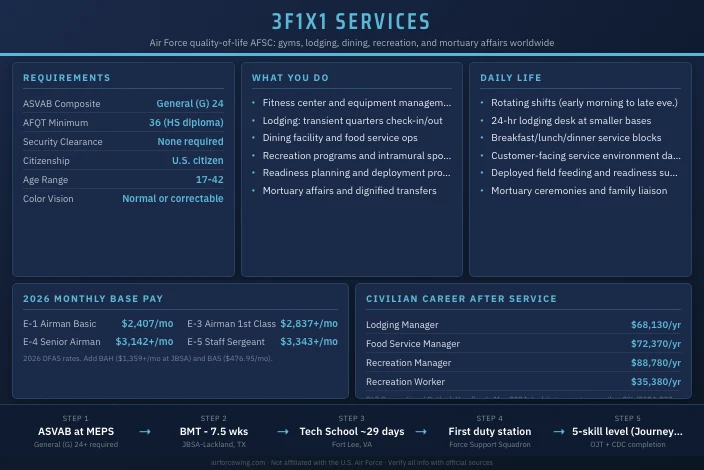
Job Role
3F1X1 Services specialists manage the quality-of-life programs that every Airman relies on: fitness centers, lodging facilities, dining operations, recreation programs, and mortuary affairs. They plan, operate, and supervise these functions across Air Force installations worldwide, directly supporting unit readiness and Airman morale.
The day-to-day work varies by assignment more than almost any other AFSC. A Services Airman stationed at a large base might oversee fitness center operations, manage scheduling for group exercise programs, and run equipment accountability for hundreds of pieces of cardio and weight equipment. The same Airman, at a deployed location, might be setting up field feeding operations to support a forward unit.
What Services Specialists Do Daily
- Operate and maintain fitness centers, including equipment maintenance logs and facility safety inspections
- Manage lodging check-in and check-out operations for transient personnel and visiting units
- Coordinate and execute food and beverage operations in dining facilities and club environments
- Run recreation programs including intramural sports, outdoor recreation, and community events
- Support unit readiness functions including deployment processing and accountability rosters
- Perform mortuary affairs duties including remains preparation, dignified transfers, and casualty assistance
Specializations Within 3F1X1
The AFSC uses skill-level suffixes rather than formal shredouts to differentiate experience tiers (1-helper, 3-apprentice, 5-journeyman, 7-craftsman, 9-superintendent). Senior NCOs develop specialization through assignment history rather than coded shredouts.
| Specialty Area | Description |
|---|---|
| Fitness and Sports | Gym operations, physical wellness programs, recreation programming |
| Food and Beverage | Dining facility management, club operations, ICBM feeding (missile alert) |
| Lodging | Transient quarters, visiting officer/enlisted quarters management |
| Readiness and Plans | Deployment processing, unit accountability, exercise support |
| Mortuary Affairs | Remains processing, dignified transfers, family liaison support |
Mission Contribution
Services supports the readiness mission by keeping the human infrastructure of an installation running. A Airman who can’t access nutritious food, a functional gym, or a place to sleep while TDY is a less effective Airman. The mortuary affairs mission carries its own weight entirely: Services specialists are the ones who receive fallen Airmen with full dignity and support their families through the worst days of their lives. Both ends of that spectrum matter.
Salary
Pay follows the standard military pay scale, set annually by Congress and administered through DFAS. A newly enlisted 3F1X1 Airman enters at E-1 and typically reaches E-4 within two to three years.
2026 Monthly Base Pay
| Rank | Grade | Monthly Base Pay |
|---|---|---|
| Airman Basic | E-1 | $2,407 |
| Airman | E-2 | $2,698 |
| Airman First Class | E-3 | $2,837 |
| Senior Airman | E-4 | $3,142 |
| Staff Sergeant | E-5 | $3,343 |
| Technical Sergeant | E-6 | $3,401 |
| Master Sergeant | E-7 | $3,932 |
Source: DFAS 2026 military pay tables. Rates reflect the 3.8% across-the-board increase effective January 1, 2026.
Allowances and Total Compensation
Base pay is only part of the picture. Basic Allowance for Subsistence (BAS) adds $476.95 per month for all enlisted Airmen. Basic Allowance for Housing (BAH) replaces housing costs for Airmen living off-base; a single E-4 at Joint Base San Antonio earns approximately $1,359/month in BAH, with rates varying by duty location and dependency status.
No current enlistment bonus is confirmed for 3F1X1. Check with your recruiter for the latest incentive list before signing, as bonus eligibility changes with each fiscal year.
Benefits Package
- Healthcare: TRICARE Prime at no cost, covering medical, dental, vision, mental health, and prescriptions
- Education: Military Tuition Assistance (up to $4,500/year), Post-9/11 GI Bill after qualifying service
- Retirement: Blended Retirement System, with TSP matching (up to 5% of base pay) after two years
- Leave: 30 days paid vacation per year
Qualifications
The entry requirements for 3F1X1 are among the most accessible in the Air Force. The ASVAB requirement is a General (G) composite score of 24, which is one of the lowest thresholds in the enlisted career structure.
Qualification Table
| Requirement | Standard |
|---|---|
| ASVAB Composite | General (G) 24 |
| AFQT Minimum | 36 (high school diploma) |
| AFQT Minimum (GED) | 65 |
| Citizenship | U.S. citizen |
| Age | 17-42 |
| Security Clearance | None required |
| Color Vision | Normal or correctable |
| Physical Profile | PULHES 333233 or better |
Sources: airforce.com/careers/logistics-and-administration/services, military.com ASVAB and Air Force Jobs.
What the G Composite Covers
The General composite draws from Verbal Expression (Word Knowledge plus Paragraph Comprehension) and Arithmetic Reasoning. Strong reading comprehension and basic math are the core skills being measured. A score of 24 is a low bar, but higher scores will give you more AFSC options if you later pursue retraining. If you want to widen your choices before MEPS, the Air Force ASVAB test prep guide is the simplest place to build that General score.
Application Process
- Contact an Air Force recruiter and take the ASVAB at a Military Entrance Processing Station (MEPS)
- Complete a medical evaluation at MEPS
- Review the available AFSC list with your recruiter based on your composite scores
- Sign an enlistment contract with 3F1X1 as your guaranteed AFSC
- Ship to Basic Military Training at Joint Base San Antonio-Lackland, TX
The selection process typically takes four to eight weeks from first recruiter contact to contract signing, depending on medical processing and available training slots.
Service Obligation
The standard active-duty enlistment is four to six years depending on your contract. First-term Airmen enter at E-1 (Airman Basic) and advance to E-2 within six months of BMT graduation if they meet conduct standards.
Mortuary affairs duties are part of the 3F1X1 AFSC. Some assignment histories involve frequent contact with this mission set. Confirm during the recruiting process whether this aspect of the job is something you can commit to.
Work Environment
Services Airmen work in commercial-style facilities: gyms, hotels, dining facilities, and recreation centers. The environment is clean, climate-controlled, and people-facing for most assignments. Deployed environments shift that picture significantly.
Settings and Schedules
The work schedule depends heavily on the function. Fitness centers typically run early morning to late evening, which means some rotating shift coverage. Lodging operations run 24 hours, so overnight shifts are common at smaller facilities without contracted support. Food and beverage positions in dining facilities often run breakfast, lunch, and dinner service blocks.
Deployed positions operate on mission-driven schedules that can extend well beyond standard duty hours. Field feeding operations and readiness support roles have an operational tempo that resembles the warfighter side of the Air Force more than the garrison Services environment.
Team Structure
Services sections are organized under Force Support Squadrons (FSS), which report to the Mission Support Group on each installation. The FSS commander is typically an officer; senior enlisted Services NCOs run the day-to-day sections. Junior Airmen work in small teams, often with a mix of active-duty, Air Reserve Component, and civilian or contractor employees alongside them.
Performance feedback comes through the Enlisted Performance Report (EPR) system, with EPRs written annually by the immediate supervisor. Stratification within an EPR (e.g., “1 of 14 SSgts”) carries more weight for promotion board consideration than the narrative.
Job Satisfaction
Services typically rates well for day-to-day variety. The assignments change enough across a career that it rarely becomes repetitive. The mortuary affairs mission is acknowledged by most experienced Services NCOs as the most demanding aspect of the career field, requiring emotional resilience and professionalism that not every Airman finds comfortable. The fitness and recreation assignments tend to be among the most popular in the AFSC.
Training
All enlisted Airmen, regardless of AFSC, begin their Air Force service with Basic Military Training before attending AFSC-specific Tech School.
Training Pipeline
| Phase | Location | Length | Focus |
|---|---|---|---|
| Basic Military Training (BMT) | JBSA-Lackland, TX | 7.5 weeks | Core military skills, discipline, Air Force values |
| Technical School (3F1X1) | Fort Lee, VA | ~29 days | Services operations: fitness, lodging, food service, mortuary |
| First Duty Station | Various | Ongoing | On-the-job qualification to the 5-skill level |
Tech School at Fort Lee covers the core Services competency areas: fitness program operations, lodging management basics, food and beverage operations, readiness planning, and mortuary affairs procedures. The course is classroom and practical-exercise based.
Skill-Level Progression
After Tech School, Airmen enter their first unit at the 3-skill level (Apprentice) and begin working toward their 5-skill level (Journeyman) through on-the-job training tasks documented in their Career Development Course (CDC) materials. Promotion to Staff Sergeant requires completion of the 5-skill level. Promotion to Technical Sergeant requires the 7-skill level (Craftsman).
Advanced Development
3F1X1 Tech School work earns college credit toward hospitality and fitness management programs at several institutions. Check with your Education Center at your first duty station to transfer credits before beginning any degree program.
Beyond skill-level training, experienced Services NCOs can pursue:
- Non-Commissioned Officer Academy (NCOA) and Senior NCO Academy for leadership development
- Mortuary Affairs Officer Course and additional certification programs through Air Force Mortuary Affairs Operations
- Civilian certifications in fitness management (ACSM, NSCA) aligned with the fitness center mission
- ServSafe certification and food safety manager credentials through dining facility assignments
Everything starts with qualifying ASVAB scores. Our study guide covers what to study first.
Career Progression
The 3F1X1 career path follows the standard Air Force promotion timeline, with additional depth available through assignment diversity and senior leader roles within Force Support Squadrons.
Rank Progression
| Rank | Grade | Typical Timeline | Role |
|---|---|---|---|
| Airman Basic | E-1 | Entry | BMT / awaiting Tech School |
| Airman | E-2 | 6 months TIS | Tech School / first assignment |
| Airman First Class | E-3 | 16 months TIS | Journeyman development begins |
| Senior Airman | E-4 | 3 years TIS | Journeyman; eligible for SSgt board |
| Staff Sergeant | E-5 | ~6 years TIS | Section supervisor; 5-skill level required |
| Technical Sergeant | E-6 | ~12 years TIS | Flight chief candidate; 7-skill level required |
| Master Sergeant | E-7 | ~17 years TIS | Flight chief or NCOIC of major function |
| Senior Master Sergeant | E-8 | ~20 years TIS | Squadron superintendent candidate |
| Chief Master Sergeant | E-9 | ~22+ years TIS | Senior Enlisted Leader; wing or MAJCOM level |
TIS = Time in Service. Promotion timelines are competitive and vary by year group.
Retraining and Lateral Moves
Airmen who qualify for retraining after their first enlistment can apply for other AFSCs through the Air Force’s formal retraining program. Services experience, with its broad exposure to operations management, makes 3F Airmen competitive for personnel, force support officer candidate programs, and civilian federal service positions. Moving from 3F1X1 to another 3F AFSC (3F0X1, 3F2X1, 3F3X1) is one of the more common lateral moves within the career group.
Performance Evaluation
The EPR system uses a 5-tier rating scale. The narrative matters, but the stratification line (“Promote this Airman NOW”) and the overall rating carry the most weight before promotion boards. Services NCOs who build a track record across diverse duty positions (deployed, garrison, operational support) compete strongly at the senior NCO level.
Physical Demands
3F1X1 is not a physically demanding AFSC in the traditional sense. There is no flight duty, heavy equipment, or explosive ordnance involved. But fitness center and mortuary affairs assignments do carry specific physical requirements.
Fitness center operations involve regular movement around the facility, equipment spotting, and occasional equipment moves. Mortuary affairs duties require the physical ability to handle and move human remains under proper protocols. Field feeding and deployed readiness roles involve sustained standing, carrying field equipment, and working in austere conditions.
Air Force Fitness Assessment Standards
All Airmen, regardless of AFSC, take the Air Force Fitness Assessment annually. The assessment is age- and gender-normed, scored on a 100-point composite scale with a minimum passing score of 75. Every component has its own minimum threshold.
| Component | Max Points | Minimum Pass Threshold |
|---|---|---|
| 1.5-Mile Run | 60 | Component minimum required |
| Push-Ups (1 min) | 10 | Component minimum required |
| Sit-Ups (1 min) | 10 | Component minimum required |
| Waist Circumference | 20 | Component minimum required |
Exact age- and gender-specific minimums are published by Air Force Personnel Center. Standards are the same for all Airmen, not AFSC-specific.
Medical Standards
Standard MEPS medical clearance applies at accession. Ongoing medical fitness for duty is evaluated through the Military Health System. No specialized medical requirements beyond the standard enlisted physical profile apply to 3F1X1.
Deployment
Services Airmen deploy. The career field has an active expeditionary mission that most people outside the Air Force don’t associate with hospitality roles.
Deployment Profile
Typical deployment lengths run 6 months for Air Force rotations. Deployed Services Airmen support field feeding operations, readiness processing, and mortuary affairs at forward operating locations. Deployment frequency in 3F1X1 is moderate, generally lower than combat-focused AFSCs but higher than some administrative career fields.
Domestic deployments in support of natural disaster response, humanitarian missions, and large exercises are also part of the Services mission set.
Duty Stations
3F1X1 is available at nearly every Air Force installation worldwide, since every base needs a Force Support Squadron. Common stateside assignments include:
- Joint Base San Antonio-Lackland, TX (large FSS, multiple facilities)
- Joint Base Lewis-McChord, WA
- Langley AFB, VA (Joint Base Langley-Eustis)
- Tinker AFB, OK
- Ramstein AB, Germany (OCONUS)
- Kadena AB, Japan (OCONUS)
Preferences can be submitted, but assignments are managed by Air Force Personnel Center based on needs of the Air Force and individual qualification.
Risk/Safety
The 3F1X1 career field carries no inherent occupational hazard comparable to maintenance, explosive ordnance, or special warfare roles. The primary risk considerations are emotional rather than physical.
Job Hazards
Mortuary affairs is the most emotionally demanding assignment in the Services career field. Airmen in this function handle human remains, interact with grieving families, and participate in dignified transfer ceremonies. The Air Force provides mental health resources and chaplain support for personnel assigned to these duties, but the psychological weight is real and should not be underestimated before selecting this AFSC.
Deployed field feeding operations expose Airmen to the same environmental hazards as other expeditionary personnel: heat, austere conditions, and proximity to operational risk depending on the location.
Security and Legal Requirements
No security clearance is required for 3F1X1. Standard Uniform Code of Military Justice (UCMJ) obligations apply, as with all enlisted Airmen. Mortuary affairs work involves strict legal protocols governing the handling of remains, personal effects, and casualty notifications. Violations of these protocols carry serious professional and legal consequences.
Impact on Family
Force support roles are based on Air Force installations, which generally means access to good family support infrastructure: on-base schools, childcare centers, commissary, and medical facilities. The Services career field itself adds to that infrastructure, since you may work in the same gym, dining facility, or lodging operation your own family uses.
Relocation
PCS (permanent change of station) moves happen every two to four years on average. Some Airmen serve back-to-back tours at the same installation; others move multiple times in a single enlistment. The Air Force moves your household goods, but managing a family relocation still requires planning and flexibility. Spouses with portable careers or education goals adapt more easily than those tied to location-specific employment.
Family Support Systems
Force Support Squadrons host the Airman and Family Readiness Center (AFRC), which provides financial counseling, deployment preparation, transition assistance, and family support programs. As a Services Airman, you will likely work closely with AFRC staff. That proximity gives Services families a practical advantage in knowing what resources are available and how to access them.
Deployment separations in 3F1X1 are real but generally predictable. The Air Force’s deployment cycle is more structured than the Army’s, with rotation schedules published in advance for most contingency operations.
Reserve and Air National Guard
The 3F1X1 AFSC is available in both the Air Force Reserve and the Air National Guard. Part-time component opportunities exist at installations and units across the country, and the career field integrates well with civilian hospitality, recreation, and food service industries.
Component Comparison
| Factor | Active Duty | Air Force Reserve | Air National Guard |
|---|---|---|---|
| Commitment | Full-time; 4-6 yr initial | 1 weekend/month + 2 wks/year | 1 weekend/month + 2 wks/year |
| E-4 Monthly Pay | $3,142 base pay | ~$444 per drill weekend (4 IDTs) | ~$444 per drill weekend (4 IDTs) |
| Healthcare | TRICARE Prime (free) | TRICARE Reserve Select (premium) | TRICARE Reserve Select (premium) |
| Education | TA ($4,500/yr) + GI Bill | Federal TA + GI Bill (part-time) | Federal TA + state tuition waivers (vary by state) |
| Deployment Tempo | Moderate (6-mo rotations) | Lower; voluntary + involuntary | Lower; more state-mission focused |
| Retirement | 20-yr active pension (BRS) | Points-based Reserve retirement | Points-based Reserve retirement |
Drill weekend pay is based on four Inactive Duty Training (IDT) periods at the E-4 daily rate. Actual pay varies by years of service and any additional training days.
Civilian Career Integration
3F1X1 pairs extremely well with civilian hospitality, recreation, and food service management careers. An Airman running a fitness center or dining facility on an Air Force base is doing work that maps directly to health club management, hotel operations, and restaurant management in the private sector. Reserve and Guard service in this AFSC typically complements rather than conflicts with civilian hospitality employment. USERRA protects your civilian job rights during mobilization and deployments, and the Air Force has employer partnership programs through Hiring Our Heroes to help manage those relationships.
Post-Service
A 3F1X1 career builds a skill set that translates into multiple civilian management tracks. The combination of operational management experience, customer service leadership, and federal government service creates strong pathways into both private sector and federal civilian roles.
Civilian Career Prospects
| Civilian Title | BLS Median Annual Salary | Job Outlook (2024-2034) |
|---|---|---|
| Lodging Manager | $68,130 | +3% |
| Food Service Manager | $72,370 | Average |
| Recreation Worker | $35,380 | +4% |
| Entertainment and Recreation Manager | $88,780 | Average |
Source: Bureau of Labor Statistics Occupational Outlook Handbook, May 2024 data.
Federal Civil Service Pathways
Services NCOs with leadership experience are competitive for GS-level positions in federal recreation management, installation support services, and DOD civilian hospitality roles. Veterans’ preference points (5 or 10 points depending on disability rating) and non-competitive appointment eligibility for certain positions give separated Airmen an advantage in federal hiring. Transition programs like the Transition Assistance Program (TAP) begin 12 months before separation and include resume writing, federal employment workshops, and individual career counseling.
Certifications to Pursue While In
Airmen in 3F1X1 who want to maximize post-service value should consider:
- ServSafe Food Manager Certification through the National Restaurant Association (earned during dining facility assignments)
- ACSM or NSCA certified personal trainer or fitness manager credentials (aligned with fitness center duties)
- Certified Hospitality Supervisor (CHS) through the American Hotel & Lodging Educational Institute
Military Tuition Assistance covers college coursework while on active duty, and many community colleges and universities grant credit for 3F1X1 Tech School and on-the-job training.
Is This a Good Job
3F1X1 fits a specific type of Airman well and will frustrate others. Getting clear on which camp you’re in before signing is worth the time.
Who Fits
- You want a people-facing job with daily variety rather than a fixed technical workstation
- Customer service comes naturally to you, and you’re good at managing competing demands from different groups simultaneously
- You’re comfortable with shift work and the irregular rhythm of hospitality operations
- The mortuary affairs mission, while sobering, is something you feel capable of approaching with professionalism and compassion
- You want solid civilian career pathways in hospitality, recreation, or food service management after separation
Who Doesn’t Fit
Services is a poor match if you want a specialized technical AFSC with a narrow focus, heavy engagement with cutting-edge military equipment, or a role where your Air Force training maps directly to a licensed profession (medicine, law, IT certifications). The work is operationally broad rather than technically deep. If deployment frequency is a hard constraint, be aware that the AFSC does deploy in support roles, though tempo is lower than combat-focused career fields.
The mortuary affairs mission deserves a direct mention in any honest assessment. It is a permanent part of the 3F1X1 career field, not an exception. Some Airmen find this mission meaningful and important. Others discover during an assignment that it is harder than they expected. There is no wrong answer, but the self-awareness to think about it in advance matters.
Career and Lifestyle Alignment
Services works well as a launching pad for civilian hospitality careers, a stepping stone to Force Support officer programs, or a long-term military career for someone who genuinely enjoys running operational programs that serve large populations. It does not work well as a path to specialized technical credentials or high-demand STEM civilian jobs.
More Information
The best next step is a conversation with an Air Force recruiter who can verify current ASVAB requirements, training seat availability, and any active bonus incentives for 3F1X1. Recruiters can also walk you through current assignment options and answer questions about specific duty locations. Find your nearest Air Force recruiting office at airforce.com.
- Prepare for the ASVAB with our study guide to make sure your line scores qualify
This site is not affiliated with the U.S. Air Force or any government agency. Verify all information with official Air Force sources before making enlistment or career decisions.
Explore more Air Force Force Support careers to see all four enlisted AFSCs in the career group and find the role that fits your goals.