3F0X1 Personnel
Every promotion, assignment, and reenlistment in the Air Force passes through one office. Personnel specialists own the records and processes that keep the entire force moving. If you want a career that touches every part of Air Force life without ever leaving the building, this might be the AFSC worth a closer look.
The 3F0X1 Personnel specialty is one of the Air Force’s most accessible white-collar fields. The ASVAB threshold is moderate, tech school is short, and the skills transfer cleanly to civilian human resources careers after service. You won’t be fixing jets or jumping out of aircraft, but the work matters because every Airman depends on it.
Qualifying requires specific ASVAB line scores. Our ASVAB study guide covers what to target and how to prepare.
Job Role
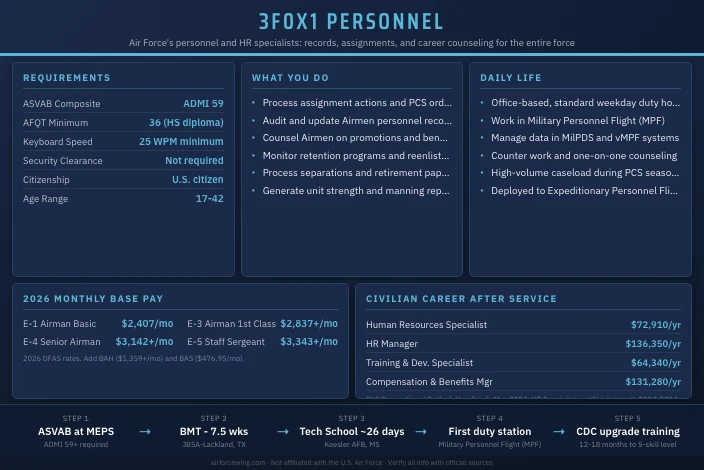
Personnel specialists (AFSC 3F0X1) manage the career data, records, and administrative programs that support every Airman at a Military Personnel Flight (MPF). They advise service members on promotions, assignments, benefits, and separation procedures, and they maintain the accuracy of the personnel records that drive pay, entitlements, and career decisions across the Air Force.
Daily Tasks
A typical day at an MPF involves a mix of counter work, records management, and benefits counseling. You might spend the morning processing in-processing paperwork for newly arrived Airmen, then spend the afternoon auditing personnel records for accuracy before a commander’s review.
Common daily duties include:
- Processing assignment actions and PCS orders
- Auditing and updating personnel records in Air Force systems
- Counseling Airmen and family members on career development, benefits, and entitlements
- Generating reports on unit strength and manning
- Monitoring retention programs and identifying Airmen eligible for reenlistment bonuses
- Conducting interviews to assess qualifications for training or special duty programs
- Processing separations, retirements, and discharge paperwork
Specialty Shredouts and Codes
The 3F0X1 career field does not carry formal shredout suffixes in the way some technical AFSCs do, but senior personnel specialists may earn Special Experience Identifiers (SEIs) that reflect assignment experience in specific functional areas such as officer assignments, military awards, or personnel readiness.
| Code | Description |
|---|---|
| 3F031 | Apprentice (3-skill level, entry) |
| 3F051 | Journeyman (5-skill level) |
| 3F071 | Craftsman (7-skill level) |
| 3F091 | Superintendent (9-skill level) |
Mission Contribution
The Air Force can’t function without accurate personnel data. Promotions require current records. Assignments require verified qualifications. Separations require documented service history. Personnel specialists are the administrators who keep all of it current and compliant, and they serve as the primary point of contact when an Airman has a problem that touches their career.
Technology and Equipment
Most of the work happens in Air Force personnel information systems. The primary platform is the Military Personnel Data System (MilPDS), a centralized database that holds every active-duty Airman’s personnel record. You’ll also work in the Virtual MPF portal, the Assignment Management System, and standard productivity tools. The job is software-intensive, not hardware-intensive.
Salary
Personnel specialists receive the same base pay as all enlisted Airmen at the same grade and years of service. The table below shows 2026 monthly base pay for early-career grades based on current DFAS pay tables.
| Grade | Rank | Less Than 2 Yrs | 4 Yrs | 6 Yrs |
|---|---|---|---|---|
| E-1 | Airman Basic | $2,407 | $2,407 | $2,407 |
| E-2 | Airman | $2,698 | $2,698 | $2,698 |
| E-3 | Airman First Class | $2,837 | $3,198 | $3,198 |
| E-4 | Senior Airman | $3,142 | $3,659 | $3,816 |
| E-5 | Staff Sergeant | $3,343 | $3,947 | $4,109 |
| E-6 | Technical Sergeant | $3,401 | $4,069 | $4,236 |
Additional Benefits
Base pay is only part of the compensation picture. Active-duty Airmen also receive:
- Basic Allowance for Housing (BAH): Varies by duty location, pay grade, and dependency status. A single E-4 at Joint Base San Antonio earns $1,359/month; an E-4 with dependents receives $1,728/month.
- Basic Allowance for Subsistence (BAS): $476.95/month (2026 flat rate for all enlisted).
- TRICARE Prime: Zero-cost health, dental, and vision coverage with no premiums, deductibles, or copays on active duty.
- Tuition Assistance (TA): Up to $4,500 per year for college courses taken while serving, capped at $250 per semester hour.
- Community College of the Air Force (CCAF): The 3F0X1 tech school course generates college credits toward an Associate in Applied Science in Human Resource Management through CCAF.
Retirement
Airmen who enter service today fall under the Blended Retirement System (BRS). After 20 years, BRS pays a pension worth 40% of the average of your highest 36 months of base pay. The government also contributes up to 5% of base pay to your Thrift Savings Plan account, with matching that begins after 60 days of service.
Work-Life Balance
Personnel work generally follows standard duty hours (Monday through Friday, roughly 0730-1630), which makes this one of the more predictable schedules in the enlisted force. Deployments exist but are less frequent than in operational AFSCs. All Airmen earn 30 days of paid leave per year and observe 11 federal holidays.
Qualifications
Qualification Requirements
| Requirement | Minimum Standard |
|---|---|
| ASVAB Composite | Administrative (ADMI) 59 |
| AFQT (HS diploma) | 36 |
| AFQT (GED) | 65 |
| Citizenship | U.S. citizen |
| Age at Enlistment | 17-42 |
| Keyboard Proficiency | 25 words per minute minimum |
| Speech | Must speak distinctly |
| Security Clearance | None required |
| Physical Profile | Minimum PULHES standards met |
The Administrative (ADMI) composite measures clerical and verbal aptitude. It draws from the Word Knowledge, Paragraph Comprehension, Arithmetic Reasoning, and Numerical Operations subtests of the ASVAB. Strong scores on these portions are a good predictor of success in this AFSC.
The keyboard proficiency requirement (25 WPM) is evaluated at MEPS or during initial processing. It’s a low bar, but practice beforehand if you haven’t typed regularly.
Application Process
The path to 3F0X1 follows the standard Air Force enlisted accession route:
Selection Criteria
Personnel is not a highly competitive AFSC at accession, but available slots depend on Air Force manning needs at the time of enlistment. Strong verbal and writing skills help. Prior customer service or administrative experience strengthens your application, though it isn’t required.
Service Obligation
Enlisted contracts are typically four years for an initial enlistment. You enter service at E-1 (Airman Basic) and should expect promotion to E-2 (Airman) after six months and E-3 (Airman First Class) within a year of enlistment, based on time-in-service standards.
An ASVAB study guide with practice tests can help you hit the ADMI 59 threshold, especially if the verbal sections aren’t your strongest area.
Work Environment
Setting and Schedule
Personnel specialists work in Military Personnel Flights on Air Force installations worldwide. The MPF is an office environment, not a flight line or a shop. Most assignments are indoors, climate-controlled, and follow a standard weekday schedule.
Some positions require shift coverage during high-tempo periods such as an exercise, large unit deployment, or mass in/out-processing events, but these are the exception rather than the rule. Remote and satellite MPF positions exist at smaller installations.
Chain of Command and Feedback
Personnel Airmen report within the Force Support Squadron, which is commanded by a Force Support Officer. Day-to-day supervision comes from NCO section leads, who assign work, review outputs, and provide mentorship. Formal performance feedback occurs through the Air Force Enlisted Performance Report (EPR) system annually for E-5 and above, with mandatory initial feedback for Airmen below E-5.
Team Dynamics
Work at the MPF is collaborative by nature. You’ll handle cases jointly with other specialists when they’re complex, and you’ll regularly coordinate with finance, legal, and medical functions to resolve Airmen’s issues. Individual caseloads are real, though, and strong self-organization matters.
Job Satisfaction
Personnel is generally considered a stable, lower-stress assignment compared to operational or maintenance AFSCs. The most common complaint from experienced 3F0X1s is the volume of administrative work and the pressure during high-demand periods like mass promotions cycles or deployment surges. The most common positive is steady hours and the ability to genuinely help Airmen solve problems that affect their lives.
Training
Training Pipeline
| Phase | Location | Length | Focus |
|---|---|---|---|
| Basic Military Training (BMT) | JBSA-Lackland, TX | 7.5 weeks | Military fundamentals, fitness, discipline |
| 3F0X1 Technical Training | Keesler AFB, MS | 26 days (~5 weeks) | Personnel systems, records management, benefits counseling |
BMT is the same experience for all enlisted Airmen. After 7.5 weeks at Lackland, you’ll ship directly to Keesler AFB in Biloxi, Mississippi for your AFSC course.
The 3F0X1 course at Keesler runs approximately 26 days. Instruction covers Air Force personnel information systems, records review procedures, benefits and entitlements processing, and customer service skills for the MPF environment. The course awards college credits toward a CCAF Associate in Applied Science in Human Resource Management upon completion. If you’re still in ASVAB prep, a PICAT voucher study course can help you qualify before you ship.
On-the-Job Training at First Assignment
Arriving at your first duty station with a 3-skill level, you’ll complete Career Development Course (CDC) volumes to upgrade to the 5-skill level (Journeyman). This OJT phase takes approximately 12-18 months and is supervised by a qualified trainer in your section. CDC tests are proctored and must be passed to complete upgrade training.
Advanced Training Opportunities
After reaching the 5-skill level, Personnel Airmen can pursue:
- Noncommissioned Officer Academy (NCOA): Required for promotion to TSgt and above.
- Air Force Senior NCO Academy: Required for promotion consideration at E-8 and E-9.
- Civilian education: TA supports college coursework, and the CCAF pathway leads directly to a bachelor’s program in HR or business if you transfer credits to a civilian institution.
- Special duty assignments: Recruiters, ROTC instructors, and drill sergeant roles are open to qualified Personnel Airmen with a strong performance record.
Career Progression
Rank Progression
| Rank | Grade | Typical Timeline |
|---|---|---|
| Airman Basic | E-1 | Entry |
| Airman | E-2 | 6 months TIS |
| Airman First Class | E-3 | 16 months TIS |
| Senior Airman | E-4 | 3 years TIS / 28 months TIG |
| Staff Sergeant | E-5 | Promotion board, ~4-6 years |
| Technical Sergeant | E-6 | Promotion board, ~9-12 years |
| Master Sergeant | E-7 | Promotion board, ~15-17 years |
| Senior Master Sergeant | E-8 | Promotion board, ~18-20 years |
| Chief Master Sergeant | E-9 | Promotion board, senior career |
E-1 through E-4 promotions are time-based and automatic barring adverse actions. E-5 and above require a promotion board score that factors EPR ratings, decorations, education, and a Promotion Fitness Examination (PFE).
Role Flexibility and Transfers
3F0X1 is a high-demand AFSC at every installation, which gives experienced personnel specialists real bargaining power when requesting specific duty locations. Retraining to another AFSC is possible after completing your initial service commitment, typically four years, through the formal retraining request process managed by AFPC.
Performance Evaluation
The Enlisted Performance Report (EPR) is the Air Force’s primary tool for evaluating and documenting performance. EPRs are written annually by the immediate supervisor and reviewed by the rater’s senior rater. The highest EPR stratification (“Promote Now” recommendations and top-block ratings) significantly improve promotion board scores for E-5 and above.
Success in Personnel comes down to accuracy, communication, and consistency. An Airman who resolves cases cleanly, counsels effectively, and maintains an error-free records section will stand out. EPR bullets should quantify outcomes: cases processed, error rates reduced, training completions achieved.
Physical Demands
Personnel is one of the Air Force’s least physically demanding AFSCs day-to-day. The job is sedentary, office-based, and does not require lifting, climbing, or sustained outdoor exposure in normal duty conditions. Deployment environments can change that, but home-station work is desk-based.
All Airmen, regardless of AFSC, must pass the Air Force Fitness Assessment annually. The assessment scores on a 100-point scale with a minimum passing composite of 75.
| Component | Max Points | Notes |
|---|---|---|
| 1.5-Mile Run | 60 | Primary aerobic component |
| Waist Circumference / Body Comp | 20 | Age/gender normed |
| Push-Ups (1 minute) | 10 | Age/gender normed |
| Sit-Ups (1 minute) | 10 | Age/gender normed |
Each component has a minimum score that must be met regardless of the composite total. Standards are age- and gender-normed. A score of 90+ earns an “Excellent” rating; 75-89.9 is “Satisfactory.” Scores below 75 result in a “Fail” and trigger an Unsatisfactory Fitness Assessment (UFA) program.
Medical Standards
Entry-level medical processing at MEPS establishes baseline standards. No unusual physical requirements exist for 3F0X1 beyond the standard Air Force enlistment physical. Periodic medical evaluations occur in conjunction with annual preventive health assessments at the base medical unit.
Personnel Airmen with a history of significant hearing or vision problems should verify waiver eligibility at MEPS. The job does not require perfect vision or hearing, but standards still apply.
Deployment
Deployment Details
3F0X1 is a worldwide deployable AFSC. Personnel specialists deploy primarily to support Expeditionary Personnel Flights at deployed locations, where they process accountability data, manage personnel records for deployed units, and support casualty reporting. Typical deployments last 4 to 6 months.
Deployment frequency for Personnel is lower than for many combat-support AFSCs. Most Airmen in this career field deploy once or twice in a four-year enlistment, though tempo varies significantly by assignment and global demand. AFPC manages deployment tasking through the Air Expeditionary Force (AEF) cycle.
Duty Stations
Personnel Airmen are assigned at virtually every Air Force installation worldwide because every base with active-duty Airmen needs an MPF. Common assignment locations include:
- CONUS major bases (JBSA, Langley, Barksdale, Travis, Hill, McGuire-Dix-Lakehurst)
- Pacific assignments (Kadena AB, Osan AB, Misawa AB)
- European assignments (Ramstein AB, Aviano AB, RAF Lakenheath)
- Special duty assignments (Pentagon, AFPC, recruiting commands)
Assignment preferences are submitted through the vMPF portal, but the Air Force matches needs against preferences rather than guaranteeing locations.
Risk/Safety
Job Hazards
Home-station personnel work carries minimal physical hazard. Deployed environments introduce standard deployment risks shared by all support personnel: vehicle accidents, environmental conditions, and the residual risks of operating near a conflict zone. Personnel specialists are not combatants and are not assigned to high-threat tactical roles.
Safety Protocols
Standard office ergonomics and screen-time management apply. Deployed personnel follow Force Protection protocols governed by the theater commander, which include movement restrictions, personal protective equipment requirements, and accountability procedures that Personnel Airmen themselves help manage for their unit.
Security and Legal Requirements
3F0X1 does not require a security clearance at accession. Access to personnel information systems is granted based on need-to-know and role-based permissions. Airmen who handle sensitive personnel data are trained on Privacy Act requirements and the consequences of unauthorized disclosure.
The service obligation for an initial enlistment contract is typically four years. Extensions, reenlistments, and early separations follow standard Air Force policy governed by AFI 36-2100 series publications.
Impact on Family
Office hours and predictable schedules make Personnel one of the more family-friendly AFSCs in the enlisted force. Spouses and families benefit from the stability of a home-station desk job compared to shift-work maintenance or irregular-hour operations roles.
The biggest family impact is permanent change of station (PCS) moves, which happen on average every three years. Personnel Airmen can request specific locations during assignment cycles, and the Air Force does attempt to accommodate accompanied tours when overseas positions allow it. On-base housing, school liaison offices, and family support programs are available at all installations.
Military OneSource and Family Support
The Air Force Aid Society and Military OneSource provide financial counseling, childcare referrals, and deployment readiness support to all Air Force families, regardless of AFSC.
Reserve and Air National Guard
Component Availability
3F0X1 is available in both the Air Force Reserve and the Air National Guard. Both components maintain active Personnel functions at their respective units, making this a practical part-time option for those who want to serve without committing to active duty.
Drill Schedule and Training Commitment
The standard Reserve and ANG schedule is one weekend per month (Unit Training Assembly, or UTA) plus two weeks of Annual Training. Personnel Airmen generally do not face additional mandatory training days beyond this baseline unless they’re supporting a unit deployment or mobilization.
Part-Time Pay
An E-4 (Senior Airman) with fewer than two years of service earns approximately $3,142 per month on active duty. The same Airman earns roughly four days of equivalent pay per monthly drill weekend (two UTAs at one day’s base pay each, times two). Exact drill pay equals 1/30th of monthly base pay per drill period, or approximately $419 for the weekend at the E-4 less-than-two-years rate.
Component Comparison
| Category | Active Duty | Air Force Reserve | Air National Guard |
|---|---|---|---|
| Commitment | Full-time | 1 wknd/mo + 2 wks/yr | 1 wknd/mo + 2 wks/yr |
| Monthly Base Pay (E-4 <2 yrs) | $3,142 | ~$419/drill wknd | ~$419/drill wknd |
| Healthcare | TRICARE Prime (free) | TRICARE Reserve Select (premiums) | TRICARE Reserve Select (premiums) |
| Education Benefits | Full TA + Post-9/11 GI Bill | Partial GI Bill eligibility | State tuition waivers vary; federal TA available |
| Deployment Tempo | Moderate | Lower; mobilization-dependent | Lower; state/federal activation |
| Retirement | 20-yr active pension (BRS) | Points-based Reserve retirement | Points-based Reserve retirement |
Civilian Career Integration
Personnel work pairs naturally with civilian HR roles, making Reserve and ANG service an excellent resume complement. Drill weekends reinforce skills in benefits administration, records management, and employee counseling that civilian employers value. The Uniformed Services Employment and Reemployment Rights Act (USERRA) protects your civilian job during mobilizations.
Post-Service
The transition from military Personnel to civilian human resources is one of the cleaner career bridges in the enlisted force. The skills transfer directly: records management, compliance, benefits administration, and employee counseling all map to HR generalist roles.
Civilian Career Prospects
| Civilian Job Title | Median Annual Salary | Job Outlook (2024-2034) |
|---|---|---|
| Human Resources Specialist | $72,910 | +6% (faster than average) |
| Human Resources Manager | $136,350 | +5% |
| Compensation and Benefits Manager | $131,280 | +2% |
| Training and Development Specialist | $64,340 | +8% |
Data from the Bureau of Labor Statistics Occupational Outlook Handbook (May 2024). HR specialists account for approximately 81,800 projected annual job openings.
Credentials and Certifications
The CCAF degree in Human Resource Management provides a direct credential for federal and civilian HR positions. Veterans can also pursue:
- SHRM-CP (Society for Human Resource Management Certified Professional): The most recognized general HR credential in the private sector.
- PHR (Professional in Human Resources) through HRCI: Valued in corporate HR departments.
- Federal HR positions: Veterans’ preference points and the OPM GS-201 Human Resources Specialist series map closely to the 3F0X1 background.
Transition Programs
The Air Force Transition Assistance Program (TAP) helps separating Airmen connect with employers. Hiring Our Heroes runs fellowships that place transitioning service members in corporate HR roles during their final months of service, which frequently convert to full-time job offers.
Is This a Good Job
Ideal Candidate Profile
3F0X1 suits someone who is organized, likes working with people, and finds satisfaction in solving administrative problems. The job rewards:
- Strong verbal and written communication skills
- Comfort with detail-oriented record-keeping
- Patience for high-volume customer service interactions
- Interest in HR, business, or law as a long-term career path
If you’re drawn to the Air Force for its technical side (working on aircraft, networks, or weapons systems), this isn’t the right pick. But if you want marketable civilian skills, a predictable schedule, and a role where you’re genuinely helping fellow service members manage their careers, Personnel delivers on all three.
Potential Challenges
The MPF environment can be stressful during high-demand periods. Mass PCS seasons, promotion cycles, and deployment surges create backlogs and pressure. Mistakes in personnel records can have real consequences for Airmen’s pay and careers, which means the accuracy standards are high.
Some Airmen find the work repetitive after a few years, particularly at smaller MPFs with limited caseload variety. Career diversity improves with assignment to larger wings, AFPC, or special duty positions, but those require competitive records to access.
Career and Lifestyle Fit
This AFSC is a strong fit if your goal is a stable stateside career followed by a civilian HR transition. It’s a poor fit if you want adventure, frequent deployments, or hands-on technical work. The lifestyle is closer to a professional office job than to what most people picture when they think of military service, which is exactly the point for a significant portion of Airmen.
More Information
Talk to an Air Force recruiter to confirm current slot availability and ASVAB requirements for 3F0X1. Recruiters can pull real-time vacancy data and tell you whether this AFSC is open at the time you’re ready to enlist. You can also explore the official airforce.com Personnel Specialist page for a current overview of duties and eligibility. If you need to raise your ADMI score before you go to MEPS, a solid understanding of the verbal and arithmetic sections is where to focus your prep time.
- Prepare for the ASVAB with our study guide to make sure your line scores qualify
This site is not affiliated with the U.S. Air Force or any government agency. Verify all information with official Air Force sources before making enlistment or career decisions.
Explore more Air Force Force Support careers to find other AFSC options in this career group.