6F0X2 Financial Analysis
When you purchase through links on our site, we may receive compensation at no extra cost to you.
Not every finance job in the Air Force is about processing transactions. Some of it is about reading the numbers, spotting the trend before it becomes a problem, and telling commanders what their money situation really looks like. That is the part of the mission 6F0X2 Financial Analysis represents. It is the budget, forecasting, and advisory side of the financial management world, built for Airmen who like spreadsheets, patterns, and hard answers backed by data. If 6F0X1 is the execution side of Air Force money, 6F0X2 is the analysis side.
Strong finance jobs begin with a solid General score. Use the ASVAB study guide before you test so the line score is not what keeps you out.
Job Role and Responsibilities
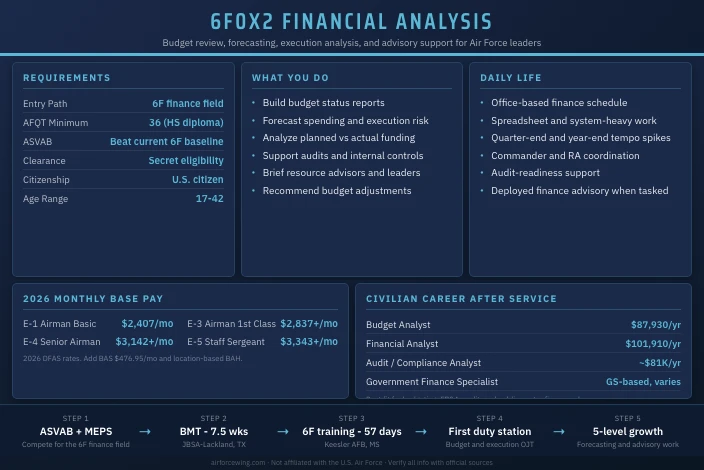
6F0X2 Financial Analysis interprets financial data for commanders and comptroller teams. Airmen in this role focus on budget status, fund forecasting, trend analysis, audit support, and advisory work that helps units decide how to allocate resources before a shortfall or execution problem appears.
Daily Responsibilities
The work is less about pushing individual payments and more about reading the picture those payments create. A normal day can include building budget reports, comparing current execution against planned spending, answering questions from resource advisors, and explaining where funds are tight, underused, or at risk.
Typical work includes:
- Reviewing fund status and execution reports
- Building forecasts for quarter-end and fiscal-year closeout
- Comparing planned spending to actual obligations
- Advising commanders and resource advisors on budget posture
- Supporting audit-readiness reviews and internal controls
- Preparing leadership briefings from financial data
How It Differs From 6F0X1
The Air Force publicly recruits for 6F0X1 Financial Management and Comptroller. 6F0X2 fits the analysis-heavy end of that same career family. In many units, an Airman starts inside 6F0X1-style work and then moves deeper into forecasting, budget analysis, and advisory tasks as experience grows. That is why public recruiting material often describes the family broadly instead of breaking out the analysis lane as a separate accession product.
Mission Contribution
Units make bad decisions when they do not understand their money. Financial analysis prevents that. It tells leaders whether they can absorb a new requirement, whether a work center is overspending, whether year-end execution is on track, and where risk sits before a deadline hits. That makes 6F0X2 work directly tied to readiness, even though it happens in an office instead of on a flight line.
Salary and Benefits
Base Pay
6F0X2 follows the 2026 enlisted table from DFAS.
| Grade | Rank | Monthly Base Pay |
|---|---|---|
| E-1 | Airman Basic (AB) | $2,407 |
| E-2 | Airman (Amn) | $2,698 |
| E-3 | Airman First Class (A1C) | $2,837-$3,198 |
| E-4 | Senior Airman (SrA) | $3,142-$3,816 |
| E-5 | Staff Sergeant (SSgt) | $3,343-$4,422 |
| E-6 | Technical Sergeant (TSgt) | $3,401-$5,044 |
Allowances And Benefits
The standard enlisted compensation package matters here:
- BAS: $476.95 per month
- BAH: tax-free and location dependent
- TRICARE Prime: active-duty health coverage
- Tuition Assistance: $4,500 annual cap
- GI Bill and BRS retirement: long-term value beyond base pay
Why The Job Pays Off Later
The payoff is civilian translation. Budget analysis, variance reporting, forecasting, and audit support all map cleanly to civilian accounting, FP&A, compliance, and government finance jobs.

Qualifications and Eligibility
Entry Standards
| Requirement | Current Guidance |
|---|---|
| Age | 17-42 at enlistment |
| Citizenship | U.S. citizen |
| Education | High school diploma or GED |
| AFQT Minimum | 36 with diploma |
| ASVAB Composite | Separate public 2026 line score not listed; plan to beat 6F0X1 baseline |
| Clearance | Secret eligibility typical for financial work |
| Character | No history involving fraud, larceny, or financial misconduct |
| Academic Strength | Strong math, reading, and spreadsheet discipline |
The public Air Force recruiting site publishes 6F0X1, not a separate 6F0X2 line score. For a finance-analysis path, the safest planning move is to clear the current 6F0X1 standard and show stronger-than-average math and reasoning.
See the ASVAB study guide if you want to raise the General score before MEPS.
Application Process
The front door into finance is the same as other enlisted specialties:
- Talk to a recruiter about finance-field openings.
- Take the ASVAB and complete the MEPS physical.
- Start security and background paperwork.
- Clarify whether the analysis-heavy lane is a direct accession target or a later assignment within the 6F career family.
Competitiveness
Finance work rewards quiet accuracy more than flash. Applicants who do well usually have strong school performance in math, accounting, business, or economics, even if those courses are informal or dual-credit classes rather than a degree.

Work Environment
Setting And Schedule
This is an office AFSC. Most of the day is spent in a comptroller flight, financial management office, or staff section working with reports, systems, and briefings. Hours are usually stable except near quarter close, fiscal-year close, or inspection periods.
The most demanding stretch of the year is September, when the fiscal year closes. Units that are running out of funds need immediate analysis to figure out where spending can be deferred. Units that still have money left need to know whether it can be obligated before expiration. That window is intense. It requires fast, accurate analysis with commanders and resource advisors waiting on results.
Quarter-close periods in December and March bring similar but smaller surges. Outside of those cycles, the daily pace is predictable and manageable. This is not a field where you will regularly work weekends or pull night shifts unless a special inspection or audit is active.
Systems And Tools
Financial analysts work inside Air Force financial management systems, budget tracking tools, and spreadsheet environments. The specific systems change over time as DoD upgrades its financial infrastructure, but the underlying logic stays the same: you are pulling data, comparing it against expected patterns, and explaining what the gap means.
Excel fluency is a real job requirement. Airmen who arrive with strong spreadsheet skills ramp up faster and get trusted with more complex analysis sooner than those who treat spreadsheets as a novelty.
Leadership And Communication
You will brief numbers to people who care what they mean. That means clear writing and plain explanations matter. A good financial analyst does not just send a spreadsheet. They explain the risk and the next move.
Commanders do not always have a finance background. Translating budget execution data into plain language is a core skill. If you can say “we have $200,000 left in this account but $350,000 in expected bills over the next 60 days, and here is where the $150,000 problem comes from,” you are doing the job right.
Team Dynamics
The work is collaborative with budget officers, resource advisors, contracting, and commanders. It is also individually accountable. If your numbers are wrong, the decision built on them may be wrong too.
Finance analysis is a small world inside a wing. Everyone knows who produces clean, reliable work and who produces reports that need to be rechecked. Your reputation builds fast in both directions. That accountability is pressure, but it also means that strong performers get recognized quickly.
Training and Skill Development
Training Pipeline
| Phase | Location | Length | Focus |
|---|---|---|---|
| Basic Military Training | JBSA-Lackland, TX | 7.5 weeks | Military fundamentals |
| Finance career field training | Keesler AFB, MS | Publicly listed 57-day 6F pipeline | Finance systems, accounting, fund control |
| First duty station OJT | Unit of assignment | 12-18 months | Budget analysis, local reporting, execution reviews |
The published Air Force finance pipeline is the 57-day Financial Management and Comptroller course at Keesler. The analysis emphasis usually grows after arrival at the unit, where Airmen start reading live execution data instead of just learning base procedures.
Do the ASVAB work before you get there. The ASVAB study guide is still the first filter.
Skill Development
The valuable growth areas here are spreadsheet fluency, trend analysis, leadership brief writing, audit-readiness support, and understanding how money moves across a wing. Those are the skills commanders remember and civilian employers pay for later.
Career Progression and Advancement
Promotion Timeline
| Rank | Grade | Typical Timeline | Role Focus |
|---|---|---|---|
| Airman Basic | E-1 | Entry | Training pipeline |
| Airman | E-2 | ~6 months | Learning finance systems |
| Airman First Class | E-3 | ~16 months | Report building and basic analysis |
| Senior Airman | E-4 | ~3 years | Independent budget support |
| Staff Sergeant | E-5 | ~5-6 years | Advisor to work centers and junior trainer |
| Technical Sergeant | E-6 | ~10-12 years | Section lead, analysis oversight |
How To Stand Out
The Airmen who do well in finance analysis are the ones who can turn data into a recommendation. Not just “here are the numbers,” but “here is the problem, here is why it is happening, and here is what the unit should do next.”
Related Paths
This role pairs naturally with later movement into officer financial management, civilian budget analysis, audit support, or corporate finance planning roles.
Physical Demands and Medical Evaluations
Daily Physical Requirements
The job is sedentary compared with most Air Force fields. The physical burden is low. The mental burden is attention and concentration over long reporting cycles.
Most of the physical activity in a typical day is walking between offices, sitting at a workstation, and occasionally transporting printed reports or audit files. There is no industrial hazard, no flight-line environment, and no field work tied to this AFSC. The biggest physical risk for analysts in this career field is the same as any desk-heavy job: prolonged sitting, eye strain from screen time, and the tendency to neglect physical fitness when the workload gets heavy.
Medical Standards
No unique medical standard is listed for 6F0X2 beyond the standard MEPS enlistment physical. Color vision, hearing, and general physical qualification requirements follow the baseline enlisted screening process. There are no aviation medicals, special altitude testing, or occupational health requirements specific to this role.
If you have questions about a particular medical condition and whether it affects qualification for finance fields, a recruiter or MEPS doctor is the right source. Most office-compatible conditions do not disqualify candidates from finance work.
Fitness Assessment
The standard Air Force test still applies.
| Component | Max Points |
|---|---|
| 1.5-mile run | 60 |
| Push-ups | 10 |
| Sit-ups | 10 |
| Waist or body composition | 20 |
Passing still requires a 75 composite with component minimums.
Airmen who work office-heavy AFSCs sometimes let fitness slip during busy reporting periods. The Air Force does not make exceptions for occupational workload. Failing the fitness assessment affects promotion eligibility and retention. Budget your time accordingly, especially during fiscal-year close when long days make it easy to skip PT.
Deployment and Duty Stations
Deployment Tempo
Finance analysts can deploy, especially when a wing or expeditionary unit needs stronger budget control in theater. Tempo is generally moderate, with more frequent garrison work than field time.
Deployed financial management teams operate with fewer people and less system infrastructure than home-station comptroller offices. An analyst who deploys may be one of two or three finance Airmen supporting an entire expeditionary unit. The breadth of work expands and the tolerance for incomplete data drops. You may find yourself producing fund status reports from a tent or a hastily assembled office with limited access to the full suite of systems you use at home station.
Deployments in this field are typically measured in 90 to 180 day windows. They are not the same constant rotation tempo as combat arms or special operations billets, but they are real, and the financial management work is genuinely important when a deployed unit is managing contracts, local national employment, and contingency funding all at once.
Common Duty Stations
Finance analysts serve at any installation with a Wing or Numbered Air Force comptroller function. Broad options include:
- Major CONUS bases (JBSA, Eglin, Travis, Tinker, Scott, Langley, Hill)
- PACAF locations (Kadena, Misawa, Osan, Hickam)
- USAFE locations (Ramstein, Spangdahlem, RAF Lakenheath, Aviano)
- Air Force Materiel Command and Air Force Global Strike Command installations
- Air Reserve and Guard comptroller elements in part-time component billets
MAJCOM and joint staff billets in financial analysis are also possible as an Airman advances to SSgt and above. Those positions tend to produce broader perspective and stronger promotion records.
Risk, Safety, and Legal Considerations
Main Risks
The risk is not physical. It is decision quality:
- Inaccurate forecasting
- Weak internal controls
- Poor audit documentation
- Bad advice to commanders based on incomplete data
A bad forecast that causes a unit to over-execute a fund account can trigger an Anti-Deficiency Act finding. An ADA violation is a legal matter that goes up through the Secretary of the Air Force to Congress. The Airmen who produced the faulty analysis will not face the same accountability as the approving officer, but inaccurate data that leads to one is still a serious mark on a career.
Integrity Requirements
Finance fields screen out applicants with histories of fraud, financial misconduct, or theft for a direct reason. The people who build the reports that commanders use to make funding decisions need to be honest about what the data actually shows, even when the answer is uncomfortable.
Fabricating or softening financial data to give a unit a better look than it deserves is a form of misconduct. It has happened in federal financial offices, and the Air Force takes it seriously. Airmen in analysis roles who feel pressure to adjust numbers in ways that do not reflect reality need to surface that pressure to their supervisor rather than comply.
Controls
Finance shops rely on review chains, reconciliations, formal reports, and audit standards. The systems feel repetitive, but they exist because money mistakes compound fast.
The Air Force Financial Improvement and Audit Remediation program means that audit findings have been a major focus across DoD for years. Analysts who understand what auditors look for and build their files accordingly are more valuable than those who just run the reports without thinking about the documentation trail behind them.
Impact on Family and Personal Life
Compared with aircraft maintenance or security forces, this field is more family-stable day to day. Office hours are easier to predict. PCS moves still matter, and fiscal-year closeout can create long days, but the overall rhythm is steadier than most operational specialties.
Schedule Predictability
Most financial management offices run standard duty hours Monday through Friday. The exceptions are quarter close, fiscal-year close, and major inspection cycles. Outside of those windows, Airmen in this field can usually plan family activities, appointments, and childcare around a known schedule. That is not something you can say about aircraft maintenance, security forces, or most operational AFSCs.
PCS Moves And Family Planning
Finance Airmen PCS every two to four years on a standard Air Force cycle. That means schools, spousal employment, and community integration get disrupted on a predictable but frequent basis. Families who plan ahead for each move, including researching the new base’s school system, BAH rates, and off-base housing market, tend to settle faster.
Overseas assignments are possible in this field, especially at PACAF and USAFE comptroller offices. Those assignments are usually three years for accompanied tours and provide on-base housing and overseas COLA that can improve the financial picture compared to equivalent CONUS assignments.
Deployment Preparation At Home
When an Airman in this field deploys, the family needs legal and financial documents in order beforehand. Power of attorney, SCRA protections, SBP enrollment status, and DEERS record accuracy all matter. Because the Airman knows the finance system, they can walk their family through those steps before they leave better than most service members in other fields.
Reserve and Air National Guard
Component Availability
The public recruiting site clearly publishes 6F0X1 across active duty, Reserve, and Guard. Analysis-heavy work exists in part-time finance offices too, but specific 6F0X2-style billets may be embedded inside the broader finance mission rather than advertised separately.
Reserve and Guard finance units operate at Wing and Group comptroller levels. Most part-time finance billets cover a mix of transaction processing, execution reporting, and budget analysis work rather than separating the two cleanly. That breadth means an Airman joining a Reserve finance office may do more variety of work than the 6F0X2 designation suggests.
Drill Schedule And Pay
An E-4 reservist earns four days of base pay per monthly drill weekend (two 4-hour drill periods per day, two days per weekend). The 2026 E-4 monthly reserve drill pay is approximately $395 for that weekend. Annual training adds 14 days of active-duty equivalent pay. It is not a living wage on its own, but combined with a civilian finance job, the income, benefits access during training periods, and retirement credit accumulation add up over a career.
Civilian Integration
This is one of the better Reserve or Guard fits because the work aligns with civilian finance, budgeting, audit, and business-analysis roles. The skills transfer without a major translation gap.
Civilian FP&A analysts, government budget specialists, and corporate accountants who also serve in a Reserve finance billet often find that each side of their career sharpens the other. The government appropriations and fund-control experience from the military side fills a gap that most civilian finance roles cannot replicate, and civilian FP&A tools and practices apply directly to the budget forecast work in the Reserve unit.
Post-Service Opportunities
Civilian Career Paths
| Civilian Role | Median Pay | Outlook |
|---|---|---|
| Budget Analyst | $87,930 median | Faster than average |
| Financial Analyst | $101,910 median | Strong across industries |
| Auditor / Compliance Analyst | About $81,000 median across accounting roles | Stable demand |
| Government finance specialist | Agency and GS dependent | Strong in federal and state hiring |
Budget analysis and forecast work are easy for civilian employers to understand. If you leave with real execution-review and reporting experience, you are not starting from zero.
Is This a Good Job for You? The Right (and Wrong) Fit
6F0X2 is a good fit if you like numbers, patterns, and explaining what the numbers mean. It is a bad fit if you want field work, hardware, or constant task variation. The satisfaction comes from helping leaders make better resource decisions with clean analysis instead of guesswork.
The Right Fit
This field makes sense if:
- You enjoy working with spreadsheets, reports, and data sets more than physical or mechanical tasks
- You are comfortable with repetitive review cycles and see them as quality discipline rather than tedium
- You want to influence how an organization uses its resources, even if that influence is behind the scenes
- You are good at explaining complex information to people who do not have a finance background
- You want a career that translates directly into high-demand civilian jobs without needing to rebuild your entire skill set
Airmen who consistently enjoy the work are usually the ones who find a sense of order in financial data and take personal satisfaction in catching a problem before it becomes a mission impact. They do not need variety every hour. They can sit with a problem, trace it through the data, and produce a clear answer.
The Wrong Fit
This field is a bad fit if:
- You want daily variety, physical challenge, or outdoor work
- You struggle to maintain concentration through detailed report cycles
- You do not have patience for process-heavy compliance requirements
- You want to operate systems, maintain equipment, or work with your hands
- You find budget numbers abstract and cannot imagine building a career around them
The Air Force has a wide range of career fields. If this profile does not match what you want out of service, the ASVAB study guide will help you score across a wide range of categories and keep more options available when you talk to a recruiter.
Your ASVAB composite scores decide which AFSCs you can qualify for. See our ASVAB study guide for a 30-day plan focused on MAGE, ELEC, MECH, ADMI, and GEND prep.
Or go straight to an ASVAB study course.

More Information
- Review the Air Force Financial Management and Comptroller page for the published enlisted finance accession track
- Compare officer progression at the Financial Management Officer page
- Raise your General score with the ASVAB study guide
Explore more Air Force finance and contracting careers such as 6F0X1 Financial Management and 6C0X1 Contracting.