6F0X2 Financial Analysis
Not every finance job in the Air Force is about processing transactions. Some of it is about reading the numbers, spotting the trend before it becomes a problem, and telling commanders what their money situation really looks like. That is the part of the mission 6F0X2 Financial Analysis represents. It is the budget, forecasting, and advisory side of the financial management world, built for Airmen who like spreadsheets, patterns, and hard answers backed by data. If 6F0X1 is the execution side of Air Force money, 6F0X2 is the analysis side.
Strong finance jobs begin with a solid General score. Use the ASVAB study guide before you test so the line score is not what keeps you out.
Job Role
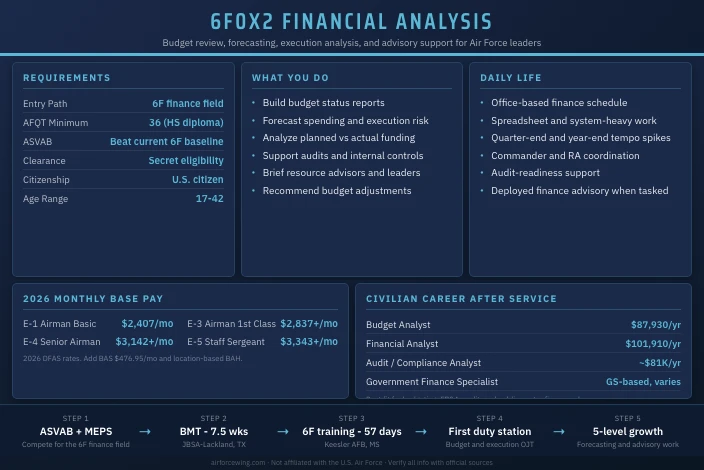
6F0X2 Financial Analysis interprets financial data for commanders and comptroller teams. Airmen in this role focus on budget status, fund forecasting, trend analysis, audit support, and advisory work that helps units decide how to allocate resources before a shortfall or execution problem appears.
Daily Responsibilities
The work is less about pushing individual payments and more about reading the picture those payments create. A normal day can include building budget reports, comparing current execution against planned spending, answering questions from resource advisors, and explaining where funds are tight, underused, or at risk.
Typical work includes:
- Reviewing fund status and execution reports
- Building forecasts for quarter-end and fiscal-year closeout
- Comparing planned spending to actual obligations
- Advising commanders and resource advisors on budget posture
- Supporting audit-readiness reviews and internal controls
- Preparing leadership briefings from financial data
How It Differs From 6F0X1
The Air Force publicly recruits for 6F0X1 Financial Management and Comptroller. 6F0X2 fits the analysis-heavy end of that same career family. In many units, an Airman starts inside 6F0X1-style work and then moves deeper into forecasting, budget analysis, and advisory tasks as experience grows. That is why public recruiting material often describes the family broadly instead of breaking out the analysis lane as a separate accession product.
Mission Contribution
Units make bad decisions when they do not understand their money. Financial analysis prevents that. It tells leaders whether they can absorb a new requirement, whether a work center is overspending, whether year-end execution is on track, and where risk sits before a deadline hits. That makes 6F0X2 work directly tied to readiness, even though it happens in an office instead of on a flight line.
Salary
Base Pay
6F0X2 follows the 2026 enlisted table from DFAS.
| Grade | Rank | Monthly Base Pay |
|---|---|---|
| E-1 | Airman Basic (AB) | $2,407 |
| E-2 | Airman (Amn) | $2,698 |
| E-3 | Airman First Class (A1C) | $2,837-$3,198 |
| E-4 | Senior Airman (SrA) | $3,142-$3,816 |
| E-5 | Staff Sergeant (SSgt) | $3,343-$4,422 |
| E-6 | Technical Sergeant (TSgt) | $3,401-$5,044 |
Allowances And Benefits
The standard enlisted compensation package matters here:
- BAS: $476.95 per month
- BAH: tax-free and location dependent
- TRICARE Prime: active-duty health coverage
- Tuition Assistance: $4,500 annual cap
- GI Bill and BRS retirement: long-term value beyond base pay
Why The Job Pays Off Later
The payoff is civilian translation. Budget analysis, variance reporting, forecasting, and audit support all map cleanly to civilian accounting, FP&A, compliance, and government finance jobs.
Qualifications
Entry Standards
| Requirement | Current Guidance |
|---|---|
| Age | 17-42 at enlistment |
| Citizenship | U.S. citizen |
| Education | High school diploma or GED |
| AFQT Minimum | 36 with diploma |
| ASVAB Composite | Separate public 2026 line score not listed; plan to beat 6F0X1 baseline |
| Clearance | Secret eligibility typical for financial work |
| Character | No history involving fraud, larceny, or financial misconduct |
| Academic Strength | Strong math, reading, and spreadsheet discipline |
The public Air Force recruiting site publishes 6F0X1, not a separate 6F0X2 line score. For a finance-analysis path, the safest planning move is to clear the current 6F0X1 standard and show stronger-than-average math and reasoning.
See the ASVAB study guide if you want to raise the General score before MEPS.
Application Process
The front door into finance is the same as other enlisted specialties:
- Talk to a recruiter about finance-field openings.
- Take the ASVAB and complete the MEPS physical.
- Start security and background paperwork.
- Clarify whether the analysis-heavy lane is a direct accession target or a later assignment within the 6F career family.
Competitiveness
Finance work rewards quiet accuracy more than flash. Applicants who do well usually have strong school performance in math, accounting, business, or economics, even if those courses are informal or dual-credit classes rather than a degree.
Work Environment
Setting And Schedule
This is an office AFSC. Most of the day is spent in a comptroller flight, financial management office, or staff section working with reports, systems, and briefings. Hours are usually stable except near quarter close, fiscal-year close, or inspection periods.
Leadership And Communication
You will brief numbers to people who care what they mean. That means clear writing and plain explanations matter. A good financial analyst does not just send a spreadsheet. They explain the risk and the next move.
Team Dynamics
The work is collaborative with budget officers, resource advisors, contracting, and commanders. It is also individually accountable. If your numbers are wrong, the decision built on them may be wrong too.
Training
Training Pipeline
| Phase | Location | Length | Focus |
|---|---|---|---|
| Basic Military Training | JBSA-Lackland, TX | 7.5 weeks | Military fundamentals |
| Finance career field training | Keesler AFB, MS | Publicly listed 57-day 6F pipeline | Finance systems, accounting, fund control |
| First duty station OJT | Unit of assignment | 12-18 months | Budget analysis, local reporting, execution reviews |
The published Air Force finance pipeline is the 57-day Financial Management and Comptroller course at Keesler. The analysis emphasis usually grows after arrival at the unit, where Airmen start reading live execution data instead of just learning base procedures.
Do the ASVAB work before you get there. The ASVAB study guide is still the first filter.
Skill Development
The valuable growth areas here are spreadsheet fluency, trend analysis, leadership brief writing, audit-readiness support, and understanding how money moves across a wing. Those are the skills commanders remember and civilian employers pay for later.
Career Progression
Promotion Timeline
| Rank | Grade | Typical Timeline | Role Focus |
|---|---|---|---|
| Airman Basic | E-1 | Entry | Training pipeline |
| Airman | E-2 | ~6 months | Learning finance systems |
| Airman First Class | E-3 | ~16 months | Report building and basic analysis |
| Senior Airman | E-4 | ~3 years | Independent budget support |
| Staff Sergeant | E-5 | ~5-6 years | Advisor to work centers and junior trainer |
| Technical Sergeant | E-6 | ~10-12 years | Section lead, analysis oversight |
How To Stand Out
The Airmen who do well in finance analysis are the ones who can turn data into a recommendation. Not just “here are the numbers,” but “here is the problem, here is why it is happening, and here is what the unit should do next.”
Related Paths
This role pairs naturally with later movement into officer financial management, civilian budget analysis, audit support, or corporate finance planning roles.
Physical Demands
Daily Physical Requirements
The job is sedentary compared with most Air Force fields. The physical burden is low. The mental burden is attention and concentration over long reporting cycles.
Fitness Assessment
The standard Air Force test still applies.
| Component | Max Points |
|---|---|
| 1.5-mile run | 60 |
| Push-ups | 10 |
| Sit-ups | 10 |
| Waist or body composition | 20 |
Passing still requires a 75 composite with component minimums.
Deployment
Deployment Tempo
Finance analysts can deploy, especially when a wing or expeditionary unit needs stronger budget control in theater. Tempo is generally moderate, with more frequent garrison work than field time.
Duty Stations
Any major installation with a comptroller flight can use this work. That gives the field broad base options and steady access to staff assignments where financial analysis matters even more.
Risk/Safety
Main Risks
The risk is not physical. It is decision quality:
- Inaccurate forecasting
- Weak internal controls
- Poor audit documentation
- Bad advice to commanders based on incomplete data
Controls
Finance shops rely on review chains, reconciliations, formal reports, and audit standards. The systems feel repetitive, but they exist because money mistakes compound fast.
Impact on Family
Compared with aircraft maintenance or security forces, this field is more family-stable day to day. Office hours are easier to predict. PCS moves still matter, and fiscal-year closeout can create long days, but the overall rhythm is steadier than most operational specialties.
Reserve and Air National Guard
Component Availability
The public recruiting site clearly publishes 6F0X1 across active duty, Reserve, and Guard. Analysis-heavy work exists in part-time finance offices too, but specific 6F0X2-style billets may be embedded inside the broader finance mission rather than advertised separately.
Civilian Integration
This is one of the better Reserve or Guard fits because the work aligns with civilian finance, budgeting, audit, and business-analysis roles. The skills transfer without a major translation gap.
Post-Service
Civilian Career Paths
| Civilian Role | Median Pay | Outlook |
|---|---|---|
| Budget Analyst | $87,930 median | Faster than average |
| Financial Analyst | $101,910 median | Strong across industries |
| Auditor / Compliance Analyst | About $81,000 median across accounting roles | Stable demand |
| Government finance specialist | Agency and GS dependent | Strong in federal and state hiring |
Budget analysis and forecast work are easy for civilian employers to understand. If you leave with real execution-review and reporting experience, you are not starting from zero.
Is This a Good Job
6F0X2 is a good fit if you like numbers, patterns, and explaining what the numbers mean. It is a bad fit if you want field work, hardware, or constant task variation. The satisfaction comes from helping leaders make better resource decisions with clean analysis instead of guesswork.
More Information
- Review the Air Force Financial Management and Comptroller page for the published enlisted finance accession track
- Compare officer progression at the Financial Management Officer page
- Raise your General score with the ASVAB study guide
This site is not affiliated with the U.S. Air Force or any government agency. Verify all information with official Air Force sources before making enlistment or career decisions.
Explore more Air Force finance and contracting careers such as 6F0X1 Financial Management and 6C0X1 Contracting.