6F0X1 Financial Management and Comptroller
Every dollar the Air Force spends, from flight pay to base construction, gets tracked, audited, and reported by someone. That someone is a 6F0X1 Financial Management and Comptroller specialist. This AFSC sits at the center of every Air Force installation’s budget operations, and the work is far more varied than the title suggests. You’re not just processing paperwork. You’re the person a commander calls when funds are running low, when a travel claim looks wrong, or when an audit needs to happen before the fiscal year closes. If you score high on the General ASVAB composite and want a technical career that follows you straight into a well-paying civilian job, this field is worth a close look.
Qualifying requires specific ASVAB line scores. Our ASVAB study guide covers what to target and how to prepare.
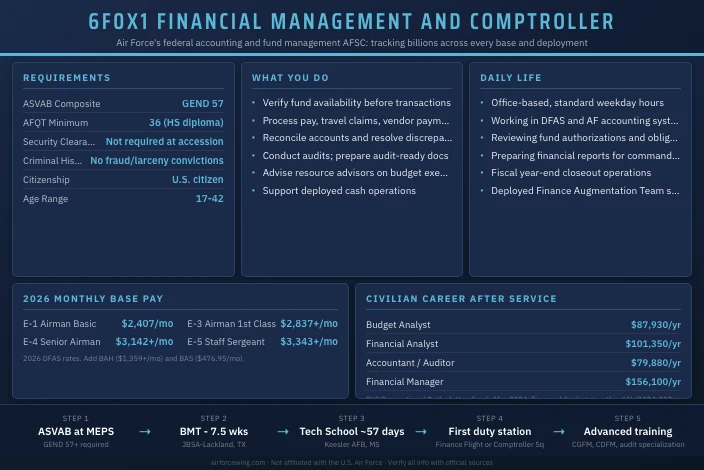
Job Role
6F0X1 Financial Management and Comptroller specialists plan, analyze, and manage the full range of financial operations for Air Force organizations worldwide. They process financial transactions, track fund availability, audit accounts, support deployed operations, and advise commanders on the status of their budgets. The AFSC spans accounting, budgeting, financial analysis, and cash management across every Air Force command.
What You Do Day to Day
The job centers on three core functions: transaction processing, analysis, and reporting.
On the transaction side, you’ll process commitments, obligations, and payments for the unit. That includes travel claims, vendor invoices, payroll entitlements, and reimbursable accounts. You verify the legality of transactions under fiscal law before any funds move. Errors on this side aren’t just accounting mistakes, they can create legal liability for the Air Force.
The analysis side is where the work gets more complex at higher skill levels. You’ll review accounts to ensure operating costs stay within authorized limits, compile financial data into reports for leadership, and flag anomalies before they become problems. Budget-to-actual comparisons, fund status reports, and forecasting projections are regular deliverables.
Deployed, the job looks different. Financial management Airmen deploy to contingency locations where they provide cash management, pay support, and financial accountability directly to the site commander. Managing physical cash in a forward environment, sometimes in foreign currency, adds a dimension you don’t get in many office-based career fields.
Specialty Classifications
| Code | Title | Level |
|---|---|---|
| 6F031 | Financial Management and Comptroller | Apprentice (3-skill) |
| 6F051 | Financial Management and Comptroller | Journeyman (5-skill) |
| 6F071 | Financial Management and Comptroller | Craftsman (7-skill) |
| 6F091 | Financial Management and Comptroller | Superintendent (9-skill) |
There are no alphabetical shredouts within 6F0X1. Career specialization happens through on-the-job assignment in areas such as budget formulation, accounting operations, disbursing, or financial analysis rather than through formal code suffixes.
Mission Contribution
Air Force units can’t operate without a functioning financial management shop. Fuel, parts, contracts, and personnel support all flow through properly obligated funds. When a unit deploys, a financial management Airman deploys with it to ensure accountability continues in the field. At the strategic level, accurate financial reporting from thousands of 6F0X1 specialists feeds the Department of the Air Force’s consolidated financial statements, statements that are audited by the Department of Defense and Congress.
Technology and Tools
Day-to-day, you’ll work inside the Defense Finance and Accounting Service (DFAS) systems and the Air Force’s financial management enterprise software. The primary system is the Standard Base Supply System (SBSS) for base-level transactions and the General Accounting and Finance System-Re-engineered (GAFS-R) for accounting records. You’ll also use automated travel and entitlement systems and standard office productivity software for reporting. There’s no specialized hardware involved, this is a screens-and-data career.
Salary
Base Pay
Base pay is the same across all enlisted AFSCs and is set annually by Congress. These are 2026 rates from DFAS.
| Rank | Grade | Under 2 Years | 4 Years | 6 Years |
|---|---|---|---|---|
| Airman Basic | E-1 | $2,407/mo | , | , |
| Airman | E-2 | $2,698/mo | , | , |
| Airman First Class | E-3 | $2,837/mo | $3,198/mo | $3,198/mo |
| Senior Airman | E-4 | $3,142/mo | $3,659/mo | $3,816/mo |
| Staff Sergeant | E-5 | $3,343/mo | $3,947/mo | $4,109/mo |
| Technical Sergeant | E-6 | $3,401/mo | $4,069/mo | $4,236/mo |
Most Airmen enter as E-1 and promote to E-3 within the first year. E-4 is typically reached around the two-year mark. Pay grows steadily with time in service and promotion.
Allowances and Additional Compensation
Base pay is only part of your total compensation. Most Airmen also receive BAH and BAS, which are tax-free.
- Basic Allowance for Housing (BAH): Varies by duty location, pay grade, and whether you have dependents. A single E-4 at Joint Base San Antonio earns $1,359/mo; with dependents, that rises to $1,728/mo. Higher-cost installations pay significantly more.
- Basic Allowance for Subsistence (BAS): $476.95/mo (2026 rate, all enlisted Airmen).
- Enlistment Bonus: No enlistment bonus is currently associated with 6F0X1, though this can change based on Air Force manning requirements. Verify with a recruiter.
- Special Pay: Limited for this AFSC. Deployed Airmen may qualify for Hostile Fire Pay or Hardship Duty Pay depending on the location.
Benefits Package
The full benefits picture adds significant value beyond base pay.
Healthcare through TRICARE Prime covers you and your family at zero enrollment cost, zero deductible, and zero copays for active-duty members. Dental and vision are included.
Education options include Tuition Assistance covering up to $4,500 per year toward a degree while on active duty, and the Post-9/11 GI Bill paying full in-state tuition at public schools after separation (private school cap: $29,920.95 for the 2025-2026 academic year). Airmen in this AFSC can earn a Community College of the Air Force (CCAF) Associate’s Degree in Financial Management tied directly to their training and job experience.
Retirement under the Blended Retirement System (BRS) pairs a pension at 20 years (40% of your high-36 average basic pay) with a Thrift Savings Plan matching up to 5% of basic pay.
Leave accrues at 2.5 days per month (30 days annually), with 11 federal holidays and the ability to carry up to 60 days forward.
Qualifications
Requirements Table
| Requirement | Standard |
|---|---|
| ASVAB Composite | General (G) 57 |
| AFQT Minimum | 36 (high school diploma); 65 (no diploma) |
| Age | 17-42 at enlistment |
| Citizenship | U.S. citizen required |
| Education | High school diploma or GED |
| Security Clearance | Secret |
| Physical Requirement | Lift 40 lbs; no disqualifying vision or color vision requirement |
| Character | No civilian court convictions for larceny, fraud, robbery, or related offenses |
The character requirement is strictly enforced. Any conviction or nonjudicial punishment for financial crimes, including fraud, theft, or wrongful appropriation, disqualifies you from this AFSC. There are no known waivers for this specific bar.
ASVAB Preparation
The General composite is calculated from Verbal Expression (Word Knowledge + Paragraph Comprehension) and Arithmetic Reasoning. A score of 57 is moderately competitive, roughly the midpoint across all enlisted AFSCs in the Air Force. Focus your prep on reading comprehension and basic algebra. Strong math skills matter more at higher skill levels, where financial analysis becomes the primary work.
An AFQT score of 36 qualifies you for enlistment with a high school diploma. GED holders need 65. The G-57 line score is the binding requirement for this specific AFSC.
Students are encouraged to start the ASVAB prep process early, ideally in their junior year of high school.
Application Process
- Contact an Air Force recruiter and take the ASVAB (at a MEPS or METS location).
- Receive MEPS medical clearance and complete the security clearance paperwork.
- Select 6F0X1 as a job preference on your enlistment contract.
- Sign and ship to Basic Military Training.
The selection process typically runs four to eight weeks from initial MEPS visit to signing a contract, depending on recruiter availability and security clearance processing. Background investigations for a Secret clearance can take several months; the investigation typically runs in parallel with BMT and Tech School.
Service Obligation
Enlistment is for four years (active component). Technical training obligations vary by contract. You enter service as an E-1 Airman Basic unless you have qualifying college credits or JROTC experience that justify an advanced entry pay grade.
Prerequisites That Strengthen Your Application
There’s no formal prerequisite beyond the ASVAB and background check, but high school or community college coursework in accounting, business math, or economics directly mirrors the Tech School curriculum. Any prior experience with bookkeeping, tax preparation, or financial software is genuinely helpful context when you arrive at Keesler.
Work Environment
Setting and Schedule
The work is almost entirely indoors, administrative offices, financial management centers, and comptroller flights located on Air Force installations worldwide. Flight-line exposure, outdoor hazards, and shift work tied to an aircraft schedule are not part of this job. Most Financial Management shops operate standard duty hours, typically 0730 to 1630 on weekdays, though end-of-month, end-of-quarter, and fiscal year-end periods routinely produce longer hours as deadlines converge.
At deployed locations, the environment changes. You may work out of a base operations center or temporary facility with more compressed hours and a faster operational tempo. The fundamental tasks are the same, but the stakes for accuracy are higher and support systems are leaner.
Chain of Command and Feedback
Financial Management Airmen work inside a Comptroller Flight, typically organized under a Wing Comptroller. Daily supervision comes from a section NCO, with reporting up to the Financial Management Officer. Enlisted Performance Reports (EPRs) are written annually by your rater and reviewed by your additional rater. The EPR system grades on a 5-point scale, and a score of 5 (“Exceeds”) is both competitive and achievable in a well-run FM shop with clear performance standards.
Team Dynamics
The work is collaborative inside the shop but individually accountable. Each Airman owns a specific account portfolio or functional area, and errors in your work directly affect colleagues and the units you support. The accountability is real, mistakes surface in audits, and you’re responsible for correcting them. This is not a job for people who want to be anonymous. Senior NCOs in this field tend to expect precision and ask questions when numbers don’t add up.
Retention and Job Satisfaction
The Air Force invests heavily in developing 6F0X1 Airmen, and retention in this career field is generally solid. Airmen who complete their first term frequently reenlist because the civilian job market for their skills is strong but the active-duty compensation package, when total benefits are included, is competitive, especially in the early career years. Common complaints center on the administrative workload during fiscal year-end and the repetitive nature of transaction processing at the 3-skill level. That repetition is also the point: it builds the accuracy habits that matter at higher levels.
Training
Training Pipeline
Advanced Training
Once you hold the 5-skill level, the Air Force offers several career development paths:
- Financial Management Journeyman Course (FMJC): An advanced resident course that deepens skills in budget formulation, accounting operations, and financial analysis. Attendance is competitive and reflects well on promotion records.
- Audit Readiness Training: The Air Force has invested significantly in audit readiness since Congress mandated a full DoD financial audit. Airmen in this field can receive targeted training in audit methodology, internal controls, and corrective action planning.
- Degree Completion Programs: Tuition Assistance supports continued coursework in accounting, finance, or business. Many 6F0X1 Airmen complete a bachelor’s degree while on active duty, which also positions them for warrant officer or officer commissioning programs.
- Officer Commissioning: 6F0X1 is a natural feeder for the 65F Comptroller Officer career path. Airmen who earn a degree and demonstrate strong performance can commission and return to the same functional area at the officer level.
Everything starts with qualifying ASVAB scores. Our study guide covers what to study first.
Career Progression
Rank and Promotion Timeline
| Rank | Grade | Typical Timeline |
|---|---|---|
| Airman Basic | E-1 | Enlistment |
| Airman | E-2 | 6 months TIS |
| Airman First Class | E-3 | 16 months TIS |
| Senior Airman | E-4 | 36 months TIS (or 28 months TIG) |
| Staff Sergeant | E-5 | ~5 years (board-select) |
| Technical Sergeant | E-6 | ~11 years (board-select) |
| Master Sergeant | E-7 | ~17 years (board-select) |
| Senior Master Sergeant | E-8 | ~20 years (board-select) |
| Chief Master Sergeant | E-9 | ~26 years (board-select) |
TIS = Total Integrated Score; TIG = Time in Grade. Board-select timelines reflect typical averages and depend on Air Force-wide promotion rates.
Promotion to E-4 is largely automatic with time. E-5 and above are board-selected based on EPR scores, the Enlisted Promotion System composite score (which includes base pay time, decoration points, and education), and the promotion rate established for that year’s force management requirements.
Specialization and Lateral Moves
6F0X1 Airmen at the 7-skill level can apply for senior functional positions in budget formulation, accounting operations leadership, or comptroller flight superintendent roles. Retraining into related AFSCs (such as 6C0X1 Contracting) is possible through the Retraining Advisory Program, though cross-training approvals depend on Air Force-wide manpower needs at the time of application.
Enlisted Performance Reports
The EPR is the primary tool for promotion documentation. Your rater scores you on job performance, leadership, professional qualities, training, and base/community involvement. A strong EPR typically demonstrates initiative beyond your assigned duties, quantifiable accomplishments (dollar amounts managed, errors caught, accounts reconciled), and contributions to the unit’s audit readiness or mission effectiveness.
Senior Airmen and above compete for stratifications within their unit, your rater may rank you against your peers. A top stratification significantly strengthens your promotion record at the higher competitive boards.
Physical Demands
The 6F0X1 is one of the least physically demanding AFSCs in the enlisted Air Force. The only documented physical requirement is the ability to lift 40 lbs. There is no requirement for color vision, no aviation-related physical standard, and no outdoor or environmental exposure requirement.
The Air Force Fitness Assessment applies to all Airmen regardless of AFSC.
Fitness Assessment Standards (2026)
| Component | Max Points |
|---|---|
| 1.5-Mile Run | 60 points |
| Push-Ups (1 minute) | 10 points |
| Sit-Ups (1 minute) | 10 points |
| Waist Circumference | 20 points |
| Minimum Passing Score | 75 / 100 |
Standards are age- and gender-normed. All Airmen must pass each component individually and achieve a minimum composite score of 75. The Air Force Fitness Assessment is administered annually for most Airmen.
Medical Standards
You must pass a MEPS medical examination before enlisting. The security clearance background investigation reviews your financial history, which is especially relevant for this AFSC given its direct handling of government funds. There are no specialty-specific physical standards beyond the general MEPS requirements and the ongoing fitness test.
Periodic medical exams are standard for active-duty Airmen but not AFSC-specific for this career field.
Deployment
Deployment Patterns
6F0X1 Airmen deploy, but the tempo is lower than combat-support AFSCs. Most financial management specialists support one deployment per four-to-six-year assignment cycle, typically for 90-120 days to locations in the Central Command, European Command, or Indo-Pacific Command areas. The mission in deployed environments focuses on cash management, paying and accounting for deployed personnel, and providing financial support to the site commander.
Some specialized positions, particularly those supporting contingency contracting or comptroller functions at expeditionary bases, may deploy more frequently. Voluntary augmentee programs also allow Airmen to pick up additional deployments.
Duty Station Options
Financial management shops exist on virtually every active-duty Air Force installation. Likely first-duty station options include major Air Force installations across CONUS and OCONUS. Common CONUS locations include:
- Barksdale AFB, LA
- Davis-Monthan AFB, AZ
- Dyess AFB, TX
- Edwards AFB, CA
- Eglin AFB, FL
- Ellsworth AFB, SD
- Fairchild AFB, WA
OCONUS options include Ramstein AB (Germany), Aviano AB (Italy), Kadena AB (Japan), and Andersen AFB (Guam). First assignments are based on Air Force needs and your preferences listed at graduation. AFPC assignment management handles all permanent change of station (PCS) orders.
Risk/Safety
Job Hazards
The physical risk profile for this AFSC is low. Office-based work carries standard ergonomic risks (repetitive strain, extended screen time) but no hazardous materials, elevated environments, or dangerous equipment. Deployed environments introduce general force protection risks shared by all Airmen at the same installation, not job-specific hazards.
Security and Legal Requirements
The bigger risk in this career field is legal, not physical. Financial management Airmen handle government funds, process payments, and have access to sensitive financial systems and personnel records. The ethical standard is high.
A Secret clearance is required. The background investigation examines your financial history, personal conduct, and foreign contacts. Poor credit, significant debt, or prior financial crimes are disqualifying or at minimum flag-raising during the adjudication process.
Misuse of government financial systems, misappropriation of funds, or fraudulent claims are serious federal offenses under the Uniform Code of Military Justice (UCMJ). The penalty structure is significantly more severe than for civilian employees in equivalent roles.
Airmen must complete fiscal law training and annual ethics refreshers. Handling public funds creates a strict accountability chain, every transaction is traceable, and discrepancies are investigated.
Contractual Obligation
Your service contract specifies both the enlistment period and any additional training obligations. There is no additional service obligation specific to 6F0X1 beyond the standard enlistment commitment.
Impact on Family
Family Considerations
The standard duty hours and office-based environment make this one of the more predictable AFSCs for family planning. Fiscal year-end periods (September) and end-of-quarter reporting months regularly produce extended hours that eat into evenings and weekends, but this is cyclical and foreseeable rather than random. Most 6F0X1 Airmen can plan personal and family activities around the budget calendar.
The Air Force Aid Society and Military OneSource provide financial counseling, childcare referrals, and relocation assistance for families navigating PCS moves. Spouses of 6F0X1 Airmen sometimes find portable career opportunities in accounting, bookkeeping, or financial services, skills their partner’s military training makes familiar, but employment outcomes for spouses vary significantly by installation location.
Relocation
PCS moves happen every two to four years on average. Each move comes with a Dislocation Allowance (DLA) and Permanent Change of Station entitlements that offset some moving costs, but relocation still disrupts schooling, spousal employment, and social networks. Families who prefer geographic stability should discuss long-term assignment preferences with their retention NCO and consider installation-specific assignment opportunities that allow back-to-back tours at the same base.
Reserve and Air National Guard
6F0X1 is available in both the Air Force Reserve and the Air National Guard. Financial management is a mission-critical function, and Reserve and Guard units maintain dedicated FM shops at their bases.
Component Comparison
| Feature | Active Duty | Air Force Reserve | Air National Guard |
|---|---|---|---|
| Commitment | Full-time | 1 weekend/mo + 15 days/yr | 1 weekend/mo + 15 days/yr |
| E-4 Monthly Pay | $3,142+ (full) | ~$785/drill weekend (4 drills) | ~$785/drill weekend (4 drills) |
| Healthcare | TRICARE Prime (free) | TRICARE Reserve Select (premium) | State varies; TRICARE Reserve Select available |
| Education | TA + Post-9/11 GI Bill | Montgomery GI Bill-Selected Reserve | State tuition waivers in many states |
| Deployment Tempo | Moderate | Lower; mobilization-dependent | Lower; mobilization-dependent |
| Retirement | 20-yr pension (BRS) | Points-based Reserve retirement | Points-based Reserve retirement |
Part-Time Pay
A drill weekend consists of four Unit Training Assembly (UTA) periods. An E-4 with fewer than 2 years of service earns roughly $196 per UTA period, totaling approximately $785 for a standard drill weekend. This compares to an active-duty E-4’s monthly base pay of $3,142, the part-time rate is roughly 25% of the full-time equivalent before allowances.
Reserve and Guard Benefits Differences
TRICARE Reserve Select requires a monthly premium but covers Reservists and Guard members outside of active-duty periods. State tuition waivers through Air National Guard programs can be substantial, some states offer full tuition at public universities in exchange for Guard service. The points-based Reserve retirement system credits one point per drill period and one point per day of active service; 20 qualifying years (at least 50 points each year) earns a retirement pension that begins at age 60.
Civilian Career Integration
6F0X1 Reserve and Guard service pairs extremely well with civilian finance careers. Federal government financial management positions, especially Defense Finance and Accounting Service (DFAS) civilian roles, frequently seek candidates with Reserve 6F0X1 experience. USERRA protections guarantee your civilian employer must hold your position during activations and cannot discriminate against you for Guard or Reserve service.
Post-Service
The civilian demand for people with government financial management experience is substantial and specific. Federal agencies, defense contractors, and audit firms actively recruit veterans with DFAS system experience, fiscal law knowledge, and DoD audit background.
Civilian Career Prospects
| Civilian Title | Median Annual Salary | Job Outlook (2024-2034) |
|---|---|---|
| Budget Analyst | $87,930 | +1% (steady openings) |
| Financial Analyst | $101,350 | +6% |
| Financial Manager | $161,700 | +15% |
| Accountant / Auditor | $79,880 | +6% |
Bureau of Labor Statistics Occupational Outlook Handbook, May 2024.
Federal government positions at GS-7 through GS-11 levels are directly accessible for veterans with this background, and the Veterans’ Preference adds 5 or 10 points to competitive civil service exams. Financial management analysts at DFAS civilian positions frequently start at GS-9 or GS-11. Defense contractor companies also hire aggressively for financial compliance and cost analysis roles that require familiarity with government contracting and DoD accounting standards.
The CCAF Associate’s Degree in Financial Management earned during service satisfies the educational requirement for many of these positions and provides a foundation for a bachelor’s degree completion program. Certified Public Accountant (CPA) or Certified Government Financial Manager (CGFM) credentials are the most valuable certifications for long-term career advancement and are achievable post-service with targeted study.
Transition assistance programs like the Transition Assistance Program (TAP) and Hiring Our Heroes can help connect you with federal and private-sector employers before your separation date.
Is This a Good Job
Who Thrives in 6F0X1
This AFSC suits people who find satisfaction in precision. If a discrepancy of $0.01 in a reconciled account bothers you until it’s resolved, that instinct serves you well here. The work rewards detail orientation, patience with repetitive processes, and comfort with bureaucratic structure. People who genuinely like accounting and find financial analysis interesting (not just tolerable) tend to build strong careers in this field.
Strong candidates typically have:
- Comfort with numbers and spreadsheet work
- Patience for process-heavy, documentation-intensive tasks
- A clean financial and legal background (required, not optional)
- Interest in the federal government financial space long-term
- Willingness to work an office-based career in a military structure
Who Should Look Elsewhere
This is not the right fit for people who want a hands-on, outdoor, or physically engaging day-to-day job. There’s no equipment to operate, no aircraft to work on, and no field operations to run. The work is computer-based, desk-bound, and document-heavy. Fiscal year-end can be genuinely stressful in ways that matter if you’re conflict-averse or disorganized. People who want military service to primarily mean tactical operations or combat-adjacent roles will be frustrated here.
The strictness of the character requirement also means that anyone with even a minor financial misconduct history should not pursue this field. The background check is thorough, and the standard is unambiguous.
Long-Term Fit
If your 5 or 10-year goal includes a federal government career, a defense contractor job, or a transition into accounting or financial management, 6F0X1 aligns almost perfectly with that trajectory. The skills are directly transferable, the credentials are recognized outside the military, and the clearance is a hiring asset in the federal financial space.
If you’re using military service as a bridge to something unrelated to finance, this AFSC will still pay the bills and give you a solid career, but the specialized value of the training won’t follow you into unrelated fields the way a more technical or broadly applicable AFSC might.
More Information
Talk to an Air Force recruiter for current ASVAB cutoff scores, enlistment bonus availability, and assignment options. Requirements change regularly, and a recruiter will have the most current information from Air Force Personnel Center (AFPC). If you’re preparing for the ASVAB, focus on the General composite, sharpen your verbal reasoning and arithmetic skills to reach at least a 57.
- Prepare for the ASVAB with our study guide to make sure your line scores qualify
This site is not affiliated with the U.S. Air Force or any government agency. Verify all information with official Air Force sources before making enlistment or career decisions.
Explore more Air Force Finance and Contracting careers such as 6C0X1 Contracting and the broader finance-and-budget roles listed in the career-group hub.