6C0X2 Contract Administration
Winning a contract is only the first half of the job. The harder half starts after the paperwork is signed: making sure the vendor delivers what the Air Force bought, on time, at the agreed quality, and without opening the government up to waste or dispute. That is where 6C0X2 Contract Administration sits. It is the post-award side of the contracting mission, focused on oversight, modifications, performance tracking, and documentation. If 6C0X1 is about awarding the deal, 6C0X2 is about controlling what happens after it.
Getting into finance or contracting starts with a strong General score. Use the ASVAB study guide before MEPS so you are not chasing the line score later.
Job Role
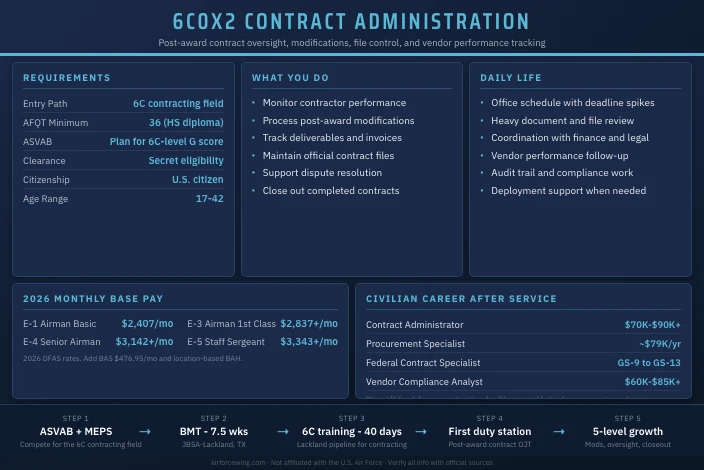
6C0X2 Contract Administration manages active contracts after award. Airmen in this role monitor contractor performance, process modifications, track deliverables, resolve documentation problems, and make sure Air Force units receive the goods or services the contract promised.
Day-To-Day Responsibilities
This work is more about oversight than negotiation. A normal day can include reviewing delivery schedules, coordinating with functional customers, documenting performance issues, updating contract files, processing changes to scope or funding, and preparing closeout packages after the requirement ends.
Typical work includes:
- Tracking vendor performance against contract terms
- Coordinating contract modifications after award
- Reviewing invoices and acceptance documentation
- Maintaining official contract files and audit trails
- Working with legal and finance offices on disputes or payment issues
- Supporting closeout actions once work is complete
How It Differs From 6C0X1
The public recruiting site currently advertises 6C0X1 Contracting as the enlisted accession point. 6C0X2 is best understood as the post-award contract-management side of that broader career family. In some organizations the same Airman may touch both award and administration. In larger offices, post-award administration becomes its own lane because the file volume and financial risk justify it.
Mission Contribution
Bad contract administration wastes money long after the award was made correctly. The Air Force depends on disciplined post-award oversight to keep construction projects on schedule, IT support contracts performing, and base services operating. This is one of those jobs where quiet paperwork mistakes can turn into visible mission failures weeks later.
Salary
Base Pay
6C0X2 uses the same 2026 enlisted pay table published by DFAS.
| Grade | Rank | Monthly Base Pay |
|---|---|---|
| E-1 | Airman Basic (AB) | $2,407 |
| E-2 | Airman (Amn) | $2,698 |
| E-3 | Airman First Class (A1C) | $2,837-$3,198 |
| E-4 | Senior Airman (SrA) | $3,142-$3,816 |
| E-5 | Staff Sergeant (SSgt) | $3,343-$4,422 |
| E-6 | Technical Sergeant (TSgt) | $3,401-$5,044 |
This role does not carry routine special pay. The economic upside is in the civilian value of procurement, compliance, and contract-file experience.
Allowances And Benefits
The standard enlisted package still applies:
- BAS: $476.95 monthly
- BAH: tax-free and location based
- TRICARE Prime: active-duty medical coverage at no enrollment fee
- Tuition Assistance: up to $4,500 per year
- GI Bill: available after qualifying service
Work-Life Balance
This is an office-driven AFSC. Duty hours are usually predictable except during fiscal-year closeout, large contract transitions, or when contractor performance problems create urgent action. Compared with operational fields, it is a steadier schedule.
Qualifications
Entry Standards
| Requirement | Current Guidance |
|---|---|
| Age | 17-42 at enlistment |
| Citizenship | U.S. citizen |
| Education | High school diploma or GED |
| AFQT Minimum | 36 with diploma |
| ASVAB Composite | Separate public 2026 line score not listed; General-heavy screening expected |
| Clearance | Secret eligibility is typical for contracting work |
| Communication | Strong written communication and attention to detail |
| Integrity | No record involving fraud, theft, or contracting misconduct |
The Air Force publicly lists a General 72 requirement for 6C0X1. Because 6C0X2 is not separately advertised on the current recruiting site, the smart planning assumption is to prepare for the same academic threshold and let the recruiter clarify how the billet is filled.
See the ASVAB study guide if you are targeting a high General score for the contracting field.
Application Process
The process usually mirrors the broader contracting path:
- Meet a recruiter and confirm whether a contracting opening exists.
- Take the ASVAB and complete the MEPS physical.
- Start security screening and integrity review.
- Clarify whether contract-administration work is a direct accession target or a later assignment inside the 6C career family.
Competitiveness
Contracting seats are never large in number, and the field screens hard on judgment. Airmen who read carefully, write clearly, and stay organized tend to do well. If you are loose with detail or dislike policy-heavy work, this is not the right lane.
Work Environment
Setting And Schedule
The work takes place in contracting squadrons, base contracting offices, and procurement support sections. Expect a normal office setting, secure systems, long document trails, and regular coordination with vendors and base customers.
Leadership And Communication
You will work for officer and civilian contracting leaders, and you will interact often with finance, legal, and customer units. Clear documentation matters because every decision may later be reviewed by an auditor, a lawyer, or a contracting officer.
Team Dynamics
Contract administration is collaborative but file-driven. One Airman may own a section of active contracts while still coordinating daily with award specialists, program managers, and vendors. The job rewards patience and disciplined follow-through more than charisma.
Training
Training Pipeline
| Phase | Location | Length | Focus |
|---|---|---|---|
| Basic Military Training | JBSA-Lackland, TX | 7.5 weeks | Military fundamentals |
| Contracting field training | JBSA-Lackland, TX | Publicly listed 40-day 6C pipeline | FAR basics, contract actions, file procedures |
| First duty station OJT | Unit of assignment | 12-18 months | Post-award oversight, modifications, closeout |
The current public recruiting pipeline is the 40-day Contracting course at Lackland. For 6C0X2-style work, most of the real specialization happens after arrival at the first unit, once an Airman starts managing active contracts instead of just learning award procedures.
Before you ever reach that course, you still need the score. The ASVAB study guide is the practical first step.
Advanced Development
This path pairs well with DoD contracting certifications, CCAF coursework, and later civilian procurement credentials. Airmen who stay in the field build the kind of resume federal agencies and defense contractors understand immediately.
Career Progression
Promotion Timeline
| Rank | Grade | Typical Timeline | Role Focus |
|---|---|---|---|
| Airman Basic | E-1 | Entry | Training pipeline |
| Airman | E-2 | ~6 months | Basic office support |
| Airman First Class | E-3 | ~16 months | Working active files |
| Senior Airman | E-4 | ~3 years | Independent case ownership |
| Staff Sergeant | E-5 | ~5-6 years | Section lead and quality control |
| Technical Sergeant | E-6 | ~10-12 years | NCOIC and workload manager |
How To Succeed
The best contract administrators are the ones who keep a file clean from start to finish. That means knowing the contract, tracking dates, documenting problems early, and never assuming someone else updated the record. Reliability is your promotion currency here.
Transfer Value
This experience maps directly to contract specialist, purchasing, vendor-management, and compliance work after service. It also fits well with later advancement into 6C0X1-style award work or officer/civilian acquisition roles.
Physical Demands
Daily Physical Requirements
The work is largely sedentary and office based. There is no heavy physical demand tied to the AFSC beyond ordinary military service and occasional file movement or site visits.
Fitness Assessment
All Airmen still meet the same Air Force fitness standard.
| Component | Max Points |
|---|---|
| 1.5-mile run | 60 |
| Push-ups | 10 |
| Sit-ups | 10 |
| Waist or body composition | 20 |
The minimum passing score remains 75 overall with component minimums.
Deployment
Deployment Tempo
Contracting teams do deploy. In a deployed setting, contract administration helps keep local service agreements, supply contracts, and contingency support actions on track. Tempo is moderate rather than constant, but the work can become urgent fast when base support depends on a contractor performing.
Duty Stations
Because every major installation needs contracting support, this field offers broad assignment variety across CONUS and overseas bases. Large centers with heavy contract volume give the best exposure to post-award oversight.
Risk/Safety
Main Risks
The real risk is financial and legal exposure:
- Accepting incomplete performance without documentation
- Missing funding or delivery changes
- Weak file control during audits
- Poor coordination with legal and finance
Controls
Formal contract files, review chains, and acquisition regulations are the safety system. If you like structure and accountability, that is a benefit. If you dislike rules, this field will wear you down.
Impact on Family
The schedule is usually more stable than aircraft or security-force work, which helps at home. PCS moves still happen every few years, and deployment support remains part of the job, but daily unpredictability is lower than in many operational fields.
Reserve and Air National Guard
Component Availability
The public recruiting site shows 6C0X1 availability across active duty, Reserve, and Guard. For 6C0X2-style contract-administration billets, actual availability depends on how a unit structures its contracting office. Ask about real billet titles at the unit, not just the broad career family.
Civilian Integration
This job fits part-time service well because procurement, vendor management, and administrative contract work have strong civilian parallels. The Reserve or Guard version of this experience can support federal or defense-industry employment without a big mismatch in skill set.
Post-Service
Civilian Career Paths
| Civilian Role | Median Pay | Outlook |
|---|---|---|
| Contract Administrator | About $70,000-$90,000 | Strong in defense and construction |
| Procurement Specialist | About $79,000 median for purchasing managers and buyers mix | Stable demand |
| Federal Contract Specialist | Often GS-9 to GS-13 progression | Strong in DoD and civilian agencies |
| Compliance / vendor-management analyst | Varies by industry | Solid in healthcare, tech, and defense |
The real value is that the military teaches disciplined file control and government contracting process, which civilian employers often struggle to train from scratch.
Is This a Good Job
6C0X2 is a good fit if you like process control, documentation, and tracking performance over time. It is not a good fit if you want fast-moving negotiation as the main event or if you dislike policy-heavy office work. The job is about making sure promises turn into delivered results.
More Information
- Review the Air Force’s current Contracting career page for the published accession baseline
- Read the broader Logistics and Administration careers page to compare adjacent officer and enlisted support fields
- Prepare for the General composite with the ASVAB study guide
This site is not affiliated with the U.S. Air Force or any government agency. Verify all information with official Air Force sources before making enlistment or career decisions.
Explore more Air Force finance and contracting careers such as 6C0X1 Contracting and 6F0X1 Financial Management.