6C0X1 Contracting
The Air Force buys billions of dollars’ worth of supplies, services, and equipment every year. Someone has to negotiate every one of those deals, and that someone is a 6C0X1 Contracting specialist. This AFSC has one of the highest ASVAB thresholds of any enlisted career in the Air Force, and for good reason: you’ll be managing federal contracts, reading legal acquisition regulations, and making purchasing decisions that affect entire wings. If you’re analytical, detail-oriented, and want a military job that maps directly to a high-paying civilian career in procurement or government contracting, 6C0X1 is worth a serious look.
Qualifying requires specific ASVAB line scores. Our ASVAB study guide covers what to target and how to prepare.
Job Role
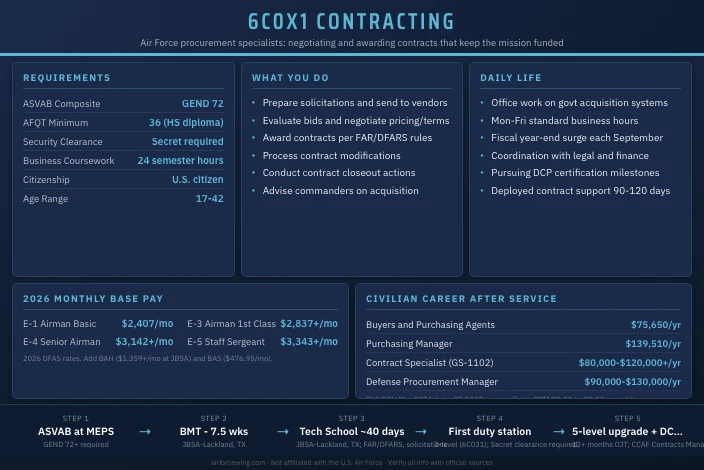
The 6C0X1 Contracting AFSC is responsible for acquiring supplies, services, and construction for the U.S. Air Force through legally binding contracts. Contracting specialists prepare solicitation documents, evaluate vendor bids, negotiate terms, award contracts, and ensure taxpayer funds are spent legally and efficiently in accordance with the Federal Acquisition Regulation (FAR) and Defense Federal Acquisition Regulation Supplement (DFARS).
What You’ll Do Day-to-Day
The daily work of a contracting specialist is closer to a procurement law office than a warehouse. You’ll spend time reviewing requirements from other base units, writing solicitations that go out to vendors, analyzing quotes and proposals, and drafting contract awards. Much of your day involves working with the FAR, which is the rulebook for all federal government purchasing.
On any given day, you might:
- Write a request for proposal (RFP) for base services or equipment
- Review vendor quotes and evaluate technical compliance
- Negotiate pricing and terms directly with contractors
- Process contract modifications when requirements change
- Conduct contract closeout procedures and final payment actions
- Advise commanders and unit resource advisors on acquisition strategy
Specific Roles and Specializations
The 6C0X1 career field uses the standard Air Force skill-level progression. There are no formal shredouts within the AFSC itself, but Contracting Officers (COs) can receive a Contracting Officer Warrant, which legally authorizes them to bind the government to contracts up to specified dollar thresholds. This warrant is one of the most significant authorities an enlisted Airman can hold in the federal government.
| Skill Level | Designation | Stage |
|---|---|---|
| 3-level | 6C031 Apprentice | Tech School graduate; learning under supervision |
| 5-level | 6C051 Journeyman | Independent contract actions; upgrade training complete |
| 7-level | 6C071 Craftsman | Supervisory authority; leads section operations |
| 9-level | 6C091 Superintendent | Senior enlisted leadership at wing or major command level |
How This Role Supports the Mission
Every deployed unit, every aircraft maintenance contract, every base service from food vendors to IT support runs through a contracting office. Without 6C0X1 Airmen, commanders can’t get the legal agreements in place to acquire what their units need. Contracting is the financial backbone of Air Force readiness.
Salary
Your pay as a 6C0X1 specialist is the same basic pay structure all enlisted Airmen receive. What sets this AFSC apart financially is how well the skills translate after service, federal GS-1102 contract specialist positions are among the most competitive civilian roles for veterans.
2026 Base Pay
| Grade | Rank | Monthly Base Pay (Entry) |
|---|---|---|
| E-1 | Airman Basic (AB) | $2,407 |
| E-2 | Airman (Amn) | $2,698 |
| E-3 | Airman First Class (A1C) | $2,837 |
| E-4 | Senior Airman (SrA) | $3,142 |
| E-5 | Staff Sergeant (SSgt) | $3,343 |
| E-6 | Technical Sergeant (TSgt) | $3,401 |
| E-7 | Master Sergeant (MSgt) | $3,932 |
2026 rates from DFAS military pay tables. Pay increases with years of service within each grade.
Allowances and Benefits
Basic pay is only part of total compensation. All enlisted Airmen receive:
- BAS (Basic Allowance for Subsistence): $476.95 per month, flat national rate
- BAH (Basic Allowance for Housing): Varies by duty station and dependency status. A single E-4 at Joint Base San Antonio earns $1,359/month; with dependents, $1,728/month
- TRICARE: Zero-premium health, dental, and vision coverage through TRICARE Prime for active-duty members and their families
The Blended Retirement System (BRS) includes a 20-year pension worth 40% of your high-36 average basic pay, plus government contributions of up to 5% of base pay into your Thrift Savings Plan (TSP) account.
Education Benefits
Active-duty Airmen can use Tuition Assistance for up to $4,500 per year toward a degree while serving. The Post-9/11 GI Bill covers full in-state tuition at public schools and up to $29,920.95 per academic year at private schools after leaving service, with a monthly housing allowance on top of that.
Contracting Airmen are also expected to complete business-related coursework as part of their career field requirements, and the Air Force Community College of the Air Force (CCAF) awards an associate degree in Contracts Management upon completion of 5-level requirements.
Work-Life Balance
Standard duty hours are Monday through Friday during normal business hours at most installations. This AFSC rarely requires shift work. Contracting offices can get busy around fiscal year end (September) when units are rushing to obligate remaining funds, and around major contract renewals. Thirty days of paid leave per year gives Airmen room to recharge. Deployment tempo for contracting is generally moderate, you’ll typically deploy for 90 to 120 days at a stretch, not for extended combat assignments.
Qualifications
Contracting carries one of the highest ASVAB requirements of any enlisted Air Force career field. The minimum is a General (GEND) composite score of 72, which filters for strong verbal and quantitative reasoning ability. The GEND composite draws from Word Knowledge, Paragraph Comprehension, Arithmetic Reasoning, and Mathematics Knowledge.
Qualification Requirements
| Requirement | Standard |
|---|---|
| ASVAB Composite | General (GEND) 72 minimum |
| AFQT Minimum | 36 (HS diploma); 65 (GED/alternate credential) |
| Citizenship | U.S. citizen required |
| Age | 17-42 at enlistment |
| Security Clearance | Eligible for Secret clearance |
| Education | High school diploma or equivalent |
| Business Coursework | 24 semester hours of business-related subjects (typically completed during service) |
| Strength | Lift and carry up to 40 lbs |
| Communication | Must be able to speak distinctly and communicate effectively in writing |
Applicants with prior court-martial convictions or non-judicial punishment related to contracting activities are disqualified. Civilian felony convictions may also disqualify you. Discuss your record candidly with a recruiter before applying.
Application Process
The path to 6C0X1 starts with the ASVAB at a Military Entrance Processing Station (MEPS), where your GEND composite score is calculated. If you score at or above 72 on the General composite, you’re eligible to request the contracting career field from your recruiter. From there, your background is reviewed for the Secret clearance eligibility requirement. Bring documentation of any post-secondary business coursework you’ve already completed, it can count toward the 24-hour requirement.
The GEND 72 minimum is among the highest enlisted ASVAB requirements in the Air Force. Scoring in that range typically requires solid preparation, especially in arithmetic and math knowledge. Use the time before your MEPS appointment to study. Check out the ASVAB prep guide to build your score before testing.
Selection Competitiveness
Contracting is a smaller career field than logistics or maintenance, so seat availability in the training pipeline is limited. Recruiters will tell you whether slots are open. Applicants who already have college-level business coursework are in a stronger position, as it satisfies part of the career field education requirement.
Service Obligation
Standard enlistment is four years of active duty. Most Airmen enter at E-1 (Airman Basic) with no prior service experience. Some college credits may qualify you for an accelerated advancement to E-3 before basic training.
Work Environment
Contracting specialists work in standard office settings on military installations worldwide. You won’t be on the flight line or in a motor pool. Your workspace is a contracting office with computers, government acquisition systems, and a constant flow of paperwork and deadlines.
Setting and Schedule
Monday through Friday, normal business hours is the standard schedule for most 6C0X1 assignments. Shift work is rare. The pace fluctuates with the government’s fiscal calendar. September can be intense as units scramble to spend funds before the fiscal year closes. Deployed environments are more unpredictable, but the work itself remains desk-based even downrange.
The Air Force uses several contract management systems including the Standard Procurement System (SPS/PD2) and Procurement Integrated Enterprise Environment (PIEE). You’ll be trained on these tools during the apprentice course and your early assignment.
Chain of Command and Feedback
Contracting offices are typically led by a Contracting Officer (CO) at the officer level, with senior enlisted Airmen (TSgt and above) running day-to-day operations. Performance is assessed through the Enlisted Performance Report (EPR) system. EPRs are completed annually and evaluate job performance, leadership contributions, professional development, and adherence to Air Force standards. Strong EPRs are essential for promotion, and in contracting, your performance is highly visible because your actions carry legal and financial weight.
Team Dynamics
Contracting teams are typically small. A base contracting office might have a handful of Airmen across skill levels, a few officers, and civilian GS-1102 employees working alongside them. You’ll work closely with the officer COs, with unit resource advisors who submit purchase requests, and with legal staff on complex contract actions. Individual judgment matters here, a junior Airman who spots a legal issue in a solicitation can prevent significant liability.
Retention and Satisfaction
Contracting has consistently strong retention rates because the civilian career translation is among the best in the military. Airmen who know they can step out of the Air Force and into a GS-12 contract specialist role at a federal agency, or a procurement manager position in the defense industry, tend to stay until it’s strategically optimal to leave. The work itself is intellectually engaging, and promotion rates for high-performing contracting NCOs are competitive.
Training
Initial Training Pipeline
All enlisted Airmen complete Basic Military Training (BMT) before any career-specific training. From there, 6C0X1 Airmen attend the Contracting Apprentice Course at Joint Base San Antonio-Lackland, TX.
| Phase | Location | Length | Focus |
|---|---|---|---|
| Basic Military Training (BMT) | JBSA-Lackland, TX | 7.5 weeks | Core military skills, fitness, Air Force values |
| Contracting Apprentice Course (3-level) | JBSA-Lackland, TX | ~40 classroom days | FAR/DFARS, small purchase procedures, solicitations, contract award process |
The apprentice course is classroom-heavy. You’ll study the Federal Acquisition Regulation and Defense Federal Acquisition Regulation Supplement in detail, learn how to prepare solicitations, evaluate offers, and process contract awards. It’s one of the more academically demanding Tech School courses in the enlisted Air Force, the same General composite skills tested on the ASVAB are what you’ll use every day here.
Advanced Training
After reaching the 5-skill level, eligible Airmen can attend the Contracting Craftsman Course (7-level), which is also approximately four academic weeks and qualifies you for supervisory and more complex contract actions.
The DoD Acquisition Professional Development Program (APDP) is a career-long professional development framework. Enlisted contracting members are expected to pursue the DoD Contracting Professional (DCP) Certification as part of their career progression. This certification requires a combination of training hours, work experience, and continuous learning credits, and it directly maps to the civilian Federal Acquisition Certification in Contracting (FAC-C).
The Air Force also supports voluntary degree completion through Tuition Assistance. An associate degree is required before competing for promotion to Senior Master Sergeant. Most Airmen work toward their CCAF Contracts Management degree during their 5-level assignment, taking one or two classes per semester.
The DCP certification is one of the most portable credentials in the military. Federal civilian agencies and defense contractors recognize it as a direct equivalent to FAC-C Level II, which is a hiring requirement for many GS-12 and above contract specialist positions.
Career Progression
Typical Career Path
Promotion in the Air Force is competitive and based on EPRs, time in service, test scores, and fitness assessment results. Contracting is a smaller career field, which means visibility is high and each promotion cycle is competitive.
| Rank | Grade | Typical Time in Service | Role |
|---|---|---|---|
| Airman Basic (AB) | E-1 | Entry | BMT / arriving at tech school |
| Airman (Amn) | E-2 | ~6 months | Progressing through apprentice course |
| Airman First Class (A1C) | E-3 | ~16 months | First duty station, 3-level assigned |
| Senior Airman (SrA) | E-4 | ~3-4 years | Upgrade training, 5-level pursuit |
| Staff Sergeant (SSgt) | E-5 | ~5-6 years | Journeyman; eligible for Contracting Officer Warrant |
| Technical Sergeant (TSgt) | E-6 | ~8-10 years | Craftsman; section lead responsibilities |
| Master Sergeant (MSgt) | E-7 | ~13-17 years | Functional manager; commands small offices |
| Senior Master Sergeant (SMSgt) | E-8 | ~18-22 years | Wing-level contracting oversight |
| Chief Master Sergeant (CMSgt) | E-9 | ~22+ years | Senior enlisted advisor, MAJCOM-level |
Specialization and Flexibility
While 6C0X1 has no formal shredout codes, experienced Airmen can specialize in areas like construction contracts, IT services contracts, or international agreements. Assignments to AFMC (Air Force Materiel Command) or SAF/AQ (Secretary of the Air Force, Acquisition) offices put Airmen on some of the largest and most complex contract actions in the federal government.
Retraining to other AFSCs is possible through the Air Force Retraining Advisory, though 6C0X1’s civilian market value makes most Airmen less likely to retrain out of contracting voluntarily.
Performance Evaluation
The Enlisted Performance Report (EPR) is the primary document used for promotion decisions. EPRs are written annually by your rater and reviewed by a senior rater. In contracting, your EPR will highlight specific contract actions you managed, dollar values involved, and any additional duties or professional development accomplishments. Strong EPRs consistently emphasize quantifiable impact, “awarded 47 contracts valued at $3.2M” carries more weight than vague praise.
Physical Demands
Daily Physical Requirements
Contracting is a sedentary AFSC. Day-to-day work does not require physical labor, heavy lifting, or outdoor duty. The maximum strength requirement for this career field is the ability to lift and carry 40 pounds, which is lower than most Air Force AFSCs. There are no physical demands specific to contracting that go beyond normal office work.
The physical challenge in this career field comes from the Air Force Fitness Assessment, which all Airmen must pass regardless of AFSC. It covers aerobic capacity, core strength, and body composition.
Air Force Fitness Assessment Standards (2026)
The Fitness Assessment is scored on a 100-point scale. A minimum composite score of 75 is required to pass. Each component has its own minimum standard that must be met regardless of total score.
| Component | Max Points | Notes |
|---|---|---|
| 1.5-Mile Run | 60 | Highest-weighted component |
| Waist Circumference / Body Composition | 20 | Age- and gender-normed |
| Push-Ups (1 minute) | 10 | Minimum reps required to pass component |
| Sit-Ups (1 minute) | 10 | Minimum reps required to pass component |
Standards are age- and gender-normed. Assessments are conducted annually for most Airmen. Failing any single component fails the entire assessment regardless of total score. Verify current component minimums with official Air Force sources.
Medical Standards
There are no unusual medical standards for 6C0X1 beyond standard Air Force enlistment physical requirements. The MEPS physical exam screens for conditions that could affect military service. Color vision and hearing requirements are standard. There are no aviation or special duty medical standards attached to this AFSC.
Deployment
Deployment Patterns
Contracting specialists deploy across the full range of Air Force operations. Deployed units need contract support to acquire local services, construction, and supplies downrange, so 6C0X1 Airmen fill Deployment Contracting Team (DCT) billets. A typical deployment lasts 90 to 120 days and may involve working in deployed environments in the CENTCOM area of responsibility, Europe, or other combatant command areas.
Deployment frequency is moderate compared to combat-oriented career fields. Most contracting Airmen deploy once every two to three years under normal operational tempo, though this varies significantly by unit and current mission requirements.
Duty Stations
6C0X1 positions exist at virtually every major Air Force installation worldwide because every base requires contract support. Common duty locations include large CONUS installations like Joint Base San Antonio, Eglin AFB, Wright-Patterson AFB, and Langley-Eustis AFB, as well as overseas assignments in Japan, Germany, South Korea, and the United Kingdom.
Permanent Change of Station (PCS) moves occur roughly every two to four years. Airmen can submit preferences, but the Air Force fills its needs first. Contracting’s worldwide presence gives this AFSC above-average geographic variety compared to career fields tied to specific platforms or equipment.
Risk/Safety
Job Hazards
Contracting is a low physical-risk occupation. There are no inherent industrial, mechanical, or combat hazards associated with the daily work. The primary risks are legal and professional: contract fraud, improper procurement actions, or failure to follow acquisition regulations can result in serious professional and legal consequences.
Safety Protocols
Standard workplace safety applies. In deployed environments, force protection measures and command authority govern off-post activity and mission operations. Inside the contracting office, the main protective framework is the regulatory compliance structure of the FAR and DFARS. Every contract action is reviewed by a warranted Contracting Officer and, for larger actions, by legal counsel.
Security and Legal Requirements
The 6C0X1 AFSC requires eligibility for a Secret security clearance. The investigation covers your background, finances, foreign contacts, and character. Financial responsibility is particularly scrutinized for this career field given its access to government funds and vendor relationships.
The Secret clearance investigation includes a detailed financial history review. Applicants with significant debt, bankruptcies, or delinquent accounts may face additional scrutiny. It doesn’t automatically disqualify you, but it needs to be disclosed fully and explained.
Contracting Airmen are also subject to ethics regulations that prohibit accepting gifts from contractors, preferential treatment of vendors, and post-government employment conflicts of interest. These rules are covered thoroughly in initial training and through annual ethics refreshers.
Impact on Family
Family Considerations
The 6C0X1 lifestyle is more predictable than most military careers. Standard weekday hours, rare shift work, and no operational aviation or combat support pace make this one of the more family-friendly enlisted specialties. Spouses and children can establish routines without the constant schedule disruption common in operations or maintenance AFSCs.
PCS moves every two to three years are the main disruption. Families should plan for relocation as a recurring reality, though installations with contracting offices are well-resourced installations that typically offer solid school districts, base housing, and community support services.
The Air Force Family Support Center and Airman and Family Readiness Centers at each installation provide resources for deployment preparation, financial counseling, and school transition support. Military OneSource offers 24/7 counseling and referral services for active-duty families.
Relocation and Flexibility
Contracting Airmen can request assignment preference and may receive some accommodation based on family circumstances (such as exceptional family member program enrollment). The Air Force Assignment Management System (AFAMS) balances personnel needs with individual preferences. High-demand overseas positions like Kadena AB, Ramstein AB, and Osan AB are available to 6C0X1 Airmen and can offer additional allowances.
Reserve and Air National Guard
Component Availability
The 6C0X1 AFSC is available in both the Air Force Reserve and the Air National Guard. Both components operate contracting offices and deploy specialists in support of active-duty missions and state emergencies. Guard units in particular benefit from members who also hold civilian procurement jobs, since the knowledge transfers directly.
Drill Schedule and Training Commitment
The standard Reserve and Guard commitment is one Unit Training Assembly (UTA) weekend per month and a two-week Annual Tour per year. Contracting UTAs follow this standard schedule. There are no additional certification drills required beyond the standard annual training commitment for most assignments, though DoD acquisition certification requirements still apply for those pursuing the DCP credential.
Part-Time Pay (E-4 Drill Weekend)
An E-4 Senior Airman earns four days of base pay for a standard drill weekend (two days, four drill periods). At the 2026 E-4 entry rate of $3,142/month, that comes to roughly $419 per drill weekend. Active-duty E-4 monthly base pay starts at $3,142, compared to a Reserve member’s annual drill pay of approximately $5,030 for the standard 12 UTAs plus Annual Tour.
Benefits Comparison
| Factor | Active Duty | Air Force Reserve | Air National Guard |
|---|---|---|---|
| Commitment | Full-time | 1 weekend/month + 2 wks/year | 1 weekend/month + 2 wks/year |
| Monthly Pay (E-4) | $3,142+ | Drill pay only (~$419/weekend) | Drill pay only (~$419/weekend) |
| Healthcare | TRICARE Prime (free) | TRICARE Reserve Select (premiums apply) | TRICARE Reserve Select (premiums apply) |
| Education | Federal TA ($4,500/yr) + GI Bill | Federal TA available; GI Bill eligibility varies | State tuition waivers available in most states |
| Deployment Tempo | Moderate (every 2-3 yrs) | Mission-dependent; less frequent | Mission-dependent; state activation possible |
| Retirement | 20-year pension + BRS | Points-based reserve retirement | Points-based reserve retirement |
Civilian Career Integration
6C0X1 is one of the best Reserve AFSCs for civilian career alignment. Members who work as federal contract specialists, procurement analysts, or GS-1102 personnel in their civilian jobs bring skills that directly reinforce their military duties. USERRA protects reservists’ civilian jobs when they are called up, and many defense contractors actively support employees who serve in Reserve contracting roles because the DoD acquisition experience makes their workforce more effective.
Post-Service
Civilian Career Prospects
The transition from 6C0X1 to civilian employment is more direct than in most enlisted career fields. Federal civilian agencies (DoD, DHS, GSA, and others) hire veterans with contracting experience directly into GS-1102 positions, often at GS-9 through GS-12 grades depending on education and experience. The OPM GS-1102 qualification standard requires 24 semester hours of business coursework, which is already a career field requirement for 6C0X1.
| Civilian Career | Median Annual Wage | Job Outlook (2024-2034) |
|---|---|---|
| Buyers and Purchasing Agents | $75,650 | +5% (faster than average) |
| Purchasing Managers | $139,510 | +5% (faster than average) |
| Contract Specialist (GS-1102) | $80,000-$120,000+ (GS-11 to GS-13) | Strong; ongoing federal demand |
| Defense Industry Procurement Manager | $90,000-$130,000 | Strong; tied to defense budget |
BLS Occupational Outlook Handbook data, May 2024. Federal GS pay ranges reflect OPM pay tables for the GS-1102 series.
The Federal Acquisition Certification in Contracting (FAC-C) and the DoD Contracting Professional (DCP) certification earned during service give you a hiring advantage that few civilian candidates can match.
Transition Programs
The DoD SkillBridge program allows Airmen within 180 days of separation to work with a civilian employer on full military pay. Defense contractors and federal agencies actively participate in SkillBridge for contracting roles. The Air Force also offers the Transition Assistance Program (TAP), mandatory for all separating Airmen, which covers resume writing, interviewing, and federal hiring processes.
Veterans’ hiring preferences under Title 5 provide an additional advantage when applying to federal GS positions, giving 5 to 10 preference points on competitive hiring lists.
Is This a Good Job
Who Does Well in This Role
Contracting attracts Airmen who are drawn to analytical, legal-adjacent work. If you enjoyed business, economics, or accounting courses in school and like the idea of negotiating deals and managing documents, this career field is well-suited to those instincts. The work is structured, intellectually demanding, and rewards attention to detail.
You’ll do well if you:
- Read carefully and catch small discrepancies in documents
- Communicate clearly in writing under deadline pressure
- Are comfortable with regulatory frameworks and procedural rules
- Want a military career that translates into a clear, high-paying civilian job
- Prefer office-based work over physical or operational environments
Where People Struggle
The GEND 72 requirement exists because the job genuinely demands strong verbal and quantitative reasoning. Airmen who struggle with reading dense regulatory text or complex arithmetic will find the apprentice course and the daily work frustrating.
This career field is not a good fit if you:
- Need constant physical activity or variety in your work environment
- Dislike document-heavy, compliance-driven work
- Have significant unresolved financial or legal history that may complicate the Secret clearance process
- Want frequent high-tempo operational assignments
Fiscal year-end pressure and the legal weight of every contract action also means the job carries real accountability. A mistake isn’t just a procedural error, it can result in an improper obligation of government funds with legal consequences. That accountability is motivating for some Airmen and stressful for others.
Long-Term Fit
For Airmen who are willing to pursue the education requirements and certifications along the way, 6C0X1 offers one of the strongest total return on enlistment of any career field in the Air Force. The combination of structured promotion, marketable certifications, and direct civilian career translation makes this AFSC a genuinely strong choice for someone who wants to serve and build a career simultaneously.
More Information
Talk to an Air Force recruiter to confirm current ASVAB score requirements, available training slots, and whether 6C0X1 openings align with your enlistment timeline. Recruiters can also tell you whether any enlistment incentives are currently available for this career field. Before your MEPS appointment, use the ASVAB prep guide to sharpen your General composite score, the 72 minimum is one of the highest in the enlisted Air Force, and preparation makes a real difference.
This site is not affiliated with the U.S. Air Force or any government agency. Verify all information with official Air Force sources before making enlistment or career decisions.
Explore more Air Force Finance and Contracting careers to see all available AFSC options in this career group.