3D0X4 Computer Systems Programming
The Air Force runs on software. Every mission system, logistics platform, and command network depends on code that someone had to write, test, and maintain. That someone is a 3D0X4 Computer Systems Programmer.
This AFSC sits in a different lane from offensive cyber or network defense. The work is development work, writing and maintaining software that Air Force systems depend on to function. You’ll qualify through two tests, not just one: the standard ASVAB and the Air Force Electronic Data Processing Test (EDPT), which filters specifically for logical reasoning and programming aptitude. Pass both gates and you’ve earned a 70-day tech school at Keesler AFB and a career that maps almost directly onto one of the most in-demand fields in the civilian job market.
The civilian runway after this AFSC is real. Software developers earned a median of $133,080 in May 2024, and the field is projected to grow 15 percent through 2034. The Air Force will pay you to learn this skill, grant you a Secret clearance, and give you hands-on production experience before you turn 25. That combination is hard to find anywhere else.
Before any of that, you need to qualify. Here’s exactly what that takes.
Qualifying requires specific ASVAB line scores. Our ASVAB study guide covers what to target and how to prepare.
Job Role
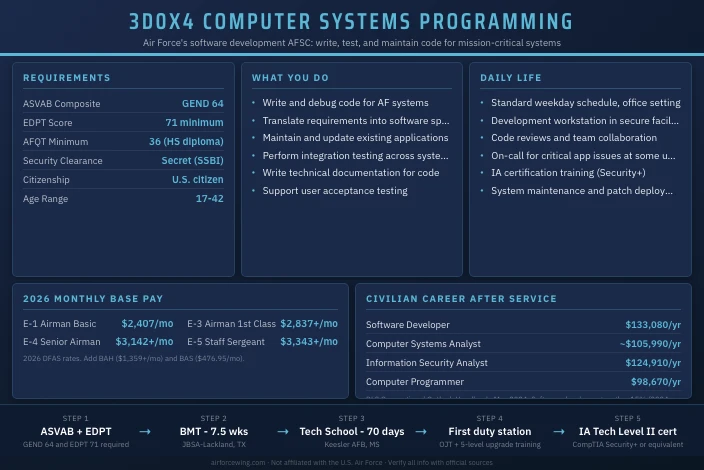
Computer Systems Programmers in the 3D0X4 career field design, develop, test, and maintain software applications for Air Force mission systems. They write code for operational platforms ranging from logistics and maintenance tracking to communications and command-and-control applications. Airmen in this AFSC follow the full software development lifecycle, from requirements analysis through deployment and ongoing maintenance, supporting systems that operational units depend on every day.
What the Work Actually Looks Like
A day for a 3D0X4 Programmer looks closer to a civilian software development job than most enlisted roles. You’ll spend time reading requirements documents, writing code in languages like Python, Java, C++, and web-based frameworks, reviewing code from peers, and troubleshooting systems when something breaks. Deployed applications mean real stakes, a bug in a logistics system can ripple across a wing’s maintenance operations.
Day-to-day tasks include:
- Writing, testing, and debugging application code for Air Force systems
- Analyzing mission requirements and translating them into software specifications
- Maintaining and updating existing applications as requirements change
- Performing integration testing with hardware and other software components
- Writing technical documentation for systems and code
- Supporting user acceptance testing and resolving defects before deployment
- Coordinating with other cyber and communications Airmen on joint system development
Specializations and Codes
The 3D0X4 career field uses the standard Air Force skill level structure. There are no publicly listed shredouts for this AFSC, but Special Experience Identifiers (SEIs) can be awarded for specific platform expertise or programming disciplines.
| Code | Skill Level | Status |
|---|---|---|
| 3D034 | Apprentice (3-level) | Initial award upon Tech School completion |
| 3D054 | Journeyman (5-level) | Awarded after OJT and upgrade training |
| 3D074 | Craftsman (7-level) | Senior developer; eligible for NCO roles |
| 3D094 | Superintendent (9-level) | Senior NCO; career field management |
Mission Contribution
Software is infrastructure. Every Air Force system that a pilot, maintainer, or logistician touches has a software layer that 3D0X4 Airmen built or maintain. That makes this career field less visible than offensive cyber or intelligence roles, but no less critical. Mission systems that work correctly are invisible; mission systems that fail become everyone’s problem. The programmers who keep them running are a significant reason why Air Force operations stay on schedule.
Salary
Base Pay
Pay for 3D0X4 Airmen follows the same DFAS tables as every other enlisted career field. The table below shows 2026 monthly base pay at the grades most relevant to early career progression.
| Rank | Grade | Under 2 Years | 4 Years | 6 Years |
|---|---|---|---|---|
| Airman Basic | E-1 | $2,407 | $2,407 | , |
| Airman First Class | E-3 | $2,837 | $3,198 | $3,198 |
| Senior Airman | E-4 | $3,142 | $3,659 | $3,816 |
| Staff Sergeant | E-5 | $3,343 | $3,947 | $4,109 |
| Technical Sergeant | E-6 | $3,401 | $4,069 | $4,236 |
Figures from DFAS 2026 pay tables. Base pay only; does not include allowances.
Special Pay and Bonuses
Enlistment bonus availability for 3D0X4 varies by fiscal year and Air Force manning needs. The Air Force periodically lists cyber and IT AFSCs for selective reenlistment bonuses when retention targets are missed. Confirm current bonus availability with your recruiter, published lists change with each fiscal year and your recruiter has access to the current incentive guide.
Allowances and Other Benefits
Allowances add substantially to take-home pay:
- BAH (Basic Allowance for Housing): Varies by duty location, rank, and dependent status. A single E-4 at Joint Base San Antonio earns $1,359/month; with dependents, $1,728/month. High cost-of-living installations pay proportionally more.
- BAS (Basic Allowance for Subsistence): $476.95/month for all enlisted Airmen (2026 flat rate).
- TRICARE: Full medical, dental, vision, and prescription coverage at no cost on active duty.
- Tuition Assistance: Up to $4,500 per year for college courses taken while on active duty.
- Post-9/11 GI Bill: After separation, eligible Airmen receive up to 36 months of education benefits. Private school tuition is capped at $29,920.95 per academic year (2025-2026 cap); public in-state tuition is covered in full.
Work-Life Balance
Programming work runs on development cycles rather than shift rotations. Most 3D0X4 Airmen work standard business hours, though deadlines, system outages, and deployment exercises can require extended hours on short notice. The Air Force provides 30 days of paid leave per year, accruing at 2.5 days per month.
Qualifications
Qualification Requirements
| Requirement | Minimum Standard |
|---|---|
| ASVAB Composite | GEND 64 (General composite) |
| EDPT Score | 71 (Air Force Electronic Data Processing Test) |
| AFQT Minimum | 36 (high school diploma) |
| Citizenship | U.S. citizen |
| Age | 17-42 at time of enlistment |
| Education | High school diploma or equivalent |
| Security Clearance | Secret (SSBI required for award and retention) |
Requirements verified against airforce.com.
The EDPT: What It Is and How to Prepare
The Electronic Data Processing Test (EDPT) is the second qualifier unique to this AFSC. Unlike the ASVAB, which most Air Force recruiters administer routinely, the EDPT measures aptitude specifically for software and data processing work. It tests logical reasoning, number sequences, pattern recognition, and coding-style problem-solving. A score of 71 is required; there’s no substitute for it.
The EDPT is not the same as the ASVAB. You can score well on the ASVAB and still fail the EDPT, the two tests measure different things. Ask your recruiter specifically about EDPT prep materials and scheduling before your MEPS visit.
The GEND (General) ASVAB composite combines Word Knowledge, Paragraph Comprehension, Arithmetic Reasoning, and Mathematics Knowledge subtests. A score of 64 is a moderate requirement, the same subtest disciplines that build a strong general composite also help with the logical reasoning patterns on the EDPT.
Security Clearance
The 3D0X4 AFSC requires a Secret clearance with a Single Scope Background Investigation (SSBI). The SSBI is more thorough than a standard background check. It examines your financial history, foreign contacts, criminal record, employment history, and drug use. Factors that can complicate the process include significant debt, recent marijuana use, or close relationships with foreign nationals. Waivers exist for some issues; nothing is automatic. Be honest with your recruiter about anything in your background before you apply.
The SSBI process takes months to complete. Anything that delays clearance processing can delay your first duty station assignment. Report everything accurately on the SF-86, omissions discovered later are treated as deception, which is harder to recover from than the underlying issue.
Application Process
Service Obligation and Entry Rank
The standard enlisted service obligation is four years for initial accessions. If you accept an enlistment bonus, additional service commitments apply, read the terms before signing. Most recruits enter as Airman Basic (E-1) and advance to Airman (E-2) and Airman First Class (E-3) during the first year based on time in service. Recruits with qualifying college credits may enter at a higher grade; ask your recruiter about advanced-grade eligibility.
See our ASVAB study guide for strategies to hit the GEND 64 score, or take the PiCAT from home if you haven’t tested before.
Work Environment
Setting and Schedule
Computer Systems Programmers work in climate-controlled office and server environments. The job is entirely desk-based, no flight line duties, no outdoor work requirements, no physical field operations. You’ll spend your days in front of development workstations, occasionally in server rooms or classified facilities depending on the system you support.
Most 3D0X4 billets run on standard Monday through Friday schedules. That said, production systems don’t go down on a schedule, and on-call rotations exist at some units for critical infrastructure. Deployed positions operate under the tempo and schedule set by the combatant command.
Chain of Command and Feedback
Programmers work within communications and cyber squadrons, reporting through NCO team leads to commissioned officers. Given the project-based nature of software development, feedback cycles align with development milestones as well as formal Enlisted Performance Report (EPR) periods. The 16th Air Force and Air Force Communications Command set technical standards that units train to.
Team Dynamics
Software development in this career field is collaborative. You’ll work alongside other 3D0X4 Airmen, 3D0X2 Cyber Systems Operators, and communications specialists, often within structured software teams that include both enlisted and officer members. Individual ownership of specific modules or applications is common, you’ll be the expert on the code you write. That requires both technical precision and the ability to document clearly enough that someone else can maintain your work after a PCS.
Job Satisfaction
The 3D0X4 career field appeals to Airmen who want technically substantive work without the operational tempo of higher-stress AFSCs. Programming is intellectually engaging for the right person, and the Air Force’s mission systems give programmers real problems to solve, not theoretical exercises. The tradeoff is that military programming environments don’t always use the latest tools and frameworks, and some assignments involve maintaining legacy systems that feel more like archaeology than development. How you feel about that depends on your patience for legacy codebases.
Training
Training Pipeline
| Phase | Location | Length | Focus |
|---|---|---|---|
| Basic Military Training (BMT) | JBSA-Lackland, TX | 7.5 weeks | Military fundamentals, discipline, physical fitness |
| Tech School, Computer Systems Programming | Keesler AFB, MS | 70 days | Programming fundamentals, software lifecycle, Air Force systems |
| On-the-Job Training (OJT) | First duty station | 12-18 months | 5-level upgrade, application-specific training |
Tech School at Keesler AFB runs 70 days, roughly 14 weeks. The 81st Training Wing runs instruction for communications and cyber AFSCs at Keesler, which is the Air Force’s primary hub for this career field group. The curriculum covers programming fundamentals, software development lifecycle principles, application maintenance procedures, and Air Force systems architecture. Students entering with prior programming experience typically find the foundational material straightforward; the adjustment is learning how Air Force systems are structured and documented.
You’ll earn college credits toward a Computer Science Technology credential upon completion of the initial skills course, per the official career page.
Advanced Training and Certifications
After achieving the 5-level (Journeyman), Airmen can pursue additional training aligned with the systems they support. The Air Force requires Information Assurance Technical Level II certification for award and retention, certifications such as CompTIA Security+ satisfy this requirement. The Air Force funds this training, which reduces out-of-pocket cost to zero.
The IA Technical Level II requirement is mandatory for retaining the AFSC. Get it done early in your first assignment rather than letting it become a last-minute issue. CompTIA Security+ is the most common path and is widely supported through Air Force training programs.
Advanced training pathways include:
- Application-specific courses tied to the systems at your duty station
- Air Force Institute of Technology (AFIT) distance-learning courses for degree completion
- DevSecOps and Agile development training through Air Force Life Cycle Management Center programs
- Industry certifications (AWS, Azure, Kubernetes) increasingly supported at tech-forward units
The ASVAB is your first qualifier. Our ASVAB study guide covers what to study to hit the GEND composite.
Career Progression
Rank Progression
| Rank | Grade | Typical Timeline | Milestone |
|---|---|---|---|
| Airman Basic | E-1 | Entry | Enlist |
| Airman | E-2 | ~6 months | Time in service |
| Airman First Class | E-3 | ~16 months | Time in service |
| Senior Airman | E-4 | ~3 years | Time in service; EPR-eligible |
| Staff Sergeant | E-5 | ~5-6 years | Promotion board; 5-level required |
| Technical Sergeant | E-6 | ~8-12 years | Promotion board; 7-level typical |
| Master Sergeant | E-7 | ~14-18 years | Senior NCO; promotion board |
| Senior Master Sergeant | E-8 | ~18-22 years | Senior leadership track |
| Chief Master Sergeant | E-9 | ~20-26 years | Top 1% of enlisted force |
Promotion to SSgt and above is competitive, based on time in service, EPR scores, fitness assessment results, and promotional examination scores. 3D0X4 Airmen who perform well technically and build EPRs that capture their project contributions tend to compete effectively. The career field is mid-sized, which means promotion rates track close to Air Force averages.
Specialization and Growth Paths
Experienced 3D0X4 Airmen can pursue several directions:
- Unit development teams: Embedded with operational squadrons to support mission-specific application development
- Air Force Life Cycle Management Center (AFLCMC): Working on major acquisition programs alongside civilian developers and program managers
- Software Factory assignments: Units like the Air Force’s Kessel Run (Boston) work on Agile development for operational software; prior-service 3D0X4 Airmen can apply for assignments here
- Instructor duty: Teaching at Keesler AFB within the 81st Training Wing
- Retraining to 1B4X1 or 17D: With the right background, experienced cyber and IT Airmen can retrain into offensive cyber operations or commission as cyberspace officers
Performance Evaluation
The Enlisted Performance Report (EPR) determines promotion eligibility at E-5 and above. For programmers, strong EPRs document specific system contributions in concrete terms: what you built, what broke less because of it, and how many users depended on it. Generic language doesn’t help. Airmen who can translate technical work into mission-impact language in writing tend to build better records than those who can’t. That’s a skill worth developing alongside your programming work.
Physical Demands
Daily Physical Demands
The 3D0X4 AFSC is sedentary work. You’ll spend most of your duty day seated at a workstation. There are no physical performance standards specific to this career field beyond the Air Force Fitness Assessment that all Airmen take annually.
Air Force Fitness Assessment Standards
All Airmen, regardless of AFSC, take the Air Force Fitness Assessment. The test is scored on a 100-point scale with a minimum passing composite of 75. Each component has its own minimum.
| Component | Max Points | Notes |
|---|---|---|
| 1.5-Mile Run | 60 | Primary aerobic component |
| Waist Circumference | 20 | Body composition measure |
| Push-Ups (1 min) | 10 | Muscular endurance |
| Sit-Ups (1 min) | 10 | Core endurance |
Standards are age- and gender-normed. Minimum passing composite is 75 out of 100. Scores below 75 create an Unsatisfactory rating, which carries promotion ineligibility and other career consequences. Scoring 90 or above (Excellent) supports your promotion record.
Medical Standards
Standard Air Force enlistment medical standards apply. No special medical requirements are associated with this AFSC beyond general eligibility. Periodic medical evaluations occur at standard Air Force intervals throughout your career. Maintaining security clearance eligibility is an ongoing requirement, changes in financial circumstances, foreign contacts, or legal issues that occur during service must be reported promptly.
Deployment
Duty Stations
3D0X4 Airmen serve at installations across the Air Force with communications, cyber, or logistics mission units. Because software development supports every mission set, this AFSC is distributed more broadly than offensive cyber AFSCs that concentrate at specific commands. Common assignment types include:
- Numbered Air Force headquarters and major command locations
- Air Force Materiel Command installations (Wright-Patterson AFB, OH; Robins AFB, GA; Hill AFB, UT)
- Air Force Space Command and Space Force installations
- CONUS bases with large communications squadrons
- OCONUS assignments in Germany, Japan, and South Korea at Air Force bases with active communications units
Specific installations with historically high 3D0X4 populations include:
| Installation | Location | Mission |
|---|---|---|
| Wright-Patterson AFB | Ohio | AFMC acquisition and software programs |
| Robins AFB | Georgia | Air Logistics Complex, software sustainment |
| Keesler AFB | Mississippi | Communications training hub, 81st Training Wing |
| Scott AFB | Illinois | Air Mobility Command headquarters |
| Offutt AFB | Nebraska | US Strategic Command support |
| Ramstein AB | Germany | USAFE communications infrastructure |
Assignment preferences can be submitted but are filled against Air Force needs. A broadly distributed AFSC like 3D0X4 typically offers more assignment variety than cyber AFSCs concentrated at specific commands. Airmen with strong performance records and early 7-level qualification tend to have more influence when preferences are submitted through the Assignment Management System.
Deployment
Deployment frequency for 3D0X4 Airmen is lower than for operational AFSCs. Software development is largely a garrison mission, though Airmen can be tasked in support of theater communications or deployed command networks. When deployed, 3D0X4 Airmen typically support existing systems rather than conduct development work in theater. Deployment lengths when tasked generally run 90 to 180 days. Some 3D0X4 Airmen spend entire first terms without a deployment, while others are assigned to units with rotational support commitments. The Air Force Materiel Command installations in particular tend to have lower deployment tempo than communications squadrons aligned with operational commands.
Risk/Safety
Job Hazards
The primary risks in this AFSC are ergonomic, extended screen time and sedentary work. Standard occupational health practices apply. There are no significant physical hazards associated with the day-to-day work environment. Long development cycles at a workstation increase the risk of repetitive strain injury; the Air Force provides ergonomic guidance through occupational health offices at each installation.
Safety Protocols
Standard Air Force occupational health guidance covers ergonomic workstation setup, monitor positioning, and screen time management. Classified facilities require secure facility access procedures; those working in SCIFs or similarly controlled environments follow the relevant physical security protocols. Entry into classified facilities is logged, and access is controlled by need-to-know at the system level, not just the room level.
Security Clearance Obligations
A Secret clearance creates legal obligations that persist throughout your service and, in some contexts, beyond it. As a 3D0X4 Airman, you’ll handle sensitive systems and data daily. Ongoing obligations include:
- Reporting foreign contacts, travel, and relationships as required
- Reporting changes in financial circumstances that could affect clearance eligibility
- Following need-to-know and information-handling procedures
- Submitting to periodic reinvestigation at standard intervals
Non-disclosure agreements signed at accession and during service remain in effect after separation. Unauthorized disclosure of classified information carries federal criminal penalties regardless of when you leave the Air Force.
Code Security and Software Integrity
3D0X4 Airmen who work on mission-critical systems carry a specific responsibility beyond general security clearance maintenance. Code written for Air Force systems is subject to configuration management controls, unauthorized changes to production code, even well-intentioned ones, violate both security policy and software release procedures. Chain-of-custody for software builds matters as much as physical security. Airmen who work in DevSecOps environments are trained on software supply chain security practices that protect against both external intrusion and inadvertent vulnerability introduction.
Any suspected compromise of a system or development environment must be reported immediately through the unit’s security officer. Delay in reporting suspected incidents, even when the Airman isn’t responsible, is itself a reportable issue.
Impact on Family
Family Considerations
The 3D0X4 work schedule is among the more family-friendly in the enlisted Air Force. Standard business hours in a garrison environment means predictable evenings and weekends for most assignments. Development deadlines and system emergencies will occasionally require extended hours, but sustained shift work is not a feature of this career field the way it is for maintenance or medical AFSCs.
The security clearance process touches family members. Spouses or close foreign national contacts may be interviewed as part of an SSBI. This is normal and manageable for most families, but worth understanding before you apply. Spouses of 3D0X4 Airmen do not need their own clearance, but they may be contacted by investigators and should be prepared for that. Foreign national spouses require additional processing but are not automatically disqualifying.
Work and Home Life
The practical separation between work and home is cleaner for 3D0X4 than for many other AFSCs. Software development work stays at the installation, classified development environments mean no work-from-home in a traditional sense. That boundary can actually benefit family life: when the shift ends, it ends. The tradeoff is that during active development cycles or system emergencies, extended duty hours compress family time unpredictably.
Military spouses in this AFSC group report that the regular schedule reduces stress compared to spouses of Airmen in shift-heavy AFSCs like medical or security forces. The main strain is PCS moves, not day-to-day schedule unpredictability.
Relocation
PCS moves follow the standard Air Force assignment cycle, typically every two to three years. Because 3D0X4 billets exist at installations across the country and overseas, the pool of available assignments is wider than for more concentrated AFSCs. Families with established school situations or dual-career considerations should expect multiple relocations over a 10-20 year career. Moving costs are covered through the Permanent Change of Station allowance system.
The Air Force’s Airman and Family Readiness Center at each installation and Military OneSource provide support resources for families navigating PCS moves. Families moving overseas to Ramstein or Osan should expect an 18-to-24-month overseas tour with on-base housing typically available.
Reserve and Air National Guard
Component Availability
The 3D0X4 AFSC is available in both the Air Force Reserve and the Air National Guard. Software development and maintenance support is needed across all components. ANG units in particular rely on 3D0X4 Airmen to support state and federal mission IT requirements. Both components actively recruit for this specialty.
Drill Schedule
Standard commitment is one Unit Training Assembly (UTA) weekend per month plus two weeks of Annual Training per year. The 3D0X4 career field does not generally carry additional required training days beyond the standard schedule, though specific units may require exercises or certification days. Confirm with the unit you’re considering.
Part-Time Pay
An E-4 Senior Airman drilling with the Reserve or ANG earns approximately $471-$549 per drill weekend based on 2026 DFAS rates for E-4 (4 drill periods per UTA). Monthly active-duty base pay for the same grade runs $3,142-$3,816, the part-time rate is a fraction of that, but Reserve and ANG service allows Airmen to maintain civilian programming careers simultaneously.
Component Comparison
| Feature | Active Duty | Air Force Reserve | Air National Guard |
|---|---|---|---|
| Commitment | Full-time | 1 wknd/mo + 2 wks/yr | 1 wknd/mo + 2 wks/yr |
| Monthly Pay (E-4) | $3,142-$3,816 | ~$471-$549/drill wknd | ~$471-$549/drill wknd |
| Healthcare | TRICARE Prime (no cost) | TRICARE Reserve Select (premiums apply) | TRICARE Reserve Select (premiums apply) |
| Education | Tuition Assistance + GI Bill | Federal TA + GI Bill (based on activation) | State tuition waivers (varies by state) + Federal TA |
| Deployment Tempo | Low to moderate | Low | Low |
| Retirement | 20-yr pension (40% high-36) | Points-based; eligible at 60 | Points-based; eligible at 60 |
Civilian Career Integration
This is where the Reserve and ANG path makes particularly strong sense for 3D0X4. A civilian software developer who drills one weekend a month maintains their Secret clearance, gets paid for additional service, and keeps skills current through Air Force training programs. Employers in defense contracting actively value staff who hold active clearances. The time commitment is manageable, and the career integration is direct.
USERRA protections apply to all Reservists and Guard members, requiring employers to hold positions and benefits during periods of military activation.
Post-Service
Civilian Career Translation
Few enlisted career fields translate to civilian work as directly as 3D0X4. The skills you use daily, writing code, debugging systems, working through a software development lifecycle, are the same skills civilian employers pay top dollar for. The clearance is an additional asset: many defense and government contracting positions require one, and cleared candidates command a premium.
| Civilian Job Title | Median Annual Salary | Job Outlook (2024-2034) |
|---|---|---|
| Software Developer | $133,080 | +15% (much faster than average) |
| Computer Systems Analyst | ~$105,990 | +9% (faster than average) |
| Computer Programmer | $98,670 | -6% (declining; offset by demand for specialized roles) |
| Information Security Analyst | $124,910 | +29% (much faster than average) |
Salary and outlook data from the Bureau of Labor Statistics Occupational Outlook Handbook, May 2024. The decline in general computer programmer employment reflects automation of routine coding tasks; specialized developers with security experience remain in demand.
Certifications and Licensing
The Air Force funds the IA Technical Level II certification required for the AFSC, typically CompTIA Security+. Depending on your assignment, you may also earn development-related certifications (AWS, Azure, PMP) through official training programs. These certifications directly support civilian employment and would cost thousands of dollars to obtain independently.
Transition Assistance
The Air Force Transition Assistance Program (TAP) is mandatory for separating Airmen. It covers resume writing, interview preparation, and job placement resources. Defense contractors and federal agencies actively recruit cleared software developers through programs like Hiring Our Heroes, which connects transitioning military with employers. Veterans with active clearances and programming experience are a narrow and sought-after talent pool.
Is This a Good Job
Who Does Well in 3D0X4
The people who thrive in this career field are the ones who genuinely enjoy programming, not just as a tool to learn for job security, but as a way of thinking through problems. If you find debugging satisfying, if you like understanding how systems fit together, if you’ve written personal projects outside of class, you’re already in the right mindset.
Patience with documentation and process matters here too. Military software development has more structure than a startup and more bureaucracy than a civilian IT department. Airmen who resist that find it frustrating; Airmen who adapt to it and learn to work inside it tend to do well.
Who Should Look Elsewhere
This is not the right AFSC if your primary motivation is physical activity, high operational tempo, or frequent travel. The work is sedentary, routine in its day-to-day structure, and largely garrison-based. If you want to be outside, on a flight line, or in an operationally intense environment, 3D0X4 will feel like the wrong fit quickly.
The EDPT is also a genuine filter. Some people score well on the ASVAB but struggle with the logical reasoning patterns the EDPT tests. If you’ve never programmed before and aren’t sure how you’ll test, ask your recruiter about taking a practice test before committing to this path.
Career and Lifestyle Alignment
For someone with a programming aptitude who wants a stable schedule, strong civilian translation, and a path into the defense tech sector, 3D0X4 is one of the better enlisted options available. The work is substantive, the post-service ceiling is high, and the clearance you build is a long-term career asset. The tradeoff is a desk-bound career with limited operational variety. If that sounds like a fair trade, it probably is.
More Information
Contact an Air Force recruiter to confirm current EDPT scheduling, available seats, and any active enlistment bonus programs for 3D0X4. Seats in technical career fields like this one can be limited, so timing matters. Visit airforce.com for the official career overview.
Questions to Ask Your Recruiter
Before you sign anything, get specific answers to these:
- Is the EDPT currently being offered at your MEPS? Scheduling varies by location and demand. Some applicants wait weeks for a test date.
- What’s the current bonus status for 3D0X4? Selective Reenlistment Bonus availability changes with each fiscal year. First-term bonus programs are separate, ask about both.
- What’s the current wait time for training seats? Keesler AFB can have backlogs for technical programs. Your recruiter knows the current pipeline queue.
- What’s the service obligation if a bonus is attached? Some bonus programs add one to two years to your standard commitment.
Useful Official Sources
- DFAS Pay Tables, Verify current 2026 base pay figures
- Air Force Personnel Center, Assignment information and career field management
- Community College of the Air Force, College credit awarded for 3D0X4 training
- Hiring Our Heroes, Civilian employer network for transitioning veterans
Prepare for both qualifiers with our ASVAB study guide and ask your recruiter specifically about EDPT practice materials before your MEPS date.
This site is not affiliated with the U.S. Air Force or any government agency. Verify all information with official Air Force sources before making enlistment or career decisions.
Explore more Air Force cyber careers such as 1B4X1 Cyber Warfare Operations and 3D0X2 Cyber Systems Operations.